List of sigmodontines

Last updated

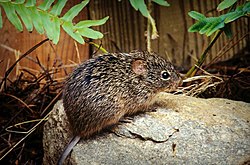
Hispid cotton rat (Sigmodon hispidus) Sigmodon hispidus1.jpg
Hispid cotton rat (Sigmodon hispidus)

Sigmodontinae is a subfamily of mammals in the rodent family Cricetidae, which in turn is part of the Myomorpha suborder in the order Rodentia. Members of this subfamily are called sigmodontines or New World rats and mice and include grass mice and rice rats. They are found in South America and southern North America, primarily in forests, shrublands, and grasslands, though some species can be found in rocky areas and wetlands. They range in size from the small vesper mouse, at 5 cm (2 in) plus a 4 cm (2 in) tail, to the Magdalena water rat, at 29 cm (11 in) plus a 27 cm (11 in) tail. Sigmodontines generally eat vegetation, seeds, and insects, though some also eat fungi, crustaceans, or small fish. No sigmodontines have population estimates, but thirteen species are categorized as endangered, and two species—the fossorial giant rat and Zuniga's dark rice rat—are categorized as critically endangered. Ten species, including the genera Megalomys , Megaoryzomys , and Noronhomys , were driven extinct after 1500 due to the European colonization of the Americas and introduction of non-native rats, with some species surviving until the 1900s. [1]

Contents

The 385 extant species of Sigmodontinae are divided into 84 genera, ranging in size from 1 to 42 species. Several extinct prehistoric sigmodontine species have been discovered, though due to ongoing research and discoveries, the exact number and categorization are not fixed. [2]

Conventions

IUCN Red List categories
Conservation status
 EX  Extinct (10 species)
 EW  Extinct in the wild (0 species)
 CR  Critically endangered (2 species)
 EN  Endangered (13 species)
 VU  Vulnerable (27 species)
 NT  Near threatened (14 species)
 LC  Least concern (265 species)
Other categories
 DD  Data deficient (59 species)
 NE  Not evaluated (5 species)

The author citation for the species or genus is given after the scientific name; parentheses around the author citation indicate that this was not the original taxonomic placement. Conservation status codes listed follow the International Union for Conservation of Nature (IUCN) Red List of Threatened Species. Range maps are provided wherever possible; if a range map is not available, a description of the sigmodontine's range is provided. Ranges are based on the IUCN Red List for that species unless otherwise noted. All extinct species, subspecies, or genera listed alongside extant species went extinct after 1500 CE, and are indicated by a dagger symbol: "".

Classification

Sigmodontinae is a subfamily of the rodent family Cricetidae consisting of 385 extant species in 84 genera. These genera range in size from 1 to 42 species. Additionally, ten species, including the genera Megalomys , Megaoryzomys , and Noronhomys , were driven extinct after 1500 due to the European colonization of the Americas and introduction of non-native rats, with some species surviving until the 1900s. This does not include hybrid species or extinct prehistoric species.

Subfamily Sigmodontinae

Sigmodontinae [3] [4]

Neomicroxus

Sigmodontines

The following classification is based on the taxonomy described by the reference work Mammal Species of the World (2005), with augmentation by generally accepted proposals made since using molecular phylogenetic analysis, as supported by both the IUCN and the American Society of Mammalogists. [5]

Genus Abrawayaomys Cunha & Cruz, 1979 – one species
Common nameScientific name and subspeciesRangeSize and ecologyIUCN status and estimated population
Ruschi's rat


A. ruschii
Cunha & Cruz, 1979
Southeastern BrazilSize: 8–14 cm (3–6 in) long, plus 8–15 cm (3–6 in) tail [6]

Habitat: Forest [7]

Diet: Vegetation, seeds, and insects [8]
 LC 


Unknown Blue question mark (italic).svg [7]

Genus Abrothrix Waterhouse, 1837 – eight species
Common nameScientific name and subspeciesRangeSize and ecologyIUCN status and estimated population
Andean Altiplano mouse

Abrothrix andina 363542836.jpg

A. andinus
(Philippi, 1858)
Western South AmericaSize: 6–10 cm (2–4 in) long, plus 4–7 cm (2–3 in) tail [9]

Habitat: Shrubland and grassland [10]

Diet: Insects, berries, seeds, and fungi [11]
 LC 


Unknown Blue question mark (italic).svg [10]

Gray grass mouse


A. illuteus
Thomas, 1925
Northern Argentina Size: 11–13 cm (4–5 in) long, plus 8–9 cm (3–4 in) tail [9]

Habitat: Forest [10]

Diet: Insects, berries, seeds, and fungi [11]
 LC 


Unknown Decrease2.svg [10]

Jelski's Altiplano mouse

Abrothrix jelskii 186917554 (cropped).jpg

A. jelskii
(Thomas, 1894)
Western South AmericaSize: 9–11 cm (4 in) long, plus 7–8 cm (3 in) tail [9]

Habitat: Rocky areas, grassland, and shrubland [10]

Diet: Insects, berries, seeds, and fungi [11]
 LC 


Unknown Steady2.svg [10]

Long-haired grass mouse

Abrothrix hirta 203213700.jpg

A. longipilis
(Waterhouse, 1837)
Southern Chile and southern ArgentinaSize: 13–14 cm (5–6 in) long, plus 8–10 cm (3–4 in) tail [9]

Habitat: Forest, grassland, shrubland, and inland wetlands [10]

Diet: Insects, berries, seeds, and fungi [11]
 LC 


Unknown Decrease2.svg [10]

Mann's grass mouse


A. manni
D'Elía, Teta, Upham, Pardiñas, & Patterson, 2015
Central Chile and western ArgentinaSize: About 11 cm (4 in) long, plus about 8 cm (3 in) tail [9]

Habitat: Forest [10]

Diet: Insects, berries, seeds, and fungi [11]
 LC 


Unknown Blue question mark (italic).svg [10]

Olive grass mouse

Abrothrix olivacea 99513268.jpg

A. olivaceus
(Waterhouse, 1837)
Chile and southern ArgentinaSize: 8–10 cm (3–4 in) long, plus 5–6 cm (2 in) tail [9]

Habitat: Shrubland, forest, and grassland [10]

Diet: Insects, berries, seeds, and fungi [11]
 LC 


Unknown Steady2.svg [10]

Sanborn's grass mouse

Abrothrix sanborni.jpg

A. sanborni
(Osgood, 1943)
Southern ChileSize: 10–12 cm (4–5 in) long, plus 6–9 cm (2–4 in) tail [9]

Habitat: Forest [10]

Diet: Insects, berries, seeds, and fungi [11]
 NT 


Unknown Decrease2.svg [10]

Woolly grass mouse


A. lanosus
(Thomas, 1897)
Southern Chile and southern ArgentinaSize: About 10 cm (4 in) long, plus 6–7 cm (2–3 in) tail [9]

Habitat: Forest and shrubland [10]

Diet: Insects, berries, seeds, and fungi [11]
 LC 


Unknown Steady2.svg [10]

Genus Aegialomys Weksler, Percequillo, & Voss, 2006 – two species
Common nameScientific name and subspeciesRangeSize and ecologyIUCN status and estimated population
Galápagos rice rat

Galapagos Rice Rat.jpg

A. galapagoensis
(Waterhouse, 1839)
Galápagos Islands in Ecuador Size: 10–16 cm (4–6 in) long, plus 12–18 cm (5–7 in) tail [12]

Habitat: Shrubland [13]

Diet: Grass, sedges, seeds, fruit, insects, crustaceans, and small fish [14]
 VU 


Unknown Blue question mark (italic).svg [13]

Yellowish rice rat


A. xanthaeolus
(Thomas, 1894)
Ecuador and western PeruSize: 10–11 cm (4 in) long, plus 11–18 cm (4–7 in) tail [12]

Habitat: Shrubland, desert, and forest [13]

Diet: Grass, sedges, seeds, fruit, insects, crustaceans, and small fish [14]
 LC 


Unknown Steady2.svg [13]

Genus Aepeomys Thomas, 1898 – two species
Common nameScientific name and subspeciesRangeSize and ecologyIUCN status and estimated population
Olive montane mouse


A. lugens
(Thomas, 1896)
Western Venezuela Size: 11–12 cm (4–5 in) long, plus 11–13 cm (4–5 in) tail [15]

Habitat: Grassland, shrubland, and forest [16]

Diet: Vegetation, seeds, and insects [8]
 LC 


Unknown Blue question mark (italic).svg [16]

Reig's montane mouse


A. reigi
Ochoa G., Aguillera, Pacheco, & Soriano, 2001
Western VenezuelaSize: 10–13 cm (4–5 in) long, plus 11–15 cm (4–6 in) tail [15]

Habitat: Forest, shrubland, and grassland [16]

Diet: Vegetation, seeds, and insects [8]
 VU 


Unknown Decrease2.svg [16]

Genus Akodon Meyen, 1833 – 39 species
Common nameScientific name and subspeciesRangeSize and ecologyIUCN status and estimated population
Altiplano grass mouse


A. lutescens
Allen, 1901
Bolivia and southern PeruSize: About 8 cm (3 in) long, plus about 6 cm (2 in) tail [17]

Habitat: Grassland, forest, and shrubland [18]

Diet: Plants and invertebrates [19]
 LC 


Unknown Steady2.svg [18]

Azara's grass mouse

Raton de campo (Akodon azarae), Uruguay, 2018.jpg

A. azarae
J. B. Fischer, 1829
Southern South America
Akodon azarae range map.PNG
Size: 9–10 cm (4 in) long, plus 6–9 cm (2–4 in) tail [15]

Habitat: Forest, shrubland, and inland wetlands [18]

Diet: Plants and invertebrates [19]
 LC 


Unknown Steady2.svg [18]

Bolivian grass mouse

Bolivian Grass Mouse, Pedro Domingo Murillo, BO-LP, BO imported from iNaturalist photo 499068187.jpg

A. boliviensis
Meyen, 1833
Western South AmericaSize: About 9 cm (4 in) long, plus about 7 cm (3 in) tail [17]

Habitat: Shrubland and grassland [18]

Diet: Plants and invertebrates [19]
 LC 


Unknown Steady2.svg [18]

Budin's grass mouse


A. budini
(Thomas, 1913)
Southern Bolivia and nothern ArgentinaSize: 11–12 cm (4–5 in) long, plus 5–9 cm (2–4 in) tail [15]

Habitat: Forest [18]

Diet: Plants and invertebrates [19]
 LC 


Unknown Steady2.svg [18]

Caparaó grass mouse


A. mystax
Hershkovitz, 1998
Eastern BrazilSize: 6–11 cm (2–4 in) long, plus 4–8 cm (2–3 in) tail [15]

Habitat: Grassland, shrubland, inland wetlands, and forest [18]

Diet: Plants and invertebrates [19]
 DD 


Unknown Blue question mark (italic).svg [18]

Chaco grass mouse


A. toba
Thomas, 1921
Central South AmericaSize: 9–13 cm (4–5 in) long, plus 6–9 cm (2–4 in) tail [15]

Habitat: Shrubland [18]

Diet: Plants and invertebrates [19]
 LC 


Unknown Steady2.svg [18]

Cloud forest grass mouse


A. torques
(Thomas, 1917)
Southern PeruSize: About 10 cm (4 in) long, plus about 9 cm (4 in) tail [17]

Habitat: Grassland, shrubland, and forest [18]

Diet: Plants and invertebrates [19]
 LC 


Unknown Steady2.svg [18]

Cochabamba grass mouse


A. siberiae
Myers & Patton, 1989
BoliviaSize: 9–12 cm (4–5 in) long, plus 7–11 cm (3–4 in) tail [15]

Habitat: Forest [18]

Diet: Plants and invertebrates [19]
 NT 


Unknown Decrease2.svg [18]

Colombian grass mouse


A. affinis
(Allen, 1912)
Colombia
Akodon affinis distribution.svg
Size: About 9 cm (4 in) long, plus about 7 cm (3 in) tail [17]

Habitat: Forest [18]

Diet: Plants and invertebrates [19]
 LC 


Unknown Steady2.svg [18]

Cursor grass mouse


A. cursor
Winge, 1888
Eastern BrazilSize: 11–12 cm (4–5 in) long, plus 9–10 cm (4 in) tail [17]

Habitat: Forest [18]

Diet: Plants and invertebrates [19]
 LC 


Unknown Blue question mark (italic).svg [18]

Day's grass mouse


A. dayi
Osgood, 1916
BoliviaSize: 11–14 cm (4–6 in) long, plus 7–9 cm (3–4 in) tail [15]

Habitat: Forest and grassland [18]

Diet: Plants and invertebrates [19]
 LC 


Unknown Steady2.svg [18]

Dolorous grass mouse


A. dolores
Thomas, 1916
ArgentinaSize: 10–12 cm (4–5 in) long, plus 7–8 cm (3 in) tail [15]

Habitat: Shrubland [18]

Diet: Plants and invertebrates [19]
 LC 


Unknown Steady2.svg [18]

El Dorado grass mouse


A. orophilus
Osgood, 1913
PeruSize: 9–11 cm (4 in) long, plus 7–10 cm (3–4 in) tail [17]

Habitat: Grassland, shrubland, and forest [18]

Diet: Plants and invertebrates [19]
 LC 


Unknown Steady2.svg [18]

Forest grass mouse


A. sylvanus
Thomas, 1921
Southern Bolivia and northern ArgentinaSize: 8–12 cm (3–5 in) long, plus 6–9 cm (2–4 in) tail [15]

Habitat: Forest and grassland [18]

Diet: Plants and invertebrates [19]
 LC 


Unknown Steady2.svg [18]

Highland grass mouse


A. aerosus
Thomas, 1913
Western South AmericaSize: 9–12 cm (4–5 in) long, plus 7–9 cm (3–4 in) tail [17]

Habitat: Forest and grassland [18]

Diet: Plants and invertebrates [19]
 LC 


Unknown Steady2.svg [18]

Intelligent grass mouse


A. iniscatus
Thomas, 1919
Southern Argentina and southern ChileSize: About 9 cm (4 in) long, plus about 6 cm (2 in) tail [15]

Habitat: Grassland, forest, and shrubland [18]

Diet: Plants and invertebrates [19]
 LC 


Unknown Steady2.svg [18]

Junín grass mouse


A. juninensis
Myers, Patton, & Smith, 1990
PeruSize: About 10 cm (4 in) long, plus about 6 cm (2 in) tail [17]

Habitat: Grassland [18]

Diet: Plants and invertebrates [19]
 LC 


Unknown Steady2.svg [18]

Koford's grass mouse


A. kofordi
Myers & Patton, 1989
Southern PeruSize: About 10 cm (4 in) long, plus about 8 cm (3 in) tail [15]

Habitat: Forest, grassland, rocky areas, and shrubland [18]

Diet: Plants and invertebrates [19]
 LC 


Unknown Blue question mark (italic).svg [18]

Lindbergh's grass mouse


A. lindberghi
Hershkovitz, 1990
Eastern BrazilSize: 6–10 cm (2–4 in) long, plus 4–8 cm (2–3 in) tail [17]

Habitat: Grassland [18]

Diet: Plants and invertebrates [19]
 DD 


Unknown Blue question mark (italic).svg [18]

Molina's grass mouse


A. molinae
Contreras, 1968
ArgentinaSize: 10–12 cm (4–5 in) long, plus 7–8 cm (3 in) tail [15]

Habitat: Shrubland and rocky areas [18]

Diet: Plants and invertebrates [19]
 LC 


Unknown Decrease2.svg [18]

Montane grass mouse

Akodon montensis.jpg

A. montensis
Thomas, 1913
Southeastern South AmericaSize: 10–11 cm (4 in) long, plus 8–9 cm (3–4 in) tail [17]

Habitat: Savanna, forest, and inland wetlands [18]

Diet: Plants and invertebrates [19]
 LC 


Unknown Decrease2.svg [18]

Monte grass mouse


A. oenos
Thomas, 1897
ArgentinaSize: 9–11 cm (4 in) long, plus 6–8 cm (2–3 in) tail [15]

Habitat: Grassland and forest [18]

Diet: Plants and invertebrates [19]
 NE 


Unknown Blue question mark (italic).svg

Paraná grass mouse

Akodon paranaensis.jpeg

A. paranaensis
Christoff, Fagundes, Sbalqueiro, Mattevi, & Yonenaga-Yassuda, 2000
Southeastern South AmericaSize: 8–13 cm (3–5 in) long, plus 6–10 cm (2–4 in) tail [15]

Habitat: Forest [18]

Diet: Plants and invertebrates [19]
 LC 


Unknown Blue question mark (italic).svg [18]

Philip Myers's akodont


A. philipmyersi
Pardiñas, D'Elía, Cirignoli, & Suárez, 2005
Northeastern ArgentinaSize: About 9 cm (4 in) long, plus about 6 cm (2 in) tail [15]

Habitat: Shrubland, grassland, and forest [18]

Diet: Plants and invertebrates [19]
 DD 


Unknown Blue question mark (italic).svg [18]

Polop's grass mouse


A. polopi
Jayat, Ortiz, Salazar-Bravo, Pardiñas, & D'Elía, 2010
AgentinaSize: 7–11 cm (3–4 in) long, plus 5–9 cm (2–4 in) tail [15]

Habitat: Grassland [18]

Diet: Plants and invertebrates [19]
 LC 


Unknown Steady2.svg [18]

Puno grass mouse


A. subfuscus
Osgood, 1944
Bolivia and southern PeruSize: 8–10 cm (3–4 in) long, plus 6–7 cm (2–3 in) tail [17]

Habitat: Grassland and forest [18]

Diet: Plants and invertebrates [19]
 LC 


Unknown Steady2.svg [18]

Reig's grass mouse


A. reigi
González, Langguth, & Oliveira, 1998
Uruguay and southern BrazilSize: 9–13 cm (4–5 in) long, plus 8–10 cm (3–4 in) tail [15]

Habitat: Inland wetlands and forest [18]

Diet: Plants and invertebrates [19]
 LC 


Unknown Steady2.svg [18]

São Paulo grass mouse


A. sanctipaulensis
Hershkovitz, 1990
Southern BrazilSize: 7–10 cm (3–4 in) long, plus 5–8 cm (2–3 in) tail [15]

Habitat: Shrubland, grassland, and forest [18]

Diet: Plants and invertebrates [19]
 DD 


Unknown Blue question mark (italic).svg [18]

Serra do Mar grass mouse


A. serrensis
Thomas, 1902
Southern BrazilSize: 8–12 cm (3–5 in) long, plus 7–11 cm (3–4 in) tail [17]

Habitat: Forest [18]

Diet: Plants and invertebrates [19]
 LC 


Unknown Blue question mark (italic).svg [18]

Silent grass mouse


A. surdus
Thomas, 1917
Southern PeruSize: About 11 cm (4 in) long, plus about 8 cm (3 in) tail [17]

Habitat: Forest [18]

Diet: Plants and invertebrates [19]
 VU 


Unknown Blue question mark (italic).svg [18]

Smoky grass mouse


A. fumeus
Thomas, 1902
Bolivia and southern PeruSize: 9–11 cm (4 in) long, plus 7–10 cm (3–4 in) tail [15]

Habitat: Grassland, forest, and shrubland [18]

Diet: Plants and invertebrates [19]
 LC 


Unknown Steady2.svg [18]

Soft grass mouse

Akodon mollis 258894404.jpg

A. mollis
Thomas, 1894
Ecuador and PeruSize: 8–12 cm (3–5 in) long, plus 5–10 cm (2–4 in) tail [17]

Habitat: Shrubland and grassland [18]

Diet: Plants and invertebrates [19]
 LC 


Unknown Steady2.svg [18]

Spegazzini's grass mouse


A. spegazzinii
Thomas, 1897
Western Argentina
Akodon spegazzinii distribution.svg
Size: 6–11 cm (2–4 in) long, plus 4–9 cm (2–4 in) tail [15]

Habitat: Grassland and forest [18]

Diet: Plants and invertebrates [19]
 LC 


Unknown Steady2.svg [18]

Tarija akodont


A. pervalens
Thomas, 1925
Southern Bolivia and northern ArgentinaSize: About 12 cm (5 in) long, plus about 9 cm (4 in) tail [15]

Habitat: Forest and shrubland [18]

Diet: Plants and invertebrates [19]
 DD 


Unknown Blue question mark (italic).svg [18]

Thespian grass mouse


A. mimus
(Thomas, 1901)
Boliva and southern PeruSize: About 10 cm (4 in) long, plus about 10 cm (4 in) tail [15]

Habitat: Forest [18]

Diet: Plants and invertebrates [19]
 LC 


Unknown Steady2.svg [18]

Unicolored grass mouse


A. caenosus
Thomas, 1918
Southern Bolivia and northern Argentina
Akodon caenosus distribution.svg
Size: 7–10 cm (3–4 in) long, plus 4–8 cm (2–3 in) tail [15]

Habitat: Grassland [18]

Diet: Plants and invertebrates [19]
 DD 


Unknown Blue question mark (italic).svg [18]

Variable grass mouse


A. varius
Thomas, 1902
BoliviaSize: 10–16 cm (4–6 in) long, plus 8–11 cm (3–4 in) tail [15]

Habitat: Forest and shrubland [18]

Diet: Plants and invertebrates [19]
 DD 


Unknown Blue question mark (italic).svg [18]

White-bellied grass mouse

Akodon albiventer 50864945.jpg

A. albiventer
Thomas, 1897
Western South AmericaSize: 8–11 cm (3–4 in) long, plus 6–8 cm (2–3 in) tail [17]

Habitat: Grassland [18]

Diet: Plants and invertebrates [19]
 LC 


Unknown Steady2.svg [18]

White-throated grass mouse


A. simulator
Thomas, 1916
Southern Bolivia and northern ArgentinaSize: 9–13 cm (4–5 in) long, plus 6–10 cm (2–4 in) tail [15]

Habitat: Forest, grassland, and shrubland [18]

Diet: Plants and invertebrates [19]
 LC 


Unknown Steady2.svg [18]

Genus Amphinectomys Malygin, 1994 – one species
Common nameScientific name and subspeciesRangeSize and ecologyIUCN status and estimated population
Ucayali water rat


A. savamis
Malygin, 1994
Northern PeruSize: 18–19 cm (7 in) long, plus 17–21 cm (7–8 in) tail [20]

Habitat: Inland wetlands and forest [21]

Diet: Unknown [22]
 DD 


Unknown Blue question mark (italic).svg [21]

Genus Andalgalomys Williams & Mares, 1978 – two species
Common nameScientific name and subspeciesRangeSize and ecologyIUCN status and estimated population
Olrog's chaco mouse


A. olrogi
Williams & Mares, 1978
Northern ArgentinaSize: 7–12 cm (3–5 in) long, plus 8–14 cm (3–6 in) tail [23]

Habitat: Shrubland [24]

Diet: Grass, grain, and mesquite fruit [25]
 LC 


Unknown Blue question mark (italic).svg [24]

Pearson's chaco mouse


A. pearsoni
(Myers, 1977)
Southern Bolivia and ParaguaySize: 8–13 cm (3–5 in) long, plus 9–14 cm (4–6 in) tail [23]

Habitat: Grassland [24]

Diet: Grass, grain, and mesquite fruit [25]
 LC 


Unknown Steady2.svg [24]

Genus Andinomys Thomas, 1902 – one species
Common nameScientific name and subspeciesRangeSize and ecologyIUCN status and estimated population
Andean mouse


A. edax
Thomas, 1902
Western South AmericaSize: 13–19 cm (5–7 in) long, plus 10–16 cm (4–6 in) tail [26]

Habitat: Grassland and shrubland [27]

Diet: Vegetation [28]
 LC 


Unknown Steady2.svg [27]

Genus Anotomys – one species
Common nameScientific name and subspeciesRangeSize and ecologyIUCN status and estimated population
Aquatic rat


A. leander
Thomas, 1906
Ecuador and ColombiaSize: 10–13 cm (4–5 in) long, plus 12–16 cm (5–6 in) tail [29]

Habitat: Inland wetlands, grassland, and forest [30]

Diet: Fish [31]
 EN 


Unknown Decrease2.svg [30]

Genus Auliscomys Thomas, 1906 – three species
Common nameScientific name and subspeciesRangeSize and ecologyIUCN status and estimated population
Andean big-eared mouse


A. sublimis
(Thomas, 1900)
Western South AmericaSize: 9–12 cm (4–5 in) long, plus 4–7 cm (2–3 in) tail [23]

Habitat: Shrubland, grassland, and rocky areas [32]

Diet: Seeds, vegetation, and lichen [33]
 LC 


Unknown Steady2.svg [32]

Bolivian big-eared mouse

Bolivian Big-eared Mouse imported from iNaturalist photo 188371874 on 9 January 2023.jpg

A. boliviensis
(Waterhouse, 1846)
Western South AmericaSize: About 13 cm (5 in) long, plus 6–10 cm (2–4 in) tail [23]

Habitat: Grassland, rocky areas, inland wetlands, and shrubland [32]

Diet: Seeds, vegetation, and lichen [33]
 LC 


Unknown Steady2.svg [32]

Painted big-eared mouse

Auliscomys pictus (Smit).jpg

A. pictus
(Thomas, 1884)
Western South AmericaSize: 10–14 cm (4–6 in) long, plus 8–11 cm (3–4 in) tail [23]

Habitat: Rocky areas, shrubland, and grassland [32]

Diet: Seeds, vegetation, and lichen [33]
 LC 


Unknown Steady2.svg [32]

Genus Bibimys Massoia, 1979 – three species
Common nameScientific name and subspeciesRangeSize and ecologyIUCN status and estimated population
Chaco crimson-nosed rat


B. chacoensis
(Shamel, 1931)
Paraguay and northern ArgentinaSize: 9–10 cm (4 in) long, plus 7–8 cm (3 in) tail [12]

Habitat: Shrubland and grassland [34]

Diet: Grass and seeds [35]
 LC 


Unknown Steady2.svg [34]

Large-lipped crimson-nosed rat

Bibimys labiosus.jpg

B. labiosus
(Winge, 1887)
Northeastern Argentina and southern BrazilSize: 7–9 cm (3–4 in) long, plus 6–8 cm (2–3 in) tail [12]

Habitat: Forest [34]

Diet: Grass and seeds [35]
 LC 


Unknown Decrease2.svg [34]

Torres's crimson-nosed rat


B. torresi
Massoia, 1979
Eastern ArgentinaSize: 9–11 cm (4 in) long, plus 7–8 cm (3 in) tail [12]

Habitat: Inland wetlands and grassland [34]

Diet: Grass and seeds [35]
 VU 


Unknown Decrease2.svg [34]

Genus Blarinomys Thomas, 1896 – one species
Common nameScientific name and subspeciesRangeSize and ecologyIUCN status and estimated population
Brazilian shrew mouse


B. breviceps
(Winge, 1888)
Northeastern Argentina and southern BrazilSize: 9–13 cm (4–5 in) long, plus 3–6 cm (1–2 in) tail [36]

Habitat: Forest [37]

Diet: Insects and worms [38]
 LC 


Unknown Decrease2.svg [37]

Genus Brucepattersonius Hershkovitz, 1998 – seven species
Common nameScientific name and subspeciesRangeSize and ecologyIUCN status and estimated population
Arroyo of Paradise brucie


B. paradisus
Mares & Braun, 2000
Northeastern Argentina and southern BrazilSize: 8–12 cm (3–5 in) long, plus 8–11 cm (3–4 in) tail [36]

Habitat: Forest and rocky areas [39]

Diet: Vegetation, seeds, and insects [8]
 DD 


Unknown Blue question mark (italic).svg [39]

Gray-bellied akodont


B. griserufescens
Hershkovitz, 1998
Southeastern BrazilSize: 9–11 cm (4 in) long, plus 9–12 cm (4–5 in) tail [36]

Habitat: Forest [39]

Diet: Vegetation, seeds, and insects [8]
 DD 


Unknown Blue question mark (italic).svg [39]

Guaraní akodont


B. guarani
Mares & Braun, 2000
Northeastern Argentina and southern BrazilSize: 8–12 cm (3–5 in) long, plus 8–11 cm (3–4 in) tail [36]

Habitat: Forest [39]

Diet: Vegetation, seeds, and insects [8]
 DD 


Unknown Blue question mark (italic).svg [39]

Ihering's akodont


B. iheringi
(Thomas, 1896)
Northeastern Argentina and southern BrazilSize: 8–12 cm (3–5 in) long, plus 8–11 cm (3–4 in) tail [36]

Habitat: Forest [39]

Diet: Vegetation, seeds, and insects [8]
 LC 


Unknown Decrease2.svg [39]

Misiones akodont


B. misionensis
Mares & Braun, 2000
Northeastern Argentina and southern BrazilSize: 8–12 cm (3–5 in) long, plus 8–11 cm (3–4 in) tail [36]

Habitat: Forest [39]

Diet: Vegetation, seeds, and insects [8]
 DD 


Unknown Blue question mark (italic).svg [39]

Red-bellied akodont


B. igniventris
Hershkovitz, 1998
Southern BrazilSize: 9–13 cm (4–5 in) long, plus 8–10 cm (3–4 in) tail [36]

Habitat: Forest [39]

Diet: Vegetation, seeds, and insects [8]
 DD 


Unknown Blue question mark (italic).svg [39]

Soricine brucie


B. soricinus
Hershkovitz, 1998
Southern BrazilSize: 9–13 cm (4–5 in) long, plus 8–10 cm (3–4 in) tail [36]

Habitat: Forest [39]

Diet: Vegetation, seeds, and insects [8]
 DD 


Unknown Blue question mark (italic).svg [39]

Genus Calomys Waterhouse, 1837 – thirteen species
Common nameScientific name and subspeciesRangeSize and ecologyIUCN status and estimated population
Andean vesper mouse


C. lepidus
(Thomas, 1884)
Western South AmericaSize: 6–7 cm (2–3 in) long, plus 3–5 cm (1–2 in) tail [9]

Habitat: Rocky areas and grassland [40]

Diet: Vegetation and insects [41]
 LC 


Unknown Steady2.svg [40]

Bolivian vesper mouse


C. boliviae
(Thomas, 1901)
Bolivia and nothern ArgentinaSize: About 11 cm (4 in) long, plus tail [42]

Habitat: Forest [40]

Diet: Vegetation and insects [41]
 LC 


Unknown Steady2.svg [40]

Caatinga vesper mouse

Calomys expulsus.jpg

C. expulsus
(Lund, 1841)
Eastern BrazilSize: 8–12 cm (3–5 in) long, plus 6–9 cm (2–4 in) tail [42]

Habitat: Savanna and shrubland [40]

Diet: Vegetation and insects [41]
 LC 


Unknown Increase2.svg [40]

Crafty vesper mouse

Calomys callidus.jpg

C. callidus
(Thomas, 1916)
Northern ArgentinaSize: 7–14 cm (3–6 in) long, plus 5–9 cm (2–4 in) tail [42]

Habitat: Shrubland [40]

Diet: Vegetation and insects [41]
 LC 


Unknown Blue question mark (italic).svg [40]

Córdoba vesper mouse


C. venustus
(Thomas, 1894)
ArgentinaSize: 6–17 cm (2–7 in) long, plus 4–11 cm (2–4 in) tail [42]

Habitat: Grassland and shrubland [40]

Diet: Vegetation and insects [41]
 LC 


Unknown Steady2.svg [40]

Delicate vesper mouse


C. tener
Winge, 1888
Eastern South AmericaSize: 7–9 cm (3–4 in) long, plus 4–8 cm (2–3 in) tail [9]

Habitat: Grassland and shrubland [40]

Diet: Vegetation and insects [41]
 LC 


Unknown Increase2.svg [40]

Drylands vesper mouse

Raton Maicero (Calomys musculinus).jpg

C. musculinus
(Thomas, 1913)
Central and southern South America
Calomys musculinus range map.PNG
Size: 8–10 cm (3–4 in) long, plus 7–9 cm (3–4 in) tail [9]

Habitat: Shrubland [40]

Diet: Vegetation and insects [41]
 LC 


Unknown Steady2.svg [40]

Fecund vesper mouse


C. fecundus
(Thomas, 1926)
BoliviaSize: 9–13 cm (4–5 in) long, plus 5–10 cm (2–4 in) tail [42]

Habitat: Forest [40]

Diet: Vegetation and insects [41]
 LC 


Unknown Steady2.svg [40]

Hummelinck's vesper mouse


C. hummelincki
(Husson, 1960)
Northern South AmericaSize: 5–7 cm (2–3 in) long, plus 4–6 cm (2 in) tail [9]

Habitat: Savanna and grassland [40]

Diet: Vegetation and insects [41]
 LC 


Unknown Decrease2.svg [40]

Large vesper mouse


C. callosus
Rengger, 1830
Central and eastern South AmericaSize: 9–13 cm (4–5 in) long, plus 7–11 cm (3–4 in) tail [42]

Habitat: Grassland and shrubland [40]

Diet: Vegetation and insects [41]
 LC 


Unknown Steady2.svg [40]

Peruvian vesper mouse


C. sorellus
(Thomas, 1900)
PeruSize: 7–9 cm (3–4 in) long, plus 4–7 cm (2–3 in) tail [9]

Habitat: Grassland, forest, and shrubland [40]

Diet: Vegetation and insects [41]
 LC 


Unknown Steady2.svg [40]

Small vesper mouse

Calomys laucha small vesper mouse.jpg

C. laucha
Fischer von Waldheim, 1814
Central and southern South AmericaSize: 5–7 cm (2–3 in) long, plus 4–6 cm (2 in) tail [9]

Habitat: Forest, grassland, and shrubland [40]

Diet: Vegetation and insects [41]
 LC 


Unknown Blue question mark (italic).svg [40]

Tocantins vesper mouse


C. tocantinsi
Bonvicino, Lima, & Almeida, 2003
Central BrazilSize: 7–12 cm (3–5 in) long, plus 6–8 cm (2–3 in) tail [42]

Habitat: Grassland, shrubland, and forest [40]

Diet: Vegetation and insects [41]
 LC 


Unknown Blue question mark (italic).svg [40]

Genus Casiomys Voss, 2024 – six species
Common nameScientific name and subspeciesRangeSize and ecologyIUCN status and estimated population
Alfaro's rice rat

Handleyomys alfaroi 70730124.jpg

C. alfaroi
(Allen, 1891)
Mexico, Central America, and northeastern South AmericaSize: 9–11 cm (4 in) long, plus 8–11 cm (3–4 in) tail [43]

Habitat: Forest [44]

Diet: Grass, sedges, seeds, fruit, insects, crustaceans, and small fish [14]
 LC 


Unknown Steady2.svg [44]

Black-eared rice rat


C. melanotis
(Thomas, 1893)
Southern MexicoSize: 8–12 cm (3–5 in) long, plus 9–14 cm (4–6 in) tail [45]

Habitat: Forest [44]

Diet: Grass, sedges, seeds, fruit, insects, crustaceans, and small fish [14]
 LC 


Unknown Blue question mark (italic).svg [44]

Chapman's rice rat

Chapman's Rice Rat imported from iNaturalist photo 59624561 on 21 April 2022.jpg

C. chapmani
(Thomas, 1898)
Southern MexicoSize: 8–16 cm (3–6 in) long, plus 9–12 cm (4–5 in) tail [45]

Habitat: Forest [44]

Diet: Grass, sedges, seeds, fruit, insects, crustaceans, and small fish [14]
 VU 


Unknown Blue question mark (italic).svg [44]

Cloud Forest rice rat


C. saturatior
(Merriam, 1901)
Southern Mexico and Central AmericaSize: 9–11 cm (4 in) long, plus 10–13 cm (4–5 in) tail [43]

Habitat: Forest [44]

Diet: Grass, sedges, seeds, fruit, insects, crustaceans, and small fish [14]
 LC 


Unknown Decrease2.svg [44]

Long-nosed rice rat

Handleyomys rostratus 203924776.jpg

C. rostratus
(Merriam, 1901)
Mexico and Central AmericaSize: 10–14 cm (4–6 in) long, plus 12–15 cm (5–6 in) tail [43]

Habitat: Forest [44]

Diet: Grass, sedges, seeds, fruit, insects, crustaceans, and small fish [14]
 LC 


Unknown Steady2.svg [44]

Striped rice rat


C. rhabdops
(Merriam, 1901)
Guatemala Size: 11–12 cm (4–5 in) long, plus 13–15 cm (5–6 in) tail [43]

Habitat: Forest [44]

Diet: Grass, sedges, seeds, fruit, insects, crustaceans, and small fish [14]
 EN 


Unknown Decrease2.svg [44]

Genus Cerradomys Weksler, Percequillo, & Voss, 2006 – four species
Common nameScientific name and subspeciesRangeSize and ecologyIUCN status and estimated population
Lindbergh's rice rat


C. scotti
(Langguth & Bonvicino, 2002)
Central South AmericaSize: 12–19 cm (5–7 in) long, plus 14–20 cm (6–8 in) tail [20]

Habitat: Shrubland, savanna, and grassland [46]

Diet: Vegetation, seeds, and insects [8]
 LC 


Unknown Blue question mark (italic).svg [46]

Maracaju rice rat


C. maracajuensis
(Langguth & Bonvicino, 2002)
Central South AmericaSize: 14–19 cm (6–7 in) long, plus 17–23 cm (7–9 in) tail [20]

Habitat: Forest and inland wetlands [46]

Diet: Vegetation, seeds, and insects [8]
 LC 


Unknown Blue question mark (italic).svg [46]

Marinho's rice rat


C. marinhus
(Bonvicino, 2003)
Eastern BrazilSize: 15–18 cm (6–7 in) long, plus 19–21 cm (7–8 in) tail [20]

Habitat: Shrubland, grassland, and savanna [46]

Diet: Vegetation, seeds, and insects [8]
 LC 


Unknown Blue question mark (italic).svg [46]

Terraced rice rat


C. subflavus
(Wagner, 1842)
Eastern BrazilSize: 12–18 cm (5–7 in) long, plus 15–21 cm (6–8 in) tail [20]

Habitat: Forest [46]

Diet: Vegetation, seeds, and insects [8]
 LC 


Unknown Decrease2.svg [46]

Genus Chelemys Thomas, 1903 – two species
Common nameScientific name and subspeciesRangeSize and ecologyIUCN status and estimated population
Andean long-clawed mouse


C. macronyx
(Thomas, 1894)
Southern Chile and southwestern ArgentinaSize: 10–15 cm (4–6 in) long, plus 4–7 cm (2–3 in) tail [9]

Habitat: Grassland, forest, and shrubland [47]

Diet: Arthropods, vegetation, and fungi [48]
 LC 


Unknown Blue question mark (italic).svg [47]

Large long-clawed mouse

HesperomysRheithrodonSmit.jpg

C. megalonyx
(Waterhouse, 1845)
Central ChileSize: 10–12 cm (4–5 in) long, plus 5–6 cm (2 in) tail [9]

Habitat: Shrubland and forest [47]

Diet: Arthropods, vegetation, and fungi [48]
 NT 


Unknown Decrease2.svg [47]

Genus Chibchanomys Voss, 1988 – two species
Common nameScientific name and subspeciesRangeSize and ecologyIUCN status and estimated population
Chibchan water mouse


C. trichotis
(Thomas, 1897)
Colombia and western VenezuelaSize: 11–13 cm (4–5 in) long, plus 11–14 cm (4–6 in) tail [29]

Habitat: Grassland, inland wetlands, and forest [49]

Diet: Aquatic invertebrates and small animals [31]
 DD 


Unknown Blue question mark (italic).svg [49]

Las Cajas water mouse


C. orcesi
(Jenkins & Barnett, 1997)
Ecuador and PeruSize: 10–11 cm (4 in) long, plus 10–13 cm (4–5 in) tail [29]

Habitat: Inland wetlands and grassland [49]

Diet: Aquatic invertebrates and small animals [31]
 DD 


Unknown Blue question mark (italic).svg [49]

Genus Chilomys Thomas, 1897 – one species
Common nameScientific name and subspeciesRangeSize and ecologyIUCN status and estimated population
Colombian forest mouse


C. instans
Thomas, 1895
Northwestern South AmericaSize: 8–10 cm (3–4 in) long, plus 10–13 cm (4–5 in) tail [15]

Habitat: Forest [50]

Diet: Omnivorous [50]
 LC 


Unknown Steady2.svg [50]

Genus Chinchillula Thomas, 1898 – one species
Common nameScientific name and subspeciesRangeSize and ecologyIUCN status and estimated population
Altiplano chinchilla mouse


C. sahamae
Thomas, 1898
Western South America
Distribution of Chinchillula sahamae.PNG
Size: 15–17 cm (6–7 in) long, plus 9–11 cm (4 in) tail [6]

Habitat: Shrubland and rocky areas [51]

Diet: Vegetation [28]
 LC 


Unknown Steady2.svg [51]

Genus Delomys Thomas, 1917 – three species
Common nameScientific name and subspeciesRangeSize and ecologyIUCN status and estimated population
Montane Atlantic Forest rat


D. collinus
Thomas, 1917
Southeastern BrazilSize: 10–14 cm (4–6 in) long, plus 10–15 cm (4–6 in) tail [6]

Habitat: Forest and grassland [52]

Diet: Vegetation, seeds, and insects [8]
 LC 


Unknown Decrease2.svg [52]

Pallid Atlantic Forest rat


D. sublineatus
Thomas, 1903
Southern BrazilSize: 12–15 cm (5–6 in) long, plus 10–13 cm (4–5 in) tail [6]

Habitat: Forest [52]

Diet: Vegetation, seeds, and insects [8]
 LC 


Unknown Blue question mark (italic).svg [52]

Striped Atlantic Forest rat

Delomys dorsalis.jpg

D. dorsalis
(Hensel, 1872)
Southeastern South AmericaSize: 10–14 cm (4–6 in) long, plus 10–15 cm (4–6 in) tail [6]

Habitat: Forest [52]

Diet: Vegetation, seeds, and insects [8]
 LC 


Unknown Decrease2.svg [52]

Genus Deltamys Thomas, 1917 – one species
Common nameScientific name and subspeciesRangeSize and ecologyIUCN status and estimated population
Kemp's grass mouse

Deltamys kempi - Gustavo Masuzzo (cropped).jpg

D. kempi
Thomas, 1917
Southeastern South AmericaSize: About 10 cm (4 in) long, plus about 8 cm (3 in) tail [17]

Habitat: Inland wetlands and grassland [53]

Diet: Plants and invertebrates [19]
 LC 


Unknown Blue question mark (italic).svg [53]

Genus Drymoreomys Percequillo, Weksler, & Costa, 2011 – one species
Common nameScientific name and subspeciesRangeSize and ecologyIUCN status and estimated population
White-throated montane forest rat

Drymoreomys albimaculatus 002.jpg

D. albimaculatus
Percequillo, Weksler, & Costa, 2011
Southeastern Brazil
Drymoreomys range.svg
Size: 11–15 cm (4–6 in) long, plus 14–18 cm (6–7 in) tail [54]

Habitat: Forest [55]

Diet: Vegetation, seeds, and insects [8]
 NT 


Unknown Blue question mark (italic).svg [55]

Genus Eligmodontia F. Cuvier, 1837 – four species
Common nameScientific name and subspeciesRangeSize and ecologyIUCN status and estimated population
Andean gerbil mouse


E. puerulus
(Philippi, 1896)
Western South AmericaSize: 6–10 cm (2–4 in) long, plus 5–10 cm (2–4 in) tail [42]

Habitat: Grassland and shrubland [56]

Diet: Grain, vegetation, and insects [25]
 LC 


Unknown Steady2.svg [56]

Lowland gerbil mouse


E. typus
F. Cuvier, 1837
Argentina and southern Chile
Eligmodontia typus range map.PNG
Size: About 9 cm (4 in) long, plus about 10 cm (4 in) tail [42]

Habitat: Desert, grassland, and shrubland [56]

Diet: Grain, vegetation, and insects [25]
 LC 


Unknown Steady2.svg [56]

Monte gerbil mouse


E. moreni
(Thomas, 1896)
Northern ArgentinaSize: 6–9 cm (2–4 in) long, plus 9–13 cm (4–5 in) tail [42]

Habitat: Desert and shrubland [56]

Diet: Grain, vegetation, and insects [25]
 LC 


Unknown Steady2.svg [56]

Morgan's gerbil mouse


E. morgani
Allen, 1901
Argentina and southern ChileSize: 8–10 cm (3–4 in) long, plus 7–9 cm (3–4 in) tail [42]

Habitat: Shrubland and grassland [56]

Diet: Grain, vegetation, and insects [25]
 LC 


Unknown Steady2.svg [56]

Genus Eremoryzomys Weksler, Percequillo, & Voss, 2006 – one species
Common nameScientific name and subspeciesRangeSize and ecologyIUCN status and estimated population
Gray rice rat


E. polius
Osgood, 1913
Northern Peru and southern Ecuador
Eremoryzomys distribution.png
Size: 14–18 cm (6–7 in) long, plus 16–21 cm (6–8 in) tail [54]

Habitat: Forest [57]

Diet: Vegetation, seeds, and insects [8]
 DD 


Unknown Blue question mark (italic).svg [57]

Genus Euneomys Coues, 1874 – four species
Common nameScientific name and subspeciesRangeSize and ecologyIUCN status and estimated population
Biting chinchilla mouse


E. mordax
Thomas, 1912
Central Chile and western ArgentinaSize: 14–15 cm (6 in) long, plus 7–9 cm (3–4 in) tail [26]

Habitat: Grassland [58]

Diet: Vegetation [59]
 LC 


Unknown Steady2.svg [58]

Burrowing chinchilla mouse


E. fossor
Thomas, 1899
Northern ArgentinaSize: 14–15 cm (6 in) long, plus 7–9 cm (3–4 in) tail [26]

Habitat: Shrubland [58]

Diet: Vegetation [59]
 DD 


Unknown Blue question mark (italic).svg [58]

Patagonian chinchilla mouse

Euneomys chinchilloides 203214532.jpg

E. chinchilloides
(Waterhouse, 1839)
Southern ChileSize: 7–16 cm (3–6 in) long, plus 4–9 cm (2–4 in) tail [26]

Habitat: Forest and shrubland [58]

Diet: Vegetation [59]
 DD 


Unknown Blue question mark (italic).svg [58]

Peterson's chinchilla mouse


E. petersoni
Allen, 1903
Southern Argentina and southern ChileSize: 7–16 cm (3–6 in) long, plus 4–9 cm (2–4 in) tail [26]

Habitat: Rocky areas, grassland, and shrubland [58]

Diet: Vegetation [59]
 LC 


Unknown Steady2.svg [58]

Genus Euryoryzomys Weksler, Percequillo, & Voss, 2006 – six species
Common nameScientific name and subspeciesRangeSize and ecologyIUCN status and estimated population
Big-headed rice rat


E. legatus
(Thomas, 1925)
Southern Boliva and northern Argentina (in yellow)
Euryoryzomys distribution.png
Size: 12–16 cm (5–6 in) long, plus 13–17 cm (5–7 in) tail [43]

Habitat: Forest [60]

Diet: Grass, sedges, seeds, fruit, insects, crustaceans, and small fish [14]
 LC 


Unknown Decrease2.svg [60]

Elegant rice rat

Elegant Rice Rat (Euryoryzomys nitidus) (28862948680).jpg

E. nitidus
(Thomas, 1884)
Western South AmericaSize: 10–17 cm (4–7 in) long, plus 11–16 cm (4–6 in) tail [43]

Habitat: Forest [60]

Diet: Grass, sedges, seeds, fruit, insects, crustaceans, and small fish [14]
 LC 


Unknown Steady2.svg [60]

Emmons' rice rat


E. emmonsae
(Musser, Brothers, Gardner, & Carleton, 1998)
Central Brazil
Euryoryzomys emmonsae distribution.png
Size: 12–15 cm (5–6 in) long, plus 14–16 cm (6 in) tail [43]

Habitat: Forest [60]

Diet: Grass, sedges, seeds, fruit, insects, crustaceans, and small fish [14]
 DD 


Unknown Blue question mark (italic).svg [60]

MacConnell's rice rat


E. macconnelli
(Thomas, 1910)
Northern South AmericaSize: 13–17 cm (5–7 in) long, plus 12–18 cm (5–7 in) tail [43]

Habitat: Forest [60]

Diet: Grass, sedges, seeds, fruit, insects, crustaceans, and small fish [14]
 LC 


Unknown Blue question mark (italic).svg [60]

Monster rice rat


E. lamia
(Thomas, 1901)
Central Brazil (in purple)
Euryoryzomys distribution.png
Size: 14–17 cm (6–7 in) long, plus 13–16 cm (5–6 in) tail [43]

Habitat: Forest and savanna [60]

Diet: Grass, sedges, seeds, fruit, insects, crustaceans, and small fish [14]
 VU 


Unknown Decrease2.svg [60]

Russet rice rat


E. russatus
(Wagner, 1848)
Southeastern South America (in blue)
Euryoryzomys distribution.png
Size: 9–18 cm (4–7 in) long, plus 9–19 cm (4–7 in) tail [43]

Habitat: Forest [60]

Diet: Grass, sedges, seeds, fruit, insects, crustaceans, and small fish [14]
 LC 


Unknown Steady2.svg [60]

Genus Galenomys Thomas, 1916 – one species
Common nameScientific name and subspeciesRangeSize and ecologyIUCN status and estimated population
Garlepp's mouse


G. garleppi
(Thomas, 1898)
Western South AmericaSize: 10–14 cm (4–6 in) long, plus 3–5 cm (1–2 in) tail [23]

Habitat: Grassland [61]

Diet: Seeds, vegetation, and lichen [33]
 DD 


Unknown Blue question mark (italic).svg [61]

Genus Geoxus Thomas, 1919 – two species
Common nameScientific name and subspeciesRangeSize and ecologyIUCN status and estimated population
Long-clawed mole mouse

Valdivian Long-clawed Molemouse imported from iNaturalist photo 388310515 on 14 August 2024.jpg

G. valdivianus
(Philippi, 1858)
Southern Chile and southern ArgentinaSize: 9–11 cm (4 in) long, plus 3–5 cm (1–2 in) tail [9]

Habitat: Forest and shrubland [62]

Diet: Worms, insects, and other arthropods [48]
 LC 


Unknown Steady2.svg [62]

Pearson's long-clawed akodont


G. annectens
(Patterson, 2003)
Central ChileSize: 10–13 cm (4–5 in) long, plus 7–9 cm (3–4 in) tail [9]

Habitat: Forest [62]

Diet: Worms, insects, and other arthropods [48]
 VU 


Unknown Decrease2.svg [62]

Genus Graomys Thomas, 1916 – four species
Common nameScientific name and subspeciesRangeSize and ecologyIUCN status and estimated population
Central leaf-eared mouse

Chaco Pericote, Ischilin, Cordoba, Argentina imported from iNaturalist photo 468355259.jpg

G. chacoensis
Thomas, 1902
South-central South AmericaSize: About 14 cm (6 in) long, plus about 16 cm (6 in) tail [42]

Habitat: Forest and grassland [63]

Diet: Grass, grain, and mesquite fruit [25]
 DD 


Unknown Blue question mark (italic).svg [63]

Edith's leaf-eared mouse


G. edithae
Thomas, 1919
Northern ArgentinaSize: About 11 cm (4 in) long, plus about 13 cm (5 in) tail [42]

Habitat: Grassland [63]

Diet: Grass, grain, and mesquite fruit [25]
 DD 


Unknown Blue question mark (italic).svg [63]

Gray leaf-eared mouse

Gray leaf-eared mouse, Escalante Department, Chubut Province, Argentina imported from iNaturalist photo 592349595.jpg

G. griseoflavus
Waterhouse, 1837
Central and southern South AmericaSize: 11–17 cm (4–7 in) long, plus 13–18 cm (5–7 in) tail [42]

Habitat: Shrubland [63]

Diet: Grass, grain, and mesquite fruit [25]
 LC 


Unknown Steady2.svg [63]

Pale leaf-eared mouse


G. domorum
(Thomas, 1902)
Southern Bolivia and northern ArgentinaSize: 10–15 cm (4–6 in) long, plus 14–17 cm (6–7 in) tail [42]

Habitat: Forest and grassland [63]

Diet: Grass, grain, and mesquite fruit [25]
 LC 


Unknown Steady2.svg [63]

Genus Gyldenstolpia Pardiñas & D'Elía & Teta, 2009 – one species
Common nameScientific name and subspeciesRangeSize and ecologyIUCN status and estimated population
Fossorial giant rat

Gyldenstolpia fronto.jpg

G. fronto
(Winge, 1888)
Southern Paraguay and northern ArgentinaSize: About 22 cm (9 in) long, plus about 11 cm (4 in) tail [12]

Habitat: Inland wetlands and savanna [64]

Diet: Vegetation, seeds, and insects [8]
 CR 


Unknown Blue question mark (italic).svg [64]

Genus Handleyomys Voss, Gómez-Laverde, and Pacheco, 2002 – two species
Common nameScientific name and subspeciesRangeSize and ecologyIUCN status and estimated population
Colombian rice rat


H. intectus
(Thomas, 1921)
Northwestern ColombiaSize: 8–12 cm (3–5 in) long, plus 7–11 cm (3–4 in) tail [43]

Habitat: Forest [65]

Diet: Vegetation, seeds, and insects [8]
 LC 


Unknown Decrease2.svg [65]

Dusky-footed Handley's mouse


H. fuscatus
(Allen, 1912)
Northwestern ColombiaSize: 8–13 cm (3–5 in) long, plus 7–11 cm (3–4 in) tail [43]

Habitat: Forest [65]

Diet: Vegetation, seeds, and insects [8]
 LC 


Unknown Decrease2.svg [65]

Genus Holochilus Brandt, 1835 – three species
Common nameScientific name and subspeciesRangeSize and ecologyIUCN status and estimated population
Amazonian marsh rat

Holochilus sciureus 11487865.jpg

H. sciureus
Wagner, 1842
Northern South AmericaSize: 13–18 cm (5–7 in) long, plus 12–17 cm (5–7 in) tail [20]

Habitat: Grassland and inland wetlands [66]

Diet: Marsh plants and molluscs [67]
 LC 


Unknown Steady2.svg [66]

Brazilian marsh rat

Holochilus brasiliensis 98969269.jpg

H. brasiliensis
(Desmarest, 1819)
Southeastern South America
Holochilus brasiliensis range map.PNG
Size: 14–24 cm (6–9 in) long, plus 16–24 cm (6–9 in) tail [20]

Habitat: Inland wetlands and forest [66]

Diet: Marsh plants and molluscs [67]
 LC 


Unknown Steady2.svg [66]

Chacoan marsh rat

Holochilus chacarius.jpg

H. chacarius
Thomas, 1906
Central South AmericaSize: 14–20 cm (6–8 in) long, plus 14–19 cm (6–7 in) tail [20]

Habitat: Inland wetlands and shrubland [66]

Diet: Marsh plants and molluscs [67]
 LC 


Unknown Decrease2.svg [66]

Genus Hylaeamys Weksler, Percequillo, & Voss, 2006 – eight species
Common nameScientific name and subspeciesRangeSize and ecologyIUCN status and estimated population
Atlantic Forest rice rat


H. seuanezi
(Lund, 1840)
Southeastern BrazilSize: 12–18 cm (5–7 in) long, plus 10–16 cm (4–6 in) tail [43]

Habitat: Forest

Diet: Vegetation, seeds, and insects [8]
 NE 


Unknown Blue question mark (italic).svg

Atlantic forest oryzomys


H. laticeps
(Lund, 1840)
Southeastern BrazilSize: 12–18 cm (5–7 in) long, plus 10–16 cm (4–6 in) tail [43]

Habitat: Forest [68]

Diet: Vegetation, seeds, and insects [8]
 VU 


Unknown Decrease2.svg [68]

Azara's broad-headed oryzomys

Large-headed rice rat, Brazil - MT - Alta Floresta - Cristalino Lodge imported from iNaturalist photo 250925444.jpg

H. megacephalus
(Fischer von Waldheim, 1814)
Central and northern South AmericaSize: 8–16 cm (3–6 in) long, plus 9–14 cm (4–6 in) tail [43]

Habitat: Forest [68]

Diet: Vegetation, seeds, and insects [8]
 LC 


Unknown Blue question mark (italic).svg [68]

Bolivian rice rat


H. acritus
(Emmons & Patton, 2005)
Northern Bolivia and western BrazilSize: 13–16 cm (5–6 in) long, plus 11–13 cm (4–5 in) tail [43]

Habitat: Forest and savanna [68]

Diet: Vegetation, seeds, and insects [8]
 DD 


Unknown Blue question mark (italic).svg [68]

Sowbug rice rat


H. oniscus
(Thomas, 1904)
Eastern BrazilSize: 14–17 cm (6–7 in) long, plus 13–17 cm (5–7 in) tail [43]

Habitat: Forest [68]

Diet: Vegetation, seeds, and insects [8]
 NT 


Unknown Decrease2.svg [68]

Tate's rice rat


H. tatei
(Musser, Brothers, Gardner, & Carleton, 1998)
EcuadorSize: 11–14 cm (4–6 in) long, plus 12–19 cm (5–7 in) tail [43]

Habitat: Forest [68]

Diet: Vegetation, seeds, and insects [8]
 DD 


Unknown Blue question mark (italic).svg [68]

Western Amazonian rice rat

Hylaeamys perenensis 63643616.jpg

H. perenensis
(Allen, 1901)
Western South AmericaSize: 8–17 cm (3–7 in) long, plus 9–16 cm (4–6 in) tail [43]

Habitat: Forest, grassland, and inland wetlands [68]

Diet: Vegetation, seeds, and insects [8]
 LC 


Unknown Steady2.svg [68]

Yungas rice rat


H. yunganus
(Thomas, 1902)
Central and northern South AmericaSize: 11–15 cm (4–6 in) long, plus 10–13 cm (4–5 in) tail [43]

Habitat: Forest [68]

Diet: Vegetation, seeds, and insects [8]
 LC 


Unknown Steady2.svg [68]

Genus Ichthyomys Thomas, 1893 – four species
Common nameScientific name and subspeciesRangeSize and ecologyIUCN status and estimated population
Crab-eating rat

Ichthyomys hydrobates soderstromi Smit.jpg

I. hydrobates
(Winge, 1891)
Northwestern South AmericaSize: 13–19 cm (5–7 in) long, plus 12–15 cm (5–6 in) tail [29]

Habitat: Inland wetlands and forest [69]

Diet: Fish, crabs, and aquatic insects [70]
 LC 


Unknown Decrease2.svg [69]

Pittier's crab-eating rat


I. pittieri
Handley & Mondolfi, 1963
Northern VenezuelaSize: 9–18 cm (4–7 in) long, plus 8–15 cm (3–6 in) tail [29]

Habitat: Inland wetlands and forest [69]

Diet: Fish, crabs, and aquatic insects [70]
 NT 


Unknown Decrease2.svg [69]

Stolzmann's crab-eating rat

IcthyomysStolzmanniSmit.jpg

I. stolzmanni
Thomas, 1893
Ecuador and PeruSize: About 16 cm (6 in) long, plus 17–19 cm (7 in) tail [29]

Habitat: Forest and inland wetlands [69]

Diet: Fish, crabs, and aquatic insects [70]
 DD 


Unknown Blue question mark (italic).svg [69]

Tweedy's crab-eating rat


I. tweedii
Anthony, 1921
EcuadorSize: 14–20 cm (6–8 in) long, plus 13–16 cm (5–6 in) tail [29]

Habitat: Inland wetlands and forest [69]

Diet: Fish, crabs, and aquatic insects [70]
 DD 


Unknown Blue question mark (italic).svg [69]

Genus Irenomys Thomas, 1919 – one species
Common nameScientific name and subspeciesRangeSize and ecologyIUCN status and estimated population
Chilean climbing mouse


I. tarsalis
(Philippi, 1900)
Southern Chile and southwestern ArgentinaSize: 10–13 cm (4–5 in) long, plus 16–20 cm (6–8 in) tail [26]

Habitat: Shrubland and forest [71]

Diet: Fruit, seeds, and vegetation [72]
 LC 


Unknown Steady2.svg [71]

Genus Juliomys González, 2000 – two species
Common nameScientific name and subspeciesRangeSize and ecologyIUCN status and estimated population
Lesser Wilfred's mouse


J. pictipes
Osgood, 1933
Southern Brazil and northeastern ArgentinaSize: 9–11 cm (4 in) long, plus 8–12 cm (3–5 in) tail [6]

Habitat: Forest [73]

Diet: Vegetation, seeds, and insects [8]
 LC 


Unknown Blue question mark (italic).svg [73]

Montane red-rumped tree mouse

Cleft-headed Juliomys, Rio de Janeiro, BR imported from iNaturalist photo 47262227.jpg

J. rimofrons
Oliveira & Bonvicino, 2002
Southeastern BrazilSize: 8–10 cm (3–4 in) long, plus 9–13 cm (4–5 in) tail [6]

Habitat: Forest [73]

Diet: Vegetation, seeds, and insects [8]
 NT 


Unknown Blue question mark (italic).svg [73]

Genus Juscelinomys Oliveira, 1965 – two species
Common nameScientific name and subspeciesRangeSize and ecologyIUCN status and estimated population
Candango mouse

Jusceliomys candango.jpg

J. candango
Oliveira, 1965
Central BrazilSize: Unknown [1]

Habitat: Unknown [74]

Diet: Vegetation and insects [75]
 EX 


0 Steady2.svg [74]

Huanchaca mouse


J. huanchacae
Emmons, 1999
Northeastern Bolivia and western BrazilSize: 13–20 cm (5–8 in) long, plus 8–10 cm (3–4 in) tail [36]

Habitat: Grassland and savanna [74]

Diet: Vegetation and insects [75]
 DD 


Unknown Blue question mark (italic).svg [74]

Genus Kunsia Hershkovitz, 1966 – one species
Common nameScientific name and subspeciesRangeSize and ecologyIUCN status and estimated population
Woolly giant rat

Kunsia tomentosus 53681639 (cropped).jpg

K. tomentosus
Lichtenstein, 1830
Northern Bolivia and western BrazilSize: 18–29 cm (7–11 in) long, plus 14–20 cm (6–8 in) tail [36]

Habitat: Grassland [76]

Diet: Roots and grass [76]
 LC 


Unknown Decrease2.svg [76]

Genus Lenoxus Thomas, 1909 – one species
Common nameScientific name and subspeciesRangeSize and ecologyIUCN status and estimated population
Andean rat


L. apicalis
(Allen, 1900)
Southern Peru and western BoliviaSize: 11–17 cm (4–7 in) long, plus 13–19 cm (5–7 in) tail [36]

Habitat: Forest [77]

Diet: Vegetation, seeds, and insects [8]
 LC 


Unknown Blue question mark (italic).svg [77]

Genus Loxodontomys Osgood, 1947 – two species
Common nameScientific name and subspeciesRangeSize and ecologyIUCN status and estimated population
Pikumche pericote


L. pikumche
Spotorno, Cofré, Manríquez, Vilina, Walker, & Marquet, 1998
Central ChileSize: 9–15 cm (4–6 in) long, plus 8–12 cm (3–5 in) tail [23]

Habitat: Shrubland [78]

Diet: Vegetation, fungi, and flowers [79]
 LC 


Unknown Decrease2.svg [78]

Southern big-eared mouse

Loxodontomys micropus.JPG

L. micropus
(Waterhouse, 1837)
Southern Chile and southwestern ArgentinaSize: 9–15 cm (4–6 in) long, plus 8–12 cm (3–5 in) tail [23]

Habitat: Shrubland [78]

Diet: Vegetation, fungi, and flowers [79]
 LC 


Unknown Steady2.svg [78]

Genus Lundomys Voss & Carleton, 1993 – one species
Common nameScientific name and subspeciesRangeSize and ecologyIUCN status and estimated population
Lund's amphibious rat


L. molitor
Winge, 1887
Uruguay and southern BrazilSize: 17–24 cm (7–9 in) long, plus 19–29 cm (7–11 in) tail [54]

Habitat: Inland wetlands, forest, and grassland [80]

Diet: Vegetation [81]
 LC 


Unknown Decrease2.svg [80]

Genus Megalomys Trouessart, 1881 – two species
Common nameScientific name and subspeciesRangeSize and ecologyIUCN status and estimated population
Desmarest's pilorie

Mus Nat Hist Nat 25022013 Megalomys desmarestii.jpg

M. desmarestii
(Fischer von Waldheim, 1829)
Martinique Size: Unknown [1]

Habitat: Unknown [82]

Diet: Unknown [83]
 EX 


0 Steady2.svg [82]

Saint Lucia pilorie

Mus Nat Hist Nat 25022013 Megalomys luciae.jpg

M. luciae
(Forsyth Major, 1901)
St. Lucia Size: Unknown [1]

Habitat: Unknown [82]

Diet: Unknown [83]
 EX 


0 Steady2.svg [82]

Genus Megaoryzomys Lenglet & Coppois, 1979 – one species
Common nameScientific name and subspeciesRangeSize and ecologyIUCN status and estimated population
Galápagos giant rat

Megaoryzomys curioi skull.JPG

M. curioi
Niethammer, 1964
Santa Cruz island of the Galápagos IslandsSize: Unknown [1]

Habitat: Shrubland [84]

Diet: Unknown [85]
 EX 


0 Steady2.svg [84]

Genus Melanomys Thomas, 1902 – three species
Common nameScientific name and subspeciesRangeSize and ecologyIUCN status and estimated population
Dusky rice rat

Melanomys caliginosus 191849723 (cropped).jpg

M. caliginosus
(Tomes, 1860)
Central America and northwestern South AmericaSize: 10–14 cm (4–6 in) long, plus 7–12 cm (3–5 in) tail [12]

Habitat: Forest [86]

Diet: Grass, sedges, seeds, fruit, insects, crustaceans, and small fish [87]
 LC 


Unknown Steady2.svg [86]

Robust dark rice rat


M. robustulus
(Thomas, 1914)
EcuadorSize: About 12 cm (5 in) long, plus about 9 cm (4 in) tail [12]

Habitat: Forest [86]

Diet: Grass, sedges, seeds, fruit, insects, crustaceans, and small fish [87]
 LC 


Unknown Steady2.svg [86]

Zuniga's dark rice rat


M. zunigae
(Sanborn, 1949)
Southwestern PeruSize: Unknown length, plus 8–11 cm (3–4 in) tail [12]

Habitat: Shrubland and desert [86]

Diet: Grass, sedges, seeds, fruit, insects, crustaceans, and small fish [87]
 CR 


Unknown Decrease2.svg [86]

Genus Microakodontomys Hershkovitz, 1993 – one species
Common nameScientific name and subspeciesRangeSize and ecologyIUCN status and estimated population
Transitional colilargo

Microakodontomys transitorius.jpg

M. transitorius
Hershkovitz, 1993
Central BrazilSize: About 7 cm (3 in) long, plus about 9 cm (4 in) tail [12]

Habitat: Shrubland and grassland [88]

Diet: Vegetation, seeds, and insects [8]
 EN 


Unknown Decrease2.svg [88]

Genus Microryzomys Thomas, 1917 – two species
Common nameScientific name and subspeciesRangeSize and ecologyIUCN status and estimated population
Montane colilargo


M. minutus
(Tomes, 1860)
Northwestern South AmericaSize: 6–10 cm (2–4 in) long, plus 11–13 cm (4–5 in) tail [54]

Habitat: Rocky areas, grassland, and forest [89]

Diet: Seeds and vegetation [89]
 LC 


Unknown Blue question mark (italic).svg [89]

Páramo colilargo


M. altissimus
(Osgood, 1933)
Ecuador and PeruSize: 6–10 cm (2–4 in) long, plus 10–14 cm (4–6 in) tail [54]

Habitat: Grassland [89]

Diet: Seeds and vegetation [89]
 LC 


Unknown Blue question mark (italic).svg [89]

Genus Mindomys Weksler, Percequillo, & Voss, 2006 – one species
Common nameScientific name and subspeciesRangeSize and ecologyIUCN status and estimated population
Hammond's rice rat


M. hammondi
Thomas, 1913
Ecuador
Mindomys distribution.png
Size: 17–29 cm (7–11 in) long, plus 22–25 cm (9–10 in) tail [45]

Habitat: Forest [90]

Diet: Grass, sedges, seeds, fruit, insects, crustaceans, and small fish [14]
 EN 


Unknown Decrease2.svg [90]

Genus Neacomys Thomas, 1900 – eight species
Common nameScientific name and subspeciesRangeSize and ecologyIUCN status and estimated population
Common bristly mouse

Neacomys spinosus.jpg

N. spinosus
Thomas, 1882
Western and central South AmericaSize: 7–11 cm (3–4 in) long, plus 8–13 cm (3–5 in) tail [91]

Habitat: Forest [92]

Diet: Seeds, insects, and fruit [92]
 LC 


Unknown Steady2.svg [92]

Dubost's bristly mouse


N. dubosti
Voss, Lunde, & Simmons, 2001
Northeastern South AmericaSize: 6–9 cm (2–4 in) long, plus 7–10 cm (3–4 in) tail [54]

Habitat: Forest [92]

Diet: Seeds, insects, and fruit [92]
 LC 


Unknown Steady2.svg [92]

Guiana bristly mouse


N. guianae
Thomas, 1905
Northern South AmericaSize: 6–9 cm (2–4 in) long, plus 6–9 cm (2–4 in) tail [54]

Habitat: Forest [92]

Diet: Seeds, insects, and fruit [92]
 LC 


Unknown Steady2.svg [92]

Musser's bristly mouse


N. musseri
Patton, Silva, & Malcolm, 2000
Eastern Peru and western BrazilSize: 6–7 cm (2–3 in) long, plus 6–9 cm (2–4 in) tail [54]

Habitat: Forest [92]

Diet: Seeds, insects, and fruit [92]
 LC 


Unknown Steady2.svg [92]

Narrow-footed bristly mouse


N. tenuipes
Thomas, 1900
Northwestern South AmericaSize: 7–10 cm (3–4 in) long, plus 7–11 cm (3–4 in) tail [54]

Habitat: Forest [92]

Diet: Seeds, insects, and fruit [92]
 LC 


Unknown Steady2.svg [92]

Painted bristly mouse


N. pictus
Goldman, 1912
Eastern PanamaSize: 6–9 cm (2–4 in) long, plus 7–9 cm (3–4 in) tail [54]

Habitat: Forest [92]

Diet: Seeds, insects, and fruit [92]
 DD 


Unknown Blue question mark (italic).svg [92]

Paracou bristly mouse


N. paracou
Voss, Lunde, & Simmons, 2001
Northern South AmericaSize: 7–9 cm (3–4 in) long, plus 6–9 cm (2–4 in) tail [91]

Habitat: Forest [92]

Diet: Seeds, insects, and fruit [92]
 LC 


Unknown Steady2.svg [92]

Small bristly mouse


N. minutus
Patton, Silva, & Malcolm, 2000
Western BrazilSize: 6–8 cm (2–3 in) long, plus 7–9 cm (3–4 in) tail [54]

Habitat: Forest [92]

Diet: Seeds, insects, and fruit [92]
 LC 


Unknown Steady2.svg [92]

Genus Necromys Ameghino, 1889 – nine species
Common nameScientific name and subspeciesRangeSize and ecologyIUCN status and estimated population
Argentine bolo mouse


N. benefactus
(Thomas, 1919)
Northeastern ArgentinaSize: 11–14 cm (4–6 in) long, plus 5–10 cm (2–4 in) tail [17]

Habitat: Grassland and shrubland [93]

Diet: Arthropods [94]
 LC 


Unknown Decrease2.svg [93]

Dark bolo mouse

Raton oscuro (Necromys obscurus), Uruguay, 2022.jpg

N. obscurus
(Waterhouse, 1837)
Uruguay and eastern ArgentinaSize: 10–13 cm (4–5 in) long, plus 5–8 cm (2–3 in) tail [17]

Habitat: Inland wetlands and grassland [93]

Diet: Arthropods [94]
 LC 


Unknown Decrease2.svg [93]

Hairy-tailed bolo mouse

Ratinho do Cerrado.jpg

N. lasiurus
(Lund, 1841)
Central and eastern South AmericaSize: 11–14 cm (4–6 in) long, plus 5–10 cm (2–4 in) tail [17]

Habitat: Savanna, forest, and grassland [93]

Diet: Arthropods [94]
 LC 


Unknown Blue question mark (italic).svg [93]

Northern grass mouse


N. urichi
(Allen & Chapman, 1897)
Northern South AmericaSize: 10–15 cm (4–6 in) long, plus 6–11 cm (2–4 in) tail [17]

Habitat: Forest [93]

Diet: Arthropods [94]
 LC 


Unknown Blue question mark (italic).svg [93]

Paraguayan bolo mouse


N. lenguarum
(Thomas, 1898)
West-central South AmericaSize: 11–14 cm (4–6 in) long, plus 5–10 cm (2–4 in) tail [17]

Habitat: Shrubland, savanna, and grassland [93]

Diet: Arthropods [94]
 LC 


Unknown Steady2.svg [93]

Pleasant bolo mouse


N. amoenus
(Thomas, 1900)
Western South AmericaSize: 9–11 cm (4 in) long, plus 6–8 cm (2–3 in) tail [17]

Habitat: Shrubland and grassland [93]

Diet: Arthropods [94]
 LC 


Unknown Steady2.svg [93]

Rufous-bellied bolo mouse


N. lactens
(Thomas, 1918)
Bolivia and northern ArgentinaSize: 9–13 cm (4–5 in) long, plus 6–9 cm (2–4 in) tail [17]

Habitat: Shrubland and grassland [93]

Diet: Arthropods [94]
 LC 


Unknown Decrease2.svg [93]

Spotted bolo mouse


N. punctulatus
(Thomas, 1894)
Colombia and EcuadorSize: About 13 cm (5 in) long, plus about 7 cm (3 in) tail [17]

Habitat: Unknown [93]

Diet: Arthropods [94]
 DD 


Unknown Blue question mark (italic).svg [93]

Temchuk's bolo mouse


N. temchuki
(Massoia, 1980)
Northeastern ArgentinaSize: 11–14 cm (4–6 in) long, plus 5–10 cm (2–4 in) tail [17]

Habitat: Grassland and forest [93]

Diet: Arthropods [94]
 LC 


Unknown Steady2.svg [93]

Genus Nectomys Peters, 1861 – five species
Common nameScientific name and subspeciesRangeSize and ecologyIUCN status and estimated population
Common water rat


N. rattus
(Pelzeln, 1883)
Central and northern South AmericaSize: 12–29 cm (5–11 in) long, plus 12–25 cm (5–10 in) tail [20]

Habitat: Grassland, forest, savanna, shrubland, and inland wetlands [95]

Diet: Vegetation, insects, tadpoles, and small fish [22]
 LC 


Unknown Steady2.svg [95]

Magdalena water rat


N. magdalenae
Thomas, 1897
ColombiaSize: 18–29 cm (7–11 in) long, plus 19–27 cm (7–11 in) tail [20]

Habitat: Inland wetlands, forest, and grassland [95]

Diet: Vegetation, insects, tadpoles, and small fish [22]
 DD 


Unknown Blue question mark (italic).svg [95]

South American water rat

Nectomys squamipes.png

N. squamipes
(Brants, 1827)
Eastern South AmericaSize: 11–26 cm (4–10 in) long, plus 12–29 cm (5–11 in) tail [20]

Habitat: Inland wetlands [95]

Diet: Vegetation, insects, tadpoles, and small fish [22]
 LC 


Unknown Blue question mark (italic).svg [95]

Trinidad water rat


N. palmipes
Allen & Chapman, 1893
Eastern Venezuela and Trinidad and Tobago Size: 15–25 cm (6–10 in) long, plus 14–23 cm (6–9 in) tail [20]

Habitat: Inland wetlands and forest [95]

Diet: Vegetation, insects, tadpoles, and small fish [22]
 LC 


Unknown Blue question mark (italic).svg [95]

Western Amazonian water rat

Nectomys apicalis 118337989.jpg

N. apicalis
Peters, 1861
Western South AmericaSize: 14–27 cm (6–11 in) long, plus 16–27 cm (6–11 in) tail [20]

Habitat: Inland wetlands, forest, and grassland [95]

Diet: Vegetation, insects, tadpoles, and small fish [22]
 LC 


Unknown Steady2.svg [95]

Genus Neomicroxus Alvarado-Serrano and D'Elía, 2013 – two species
Common nameScientific name and subspeciesRangeSize and ecologyIUCN status and estimated population
Bogotá grass mouse


N. bogotensis
Thomas, 1895
Colombia and Western VenezuelaSize: 7–9 cm (3–4 in) long, plus 6–8 cm (2–3 in) tail [6]

Habitat: Forest and grassland [96]

Diet: Vegetation, seeds, and insects [8]
 LC 


Unknown Steady2.svg [96]

Ecuadorian grass mouse


N. latebricola
Thomas, 1895
EcuadorSize: 7–11 cm (3–4 in) long, plus 6–10 cm (2–4 in) tail [6]

Habitat: Shrubland, grassland, and forest [96]

Diet: Vegetation, seeds, and insects [8]
 EN 


Unknown Decrease2.svg [96]

Genus Neotomys Thomas, 1894 – one species
Common nameScientific name and subspeciesRangeSize and ecologyIUCN status and estimated population
Andean swamp rat

Neotomys ebriosus.jpg

N. ebriosus
Thomas, 1894
Western South AmericaSize: 9–15 cm (4–6 in) long, plus 6–9 cm (2–4 in) tail [26]

Habitat: Inland wetlands, shrubland, and grassland [97]

Diet: Vegetation, seeds, and insects [8]
 LC 


Unknown Steady2.svg [97]

Genus Nephelomys Weksler, Percequillo, & Voss, 2006 – seven species
Common nameScientific name and subspeciesRangeSize and ecologyIUCN status and estimated population
Boquete rice rat

Nephelomys devius 186304475.jpg

N. devius
(Bangs, 1902)
Costa Rica and Panama
Status iucn3.1 LC.svg
Size: 15–17 cm (6–7 in) long, plus 18–20 cm (7–8 in) tail [6]

Habitat: Forest [98]

Diet: Grass, sedges, seeds, fruit, insects, crustaceans, and small fish [14]
 LC 


Unknown Steady2.svg [98]

Caracol rice rat


N. caracolus
(Thomas, 1914)
Northern Venezuela
Status iucn3.1 LC.svg
Size: About 14 cm (6 in) long, plus about 16 cm (6 in) tail [6]

Habitat: Forest [98]

Diet: Grass, sedges, seeds, fruit, insects, crustaceans, and small fish [14]
 LC 


Unknown Blue question mark (italic).svg [98]

Ecuadorian rice rat


N. auriventer
(Thomas, 1899)
Ecuador
Status iucn3.1 LC.svg
Size: 14–18 cm (6–7 in) long, plus 16–20 cm (6–8 in) tail [45]

Habitat: Forest and grassland [98]

Diet: Grass, sedges, seeds, fruit, insects, crustaceans, and small fish [14]
 LC 


Unknown Blue question mark (italic).svg [98]

Keays's rice rat


N. keaysi
(Allen, 1900)
Southern Peru and Bolivia
Status iucn3.1 LC.svg
Size: 12–17 cm (5–7 in) long, plus 14–21 cm (6–8 in) tail [45]

Habitat: Forest [98]

Diet: Grass, sedges, seeds, fruit, insects, crustaceans, and small fish [14]
 LC 


Unknown Decrease2.svg [98]

Light-footed rice rat


N. levipes
(Thomas, 1902)
Southern Peru and Bolivia
Status iucn3.1 LC.svg
Size: 11–17 cm (4–7 in) long, plus 14–19 cm (6–7 in) tail [45]

Habitat: Forest [98]

Diet: Grass, sedges, seeds, fruit, insects, crustaceans, and small fish [14]
 LC 


Unknown Decrease2.svg [98]

Mérida rice rat


N. meridensis
(Thomas, 1894)
Western Venezuela
Status iucn3.1 LC.svg
Size: 13–16 cm (5–6 in) long, plus 17–18 cm (7 in) tail [6]

Habitat: Forest [98]

Diet: Grass, sedges, seeds, fruit, insects, crustaceans, and small fish [14]
 LC 


Unknown Steady2.svg [98]

Tomes's rice rat


N. albigularis
(Tomes, 1860)
Panama and Northwestern South America
Status iucn3.1 LC.svg
Size: 10–17 cm (4–7 in) long, plus 13–19 cm (5–7 in) tail [45]

Habitat: Forest [98]

Diet: Grass, sedges, seeds, fruit, insects, crustaceans, and small fish [14]
 LC 


Unknown Decrease2.svg [98]

Genus Nesoryzomys Heller, 1904 – five species
Common nameScientific name and subspeciesRangeSize and ecologyIUCN status and estimated population
Darwin's Galápagos mouse


N. darwini
Osgood, 1929
Santa Cruz island of the Galápagos IslandsSize: Unknown [1]

Habitat: Forest and shrubland [99]

Diet: Grass, sedges, seeds, fruit, insects, crustaceans, and small fish [100]
 EX 


0 Steady2.svg [99]

Fernandina Galápagos mouse


N. fernandinae
Hutterer & Hirsch, 1979
Fernandina island of the Galápagos IslandsSize: 10–13 cm (4–5 in) long, plus 7–10 cm (3–4 in) tail [12]

Habitat: Shrubland and forest [99]

Diet: Grass, sedges, seeds, fruit, insects, crustaceans, and small fish [100]
 VU 


Unknown Blue question mark (italic).svg [99]

Indefatigable Galápagos mouse


N. indefessus
(Thomas, 1899)
Galápagos IslandsSize: Unknown [1]

Habitat: Shrubland [99]

Diet: Grass, sedges, seeds, fruit, insects, crustaceans, and small fish [100]
 EX 


0 Steady2.svg [99]

Large Fernandina Galápagos mouse


N. narboroughi
Heller, 1904
Fernandina island of the Galápagos IslandsSize: 11–18 cm (4–7 in) long, plus 10–16 cm (4–6 in) tail [12]

Habitat: Forest and shrubland [99]

Diet: Grass, sedges, seeds, fruit, insects, crustaceans, and small fish [100]
 VU 


Unknown Decrease2.svg [99]

Santiago Galápagos mouse


N. swarthi
Orr, 1938
Santiago island of the Galápagos IslandsSize: 11–19 cm (4–7 in) long, plus 10–17 cm (4–7 in) tail [12]

Habitat: Shrubland and grassland [99]

Diet: Grass, sedges, seeds, fruit, insects, crustaceans, and small fish [100]
 VU 


Unknown Blue question mark (italic).svg [99]

Genus Neusticomys Anthony, 1921 – six species
Common nameScientific name and subspeciesRangeSize and ecologyIUCN status and estimated population
Ferreira's fish-eating rat


N. ferreirai
(Percequillo, Carmignotto, & Silva, 2005)
Central BrazilSize: 10–12 cm (4–5 in) long, plus 7–10 cm (3–4 in) tail [29]

Habitat: Forest [101]

Diet: Aquatic invertebrates [102]
 DD 


Unknown Blue question mark (italic).svg [101]

Montane fish-eating rat

Neusticomys monticolus.jpg

N. monticolus
Anthony, 1921
Colombia and EcuadorSize: 9–21 cm (4–8 in) long, plus 8–12 cm (3–5 in) tail [29]

Habitat: Inland wetlands and forest [101]

Diet: Aquatic invertebrates [102]
 LC 


Unknown Decrease2.svg [101]

Oyapock's fish-eating rat


N. oyapocki
Dubost & Petter, 1978
Northwestern South AmericaSize: 9–12 cm (4–5 in) long, plus 6–9 cm (2–4 in) tail [29]

Habitat: Forest, inland wetlands, and savanna [101]

Diet: Aquatic invertebrates [102]
 DD 


Unknown Blue question mark (italic).svg [101]

Peruvian fish-eating rat


N. mussoi
Ochoa G. & Soriano, 1991
Western VenezuelaSize: 9–12 cm (4–5 in) long, plus 7–9 cm (3–4 in) tail [29]

Habitat: Forest and inland wetlands [101]

Diet: Aquatic invertebrates [102]
 VU 


Unknown Decrease2.svg [101]

Peruvian fish-eating rat


N. peruviensis
Musser & Gardner, 1974
Southern PeruSize: 11–14 cm (4–6 in) long, plus 9–11 cm (4 in) tail [29]

Habitat: Forest and inland wetlands [101]

Diet: Aquatic invertebrates [102]
 LC 


Unknown Steady2.svg [101]

Venezuelan fish-eating rat


N. venezuelae
Anthony, 1929
Northern South AmericaSize: 10–14 cm (4–6 in) long, plus 10–12 cm (4–5 in) tail [29]

Habitat: Inland wetlands and forest [101]

Diet: Aquatic invertebrates [102]
 VU 


Unknown Decrease2.svg [101]

Genus Noronhomys Olson & Carleton, 1999 – one species
Common nameScientific name and subspeciesRangeSize and ecologyIUCN status and estimated population
Vespucci's rodent


N. vespuccii
Olson & Carleton, 1999
Fernando de Noronha islands northeast of Brazil
Location Noronha circle.png
Size: Unknown [1]

Habitat: Shrubland [103]

Diet: Vegetation, seeds, and insects [8]
 EX 


0 Steady2.svg [103]

Genus Notiomys Thomas, 1890 – one species
Common nameScientific name and subspeciesRangeSize and ecologyIUCN status and estimated population
Edwards's long-clawed mouse


N. edwardsii
(Thomas, 1890)
Southern ArgentinaSize: 8–12 cm (3–5 in) long, plus 3–5 cm (1–2 in) tail [9]

Habitat: Shrubland, grassland, and rocky areas [104]

Diet: Insects and seeds [105]
 LC 


Unknown Steady2.svg [104]

Genus Oecomys Thomas, 1906 – fifteen species
Common nameScientific name and subspeciesRangeSize and ecologyIUCN status and estimated population
Atlantic Forest arboreal rice rat

Oecomys catherinae 416717788 (cropped).jpg

O. catherinae
Thomas, 1909
Eastern South AmericaSize: 12–14 cm (5–6 in) long, plus 14–17 cm (6–7 in) tail [43]

Habitat: Grassland, shrubland, savanna, and inland wetlands [106]

Diet: Grass, sedges, seeds, fruit, insects, crustaceans, and small fish [100]
 LC 


Unknown Decrease2.svg [106]

Bicolored arboreal rice rat

Oecomys bicolor 2.jpg

O. bicolor
(Tomes, 1860)
Central and northern South America and PanamaSize: 9–11 cm (4 in) long, plus 9–12 cm (4–5 in) tail [45]

Habitat: Forest [106]

Diet: Grass, sedges, seeds, fruit, insects, crustaceans, and small fish [100]
 LC 


Unknown Blue question mark (italic).svg [106]

Brazilian arboreal rice rat


O. paricola
Thomas, 1904
Central South AmericaSize: 10–12 cm (4–5 in) long, plus 11–14 cm (4–6 in) tail [45]

Habitat: Forest [106]

Diet: Grass, sedges, seeds, fruit, insects, crustaceans, and small fish [100]
 DD 


Unknown Blue question mark (italic).svg [106]

Cleber's arboreal rice rat


O. cleberi
Locks, 1981
Southern BrazilSize: 8–12 cm (3–5 in) long, plus 8–13 cm (3–5 in) tail [43]

Habitat: Inland wetlands and forest [106]

Diet: Grass, sedges, seeds, fruit, insects, crustaceans, and small fish [100]
 DD 


Unknown Decrease2.svg [106]

Dusky arboreal rice rat


O. phaeotis
(Thomas, 1901)
Southern PeruSize: 10–12 cm (4–5 in) long, plus 10–13 cm (4–5 in) tail [45]

Habitat: Forest [106]

Diet: Grass, sedges, seeds, fruit, insects, crustaceans, and small fish [100]
 LC 


Unknown Steady2.svg [106]

Foothill arboreal rice rat


O. superans
Thomas, 1911
Western South AmericaSize: 13–17 cm (5–7 in) long, plus 15–19 cm (6–7 in) tail [45]

Habitat: Forest [106]

Diet: Grass, sedges, seeds, fruit, insects, crustaceans, and small fish [100]
 LC 


Unknown Steady2.svg [106]

King arboreal rice rat


O. rex
Thomas, 1910
Northern South America
Oecomys rex range.svg
Size: 12–14 cm (5–6 in) long, plus 14–17 cm (6–7 in) tail [45]

Habitat: Forest [106]

Diet: Grass, sedges, seeds, fruit, insects, crustaceans, and small fish [100]
 LC 


Unknown Steady2.svg [106]

Mamore arboreal rice rat


O. mamorae
Thomas, 1906
Central South America
Oecomys mamorae range 2016.svg
Size: 12–17 cm (5–7 in) long, plus 14–18 cm (6–7 in) tail [45]

Habitat: Forest, savanna, and shrubland [106]

Diet: Grass, sedges, seeds, fruit, insects, crustaceans, and small fish [100]
 LC 


Unknown Steady2.svg [106]

North Amazonian arboreal rice rat


O. auyantepui
Tate, 1939
Northern South AmericaSize: 10–13 cm (4–5 in) long, plus 10–13 cm (4–5 in) tail [45]

Habitat: Forest [106]

Diet: Grass, sedges, seeds, fruit, insects, crustaceans, and small fish [100]
 LC 


Unknown Blue question mark (italic).svg [106]

Red arboreal rice rat


O. rutilus
Anthony, 1921
Northern South AmericaSize: 7–12 cm (3–5 in) long, plus 8–13 cm (3–5 in) tail [45]

Habitat: Forest [106]

Diet: Grass, sedges, seeds, fruit, insects, crustaceans, and small fish [100]
 LC 


Unknown Blue question mark (italic).svg [106]

Robert's arboreal rice rat


O. roberti
Thomas, 1904
Central South AmericaSize: 8–13 cm (3–5 in) long, plus 10–16 cm (4–6 in) tail [45]

Habitat: Forest [106]

Diet: Grass, sedges, seeds, fruit, insects, crustaceans, and small fish [100]
 LC 


Unknown Blue question mark (italic).svg [106]

Trinidad arboreal rice rat


O. trinitatis
(Allen & Chapman, 1893)
Central America and western, northern, and eastern South AmericaSize: 11–14 cm (4–6 in) long, plus 13–17 cm (5–7 in) tail [45]

Habitat: Forest [106]

Diet: Grass, sedges, seeds, fruit, insects, crustaceans, and small fish [100]
 LC 


Unknown Steady2.svg [106]

Unicolored arboreal rice rat


O. concolor
Wagner, 1845
Central and northern South AmericaSize: 11–15 cm (4–6 in) long, plus 13–16 cm (5–6 in) tail [45]

Habitat: Forest [106]

Diet: Grass, sedges, seeds, fruit, insects, crustaceans, and small fish [100]
 LC 


Unknown Blue question mark (italic).svg [106]

Venezuelan arboreal rice rat


O. speciosus
(Allen & Chapman, 1893)
Northern South AmericaSize: 10–13 cm (4–5 in) long, plus 12–15 cm (5–6 in) tail [45]

Habitat: Forest [106]

Diet: Grass, sedges, seeds, fruit, insects, crustaceans, and small fish [100]
 LC 


Unknown Steady2.svg [106]

Yellow arboreal rice rat


O. flavicans
(Thomas, 1894)
Northern Colombia and northwestern VenezuelaSize: 10–14 cm (4–6 in) long, plus 13–15 cm (5–6 in) tail [45]

Habitat: Forest [106]

Diet: Grass, sedges, seeds, fruit, insects, crustaceans, and small fish [100]
 LC 


Unknown Steady2.svg [106]

Genus Oligoryzomys Bangs, 1900 – nineteen species
Common nameScientific name and subspeciesRangeSize and ecologyIUCN status and estimated population
Andean pygmy rice rat


O. andinus
(Osgood, 1914)
Peru and BoliviaSize: About 10 cm (4 in) long, plus about 15 cm (6 in) tail [91]

Habitat: Shrubland [107]

Diet: Seeds, fruit, and insects [87]
 LC 


Unknown Steady2.svg [107]

Black-footed pygmy rice rat

Ejemplar de colilargo grande (Oligoryzomys nigripes), Uruguay, 2022.jpg

O. nigripes
(Olfers, 1818)
Eastern South AmericaSize: 7–12 cm (3–5 in) long, plus 10–15 cm (4–6 in) tail [91]

Habitat: Shrubland, savanna, forest, and grassland [107]

Diet: Seeds, fruit, and insects [87]
 LC 


Unknown Steady2.svg [107]

Brazilian pygmy rice rat


O. eliurus
Wagner, 1845
Eastern South AmericaSize: 7–12 cm (3–5 in) long, plus 10–15 cm (4–6 in) tail [91]

Habitat: Grassland, shrubland, inland wetlands, and forest [107]

Diet: Seeds, fruit, and insects [87]
 LC 


Unknown Decrease2.svg [107]

Brenda's pygmy rice rat


O. brendae
Massoia, 1998
Northern ArgentinaSize: 7–11 cm (3–4 in) long, plus 11–14 cm (4–6 in) tail [91]

Habitat: Forest and grassland [107]

Diet: Seeds, fruit, and insects [87]
 DD 


Unknown Blue question mark (italic).svg [107]

Chacoan pygmy rice rat


O. chacoensis
(Myers & Carleton, 1981)
Central South AmericaSize: About 10 cm (4 in) long, plus 10–15 cm (4–6 in) tail [91]

Habitat: Shrubland, inland wetlands, and grassland [107]

Diet: Seeds, fruit, and insects [87]
 LC 


Unknown Steady2.svg [107]

Delta pygmy rice rat


O. delticola
Thomas, 1917
Southeastern South AmericaSize: 7–12 cm (3–5 in) long, plus 10–15 cm (4–6 in) tail [91]

Habitat: Shrubland and grassland [107]

Diet: Seeds, fruit, and insects [87]
 LC 


Unknown Steady2.svg [107]

Destructive pygmy rice rat


O. destructor
(Tschudi, 1844)
Western South AmericaSize: 9–10 cm (4 in) long, plus 11–13 cm (4–5 in) tail [91]

Habitat: Forest and grassland [107]

Diet: Seeds, fruit, and insects [87]
 LC 


Unknown Steady2.svg [107]

Fornes' pygmy rice rat


O. fornesi
(Massoia, 1973)
Central and eastern South AmericaSize: 8–10 cm (3–4 in) long, plus 9–13 cm (4–5 in) tail [91]

Habitat: Savanna, grassland, and shrubland [107]

Diet: Seeds, fruit, and insects [87]
 LC 


Unknown Decrease2.svg [107]

Fulvous pygmy rice rat

Oligoryzomys fulvescens 195157291.jpg

O. fulvescens
(Saussure, 1860)
Mexico, Central America, and northern South AmericaSize: 7–9 cm (3–4 in) long, plus 8–12 cm (3–5 in) tail [43]

Habitat: Forest [107]

Diet: Seeds, fruit, and insects [87]
 LC 


Unknown Steady2.svg [107]

Grayish pygmy rice rat


O. griseolus
(Osgood, 1912)
Colombia and western VenezuelaSize: 7–9 cm (3–4 in) long, plus 9–12 cm (4–5 in) tail [91]

Habitat: Forest and grassland [107]

Diet: Seeds, fruit, and insects [87]
 LC 


Unknown Decrease2.svg [107]

Highlands pygmy rice rat


O. rupestris
Weksler & Bonvicino, 2005
Eastern BrazilSize: 7–10 cm (3–4 in) long, plus 11–14 cm (4–6 in) tail [91]

Habitat: Savanna, shrubland, and grassland [107]

Diet: Seeds, fruit, and insects [87]
 DD 


Unknown Blue question mark (italic).svg [107]

Long-tailed pygmy rice rat

Raton colilarga.jpg

O. longicaudatus
(Bennett, 1832)
Chile and southern Argentina
Oligoryzomys longicaudatus distribution.png
Size: 9–11 cm (4 in) long, plus 10–13 cm (4–5 in) tail [91]

Habitat: Shrubland, grassland, and forest [107]

Diet: Seeds, fruit, and insects [87]
 LC 


Unknown Steady2.svg [107]

Magellanic pygmy rice rat

The zoology of the voyage of H.M.S. Beagle (Pl. 14) BHL40299891.jpg

O. magellanicus
(Bennett, 1836)
Southern Chile and southern ArgentinaSize: 9–11 cm (4 in) long, plus 10–13 cm (4–5 in) tail [91]

Habitat: Forest [107]

Diet: Seeds, fruit, and insects [87]
 LC 


Unknown Steady2.svg [107]

Moojen's pygmy rice rat


O. moojeni
Weksler & Bonvicino, 2005
Central BrazilSize: 8–10 cm (3–4 in) long, plus 11–14 cm (4–6 in) tail [91]

Habitat: Savanna and forest [107]

Diet: Seeds, fruit, and insects [87]
 DD 


Unknown Blue question mark (italic).svg [107]

Sandy pygmy rice rat


O. arenalis
(Thomas, 1913)
Western PeruSize: About 8 cm (3 in) long, plus about 11 cm (4 in) tail [91]

Habitat: Shrubland and desert [107]

Diet: Seeds, fruit, and insects [87]
 LC 


Unknown Decrease2.svg [107]

Small-eared pygmy rice rat

Oligoryzomys microtis.jpg

O. microtis
Allen, 1916
West-central South AmericaSize: 7–10 cm (3–4 in) long, plus 7–13 cm (3–5 in) tail [91]

Habitat: Forest [107]

Diet: Seeds, fruit, and insects [87]
 LC 


Unknown Steady2.svg [107]

Sprightly pygmy rice rat


O. vegetus
(Bangs, 1902)
Costa Rica and western PanamaSize: 7–11 cm (3–4 in) long, plus 11–14 cm (4–6 in) tail [91]

Habitat: Forest [107]

Diet: Seeds, fruit, and insects [87]
 LC 


Unknown Steady2.svg [107]

St. Vincent pygmy rice rat


O. victus
(Thomas, 1898)
Saint Vincent and the Grenadines Size: Unknown [1]

Habitat: Unknown and forest [107]

Diet: Seeds, fruit, and insects [87]
 EX 


0 Steady2.svg [107]

Straw-colored pygmy rice rat


O. stramineus
Bonvicino & Weksler, 1998
Eastern BrazilSize: 7–12 cm (3–5 in) long, plus 9–14 cm (4–6 in) tail [91]

Habitat: Shrubland, forest, savanna, and grassland [107]

Diet: Seeds, fruit, and insects [87]
 LC 


Unknown Blue question mark (italic).svg [107]

Yellow pygmy rice rat

Colilargo chico (Oligoryzomys flavescens), Uruguay, 2022.jpg

O. flavescens
(Waterhouse, 1837)
Southern South AmericaSize: 8–10 cm (3–4 in) long, plus 9–13 cm (4–5 in) tail [91]

Habitat: Shrubland, grassland, and inland wetlands [107]

Diet: Seeds, fruit, and insects [87]
 LC 


Unknown Steady2.svg [107]

Genus Oreoryzomys Weksler, Percequillo, & Voss, 2006 – one species
Common nameScientific name and subspeciesRangeSize and ecologyIUCN status and estimated population
Peruvian rice rat

Oreozyomys balneator.jpg

O. balneator
(Thomas, 1900)
Ecuador and northwestern PeruSize: 7–10 cm (3–4 in) long, plus 9–12 cm (4–5 in) tail [54]

Habitat: Forest [108]

Diet: Vegetation, seeds, and insects [8]
 DD 


Unknown Blue question mark (italic).svg [108]

Genus Oryzomys Baird, 1857 – six species
Common nameScientific name and subspeciesRangeSize and ecologyIUCN status and estimated population
Coues's rice rat

Coues's Marsh Rice Rat, Calakmul, Camp., Mexico imported from iNaturalist photo 195158288.jpg

O. couesi
(Alston, 1877)
Southern North America, Central America, and northwestern South America (in red)
Oryzomys distribution.png
Size: 9–15 cm (4–6 in) long, plus 10–16 cm (4–6 in) tail [20]

Habitat: Inland wetlands [109]

Diet: Grass, sedges, seeds, fruit, insects, crustaceans, and small fish [14]
 LC 


Unknown Blue question mark (italic).svg [109]

Gorgas's rice rat


O. gorgasi
Hershkovitz, 1971
Northwestern South AmericaSize: 9–16 cm (4–6 in) long, plus 11–14 cm (4–6 in) tail [12]

Habitat: Inland wetlands, forest, and grassland [109]

Diet: Grass, sedges, seeds, fruit, insects, crustaceans, and small fish [14]
 EN 


Unknown Decrease2.svg [109]

Jamaican rice rat

Oryzomys antillarum Ray 2.png

O. antillarum
Thomas, 1898
Jamaica (in green)
Oryzomys distribution.png
Size: Unknown [1]

Habitat: Unknown [109]

Diet: Grass, sedges, seeds, fruit, insects, crustaceans, and small fish [14]
 EX 


0 Steady2.svg [109]

Marsh rice rat

Oryzomys palustris in vegetation.jpg

O. palustris
(Harlan, 1837)
Southern and eastern United States (in dark blue)
Oryzomys palustris distribution.png
Size: 13–14 cm (5–6 in) long, plus 12–15 cm (5–6 in) tail [20]

Habitat: Inland wetlands, grassland, and intertidal marine [109]

Diet: Grass, sedges, seeds, fruit, insects, crustaceans, and small fish [14]
 LC 


Unknown Steady2.svg [109]

Nelson's rice rat

Oryzomys nelsoni dorsal.png

O. nelsoni
Merriam, 1898
Islas Marías west of Mexico (in orange)
Oryzomys distribution W Mexico.png
Size: Unknown [1]

Habitat: Shrubland and inland wetlands [109]

Diet: Grass, sedges, seeds, fruit, insects, crustaceans, and small fish [14]
 EX 


0 Steady2.svg [109]

Thomas's rice rat


O. dimidiatus
(Thomas, 1905)
Southeastern Nicaragua (in yellow)
Oryzomys distribution C America.png
Size: 11–13 cm (4–5 in) long, plus 11–12 cm (4–5 in) tail [20]

Habitat: Forest and inland wetlands [109]

Diet: Grass, sedges, seeds, fruit, insects, crustaceans, and small fish [14]
 DD 


Unknown Blue question mark (italic).svg [109]

Genus Oxymycterus Waterhouse, 1837 – seventeen species
Common nameScientific name and subspeciesRangeSize and ecologyIUCN status and estimated population
Amazonian hocicudo


O. amazonicus
Hershkovitz, 1994
Central BrazilSize: 14–15 cm (6 in) long, plus 8–10 cm (3–4 in) tail [36]

Habitat: Forest [110]

Diet: Insects, as well as other invertebrates and vegetation [38]
 LC 


Unknown Blue question mark (italic).svg [110]

Angular hocicudo


O. angularis
Thomas, 1909
Eastern BrazilSize: 12–20 cm (5–8 in) long, plus 9–16 cm (4–6 in) tail [36]

Habitat: Shrubland, grassland, and savanna [110]

Diet: Insects, as well as other invertebrates and vegetation [38]
 LC 


Unknown Blue question mark (italic).svg [110]

Argentine hocicudo


O. akodontius
Thomas, 1921
Northern ArgentinaSize: 10–16 cm (4–6 in) long, plus 7–13 cm (3–5 in) tail [36]

Habitat: Forest [110]

Diet: Insects, as well as other invertebrates and vegetation [38]
 NE 


Unknown Blue question mark (italic).svg

Atlantic Forest hocicudo

Atlantic Forest hocicudo, Queluz - State of Sao Paulo, 12800-000, Brazil imported from iNaturalist photo 164570277.jpg

O. dasytrichus
(Schinz, 1821)
Southeastern BrazilSize: 12–20 cm (5–8 in) long, plus 9–16 cm (4–6 in) tail [36]

Habitat: Forest, inland wetlands, and shrubland [110]

Diet: Insects, as well as other invertebrates and vegetation [38]
 LC 


Unknown Steady2.svg [110]

Caparaó hocicudo


O. caparoae
Hershkovitz, 1998
Southeastern BrazilSize: 11–14 cm (4–6 in) long, plus 8–11 cm (3–4 in) tail [36]

Habitat: Forest [110]

Diet: Insects, as well as other invertebrates and vegetation [38]
 LC 


Unknown Blue question mark (italic).svg [110]

Cook's hocicudo


O. josei
Hoffmann, Lessa, & Smith, 2002
Southern UruguaySize: 12–18 cm (5–7 in) long, plus 7–11 cm (3–4 in) tail [36]

Habitat: Inland wetlands, shrubland, and grassland [110]

Diet: Insects, as well as other invertebrates and vegetation [38]
 NT 


Unknown Decrease2.svg [110]

Hispid hocicudo


O. hispidus
Pictet, 1843
Southeastern BrazilSize: 12–20 cm (5–8 in) long, plus 9–16 cm (4–6 in) tail [36]

Habitat: Forest [110]

Diet: Insects, as well as other invertebrates and vegetation [38]
 LC 


Unknown Steady2.svg [110]

Incan hocicudo


O. inca
Thomas, 1900
Bolivia and PeruSize: 13–19 cm (5–7 in) long, plus 8–13 cm (3–5 in) tail [36]

Habitat: Forest, grassland, shrubland, and savanna [110]

Diet: Insects, as well as other invertebrates and vegetation [38]
 LC 


Unknown Steady2.svg [110]

Long-nosed hocicudo

Oxymycterus nasutus (The zoology of the voyage of H.M.S. Beagle (Pl. 17) BHL40299903).jpg

O. nasutus
(Waterhouse, 1837)
Southern Brazil and UruguaySize: 12–14 cm (5–6 in) long, plus 8–10 cm (3–4 in) tail [36]

Habitat: Inland wetlands and grassland [110]

Diet: Insects, as well as other invertebrates and vegetation [38]
 LC 


Unknown Blue question mark (italic).svg [110]

Paramo hocicudo


O. paramensis
Thomas, 1902
Western South AmericaSize: 10–16 cm (4–6 in) long, plus 7–13 cm (3–5 in) tail [36]

Habitat: Forest [110]

Diet: Insects, as well as other invertebrates and vegetation [38]
 LC 


Unknown Steady2.svg [110]

Quaestor hocicudo


O. quaestor
Thomas, 1903
Southern Brazil and northeastern ArgentinaSize: 13–18 cm (5–7 in) long, plus 9–15 cm (4–6 in) tail [36]

Habitat: Shrubland and forest [110]

Diet: Insects, as well as other invertebrates and vegetation [38]
 LC 


Unknown Blue question mark (italic).svg [110]

Quechuan hocicudo


O. hucucha
Hinojosa, Anderson, & Patton, 1987
Central BoliviaSize: 9–11 cm (4 in) long, plus 7–8 cm (3 in) tail [36]

Habitat: Forest [110]

Diet: Insects, as well as other invertebrates and vegetation [38]
 EN 


Unknown Decrease2.svg [110]

Ravine hocicudo


O. wayku
Jayat, D'Elía, Pardiñas, Miotti, & Ortiz, 2008
Northern ArgentinaSize: 12–15 cm (5–6 in) long, plus 7–10 cm (3–4 in) tail [36]

Habitat: Forest and grassland [110]

Diet: Insects, as well as other invertebrates and vegetation [38]
 VU 


Unknown Blue question mark (italic).svg [110]

Red hocicudo

Red Hocicudo, Parana, Entre Rios, Argentina imported from iNaturalist photo 201867749.jpg

O. rufus
Fischer von Waldheim, 1814
Northern ArgentinaSize: 12–17 cm (5–7 in) long, plus 6–12 cm (2–5 in) tail [36]

Habitat: Grassland [110]

Diet: Insects, as well as other invertebrates and vegetation [38]
 LC 


Unknown Decrease2.svg [110]

Robert's hocicudo


O. roberti
Thomas, 1901
Southeastern BrazilSize: 8–13 cm (3–5 in) long, plus 10–16 cm (4–6 in) tail [45]

Habitat: Grassland and forest [110]

Diet: Insects, as well as other invertebrates and vegetation [38]
 LC 


Unknown Blue question mark (italic).svg [110]

Small hocicudo


O. hiska
Hinojosa, Anderson, & Patton, 1987
Southeastern BrazilSize: 9–13 cm (4–5 in) long, plus 7–10 cm (3–4 in) tail [36]

Habitat: Forest [110]

Diet: Insects, as well as other invertebrates and vegetation [38]
 LC 


Unknown Steady2.svg [110]

Spy hocicudo


O. delator
Thomas, 1903
Southern Brazil and ParaguaySize: 11–18 cm (4–7 in) long, plus 7–12 cm (3–5 in) tail [36]

Habitat: Inland wetlands and grassland [110]

Diet: Insects, as well as other invertebrates and vegetation [38]
 LC 


Unknown Steady2.svg [110]

Genus Phaenomys Thomas, 1917 – one species
Common nameScientific name and subspeciesRangeSize and ecologyIUCN status and estimated population
Rio de Janeiro arboreal rat

Phaenomys ferrugineus.jpg

P. ferrugineus
(Thomas, 1894)
Southeastern BrazilSize: 14–17 cm (6–7 in) long, plus 18–20 cm (7–8 in) tail [26]

Habitat: Forest [111]

Diet: Vegetation, seeds, and insects [8]
 EN 


Unknown Decrease2.svg [111]

Genus Phyllotis Waterhouse, 1837 – sixteen species
Common nameScientific name and subspeciesRangeSize and ecologyIUCN status and estimated population
Andean leaf-eared mouse


P. andium
Thomas, 1912
Ecuador and PeruSize: About 11 cm (4 in) long, plus 10–14 cm (4–6 in) tail [42]

Habitat: Shrubland, inland wetlands, and forest [112]

Diet: Seeds, vegetation, and lichen [33]
 LC 


Unknown Steady2.svg [112]

Anita's leaf-eared mouse


P. anitae
Jayat, D'Elía, Pardiñas, & Namen, 2007
Northern ArgentinaSize: 8–13 cm (3–5 in) long, plus 9–13 cm (4–5 in) tail [23]

Habitat: Forest [112]

Diet: Seeds, vegetation, and lichen [33]
 DD 


Unknown Blue question mark (italic).svg [112]

Buenos Aires leaf-eared mouse


P. bonariensis
Crespo, 1964
Eastern ArgentinaSize: 12–16 cm (5–6 in) long, plus 11–15 cm (4–6 in) tail [23]

Habitat: Grassland, rocky areas, and shrubland [112]

Diet: Seeds, vegetation, and lichen [33]
 NT 


Unknown Decrease2.svg [112]

Bunchgrass leaf-eared mouse


P. osilae
Allen, 1901
Western South AmericaSize: About 11 cm (4 in) long, plus about 12 cm (5 in) tail [23]

Habitat: Grassland and rocky areas [112]

Diet: Seeds, vegetation, and lichen [33]
 LC 


Unknown Steady2.svg [112]

Capricorn leaf-eared mouse


P. caprinus
Pearson, 1958
Southern Bolivia and northern ArgentinaSize: 10–14 cm (4–6 in) long, plus 11–16 cm (4–6 in) tail [23]

Habitat: Grassland, forest, and shrubland [112]

Diet: Seeds, vegetation, and lichen [33]
 LC 


Unknown Steady2.svg [112]

Darwin's leaf-eared mouse

Phyllotis darwinii 325349843.jpg

P. darwini
(Waterhouse, 1837)
Central ChileSize: 10–14 cm (4–6 in) long, plus 10–15 cm (4–6 in) tail [23]

Habitat: Shrubland [112]

Diet: Seeds, vegetation, and lichen [33]
 LC 


Unknown Steady2.svg [112]

Definitive leaf-eared mouse


P. definitus
Osgood, 1915
Western PeruSize: About 12 cm (5 in) long, plus 10–14 cm (4–6 in) tail [42]

Habitat: Rocky areas and shrubland [112]

Diet: Seeds, vegetation, and lichen [33]
 EN 


Unknown Decrease2.svg [112]

Friendly leaf-eared mouse


P. amicus
(Thomas, 1900)
Western PeruSize: 8–9 cm (3–4 in) long, plus 10–11 cm (4 in) tail [42]

Habitat: Desert and rocky areas [112]

Diet: Seeds, vegetation, and lichen [33]
 LC 


Unknown Steady2.svg [112]

Gerbil leaf-eared mouse


P. gerbillus
(Thomas, 1900)
Western PeruSize: 7–10 cm (3–4 in) long, plus 6–9 cm (2–4 in) tail [42]

Habitat: Desert and shrubland [112]

Diet: Seeds, vegetation, and lichen [33]
 LC 


Unknown Steady2.svg [112]

Haggard's leaf-eared mouse


P. haggardi
Thomas, 1908
EcuadorSize: 9–12 cm (4–5 in) long, plus 7–9 cm (3–4 in) tail [42]

Habitat: Grassland, shrubland, and rocky areas [112]

Diet: Seeds, vegetation, and lichen [33]
 LC 


Unknown Steady2.svg [112]

Lima leaf-eared mouse


P. limatus
Thomas, 1912
Southern Peru and northern ChileSize: About 11 cm (4 in) long, plus about 13 cm (5 in) tail [42]

Habitat: Desert, shrubland, grassland, rocky areas, and forest [112]

Diet: Seeds, vegetation, and lichen [33]
 LC 


Unknown Steady2.svg [112]

Los Alisos leaf-eared mouse


P. alisosiensis
Ferro, Martínez, & Barquez, 2010
Northern ArgentinaSize: 12–15 cm (5–6 in) long, plus 12–14 cm (5–6 in) tail [23]

Habitat: Forest [112]

Diet: Seeds, vegetation, and lichen [33]
 EN 


Unknown Blue question mark (italic).svg [112]

Master leaf-eared mouse


P. magister
Thomas, 1912
Southern Peru and northern ChileSize: 10–15 cm (4–6 in) long, plus about 16 cm (6 in) tail [23]

Habitat: Shrubland, rocky areas, and forest [112]

Diet: Seeds, vegetation, and lichen [33]
 LC 


Unknown Steady2.svg [112]

Osgood's leaf-eared mouse


P. osgoodi
Fischer, 1945
Western South AmericaSize: 8–14 cm (3–6 in) long, plus 8–11 cm (3–4 in) tail [23]

Habitat: Grassland, shrubland, and rocky areas [112]

Diet: Seeds, vegetation, and lichen [33]
 DD 


Unknown Blue question mark (italic).svg [112]

Wolffsohn's leaf-eared mouse


P. wolffsohni
Thomas, 1902
BoliviaSize: 11–15 cm (4–6 in) long, plus 11–16 cm (4–6 in) tail [23]

Habitat: Shrubland [112]

Diet: Seeds, vegetation, and lichen [33]
 LC 


Unknown Steady2.svg [112]

Yellow-rumped leaf-eared mouse

Phyllotis xanthopygus.jpg

P. xanthopygus
(Waterhouse, 1837)
Western and southern South AmericaSize: 9–15 cm (4–6 in) long, plus 8–15 cm (3–6 in) tail [23]

Habitat: Rocky areas, forest, shrubland, and grassland [112]

Diet: Seeds, vegetation, and lichen [33]
 LC 


Unknown Steady2.svg [112]

Genus Podoxymys Anthony, 1929 – one species
Common nameScientific name and subspeciesRangeSize and ecologyIUCN status and estimated population
Roraima mouse


P. roraimae
Anthony, 1929
Northern South AmericaSize: 7–11 cm (3–4 in) long, plus 7–11 cm (3–4 in) tail [36]

Habitat: Forest [113]

Diet: Vegetation, seeds, and insects [8]
 VU 


Unknown Blue question mark (italic).svg [113]

Genus Pseudoryzomys Hershkovitz, 1962 – one species
Common nameScientific name and subspeciesRangeSize and ecologyIUCN status and estimated population
Brazilian false rice rat


P. simplex
(Winge, 1888)
Central and eastern South America
Pseudoryzomys distribution.png
Size: 9–13 cm (4–5 in) long, plus 10–14 cm (4–6 in) tail [54]

Habitat: Grassland, savanna, and shrubland [114]

Diet: Grass, sedges, seeds, fruit, insects, crustaceans, and small fish [22]
 LC 


Unknown Blue question mark (italic).svg [114]

Genus Punomys Osgood, 1943 – two species
Common nameScientific name and subspeciesRangeSize and ecologyIUCN status and estimated population
Eastern puna mouse


P. kofordi
Pacheco & Patton, 1995
Southern PeruSize: 12–17 cm (5–7 in) long, plus 6–9 cm (2–4 in) tail [26]

Habitat: Shrubland and grassland [115]

Diet: Twigs from herbs [116]
 NT 


Unknown Blue question mark (italic).svg [115]

Puna mouse


P. lemminus
Osgood, 1943
Western South AmericaSize: 13–15 cm (5–6 in) long, plus 4–7 cm (2–3 in) tail [26]

Habitat: Grassland, shrubland, and rocky areas [115]

Diet: Twigs from herbs [116]
 VU 


Unknown Blue question mark (italic).svg [115]

Genus Reithrodon Waterhouse, 1837 – two species
Common nameScientific name and subspeciesRangeSize and ecologyIUCN status and estimated population
Bunny rat

Reithrodon auritus 203213013.jpg

R. auritus
(Fischer von Waldheim, 1814)
Argentina and southern ChileSize: 12–15 cm (5–6 in) long, plus 7–10 cm (3–4 in) tail [6]

Habitat: Grassland and shrubland [117]

Diet: Grass, rhizomes, and roots [118]
 LC 


Unknown Steady2.svg [117]

Naked-soled conyrat

Naked-soled Conyrat, Arbolito, 37000 Departamento de Cerro Largo, Uruguay imported from iNaturalist photo 161810036.jpg

R. typicus
Waterhouse, 1837
Southeastern South AmericaSize: 14–15 cm (6 in) long, plus 9–12 cm (4–5 in) tail [6]

Habitat: Grassland [117]

Diet: Grass, rhizomes, and roots [118]
 LC 


Unknown Steady2.svg [117]

Genus Rhagomys Thomas, 1917 – two species
Common nameScientific name and subspeciesRangeSize and ecologyIUCN status and estimated population
Brazilian arboreal mouse


R. rufescens
(Thomas, 1886)
Southeastern BrazilSize: 8–10 cm (3–4 in) long, plus 8–11 cm (3–4 in) tail [119]

Habitat: Forest [120]

Diet: Vegetation, seeds, and insects [8]
 VU 


Unknown Decrease2.svg [120]

Long-tongued arboreal mouse


R. longilingua
Luna & Patterson, 2003
Southern Peru and western BoliviaSize: 8–11 cm (3–4 in) long, plus 9–11 cm (4 in) tail [15]

Habitat: Forest [120]

Diet: Vegetation, seeds, and insects [8]
 LC 


Unknown Blue question mark (italic).svg [120]

Genus Rheomys Thomas, 1906 – four species
Common nameScientific name and subspeciesRangeSize and ecologyIUCN status and estimated population
Goldman's water mouse


R. raptor
Goldman, 1912
Costa Rica and PanamaSize: 9–14 cm (4–6 in) long, plus 8–12 cm (3–5 in) tail [29]

Habitat: Inland wetlands and forest [121]

Diet: Fish, snails, and aquatic insects [122]
 LC 


Unknown Steady2.svg [121]

Mexican water mouse


R. mexicanus
Goodwin, 1959
Southern MexicoSize: 10–15 cm (4–6 in) long, plus 13–18 cm (5–7 in) tail [29]

Habitat: Forest and inland wetlands [121]

Diet: Fish, snails, and aquatic insects [122]
 EN 


Unknown Blue question mark (italic).svg [121]

Thomas's water mouse


R. thomasi
Dickey, 1928
Southern Mexico and northern Central AmericaSize: 10–14 cm (4–6 in) long, plus 10–14 cm (4–6 in) tail [29]

Habitat: Inland wetlands and forest [121]

Diet: Fish, snails, and aquatic insects [122]
 NT 


Unknown Blue question mark (italic).svg [121]

Underwood's water mouse

Rheomys underwoodi.jpg

R. underwoodi
Thomas, 1906
Costa Rica and western PanamaSize: 13–15 cm (5–6 in) long, plus 14–16 cm (6 in) tail [29]

Habitat: Forest and inland wetlands [121]

Diet: Fish, snails, and aquatic insects [122]
 LC 


Unknown Steady2.svg [121]

Genus Rhipidomys Tschudi, 1845 – 22 species
Common nameScientific name and subspeciesRangeSize and ecologyIUCN status and estimated population
Albuja's climbing rat

Rhipidomys albujai.jpg

R. albujai
Brito & Ojala-Barbour, 2017
Central EcuadorSize: 11–13 cm (4–5 in) long, plus 14–17 cm (6–7 in) tail [119]

Habitat: Forest [123]

Diet: Vegetation, seeds, and insects [8]
 DD 


Unknown Blue question mark (italic).svg [123]

Atlantic Forest climbing mouse

Rato-da-arvore (Rhipidomys mastacalis).jpg

R. mastacalis
(Lund, 1841)
Eastern BrazilSize: 12–16 cm (5–6 in) long, plus 14–17 cm (6–7 in) tail [119]

Habitat: Forest [123]

Diet: Vegetation, seeds, and insects [8]
 LC 


Unknown Blue question mark (italic).svg [123]

Broad-footed climbing mouse


R. latimanus
(Tomes, 1860)
Panama and northwestern South AmericaSize: 9–13 cm (4–5 in) long, plus 13–19 cm (5–7 in) tail [119]

Habitat: Forest [123]

Diet: Vegetation, seeds, and insects [8]
 LC 


Unknown Decrease2.svg [123]

Buff-bellied climbing mouse


R. fulviventer
Thomas, 1896
Venezuela and ColombiaSize: 8–12 cm (3–5 in) long, plus 10–14 cm (4–6 in) tail [119]

Habitat: Forest [123]

Diet: Vegetation, seeds, and insects [8]
 LC 


Unknown Blue question mark (italic).svg [123]

Cariri climbing mouse


R. cariri
Tribe, 2005
Eastern BrazilSize: 13–19 cm (5–7 in) long, plus 14–27 cm (6–11 in) tail [119]

Habitat: Grassland [123]

Diet: Vegetation, seeds, and insects [8]
 DD 


Unknown Blue question mark (italic).svg [123]

Cauca climbing mouse

Rhipidomys caucensis.jpg

R. caucensis
Allen, 1913
Western ColombiaSize: About 10 cm (4 in) long, plus about 13 cm (5 in) tail [119]

Habitat: Forest [123]

Diet: Vegetation, seeds, and insects [8]
 DD 


Unknown Blue question mark (italic).svg [123]

Cerrado climbing mouse

Rhipidomys macrurus.jpg

R. macrurus
(Gervais, 1855)
Northern South AmericaSize: 11–16 cm (4–6 in) long, plus 13–19 cm (5–7 in) tail [119]

Habitat: Savanna and forest [123]

Diet: Vegetation, seeds, and insects [8]
 LC 


Unknown Blue question mark (italic).svg [123]

Charming climbing mouse


R. venustus
Thomas, 1900
Northern Venezuela and northern ColombiaSize: 12–15 cm (5–6 in) long, plus 12–17 cm (5–7 in) tail [119]

Habitat: Forest [123]

Diet: Vegetation, seeds, and insects [8]
 LC 


Unknown Blue question mark (italic).svg [123]

Coues's climbing mouse


R. couesi
(Allen & Chapman, 1893)
Venezuela and ColombiaSize: 15–21 cm (6–8 in) long, plus 17–20 cm (7–8 in) tail [119]

Habitat: Forest [123]

Diet: Vegetation, seeds, and insects [8]
 LC 


Unknown Steady2.svg [123]

Eastern Amazon climbing mouse


R. emiliae
(Allen, 1916)
BrazilSize: 11–16 cm (4–6 in) long, plus 14–18 cm (6–7 in) tail [119]

Habitat: Forest and savanna [123]

Diet: Vegetation, seeds, and insects [8]
 LC 


Unknown Blue question mark (italic).svg [123]

Gardner's climbing mouse


R. gardneri
Patton, Silva, & Malcolm, 2000
Southern Peru and western BrazilSize: 16–19 cm (6–7 in) long, plus 17–20 cm (7–8 in) tail [119]

Habitat: Forest [123]

Diet: Vegetation, seeds, and insects [8]
 LC 


Unknown Blue question mark (italic).svg [123]

Ipuca climbing rat


R. ipukensis
Rocha, Costa, & Costa, 2011
Central BrazilSize: 9–15 cm (4–6 in) long, plus 11–17 cm (4–7 in) tail [119]

Habitat: Forest [123]

Diet: Vegetation, seeds, and insects [8]
 DD 


Unknown Blue question mark (italic).svg [123]

MacConnell's climbing mouse


R. macconnelli
De Winton, 1900
Northern South AmericaSize: 10–13 cm (4–5 in) long, plus 14–19 cm (6–7 in) tail [119]

Habitat: Forest [123]

Diet: Vegetation, seeds, and insects [8]
 LC 


Unknown Steady2.svg [123]

Peruvian climbing mouse


R. modicus
Thomas, 1926
PeruSize: 13–17 cm (5–7 in) long, plus about 18 cm (7 in) tail [119]

Habitat: Forest [123]

Diet: Vegetation, seeds, and insects [8]
 LC 


Unknown Decrease2.svg [123]

Sky climbing rat


R. itoan
Costa, Geise, Pereira, & Costa, 2011
Southern BrazilSize: 11–17 cm (4–7 in) long, plus 13–21 cm (5–8 in) tail [119]

Habitat: Forest [123]

Diet: Vegetation, seeds, and insects [8]
 LC 


Unknown Blue question mark (italic).svg [123]

Southern climbing mouse


R. austrinus
Thomas, 1921
Bolivia and northern ArgentinaSize: 12–14 cm (5–6 in) long, plus 13–17 cm (5–7 in) tail [124]

Habitat: Forest [123]

Diet: Vegetation, seeds, and insects [8]
 LC 


Unknown Steady2.svg [123]

Splendid climbing mouse


R. nitela
Thomas, 1901
Northern South AmericaSize: 10–14 cm (4–6 in) long, plus 15–18 cm (6–7 in) tail [119]

Habitat: Forest [123]

Diet: Vegetation, seeds, and insects [8]
 LC 


Unknown Steady2.svg [123]

Tribe's climbing rat


R. tribei
Costa, Geise, Pereira, & Costa, 2011
Southeastern BrazilSize: 9–13 cm (4–5 in) long, plus 13–15 cm (5–6 in) tail [119]

Habitat: Forest [123]

Diet: Vegetation, seeds, and insects [8]
 DD 


Unknown Blue question mark (italic).svg [123]

Venezuelan climbing mouse

Rhipidomys venezuelae.jpg

R. venezuelae
Thomas, 1896
Northern Venezuela and northern ColombiaSize: 12–16 cm (5–6 in) long, plus 13–19 cm (5–7 in) tail [119]

Habitat: Forest [123]

Diet: Vegetation, seeds, and insects [8]
 LC 


Unknown Steady2.svg [123]

Wetzel's climbing mouse


R. wetzeli
Gardner, 1990
Southern Venezuela and northern BrazilSize: 6–11 cm (2–4 in) long, plus 8–13 cm (3–5 in) tail [119]

Habitat: Forest and rocky areas [123]

Diet: Vegetation, seeds, and insects [8]
 LC 


Unknown Steady2.svg [123]

White-footed climbing mouse

Hesperomys (Rhipidomys) sclateri (cropped).jpg

R. leucodactylus
Tschudi, 1844
Northern and western South AmericaSize: 17–21 cm (7–8 in) long, plus 22–24 cm (9 in) tail [119]

Habitat: Forest [123]

Diet: Vegetation, seeds, and insects [8]
 LC 


Unknown Blue question mark (italic).svg [123]

Yellow-bellied climbing mouse


R. ochrogaster
Allen, 1901
Southern Peru and western BoliviaSize: 15–16 cm (6 in) long, plus 19–23 cm (7–9 in) tail [119]

Habitat: Forest [123]

Diet: Vegetation, seeds, and insects [8]
 DD 


Unknown Blue question mark (italic).svg [123]

Genus Salinomys Braun & Mares, 1995 – one species
Common nameScientific name and subspeciesRangeSize and ecologyIUCN status and estimated population
Delicate salt flat mouse


S. delicatus
Braun & Mares, 1995
Northern ArgentinaSize: 6–9 cm (2–4 in) long, plus 9–13 cm (4–5 in) tail [23]

Habitat: Shrubland and inland wetlands [125]

Diet: Seeds, arthropods, and vegetation [125]
 DD 


Unknown Blue question mark (italic).svg [125]

Genus Scapteromys Waterhouse, 1837 – two species
Common nameScientific name and subspeciesRangeSize and ecologyIUCN status and estimated population
Argentine swamp rat

Argentine swamp rat, Area Natural protegida Monte Blanco, Delta de Tigre, Arroyo Rama Negra Chico, a 500 metros del arroyo Espera, B1608 Tigre, Provincia de Buenos Aires, Argentina imported from iNaturalist photo 380728235.jpg

S. aquaticus
Thomas, 1920
Northern Argentina and southern ParaguaySize: 12–25 cm (5–10 in) long, plus 10–15 cm (4–6 in) tail [12]

Habitat: Shrubland and inland wetlands [126]

Diet: Grass and seeds [127]
 LC 


Unknown Steady2.svg [126]

Waterhouse's swamp rat

The zoology of the voyage of H.M.S. Beagle (Pl. 18) BHL40299907 (cropped).jpg

S. tumidus
(Waterhouse, 1837)
Southeastern South AmericaSize: 15–20 cm (6–8 in) long, plus 13–18 cm (5–7 in) tail [12]

Habitat: Inland wetlands, grassland, shrubland, and forest [126]

Diet: Grass and seeds [127]
 LC 


Unknown Steady2.svg [126]

Genus Scolomys Anthony, 1924 – two species
Common nameScientific name and subspeciesRangeSize and ecologyIUCN status and estimated population
South American spiny mouse


S. melanops
Anthony, 1924
Ecuador and northern PeruSize: 8–11 cm (3–4 in) long, plus 5–8 cm (2–3 in) tail [6]

Habitat: Forest [128]

Diet: Seeds and invertebrates [129]
 LC 


Unknown Blue question mark (italic).svg [128]

Ucayali spiny mouse


S. ucayalensis
Pacheco, 1991
Western South AmericaSize: 8–12 cm (3–5 in) long, plus 6–8 cm (2–3 in) tail [6]

Habitat: Forest [128]

Diet: Seeds and invertebrates [129]
 LC 


Unknown Blue question mark (italic).svg [128]

Genus Sigmodon Say & Ord, 1825 – fourteen species
Common nameScientific name and subspeciesRangeSize and ecologyIUCN status and estimated population
Allen's cotton rat


S. alleni
Bailey, 1902
Southern MexicoSize: 13–16 cm (5–6 in) long, plus 8–13 cm (3–5 in) tail [29]

Habitat: Forest [130]

Diet: Omnivorous, including vegetation, insects, invertebrates, and small animals [131]
 VU 


Unknown Decrease2.svg [130]

Alston's cotton rat


S. alstoni
Thomas, 1881
Northern South AmericaSize: 10–16 cm (4–6 in) long, plus 7–11 cm (3–4 in) tail [132]

Habitat: Grassland and shrubland [130]

Diet: Omnivorous, including vegetation, insects, invertebrates, and small animals [131]
 LC 


Unknown Blue question mark (italic).svg [130]

Arizona cotton rat

ARIZONA COTTON RAT (Sigmodon arizonae) (4-9-14) 78 circulo montana, patagonia lake ranch estates, scc, az -01 (13767813593).jpg

S. arizonae
Mearns, 1890
Western Mexico and southwestern United StatesSize: 22–24 cm (9 in) long, plus 9–16 cm (4–6 in) tail [29]

Habitat: Shrubland, desert, and grassland [130]

Diet: Omnivorous, including vegetation, insects, invertebrates, and small animals [131]
 LC 


Unknown Blue question mark (italic).svg [130]

Hispid cotton rat

Hispid cotton rat (Sigmodon hispidus) - National Butterfly Center - Mission - Texas - USA.jpg

S. hispidus
Say & Ord, 1825
Central and southern United States and northern MexicoSize: 12–23 cm (5–9 in) long, plus 8–17 cm (3–7 in) tail [29]

Habitat: Desert and grassland [130]

Diet: Omnivorous, including vegetation, insects, invertebrates, and small animals [131]
 LC 


Unknown Increase2.svg [130]

Jaliscan cotton rat

Sigmodon mascotensis.jpg

S. mascotensis
Allen, 1897
Southern MexicoSize: 12–20 cm (5–8 in) long, plus 7–14 cm (3–6 in) tail [29]

Habitat: Forest [130]

Diet: Omnivorous, including vegetation, insects, invertebrates, and small animals [131]
 LC 


Unknown Steady2.svg [130]

Miahuatlán cotton rat


S. planifrons
Nelson & Goldman, 1933
Southern MexicoSize: About 12 cm (5 in) long, plus 8–12 cm (3–5 in) tail [29]

Habitat: Forest [29]

Diet: Omnivorous, including vegetation, insects, invertebrates, and small animals [131]
 NE 


Unknown Blue question mark (italic).svg

Montane cotton rat


S. zanjonensis
Goodwin, 1932
Southern Mexico and GuatamalaSize: 14–17 cm (6–7 in) long, plus 10–16 cm (4–6 in) tail [29]

Habitat: Desert and grassland [130]

Diet: Omnivorous, including vegetation, insects, invertebrates, and small animals [131]
 NE 


Unknown Blue question mark (italic).svg

Peruvian cotton rat


S. peruanus
Allen, 1897
Western Ecuador and western PeruSize: 12–18 cm (5–7 in) long, plus 7–12 cm (3–5 in) tail [132]

Habitat: Forest and inland wetlands [130]

Diet: Omnivorous, including vegetation, insects, invertebrates, and small animals [131]
 LC 


Unknown Steady2.svg [130]

Southern cotton rat

Sigmodon hirsutus.jpg

S. hirsutus
Burmeister, 1854
Southern Mexico, Central America, and northwestern South AmericaSize: 12–23 cm (5–9 in) long, plus 9–17 cm (4–7 in) tail [29]

Habitat: Forest [130]

Diet: Omnivorous, including vegetation, insects, invertebrates, and small animals [131]
 LC 


Unknown Increase2.svg [130]

Tawny-bellied cotton rat

Sigmodon fulviventer 347663.jpg

S. fulviventer
Allen, 1889
Mexico and southwestern United StatesSize: 13–20 cm (5–8 in) long, plus 10–12 cm (4–5 in) tail [29]

Habitat: Forest, shrubland, and grassland [130]

Diet: Omnivorous, including vegetation, insects, invertebrates, and small animals [131]
 LC 


Unknown Steady2.svg [130]

Toltec cotton rat


S. toltecus
Saussure, 1860
Eastern Mexico and northern Central AmericaSize: 13–23 cm (5–9 in) long, plus 11–17 cm (4–7 in) tail [29]

Habitat: Grassland [130]

Diet: Omnivorous, including vegetation, insects, invertebrates, and small animals [131]
 LC 


Unknown Blue question mark (italic).svg [130]

Unexpected cotton rat


S. inopinatus
Anthony, 1924
EcuadorSize: 13–17 cm (5–7 in) long, plus 7–10 cm (3–4 in) tail [132]

Habitat: Inland wetlands, shrubland, and grassland [130]

Diet: Omnivorous, including vegetation, insects, invertebrates, and small animals [131]
 VU 


Unknown Decrease2.svg [130]

White-eared cotton rat

White-eared cotton rat, La Vega, 38610 Acambaro, Gto., Mexico imported from iNaturalist photo 47989124.jpg

S. leucotis
Bailey, 1902
MexicoSize: 13–16 cm (5–6 in) long, plus 8–11 cm (3–4 in) tail [132]

Habitat: Forest [130]

Diet: Omnivorous, including vegetation, insects, invertebrates, and small animals [131]
 LC 


Unknown Blue question mark (italic).svg [130]

Yellow-nosed cotton rat

Yellownosedcottonrat.jpg

S. ochrognathus
Bailey, 1902
Mexico and southwestern United StatesSize: 13–15 cm (5–6 in) long, plus 8–11 cm (3–4 in) tail [29]

Habitat: Forest and grassland [130]

Diet: Omnivorous, including vegetation, insects, invertebrates, and small animals [131]
 LC 


Unknown Blue question mark (italic).svg [130]

Genus Sigmodontomys Allen, 1897 – one species
Common nameScientific name and subspeciesRangeSize and ecologyIUCN status and estimated population
Alfaro's rice water rat


S. alfari
Allen, 1897
Central America and northwestern South AmericaSize: 12–18 cm (5–7 in) long, plus 14–19 cm (6–7 in) tail [12]

Habitat: Inland wetlands and forest [133]

Diet: Seeds and vegetation [133]
 LC 


Unknown Steady2.svg [133]

Genus Sooretamys Weksler, Percequillo, & Voss, 2006 – one species
Common nameScientific name and subspeciesRangeSize and ecologyIUCN status and estimated population
Rat-headed rice rat


S. angouya
(Fischer von Waldheim, 1814)
Southeastern South AmericaSize: 12–21 cm (5–8 in) long, plus 16–24 cm (6–9 in) tail [54]

Habitat: Forest and savanna [134]

Diet: Vegetation, seeds, and insects [8]
 LC 


Unknown Blue question mark (italic).svg [134]

Genus Tanyuromys Pine & Timm & Weksler, 2012 – one species
Common nameScientific name and subspeciesRangeSize and ecologyIUCN status and estimated population
Harris's rice water rat


T. aphrastus
Harris Jr., 1932
Southern Central America and northwestern South AmericaSize: 11–16 cm (4–6 in) long, plus 17–23 cm (7–9 in) tail [12]

Habitat: Forest [135]

Diet: Vegetation, seeds, and insects [8]
 DD 


Unknown Blue question mark (italic).svg [135]

Genus Tapecomys Anderson & Yates, 2000 – one species
Common nameScientific name and subspeciesRangeSize and ecologyIUCN status and estimated population
Primordial tapecua

Tapecomys primus.jpg

T. primus
Anderson & Yates, 2000
Southern Bolivia and northern ArgentinaSize: 12–16 cm (5–6 in) long, plus 14–16 cm (6 in) tail [23]

Habitat: Forest [136]

Diet: Vegetation, seeds, and insects [8]
 LC 


Unknown Decrease2.svg [136]

Genus Thalpomys Thomas, 1916 – two species
Common nameScientific name and subspeciesRangeSize and ecologyIUCN status and estimated population
Cerrado mouse

Cerrado mouse, Jaborandi - State of Bahia, Brazil imported from iNaturalist photo 477055843.jpg

T. cerradensis
Hershkovitz, 1990
Central BrazilSize: 9–11 cm (4 in) long, plus 5–7 cm (2–3 in) tail [36]

Habitat: Savanna, grassland, and shrubland [137]

Diet: Vegetation, seeds, and insects [8]
 LC 


Unknown Blue question mark (italic).svg [137]

Hairy-eared cerrado mouse


T. lasiotis
Thomas, 1916
BrazilSize: About 8 cm (3 in) long, plus about 5 cm (2 in) tail [36]

Habitat: Shrubland, grassland, and savanna [137]

Diet: Vegetation, seeds, and insects [8]
 LC 


Unknown Blue question mark (italic).svg [137]

Genus Thaptomys Thomas, 1916 – one species
Common nameScientific name and subspeciesRangeSize and ecologyIUCN status and estimated population
Blackish grass mouse

Blackish grass mouse, Arataca, Bahia, Brazil imported from iNaturalist photo 330339625.jpg

T. nigrita
(Lichtenstein, 1830)
Southeastern South AmericaSize: 8–10 cm (3–4 in) long, plus 3–5 cm (1–2 in) tail [17]

Habitat: Grassland, shrubland, and forest [138]

Diet: Plants and invertebrates [19]
 LC 


Unknown Blue question mark (italic).svg [138]

Genus Thomasomys Coues, 1884 – 42 species
Common nameScientific name and subspeciesRangeSize and ecologyIUCN status and estimated population
Anderson's Oldfield mouse


T. andersoni
Salazar-Bravo & Yates, 2007
BoliviaSize: 10–11 cm (4 in) long, plus 12–13 cm (5 in) tail [26]

Habitat: Forest [139]

Diet: Vegetation, seeds, and insects [8]
 VU 


Unknown Blue question mark (italic).svg [139]

Apeco Oldfield mouse


T. apeco
Leo & Gardner, 1993
Central PeruSize: About 24 cm (9 in) long, plus 28–33 cm (11–13 in) tail [26]

Habitat: Forest [139]

Diet: Vegetation, seeds, and insects [8]
 LC 


Unknown Blue question mark (italic).svg [139]

Ash-colored Oldfield mouse


T. cinereus
(Thomas, 1882)
Western PeruSize: 10–15 cm (4–6 in) long, plus about 15 cm (6 in) tail [124]

Habitat: Forest [139]

Diet: Vegetation, seeds, and insects [8]
 LC 


Unknown Steady2.svg [139]

Ashaninka Oldfield mouse


T. onkiro
Luna & Pacheco, 2002
Southern PeruSize: 9–12 cm (4–5 in) long, plus 14–16 cm (6 in) tail [26]

Habitat: Shrubland and forest [139]

Diet: Vegetation, seeds, and insects [8]
 LC 


Unknown Decrease2.svg [139]

Ashy-bellied Oldfield mouse


T. cinereiventer
Allen, 1912
Western ColombiaSize: 12–17 cm (5–7 in) long, plus 14–18 cm (6–7 in) tail [124]

Habitat: Forest [139]

Diet: Vegetation, seeds, and insects [8]
 LC 


Unknown Decrease2.svg [139]

Austral Oldfield mouse


T. australis
Anthony, 1925
Central BoliviaSize: 8–10 cm (3–4 in) long, plus about 14 cm (6 in) tail [26]

Habitat: Unknown [139]

Diet: Vegetation, seeds, and insects [8]
 DD 


Unknown Blue question mark (italic).svg [139]

Beady-eyed mouse

Thomasomys baeops.jpg

T. baeops
(Thomas, 1899)
Western Colombia and EcuadorSize: 9–12 cm (4–5 in) long, plus 10–15 cm (4–6 in) tail [124]

Habitat: Forest, shrubland, and grassland [139]

Diet: Vegetation, seeds, and insects [8]
 LC 


Unknown Decrease2.svg [139]

Cajamarca Oldfield mouse


T. praetor
(Thomas, 1900)
Western PeruSize: 16–19 cm (6–7 in) long, plus about 18 cm (7 in) tail [26]

Habitat: Shrubland, grassland, and forest [139]

Diet: Vegetation, seeds, and insects [8]
 NT 


Unknown Blue question mark (italic).svg [139]

Central Andes Oldfield mouse


T. contradictus
Anthony, 1925
Western ColombiaSize: 10–14 cm (4–6 in) long, plus about 15 cm (6 in) tail [124]

Habitat: Forest [139]

Diet: Vegetation, seeds, and insects [8]
 DD 


Unknown Blue question mark (italic).svg [139]

Cinnamon-colored Oldfield mouse

Thomasomys cinnameus.jpg

T. cinnameus
Anthony, 1924
Ecuador and southwestern ColombiaSize: 8–9 cm (3–4 in) long, plus 11–13 cm (4–5 in) tail [124]

Habitat: Rocky areas, forest, and inland wetlands [139]

Diet: Vegetation, seeds, and insects [8]
 LC 


Unknown Blue question mark (italic).svg [139]

Colombian Oldfield mouse


T. dispar
Anthony, 1925
Southwestern ColombiaSize: 9–12 cm (4–5 in) long, plus tail [124]

Habitat: Forest [139]

Diet: Vegetation, seeds, and insects [8]
 DD 


Unknown Blue question mark (italic).svg [139]

Daphne's Oldfield mouse


T. daphne
Thomas, 1917
Bolivia and southern PeruSize: 8–11 cm (3–4 in) long, plus about 13 cm (5 in) tail [26]

Habitat: Forest [139]

Diet: Vegetation, seeds, and insects [8]
 LC 


Unknown Blue question mark (italic).svg [139]

Distinguished Oldfield mouse


T. notatus
Thomas, 1917
PeruSize: 11–13 cm (4–5 in) long, plus 10–13 cm (4–5 in) tail [26]

Habitat: Forest [139]

Diet: Vegetation, seeds, and insects [8]
 LC 


Unknown Decrease2.svg [139]

Dressy Oldfield mouse


T. vestitus
(Thomas, 1898)
Western VenzuelaSize: 13–15 cm (5–6 in) long, plus about 17 cm (7 in) tail [124]

Habitat: Forest [139]

Diet: Vegetation, seeds, and insects [8]
 NT 


Unknown Blue question mark (italic).svg [139]

Forest Oldfield mouse


T. silvestris
Anthony, 1924
EcuadorSize: 9–13 cm (4–5 in) long, plus 13–16 cm (5–6 in) tail [124]

Habitat: Shrubland, forest, and grassland [139]

Diet: Vegetation, seeds, and insects [8]
 LC 


Unknown Decrease2.svg [139]

Golden Oldfield mouse


T. aureus
(Tomes, 1860)
Western South AmericaSize: 14–18 cm (6–7 in) long, plus 17–25 cm (7–10 in) tail [124]

Habitat: Forest [139]

Diet: Vegetation, seeds, and insects [8]
 LC 


Unknown Decrease2.svg [139]

Hudson's Oldfield mouse


T. hudsoni
Anthony, 1923
Southern EcuadorSize: 8–10 cm (3–4 in) long, plus 11–12 cm (4–5 in) tail [26]

Habitat: Grassland and shrubland [139]

Diet: Vegetation, seeds, and insects [8]
 VU 


Unknown Blue question mark (italic).svg [139]

Inca Oldfield mouse


T. incanus
(Thomas, 1894)
PeruSize: 11–14 cm (4–6 in) long, plus about 13 cm (5 in) tail [26]

Habitat: Forest [139]

Diet: Vegetation, seeds, and insects [8]
 LC 


Unknown Decrease2.svg [139]

Kalinowski's Oldfield mouse


T. kalinowskii
(Thomas, 1894)
PeruSize: 13–15 cm (5–6 in) long, plus about 16 cm (6 in) tail [26]

Habitat: Forest [139]

Diet: Vegetation, seeds, and insects [8]
 LC 


Unknown Decrease2.svg [139]

Ladew's Oldfield mouse


T. ladewi
Anthony, 1926
Southern Peru and western BoliviaSize: 12–14 cm (5–6 in) long, plus about 16 cm (6 in) tail [26]

Habitat: Forest [139]

Diet: Vegetation, seeds, and insects [8]
 LC 


Unknown Blue question mark (italic).svg [139]

Large-eared Oldfield mouse


T. macrotis
Gardner & Romo, 1993
Central PeruSize: 15–17 cm (6–7 in) long, plus 19–22 cm (7–9 in) tail [26]

Habitat: Forest, shrubland, and grassland [139]

Diet: Vegetation, seeds, and insects [8]
 LC 


Unknown Decrease2.svg [139]

Montane Oldfield mouse


T. oreas
Anthony, 1926
Peru and BoliviaSize: 9–11 cm (4 in) long, plus about 14 cm (6 in) tail [26]

Habitat: Forest [139]

Diet: Vegetation, seeds, and insects [8]
 LC 


Unknown Blue question mark (italic).svg [139]

Paramo Oldfield mouse


T. paramorum
Thomas, 1898
Ecuador and southwestern ColombiaSize: 8–12 cm (3–5 in) long, plus 11–14 cm (4–6 in) tail [124]

Habitat: Grassland, forest, and shrubland [139]

Diet: Vegetation, seeds, and insects [8]
 LC 


Unknown Blue question mark (italic).svg [139]

Peruvian Oldfield mouse


T. eleusis
Thomas, 1926
Central PeruSize: 12–14 cm (5–6 in) long, plus 12–15 cm (5–6 in) tail [26]

Habitat: Grassland, shrubland, and forest [139]

Diet: Vegetation, seeds, and insects [8]
 VU 


Unknown Decrease2.svg [139]

Pichincha Oldfield mouse


T. vulcani
(Thomas, 1898)
EcuadorSize: 11–13 cm (4–5 in) long, plus 11–14 cm (4–6 in) tail [124]

Habitat: Grassland, shrubland, and forest [139]

Diet: Vegetation, seeds, and insects [8]
 DD 


Unknown Blue question mark (italic).svg [139]

Popayán Oldfield mouse


T. popayanus
Allen, 1912
Western ColombiaSize: 14–17 cm (6–7 in) long, plus 20–22 cm (8–9 in) tail [124]

Habitat: Grassland, forest, and shrubland [139]

Diet: Vegetation, seeds, and insects [8]
 DD 


Unknown Blue question mark (italic).svg [139]

Red Andean Oldfield mouse


T. auricularis
(Anthony, 1923)
Southern EcuadorSize: 13–16 cm (5–6 in) long, plus 16–19 cm (6–7 in) tail [124]

Habitat: Forest and grassland [139]

Diet: Vegetation, seeds, and insects [8]
 DD 


Unknown Blue question mark (italic).svg [139]

Rosalinda's Oldfield mouse


T. rosalinda
Thomas & St. Leger, 1926
Western PeruSize: About 14 cm (6 in) long, plus about 17 cm (7 in) tail [26]

Habitat: Forest [139]

Diet: Vegetation, seeds, and insects [8]
 EN 


Unknown Decrease2.svg [139]

Silky Oldfield mouse


T. bombycinus
Anthony, 1925
Western ColombiaSize: 11–13 cm (4–5 in) long, plus about 13 cm (5 in) tail [124]

Habitat: Forest, shrubland, and grassland [139]

Diet: Vegetation, seeds, and insects [8]
 VU 


Unknown Blue question mark (italic).svg [139]

Slender Oldfield mouse


T. gracilis
Thomas, 1917
Southern PeruSize: 8–11 cm (3–4 in) long, plus about 12 cm (5 in) tail [26]

Habitat: Inland wetlands, grassland, and forest [139]

Diet: Vegetation, seeds, and insects [8]
 NT 


Unknown Decrease2.svg [139]

Smoky Oldfield mouse


T. fumeus
Anthony, 1924
EcuadorSize: 10–13 cm (4–5 in) long, plus 9–12 cm (4–5 in) tail [124]

Habitat: Unknown [139]

Diet: Vegetation, seeds, and insects [8]
 DD 


Unknown Blue question mark (italic).svg [139]

Snow-footed Oldfield mouse


T. niveipes
(Thomas, 1896)
Central ColombiaSize: 11–14 cm (4–6 in) long, plus 11–14 cm (4–6 in) tail [124]

Habitat: Grassland and shrubland [139]

Diet: Vegetation, seeds, and insects [8]
 LC 


Unknown Blue question mark (italic).svg [139]

Soft-furred Oldfield mouse


T. laniger
(Thomas, 1895)
ColombiaSize: 10–12 cm (4–5 in) long, plus 10–13 cm (4–5 in) tail [124]

Habitat: Grassland, shrubland, and forest [139]

Diet: Vegetation, seeds, and insects [8]
 LC 


Unknown Steady2.svg [139]

Strong-tailed Oldfield mouse


T. ischyrus
Osgood, 1914
PeruSize: 13–14 cm (5–6 in) long, plus about 15 cm (6 in) tail [26]

Habitat: Forest [139]

Diet: Vegetation, seeds, and insects [8]
 LC 


Unknown Decrease2.svg [139]

Taczanowski's Oldfield mouse

Thomasomys taczanowskii.jpg

T. taczanowskii
(Thomas, 1882)
Western South AmericaSize: About 10 cm (4 in) long, plus about 14 cm (6 in) tail [124]

Habitat: Grassland, shrubland, and forest [139]

Diet: Vegetation, seeds, and insects [8]
 LC 


Unknown Blue question mark (italic).svg [139]

Thomas's Oldfield mouse


T. pyrrhonotus
Thomas, 1886
Southern Ecuador and northwestern PeruSize: 13–15 cm (5–6 in) long, plus about 19 cm (7 in) tail [26]

Habitat: Grassland, shrubland, and forest [139]

Diet: Vegetation, seeds, and insects [8]
 VU 


Unknown Decrease2.svg [139]

Ucucha Oldfield mouse


T. ucucha
Voss, 2003
Northern Ecuador and Southwestern ColombiaSize: 9–11 cm (4 in) long, plus 12–16 cm (5–6 in) tail [124]

Habitat: Grassland and forest [139]

Diet: Vegetation, seeds, and insects [8]
 VU 


Unknown Decrease2.svg [139]

Unicolored Oldfield mouse


T. monochromos
Bangs, 1900
Northern ColombiaSize: 10–12 cm (4–5 in) long, plus about 12 cm (5 in) tail [124]

Habitat: Forest and grassland [139]

Diet: Vegetation, seeds, and insects [8]
 VU 


Unknown Decrease2.svg [139]

Venezuelan Oldfield mouse


T. emeritus
Thomas, 1916
Western VenezuelaSize: 10–12 cm (4–5 in) long, plus 10–13 cm (4–5 in) tail [124]

Habitat: Grassland and forest [139]

Diet: Vegetation, seeds, and insects [8]
 DD 


Unknown Blue question mark (italic).svg [139]

Wandering Oldfield mouse


T. erro
Anthony, 1926
EcuadorSize: 10–16 cm (4–6 in) long, plus 13–18 cm (5–7 in) tail [124]

Habitat: Forest [139]

Diet: Vegetation, seeds, and insects [8]
 LC 


Unknown Blue question mark (italic).svg [139]

White-tipped Oldfield mouse

Thomasomys caudivarius.jpg

T. caudivarius
Anthony, 1923
Ecuador and western PeruSize: 9–13 cm (4–5 in) long, plus 14–17 cm (6–7 in) tail [124]

Habitat: Forest [139]

Diet: Vegetation, seeds, and insects [8]
 LC 


Unknown Decrease2.svg [139]

Woodland Oldfield mouse


T. hylophilus
Osgood, 1912
Northern Colombia and western VenezuelaSize: 10–13 cm (4–5 in) long, plus 12–16 cm (5–6 in) tail [124]

Habitat: Forest [139]

Diet: Vegetation, seeds, and insects [8]
 VU 


Unknown Decrease2.svg [139]

Genus Transandinomys Weksler, Percequillo, & Voss, 2006 – two species
Common nameScientific name and subspeciesRangeSize and ecologyIUCN status and estimated population
Long-whiskered rice rat


T. bolivaris
(Allen, 1901)
Central America and northwestern South America
Transandinomys bolivaris distribution.png
Size: 10–14 cm (4–6 in) long, plus 9–13 cm (4–5 in) tail [45]

Habitat: Inland wetlands and forest [140]

Diet: Grass, sedges, seeds, fruit, insects, crustaceans, and small fish [14]
 LC 


Unknown Steady2.svg [140]

Talamancan rice rat


T. talamancae
(Allen, 1891)
Central America and northwestern South America
Transandinomys talamancae distribution.png
Size: 12–16 cm (5–6 in) long, plus 10–16 cm (4–6 in) tail [45]

Habitat: Forest and other [140]

Diet: Grass, sedges, seeds, fruit, insects, crustaceans, and small fish [14]
 LC 


Unknown Steady2.svg [140]

Genus Wiedomys Hershkovitz, 1959 – two species
Common nameScientific name and subspeciesRangeSize and ecologyIUCN status and estimated population
Cerrado red-nosed mouse

Cerrado Red-nosed Mouse, Pedra Preta - RN, Brasil imported from iNaturalist photo 355879003.jpg

W. cerradensis
Gonçalves, Almeida, & Bonvicino, 2005
Eastern BrazilSize: 10–11 cm (4 in) long, plus 14–17 cm (6–7 in) tail [26]

Habitat: Forest and shrubland [141]

Diet: Seeds and insects [142]
 DD 


Unknown Blue question mark (italic).svg [141]

Red-nosed mouse


W. pyrrhorhinos
(Wied-Neuwied, 1820)
Eastern BrazilSize: 10–12 cm (4–5 in) long, plus 11–19 cm (4–7 in) tail [26]

Habitat: Shrubland, savanna, and grassland [141]

Diet: Seeds and insects [142]
 LC 


Unknown Blue question mark (italic).svg [141]

Genus Wilfredomys Avila-Pires, 1960 – one species
Common nameScientific name and subspeciesRangeSize and ecologyIUCN status and estimated population
Greater Wilfred's mouse

Rata de hocico ferrugineo (Wilfredomys oenax), Uruguay, 1998.jpg

W. oenax
(Thomas, 1928)
Southeastern South AmericaSize: 11–13 cm (4–5 in) long, plus 16–21 cm (6–8 in) tail [9]

Habitat: Forest [143]

Diet: Vegetation, seeds, and insects [8]
 EN 


Unknown Blue question mark (italic).svg [143]

Genus Zygodontomys Allen, 1897 – two species
Common nameScientific name and subspeciesRangeSize and ecologyIUCN status and estimated population
Brown cane mouse


Z. brunneus
Thomas, 1898
Western ColombiaSize: 13–16 cm (5–6 in) long, plus 11–12 cm (4–5 in) tail [6]

Habitat: Grassland and inland wetlands [144]

Diet: Seeds, grass, and fruit [145]
 LC 


Unknown Steady2.svg [144]

Short-tailed cane mouse


Z. brevicauda
Allen & Chapman, 1893
Southern Central America and northern South AmericaSize: 14–17 cm (6–7 in) long, plus 10–12 cm (4–5 in) tail [6]

Habitat: Savanna, forest, inland wetlands, and grassland [144]

Diet: Seeds, grass, and fruit [145]
 LC 


Unknown Steady2.svg [144]

References

  1. 1 2 3 4 5 6 7 8 9 10 11 Chernasky; Motis; Burgin, pp. 700–702
  2. "Subfamily Sigmodontinae Wagner 1843 (rodent)". Paleobiology Database . University of Wisconsin–Madison. Archived from the original on August 28, 2023. Retrieved December 12, 2025.
  3. Gonçalves, P. R.; Christoff, A. U.; Machado, L. F.; Bonvicino, C. R.; Peters, F. B.; Percequillo, A. R. (2020). "Unraveling Deep Branches of the Sigmodontinae Tree (Rodentia: Cricetidae) in Eastern South America". Journal of Mammalian Evolution . 27 (1): 139–160. doi:10.1007/s10914-018-9444-y.
  4. Salazar-Bravo, J.; Tinoco, N.; Zeballos, H.; Brito, J.; Arenas-Viveros, D.; Marín-C, D.; Ramírez-Fernández, J. D.; Percequillo, A. R.; Lee, Jr., T. E.; Solari, S.; Colmenares-Pinzon, J.; Nivelo, C.; Rodríguez Herrera, B.; Merino, W.; Medina, C. E.; Murillo-García, O.; Pardiñas, U. F.J. (2023). "Systematics and diversification of the Ichthyomyini (Cricetidae, Sigmodontinae) revisited: evidence from molecular, morphological, and combined approaches". PeerJ . 11 e14319. doi: 10.7717/peerj.14319 .
  5. Wilson; Reeder, pp. 1086-1185
  6. 1 2 3 4 5 6 7 8 9 10 11 12 13 14 15 16 17 18 Chernasky; Motis; Burgin, pp. 248–249
  7. 1 2 "Abrawayaomys". IUCN Red List of Threatened Species . International Union for Conservation of Nature . Retrieved November 22, 2025.
  8. 1 2 3 4 5 6 7 8 9 10 11 12 13 14 15 16 17 18 19 20 21 22 23 24 25 26 27 28 29 30 31 32 33 34 35 36 37 38 39 40 41 42 43 44 45 46 47 48 49 50 51 52 53 54 55 56 57 58 59 60 61 62 63 64 65 66 67 68 69 70 71 72 73 74 75 76 77 78 79 80 81 82 83 84 85 86 87 88 89 90 91 92 93 94 95 96 97 98 99 100 101 102 103 104 105 106 107 108 109 110 111 112 113 Nowak, p. 1346
  9. 1 2 3 4 5 6 7 8 9 10 11 12 13 14 15 16 17 18 19 20 Chernasky; Motis; Burgin, pp. 274–275
  10. 1 2 3 4 5 6 7 8 9 10 11 12 13 14 15 16 "Abrothrix". IUCN Red List of Threatened Species . International Union for Conservation of Nature . Retrieved November 22, 2025.
  11. 1 2 3 4 5 6 7 8 Nowak, p. 1391
  12. 1 2 3 4 5 6 7 8 9 10 11 12 13 14 15 16 17 18 Chernasky; Motis; Burgin, pp. 260–261
  13. 1 2 3 4 "Aegialomys". IUCN Red List of Threatened Species . International Union for Conservation of Nature . Retrieved November 22, 2025.
  14. 1 2 3 4 5 6 7 8 9 10 11 12 13 14 15 16 17 18 19 20 21 22 23 24 25 26 27 28 29 30 Nowak, p. 1367
  15. 1 2 3 4 5 6 7 8 9 10 11 12 13 14 15 16 17 18 19 20 21 22 23 24 25 26 27 28 Chernasky; Motis; Burgin, pp. 266–267
  16. 1 2 3 4 "Aepeomys". IUCN Red List of Threatened Species . International Union for Conservation of Nature . Retrieved November 22, 2025.
  17. 1 2 3 4 5 6 7 8 9 10 11 12 13 14 15 16 17 18 19 20 21 22 23 24 25 26 Chernasky; Motis; Burgin, pp. 264–265
  18. 1 2 3 4 5 6 7 8 9 10 11 12 13 14 15 16 17 18 19 20 21 22 23 24 25 26 27 28 29 30 31 32 33 34 35 36 37 38 39 40 41 42 43 44 45 46 47 48 49 50 51 52 53 54 55 56 57 58 59 60 61 62 63 64 65 66 67 68 69 70 71 72 73 74 75 76 77 "Akodon". IUCN Red List of Threatened Species . International Union for Conservation of Nature . Retrieved November 22, 2025.
  19. 1 2 3 4 5 6 7 8 9 10 11 12 13 14 15 16 17 18 19 20 21 22 23 24 25 26 27 28 29 30 31 32 33 34 35 36 37 38 39 40 41 Nowak, p. 1387
  20. 1 2 3 4 5 6 7 8 9 10 11 12 13 14 15 16 Chernasky; Motis; Burgin, pp. 258–259
  21. 1 2 "Amphinectomys". IUCN Red List of Threatened Species . International Union for Conservation of Nature . Retrieved November 22, 2025.
  22. 1 2 3 4 5 6 7 Nowak, p. 1375
  23. 1 2 3 4 5 6 7 8 9 10 11 12 13 14 15 16 17 18 19 20 Chernasky; Motis; Burgin, pp. 278–279
  24. 1 2 3 4 "Andalgalomys". IUCN Red List of Threatened Species . International Union for Conservation of Nature . Retrieved November 22, 2025.
  25. 1 2 3 4 5 6 7 8 9 10 Nowak, p. 1404
  26. 1 2 3 4 5 6 7 8 9 10 11 12 13 14 15 16 17 18 19 20 21 22 23 24 25 26 27 28 29 30 Chernasky; Motis; Burgin, pp. 272–273
  27. 1 2 "Andinomys". IUCN Red List of Threatened Species . International Union for Conservation of Nature . Retrieved November 22, 2025.
  28. 1 2 Nowak, p. 1411
  29. 1 2 3 4 5 6 7 8 9 10 11 12 13 14 15 16 17 18 19 20 21 22 23 24 25 26 27 28 Chernasky; Motis; Burgin, pp. 246–247
  30. 1 2 "Anotomys". IUCN Red List of Threatened Species . International Union for Conservation of Nature . Retrieved November 22, 2025.
  31. 1 2 3 Nowak, p. 1415
  32. 1 2 3 4 5 6 "Auliscomys". IUCN Red List of Threatened Species . International Union for Conservation of Nature . Retrieved November 22, 2025.
  33. 1 2 3 4 5 6 7 8 9 10 11 12 13 14 15 16 17 18 19 20 Nowak, p. 1406
  34. 1 2 3 4 5 6 "Bibimys". IUCN Red List of Threatened Species . International Union for Conservation of Nature . Retrieved November 22, 2025.
  35. 1 2 3 Nowak, p. 1399
  36. 1 2 3 4 5 6 7 8 9 10 11 12 13 14 15 16 17 18 19 20 21 22 23 24 25 26 27 28 29 30 Chernasky; Motis; Burgin, pp. 262–263
  37. 1 2 "Blarinomys". IUCN Red List of Threatened Species . International Union for Conservation of Nature . Retrieved November 22, 2025.
  38. 1 2 3 4 5 6 7 8 9 10 11 12 13 14 15 16 17 18 Nowak, p. 1394
  39. 1 2 3 4 5 6 7 8 9 10 11 12 13 14 "Brucepattersonius". IUCN Red List of Threatened Species . International Union for Conservation of Nature . Retrieved November 22, 2025.
  40. 1 2 3 4 5 6 7 8 9 10 11 12 13 14 15 16 17 18 19 20 21 22 23 24 25 26 "Calomys". IUCN Red List of Threatened Species . International Union for Conservation of Nature . Retrieved November 22, 2025.
  41. 1 2 3 4 5 6 7 8 9 10 11 12 13 Nowak, p. 1403
  42. 1 2 3 4 5 6 7 8 9 10 11 12 13 14 15 16 17 18 19 20 21 Chernasky; Motis; Burgin, pp. 276–277
  43. 1 2 3 4 5 6 7 8 9 10 11 12 13 14 15 16 17 18 19 20 21 22 23 Chernasky; Motis; Burgin, pp. 252–253
  44. 1 2 3 4 5 6 7 8 9 10 11 12 "Casiomys". IUCN Red List of Threatened Species . International Union for Conservation of Nature . Retrieved November 22, 2025.
  45. 1 2 3 4 5 6 7 8 9 10 11 12 13 14 15 16 17 18 19 20 21 22 23 Chernasky; Motis; Burgin, pp. 250–251
  46. 1 2 3 4 5 6 7 8 "Cerradomys". IUCN Red List of Threatened Species . International Union for Conservation of Nature . Retrieved November 22, 2025.
  47. 1 2 3 4 "Chelemys". IUCN Red List of Threatened Species . International Union for Conservation of Nature . Retrieved November 22, 2025.
  48. 1 2 3 4 Nowak, p. 1397
  49. 1 2 3 4 "Chibchanomys". IUCN Red List of Threatened Species . International Union for Conservation of Nature . Retrieved November 22, 2025.
  50. 1 2 3 "Chilomys". IUCN Red List of Threatened Species . International Union for Conservation of Nature . Retrieved November 22, 2025.
  51. 1 2 "Chinchillula". IUCN Red List of Threatened Species . International Union for Conservation of Nature . Retrieved November 22, 2025.
  52. 1 2 3 4 5 6 "Delomys". IUCN Red List of Threatened Species . International Union for Conservation of Nature . Retrieved November 22, 2025.
  53. 1 2 "Deltamys". IUCN Red List of Threatened Species . International Union for Conservation of Nature . Retrieved November 22, 2025.
  54. 1 2 3 4 5 6 7 8 9 10 11 12 13 14 Chernasky; Motis; Burgin, pp. 256–257
  55. 1 2 "Drymoreomys". IUCN Red List of Threatened Species . International Union for Conservation of Nature . Retrieved November 22, 2025.
  56. 1 2 3 4 5 6 7 8 "Eligmodontia". IUCN Red List of Threatened Species . International Union for Conservation of Nature . Retrieved November 22, 2025.
  57. 1 2 "Eremoryzomys". IUCN Red List of Threatened Species . International Union for Conservation of Nature . Retrieved November 22, 2025.
  58. 1 2 3 4 5 6 7 8 "Euneomys". IUCN Red List of Threatened Species . International Union for Conservation of Nature . Retrieved November 22, 2025.
  59. 1 2 3 4 Nowak, p. 1409
  60. 1 2 3 4 5 6 7 8 9 10 11 12 "Euryoryzomys". IUCN Red List of Threatened Species . International Union for Conservation of Nature . Retrieved November 22, 2025.
  61. 1 2 "Galenomys". IUCN Red List of Threatened Species . International Union for Conservation of Nature . Retrieved November 22, 2025.
  62. 1 2 3 4 "Geoxus". IUCN Red List of Threatened Species . International Union for Conservation of Nature . Retrieved November 22, 2025.
  63. 1 2 3 4 5 6 7 8 "Graomys". IUCN Red List of Threatened Species . International Union for Conservation of Nature . Retrieved November 22, 2025.
  64. 1 2 "Gyldenstolpia". IUCN Red List of Threatened Species . International Union for Conservation of Nature . Retrieved November 22, 2025.
  65. 1 2 3 4 "Handleyomys". IUCN Red List of Threatened Species . International Union for Conservation of Nature . Retrieved November 22, 2025.
  66. 1 2 3 4 5 6 "Holochilus". IUCN Red List of Threatened Species . International Union for Conservation of Nature . Retrieved November 22, 2025.
  67. 1 2 3 Nowak, p. 1378
  68. 1 2 3 4 5 6 7 8 9 10 11 12 13 14 "Hylaeamys". IUCN Red List of Threatened Species . International Union for Conservation of Nature . Retrieved November 22, 2025.
  69. 1 2 3 4 5 6 7 8 "Ichthyomys". IUCN Red List of Threatened Species . International Union for Conservation of Nature . Retrieved November 22, 2025.
  70. 1 2 3 4 Nowak, p. 1417
  71. 1 2 "Irenomys". IUCN Red List of Threatened Species . International Union for Conservation of Nature . Retrieved November 22, 2025.
  72. Nowak, p. 1412
  73. 1 2 3 4 "Juliomys". IUCN Red List of Threatened Species . International Union for Conservation of Nature . Retrieved November 22, 2025.
  74. 1 2 3 4 "Juscelinomys". IUCN Red List of Threatened Species . International Union for Conservation of Nature . Retrieved November 22, 2025.
  75. 1 2 Nowak, p. 1393
  76. 1 2 3 "Kunsia". IUCN Red List of Threatened Species . International Union for Conservation of Nature . Retrieved November 22, 2025.
  77. 1 2 "Lenoxus". IUCN Red List of Threatened Species . International Union for Conservation of Nature . Retrieved November 22, 2025.
  78. 1 2 3 4 "Loxodontomys". IUCN Red List of Threatened Species . International Union for Conservation of Nature . Retrieved November 22, 2025.
  79. 1 2 Nowak, p. 1408
  80. 1 2 "Lundomys". IUCN Red List of Threatened Species . International Union for Conservation of Nature . Retrieved November 22, 2025.
  81. Nowak, p. 1377
  82. 1 2 3 4 "Megalomys". IUCN Red List of Threatened Species . International Union for Conservation of Nature . Retrieved November 22, 2025.
  83. 1 2 Nowak, p. 1372
  84. 1 2 "Megaoryzomys". IUCN Red List of Threatened Species . International Union for Conservation of Nature . Retrieved November 22, 2025.
  85. Nowak, p. 1384
  86. 1 2 3 4 5 6 "Melanomys". IUCN Red List of Threatened Species . International Union for Conservation of Nature . Retrieved November 22, 2025.
  87. 1 2 3 4 5 6 7 8 9 10 11 12 13 14 15 16 17 18 19 20 21 22 23 Nowak, p. 1369
  88. 1 2 "Microakodontomys". IUCN Red List of Threatened Species . International Union for Conservation of Nature . Retrieved November 22, 2025.
  89. 1 2 3 4 5 6 "Microryzomys". IUCN Red List of Threatened Species . International Union for Conservation of Nature . Retrieved November 22, 2025.
  90. 1 2 "Mindomys". IUCN Red List of Threatened Species . International Union for Conservation of Nature . Retrieved November 22, 2025.
  91. 1 2 3 4 5 6 7 8 9 10 11 12 13 14 15 16 17 18 19 20 Chernasky; Motis; Burgin, pp. 254–255
  92. 1 2 3 4 5 6 7 8 9 10 11 12 13 14 15 16 17 18 19 20 21 22 23 24 "Neacomys". IUCN Red List of Threatened Species . International Union for Conservation of Nature . Retrieved November 22, 2025.
  93. 1 2 3 4 5 6 7 8 9 10 11 12 13 14 15 16 17 18 "Necromys". IUCN Red List of Threatened Species . International Union for Conservation of Nature . Retrieved November 22, 2025.
  94. 1 2 3 4 5 6 7 8 9 Nowak, p. 1388
  95. 1 2 3 4 5 6 7 8 9 10 "Nectomys". IUCN Red List of Threatened Species . International Union for Conservation of Nature . Retrieved November 22, 2025.
  96. 1 2 3 4 "Neomicroxus". IUCN Red List of Threatened Species . International Union for Conservation of Nature . Retrieved November 22, 2025.
  97. 1 2 "Neotomys". IUCN Red List of Threatened Species . International Union for Conservation of Nature . Retrieved November 22, 2025.
  98. 1 2 3 4 5 6 7 8 9 10 11 12 13 14 "Nephelomys". IUCN Red List of Threatened Species . International Union for Conservation of Nature . Retrieved November 22, 2025.
  99. 1 2 3 4 5 6 7 8 9 10 "Nesoryzomys". IUCN Red List of Threatened Species . International Union for Conservation of Nature . Retrieved November 22, 2025.
  100. 1 2 3 4 5 6 7 8 9 10 11 12 13 14 15 16 17 18 19 20 Nowak, p. 1371
  101. 1 2 3 4 5 6 7 8 9 10 11 12 "Neusticomys". IUCN Red List of Threatened Species . International Union for Conservation of Nature . Retrieved November 22, 2025.
  102. 1 2 3 4 5 6 Nowak, p. 1414
  103. 1 2 "Noronhomys". IUCN Red List of Threatened Species . International Union for Conservation of Nature . Retrieved November 22, 2025.
  104. 1 2 "Notiomys". IUCN Red List of Threatened Species . International Union for Conservation of Nature . Retrieved November 22, 2025.
  105. Nowak, p. 1395
  106. 1 2 3 4 5 6 7 8 9 10 11 12 13 14 15 16 17 18 19 20 21 22 23 24 25 26 27 28 29 30 "Oecomys". IUCN Red List of Threatened Species . International Union for Conservation of Nature . Retrieved November 22, 2025.
  107. 1 2 3 4 5 6 7 8 9 10 11 12 13 14 15 16 17 18 19 20 21 22 23 24 25 26 27 28 29 30 31 32 33 34 35 36 37 38 39 40 "Oligoryzomys". IUCN Red List of Threatened Species . International Union for Conservation of Nature . Retrieved November 22, 2025.
  108. 1 2 "Oreoryzomys". IUCN Red List of Threatened Species . International Union for Conservation of Nature . Retrieved November 22, 2025.
  109. 1 2 3 4 5 6 7 8 9 10 11 12 "Oryzomys". IUCN Red List of Threatened Species . International Union for Conservation of Nature . Retrieved November 22, 2025.
  110. 1 2 3 4 5 6 7 8 9 10 11 12 13 14 15 16 17 18 19 20 21 22 23 24 25 26 27 28 29 30 31 32 33 "Oxymycterus". IUCN Red List of Threatened Species . International Union for Conservation of Nature . Retrieved November 22, 2025.
  111. 1 2 "Phaenomys". IUCN Red List of Threatened Species . International Union for Conservation of Nature . Retrieved November 22, 2025.
  112. 1 2 3 4 5 6 7 8 9 10 11 12 13 14 15 16 17 18 19 20 21 22 23 24 25 26 27 28 29 30 31 32 "Phyllotis". IUCN Red List of Threatened Species . International Union for Conservation of Nature . Retrieved November 22, 2025.
  113. 1 2 "Podoxymys". IUCN Red List of Threatened Species . International Union for Conservation of Nature . Retrieved November 22, 2025.
  114. 1 2 "Pseudoryzomys". IUCN Red List of Threatened Species . International Union for Conservation of Nature . Retrieved November 22, 2025.
  115. 1 2 3 4 "Punomys". IUCN Red List of Threatened Species . International Union for Conservation of Nature . Retrieved November 22, 2025.
  116. 1 2 Nowak, p. 1401
  117. 1 2 3 4 "Reithrodon". IUCN Red List of Threatened Species . International Union for Conservation of Nature . Retrieved November 22, 2025.
  118. 1 2 Nowak, p. 1410
  119. 1 2 3 4 5 6 7 8 9 10 11 12 13 14 15 16 17 18 19 20 21 22 Chernasky; Motis; Burgin, pp. 268–269
  120. 1 2 3 4 "Rhagomys". IUCN Red List of Threatened Species . International Union for Conservation of Nature . Retrieved November 22, 2025.
  121. 1 2 3 4 5 6 7 8 "Rheomys". IUCN Red List of Threatened Species . International Union for Conservation of Nature . Retrieved November 22, 2025.
  122. 1 2 3 4 Nowak, p. 1418
  123. 1 2 3 4 5 6 7 8 9 10 11 12 13 14 15 16 17 18 19 20 21 22 23 24 25 26 27 28 29 30 31 32 33 34 35 36 37 38 39 40 41 42 43 44 "Rhipidomys". IUCN Red List of Threatened Species . International Union for Conservation of Nature . Retrieved November 22, 2025.
  124. 1 2 3 4 5 6 7 8 9 10 11 12 13 14 15 16 17 18 19 20 21 22 23 24 25 Chernasky; Motis; Burgin, pp. 270–271
  125. 1 2 3 "Salinomys". IUCN Red List of Threatened Species . International Union for Conservation of Nature . Retrieved November 22, 2025.
  126. 1 2 3 4 "Scapteromys". IUCN Red List of Threatened Species . International Union for Conservation of Nature . Retrieved November 22, 2025.
  127. 1 2 Nowak, p. 1398
  128. 1 2 3 4 "Scolomys". IUCN Red List of Threatened Species . International Union for Conservation of Nature . Retrieved November 22, 2025.
  129. 1 2 Nowak, p. 1373
  130. 1 2 3 4 5 6 7 8 9 10 11 12 13 14 15 16 17 18 19 20 21 22 23 24 25 "Sigmodon". IUCN Red List of Threatened Species . International Union for Conservation of Nature . Retrieved November 22, 2025.
  131. 1 2 3 4 5 6 7 8 9 10 11 12 13 14 Nowak, p. 1413
  132. 1 2 3 4 Chernasky; Motis; Burgin, p. 245
  133. 1 2 3 "Sigmodontomys". IUCN Red List of Threatened Species . International Union for Conservation of Nature . Retrieved November 22, 2025.
  134. 1 2 "Sooretamys". IUCN Red List of Threatened Species . International Union for Conservation of Nature . Retrieved November 22, 2025.
  135. 1 2 "Tanyuromys". IUCN Red List of Threatened Species . International Union for Conservation of Nature . Retrieved November 22, 2025.
  136. 1 2 "Tapecomys". IUCN Red List of Threatened Species . International Union for Conservation of Nature . Retrieved November 22, 2025.
  137. 1 2 3 4 "Thalpomys". IUCN Red List of Threatened Species . International Union for Conservation of Nature . Retrieved November 22, 2025.
  138. 1 2 "Thaptomys". IUCN Red List of Threatened Species . International Union for Conservation of Nature . Retrieved November 22, 2025.
  139. 1 2 3 4 5 6 7 8 9 10 11 12 13 14 15 16 17 18 19 20 21 22 23 24 25 26 27 28 29 30 31 32 33 34 35 36 37 38 39 40 41 42 43 44 45 46 47 48 49 50 51 52 53 54 55 56 57 58 59 60 61 62 63 64 65 66 67 68 69 70 71 72 73 74 75 76 77 78 79 80 81 82 83 84 "Thomasomys". IUCN Red List of Threatened Species . International Union for Conservation of Nature . Retrieved November 22, 2025.
  140. 1 2 3 4 "Transandinomys". IUCN Red List of Threatened Species . International Union for Conservation of Nature . Retrieved November 22, 2025.
  141. 1 2 3 4 "Wiedomys". IUCN Red List of Threatened Species . International Union for Conservation of Nature . Retrieved November 22, 2025.
  142. 1 2 Nowak, p. 1386
  143. 1 2 "Wilfredomys". IUCN Red List of Threatened Species . International Union for Conservation of Nature . Retrieved November 22, 2025.
  144. 1 2 3 4 "Zygodontomys". IUCN Red List of Threatened Species . International Union for Conservation of Nature . Retrieved November 22, 2025.
  145. 1 2 Nowak, p. 1376

Sources