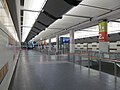
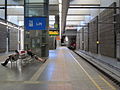
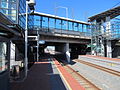
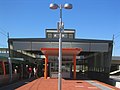
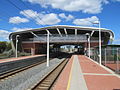
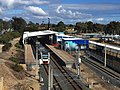
The Mandurah line, which is also known as the Southern Suburbs Railway and the South West Metropolitan Railway, is a suburban railway line and service that links the central business district (CBD) of Perth, Western Australia, with Mandurah to the south. Western Australia's Public Transport Authority (PTA) operates the line, which is 70.8 kilometres (44.0mi) long and has 13 stations, as part of the Transperth system. The line provides a through service from the Yanchep line in the north, and includes two stations in the William Street tunnel under the CBD. It continues south to the median strip of the Kwinana Freeway, where five of its stations are located, then diverges from the freeway for the southernmost six stations in the cities of Kwinana, Rockingham and Mandurah.
Early planning for the Mandurah line began in 1989 whilst the Yanchep line was being planned. In 1994, planners chose a route branching off the Armadale line at Kenwick to follow the Kwinana freight railway and Kwinana Freeway was selected, but after the election of a Labor state government in 2001, the planned route was changed to go via a tunnel under the CBD. The Mandurah line, which was built as part of the New MetroRail project, was divided into seven major contract packages. It was designed similarly to the Yanchep line, using widely spaced stations with bus interchanges and large park-and-rides.
Construction began in February 2004; it was disrupted by labour strikes and technical issues, particularly on the CBD tunnel section. The William Street tunnel, which was originally planned to open between Perth and Warnbro station in 2006, and between Warnbro and Mandurah in 2007, opened on 15October 2007, and the rest of the line opened on 23December 2007. The total cost of New MetroRail was A$1.725billion. Two infill stations have since opened: Aubin Grove in April 2017 and Lakelands in June 2023. In June 2025, the Thornlie line was extended to Cockburn Central station on the Mandurah line, completing the Kenwick route that was planned before 2001.
B-series and C-series trains are the main rolling stock used on the Mandurah line, and A-series trains were also formerly common. Trains run at a fifteen-minute headway, reducing to as short as a five-minute headway in peak times, when some services terminate at Cockburn Central. The travel time from Perth to Mandurah is 54 minutes. The line's patronage has significantly exceeded expectations, reaching a high of 23,075,517 boardings in the 2024–25 financial year,[a] making it the busiest Transperth railway line.
History
Route selection
In February 1989, ahead of that year's state election and amidst planning for the Northern Suburbs Railway, now known as the Yanchep line, the government of Western Australia announced it was investigating the building of a railway line from Perth to Rockingham or Mandurah. Later that year, the South West Rapid Transit Study was formed; its steering committee consisted of representatives from the Department of Transport, the Main Roads Department, the Department of Planning and Urban Development, Transperth and Westrail. In 1990, the committee released a report outlining two route options: an extension of the Fremantle line or a branch off the Armadale line at Kenwick, both of which made use of freight rail corridors.[1] The Premier of Western Australia, Carmen Lawrence, announced in February 1992 the Fremantle option had been chosen. By this stage, bus rapid transit had been ruled out. The South West Area Transit (SWAT) Steering Committee was formed to consider rail-based alternatives, such as light rail.[2][3][4] The section between Fremantle and Rockingham was scheduled to open in 1996, with the Rockingham-to-Mandurah section opening five years later. Legislation to build the railway was introduced to the Parliament of Western Australia later that year.[5] By January 1993, the SWAT Steering Committee had recommended to government the rail line should be an extension of the existing network, and not light rail.[6]
Independently of the SWAT Steering Committee, Westrail investigated a direct route from Perth to Mandurah via Thomsons Lake at the behest of the Department of Planning and Urban Development. The Kwinana Freeway's median strip south of the Narrows Bridge was considered too narrow compared to that of the Mitchell Freeway, where the Northern Suburbs Railway was constructed. An underground route from Perth to the Mount Henry Bridge was determined to cost about A$800million, which was considered too expensive.[4]
Following the 1993 state election, the new Liberal government deferred the construction of the railway to Mandurah, but continued its planning.[7] The Kenwick route became the preferred option because its travel time to Perth was shorter than that of the Fremantle route.[8] The Kenwick route was reserved in the Metropolitan Region Scheme in December 1994.[9][8] Ahead of the 1996 state election, Labor leader Geoff Gallop committed to building within four years a railway line from Fremantle to Rockingham that would be extended to Mandurah if Labor won a second term in government.[10][11] Western Australia's Transport Minister Eric Charlton instead pledged the new line would branch off the Armadale line at Kenwick.[12]
Kenwick route
In August 1997, the Liberal state government commissioned a master plan for the Kenwick route.[13][14] The cabinet endorsed the South West Metropolitan Railway Master Plan and released it in March 1999. The plan outlined the route of the Mandurah line and its construction.[15][16] The new track was to be 69 kilometres (43mi) long; including existing track between Perth and Kenwick, the distance from Perth to Mandurah would have been 81.6 kilometres (50.7mi).[17] Commencing at Kenwick, the railway would run parallel to the Kwinana freight railway until the Glen Iris estate in Jandakot, then south along the Kwinana Freeway's median strip to Kwinana, then southwest through Kwinana, Rockingham and Mandurah along the alignment reserved in the Metropolitan Region Scheme.[18] Three options were given for the railway's route through Rockingham.[19] The new line was forecast to cost, in total, $941million, of which $629million was for infrastructure and $312million was for rolling stock.[20] The line was planned to open as far as Thomsons Lake in 2005, with an extension to Rockingham and Mandurah opening in 2006.[21] Two busways were built to supplement the railway; one along the Kwinana Freeway from Perth to the Murdoch Park 'n' Ride, and one from Fremantle to Rockingham.[22]
Stations were planned at Thornlie, Nicholson Road, Canning Vale (later renamed Ranford Road), South Lake, Thomsons Lake (later renamed Cockburn Central), Thomas Road (later renamed Kwinana), Leda (later renamed Wellard), and depending on which route was selected, one or two stations in Rockingham, Waikiki (later renamed Warnbro), and Mandurah, with provision for additional intermediate stations in the future.[23] Upgrades along the Armadale line would have been necessary due to short station spacing and level crossings.[24]Lathlain and Welshpool stations were to be closed, and Carlisle and Victoria Park stations were to be rebuilt and relocated, in part to fill the gap left by the closure of Lathlain station.[25]Perth, Oats Street, Queens Park and Beckenham stations were to be upgraded as well.[26] Several road and pedestrian level crossings were to be grade separated.[27] The new service was to operate as a through service with the Yanchep line, known at the time as the Joondalup line,[b] due to similar levels of patronage of the two lines, leaving the Armadale line to terminate at Perth station.[29]
Proposed routes for the Mandurah line through Rockingham: the Rockingham city centre route (left),'"`UNIQ--ref-00000061-QINU`"' the bypass route (right),'"`UNIQ--ref-00000062-QINU`"' and the route selected in the 2002 master plan (middle).'"`UNIQ--ref-00000063-QINU`"'
The master plan included three options for the railway's route through Rockingham. Two options would run via Rockingham city centre, the first having a 2.25-kilometre (1.40mi) tunnel and the second having a 1.40-kilometre (0.87mi) tunnel,[30] each with a station in the city centre and at Ennis Avenue.[19] The third option would run along Rockingham's outskirts, bypassing the city centre, with one station at Dixon Road.[31] The options were costed at $143million, $107million and $31million, respectively.[30][32] The City of Rockingham was strongly in favour of the first two options,[33] but in the first two options, trains travelling through Rockingham would take an additional five minutes, and demand modelling projected similar patronage for all three options.[34] Two weeks after the master plan was released, a task force was formed to meet with members of the Rockingham community and receive submissions.[35] Out of 9,000 written submissions, 93 percent supported running the route through the city centre.[36] In October 2000, the state government announced that a route through Rockingham city centre had been chosen.[37][38]
The Kenwick tunnel, which was used for the Thornlie line instead, after the direct route was selected.
Excluding Rockingham, three short tunnels were required for this route, which were constructed ahead of time. The two tunnels for the railway to enter and exit the Kwinana Freeway median strip, at Glen Iris and Anketell, were constructed for $30million as part of a project to upgrade and extend the freeway.[39][40] The northbound freeway carriageway between Kwinana and Jandakot was also moved 10 metres (33ft) west to accommodate the railway line in the median strip.[41] A tunnel was constructed in Kenwick as part of the extension of Roe Highway and the realignment of the Albany Highway.[39][42] Between Warnbro and Mandurah, the line was planned to have a single track, allowing a maximum of two trains per hour to Mandurah.[43][44] The plan for that section was changed to double track in 2000 for an additional $20million.[45][46]
State Parliament passed the Railway (Northern and Southern Urban Extensions) Bill in November 1999, authorising the construction of the railway to Mandurah, and the extension of the Joondalup line to Clarkson and Butler.[47][48] A new master plan with revisions was released in April 2000,[49] and in June 2000, the South West Metropolitan Railway project and the Joondalup line extension to Clarkson were merged into one project, known as the Perth Urban Rail Development Project.[50][51] In October 2000, the funding arrangements were decided, allowing the planned opening date to be brought forward to 2004 for Kenwick to Thomsons Lake, and 2005 for the full line to Mandurah. The privatisation of AlintaGas would provide $300million, a railcar lease would provide $398million, and the remaining $449million would be funded by government debt.[52][53][54]
Direct route
While in opposition, the Labor Party opposed the Kenwick route and wanted the railway to be an extension of the Fremantle line.[55][56][57]Murdoch University professor and transport expert Peter Newman criticised the route for not going via Fremantle,[58] but by 1999, he was advocating for a direct route along the Kwinana Freeway between Perth and Jandakot.[59] By 2000, the Labor Party, not wanting to appear too critical, was in favour of the Kenwick route.[60] The Department of Transport opposed the direct route, saying it would require the closure of the Kwinana Freeway bus lanes and serve a lower population than the Kenwick route.[61] The following year, Labor was elected to state government, and in July 2001, the new Cabinet approved a change from the Kenwick route to the direct route along the Kwinana Freeway. This direct route involved a tunnel to bring the line through the central business district (CBD). The route's main advantage was that it made for a shorter, more direct journey from Mandurah to Perth, reducing the journey time by twelve minutes. It also allowed for stations near Murdoch University and in the south of the Perth CBD, but was more expensive, requiring parts of the original plan to be cut. To make use of the already-constructed Kenwick tunnel, the Thornlie line was to be built as a one-station spur off the Armadale line. The Mandurah line's opening date was postponed for a year, but the government committed to not exceeding the cost of the Kenwick route.[62][63]
The master plan for the new route was released in August 2002. There were to be stations at William Street (later renamed Perth Underground), Esplanade (later renamed (Elizabeth Quay),[c]Canning Bridge, Leach Highway (later renamed Bull Creek), South Street (later renamed Murdoch), Thomsons Lake (later renamed Cockburn Central), Thomas Road (later renamed Kwinana), Rockingham, Waikiki (later renamed Warnbro), and Mandurah.[66][67] South Lake station at Berrigan Drive was removed to save $6million.[68] Leda station was funded but not initially planned for construction due to the lack of nearby suburban development;[69]the station, now known as Wellard, was later brought forward to be constructed with the rest of the line.[70][71] Planned upgrades to the Armadale line between Perth and Kenwick were scaled back.[72] The section from Perth to Waikiki was planned to open in December 2006, and the section between Waikiki and Mandurah was planned to open the following December.[73]
Blue poles in South Perth
The direct route received criticism from several sources. Residents of South Perth complained the railway would be an eyesore and encroach on the Royal Perth Golf Club. The local Member of Parliament (MP), Phillip Pendal, and former transport minister Julian Grill called for the railway and freeway to be put underground between the Narrows Bridge and Mount Henry Bridge; the minister for planning and infrastructure, Alannah MacTiernan, said doing so would cost $500million, and that the ground-level option would have minimal aesthetic impact because it would be in the middle of a freeway.[74][75][76] Use of a third rail instead of overhead lines in South Perth was considered but ruled out due to cost, operational reasons, safety and aesthetics.[77][78] In response to community concerns, the poles for the overhead lines in South Perth were painted blue and made of steel rather than concrete, allowing them to be slim.[79]
To ensure costs remained within that of the Kenwick route, the diversion through Rockingham city centre was cancelled, resulting in criticism from the Mayor of Rockingham, Chris Elliott.[63][80] Rockingham station was relocated to the intersection of Ennis Avenue and Rae Road by using a corridor reserved for the unbuilt Garden Island Highway; this was closer to the Rockingham city centre than the 1999 master plan's bypass route.[81] The Rockingham City Centre Transit System was proposed to link the station to the Rockingham city centre and foreshore. Guided buses and light rail were considered,[82][83][84] and in 2004, a bus service running partially along a dedicated transitway, was chosen.[85] The cancellation of stage two of the Kwinana Freeway Bus Transitway, a reduction in railcars required for the shorter route, and a downscaling of the Armadale line and Perth station upgrades also helped ensure the direct route could remain within the costs of the Kenwick route.[86] The plan to lease the railcars was also cancelled because it would have been more expensive in the long term.[87][88]
Construction
Construction of the Southern Suburbs Railway was divided into eight contract packages; this allowed for works on the freeway and bridges to begin before other parts of the project were finalised, and for the awarding of contracts to small businesses.[89] With the exception of Package E, which was managed by Main Roads Western Australia,[90] the packages were managed by New MetroRail,[90] a division of the Public Transport Authority (PTA) that was responsible for rail expansion,[91] The eight packages were:
In October 2001, the Perth City Rail Advisory Committee was formed in response to controversy over the route through Perth's CBD.[99][100] The committee released its report in March 2002, detailing three main route options: a western route via the Mitchell Freeway, a central route via a tunnel under William Street and an eastern route via a longer tunnel further east. The committee recommended the eastern route but the government ruled that out due to its cost.[101][102] The committee was re-established to reconsider the two remaining route options in more detail.[103][104] In May, it recommended the William Street route,[105] which was approved by Cabinet in June.[106][107] Expressions of interest for Package F, which was expected to cost $200million, were called for in March 2003[108] and closed in April 2003; five consortia submitted expressions of interest.[109] In May 2003, CityConnect (Clough–McConnell Dowell–Obayashi) and Leighton–Kumagai Gumi were shortlisted,[110][111] and in November that year, the Leighton–Kumagai Gumi Team was selected.[112][113] Cabinet approved the contract the following month, with the cost rising to about $320million, taking the cost of the Southern Suburbs Railway to $1.059billion.[114][115] In February 2004, the contract was signed for $324.5million.[116][117]
Construction work at the Esplanade station site, February 2005
On 26February 2004, A ceremony was held to mark the start of preliminary drilling and surveying, which was the first physical work done for the Southern Suburbs Railway.[118][119] Demolition of buildings to make way for William Street station began in April 2004.[120] Technical issues with the tunnel boring machine (TBM) delayed the start of tunneling.[121][122] Tunnelling from Esplanade station began on 25October 2005,[89][122] and was initially expected to reach William Street station before 25 December,[121] the first phase of tunnelling was delayed by technical issues and industrial action,[123][124] which led to the Australian Industrial Relations Commission issuing a strike ban for the remainder of the project in December 2005.[125][126] Over 400 workers struck for twelve days in February and March 2006.[127][128][129] In April and May 2006, tunnelling was paused for several weeks because of a dispute between the contractors and the PTA regarding insurance.[130][131][132] The TBM broke through into William Street station on 7February 2006.[133][134] It was relaunched heading north on 4 May,[133] reaching the Roe Street dive structure on 3June.[135][136] The TBM was launched from Esplanade station for the second time on 19July, and reached William Street station on the night of 30–31August.[133][137] It was relaunched on 22September[133] and reached the Roe Street dive structure on 24October 2006, marking the end of tunnelling.[138][139]
Eighty-seven of the 107 workers who were prosecuted for violating the strike ban[140][141] were fined up to $10,000.[142][143] Leighton filed several writs against the PTA in the Supreme Court of Western Australia regarding a dispute over the contract's rise-and-fall provisions,[144] the cost of disposing of contaminated soil, an extension of the practical completion deadline,[145] and the cost of dewatering.[146] All legal action ended with a settlement in May 2009, bringing the total cost of the City Project to $439.3million, excluding legal fees.[147][148] Leighton also reached two settlements, worth millions of dollars, with the Construction, Forestry and Maritime Employees Union.[149][150]
Package E was for alterations to the Kwinana Freeway between the CBD and Glen Iris. This included upgrades to the Narrows and Mount Henry Bridges, earthworks for Bull Creek and Murdoch stations, the realignment and reconstruction of the freeway ramps and intersections at Leach Highway and South Street, a replacement bus on-ramp at Canning Bridge station, and a realignment of the freeway carriageways.[109][151] Work was not required south of Glen Iris; this was done as part of the previous Kwinana Freeway upgrade.[152]
By May 2003, two consortia had been shortlisted: Leighton Contractors, and a joint venture between Thiess and Barclay Mowlem.[109] Because Thiess was a subsidiary of Leighton, concerns about a lack of competition in the tender process were raised, but MacTiernan said a lack of competent contractors left the government with no choice but to accept the bids.[153] Leighton was selected in October 2003[151][154] and in December that year, the contract was approved for $99.1million.[155] This coincided with an announcement the planned start of services to Mandurah had been brought forward to the end of 2006.[155][156] The contract was signed the following month.[157][158]
Before the Mandurah line was built, the Narrows Bridge, which crosses the Swan River, consisted of two parallel bridges with bus lanes as the innermost lane of each bridge. The recently-built northbound bridge was able to carry the northbound Mandurah line track with only minor strengthening,[159][160] but the older southbound bridge was too weak and did not have enough room for the southbound track, so a new bridge for the southbound track was built in between the extant bridges. The new brindge was built using precast concrete beams that were craned into position.[159][160] The first four beams were lifted into place by October 2005,[161] and the bridge was completed by April 2006.[162] The original plan for the Mount Henry Bridge, which crosses the Canning River, was the addition of extra lanes to both its west and east sides, and for the Mandurah line to run across the middle. Leighton proposed to construct a single bridge on the western side instead,[159][163] saving $17million.[163] Construction at the Mount Henry Bridge began in May 2004.[89] The new bridge opened on 22–23January 2006, allowing work on the rail corridor to begin on the original bridge. The new bridge is 15 metres (49ft) wide and 660 metres (2,170ft) long, and was constructed using the incremental launch method.[163][164] To enable the Mandurah line to exit the freeway and enter the northern end of the William Street tunnel, a bridge was built for the southbound carriageway of the Mitchell Freeway. This was built from the top down, allowing three lanes to remain open at all times.[165] Package E was completed in June 2006.[166]
Railway construction
View from Cranford Avenue, April 2006
Package A involved civil works, drainage, construction of track and overhead line equipment, as well as earthworks for stations between Cockburn Central and Mandurah. By May 2003, four consortia had qualified to tender for Package A:[109]
RailLink Joint Venture (John Holland, Macmahon Contractors and Multiplex Constructions)
Thiess Barclay Mowlem (Thiess and Barclay Mowlem)[109]
In addition to Package E, concerns about a lack of competition were raised for Package A, because John Holland and Thiess were subsidiaries of Leighton Contractors, meaning three of the four bids involved Leighton.[153] ConnectWest withdrew during the tender period. RailLink Joint Venture was selected in December 2003[167][168] and was awarded the contract for $310million in May 2004 .[169][170]
Tracklaying began on 16March 2006, starting from RailLink's temporary depot in Hillman.[89][171] For the most part, a tracklaying machine that could lay 1 kilometre (0.6mi) of track per day was used.[171][172] The machine started by laying track north from Hillman to Roe Highway, then south from Hillman to Gordon Road in Mandurah, then north from Roe Highway to the Narrows Bridge. The machine did not lay any track south of Gordon Road and north of the Narrows Bridge.[165][172] By the end of 2006, track laying was complete.[89][173] Because of a delay caused by the late completion of other packages, the PTA reached a $21.8million settlement with RailLink in June 2006.[174][175] By April 2007, the completion of Package A was further delayed by problems with the installation of signalling, which by August that year was the main issue delaying the opening of the Mandurah line.[176]
The nine stations between Canning Bridge and Mandurah were grouped into three packages. In September 2003, the state government called for expressions of interest for the three station packages.[177][178] The Package D contract, which was for Canning Bridge, Bull Creek and Murdoch stations, was awarded to John Holland for $32million in November 2004.[179][180] In March 2005, the Package B contract, which was for Cockburn Central, Kwinana and Wellard stations, was awarded to a joint venture between DORIC Constructions and Brierty Contractors for $32million.[181][182] Package C was divided into two contracts, which were awarded in June 2005 for a total of $38million. The contract for Rockingham and Warnbro stations was awarded to the DORIC–Brierty Joint Venture, and the contract for Mandurah station was awarded to JM and ED Moore.[183][184]
By the end of 2005, construction of most stations had begun.[185] Cockburn Central, Kwinana, Wellard and Mandurah stations reached practical completion in January or February 2007, Rockingham and Warnbro stations reached practical completion in March or April, and Canning Bridge, Bull Creek and Murdoch stations reached practical completion in June 2007.[166][89]
Train control system and depot
Package G was for a new train control system for the Southern Suburbs Railway and the existing network, which used a system installed in 1989. The Package G contract was awarded to Union Switch & Signal for $10.6million in July 2003.[186] The new system was launched on 4July 2005.[187]EDI Rail and Bombardier Transportation built Nowergup railcar depot on the Joondalup line as part of the contract to construct the B-series trains. The depot opened on 13June 2004.[188]
Cost escalations and opening
In April 2005, MacTiernan said the Southern Suburbs Railway would be completed on time and on budget, despite the ongoing industrial problems.[189] Later that month, she said the opening had been delayed from December 2006 to April 2007 because of delays on the City Project as a result of heritage protection works at Perth Underground station, engineering challenges on the foreshore, and industrial disputes, which also delayed Package A's tracklaying. A $45million escalation in the project's budget contingency was also announced because the last two station contracts cost more than expected.[190][191] In April 2006, a further postponement to July 2007 was announced, along with a $50million escalation in the budget contigency due to claims made by Leighton–Kumagai and RailLink.[192][193] The May 2006 state budget revealed the Mandurah line's debt would be fully paid off using a budget surplus.[194][195] In May 2007, it was announced the July opening date would not be met and that the new opening date was unknown.[196][197] In June 2007, a completion deadline of that year's November was given.[198] Another $50million cost escalation was revealed in September 2007, bringing the total cost of New MetroRail to $1.66billion.[199][200][d] The 2009–10[202] and the 2010–11 state budgets revealed further cost increases, making the final cost of New MetroRail $1.725 billion.[203] The Mandurah line's construction cost was substantially lower than that of other comparable Australian rail projects.[204][205][206][207] For example, a 2011 Parliament of New South Wales inquiry noted Sydney's South West Rail Link was estimated to cost almost ten times more per kilometre than the Mandurah line.[201]
Plaque at Mandurah station commemorating the opening of the Mandurah line on 23December 2007
The first train ran through the William Street tunnel in August 2007.[208][209] The City Project reached practical completion in September 2007 and was handed to the PTA on 10September.[166][210] From 7–14October, the Fremantle line was fully closed and the Joondalup line was closed south of Leederville station so the William Street tunnel's tracks, signalling, electrical and communications systems could be connected to the rest of the network.[89][211] Perth Underground and Esplanade stations opened on 15October 2007.[212][213]
Electricity for the whole line was first switched on in September 2007.[214] A test train ran between Perth and Rockingham on 9November 2007, becoming the first train south of the Narrows Bridge.[215][216] The success of the test train allowed for the announcement of the line's opening date of 23December 2007 the following day. Driver training was scheduled to begin on 19November.[217][218] A public ballot was held for people to win a ticket to ride the inaugural train.[219] WA's Premier Alan Carpenter, and the Minister for Planning and Infrastructure Alannah MacTiernan, opened the line on 23December.[220][221][222]
After opening
Within weeks of the line opening, parking at several stations was at capacity, causing many people to park illegally.[223] In March 2008, the government acknowledged the car parks were full, and said it was considering expanding them and adding more bicycle storage facilities.[224] In September 2008, the Liberal Party committed $49million to adding 3,000 new parking bays along the Mandurah and Joondalup lines, and Labor committed to adding 2,000 bays.[225][226] The first new parking bays were opened at Murdoch station in July 2009.[227] By July 2012, the 3,000-parking-bay promise had been exceeded.[228][229]
Infill stations
The site of the proposed South Perth station
Provision was made for infill stations at South Perth,[230] Berrigan Drive, Russell Road / Gibbs Road, Rowley Road, Anketell Road, Challenger Avenue,[231] Stakehill Road, Paganoni Road, Lakelands, and Gordon Road.[72] The 2002 master plan justified not building South Perth station with the rest of the Mandurah line; the station would receive low patronage because the existing bus and ferry services were attractive, and there was little opportunity to provide car parking.[230] Later that year, to receive the support of the Greens in passing the Railway (Jandakot to Perth) Bill, the government committed to constructing the station by 2010.[94][95] During the Mandurah line's construction, the southbound freeway carriageway was relocated in the vicinity of Richardson Street to create room for South Perth station.[232][78] Following the 2008 state election, the opening of South Perth station was deferred until 2013,[233] and in 2009, the station was indefinitely deferred after being left out of the state budget.[234] Since then, the City of South Perth has advocated for the station to be built.[235][236][237][238] In 2017, the Mayor of South Perth said the station would receive 4,500 to 5,500 boardings per day by 2026.[239]
In August 2012, the government announced Aubin Grove station would be built at Russell Road / Gibbs Road, with a budget of $80million.[240][241] This followed a commitment two months earlier by Opposition Leader Mark McGowan to built the station if Labor were to win the upcoming state election. The station was planned to relieve pressure on Cockburn Central station, where car parks became fully occupied the earliest each day of any Mandurah line station.[242][243] An early contractor involvement model was used for Aubin Grove station. Georgiou Group was selected as the construction contractor in February 2015 for $57million[244]and the contract was signed in late 2015.[245] The remaining $23million in the budget was for railcar acquisition.[244] Construction began in March 2016[246] and the station opened on 23April 2017.[247][248]
In 2015, due to high population growth in the region, McGowan committed to building Karnup station at Paganoni Road if he became Premier.[249][250] After Labor won the 2017 state election, planning for Karnup station began.[251] In the same year, several public figures, including Mandurah Mayor Marina Vergone and federal Liberal MP Andrew Hastie, began lobbying for Lakelands station to be built instead of Karnup station.[251][252] By July 2019, the federal government had committed $35million for Lakelands station, which Transport Minister Rita Saffioti said was not enough for the state government to build the station.[253][254] In November 2019, after the federal government had committed $64million, or 80 percent of the station's $80million cost, the state government deferred Karnup station and committed to Lakelands station.[255][256] The contract to build Lakelands station was awarded to ADCO Constructions in January 2021,[257][258] early works commenced in August that year[259][260] and Lakelands station opened on 11June 2023, $8million under budget.[261][262] As of 2025, the state government said it is committed to building Karnup station.[263]
The Thornlie–Cockburn line (inner tracks) and the Mandurah line (outer tracks), viewed from Berrigan Drive
Ahead of the 2017 state election, the Labor Party also committed to extending the Thornlie line from Thornlie to Cockburn Central, completing the original route of the Mandurah line.[264][265] The NEWest Alliance, a joint venture between CPB Contractors and Downer, was awarded the contract in December 2019,[266][267] and construction was underway by the middle of 2020.[268] The Glen Iris tunnel, which was constructed in 2000 for the Mandurah line's Kenwick route, was used by the Thornlie–Cockburn line to enter the Kwinana Freeway median strip to reach Cockburn Central.[269] The platform at Cockburn Central was extended to the north to create a new "dock-style platform", allowing the Thornlie–Cockburn line to remain operationally separate from the Mandurah line.[270]
From 26December 2021 to 14January 2022, the Mandurah line between Elizabeth Quay and Aubin Grove stations was shut to facilitate works on the Thornlie–Cockburn Link.[271][272] A temporary bus station was opened in Perth Convention and Exhibition Centre .[271][273] This was the longest planned shutdown of a railway line in Perth's history at the time, and 3 kilometres (2mi) of track between Cockburn Central station and the Glen Iris tunnel was moved to accommodate track for the Thornlie–Cockburn line.[271][274] A second major shutdown of the Mandurah line occurred between 26December 2022 and 3January 2023 for the installation of turnouts linking the Thornlie–Cockburn line with the Mandurah line, communication and signalling equipment, overhead line equipment, and 4 kilometres (2.5mi) of rail.[275][276] The Thornlie–Cockburn Link opened on 8June 2025, with a final cost of $1.35billion.[277][278]
The Mandurah line runs from Perth Underground station in the north to Mandurah station in the south, a distance of 70.8 kilometres (44.0mi), and continues north of Perth Underground station as the Yanchep line.[281] Trains in the William Street tunnel between Perth Underground and Elizabeth Quay stations are considered to be simultaneously part of the Yanchep line and Mandurah line.[285]
The Mandrah line runs south from Perth Underground station, through a 0.6-kilometre (0.4mi) tunnel to Elizabeth Quay station, surfaces and enters the Kwinana Freeway's median strip, and crosses the Swan River via the Narrows Bridge at the 1.9-kilometre (1.2mi) mark. South of the Narrows Bridge, the Mandurah line continues southwards along the Kwinana Freeway median strip, crossing the Canning River on the Mount Henry Bridge at the 10.1-kilometre (6.3mi) mark. There are five stations along the Kwinana Freeway; they are, from north to south: Canning Bridge, Bull Creek, Murdoch, Cockburn Central, and Aubin Grove. The Mandurah line connects to the Thornlie–Cockburn line at Cockburn Central station. South of Cockburn Central station are two turnback sidings where trains change direction.[281][286]
Near Kwinana, at approximately 31.5 kilometres (19.6mi), the Mandurah line exits the Kwinana Freeway and veers to the south-west via the Anketell tunnel. South-west from there, the line has six stations: Kwinana, Wellard, Rockingham, Warnbro, Lakelands, and Mandurah. At Rockingham station, the Mandurah line veers southwards to parallel Ennis Avenue for a few kilometres. Continuing southwards, the line traverses the Mandjoogoordap Drive median strip and terminates at Mandurah station, where the Mandurah railcar depot is located.[281][286]
Stations
All stations on the Mandurah line are fully accessible[287] and have a bus interchange.[285]
Transperth train services are operated by the Public Transport Authority's (PTA) Transperth Train Operations division.[289] Mandurah line headways are a short as five minutes during peak hours, increasing to fifteen minutes outside peak and on weekends, and half-an-hour to an hour at night. During peak times, some trains terminate or commence at Cockburn Central station. The travel time from Perth Underground station to Mandurah station is 54 minutes. On weeknights, the last train arrives at Mandurah station at 1:11am and the first train departs at 4:35am. On Saturday and Sunday nights, the last train arrives at Mandurah station 3:09am, and the first train departs at 5:02am on Saturdays and at 6:25am on Sundays.[290] During events at Perth Stadium, additional services run from Mandurah to Perth Stadium station and vice versa via the Thornlie–Cockburn line.[291]
Before January 2016, express services operated on the Mandurah line during peak periods to manage overcrowding. The introduction of more B-series sets allowed for most peak-time trains to be six cars long, which increased capacity and allowed all services to stop at all stations from 31January 2016.[292][293] Before then, some peak trains did not serve Canning Bridge station.[294][295] Before June 2009, services terminating at Cockburn Central also operated off-peak, making for 7½-minute headways between Perth and Cockburn Central during the day.[296][297] These services were withdrawn to reduce costs.[298][299][300]
From 2031, peak frequencies on the Mandurah line are planned to reach 18 trains per hour, which will be made possible by C-series trains having three doors per car, which reduces dwell times compared to B-series trains, and the communications-based train-control signalling upgrade.[301]
The main rolling stock used on the Mandurah line are Transperth B-series and C-series trains, with occasional use of A-series trains. The A-series trains entered service between 1991 and 1999, have a maximum speed of 110 kilometres per hour (68mph), and consist of two cars that are usually joined to form four-car trains. Each car has two doors on each side.[302] The B-series trains entered service between 2004 and 2019,[303] have a maximum speed of 130 kilometres per hour (81mph), and consist of three cars that are usually joined to form six-car trains. Each car has two doors per side.[304] The C-series trains have been entering service since 2024, have a maximum speed of 130 kilometres per hour (81mph), and consist of six cars with three doors on the side of each car.[301]
In May 2002, the state government signed a contract with EDI Rail and Bombardier Transportation for the construction of Nowergup depot at the northern end of the Joondalup line, and the delivery and maintenance of 31 three-car B-series trains to be used on the Joondalup and Mandurah lines.[305][306] Those trains were all delivered by June 2006.[165] The government ordered 15 additional B-series trains in December 2006.[307][308][309] The first of the additional railcars entered service in June 2009, allowing for the transfer of some A-series trains to other lines.[298] In July 2011, a further 15 B-series trains were ordered;[310][311] this order was eventually increased to 22.[312][313] The first of these trains entered service in December 2013, and by the end of the order, all A-series trains had been transferred to other lines and almost every peak-hour train on the Mandurah line had six cars.[314]
In December 2019, the state government signed a contract with Alstom for the delivery and maintenance of 41 C-series trains[315][316] to replace the A-series trains and provide rolling stock for network expansions. The C-series trains have three doors on the side of each car, decreasing dwell times.[301] The first C-series train entered service on the Mandurah and Joondalup lines on 8April 2024.[317][318][319] The C-series trains are planned to be initially used only on the Yanchep and Mandurah lines, with B-series trains transferred to other lines to replace the retiring A-series trains.[301]
Most trains on the Mandurah line are stored and cleaned at Nowergup depot, and Mandurah depot can store and clean a smaller number of trains. Maintenance occurs at Nowergup depot. As a result of increasing train frequency, a new depot may in the future be required along the Mandurah line.[320]
Patronage on the Mandurah line has exceeded expectations, and has driven increases in use on other train lines and bus routes by extending the network's overall reach.[322][323] Before opening in December 2007, it was projected 50,000 passengers would use the Mandurah line per weekday.[220][222] By February 2008, the line's average number of boardings were over 30,000 per weekday and 15,000 per weekend day.[324][325] By March, patronage exceeded 40,000 boardings per weekday,[224][326][327] and by July, nearly 50,000 boardings per weekday, reaching the target more quickly than expected.[328] Patronage on the bus routes that were replaced was 16,000 per weekday.[325][326] Boardings across the whole train network had increased by 57 percent since the Mandurah line opened, from 115,000 to 180,000 per day.[328] Canning Bridge, Bull Creek and Murdoch, the stations the Kenwick route did not serve, recorded some of the strongest patronage.[327] In the first half of 2008, the Mandurah line made up 28 percent of all fare-paying boardings on Transperth trains,[329] and over the whole of 2008, the Mandurah line had approximately 15million boardings,[330] exceeded that of the Joondalup line to become the busiest Transperth railway line. The PTA's chief executive officer Reece Waldock described the Mandurah line as a "victim of its own success" due to overcrowding and full car parks. He attributed the higher-than-expected patronage to a resources boom in Western Australia at the time, an increase in fuel prices and individual awareness of climate change.[329]
The Mandurah line reached an initial peak of 21,150,408 boardings in the 2012–13 financial year[a] before a period of stagnation.[321] Patronage declined the following financial year because of shutdowns caused by the Perth City Link and economic factors,[331] but slightly increased in the year next. In 2015–16 and 2016–17, patronage declined again,[321] but then increased over the following two years, reaching 20,900,819 in 2018–19 due to a rebound in Western Australia's economy.[321][332] The COVID-19 pandemic's onset in 2020 resulted in a massive decrease,[333] reaching a low of 14,357,888 boardings in 2021–22,[321] since then recovering to reach a record high of 23,075,517 boardings in 2024–25.[321][334]
The busiest stations on the Mandurah line as of 2013–14 were Perth Underground, Elizabeth Quay, Murdoch, Cockburn Central, Mandurah, and Bull Creek. The least-busiest stations as of 2013–14 were Wellard, Kwinana, and Canning Bridge.[335] As of October 2017, Elizabeth Quay and Murdoch stations are the second-busiest and third-busiest Transperth stations, respectively.[336]
Notes
12An Australian financial year is from 1July to 30June the following year.
↑The Joondalup line was renamed the Yanchep line on 15June 2024.[28]
↑The media incorrectly reported this as the cost of the Mandurah line, not the cost of New MetroRail as a whole, which includes the Clarkson extension and Thornlie line.[201]
References
↑University of Melbourne (December 2014). "Australia – South West Corridor Railway"(PDF). Omega Centre. Bartlett School of Planning, University College London. p.24. Archived(PDF) from the original on 18 January 2025. Retrieved 24 January 2025.
↑MacTiernan, Alannah; Gallop, Geoff (13 August 2002). "Master Plan shows new line a winner" (Press release). Government of Western Australia. Retrieved 23 June 2025.
↑Robb, Trevor (14 August 2002). "ALP claims win on freeway line". The West Australian. p.4.
↑Penn, Simon; Platell, Frank (6 December 2003). "Agreement gives go-ahead for new village in Wellard – 8500 people, 2700 blocks". The West Australian. p.4.
↑"Green light for rail". The West Australian. 14 November 2003. p.7.
↑MacTiernan, Alannah (31 October 2001). "City rail options to be examined" (Press release). Government of Western Australia. Retrieved 31 October 2023.
↑Robb, Trevor (1 November 2001). "Minister puts rail options on track". The West Australian. p.36.
↑MacTiernan, Alannah (14 March 2002). "City Rail options released" (Press release). Government of Western Australia. Retrieved 31 October 2023.
↑Burns, Anne; Robb, Trevor (14 March 2002). "Rail review backs bypass". The West Australian. p.7.
↑Robb, Trevor (19 April 2002). "State revisits railway options". The West Australian. p.31.
↑MacDonald, Kim (9 May 2006). "Rail work resumes after dispute". The West Australian. p.6.
1234Sigl, Oskar; Yamazaki, Hiroshi (January 2007). "TBM tunnelling". Proceedings of the Seminar on New MetroRail City Project Tunnelling and Underground Structures. Engineers Australia. p.64. ISBN978-1-925627-28-2.
↑Drummond, Mark (1 July 2006). "More rail blowouts likely despite $22m deal". The West Australian. p.14.
↑Riley, Sam; MacDonald, Kim (10 August 2007). "'Signals' blamed for railway delay – As the $1.6b rail project hits another hurdle, the unionist who sparked the rail strike of 2005 gets another job in town". The West Australian. p.6.
↑Phillips, Yasmine; Campbell, Kate (5 September 2008). "Liberals put faith in railway station carparks as Labor backs more trains". The West Australian. p.9.
↑Hatch, Daniel (20 January 2009). "Train station carparks full by 8am". The West Australian. p.6.
12345"Manual – Rail Access"(PDF). Public Transport Authority. 27 October 2025. pp.31, 152. Archived(PDF) from the original on 5 May 2025. Retrieved 17 December 2025.
↑AECOM (April 2015). "A-Series EMU Railcar Review"(PDF). Parliament of Western Australia. p.21. Archived(PDF) from the original on 20 January 2021. Retrieved 8 March 2024.
↑Pratley, Jerry (13 May 2002). "$437m deal for fast rail cars". The West Australian. p.7.
↑Carpenter, Alan; MacTiernan, Alannah (19 September 2006). "More trains for Perth's transport system" (Press release). Government of Western Australia. Retrieved 16 November 2024.
↑Mason, Graham (20 September 2006). "Commuters face 3-year wait for new trains". The West Australian. p.48.
↑MacTiernan, Alannah (22 September 2006). "WA Government secures new railcars" (Press release). Government of Western Australia. Retrieved 16 November 2024.
↑"HCS SWTR Book 1 – Scope of Works DRAFT 01-09-21_Redacted". Tenders WA. 30 September 2021. pp.77, 79, 96. Archived from the original on 20 January 2022. Retrieved 20 January 2022. Click Download Now, then Download for Information Only. Make sure HCS SWTR Book 1 – Scope of Works DRAFT 01-09-21_Redacted.pdf is selected, then click Download Documents.
This page is based on this Wikipedia article Text is available under the CC BY-SA 4.0 license; additional terms may apply. Images, videos and audio are available under their respective licenses.