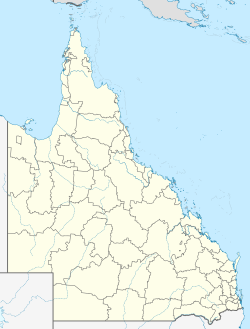
Miva, Queensland Last updated March 11, 2026 Geography Miva's eastern boundary is the Mary River . Its western boundary is the Bauple-Woolooga Road. Miva is almost entirely within the Gympie Region apart from a small section in the north-east of the locality which is part of the Fraser Coast Region. The lower parts of the locality near the river and along the valleys (elevation 20–70 metres are used for farming). The hilly land to the west rises to peaks of 100 metres and the hilly land to the south-east rises to a peak of 150 metres; the hilly land is undeveloped bushland. [ 4]
The former Kingaroy branch railway passed through Miva from the east to the south-west; Miva was served by the now-abandoned Miva railway station ( 25°57′30″S 152°29′30″E / 25.9584°S 152.4917°E / -25.9584; 152.4917 (Miva railway station (former) ) [ 5] [ 6]
History The name Miva is taken from the name of a pastoral run belonging to Gideon Scott, a pastoralist in March 1851. It is thought to be an Aboriginal word indicating either stony knob or Moreton Bay chestnut . [ 2] [ 3] [ 7]
In 1870, a punt began to operate a river crossing service at Miva. [ 8]
The Nanango railway line opened in December 1886 as far as Kilkivan.
Munna Creek Cemetery (also known as Miva Cemetery) opened circa 1905-6 on a 3-acre (1.2 ha) site. [ 9] [ 10]
Miva Provisional School opened about 1888, becoming Miva State School on 1 January 1909. In March 1922, it became a half-time provisional school, sharing its teacher with the Sexton State School , who taught at each school in alternating weeks. [ 11] The two schools were closed in September 1924. [ 12] It reopened in 1926 as a provisional school, but closed finally about 1934. [ 13] It was on Munna Miva Road beside the Mary River ( 25°57′05″S 152°29′37″E / 25.95140°S 152.49366°E / -25.95140; 152.49366 (Miva State School (former) ) [ 14] [ 15] [ 16]
Dickabram Cemetery opened in 1909 on a 1-acre (0.40 ha) site. [ 17] [ 18]
Miva Post Office opened by May 1908 (a receiving office had been open from 1888) and closed in 1976. [ 19]
Demographics In the 2016 census , the locality of Miva had a population of 57 people. [ 20]
In the 2021 census , the locality of Miva had a population of 55 people. [ 1]
Heritage listings Dickabram Bridge Miva has a number of heritage-listed sites, including:
References 1 2 3 Australian Bureau of Statistics (28 June 2022). "Miva (SAL)" . 2021 Census QuickStats . Retrieved 28 February 2023 . 1 2 "Miva – Gympie Region (entry 47615)" . Queensland Place Names . Queensland Government . Retrieved 2 March 2017 . 1 2 "Miva – Fraser Coast Region (entry 46742)" . Queensland Place Names . Queensland Government . Retrieved 2 March 2017 . ↑ "Queensland Globe" . State of Queensland . Retrieved 2 March 2017 . ↑ "Miva – railway station in the Gympie Region (entry 22398)" . Queensland Place Names . Queensland Government . Retrieved 2 March 2017 . ↑ "Railway stations and sidings - Queensland" . Queensland Open Data . Queensland Government . 2 October 2020. Archived from the original on 5 October 2020. Retrieved 5 October 2020 . ↑ "NOMENCLATURE OF QUEENSLAND.—194" . The Courier-Mail . Brisbane: National Library of Australia. 14 May 1936. p. 14. Retrieved 8 July 2013 . ↑ "LOCAL AND GENERAL NEWS" . Gympie Times And Mary River Mining Gazette . Vol. III, no. 272. Queensland, Australia. 6 July 1870. p. 3. Retrieved 5 November 2022 – via National Library of Australia. ↑ "Crown Lands" . The Telegraph . No. 10304. Queensland, Australia. 25 November 1905. p. 3. Retrieved 13 December 2024 – via National Library of Australia. ↑ "OFFICIAL NOTIFICATIONS" . The Brisbane Courier . Vol. LXIII, no. 15, 169. Queensland, Australia. 24 August 1906. p. 6. Retrieved 13 December 2024 – via National Library of Australia. ↑ "OFFICIAL NOTIFICATIONS" . Daily Standard . No. 603. Queensland, Australia. 20 November 1914. p. 2. Retrieved 7 October 2024 – via National Library of Australia. ↑ "TIARO" . The Brisbane Courier . No. 20, 785. Queensland, Australia. 4 September 1924. p. 13. Archived from the original on 7 October 2024. Retrieved 7 October 2024 – via National Library of Australia. ↑ Queensland Family History Society (2010), Queensland schools past and present (Version 1.01 ed.), Queensland Family History Society , ISBN 978-1-921171-26-0 ↑ "County of Lennox sheet 1" (Map). Queensland Government . 1921. Archived from the original on 9 August 2023. Retrieved 13 December 2024 . ↑ "Queensland Two Mile series sheet 2m113" (Map). Queensland Government . 1936. Archived from the original on 6 October 2024. Retrieved 13 December 2024 . ↑ "Layers: Locality; Road and rail; Land parcel; Watercourse" . Queensland Globe . Queensland Government . Archived from the original on 19 December 2017. Retrieved 13 December 2024 . ↑ "Advertising" . Gympie Times And Mary River Mining Gazette . Vol. XLI, no. 5331. Queensland, Australia. 13 February 1909. p. 2. Retrieved 13 December 2024 – via National Library of Australia. ↑ "NEW RESERVES" . The Brisbane Courier . Vol. LXVI, no. 16, 132. Queensland, Australia. 24 September 1909. p. 3. Retrieved 13 December 2024 – via National Library of Australia. ↑ Phoenix Auctions History. "Post Office List" . Phoenix Auctions. Retrieved 5 March 2021 . ↑ Australian Bureau of Statistics (27 June 2017). "Miva (SSC)" . 2016 Census QuickStats . Retrieved 20 October 2018 . ↑ "Dickabram Bridge (entry 600836)" . Queensland Heritage Register . Queensland Heritage Council. Retrieved 8 July 2013 . ↑ "Layers: Locality; Schools and school catchments" . Queensland Globe . Queensland Government . Archived from the original on 19 December 2017. Retrieved 13 December 2024 . ↑ "Branch Locations" . Queensland Country Women's Association . Archived from the original on 26 December 2018. Retrieved 26 December 2018 . ↑ "Cemetery Areas - Queensland" . Queensland Open Data . Queensland Government . 12 November 2020. Archived from the original on 15 November 2020. Retrieved 12 November 2020 . ↑ "Dickabram cemetery" . Gympie Regional Council. Archived from the original on 27 October 2024. Retrieved 13 December 2024 . ↑ "Cemetery Areas - Queensland" . Queensland Open Data . Queensland Government . 12 November 2020. Archived from the original on 15 November 2020. Retrieved 12 November 2020 . ↑ "Fraser Coast Cemeteries" . Fraser Coast Regional Council . p. 2. Archived from the original on 22 July 2024. Retrieved 13 December 2024 . This page is based on this
Wikipedia article Text is available under the
CC BY-SA 4.0 license; additional terms may apply.
Images, videos and audio are available under their respective licenses.