
The Asian palm civet is a viverrid native to South and Southeast Asia. Since 2008, it is IUCN Red Listed as Least Concern as it accommodates to a broad range of habitats. It is widely distributed with large populations that in 2008 were thought unlikely to be declining. In Indonesia, it is threatened by poaching and illegal wildlife trade; buyers use it for the increasing production of kopi luwak, a form of coffee that involves ingestion and excretion of the beans by the animal.

Udawalawe National Park lies on the boundary of Sabaragamuwa and Uva Provinces, in Sri Lanka. The national park was created to provide a sanctuary for wild animals displaced by the construction of the Udawalawe Reservoir on the Walawe River, as well as to protect the catchment of the reservoir. The reserve covers 30,821 hectares (119.00 sq mi) of land area and was established on 30 June 1972. Before the designation of the national park, the area was used for shifting cultivation. The farmers were gradually removed once the national park was declared. The park is 165 kilometres (103 mi) from Colombo. Udawalawe is an important habitat for water birds and Sri Lankan elephants. It is a popular tourist destination and the third most visited park in the country.
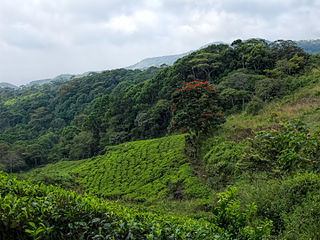
Sinharaja Forest Reserve is a forest reserve and a biodiversity hotspot in Sri Lanka. It is of international significance and has been designated a Biosphere Reserve and World Heritage Site by UNESCO.

Paradoxurus is a genus of three palm civets within the viverrid family that was denominated and first described by Frédéric Cuvier in 1822. The Paradoxurus species have a broad head, a narrow muzzle with a large rhinarium that is deeply sulcate in the middle. Their large ears are rounded at the tip. The tail is nearly as long as the head and body.

The grizzled giant squirrel is a large tree squirrel in the genus Ratufa found in the highlands of the Central and Uva provinces of Sri Lanka, and in patches of riparian forest along the Kaveri River and in the hill forests of Karnataka, Tamil Nadu and Kerala states of southern India. The International Union for Conservation of Nature (IUCN) lists the species as near threatened due to habitat loss and hunting.

The Sulawesi palm civet, also known as Sulawesi civet, musang and brown palm civet is a little-known palm civet endemic to Sulawesi. It is listed as Vulnerable on the IUCN Red List due to population decline estimated to have been more than 30% over the last three generations inferred from habitat destruction and degradation.
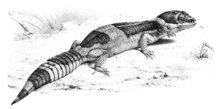
The East Indian leopard gecko, also known commonly as Hardwicke's gecko, is a species of gecko, a lizard in the family Eublepharidae. The species is endemic to India and Bangladesh.

The Indian golden gecko or Beddome's golden gecko is a species of gecko known only from the Eastern Ghats of India. It was rediscovered from the hills near present-day Tirupati. The rediscovery was after over 100 years since its description.

The small-toothed palm civet, also known as the three-striped palm civet, is a palm civet native to dense forests of Southeast Asia, from the Assam district of India to Indochina and the Malay Peninsula and on Sumatra, Bangka, Java, Borneo, and numerous small nearby islands of Indonesia.

The golden palm civet is a palm civet endemic to Sri Lanka. It is listed as Vulnerable on the IUCN Red List. Its distribution is severely fragmented, and the extent and quality of its habitat in Sri Lanka's hill regions are declining.

The brown palm civet also called the Jerdon's palm civet is a palm civet endemic to the Western Ghats of India.

The ruddy mongoose is a mongoose species native to hill forests in India and Sri Lanka. This mongoose, along with the striped-neck and Indian grey mongeese, are the only mongoose species endemic to India and Sri Lanka. The ruddy mongoose is very closely related to Indian grey mongoose, but distinguished by its slightly larger size and black-tipped tail extending for 2 to 3 inches at the distal end. There are two subspecies of this mongoose, H. smithii smithii in India, and H. smithii zeylanicus in Sri Lanka.

The Sri Lanka montane rain forests is an ecoregion found above 1000 m in the central highlands of Sri Lanka. Owing to their rich biodiversity, this region considered a super-hotspot within the endemism hotspot of global importance. These forests are cooler than lowland forests and therefore they have ideal conditions for growth of cloud forests. Half of Sri Lanka's endemic flowering plants and 51 percent of the endemic vertebrates are restricted to these forests. More than 34 percent of Sri Lanka's endemic trees, shrubs, and herbs can only be found in this ecoregion. Twisted, stunted trees are a common sight in these forests, together with many varieties of orchids, mosses and ferns. The trees of montane rain forests grow to a height 10–15 meters, shorter than the lowland rain forest trees. These high altitude forests are the catchment area for most of Sri Lanka's major rivers.

A civet is a small, lean, mostly nocturnal mammal native to tropical Asia and Africa, especially the tropical forests. The term civet applies to over a dozen different mammal species. Most of the species diversity is found in southeast Asia. The best-known civet species is the African civet, Civettictis civetta, which historically has been the main species from which a musky scent used in perfumery was obtained. The word civet may also refer to the distinctive musky scent produced by the animals.
Layard's palm squirrel or flame-striped jungle squirrel is a species of rodents in the family Sciuridae endemic to Sri Lanka. The validity of the subspecies F. l. dravidianus based on a single specimen from the southern tip of India has been questioned, and is probably a juvenile F. sublineatus. Known as මූකලන් ලේනා in Sinhala.

Paradoxurus aureus, the golden palm civet, also called golden paradoxurus and golden wet-zone palm civet is a viverrid species native to Sri Lanka. It was first described by Frédéric Cuvier in 1822.
Paradoxurus montanus, the Sri Lankan brown palm civet, is a viverrid species endemic to Sri Lanka where it is known as ශ්රී ලංකා බොර කලවැද්දා in Sinhala. Until 2009, it was considered as the same species as the golden palm civet, but proposed to be given specific rank.

Kaludiya Pokuna Archeological Forest Site, is a forest with archeological remains in Kandalama, in the Dry Zone of Sri Lanka.

