Henry County, Tennessee | |
|---|---|
| Henry County Courthouse in Paris | |
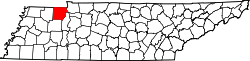
| Location within the U.S. state of Tennessee | |
| Coordinates: 36°20′N88°18′W / 36.33°N 88.3°W | |
| Country | |
| State | |
| Founded | 1821 |
| Named after | Patrick Henry [1] |
| Seat | Paris |
| Largest city | Paris |
| Area | |
• Total | 593 sq mi (1,540 km2) |
| • Land | 562 sq mi (1,460 km2) |
| • Water | 31 sq mi (80 km2) 5.3% |
| Population (2020) | |
• Total | 32,199 |
| • Density | 58/sq mi (22/km2) |
| Time zone | UTC−6 (Central) |
| • Summer (DST) | UTC−5 (CDT) |
| Congressional district | 8th |
| Website | henrycountytn |
Henry County is a county located on the northwestern border of the U.S. state of Tennessee, and is considered part of West Tennessee. As of the 2020 census, the population was 32,199. [2] Its county seat is Paris. [3] The county is named for the Virginia orator and American Founding Father Patrick Henry. [4]
Henry County comprises the Paris, TN Micropolitan Statistical Area. West Tennessee lands and commodity culture were associated with the lowlands and delta of the Mississippi River, which created fertile areas that supported cotton culture. During the antebellum era, numerous enslaved African Americans provided labor for the cotton plantations.
According to the U.S. Census Bureau, the county has a total area of 593 square miles (1,540 km2), of which 562 square miles (1,460 km2) are land and 31 square miles (80 km2) (5.3%) are covered by water. [5]
| Census | Pop. | Note | %± |
|---|---|---|---|
| 1830 | 12,249 | — | |
| 1840 | 14,906 | 21.7% | |
| 1850 | 18,233 | 22.3% | |
| 1860 | 19,133 | 4.9% | |
| 1870 | 20,380 | 6.5% | |
| 1880 | 22,142 | 8.6% | |
| 1890 | 21,070 | −4.8% | |
| 1900 | 24,208 | 14.9% | |
| 1910 | 25,434 | 5.1% | |
| 1920 | 27,151 | 6.8% | |
| 1930 | 26,432 | −2.6% | |
| 1940 | 25,877 | −2.1% | |
| 1950 | 23,828 | −7.9% | |
| 1960 | 22,275 | −6.5% | |
| 1970 | 23,749 | 6.6% | |
| 1980 | 28,656 | 20.7% | |
| 1990 | 27,888 | −2.7% | |
| 2000 | 31,115 | 11.6% | |
| 2010 | 32,330 | 3.9% | |
| 2020 | 32,199 | −0.4% | |
| U.S. Decennial Census [6] 1790–1960 [7] 1900–1990 [8] 1990–2000 [9] 2010–2014 [2] | |||
| Race | Num. | Perc. |
|---|---|---|
| White (non-Hispanic) | 27,250 | 84.63% |
| Black or African American (non-Hispanic) | 2,307 | 7.16% |
| Native American | 76 | 0.24% |
| Asian | 202 | 0.63% |
| Pacific Islander | 7 | 0.02% |
| Other/Mixed | 1,480 | 4.6% |
| Hispanic or Latino | 877 | 2.72% |
As of the 2020 census, the county had a population of 32,199, 13,742 households, and 9,024 families. The median age was 46.9 years. 20.6% of residents were under the age of 18 and 24.0% of residents were 65 years of age or older. For every 100 females there were 95.2 males, and for every 100 females age 18 and over there were 93.2 males age 18 and over. [11] [12]
The racial makeup of the county was 85.5% White, 7.3% Black or African American, 0.3% American Indian and Alaska Native, 0.7% Asian, <0.1% Native Hawaiian and Pacific Islander, 1.3% from some other race, and 5.0% from two or more races. Hispanic or Latino residents of any race comprised 2.7% of the population. [12]
32.2% of residents lived in urban areas, while 67.8% lived in rural areas. [13]
There were 13,742 households in the county, of which 25.9% had children under the age of 18 living in them. Of all households, 46.9% were married-couple households, 18.9% were households with a male householder and no spouse or partner present, and 27.7% were households with a female householder and no spouse or partner present. About 30.4% of all households were made up of individuals and 15.3% had someone living alone who was 65 years of age or older. [11]
There were 16,937 housing units, of which 18.9% were vacant. Among occupied housing units, 72.8% were owner-occupied and 27.2% were renter-occupied. The homeowner vacancy rate was 2.1% and the rental vacancy rate was 7.0%. [11]
As of the census [14] of 2000, 31,115 people, 13,019 households, and 9,009 families resided in the county. The population density was 55 people per square mile (21 people/km2). The 15,783 housing units averaged 28 per square mile (11/km2). The racial makeup of the county was 89.21% White, 8.96% African American, 0.19% Native American, 0.28% Asian, 0.03% Pacific Islander, 0.39% from other races, and 0.95% from two or more races. About 1.00% of the population was Hispanic or Latino of any race.
Of the 13,019 households, 27.50% had children under the age of 18 living with them, 54.40% were married couples living together, 11.20% had a female householder with no husband present, and 30.80% were not families. About 27.00% of all households were made up of individuals, and 12.80% had someone living alone who was 65 years of age or older. The average household size was 2.35 and the average family size was 2.82.
In the county, the population was distributed as 22.20% under the age of 18, 7.60% from 18 to 24, 26.30% from 25 to 44, 25.70% from 45 to 64, and 18.20% who were 65 years of age or older. The median age was 41 years. For every 100 females, there were 93.40 males. For every 100 females age 18 and over, there were 90.40 males.
The median income for a household in the county was $30,169, and for a family was $35,836. Males had a median income of $27,849 versus $20,695 for females. The per capita income for the county was $15,855. About 10.60% of families and 14.30% of the population were below the poverty line, including 20.10% of those under age 18 and 14.30% of those age 65 or over.
Henry County, like much of West Tennessee, was historically a Democratic stronghold and a center of Confederate sympathy during the Civil War, when it sent more than 2,500 men to the Confederate Army and earned the nickname "Volunteer County of the Volunteer State." [15] After the war the county remained part of the Democratic "Solid South" well into the 20th century. Like much of Tennessee, however, it began to shift toward the Republican Party in the 2000s.
In 2004, George W. Bush flipped Henry County to the Republican column, and it has since become a Republican stronghold. Donald Trump in 2024 received over 77% of the vote.
| Year | Republican | Democratic | Third party(ies) | |||
|---|---|---|---|---|---|---|
| № | % | № | % | № | % | |
| 1912 | 941 | 24.38% | 2,526 | 65.44% | 393 | 10.18% |
| 1916 | 1,393 | 31.32% | 2,988 | 67.19% | 66 | 1.48% |
| 1920 | 1,957 | 29.50% | 4,613 | 69.55% | 63 | 0.95% |
| 1924 | 562 | 17.60% | 2,478 | 77.61% | 153 | 4.79% |
| 1928 | 1,041 | 28.04% | 2,667 | 71.83% | 5 | 0.13% |
| 1932 | 340 | 10.45% | 2,867 | 88.08% | 48 | 1.47% |
| 1936 | 470 | 12.64% | 3,223 | 86.69% | 25 | 0.67% |
| 1940 | 563 | 14.49% | 3,307 | 85.10% | 16 | 0.41% |
| 1944 | 702 | 18.32% | 3,111 | 81.21% | 18 | 0.47% |
| 1948 | 604 | 14.13% | 3,292 | 76.99% | 380 | 8.89% |
| 1952 | 2,421 | 29.77% | 5,677 | 69.81% | 34 | 0.42% |
| 1956 | 2,337 | 28.97% | 5,625 | 69.72% | 106 | 1.31% |
| 1960 | 3,033 | 36.93% | 5,049 | 61.48% | 131 | 1.60% |
| 1964 | 2,261 | 27.79% | 5,874 | 72.21% | 0 | 0.00% |
| 1968 | 2,068 | 23.89% | 3,149 | 36.38% | 3,439 | 39.73% |
| 1972 | 4,613 | 60.61% | 2,694 | 35.40% | 304 | 3.99% |
| 1976 | 2,585 | 26.16% | 7,162 | 72.48% | 134 | 1.36% |
| 1980 | 4,299 | 38.49% | 6,601 | 59.11% | 268 | 2.40% |
| 1984 | 5,376 | 49.61% | 5,407 | 49.89% | 54 | 0.50% |
| 1988 | 4,784 | 47.96% | 5,138 | 51.51% | 53 | 0.53% |
| 1992 | 3,661 | 30.27% | 6,797 | 56.20% | 1,637 | 13.53% |
| 1996 | 4,272 | 37.14% | 6,153 | 53.50% | 1,076 | 9.36% |
| 2000 | 5,944 | 48.29% | 6,093 | 49.50% | 272 | 2.21% |
| 2004 | 7,340 | 55.70% | 5,732 | 43.50% | 105 | 0.80% |
| 2008 | 8,182 | 60.41% | 5,153 | 38.04% | 210 | 1.55% |
| 2012 | 8,193 | 64.31% | 4,339 | 34.06% | 207 | 1.62% |
| 2016 | 9,508 | 73.45% | 3,063 | 23.66% | 374 | 2.89% |
| 2020 | 11,239 | 74.69% | 3,548 | 23.58% | 260 | 1.73% |
| 2024 | 11,629 | 77.14% | 3,286 | 21.80% | 161 | 1.07% |