According to one author "The native characteristics of British philosophy are these: common sense, dislike of complication, a strong preference for the concrete over the abstract and a certain awkward honesty of method in which an occasional pearl of poetry is embedded".[1]
According to American pragmatist Charles Sanders Peirce: "From very early times, it has been the chief intellectual characteristics of the English to wish to effect everything by the plainest and directest means, without unnecessary contrivance...In philosophy, this national tendency appears as a strong preference for the simplest theories, and a resistance to any complication of the theory as long as there is the least possibility that the facts can be explained in the simpler way. And, accordingly, British philosophers have always desired to weed out of philosophy all conceptions which could not be made perfectly definite and easily intelligible, and have shown strong nominalistic tendencies since the time of Edward I, or even earlier."
Bertrand Russell wrote: "The British are distinguished among the nations of modern Europe, on the one hand by the excellence of their philosophers, and on the other hand by their contempt for philosophy. In both respects they show their wisdom."[2]
Saint Anselm of Canterbury (c. 1033 – 1109) was an important philosopher and theologian of the Catholic Church, who held the office of Archbishop of Canterbury from 1093 to 1109. Anselm is famed as the originator of the ontological argument for the existence of God and of the satisfaction theory of atonement. Anselm's works are considered philosophical as well as theological since they endeavour to render Christian tenets of faith, traditionally taken as a revealed truth, as a rational system.[5]
Adelard of Bath
Adelard of Bath (c. 1080–c. 1150) may be the first philosopher from England. He tried to reconcile Plato and Aristotle, and is known as the translator of Euclid's Elements, and also was one of the first to introduce the Arabic numeral system to Europe.[6]
Robert Grosseteste (c.1170–1253) played a key role in the development of the scientific method, emphasizing experiments. A.C. Crombie called him "the real founder of the tradition of scientific thought in medieval Oxford, and in some ways, of the modern English intellectual tradition".[8]
Alexander of Hales
Alexander of Hales (c. 1185 – 1245) was instrumental to the development of scholasticism. He wrote a commentary on Peter Lombard's Sentences.[9]
William of Sherwood
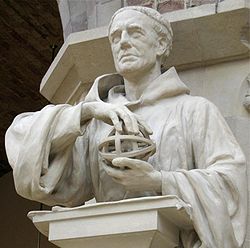
Statue of Roger Bacon at the Oxford University Museum of Natural History
William of Sherwood (c.1200– c.1272) was a medievalEnglishscholastic philosopher, logician, and teacher. Little is known of his life, but he is thought to have studied in Paris and he was a master at Oxford in 1252. He was the author of two books which were an important influence on the development of scholastic logic: Introductiones in Logicam (Introduction to Logic), and Syncategoremata. These are the first known works to deal in a systematic way with what is now called supposition theory, and were influential on the development of logic in both England and on the continent.[a]
Nicknamed Doctor Subtilis (the subtle doctor), he is well known for the "univocity of being," the formal distinction, and the idea of haecceity. The univocity of being holds that existence is the most abstract concept we have and is applicable to everything that exists. The formal distinction is a way of distinguishing between different aspects of the same thing such that the distinction is intermediate between what is merely conceptual, and what is fully real or mind-independent. Haecceity (from the Latinhaecceitas) is the idea of "thisness," a concept which denotes the discrete qualities, properties or characteristics of a thing which make it a particular thing.
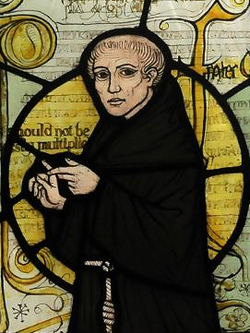
He is perhaps most well known for his principle of parsimony, famously known as Occam's razor. This actual term is claimed not to appear in his writings,[17] but rather summarizes the principle he expressed in passages such as Numquam ponenda est pluralitas sine necessitate [Plurality must never be posited without necessity][18][19] and Frustra fit per plura quod potest fieri per pauciora (It is futile to do with more things that which can be done with fewer).[20] Generally it refers to distinguishing between two hypotheses either by "shaving away" unnecessary assumptions or cutting apart two similar conclusions.
The words often attributed to Occam: entia non sunt multiplicanda praeter necessitatem ("entities must not be multiplied beyond necessity") are absent in his extant works;[21] This particular phrasing comes from John Punch who used it in describing a "common axiom" (axioma vulgare) of the Scholastics.[22]
John Wycliffe (1328 – 1384) was one of the last scholastics, and an important predecessor of Protestantism.[23] He was influenced by Richard FitzRalph.
Francis Bacon (1561–1626) was an Englishman who was a statesman, scientist, lawyer, jurist and author in addition to being a philosopher. He famously died of pneumonia contracted while studying the effects of freezing on the preservation of meat. He served both as Attorney General and Lord Chancellor of England. Although his political career ended in disgrace, he remained extremely influential through his works, especially as philosophical advocate and practitioner of the scientific method and pioneer in the Scientific Revolution.
Bacon has been called the father of empiricism.[26] His works established and popularized deductive methodologies for scientific inquiry, often called the Baconian method or simply, the scientific method. His demand for a planned procedure of investigating all things natural marked a new turn in the rhetorical and theoretical framework for science, much of which still surrounds conceptions of proper methodology today. His dedication probably led to his death, so bringing him into a rare historical group of scientists who were killed by their own experiments.
Bacon had a major influence on scientist Robert Boyle.
Thomas Hobbes
Thomas Hobbes (1588–1679) was an English philosopher, remembered today for his work on political philosophy. His 1651 book Leviathan established the foundation for most of Western political philosophy from the perspective of social contract theory.[27]
Hobbes was a champion of absolutism for the sovereign but he also developed some of the fundamentals of European liberal thought: the right of the individual; the natural equality of all men; the artificial character of the political order (which led to the later distinction between civil society and the state); the view that all legitimate political power must be "representative" and based on the consent of the people; and a liberal interpretation of law which leaves people free to do whatever the law does not explicitly forbid.[28]
Hobbes also contributed to a diverse array of fields, including history, geometry, physics of gases, theology, ethics, general philosophy, and political science. His account of human nature as self-interested cooperation has proved to be an enduring theory in the field of philosophical anthropology. He was one of the key founders of philosophical materialism.
The three 'classic' British empiricists in the early modern era were John Locke, George Berkeley, and David Hume. The term "British empiricism" refers to the philosophical tradition in Britain that was epitomised by these thinkers (though this tradition did have precursors in Britain stretching back to Roger Bacon). Berkeley, despite being Irish, was referred to as British as County Kilkenny, where he lived in Ireland, was a part of the United Kingdom of Great Britain and Ireland at the time.
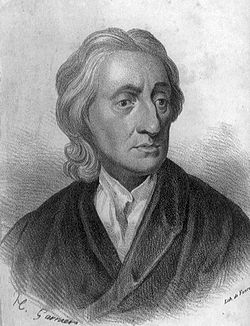
John Locke (1632–1704) was an empiricist at the beginning of the modern period of philosophy. Locke held that all of the objects of the understanding are ideas, where ideas exist in the mind. One of his goals in his work An Essay Concerning Human Understanding is to trace the origin of ideas. There are no innate ideas “stamped upon the mind” from birth, and all knowledge is rooted in experience. Further, there are also simple ideas and complex ideas. Simple ideas enter by the senses, and they are simple and unmixed. Complex ideas are simple ideas that have been combined and related together using the abstracting activity of the mind.
John Locke embodied the idea of religious tolerance and said "no mans knowledge can exceed his experience" based on his background in epistemology.
Locke is also responsible for an early theory of personal identity. He thought that our being the same person from one time to another consists, not in our having the same soul or the same body, but rather the same series of psychological connections. For Locke, to be a person is to be an intelligent thinking being that can know itself as itself, the same thinking thing in different times and places.
Locke's patron's grandson was moral philosopher. Lord Shaftesbury.
George Berkeley (1685–1753) was an Irish philosopher who served as Bishop of Cloyne from 1734 until his death. He was a British empiricist,[30] an immaterialist, and an idealist. Many of his most important ideas were first put forth in A Treatise Concerning the Principles of Human Knowledge, a work which was critical of John Locke's philosophy. Berkeley agreed with Locke that there was an outside world which caused the ideas within the mind, but Berkeley sought to prove that the outside world was also composed solely of ideas. Berkeley thought that the ideas that we possessed could only resemble other ideas (not physical objects) and thus the external world consisted not of physical form, but rather of ideas. This world was given logic and regularity by some other force, which Berkeley concluded was God.
Berkeley is famous for his motto "esse est percipi aut percipere", or otherwise, "to exist is to be perceived, or to perceive". This means that there are no things other than ideas and the minds that house them. There is no such thing as a mind-independent entity.
After Berkeley, metaphysics was temporarily abandoned in Britain, with the exception of James Burnett.
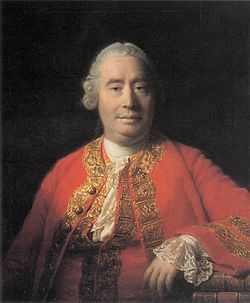
Hume famously described the problem of induction. He argues that inductive reasoning cannot be rationally employed, since, in order to justify induction, one would either have to provide a sound deductive argument or an inductively strong argument. But there is no sound deductive argument for induction, and to ask for an inductive argument to justify induction would be to beg the question.
Hume's problem of causation is related to his problem of induction. He held that there is no empirical access to the supposed necessary connection between cause and effect. In seeking to justify the belief that A causes B, one would point out that, in the past, B has always closely followed A in both space and time. But the special necessary connection that is supposed to be causation is never given to us in experience. We only observe a constant conjunction of events, with no necessity whatsoever.
In personal identity, Hume was a bundle theorist. He said that there is no robust self to which properties adhere. Experience only shows us that there is only a bundle of perceptions.
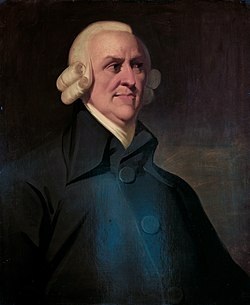
Smith studied moral philosophy at the University of Glasgow and the University of Oxford. After graduating, he delivered a successful series of public lectures at Edinburgh, leading him to collaborate with David Hume. Smith obtained a professorship at Glasgow teaching moral philosophy, and during this time he wrote and published The Theory of Moral Sentiments.
Jeremy Bentham (1748–1832) is well known for beginning the tradition of classical utilitarianism in Britain. Classical utilitarianism is said to be hedonistic because it regards pleasure as the only intrinsic good and pain as the only intrinsic evil.[32]
Utilitarianism was described by Bentham as "the greatest happiness or greatest felicity principle".[33] Bentham's utilitarianism is known for arguing that the felicific calculus should be used to determine the rightness and wrongness of acts. It does this by measuring the amount of pain and pleasure for various acts. Bentham thought that pleasure and pain could be broken down into distinct units called hedons and dolors.
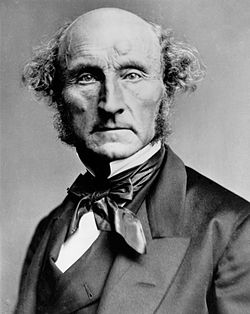
Mill also continued Bentham's tradition of advancing and defending utilitarianism. Mill's book Utilitarianism is a philosophical defense of utilitarianism. The essay first appeared as a series of three articles published in Fraser's Magazine in 1861; the articles were collected and reprinted as a single book in 1863.
Analytic philosophy sought to accommodate the new developments in logic pioneered by German mathematician Gottlob Frege. It has dominated philosophy in the English-speaking world since the early 20th century.
G. E. Moore
George Edward Moore (1873–1958) was one of the founders of the analytic tradition. He led the British 'revolt against idealism' at the turn of the twentieth century, along with Bertrand Russell, who stated that it was in fact Moore who "led the way".[37]
Moore is best known today for his defence of ethical non-naturalism, his emphasis on common sense in philosophical method, and the paradox that bears his name. He was admired by and influential among other academic philosophers, and also by the Bloomsbury Group. He was president of the Aristotelian Society from 1918 to 1919.[38] Moore is known for his clear, circumspect writing style, and for his methodical and patient approach to philosophical problems. He was critical of philosophy for its lack of progress, which he believed was in stark contrast to the dramatic advances in the natural sciences since the Renaissance. Among his most famous works are his book Principia Ethica, and his essays, "The Refutation of Idealism", "A Defence of Common Sense", and "A Proof of the External World".
Ordinary language philosophy is a philosophical school that approaches traditional philosophical problems as rooted in misunderstandings that philosophers develop by forgetting what words mean in their everyday use. It was a major philosophic school between 1930 and 1970.
This approach typically involves eschewing philosophical theories in favour of close attention to the detail of everyday language. Sometimes also called "Oxford philosophy", it is generally associated with the work of a number of mid-century Oxford professors: mainly J. L. Austin, but also Gilbert Ryle, H. L. A. Hart, and P. F. Strawson.
↑According to Roger Bacon, Sherwood was among "the more famous wise men of Christendom", of whom he names another as Albertus Magnus. Bacon judged Sherwood to be "much wiser than Albert".[10]
↑Liebeschuetz, Hans (1950). Medieval Humanism in the life and writings of John of Salisbury. London: The Warburg Institute, University of London. p.1.
↑Crombie, A. C. Robert Grosseteste and the Origins of Experimental Science. Oxford: Clarendon Press, 1971
↑Cullen, Christopher M. “Alexander of Hales,” in Companion to Philosophy in the Middle Ages, edited by Jorge J.E. Gracia and Timothy B. Noone. Oxford: Blackwell, 2006, 104–109.
↑Bacon, Roger (1859). "Preface". In Brewer, J.S. (ed.). Fr. Rogeri Bacon opera quædam hactenus inedita. Vol.I. Translated by Kretzmann, Norman.
↑AN INTRODUCTION TO THE PRINCIPLES OF MORALS AND LEGISLATION, Jeremy Bentham, 1789 (“printed” in 1780, “first published” in 1789, "corrected by the Author" in 1823.) See Chapter I: Of the Principle of Utility. For Bentham on animals, see Ch. XVII Note 122.
↑"John Stuart Mill's On Liberty". victorianweb. Retrieved 2009-07-23. On Liberty is a rational justification of the freedom of the individual in opposition to the claims of the state to impose unlimited control and is thus a defence of the rights of the individual against the state.
↑Ludlow, Peter, "Descriptions", The Stanford Encyclopedia of Philosophy (Fall 2008 Edition), Edward N. Zalta (ed.), URL = .
↑Richard Rempel (1979). "From Imperialism to Free Trade: Couturat, Halevy and Russell's First Crusade". Journal of the History of Ideas. 40 (3). University of Pennsylvania Press: 423–443. doi:10.2307/2709246. JSTOR2709246.
↑Bertrand Russell (1988) [1917]. Political Ideals. Routledge. ISBN0-415-10907-8.
This page is based on this Wikipedia article Text is available under the CC BY-SA 4.0 license; additional terms may apply. Images, videos and audio are available under their respective licenses.