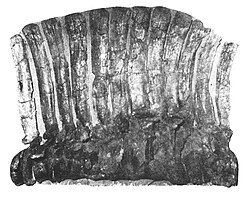
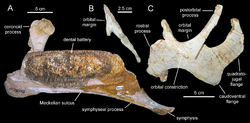
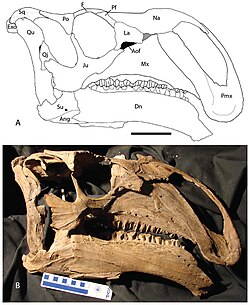
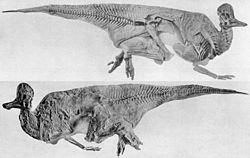
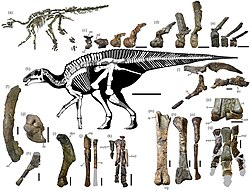
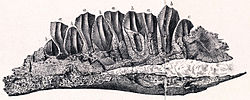
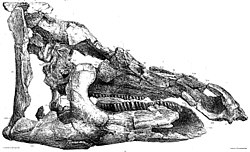
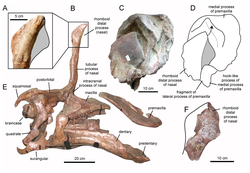
This list of specimens is a comprehensive catalogue of all the type specimens and their scientific designations for each of the genera and species that are included in the clade ornithopoda.
An early depiction of Iguanodon from the late 19th century
Ornithopoda is a clade of ornithischiandinosaurs that includes some of the most common and widespread Mesozoic animals including iguanodonts, hadrosaurs, and some animals formerly called "hypsilophodonts". The clade was named by Othniel Charles Marsh in 1881[1] and roughly means "bird feet". This name is reflective of the tridactyl feet of most ornithopods, which are superficially similar to many birds. Ornithopods were among the first dinosaurs known to scientists. The first species to be described was Iguanodon, which was described in 1825 by Sir Richard Owen.[2] Today, they collectively comprise the most diverse ornithischian group.[3][4]
The exact origin of ornithopods is uncertain. Some authors consider very primitive ornithischians like Nanosaurus, Hypsilophodon, and Jeholosaurus to be ornithopods,[5] while others do not.[6] Most ornithischians were ancestrally small and bipedal, which makes the taxonomy of these species complex and uncertain.[7][8] However, they are generally agreed to have originated by the middle Jurassic and shortly thereafter, they proliferated to most of the world's continents.[9] Ornithischians in general, but especially ornithopods, saw a large degree of diversification during the early Cretaceous.[10] This culminated in the proliferation of the giant hadrosaurs across the Northern Hemisphere and even into Africa[11] and South America.[12] Ornithopod remains are known from all of the world's continents, including Antarctica.[13]
Scope and Terminology
This list will include the typefossils of each ornithopod species. In paleontology, a type specimen is one which is definitionally a member of a biological taxon. Additional specimens can only be "referred" to these taxa if an expert deems them sufficiently similar to the type and publishes that opinion in the scientific literature.
There is no complete, canonical list of all dinosaur taxa or holotype specimens. Attempts are regularly published in the form of books, such as the Princeton Field Guide to Dinosaurs by Gregory Paul[3] and Dinosaurs: The Most Complete, Up-to-Date Encyclopedia for Dinosaur Lovers of All Ages by Thomas Holtz and Luis Rey.[4] Where appropriate, The Paleobiology Database and Fossilworks, which are both online databases of named fossil taxa, are used to supplement the entries from published encyclopedias which are missing or data-deficient.
This list will also be updated regularly as new scientific descriptions are published and new taxa are named. The most recently named ornithopod is Minqaria bata, which was described in February 2024 by Nicholas R. Longrich, Xabier Pereda-Suberbiola, Nathalie Bardet, and Nour-Eddine Jalil.[14]
Type System
Types are also used to diagnose higher-level taxa than an individual. One individual might represent the "type specimen" of a particular species. This species would in turn represent the "type species" of a particular genus, unless it is referred to a previously described genus. Most dinosaur genera are monospecific, therefore most type specimens are also the type species of their respective genera. On this list, the type species of a genus is only noted when it belongs to a genus with multiple referred species, such as Dryosaurus or Parasaurolophus. Furthermore, when an animal is different enough from its close relatives that it is given its own family, it is conventional in dinosaur systematics to name a family after the first described, most famous, or most abundant genus assigned to it. Therefore, on this list, the type species of any type genus for a family or sub-family level taxon is also noted when appropriate.
There are several different varieties of type specimen when referring to fossil animals:[15]
Holotype: This is the most common and simplest form of type specimen. A holotype is the first material of a fossil taxon that is described in the scientific literature. In order to qualify as a true holotype, all of the fossils of the type must belong to the same individual animal. All type specimens on this list are holotypes, unless otherwise indicated.
Paratype(s): These are described in the same publication as the holotype. A paratype is designated when the fossil material is diagnostic enough to belong to the same species as the holotype, but it is not from the same individual animal. In these cases, the holotype and paratype(s) are collectively called the "type series" for that taxon. On this list, paratypes are noted in the same entry as their associated holotype.
Neotype: When a holotype specimen is lost, destroyed, or otherwise unable to be studied further by scientists, a new type specimen for that taxon is required in order to identify future material. On this list, neotypes are only given their own entries when the holotype was never formally given a specimen number, otherwise they are noted in the entry for the holotype.
Syntype(s): This is a type series in which no single specimen is selected to serve as a holotype, nor are any designated as paratypes. This is typically done if the fossil material is believed to be from multiple animals, but none of the individual animals were well-preserved enough to provide a complete list of diagnostic characters. These are also sometimes called "cotypes" in publications, although this is discouraged by the ICZN.
Lectotype: When a single type specimen from a series of syntypes is designated as the new primary type specimen in a subsequent publication, this is considered to be a lectotype. On this list, lectotypes are given their own entries.
Paralectotype(s): When a lectotype is designated from a series of syntypes, the remaining syntypes become paralectotypes as part of a reorganized type series. On this list, paralectotypes are noted alongside the list entry for the lectotype of their respective series.
Plastotype: Sometimes, if a cast of a type specimen is made and the original type specimen is lost or destroyed, the cast can be used for the purposes of diagnostic referral to a taxon. Plastotypes are only given their own entries on this list if the holotype was not given a specimen number. Otherwise, they are noted alongside the entry for the holotype.
Topotype: When a specimen is discovered from the same locality as a holotype specimen it may be given a new specimen number. If the second specimen is later determined to belong to the same animal as the holotype after the holotype has been described, it becomes a topotype.
All name-bearing type specimens (i.e. holotypes, lectotypes, neotypes, and syntypes) have unique entries on this list, and non-name-bearing types (i.e. paratypes, paralectotypes, topotypes, and holotypes that have been subsumed by a neotype) are noted alongside their name-bearing counterpart.
Validity
Some described species are later determined to be invalid by subsequent scientific publications. However, invalid species are sometimes resurrected, such as in the case of Brontosaurus,[16] and sometimes the validity of a species can be controversial among researchers (e.g. the case of Torosaurus and Triceratops[17][18]). For the purposes of neutrality and completeness, all described species and genera of marginocephalians are included, even those that have been considered invalid in subsequent scientific publications.
Junior synonym: A name which describes the same taxon as a previously published name. If two or more taxa are formally designated and the type specimens are later assigned to the same taxon, the first to be published (in chronological order) is the senior synonym, and all other instances are junior synonyms. Senior synonyms are generally used, except by special decision of the ICZN, but junior synonyms cannot be used again, even if deprecated. Junior synonymy is often subjective, unless the genera described were both based on the same type specimen.
Nomen dubium (Latin for "dubious name"): A name describing a fossil with no unique diagnostic features. T his can be an extremely controversial designation, and as such, they are only notated when their supposedly dubious status has been formally published. Furthermore, if the scientific community has yet to reach a consensus on the validity of a name or taxon, the ongoing nature of the controversy will be stated.
Nomen nudum (Latin for "naked name"): A name that has appeared in print but has not yet been formally published by the standards of the ICZN. Nomina nuda (the plural form) are invalid, and are not included on this list.
Preoccupied name: A name that is formally published, but which has already been used for another taxon. This second use is invalid (as are all subsequent uses) and the name must be replaced.
Omissions
Some ornithopod taxa are not included on this list. Nomina nuda are not included because a type does not become recognized by the ICZN until it is published in a scientific journal with a full description.
Some misidentified taxa are also not included so long as there is a scientific consensus with regard to the specimen in question. If a specimen is later referred to a taxon outside ornithopoda, it is not included on this list. However, specimens that are identified as ornithopods in publications subsequent to their initial description are included under the name they are given within ornithopoda.
Referred taxa are only included on the list as separate entries when their initial description includes a unique type specimen.
In the case of specimens with uncertain taxonomic affinity, they will be excluded unless they are considered ornithopods by the most recently published nomenclatural study of ornithischian dinosaurs, published in 2021.[8] This excludes animals like Jeholosaurus and Thescelosaurus, which are considered basal neornithischians by the authors. This is the same definition used on the article "Ornithopoda".
List of Specimens
Binomial name: All animals species are given a unique binomial name, typically consisting of Latin or Greek words which are used to formally and scientifically identify each species.
Catalogue number: In most museum collections, each fossil specimen will be given a unique catalogue number which is published with the description of the fossils after they are prepared. This serves as a formal name for every single described fossil so that authors are able to refer to individual fossil discoveries in the scientific literature by name.
Institution: Most published fossils are stored in museum collections or at universities. This is also true of type specimens, many of which are on display in museums around the world. If a type specimen has been lost, the last known location of the type is listed.
Age: The geological stage from which the specimen was recovered is listed, when it is known. The exact age of some geological formations is not known. If this is the case, a range of possible ages is given.
Unit: Most fossils are recovered from named geologic formations (e.g. the Morrison Formation or the Hell Creek Formation). When this is not the case, a city or landmark near the locality from which the fossil was recovered is listed.
Material: The vast majority of fossils do not preserve the complete skeleton of an animal. In these cases, the specific bones which are fossilized have been listed.
Notes: Other general information, such as the validity status of the taxon in question, or any other material in the type series may be listed here.
Fossil Research and Development Center, Third Geology and Mineral Resources Exploration Academy of the Gansu Provincial Bureau of Geo-Exploration and Mineral Development
1 2 Hotlz, Dr. Thomas R. (2007). Dinosaurs: The Most Complete, Up-to-Date Encyclopedia for Dinosaur Lovers of All Ages. Rey, Luis V. Random House Books for Young Readers. ISBN978-0-375-82419-7.
↑ Ibiricu, Lucio M.; Martínez, Rubén D.; Lamanna, Matthew C.; Casal, Gabriel A.; Luna, Marcelo; Harris, Jerald D.; Lacovara, Kenneth J. (2010). "A Medium-Sized Ornithopod (Dinosauria: Ornithischia) from the Upper Cretaceous Bajo Barreal Formation of Lago Colhué Huapi, Southern Chubut Province, Argentina". Annals of Carnegie Museum. 79: 39–50. doi:10.2992/007.079.0103. S2CID53407321.
1 2 3 4 Gates, Terry A., Zubair Jinnah, Carolyn Levitt, Michael A. Getty, D. A. Eberth, and D. C. Evans. "New hadrosaurid (Dinosauria, Ornithopoda) specimens from the lower-middle Campanian Wahweap Formation of southern Utah." Hadrosaurs (2014): 156-173.
1 2 3 4 Norman, David B. (1998). "On Asian ornithopods (Dinosauria: Ornithischia). 3. A new species of iguanodontid dinosaur". Zoological Journal of the Linnean Society. 122 (1–2): 291–348. doi:10.1111/j.1096-3642.1998.tb02533.x. ISSN0024-4082.
1 2 3 4 Godefroit, Pascal, Yuri L. Bolotsky, and Jimmy Van Itterbeeck. "The lambeosaurine dinosaur Amurosaurus riabinini, from the Maastrichtian of Far Eastern Russia." Acta Palaeontologica Polonica 49, no. 4 (2004).
1 2 3 4 Hunt, Adrian P.; Lucas, Spencer G. (1993). "Cretaceous vertebrates of New Mexico". In Lucas, S.G.; Zidek, J. (eds.). Dinosaurs of New Mexico. New Mexico Museum of Natural History and Science Bulletin, 2. Albuquerque, New Mexico: New Mexico Museum of Natural History and Science. pp. 77–91.
1 2 3 4 Wagner, Jonathan R.; Lehman, Thomas M. (2009-06-12). "An enigmatic new lambeosaurine hadrosaur (Reptilia: Dinosauria) from the Upper Shale member of the Campanian Aguja Formation of Trans-Pecos Texas". Journal of Vertebrate Paleontology. 29 (2): 605–611. Bibcode:2009JVPal..29..605W. doi:10.1671/039.029.0208. ISSN0272-4634. S2CID128555861.
1 2 3 4 Prieto-Márquez, Albert; Wagner, Jonathan R.; Lehman, Thomas (2020-03-18). "An unusual 'shovel-billed' dinosaur with trophic specializations from the early Campanian of Trans-Pecos Texas, and the ancestral hadrosaurian crest". Journal of Systematic Palaeontology. 18 (6): 461–498. doi:10.1080/14772019.2019.1625078. ISSN1477-2019. S2CID202018197.
1 2 3 4 Godefroit, Pascal, Vladimir Alifanov, and Yuri Bolotsky. "A re-appraisal of Aralosaurus tuberiferus (Dinosauria, Hadrosauridae) from the Late Cretaceous of Kazakhstan." Bulletin de l'Institut royal des Sciences naturelles de Belgique, Sciences de la Terre74 (2004): 139-154.
1 2 3 4 Godefroit, Pascal, François Escuillié, Yuri L. Bolotsky, and Pascaline Lauters. "A new basal hadrosauroid dinosaur from the Upper Cretaceous of Kazakhstan." Bernissart dinosaurs and Early Cretaceous terrestrial ecosystems (2012): 335-358.
1 2 Wenhao, Wu, and Pascal Godefroit. "Anatomy and relationships of Bolong yixianensis, an Early Cretaceous iguanodontid dinosaur from western Liaoning, China." Bernissart dinosaurs and Early Cretaceous terrestrial ecosystems 293 (2012): 293-333.
1 2 3 4 Ruiz-Omeñaca, José Ignacio; Suberbiola, Xabier Pereda; Galton, Peter M., "Callovosaurus leedsi, the Earliest Dryosaurid Dinosaur (Ornithischia: Euornithopoda) from the Middle Jurassic of England", Horns and Beaks, Indiana University Press, pp.3–16, doi:10.2307/j.ctt1zxz1md.6
1 2 Galton, Peter M., "Teeth of Ornithischian Dinosaurs (Mostly Ornithopoda) from the Morrison Formation (Upper Jurassic) of the Western United States", Horns and Beaks, Indiana University Press, pp.17–48, doi:10.2307/j.ctt1zxz1md.7
1 2 3 4 Gilpin, David; DiCroce, Tony; Carpenter, Kenneth, "A Possible New Basal Hadrosaur from the Lower Cretaceous Cedar Mountain Formation of Eastern Utah", Horns and Beaks, Indiana University Press, pp.79–90, doi:10.2307/j.ctt1zxz1md.10
1 2 3 4 Brown, Barnum (1914). Corythosaurus casuarius, a new crested dinosaur from the Belly River Cretaceous: with Provisional classification of the family Trachodontidae. [Published by order of the Trustees, American Museum of Natural History]. OCLC31841239.
1 2 Martill, David M., Darren Naish, and S. Earland. "Dinosaurs in marine strata: evidence from the British Jurassic, including a review of the allochthonous vertebrate assemblage from the marine Kimmeridge Clay Formation (Upper Jurassic) of Great Britain." Actas de las III Jornadas Intrernacionales sobre Paleontologýá de Dinosaurios y su Entorno, 16–17 September 2004 (2006): 47-84.
1 2 3 4 5 6 7 8 9 10 11 12 13 14 Norman, David B. "On the taxonomy and diversity of Wealden iguanodontian dinosaurs (Ornithischia: Ornithopoda)." Revue de Paléobiologie 32, no. 2 (2013): 385-404.
1 2 3 4 Xu, S. C., H. L. You, J. W. Wang, S. Z. Wang, J. Yi, and L. Jia. "A new hadrosauroid dinosaur from the Late Cretaceous of Tianzhen, Shanxi Province, China." Vertebrata PalAsiatica 54, no. 1 (2016): 67-78.
1 2 3 Coombs Jr, Walter P. "The status of the dinosaurian genus Diclonius and the taxonomic utility of hadrosaurian teeth." Journal of Paleontology (1988): 812-817.
↑ Cope, Edward D. "Descriptions of some vertebrate remains from the Fort Union beds of Montana." Proceedings of the Academy of Natural Sciences of Philadelphia (1876): 248-261.
1 2 3 4 Galton, Peter M. (1981). "Dryosaurus, a hypsilophodontid dinosaur from the upper jurassic of north America and Africa postcranial skeleton". Paläontologische Zeitschrift. 55 (3–4): 271–312. doi:10.1007/bf02988144. ISSN0031-0220. S2CID129591644.
1 2 3 Hubner, Tom R.; Rauhaut, Oliver W. M. (2010-08-16). "A juvenile skull of Dysalotosaurus lettowvorbecki (Ornithischia: Iguanodontia), and implications for cranial ontogeny, phylogeny, and taxonomy in ornithopod dinosaurs". Zoological Journal of the Linnean Society. 160 (2): 366–396. doi:10.1111/j.1096-3642.2010.00620.x. ISSN0024-4082. S2CID84109541.
1 2 3 Galton, Peter M. "The posture of hadrosaurian dinosaurs." Journal of Paleontology (1970): 464-473.
1 2 3 4 Kirkland, J. I. "A new hadrosaurid from the upper Cedar Mountain Formation (Albian-Cenomanian: Cretaceous) of eastern Utah–the oldest known hadrosaurid (lambeosaurine?)." New Mexico Museum of Natural History and Science Bulletin 14 (1998): 283-295.
1 2 3 4 Escaso, Fernando; Ortega, Francisco; Dantas, Pedro; Malafaia, Elisabete; Silva, Bruno; Gasulla, José M.; Mocho, Pedro; Narváez, Iván; Sanz, JosÉ L. (2014-07-29). "A new dryosaurid ornithopod (Dinosauria, Ornithischia) from the Late Jurassic of Portugal". Journal of Vertebrate Paleontology. 34 (5): 1102–1112. Bibcode:2014JVPal..34.1102E. doi:10.1080/02724634.2014.849715. ISSN0272-4634. S2CID86780835.
1 2 3 4 Bell, Phil R.; Brougham, Tom; Herne, Matthew C.; Frauenfelder, Timothy; Smith, Elizabeth T. (2019-01-02). "Fostoria dhimbangunmal, gen. et sp. nov., a new iguanodontian (Dinosauria, Ornithopoda) from the mid-Cretaceous of Lightning Ridge, New South Wales, Australia". Journal of Vertebrate Paleontology. 39 (1) e1564757. Bibcode:2019JVPal..39E4757B. doi:10.1080/02724634.2019.1564757. ISSN0272-4634. S2CID195424096.
1 2 3 4 5 Agnolin, Federico L.; Ezcurra, Martín D.; Pais, Diego F.; Salisbury, Steven W. (2010-05-24). "A reappraisal of the Cretaceous non-avian dinosaur faunas from Australia and New Zealand: evidence for their Gondwanan affinities". Journal of Systematic Palaeontology. 8 (2): 257–300. doi:10.1080/14772011003594870. ISSN1477-2019. S2CID130568551.
↑ Prieto-Márquez, Albert; Norell, Mark A. (2010). "Anatomy and Relationships ofGilmoreosaurus mongoliensis(Dinosauria: Hadrosauroidea) from the Late Cretaceous of Central Asia". American Museum Novitates (3694): 1–49. doi:10.1206/3694.2. ISSN0003-0082. S2CID56372891.
1 2 3 4 You, H. L., Da-Qing Li, and Peter Dodson. "Gongpoquansaurus mazongshanensis (Lü, 1997) comb. nov.(Ornithischia: Hadrosauroidea) from the Early Cretaceous of Gansu Province, northwestern China." In Hadrosaurs. Proceedings of the International Hadrosaur Symposium. Indiana University Press, Bloomington and Indianapolis, Indiana, pp. 73-76. 2014.
1 2 3 4 Prieto-Márquez, Albert (2012). "The skull and appendicular skeleton of Gryposaurus latidens, a saurolophine hadrosaurid (Dinosauria: Ornithopoda) from the early Campanian (Cretaceous) of Montana, USA". Canadian Journal of Earth Sciences. 49 (3): 510–532. Bibcode:2012CaJES..49..510P. doi:10.1139/e11-069. ISSN0008-4077.
1 2 3 4 Prieto-Márquez, Albert (2006). The dinosaur Hadrosaurus foulkii, from the Campanian of the East Coast of North America, with a reevaluation of the genus. OCLC999075348.
1 2 3 Brown, Barnum. "A new trachodont dinosaur, Hypacrosaurus, from the Edmonton Cretaceous of Alberta. Bulletin of the AMNH; v. 32, article 20." (1913).
↑ "Dec. 21st". Proceedings of the Academy of Natural Sciences of Philadelphia. 21: 191–192. 1869. ISSN0097-3157. JSTOR4060125.
1 2 3 4 Horner, John R. "Upper Cretaceous dinosaurs from the Bearpaw Shale (marine) of south-central Montana with a checklist of Upper Cretaceous dinosaur remains from marine sediments in North America." Journal of Paleontology (1979): 566-577.
1 2 3 4 McDonald, Andrew T.; Barrett, Paul M.; Chapman, Sandra D. (2010-08-17). "A new basal iguanodont (Dinosauria: Ornithischia) from the Wealden (Lower Cretaceous) of England". Zootaxa. 2569 (1): 1. doi:10.11646/zootaxa.2569.1.1. ISSN1175-5334.
1 2 3 4 You, Hai-Lu; Ji, Qiang; Li, Daqing (2005). "Lanzhousaurus magnidens gen. et sp. nov. from Gansu Province, China: The largest-toothed herbivorous dinosaur in the world". Geological Bulletin of China. 24 (9): 785–794.
1 2 3 4 Coria, Rodolfo A.; Riga, Bernardo González; Casadío, Silvio (2012). "Un Nuevo Hadrosáurido (Dinosauria, Ornithopoda) de la Formación Allen, Provincia de la Pampa, Argentina". Ameghiniana. 49 (4): 552–572. doi:10.5710/amgh.9.4.2012.487. ISSN0002-7014. S2CID131521822.
1 2 3 4 Calvo, Jorge O.; Porfiri, Juan D.; Novas, Fernando E. (2007). "Discovery of a new ornithopod dinosaur from the Portezuelo formation (Upper Cretaceous), Neuquen, Patagonia, Argentina". Arquivos do Museu Nacional, Rio de Janeiro. 65 (4): 471–483.
1 2 3 4 Prieto-Márquez A, Wagner JR (2022). "A new 'duck-billed' dinosaur (Ornithischia: Hadrosauridae) from the upper Campanian of Texas points to a greater diversity of early hadrosaurid offshoots". Cretaceous Research. 143. 105416. doi:10.1016/j.cretres.2022.105416. S2CID253470207.
1 2 Yang, Dashan, Zhengyi Wei, Weirong Li, and Translated By Will Downs. "Preliminary note on some hadrosaurs from the Cretaceous of Jiayin County, Heilongjiang Province (Manchuria)." (2002).
1 2 3 4 Dong, Z. M., Guangdong Province Nanxiong, and Translated By Will Downs. "Dinosaurs from the Cretaceous of south China." In Mesozoic and Cenozoic red beds of south China: selected papers from the Cretaceous–Tertiary Workshop, Nanxiong, Guangdong Province. Edited by Institute of Vertebrate Paleontology and Paleoanthropology. Science Press, Beijing, China, pp. 342-350. 1979.
1 2 3 4 Bartholomai, A. L. A. N., and R. E. Molnar. "Muttaburrasaurus, a new iguanodontid (Ornithischia: Ornithopoda) dinosaur from the Lower Cretaceous of Queensland." Memoirs of the Queensland Museum 20, no. 2 (1981): 319-49.
1 2 3 4 Prieto-Márquez, Albert (2013-05-08). "Skeletal morphology of Kritosaurus navajovius (Dinosauria: Hadrosauridae) from the Late Cretaceous of the North American south-west, with an evaluation of the phylogenetic systematics and biogeography of Kritosaurini". Journal of Systematic Palaeontology. 12 (2): 133–175. doi:10.1080/14772019.2013.770417. ISSN1477-2019. S2CID84942579.
1 2 3 4 Xing, X. U., Z. H. A. O. Xi-Jin, L. U. Jun-Chang, H. U. A. N. G. Wang-Bo, L. I. Zhan-yang, and D. O. N. G. Zhi-Ming. "A new iguanodontian from Sangping Formation of Neixiang, Henan and its stratigraphical implication." Vertebrata PalAsiatica 38, no. 03 (2000): 176.
1 2 3 4 Galton, P.M. Notes on Neocomian (Lower Cretaceous) ornithopod dinosaurs from England: Hypsilophodon, Valdosaurus, 'Camptosaurus', 'Iguanodon': and referred specimens from Romania and elsewhere. OCLC770349702.
1 2 3 Sullivan, Robert M. (1999). A new skull of Parasaurolophus (Dinosauria, Hadrosauridae) from the Kirtland Formation of New Mexico and a revision of the genus. New Mexico Museum of Natural History and Science. OCLC41244261.
1 2 3 4 DiCroce, T.; Carpenter, K. (2001). Tanke, D.; Carpenter, K. (eds.). "New ornithopod from the Cedar Mountain Formation (Lower Cretaceous) of Eastern Utah". Mesozoic Vertebrate Life. Bloomington: Indiana University Press: 183–196.
1 2 3 4 Tsogtbaatar, Khishigjav, David B. Weishampel, David C. Evans, and Mahito Watabe. "A new hadrosauroid (Plesiohadros djadokhtaensis) from the Late Cretaceous Djadokhtan Fauna of southern Mongolia." In Hadrosaurs, pp. 108-135. Indiana University Press, 2014.
1 2 3 4 5 Brett-Surman, Michael Keith. A revision of the Hadrosauridae (Reptilia: Ornithischia) and their evolution during the Campanian and Maastrichtian. The George Washington University, 1989.
1 2 3 4 Gates, Terry A.; Scheetz, Rodney (2015-08-03). "A new saurolophine hadrosaurid (Dinosauria: Ornithopoda) from the Campanian of Utah, North America". Journal of Systematic Palaeontology. 13 (8): 711–725. doi:10.1080/14772019.2014.950614. ISSN1477-2019. S2CID129231015.
1 2 3 4 Novas, Fernando E., Andrea V. Cambiaso, and Alfredo Ambrosio. "A new basal iguanodontian (Dinosauria, Ornithischia) from the Upper Cretaceous of Patagonia." Ameghiniana 41, no. 1 (2004): 75-82.
1 2 Zhang, J. L., Q. Wang, S. X. Jiang, X. Cheng, N. Li, R. Qiu, X. J. Zhang, and X. L. Wang. "Review of historical and current research on the Late Cretaceous dinosaurs and dinosaur eggs from Laiyang, Shandong." Vertebrata PalAsiatica 55, no. 2 (2017): 187-200.
1 2 3 Weishampel, David B., David B. Norman, and Dan Grigorescu. "Telmatosaurus transsylvanicus from the Late Cretaceous of Romania: the most basal hadrosaurid dinosaur." Palaeontology 36, no. 2 (1993): 361-385.
↑ Dalla Vecchia, Fabio M. "Telmatosaurus and the other hadrosauroids of the Cretaceous European Archipelago. An update." Natura Nascosta 39 (2009): 1-18.
1 2 3 4 Brill, Kathleen; Carpenter, Kenneth, "A Description of a New Ornithopod from the Lytle Member of the Purgatoire Formation (Lower Cretaceous) and a Reassessment of the Skull of Camptosaurus", Horns and Beaks, Indiana University Press, pp.49–68, doi:10.2307/j.ctt1zxz1md.8
1 2 3 4 5 6 7 Prieto-Márquez, Albert (2008). Phylogeny and historical biogeography of hadrosaurid dinosaurs. OCLC251464747.
1 2 3 4 5 6 7 Weishampel, David B.; Jianu, Coralia-Maria; Csiki, Zoltan; Norman, David B. (2003-01-01). "Osteology and phylogeny of Zalmoxes (n. g.), an unusual Euornithopod dinosaur from the latest Cretaceous of Romania". Journal of Systematic Palaeontology. 1 (2): 65–123. doi:10.1017/S1477201903001032. ISSN1477-2019. S2CID86339025.
1 2 3 4 Wang, Run-Fu; You, Hai-Lu; Wang, Suo-Zhu; Xu, Shi-Chao; Yi, Jian; Xie, Li-Juan; Jia, Lei; Xing, Hai (2017-01-02). "A second hadrosauroid dinosaur from the early Late Cretaceous of Zuoyun, Shanxi Province, China". Historical Biology. 29 (1): 17–24. doi:10.1080/08912963.2015.1118688. ISSN0891-2963. S2CID130536621.
This page is based on this Wikipedia article Text is available under the CC BY-SA 4.0 license; additional terms may apply. Images, videos and audio are available under their respective licenses.