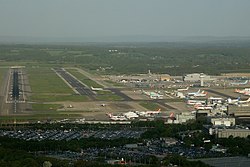
Its northernmost part amounts to a 2-mile (3.2km) spur north of junction 7 of the M25 motorway (junction 8 of the M23) which has spur roads for all directions (is a stack interchange) and intuitively would be numbered 1 – as a long, publicly opposed section further to the north was never built. During its 17 miles (27km) length it runs without a serving junction for central parts of Redhill, Surrey, as its next and busiest junction is for Gatwick Airport and it concludes with three, widely spaced out, for Crawley which also serve Horsham and East Grinstead. It cuts through the a gap in the North Downs and a slight gap in the Greensand Ridge, long mainly wooded hill ranges, locally part of the Surrey Hills National Landscape. For the airport to its west, junction 9, has no direct routes to the more rural east; however sweeping to the north-west point of the airport, the M23 Spur gives ready access to Horley, Charlwood and all the northernmost parts and associated out of town workplaces of Crawley.
To the south the A23 is a dualled trunk road so far as the city of Brighton, whereas to the north it sees long single-carriageway urban parts, in the centre of Hooley, north Coulsdon, south Purley, and no traffic-prioritised continuations to reach Inner London, which was the original scheme behind the motorway.
History
The motorway was constructed between 1972 and 1975, at the same time as the southern section of the M25 from Godstone to Reigate (M25 junctions 6 to 8).[1] The current northern terminus at junction 7 runs along most of what would have been its own sliproads for a broad northern continuation. In so doing, these splayed roads split to offer access to the more urban road which the M23 bypasses, the A23, and a flyover above the splayed fledgling motorway still exists for the onward northern continuation which remains unused, between these briefly, but widely, splayed carriageways of the motorway.[2]
Junction 9, looking north
The cancellation of the unbuilt northern section from the M25 in towards Central London has resulted in the A23 carrying the majority of traffic through South London to the motorway. This is largely a single carriageway route, with many level junctions, traffic lights and awkward interchanges. It travels largely through residential areas and means south London reliance on the A22 (hence the Caterham Bypass), running SSE, and A3/A3M running SW (southwest).
A new junction (J10a) was opened in 1997,[3] between J10 and J11, for access to the new Crawley neighbourhood of Maidenbower.[4] It was financed as part of the development of Maidenbower by the construction consortium. It has only a northbound slip road, no southbound access.
In an earlier version of the Ringways Plan it would have continued into central London where it would have met the Balham Loop spur from Ringway 1 (the London Motorway Box) at Tooting.[6] This was dropped in 1967 when the northern terminus was changed to Ringway 2. While a definite route had not been chosen at that time for the northern section, approval was met for the route south of the Greater London boundary at Hooley.[7]
By 1972 the southern section of Ringway 2 had been dropped from the plan,[8] with an alternative proposal that the M23 continue further into London to end on Ringway 1. This was immediately countered in the same year by the GLC, who announced they would not be building that Ringway,[7] which meant that had the M23 continued into inner London it would not have had the arteries required at its northern end to distribute traffic to the east and west. The plan was again scaled back to scrap any reaching to Mitcham Common but which would see an unsuitable terminus on Croydon Road (A232).[7] and Minister for Transport "postponed indefinitely" the plan. By the late 1970s, this proposed northern corridor earmarked for significant demolition saw urban blight,[9] and while the proposals were finally dropped in the mid-1980s, pockets of land that had been acquired were not released by the Department for Transport until the mid-1990s.
The unbuilt six-junctions motorway north of Hooley was due to the refusal of the GLC to finance the project, understanding the ultimately decisive, large-scale opposition to the construction of London Ringways, any network of high speed roads within London.[7] However, the scale of the four-tier junction between the M23 and the M25, one of only three stack interchanges in the UK at the time, is indicative of the importance attached to the M23 at that time.
The motorway and its road continuations mirror its secondary importance to London in the original system of road numbering zones 1 to 4; the A23/M23 running due south from London, is as the original axes suggest, less arterial for London traffic than Central London's eight main routes the M1/A41, the A1 (as far in as Finchley), M11/A205, A2/M2, A3 and M3/A316, M4 and A40/M40. To these can be added, much expanded, three roads running far into Essex which are at least doubled, just as they are deep into London.
Between July 2018 and July 2020 works took place to upgrade the M23 between junctions 8 and 10 to an all-lane-running motorway. The upgrades took place mostly for more reliable journeys to Gatwick Airport and increase the overall capacity of the route. The upgrades include an all-lane-running motorway, 12 new emergency areas, a new concrete central barrier replacing the current steel one, new roadside sound barriers, variable speed limits and two new emergency access slip roads. Changes were also implemented on the M23 junction 9 spurs: the hard shoulder westbound now a running lane; and for 50mph (80km/h) speed limits in both directions.[10]
In January 2020 all smart motorway projects were put under review due to concerns about their safety, during this period no new smart motorways could open. The review was published on 12 March 2020 and required no immediate amendments to the design or construction, however new technology to detect static vehicles is required to be fitted within three years, and a review on spacing of emergency refuge areas was to be carried out.[11]
The fourth lanes were opened to traffic on 2 April 2020 with a temporary 50mph speed limit. Works ran into the late summer to install more equipment, followed by testing and commissioning, before the project could complete and run at the national speed limit.[12]
Junctions
Data from driver location signs are used to provide distance and carriageway identifier information.[13] Where a junction spans several hundred metres (yards) and start and end points are available, both are cited.[14]
This page is based on this Wikipedia article Text is available under the CC BY-SA 4.0 license; additional terms may apply. Images, videos and audio are available under their respective licenses.

 M23 highlighted in blue