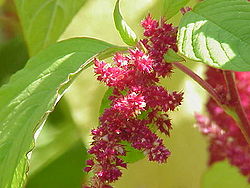
Amaranthus is a genus of plants commonly known as amaranths. Some species are known by variants of the common name "pigweed".[1] Some members are annual and others are perennial. The plant can grow from 1 to 2.5 metres (3 to 8 feet) tall with a succulent, hollow stem. Parts of the plant vary from green to reddish. Catkin-like cymes of densely packed flowers grow in the summer or fall.
Amaranth is a herbaceous plant or shrub that is either annual or perennial across the genus.[2] The plant has a primary root with deeper spreading secondary fibrous root structures.[3] Amaranths contain concentric rings of vascular bundles and fix carbon efficiently with a C4 photosynthetic pathway.[2] Amaranth can grow from 1 to 2.5 metres (3 to 8 feet) tall with a cylindrical, succulent, fibrous stem that is hollow with grooves and bracteoles when mature varies in flower, leaf, and stem color with a range of striking pigments from the spectrum of maroon to crimson.[2] The leaves are approximately 6.5–15 centimetres (2+1⁄2–6 inches) and of oval or elliptical shape that are either opposite or alternate across species, although most are whole and simple with entire margins.[2]
Catkin-like cymes of densely packed flowers grow in the summer or fall.[4] The inflorescences are in the form a large panicle that varies from terminal to axial, color, and sex. The tassel of fluorescence is either erect or bent and varies in width and length between species. The flowers are radially symmetric and either bisexual or unisexual with very small, bristly perianth and pointy bracts.[3] The flowers vary interspecifically from the presence of 3 or 5 tepals and stamens, whereas a 7-porate pollen grain structure remains consistent across the family.[2]
Species in this genus are either monoecious (e.g. A.hybridus,) or dioecious (e.g. A.palmeri).[3] The fruits are in the form of capsules referred to as a unilocular pixdio that opens at maturity.[3] The top (operculum) of the capsule releases the urn that contains the seed.[3] The seeds are circular, 1 to 1.5 millimeters in diameter and range in color with a shiny, smooth seed coat.[3] The panicle is harvested 200 days after cultivation with approximately 1,000 to 3,000 seeds harvested per gram.[5]
Taxonomy
Amaranthus shows a wide variety of morphological diversity among and even within certain species. Amaranthus is part of the Amaranthaceae that is part of the larger grouping of the Carophyllales.[2] Although the family (Amaranthaceae) is distinctive, the genus has few distinguishing characters among the 75 species present across six continents.[6] This complicates taxonomy and Amaranthus has generally been considered among systematists as a "difficult" genus and to hybridize often.[7]
In 1955, Sauer classified the genus into two subgenera, differentiating only between monoecious and dioecious species: Acnida (L.) Aellen ex K.R. Robertson and Amaranthus.[7] Although this classification was widely accepted, further infrageneric classification was (and still is) needed to differentiate this widely diverse group. Mosyakin and Robertson 1996 later divided into three subgenera: Acnida, Amaranthus, and Albersia.[8] The support for the addition of the subdivision Albersia because of its indehiscent fruits coupled with three elliptic to linear tepals to be exclusive characters to members of this subgenus. The classification of these groups are further supported with a combination of floral characters, reproductive strategies, geographic distribution, and molecular evidence.[6][9][10]
The phylogenies of Amaranthus using maximum parsimony and Bayesian analysis of nuclear and chloroplast genes suggest five groups within the genus: Dioecious/Pumilus clade; Hybridus clade; Galapagos (three clades); Eurasian + South African + Australian (ESA) clade; ESA + South American clade (with South American samples forming an evolutionary grade).[9]
Amaranthus includes three recognised subgenera and 75 species, although species numbers are questionable due to hybridisation and species concepts.[2] Infrageneric classification focuses on inflorescence, flower characters and whether a species is monoecious/dioecious, as in the Sauer (1955) suggested classification.[6] Bracteole morphology present on the stem is used for taxonomic classification of Amaranth. Wild species have longer bracteoles compared to cultivated species.[7] A modified infrageneric classification of Amaranthus includes three subgenera: Acnida, Amaranthus, and Albersia, with the taxonomy further differentiated by sections within each of the subgenera.[11] According to one source, 10 species are dioecious and native to North America, while the rest are monoecious and cosmopolitan.[12]
There is near certainty that A. hypochondriacus is the common ancestor to the cultivated grain species, but their later domestication remains unclear. There has been opposing hypotheses of a single as opposed to multiple domestication events of the three grain species.[6][13] There is evidence of phylogenetic and geographical support for clear groupings that indicate separate domestication events in South America and Central America.[6]A.hybridus may derive from South America, whereas A.caudatus, A.hypochondriacus, and A.quentiensis are native to Central America and elsewhere in North America.[6][13]
The word amaranth derives from Ancient Greekἀμάραντος (amárantos), meaning 'unfading', a name used across cultures. Its development is associated with the Greek word for 'flower', ἄνθος (ánthos), giving rise to the idea of the 'unfading flower'. Amarant is an archaic variant of the name.
The botanical name Amaranthus likewise comes from the Ancient Greek ἀμάραντος. The noun is formed from the privative prefix ἀ- (a-), meaning 'without', and the verb μαραίνω (maraínō), meaning 'to consume' or 'to exhaust'. Classical references to the plant appear in the works of Dioscorides (Book 3, section 9; Book 4, sections 55 and 57).[18][19]
The name amaranth was first applied in Europe to the related genus Celosia. At the time, plants of the genus Amaranthus were not yet known in Europe. Amaranthus and Celosia share long-lasting dried flowers, which contributed to the transfer of the name.[20]
The Latin form amaranthus, which includes the letter h, arose from an erroneous association with the Greek word ἄνθος (anthos), meaning 'flower'. This element appears in the names of many plants, such as Agapanthus, and influenced later botanical spelling.
In the languages of Indigenous peoples who cultivated amaranth in the Americas since ancient times, the plant is known by a variety of names. In Nahuatl, it is called huauhtli.[21] In Quechua, it is known as kiwicha and ataĉo.[22] In Maya, it is called tez or xtes. Additional names include ahparie in the Purépecha language, wa've in Huichol, and guegui in the Tarahumara.[citation needed]
Distribution and habitat
The genus most likely originated in Central America.[6][13] The native range of the genus is cosmopolitan[5] in tropical regions. It is found in elevations ranging from lowlands to mountain ranges such as the Himalayas.[12]
A new herbicide-resistant strain of A.palmeri has appeared; it is glyphosate-resistant and so cannot be killed by herbicides using the chemical. Also, this plant can survive in tough conditions. A.palmeri (Palmer amaranth) causes the greatest reduction in soybean yields and has the potential to reduce yields by 17–68% in field experiments.[23] According to one source, A.palmeri is among the "top five most troublesome weeds" in the southeast of the U.S. and has already evolved resistances to dinitroaniline herbicides and acetolactate synthase inhibitors.[27] This makes the proper identification of Amaranthus species at the seedling stage essential for agriculturalists. Proper weed control needs to be applied before the species successfully colonizes in the crop field and causes significant yield reductions.
An evolutionary lineage of around 90 species within the genus has acquired the C4 carbon fixation pathway, which increases their photosynthetic efficiency. This probably occurred in the Miocene.[28][29]
Amaranths are recorded as food plants for some Lepidoptera (butterfly and moth) species including the nutmeg moth and various case-bearer moths of the genus Coleophora: C.amaranthella, C.enchorda (feeds exclusively on Amaranthus), C.immortalis (feeds exclusively on Amaranthus), C.lineapulvella, and C.versurella (recorded on A.spinosus).
Amaranth grain has been found in Antofagasta de la Sierra Department, Catamarca, in the southern Puna desert of northern Argentina dating from 4,500 years ago, with evidence suggesting earlier use.[3] Archeological digs unearthed A.cruentus seeds in a cave in Tehuacán, Mexico that dated to 6,000 years before present, while other digs in the same caves found A.hypochondriacus seeds dating to 1,500 years before present.[31]Ancient amaranth grains still used include A.caudatus, A.cruentus, and A.hypochondriacus.[32] Evidence from single-nucleotide polymorphisms and chromosome structure supports A.hypochondriacus as the common ancestor of the three grain species.[33]
In pre-Hispanic times, amaranth was cultivated by the Aztec and their tributary communities in a quantity very similar to maize.[34] Known to the Aztecs as huāuhtli,[35] amaranth is thought to have represented up to 80% of their energy consumption before the Spanish conquest.[citation needed]
Amaranth has been proposed as an inexpensive native crop that could be cultivated by indigenous people in rural areas for several reasons:
A small amount of seed plants a large area (seeding rate 1kg/ha).
Yields are high compared to the seeding rate: 1,000kg or more per hectare.
It is easily harvested and easily processed, post harvest, as there are no hulls to remove.
It has rich content of the dietary minerals, calcium, magnesium, phosphorus, and potassium.
In cooked and edible forms, amaranth retains adequate content of several dietary minerals.
It grows fast and, in three cultivated species, the large seedheads can weigh up to 1kg and contain a half-million small seeds.[5]
In the U.S., the amaranth crop is mostly used for seed production. Most amaranth in American food products starts as a ground flour, blended with wheat or other flours to create cereals, crackers, cookies, bread or other baked products.[37] Despite utilization studies showing that amaranth can be blended with other flours at levels above 50% without affecting functional properties or taste, most commercial products use amaranth only as a minor portion of their ingredients despite them being marketed as "amaranth" products.[37]
The stalks may have sharp spines that need to be removed before consumption.[40]
Uses
All parts of the plant are considered edible.[41] It is well established as a highly nutritious and stress-tolerant crop well-suited for climate change-related stress if cultivated with agrivoltaics.[42] Its high oxalic content may be partially offset by its yield of calcium.[43]
The genus also contains several well-known ornamental plants such as A.caudatus and A.hypochondriacus.
Uncooked amaranth grain by weight is 11% water, 65% carbohydrates (including 7% dietary fiber), 14% protein, and 7% fat. A 100-gram (3+1⁄2-ounce) reference serving of uncooked amaranth grain provides 1,550 kilojoules (371 kilocalories) of food energy, and is a rich source (20% or more of the Daily Value, DV) of protein, dietary fiber, pantothenic acid, vitamin B6, folate, and several dietary minerals. Uncooked amaranth is particularly rich in manganese (159% DV), phosphorus (80% DV), magnesium (70% DV), iron (59% DV), and selenium (34% DV). Amaranth has a high oxalate content. Cooking leads to an apparent substantial decrease in nutritional value, though this is mainly due to an increase in water content to 75% by weight.[46]
Raw and cooked amaranth leaves are a rich source of vitamin A, vitamin C, calcium, and manganese, with moderate levels of folate, iron, magnesium, and potassium.[47]
Interest in amaranth seeds (especially A.cruentus and A.hypochondriacus) revived in the 1970s during the health movement.[51] It was recovered in Mexico from wild varieties.[51]
Amaranth and its relative quinoa are considered pseudocereals because of their similarities to cereals in flavor and cooking.[citation needed] The grain can be ground into a flour for use like other grain flours.[37] It can be popped like popcorn or flaked like oatmeal.[52]
Four Amaranthus species are documented as cultivated vegetables in eastern Asia: A.cruentus, A.blitum, A.dubius, and A.tricolor.[54] In India, the greens can be prepared as curry, stir fry, saag, and thoran. In China, the leaves and stems are used as a stir-fry vegetable or in soups. In Vietnam, it is used to make soup, mostly popularly A.tricolor and A.viridis.[citation needed]
A traditional food plant in Africa, amaranth has the potential to improve nutrition, boost food security, foster rural development and support sustainable land care.[55][56][57]
The flowers of the 'Hopi Red Dye' amaranth were used by the Hopi (a tribe in the western U.S.) as the source of a deep red dye. A synthetic dye was named "amaranth" for its similarity in color to the natural amaranth pigments known as betalains. This synthetic dye is also known as Red No. 2 in North America and E123 in the European Union.[60]
In culture
Amaranth's cosmopolitan distribution has led some to cite it as supporting pre-Columbian contact between Old and New World human cultures.[61][62] The earliest archeological evidence for amaranth in the Old World is in Narhan, India, dated to 1000–800BCE.[63]
Skull shapes made of amaranth and honey for Day of the Dead in Mexico
In the 16th century, Dominican friar Diego Durán described the festivities for the Aztec god Huitzilopochtli. The Aztec month of Panquetzaliztli (7 December to 26 December) was dedicated to Huitzilopochtli. People decorated their homes and trees with paper flags; ritual races, processions, dances, songs, prayers, and finally human sacrifices were held. This was one of the more important Aztec festivals, and the people prepared for the whole month. They fasted or ate very little; a statue of the god was made out of amaranth seeds and honey, and at the end of the month, it was cut into small pieces so everybody could eat a piece of the god. After the Spanish conquest, cultivation of amaranth was outlawed, while some of the festivities were subsumed into the Christmas celebration.[citation needed] Another important use of amaranth throughout Mesoamerica was in ritual drinks and foods. To this day, amaranth grains are toasted much like popcorn and mixed with honey, molasses, or chocolate to make a treat called alegría, meaning "joy" in Spanish.[64]
Amaranth is associated with longevity and, poetically, with death and immortality.[65] The immortality symbolism is linked to the persistence of its calyx, which does not readily wither; for this reason, some species of amaranth are used in dry bouquets.[66] Amaranth garlands were used in the mourning of Achilles.[65][67]
John Milton's Paradise Lost portrays a showy amaranth in the Garden of Eden, "remov'd from Heav'n" when it blossoms because the flowers "shade the fountain of life".[68] He describes amaranth as "immortal" in reference to the flowers that generally do not wither and retain bright reddish tones of color, even when deceased.
1234567Schmid, Rudolf; Judd, Walter S.; Campbell, Christopher S.; etal. (1 October 2007). "Plant Systematics: A Phylogenetic Approach". Taxon. 56 (4): 1316. doi:10.2307/25065934. ISSN0040-0262. JSTOR25065934.
1234567Arreguez, Guillermo A.; Martínez, Jorge G.; Ponessa, Graciela (September 2013). "Amaranthus hybridus L. ssp. hybridus in an archaeological site from the initial mid-Holocene in the Southern Argentinian Puna". Quaternary International. 307: 81–85. Bibcode:2013QuInt.307...81A. doi:10.1016/j.quaint.2013.02.035. hdl:11336/21990.
↑Sergei L. Mosyakin; Kenneth R. Robertson (1996). "New infrageneric taxa and combinations in Amaranthus (Amaranthaceae)". Ann. Bot. Fennici. 33 (4): 275–281. JSTOR23726306.
↑Costea, Mihai; Tardif, François J. (2003). "The Name of the Amaranth: Histories of Meaning". SIDA, Contributions to Botany. 20 (3): 1073–1083. JSTOR41968150.
↑Karttunen, Frances (1992). An Analytical Dictionary of Nahuatl. University of Oklahoma Press. p.82.
↑Gen, Emmanuelle (1992). "La re-découverte des Amériques". Cahiers d'Outre-Mer (in French). 45 (179–180): 495–514. doi:10.3406/caoum.1992.3461.
↑Sage, R.F.; Sage, T.L.; Pearcy, R.W.; Borsch, T. (2007). "The taxonomic distribution of C4 photosynthesis in Amaranthaceae sensu stricto". American Journal of Botany. 94 (12): 1992–2003. doi:10.3732/ajb.94.12.1992. ISSN0002-9122. PMID21636394.
↑Costea, M.; Brenner, D. M.; Tardif, F. J.; Tan, Y. F.; Sun, M. (6 October 2006). "Delimitation of Amaranthus cruentus L. and Amaranthus caudatus L. using micromorphology and AFLP analysis: an application in germplasm identification". Genetic Resources and Crop Evolution. 53 (8): 1625–1633. doi:10.1007/s10722-005-0036-3. ISSN0925-9864.
↑Mapes, Cristina, Eduardo Espitia, and Scott Sessions. "Amaranth." In The Oxford Encyclopedia of Mesoamerican Cultures.: Oxford University Press, 2001. ISBN0195108159
↑United States Department of the Army (2009). The Complete Guide to Edible Wild Plants. New York: Skyhorse Publishing. p.19. ISBN978-1-60239-692-0. OCLC277203364.
↑Saraswat, K.S.; Sharma, N.K.; Saini, D.C. (1994). Plant Economy at Ancient Narhan (ca. 1300 B.C.-300/400 A.D.) in Excavations at Narhan (1984-1989), Appendix IV. Varanasi, Uttar Pradesh, India: Department of Ancient Indian History, Culture and Archaeology, Banaras Hindu University. pp.225–337.
↑Allen, D. C. (1957). "Milton's Amarant". Modern Language Notes. 72 (4): 256–258. doi:10.2307/3043098. ISSN0149-6611. JSTOR3043098. The amaranthus was known to antiquity as an unfading flower, and it was used as a garland in the veneration of the wraith of Achilles
↑Milton, John (2000). Paradise Lost. Penguin Books. OCLC647024119.
This page is based on this Wikipedia article Text is available under the CC BY-SA 4.0 license; additional terms may apply. Images, videos and audio are available under their respective licenses.