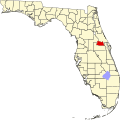
On July 21, 1821, two counties formed Florida: Escambia to the west and St. Johns to the east. In 1824, the area to the south of St. Johns County was designated Mosquito County, with its seat at Enterprise. The county's name was changed to Orange County in 1845 when Florida became a state, and over the next 70 years several other counties were created. Seminole County was one of the last to split.
Seminole County was created on April 25, 1913, out of the northern portion of Orange County by the Florida Legislature. It was named for the Seminole people who historically lived throughout the area. The name "Seminole" is thought to be derived from the Spanish word cimarron, meaning "wild" or "runaway".
Geography
According to the U.S. Census Bureau, the county has an area of 345 square miles (890km2), of which 309 square miles (800km2) is land and 36 square miles (93km2) (10.4%) is water.[5] It is Florida's fourth-smallest county by land area and third-smallest by total area.
Seminole County's location between Volusia County and Orange County has made it one of Florida's fastest-growing counties. The Greater Orlando Metropolitan District which includes Seminole, Osceola, and the surrounding counties of Lake and Orange counties, together with neighboring Volusia and Brevard counties create a viable, progressive, and diverse setting for economic growth and residential development.
U.S. Decennial Census[6] 1790-1960[7] 1900-1990[8] 1990-2000[9] 2010-2019[2] 2022[10]
2020 census
As of the 2020 census, the county had a population of 470,856. The median age was 39.4 years. 21.3% of residents were under the age of 18 and 16.3% of residents were 65 years of age or older. For every 100 females there were 92.9 males, and for every 100 females age 18 and over there were 90.2 males age 18 and over.[11]
96.8% of residents lived in urban areas, while 3.2% lived in rural areas.[13]
There were 182,420 households in the county, of which 31.4% had children under the age of 18 living in them. Of all households, 47.6% were married-couple households, 17.0% were households with a male householder and no spouse or partner present, and 28.1% were households with a female householder and no spouse or partner present. About 24.5% of all households were made up of individuals and 9.3% had someone living alone who was 65 years of age or older.[11]
There were 193,790 housing units, of which 5.9% were vacant. Among occupied housing units, 63.0% were owner-occupied and 37.0% were renter-occupied. The homeowner vacancy rate was 1.5% and the rental vacancy rate was 7.5%.[11]
As of 2020, the Seminole County School District was the 12th largest school district in Florida and 60th nationally with more than 67,000 students and 10,000 employees.[14]
Racial and ethnic composition
Seminole County racial composition as of 2020 (NH = Non-Hispanic)[a]
As of the census of 2000, there were 365,196 people, 139,572 households, and 97,281 families residing in the county. The population density was 1,185 inhabitants per square mile (458/km2). There were 147,079 housing units at an average density of 477 per square mile (184/km2). The racial makeup of the county was 82.4% White, 9.5% Black or African American, 0.3% Native American, 2.5% Asian, <0.1% Pacific Islander, 3.1% from other races, and 2.2% from two or more races. 11.2% of the population were Hispanic or Latino of any race.
There were 139,572 households, out of which 33.9% had children under the age of 18 living with them, 54.3% were married couples living together, 11.5% had a female householder with no husband present, and 30.3% were non-families. 22.9% of all households were made up of individuals, and 6.6% had someone living alone who was 65 years of age or older. The average household size was 2.59 and the average family size was 3.07. The Department of Education states that in 2003, school enrollment was approximately 72,630. As of 2006, the Seminole County School District was the 52nd largest in the nation.[19]
Population was distributed with 25.4% under the age of 18, 8.4% from 18 to 24, 32.0% from 25 to 44, 23.6% from 45 to 64, and 10.6% who were 65 years of age or older. The median age was 36 years. For every 100 females, there were 95.90 males. For every 100 females age 18 and over, there were 92.90 males.
The median income for a household in the county was $49,326, and the median income for a family was $56,895. Males had a median income of $40,001 versus $28,217 for females. The per capita income for the county was $24,591. About 5.1% of families and 7.4% of the population were below the poverty line, including 8.6% of those under age 18 and 6.6% of those age 65 or over. As of March 2009, according to Workforce Central Florida, the unemployment rate for Seminole County is 9.2 percent.
Religion
The following reflects the latest year available for religious statistics, which was 2000.[20]
Seminole County is part of the strongly Republican belt of central and southwest Florida that was the first portion of the state to politically distance itself from the "Solid South", until Joe Biden carried the county in 2020; the last Democratic Party candidate to win the county in a presidential election had been Harry Truman in 1948, and the last Democrat to win a majority of votes in the county being Franklin D. Roosevelt in 1944.[21]As of October31,2024[update], Republicans outnumbered Democrats 122,489 to 113,260, in registered voters.[22]
United States presidential election results for Seminole County, Florida[23]
The government operates under a County Charter adopted in 1989 and amended in November 1994. Policymaking and the legislative authority are vested in the Board of County Commissioners, a five-member board elected to four-year terms in partisan, countywide elections and from single member districts. The board adopts the county budget, levies property taxes and other fees, and hires the county manager and county attorney. In addition to the board, five constitutional officers are elected to partisan, four-year terms in accordance with the constitution of the State of Florida.
The constitutional officers, clerk of the circuit and county courts, sheriff, tax collector, property appraiser, and supervisor of elections, maintain separate accounting records and budgets. The board funds a portion or, in certain instances, all of the operating budgets of the county's constitutional officers.
The county provides a full range of services: the construction and maintenance of the county's infrastructure, public safety, recreation, health and human services, and development and protection of the physical and economic environment.
In addition to the county government described above, there are other political entities which are controlled by the county, but have their own appointed boards; the Seminole County Expressway Authority, the Seminole County Port Authority, the Fred R. Wilson Memorial Law Library and the US 17-92 Community Redevelopment Agency.
County elected officials
Republicans control all of Seminole County's partisan elected offices. In 2020, despite Joe Biden narrowly winning Seminole County in the presidential election, Republican candidates for county office won by wide margins over their Democratic opponents.[24]
The Seminole County Sheriff's Office is the law enforcement agency for unincorporated areas of Seminole County. As of 2022[update] the current sheriff is Dennis M. Lemma, who took office in 2017.
The Seminole County Sheriff's Office is currently accredited by eight independent bodies:
The library system was founded in 1978 by the Seminole County Board of County Commissioners. It contains 500,000 volumes and has a circulation of 2.5 million books annually.[26] There are five branches, located in the cities of Casselberry, Sanford, Lake Mary, Oviedo, and Longwood.[27]
An online catalog is available including access to e-books and audio books. Library cards are restricted to county residents, property owners, students (enrolled in a county public school), or employed by the county government.[28]
LYNX provides public bus service to three counties in Central Florida, including Seminole County. As of January2026[update], LYNX operates 3 bus routes in the southern part of the county.[30][31]
In 2025, the county introduced a microtransit service, dubbed Scout, which replaced most of the county's LYNX routes in early 2026.[32] Scout offers on-demand service in five designated zones across the county, as well as to the University of Central Florida in neighboring Orange County. The service costs $4-14 per ride, depending on the number of zone boundaries crossed during a trip.[30]
↑Note: the US Census treats Hispanic/Latino as an ethnic category. This table excludes Latinos from the racial categories and assigns them to a separate category. Hispanics/Latinos can be of any race.[15][16]
This page is based on this Wikipedia article Text is available under the CC BY-SA 4.0 license; additional terms may apply. Images, videos and audio are available under their respective licenses.





 United States
 Florida