- Crew-11 astronauts walk out from the O&C Building
| Launch of Crew-11 | |
| Names | USCV-11 |
|---|---|
| Mission type | ISS crew transport |
| Operator | SpaceX |
| COSPAR ID | 2025-166A |
| SATCAT no. | 65077 |
| Mission duration | 166 days, 16 hours and 57 minutes |
| Spacecraft properties | |
| Spacecraft | Crew Dragon Endeavour |
| Spacecraft type | Crew Dragon |
| Manufacturer | SpaceX |
| Crew | |
| Crew size | 4 |
| Members | |
| Expedition | Expedition 73/74 |
| Start of mission | |
| Launch date | August 1, 2025, 15:43:42 UTC (11:43:42 am EDT) [1] |
| Rocket | Falcon 9 Block 5 (B1094-3), Flight 512 |
| Launch site | Kennedy, LC‑39A |
| End of mission | |
| Recovered by | MV Shannon |
| Landing date | January 15, 2026, 08:41:36 UTC (12:41:36 am PST) [2] |
| Landing site | Pacific Ocean near San Diego ( 32°36′N117°42′W / 32.6°N 117.7°W ) [2] |
| Orbital parameters | |
| Reference system | Geocentric orbit |
| Regime | Low Earth orbit |
| Perigee altitude | 192 km (119 mi) |
| Apogee altitude | 214 km (133 mi) |
| Inclination | 51.65° |
| Docking with ISS | |
| Docking port | Harmony zenith |
| Docking date | August 2, 2025, 06:26:56 UTC |
| Undocking date | January 14, 2026, 22:20 UTC [2] |
| Time docked | 165 days, 15 hours and 53 minutes |
| NASA (left), SpaceX (middle), and JAXA (right) mission patches Clockwise, from top left: Platonov, Yui, Cardman, and Fincke | |
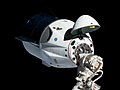
SpaceX Crew-11 was the eleventh operational NASA Commercial Crew Program flight and the 19th crewed orbital flight of a Crew Dragon spacecraft. The mission transported four crew members, NASA astronauts Zena Cardman and Michael Fincke, JAXA astronaut Kimiya Yui, and Roscosmos cosmonaut Oleg Platonov, to the International Space Station (ISS). The mission launched on August 1, 2025 and docked with the ISS the next day. On January 8, 2026, NASA announced that the mission would end about a month earlier than planned due to an undisclosed "medical situation" involving a crew member. [3]
Zena Cardman was originally assigned to SpaceX Crew-9, [4] but she and Stephanie Wilson were removed from that flight, [5] which launched with only two crew members and returned with the crew of the Boeing Crew Flight Test due to issues with the Boeing Starliner Calypso, [6] while Michael Fincke and Kimiya Yui were initially assigned to Boeing Starliner-1, but they were reassigned to Crew-11 due to testing with the Boeing Starliner capsule. [7]
| Position [8] | Crew | |
|---|---|---|
| Commander | Zena Cardman, NASA Expedition 73/74 First spaceflight | |
| Pilot | Michael Fincke, NASA Expedition 73/74 Fourth spaceflight | |
| Mission specialist | Kimiya Yui, JAXA Expedition 73/74 Second spaceflight | |
| Mission specialist | Oleg Platonov, Roscosmos Expedition 73/74 First spaceflight | |
| Position [9] | Crew | |
|---|---|---|
| Mission specialist | Oleg Artemyev, Roscosmos | |
| Attempt | Planned | Result | Turnaround | Reason | Decision point | Weather go (%) | Notes |
|---|---|---|---|---|---|---|---|
| 1 | 31 Jul 2025, 12:09:20 pm | Scrubbed | — | Weather | 31 Jul 2025, 12:08 pm (T−00:01:07) | 90% [10] | Storm clouds at launch pad. |
| 2 | 1 Aug 2025, 11:43:42 am | Success | 0 days 23 hours 34 minutes | 75% [11] |
The eleventh SpaceX operational mission in the Commercial Crew Program was scheduled for launch on July 31, 2025, but was scrubbed due to weather. [10] After a quick turn around, SpaceX was able to launch the mission the next day on August 1, 2025. [12] The mission marked the final landing of a Falcon 9 booster on Landing Zone 1, which was then retired. [12] At 14 hours, 43 minutes, and 10 seconds, it is the fastest Crew Dragon rendezvous to date. [13]
On January 7, 2026, one of the astronauts experienced an undisclosed "medical situation" that prompted NASA to cut the mission short. [14] The medical issue already caused the cancellation of a planned extravehicular activity, USA EVA 94 that was supposed to take place on January 8, 2026. The EVA would have prepared the station to receive the final pair of ISS Roll-Out Solar Arrays (iROSAs). [15] At a news conference on January 8, 2026, NASA administrator Jared Isaacman announced that Crew-11 would return to Earth early, because of the astronaut that is suffering the medical issue. [16] It was not stated at the time when they would come back, nor if Crew-12 could be moved up from its planned mid-February 2026 launch date. [17] Subsequently, Crew-11 splashed back down to Earth on January 15, 2026. [18] Isaacman said that the early return of Crew-11 and an earlier launch of Crew-12 would not affect plans for Artemis II, which is planned to launch no earlier than February 6. [19]