Calendar of saints (Lutheran)

Last updated

The Lutheran Church has, from the time of the Reformation, continued the remembrance of saints. The theological basis for this remembrance is understood as being connected to the words of the Epistle to the Hebrews 12:1. [a] The Apology of the Augsburg Confession states that the remembrance of the saints has three parts: thanksgiving to God, the strengthening our faith, and the imitation of the saints' holy living. [b] [3]

Contents

As a result, the Lutheran reformers retained a robust calendar of saints to be commemorated throughout the year. In addition to figures found in the Bible, early Christians such as Saint Lawrence and Martin of Tours were retained as saints on the calendar, as were extra-Biblical commemorations like the Assumption of Mary. Following the Reformation, most especially in the latter half of the twentieth century, many names were added to the calendar, both new and restored pre-Reformation commemorations.

The Calendar found below is a listing of the primary annual feasts, festivals and events that are celebrated liturgically by various Lutheran Churches in the English-speaking world. The calendars of the Lutheran Church–Missouri Synod (LCMS) and the Evangelical Lutheran Church in America (ELCA) in their present forms are listed below, as found in the 2006 Lutheran Service Book of the LCMS, and the 2006 Evangelical Lutheran Worship of the ELCA. In addition to these, some historic observances not currently found on the aforementioned calendars but appearing in earlier Lutheran uses are also provided. [4]

While extensive, the Lutheran sanctoral calendar is not presently as strictly ranked as that of the Roman Catholic Church. Principal festivals are marked with BOLD CAPS and lesser festivals with bold text. If a saint’s day is not commonly observed in North America, the country where that saint is observed is also noted. For individuals, the date given is generally the date of their death or "heavenly birthday." The liturgical color for vestments and paraments is noted as follows: White (W), Red (R) or Violet (V). Commemorations specific to the LCMS, ELCA, or an earlier source are noted following each entry. Commemorations and festivals held in common are not annotated.
January

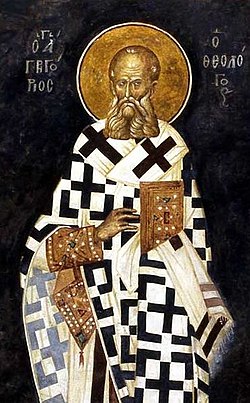
Gregory of Nazianzus Gregor-Chora (cropped).jpg
Gregory of Nazianzus

February

Martin Luther's face and hands cast at his death. Luther death-hand mask.jpg
Martin Luther's face and hands cast at his death.

March

Simon Ushakov, The Last Supper Simon ushakov last supper 1685.jpg
Simon Ushakov, The Last Supper
Saint Joseph Saint Joseph with the Infant Jesus by Guido Reni, c 1635.jpg
Saint Joseph

April

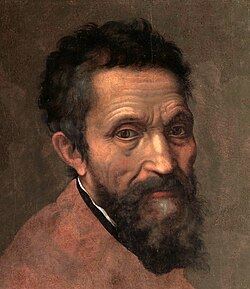
Michelangelo Miguel Angel, por Daniele da Volterra (detalle).jpg
Michelangelo
Catherine of Siena Catherine of Siena writing.jpg
Catherine of Siena

May

Sts. Constantine and Helen Brosen icon constantine helena.jpg
Sts. Constantine and Helen

June

Lucas Cranach the Elder, Philipp Melanchthon PhilippMelanchthon.jpg
Lucas Cranach the Elder, Philipp Melanchthon

July

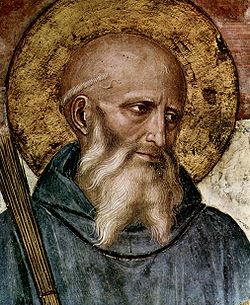
Benedict of Nursia Fra Angelico 031.jpg
Benedict of Nursia
Elias Gottlob Haussmann, Johann Sebastian Bach Bach.jpg
Elias Gottlob Haussmann, Johann Sebastian Bach

August

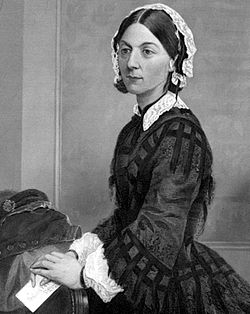
Florence Nightingale Florence Nightingale.jpg
Florence Nightingale
Mary, Mother of Our Lord Frari (Venice) - Sacristy - Il Sassoferrato - Madonna in prayer.jpg
Mary, Mother of Our Lord

September

Carlo Crivelli, Francis of Assisi Carlo Crivelli 019.jpg
Carlo Crivelli, Francis of Assisi

October

Gianlorenzo Bernini The Ecstasy of St. Teresa Ecstasy of Saint Teresa September 2015-2a.jpg
Gianlorenzo Bernini The Ecstasy of St. Teresa

November

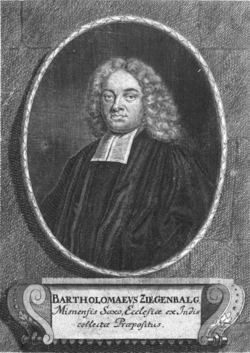
Bartholomaeus Ziegenbalg Ziegenbalg.png
Bartholomaeus Ziegenbalg

December

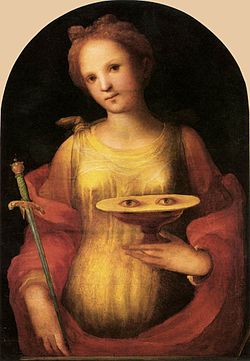
Domenico di Pace Beccafumi, Saint Lucy Saint Lucy by Domenico di Pace Beccafumi.jpg
Domenico di Pace Beccafumi, Saint Lucy

See also

Notes

  1. " "Seeing we also are compassed about with so great a cloud of witnesses, let us lay aside every weight, and the sin which doth so easily beset us, and let us run with patience the race that is set before us." [1]
  2. "The first is thanksgiving. For we ought to give thanks to God because He has shown examples of mercy; because He has shown that He wishes to save men; because He has given teachers or other gifts to the Church. And these gifts, as they are the greatest, should be amplified, and the saints themselves should be praised, who have faithfully used these gifts, just as Christ praises faithful business-men (Matt. 25:21, 23). The second service is the strengthening of our faith; when we see the denial forgiven Peter, we also are encouraged to believe the more that grace truly superabounds over sin (Rom. 5:20). The third honor is the imitation, first, of faith, then of the other virtues, which every one should imitate according to his calling." [2]

References

  1. Hebrews 12:1
  2. Apology of the Augsburg Confession, XXI.4-6
  3. Lutheran Service Book. Concordia Publishing House. 2006. pp. xii. ISBN   978-0-7586-1217-5. The Lutheran reformers understood that there was great benefit in remembering the saints whom God has given to His Church. The Apology of the Augsburg Confession (Article 21) gives three reasons for such honor. First, we thank God for giving faithful servants to His Church. Second, through such remembrance our faith is strengthened as we see the mercy that God extended to His saints of old. Third, these saints are examples by which we may imitate both their faith and their holy living according to our calling in life. [...] 'Therefore, since we are surrounded by so great a cloud of witnesses, let us also lay aside every weight, and sin which clings to closely, and let us run with endurance the race that is set before us.' Hebrews 12:1
  4. Mayes, Benjamin T. G. "Martyrology of W Loehe".
  5. 1 2 "The Church Year" (PDF). Renewing Worship. January 2006. Archived from the original (PDF) on September 8, 2006. Retrieved April 14, 2020.
  6. Evangelical Lutheran Worship Leaders Desk Edition (8th (2019) Printing ed.). Minneapolis, MN: Augsburg Fortress. 2006. p. 58. ISBN   978-0-8066-5620-5.

Bibliography