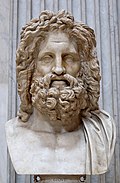
The religious practice in honour of Zeus, known as his "cult", stretched across the Greek world. He seldom occupied an elevated position in the pantheons of individual cities, few of which had him as their patron god. He was often worshipped on the peaks of mountains, and his Panhellenic sanctuaries (which attracted Greeks from afar) were located in remote areas.
Zeus's cult is attested as early as the 2nd millennium BC, his with name appearing on tablets written in Linear B (a script of Mycenaean Greek). His preeminent sanctuary was Olympia, where the high point of the religious festival which included the ancient Olympic Games was a giant sacrifice of cattle to Zeus. It was the site of a a temple dedicated to him, the largest in the Peloponnese, and an ash altar measuring 6.5 metres (21ft) in height, composed of bones and ash which had accumuluated from repeated sacrifice. At Nemea, another athletic festival, the Nemean Games, was held in his honour. Under different epithets (surnames or titles), he was the recipient of Athenian festivals such as the Dipolieia and Diasia. His Cretan cult sites included a sanctuary at Palaikastro, where the Hymn to Zeus Diktaios was discovered, and a cave on Mount Ida, where he was worshipped for over 1000 years. His sanctuary on the peak of Mount Lykaion, in Arcadia, was rumoured in antiquity to have been the site of human sacrifice.
Distribution and characteristics
In the context of ancient history, "cult" describes the practices used to venerate a particular superhuman entity;[1] for the Greeks, such actions included sacrifices, prayers, the celebration of festivals, and the construction of temples and altars.[2] The cult in honour of Zeus extended across the Greek world, and existed from the Bronze Age until late antiquity.[3] Although Zeus was the head of the Greek pantheon, he was rarely afforded an elevated position within the local pantheons of individual cities, only occupying such a role from the 4th century BC onwards.[4] He was the patron god of few individual poleis (city-states; sg.: 'polis'),[5] and seldom were there sanctuaries dedicated to him on acropoleis (the upper part of Greek cities; sg.: 'acropolis').[6]Fritz Graf writes that Zeus's protection, which was universal, could not be restricted to a single polis,[7] and Walter Burkert describes Zeus as an impartial figure whom "[h]ardly any city can claim [...] simply as its city god".[8] Bernhard Linke argues that Zeus occupied a decentralised position within the polis because a concentrated cult to a god of such immense importance would have threatened to destabilise the balance of power.[9]
Early on, Zeus was worshipped primarily in remote locations.[10] A common place of Zeus's cult was the mountain peak, a natural abode for a god who presided over the sky and rain.[11] On these peaks, he often bore an epithet, a surname or title which accompanied his name (such as "Ombrios" in "Zeus Ombrios", meaning 'Zeus of rain'); such epithets often derived from the name of the mountain or expressed an aspect of his personality there.[12] At Olympia, Dodona, and Nemea, Zeus was the recipient of Panhellenic sanctuaries (which attracted Greeks from across large distances);[13] these three sites were located far outside cities, seemingly an defining quality of his Panhellenic cult.[14] Zeus's earliest temples, attested from the 6th century BC, were later than those to other gods, with his worship initially taking place under the open sky.[15]
Zeus was more multiform and had a greater variety of cultic associations than any other Greek god.[16] He was thought to control the weather, including rain and lightning,[17] and in places was associated with fertility and vegetation, sometimes acquiring traits which were chthonic ('of the earth').[18] He was the protector of the social order,[19] and had functions pertaining to aspects of society such as families, property, clans, and the agora (a public assembly space within poleis).[20] Hundreds of his cult epithets survive,[21] some of which were Panhellenic in importance, appearing in both literature and regional cultic contexts, with others pertaining to specific locations; certain epithets allude to the content of rituals.[22] The different manifestations of Zeus expressed in epithets could be treated as disparate in certain contexts, and part of a unified whole in others.[23]
Across his cult, Zeus was worshipped alongside most of the other Olympians (the main gods of the pantheon), as well as heroes (mortals worshipped after death).[24] The Romans identified him with their own chief god, Jupiter,[25] who shared several fundamental functions with Zeus, such as control of the sky and weather.[26] Jupiter's cult was commonly located on hills, though seldom on mountain summits,[27] and he had a temple on the Capitoline Hill in Rome, whereas no important temple of Zeus was located on an acropolis.[28] Jupiter was also was much more political in nature: he was thought to have a particular loyalty to Rome, and to be the city's protector.[29]
Map showing some of Zeus's major locations of worship on the Greek mainland (including the Peloponnese), in Anatolia, and on Crete
Mycenaean Greece and continuity
Tn 316, a Linear B tablet from Pylos, lists offerings to Zeus, Hera, and one "Drimios" (described as Zeus's son).
Zeus's cult is attested as far back as the 2nd millennium BC.[31] References to his name appear on tablets composed in Linear B,[31] a script used c. 1400–1200 BC to write in Mycenaean Greek.[32] One such tablet from Pylos describes offerings to Zeus, Hera, and a son of Zeus named "Drimios",[33] indicating a shared cult between the three figures at a Pylian sanctuary of Zeus.[34] A tablet from Chania, Crete, similarly mentions a sanctuary of Zeus (located in that city's vicinity),[35] where there was joint worship of Zeus and Dionysus.[36] Two tablets from Knossos refer to a cult of Zeus Diktaios ('of Mt Dikte')[37] and to a month of Zeus during which offerings of oil were given "to all the gods".[38] Tablets from Pylos and Knossos also attest a goddess named di-wi-ja, seemingly a feminine counterpart of Zeus.[39]
The Mycenaeans seemingly introduced Zeus to Crete around the latter half of the 15th century BC,[40] and amalgamated him there with a local Minoan deity.[41]Walter Burkert views Zeus already as "one of the most important gods, perhaps even the highest god" in the Mycenaean period.[42] Such a place within the pantheon could be indicated by the frequency and geographic spread of the references to him.[43] Ratko Duev contends that the offerings to Zeus described on the tablets are often no greater (and sometimes smaller) than those to other deities, which does not suggest an exceptional position.[44]
The degree of continuity between the religion of Mycenaean Greece and that of the archaic period has been a matter of scholarly dispute.[45] At the sanctuary of Zeus on Mount Lykaion, 21st-century excavations of the ash altar to the god have found evidence of its continuous ritual use from Mycenaean times to the Hellenistic period (c. 323–30 BC).[46] Ritual animal sacrifice stretching back to the 15th and 16th centuries BC is indicated by burned animals bones, which were found mingled with pottery, figurines, and other objects.[47] Martina Dieterle views archaeological evidence dating to the Bronze Age (c. 3000–1000 BC)[48] at Dodona (a sanctuary of Zeus attested from the 8th century BC) as probable indication of early cultic activity there, though she repudiates the theory of a continuous cult of Zeus from the Mycenaean period.[49] According to Birgitta Eder, pottery from Olympia (the location of a major sanctuary to Zeus) suggests that cultic activity began there in the 11th century BC, as opposed to having descended from a cult of the Palatial Bronze Age (c. 1400–1200 BC).[50]
Panhellenic sanctuaries
Olympia
Zeus's preeminent sanctuary was Olympia,[51] situated in Elis, Peloponnese, near the river Alfeios.[52] It was the site of the ancient Olympic Games, the oldest and greatest athletic festival of ancient Greece.[53] Religious activity began at the site in the late 11th century BC,[54] although the exact age of Zeus's cult there is unclear.[55] The use of an ash altar, a pile of ash that would have accumulated over time as a result of repeated sacrifice,[56] is attested from the late 11th century BC to the period around 600 BC.[57] Bronze figurines from the Geometric period (c. 900–700 BC), depicting armed, helmeted men (often with raised arms), have been thought by some scholars to represent Zeus.[58] From the end of the 8th century BC, poleis (Greek city-states) would gift one-tenth of the spoils from a victory to Zeus at Olympia;[59] this could include weapons, armour, monuments, and tropaia (trophies, typically in the form of weapons or armour attached to a wooden structure).[60] Military offerings predominate among the items discovered from the first half of the 1st millennium BC.[61] The earliest temple at the site, the Temple to Hera, was erected around 600 BC,[62] and was probably originally dedicated to Zeus, according to Ulrich Sinn.[63] Its construction prompted the ash altar to be relocated eastwards.[64]
The Olympic Games' founding was traditionally dated to 776 BC,[65] although archaeological evidence does not support their commencement in this exact year.[66] In myth, figures credited with their founding include the hero Pelops, Heracles, and Zeus himself.[67] They were held in honour of Zeus Olympios ('Olympian, of Olympus'),[68] and took place at four-year intervals;[69] initially lasting one or two days, by the 5th century BC the festival had lengthened to five days.[70] The earliest event was a roughly 200-metre (660ft) running race (the stadion); further competitions were added over the Games' first few centuries, and in the 5th century BC events included horse racing, a pentathlon, wrestling, boxing, and pankration (a form of fighting with few rules).[71] Scholars refer to Olympia as "Panhellenic" because its competitions, of exceptional prestige, attracted and allowed entry to individuals from across Greece.[72]
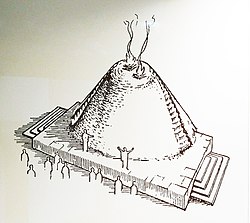
Reimagining of the altar of Zeus at Olympia
The athletic competitions at Olympia took place as part of a religious festival.[74] The zenith of this festival was an enormous sacrifice of cattle to Zeus, known as the "hecatomb", carried out on the god's ash altar.[75] This ash altar was erected as part of a major construction program at the site, beginning in the first half of the 5th century BC.[76] According to Pausanias (2nd century AD), this altar comprised a base of around 37 metres (121ft) in perimeter (known as the próthusis, πρόθυσις), with stone steps on either side, and a pile of ashes atop the base, measuring around 6.5 metres (21ft) in height and 9.5 metres (31ft) in perimeter, accessible by steps in its sides.[77] The cattle would have been killed on the altar's base, and their thigh bones taken to the peak and burned.[78] The term "hecatomb" (hekatómbē, ἑκατόμβη), used by Lucian (2nd century AD) to refer to the sacrifice,[79] implies that its victims were one hundred oxen,[80] a notion which has been repeated in modern scholarship.[81] According to Pausanias, sacrifices were also performed at the altar in the periods between festivals.[82]
An oracle operated at the peak of the altar, and its seers interpreted signs from the altar's flames.[83] The earliest author to mention oracular activity there is Pindar (5th century BC),[84] although Sinn believes the oracle existed as early as the 8th century BC.[85] Dating from 36 BC onwards, inscriptions from the site reference its seers as belonging to two families, the Iamidai and Klytiadai,[86] said in myth to be the descendants of Iamus and Klytios, respectively.[87] The former family is attested at the site from the late archaic era, and the latter from the Hellenistic period.[88] Olympia's seers often provided guidance on the battlefield,[89] and during the 5th and 4th centuries BC the oracle was visited for its military advice.[90] According to Pausanias, the seers were also responsible for looking after the ash altar.[91]
The Temple of Zeus was erected at the site around 470 to 456 BC.[92] According to Pausanias, the polis of Elis constructed it from war booty attained in its defeat of nearby Pisa; scholars have disputed this account, though there is unanimity that its construction commemorated a military triumph.[93] The temple's stylobate (the surface on which the columns stood) measured 27.68 by 64.12 metres (90.8 by 210.4ft); the columns were around 10.53 metres (34.5ft) tall, and the temple's full height would have been roughly 20 metres (66ft).[94] It was the largest temple in the Peloponnese, and is deemed the purest realisation of the Doric system of ancient Greek architecture.[95] The temple's two pediments each depicted a mythological scene: the war between the centaurs and the Lapiths on the west pediment, and Pelops' chariot race against the Pisan king Oenomaus on the east pediment.[96]
Around 438 to 432 BC, the sculptor Phidias produced an enormous chryselephantine (gold and ivory) cult statue of Zeus, which measured around 13.5 metres (44ft) in height.[97] It was the most famous statue of Zeus in antiquity,[3] and came to be included among the Seven Wonders of the Ancient World.[98] It showed him seated on a throne, with the goddess Nike in his right hand and an eagle-topped sceptre in his left.[99] The statue is entirely lost, though literary descriptions and representations in later art survive.[100] It was housed in the temple's cella (an enclosed inner area),[101] which underwent modifications as part of the statue's installation.[102]
Over fifty gods and heroes were worshipped at Olympia;[103] the most important of these include Hera, Zeus's wife, and Cronus and Rhea, his parents.[104] Each month there was a procession through Olympia, during which sacrifices were made at each of its altars, which numbered 69 according to Pausanias.[105] Of these altars, at least eight were dedicated to Zeus under different epithets, such as Areios ('of Ares, warlike, martial, of war'), Keraunios ('of a thunderbolt'), and Chthonios ('of the underworld').[106] As Zeus Keraunios, he was affiliated with war; before and during the first half of the 5th century BC, representations of the god as Zeus Keraunios (that is, throwing a thunderbolt) seem to predominate at Olympia.[107] He also appeared as an adjudicator: before a statue of Zeus Horkios ('of the oath'),[108] which held two thunderbolts, Olympic athletes and trainers swore to compete fairly.[109]
Dodona
Zeus's most renowned oracle was that at Dodona,[110] a sanctuary situated below Mount Tomaros in the region of Epirus in north-western Greece.[111] In antiquity, this oracle was reputed to be the most ancient in Greece.[112] The site is securely attested as having a religious function by the late 8th century,[113] and there is disagreement among scholars as to whether cultic activity there dates back to the Late Bronze Age (1700–1000 BC).[114] From the 8th century BC, the sanctuary is known to have been dedicated to Zeus.[115] Dodona is referenced in the Homeric epics– the Iliad and Odyssey– probably both composed in the late 8th or early 7th century BC.[116] In the Iliad, the Zeus of Dodona is addressed by the Greek hero Achilles as "Pelasgian",[117] a label which connotes great age (and which the Greeks associated with the pre-Greek population).[118] In place of Hera, Zeus's consort at Dodona was Dione, whose name is a feminine version of Zeus (which in the genitive case is Dios).[119] Zeus was venerated at the site under the epithet "Naios" (which has elicited various scholarly interpretations), with Dione bearing the epithet "Naia" there.[120]
The Iliad relates that the priests of Zeus at Dodona, whom it calls the selloi, sleep upon the ground and do not wash their feet.[121] In the Odyssey, the hero Odysseus claims that he visited Dodona where he listened to the will of Zeus via an oak tree.[122] According to the 5th-century BC historian Herodotus, there were three priestesses at Dodona, described as peleiádes (πελειάδες, 'doves');[123] it appears that the selloi were the site's initial priesthood, with the peleiades appearing at some point.[124] Archaeological evidence of the oracle's operation includes thousands of lamellae (thin tablets) from the site, most of which bear inscribed questions asked of the oracle, with a few seemingly containing answers.[125]
Nemea
Remains of the Temple of Zeus (left) and the southern end of the altar (right) from his sanctuary at Nemea
Nemea was a valley in northwest Argolis, Peloponnese, and the location of the sanctuary of Zeus that hosted the Nemean Games,[126] one of the four Panhellenic athletic festivals of ancient Greece.[127] Archaeological finds, including sherds found close to the later Temple of Zeus, indicate some form of activity at the site as early as the 8th century BC.[128] By the 6th century BC, the site was under the control of the nearby city of Cleonae,[129] and in 573 BC, according to the traditional dating, the Nemean Games attained Panhellenic status.[130] The Games were dedicated to Zeus Nemeios, were held biennially,[131] and included gymnic and equestrian competitions, as well as musical events.[132] In myth, they are established by Heracles after killing the Nemean lion,[133] or founded as funeral games in honour of the child Opheltes, who was killed by a snake.[134]
The Temple of Zeus was the centrepiece of the sanctuary, and its first iteration seems to have been constructed in the first half of the 6th century BC.[135] The temple and numerous other structures at the site were destroyed in the late 5th century, after which the Games were held elsewhere (probably in Argos).[136] They moved back to Nemea in the late 4th century BC, when the sanctuary was subject to a major construction program,[137] which included the erection of a new Temple of Zeus and a stadium.[138] This temple employed all three orders of ancient Greek architecture (the Doric, Ionic, and Corinthian),[139] and contained a crypt within its adyton (the innermost area of an ancient Greek temple).[140] On the eastern side of the temple there was an especially long altar to Zeus, which at minimum measured 41 metres.[141] It was created in the 6th century BC, and increased to its full length in the 4th century BC.[142] Faunal remains indicate the sacrifice of sheep, goats, and (ostensibly) cattle there.[143] The Games had returned to Argos by 271 BC, and over the following centuries the site was abandoned, with Pausanias reporting in the 2nd century AD that the temple's roof had fallen in.[144]
Attica
Multiple mountains in Attica were locations of Zeus's cult.[145] His sanctuary on Mount Hymettos is attested as early as the Protogeometric period (c. 1025–900),[146] and excavations have uncovered inscriptions to Zeus on its summit.[147] Pausanias mentions an altar to Zeus Ombrios ('of rain') on the mountain;[148] Merle Langdon argues that this altar can be identified with the excavated site at the peak, which, in his view, farmers would have visited to make offerings, primarily for rain.[149] There is evidence of a sanctuary of Zeus on Mount Parnes from the 10th or 9th century BC,[150] and Pausanias mentions several of his altars near its peak.[151] According to Langdon, there was also a sanctuary of Zeus on Tourkovounia (which he identifies with Anchesmos, mentioned by Pausanias).[152] In the classical period, activity at the god's Attic mountaintop sanctuaries waned.[153]
Within Athens, on the Acropolis, there was a sanctuary of Zeus Polieus ('of the city'),[154] whom scholars have characterised as the protector of the city.[155] Most scholars have identified this precinct with an area to the northeast of the Parthenon (Athena's temple on the Acropolis), containing the citadel's vertex, a shrine with a cella, and an offering table.[156] The Dipolieia festival to Zeus Polieus took place on the 14th day of Skirophorion, the final month of the Athenian year, and included a ritual known as the Buphonia ('ox-killing').[157] In this rite, offerings of grain were placed at the god's altar on the Acropolis, and the first among a group of oxen to eat from these offerings, thereby violating them, was slaughtered.[158] The priest who performed the killing absconded, and the sacrificial knife (or axe) was convicted in court, then deposited in the sea.[159] This rite is described as antiquated already by Aristophanes (5th to 4th centuries BC), though is still attested in Pausanias's time (2nd century AD).[160]Walter Burkert views the ritual as one of "dissolution" near the end of the year, where humans attempted to escape the "horror of killing".[161] According to Robert Parker, at the rite's centre is man's exonerating himself from the "guilt of sacrifice", with the ox incurring culpability by consuming offerings and the weapon assigned guilty in court.[162] Sacrifices to Zeus Polieus are also recorded on the calendars of the Attic demes (or districts) of Erchia and Thorikos.[163]
The Diasia festival was dedicated to Zeus Meilichios ('the mild'),[164] whose name was euphemistic, used as a way of appeasing him.[165] Scholars have often classed him among the chthonic deities,[166] and he was often depicted on votive reliefs as a giant serpent.[167] The festival took place on the 23rd day of the month of Anthesterion, outside the city in the deme of Agrae.[168]Thucydides (5th century BC) called it the "greatest Athenian festival of Zeus",[169] and describes it as celebrated en masse (pandēmeí, πανδημεί), though Parker writes that it is unclear whether all Attic demes participated.[170] Thucydides mentions it as including local offerings, which would have been bloodless and wineless,[171] though the sacrifice of animals is evidenced by two Attic calendars.[172]Scholia on Lucian (marginal notes in his works' manuscripts) described it as carried out "with a certain grimness",[173] though other ancient authors presented it as a cheerful event.[174] Zeus Meilichios was also the dedicatee of the Athenian Pompaia festival, which featured a purification ritual in which a procession carried the fleeces of sacrificed sheep and a caduceus.[175]
In the northwest part of the Athenian agora, there was a stoa, a long, roofed colonnade with a rear wall, dedicated to Zeus Eleutherios ('of freedom').[176] It was constructed around 430 to 420 BC,[177] and outside its front sat an altar and statue of the god.[178] There is evidence under the stoa of a structure dating to the 6th century BC, which was destroyed in the Persian invasion of 480 to 479 BC,[179] and would have been dedicated to Zeus.[180] In the agora, the cult of Zeus Eleutherios was the same as that of Zeus Soter ('the saviour'),[181] though there are some differences in how ancient sources use the two names.[182]Kurt Raaflaub argues that the recipient of the early structure in the agora was Zeus Soter, who attained the epithet Eleutherios following the Persian Wars.[183] Another Zeus Soter, different to that of the agora,[184] was jointly honoured with Athena Soteira in a temple in the Attic harbour town of Piraeus.[185] His cult in the town is attested by the early 4th century BC, and mostly serviced individual worshippers hoping to be "saved" from personal problems, attracting visitors from Attica and abroad.[186] His joint festival with Athena Soteira, the Diisoteria, centred around a procession to their temple.[187]
The foremost deity of eastern Crete was Zeus Diktaios.[188] Most scholars agree that this was the god honoured in a sanctuary at Palaikastro (at the eastern end of Crete),[189] constructed in the 8th century BC on the remains of a Minoan town.[190] At the site, a section of wall measuring 36 metres (118ft) has been considered a segment of a temenos's boundary.[191] The sanctuary was the site of open-air worship – the nexus of which was an ash altar – until the 6th century BC, during which a temple was probably erected.[192] Votive offerings discovered at the site, which include bronze tripods, shields, and bull statuettes, indicate that it flourished between the 7th and 5th centuries BC.[193] The Hymn to Zeus Diktaios, also known as the Hymn of the Kouretes, is the most important discovery from the site;[194] the original text of the hymn, often dated to the 4th or 3rd century BC, was preserved in an inscription from around the 3rd century AD.[195] It addresses Zeus as the "greatest youth" (mégistos koûros, μέγιστος κοῦρος) and asks him to come to his sanctuary for an annual festival which included the singing of the hymn around his altar.[196] The hymn is also concerned with fertility, requesting that the god "leap into" (thór' es, θόρ' ἐς) fields, flocks, herds, and offspring-filled homes.[197]
Found amongst the remains of the Minoan town was a 15th-century BC chryselephantine statuette, known as the Palaikastro Kouros, depicting a male youth and measuring 0.5 metres (1.6ft) in height.[198] He has clenched fists, raised towards his chest, a stance also displayed by figurines from nearby Mount Pesofas, where there was a peak sanctuary.[199] The statuette's subject is almost certainly a deity, and Alexander MacGillivray and Hugh Sackett interpret him as Zeus Diktaios.[200] The Palaikastro Kouros may indicate there was a Minoan forerunner to Zeus Diktaios's archaic and classical cult,[201] although continuity of worship is not indicated by the archaeological evidence.[202]
Crete is the location most often given as Zeus's birthplace,[203] appearing in this role as early as around 700 BC in the Theogony of Hesiod.[204] The location of his birth on Crete was a matter of disagreement in antiquity:[205] it was said to be a cave on either Mount Dikte or Mount Ida.[206] There is a consensus in modern scholarship that Dikte is located in eastern Crete,[207] and Charles Crowther identifies it with Mount Petsofas in particular.[208] There is also agreement that Zeus Diktaios was a form of the Cretan-born Zeus, known as Zeus Kretagenes,[209] and the hymn from Palaikastro displays awareness of a tradition in which Zeus's upbringing takes place on Dikte.[210] Zeus was also said to have died in Crete, a tradition unique to the island,[211] with ancient authors variously locating his grave at Knossos, Mount Ida, and Mount Dikte.[212] Some scholars have argued that a chasm in the peak sanctuary on Mount Juktas, near Knossos, was considered a burial site of Zeus in antiquity.[213]
A bronze tympanon from the cave on Mount Ida, dating to the late 8th or early 7th century BC, depicting Zeus in a style which indicates Near Eastern influence
Zeus was venerated for over 1000 years in a cave on Mount Ida, situated in central Crete.[215] Religious activity is attested at the site as early as the Middle Minoan period's end (c. 1700–1675),[216] and Yannis Sakellarakis believes the Cretan Zeus was honoured there by the Late Minoan III period (c. 1420/1410–1075/1050), following the worship of a Minoan god of vegetation.[217] The cave's entrance is 25 metres (82ft) in width, and its interior comprises a main room, the maximum measurements of which are 36 by 34 metres (118 by 112ft) with a height of 17 metres (56ft), and two recesses;[218] outside the entrance is an altar, hewn from stone.[219] Ranging from the Middle Minoan period to the 5th century AD, finds from the site include bronze shields, bronze tripods, figurines of animals and humans, lamps, pottery, jewellery, and various other gold, ivory, and bronze items;[220] there survive a profusion of votive offerings, which become markedly more numerous during the 8th and 7th centuries BC.[221] Animals were sacrificed inside the cave, as evidenced by the presence of bones and black earth.[222]
The cult at the Idaean cave drew worshippers from numerous communities,[223] and multiple Cretan cities played an official role in its operation. Coins from the cave, originating from various Cretan cities, indicate the site's influence across the island, and Zeus Idatas (or Idaean Zeus) appears in Cretan treaties.[224] The site was known outside Crete by the classical period, being referenced by authors such as Pindar, Euripides, and Plato; it was also said to have been visited by the philosopher Pythagoras.[225] Scholars have variously conceived of the cult as concerning vegetation or initiation rites (of warriors or young men),[226] and Angelos Chaniotis argues the cave was the site of an oracle.[227] A fragment from Euripides' lost play Cretans, dating to the late 5th century BC,[228] refers to "mústai of Idaean Zeus", and some scholars have seen the cave as the site of mysteries.[229]
At Amnisos, a settlement along Crete's northern coast, there was a sanctuary dedicated to Zeus Thenatas.[230] It seems to have been the site of an ash altar, and epigraphic evidence indicates the god's worship at the sanctuary in the Hellenistic period;[231] Chaniotis and Jörg Schäfer believe his cult there dates to at least the 8th century BC.[232] At the site of Hagia Triada, near Phaistos, Zeus Velchanos was worshipped during the Hellenistic period;[233] the name Velchanos is inscribed on late-4th-century BC coins from Phaistos, depicting a young deity without a beard, perched in a tree.[234]
Arcadia
Zeus Lykaios depicted on an Arcadian coin, c. 363–362 BC,[235] and in the form of a statuette (discovered on Mount Lykaion, near the column bases), holding a thunderbolt and crook, c. 540–530 BC[236]
There was a sanctuary of Zeus on the southern peak of Mount Lykaion in western Arcadia,[237] on which he was worshipped under the epithet Lykaios.[238] The mountain is described by Callimachus (3rd century BC) and Pausanias as the god's birthplace,[239] and his cult there was said to have been established by Lycaon, son of the mythical first Arcadian king, Pelasgus.[240] During the archaic and classical periods, the site was the foremost Arcadian sanctuary:[241] Zeus Lyaios is depicted on Arcadian coinage during the 5th and 4th centuries BC,[242] and Xenophon (5th to 4th centuries BC) reports that the Arcadians of the Ten Thousand celebrated the Lykaia (the festival held on Mount Lykaion) while in Peltae, Asia Minor.[243]
At the summit of Mount Lykaion is an altar in the form of a mound, measuring 1.5 metres (4.9ft) in height and 30 metres (98ft) in diameter.[244] Excavations indicate that it is composed of burned animal bones (primarily those of sheep and goats), ash, pottery, and votive offerings such as ceramic figurines and bronze tripods.[245] These finds evince the altar's usage continuously from Mycenaean times to the Hellenistic period.[246]
At an elevation approximately 20 metres (66ft) below the peak is a temenos (or precinct), a level area bounded by stones and measured in the 20th century at 55 by 120 metres (180 by 394ft).[247] Pausanias described this space as an abaton (a sacred area to which entry was prohibited),[248] claiming that those who set foot there perished within a year, and that inside its bounds all living beings lacked a shadow.[249] Around the eastern end of the temenos are two column bases, 7 metres (23ft) apart, which are the remains of 5th-century Doric columns said by Pausanias to have been topped with golden eagles.[250] Items excavated in the vicinity of the column bases include bronze statuettes, several of which depict Zeus, an askos (perhaps used at the site for libations), and a votive greave.[251]
From at least the 5th century BC, the Lykaia festival was held on Mount Lykaion, on either a biennial or quadrennial basis.[252] It took place in a part of the sanctuary at an elevation 200 metres (660ft) below the altar, in a meadow which contained a hippodrome, stadium, and other structures.[253] The festival was dedicated to Zeus, and included athletic and equestrian competitions.[254] It was hosted by Mount Lykaion up to the late 4th century BC, after which it may have moved to Megalopolis;[255] evidence for the festival over the following centuries is patchy.[256] Between the meadow and the peak lay a spring, Hagno.[257] Pausanias described a ritual performed there to bring rain during protracted droughts:[258] the priest of Zeus Lykaios would make prayers and sacrifices, and then disturb the water's surface with an oak branch, causing a vapour to rise and form clouds.[259]
In antiquity, Mount Lykaion was reputed to be the site of human sacrifice.[260] The earliest reference to this idea comes from Plato's Republic (4th century BC),[261] which mentions a legend (mûthos, μῦθος) that, at the sanctuary of Zeus Lykaios, human entrails were mixed into the meat meal (eaten after a sacrifice in Greek religion),[262] and that he who consumed them was transformed into a wolf; the presence of the entrails in the meal implies that a human was part of the sacrifice.[263] Other 4th-century BC sources mention human sacrifice as part of the Lykaia,[264] and Pausanias (2nd century AD) is reticent about the rites carried out on the altar during his time.[265]Pliny the Elder (1st century AD) relates a tale of an Olympian, Demaenetus, who became a wolf for ten years after eating the innards of a child sacrificed to Zeus Lykaios.[266] In some versions of the myth of Lycaon, Zeus is presented by Lycaon with a meal of human flesh, prompting the god to turn him into a wolf (although sometimes the transgressors are Lycaon's sons).[267] This story is an aetiology for the Lykaia,[268] and in Pausanias's telling the transformation occurs after sacrificing a child on Zeus Lykaios's altar.[269]
In the ancient literary evidence, Burkert perceives an initiation rite for young men, which would have taken place on Mount Lykaion, and involved those who ate (or perhaps were thought to eat) human entrails at the sacrificial meal leaving society for nine years. He argues that, after the founding of Megalopolis in 371 BC, the Lykaia would have moved to that city, and the rite held at Mount Lykaion would have "civilised" to a degree, and become restricted to a single family.[270] Richard Buxton contends that nine years seems an overly lengthy duration for an initiation ritual,[271] and Madeleine Jost objects to the rite's confinement to one family on the basis that Pausanias does not suggest any sort of restriction on participation.[272] There has been disagreement among scholars as to the historicity of human sacrifice at the site;[273] excavations of the ash altar in the 21st century, however, have not uncovered evidence of human remains, and according to Daniel Ogden, writing in 2021, "[i]n recent years a consensus has built against the reality of human sacrifice" at the site.[274]
The Temple of Zeus Olympios at the city of Acragas (modern-day Agrigento), in Sicily, was among the largest and most architecturally novel Greek temples.[275] Its stylobate has been estimated to measure around 110.10 by 52.74 metres (361.2 by 173.0ft), and was enclosed by walls lined with half columns.[276] Between these half columns sat atlantes, supports in the form of sculpted men, which were around 7.52 metres (24.7ft) in height.[277] The beginning of the building's construction is placed after 480 BC by most scholars,[278] and Mirko Vonderstein argues the tyrant Theron sought to use it as a means of legitimising his rule,[279] though by 406 BC the temple was still unfinished.[280] Literary sources attest the existence of sanctuaries dedicated to Zeus Polieus and Zeus Atabyrius in Acragas.[281]
Upon a hill at the Sicilian city of Selinunte, there were precincts dedicated to Zeus Meilichios and Demeter Malophoros, from which the oldest Greek evidence dates to the late 7th century BC.[282] West of Zeus Meilichios's precinct was an area containing numerous stelae (blocks of stone bearing inscriptions or reliefs) and votive deposits, which included bones and figurines.[283] This cult of Zeus Meilichios was familial in nature,[284] and may have included the worship of male ancestors.[285] A lex sacra (or sacred law), which has been dated to the mid-5th century BC, was inscribed on a tablet from Selinunte, possibly from the sanctuary of Zeus Meilichios.[286] It describes sacrifices to figures such as Zeus Eumenes and Zeus Meilichios, and a purificatory rite.[287]
In the 6th century BC, a large Doric temple to Zeus Olympios was constructed along the Anapus river, outside the city of Syracuse.[288] In 466 BC, upon the overthrow of the tyrant Thrasybulus, a cult to Zeus Eleutherios was instituted in the city, with games and an enormous statue of the god being created.[289] Under the rule of Hiero II, a temple of Zeus Olympios was constructed in the agora which superseded the one outside the city,[290] reflecting the tyrant's desire to be linked with the god.[291]
Anatolia
Remains of the temple of Zeus Labraundos at Labraunda (left) and Zeus Labraundos on a tetradrachm from Caria (right)
Zeus Labraundos was the recipient of a sanctuary at Labraunda, in a mountainous area near the city of Mylasa, in the region of Caria in Anatolia (modern-day Turkey).[292] Probably during the late archaic period, a temple to Zeus Labraundos was built at the site.[293] As part of a building program conducted in the 4th century BC by the Hecatomnids (the Achaemenid rulers of Caria), a new, Ionic temple was erected over the earlier structure, with two andrones (ritual banquet halls) built nearby.[294] An annual, one-day festival in honour of Zeus Labraundos was lengthened, most likely to five days, and allowed all Carians to participate.[295] Zeus Labraunda, an amalgam of Greek and indigenous elements, was represented on Hecatomnid coinage and Mylasan altars, and had the double axe as his characteristic attribute.[296] The principal deity of Mylasa alongside Zeus Labraunda was Zeus Osogollis, whose sanctuary was situated to the city's south-west.[297]
Atop a ridge near the Carian city of Stratonicea, there was a sanctuary dedicated to Zeus Karios ('of Caria') from at least the late 3rd century BC.[298] Stratonicea gradually gained control over the site, securing this hold by the late 2nd century BC.[299] In 40 to 39 BC, the Roman general Quintus Labienus led Parthian troops into southern Anatolia;[300] he attempted unsuccessfully to take Stratonicea, afterwards attacking Panamara, which was thought to be saved by an epiphany (or miraculous intervention) of Zeus.[301] This prompted Zeus's epithet to be shifted from Karios to Panamaros; the emergent divine identity of Zeus Panamaros was Stratonicea's protector, who appeared on its coinage and had his epiphany recalled in a ten-day festival, the Panamareia.[302] The Carian city of Euromus was the site of a temple dedicated to Zeus Lepsinos, which is among the best-preserved from Anatolia.[303]
Remains of the temples of Zeus at Aizanoi (left) and Euromus (right)
Most of the few instances of Zeus as a city's protector and chief god, honoured with an acropolitan temple, come from Anatolia.[304] At Selge, in the region of Pisidia, there was an Ionic temple of Zeus on the acropolis, to which a 3rd-century BC date has been assigned. Zeus had replaced a long-established Anatolian weather deity in the city, probably during the Hellenistic period.[305] Zeus was the chief god of the Phrygian city of Aizanoi, and the recipient of its largest temple, the building of which commenced in the 1st century AD; there was an earlier temple to him in the city, dating to the 2nd century BC at the latest.[306]
On Mount Tmolus, in the region of Lydia, the Lydian Zeus was worshipped as a rain deity, a cult referenced by the poet Eumelus of Corinth (who may date to the 8th century BC).[307] The city of Magnesia on the Maeander, in Ionia, celebrated a festival in honour of Zeus Sosipolis ('saviour of the city'), as recorded in a decree from 196 BC.[308] A bull was purchased, dedicated to Zeus Sosipolis at the start of the agricultural year, and several months later sacrificed to the god,[309] alongside a procession honouring a collection of twelve gods; this ritual reflected the growth of crops, spanning their sowing and harvest.[310]
Other cults
Macedonia
The cult statue of Zeus Hypsistos (top)[311] and the peak of Agios Antonios on Mount Olympus (bottom), where a sanctuary with inscriptions to Zeus Olympios was discovered
Zeus was the foremost god of the kingdom of Macedonia.[312] Straddling its border with Thessaly was Mount Olympus, the tallest mountain on the Greek mainland,[313] and in myth the abode of Zeus and his fellow Olympians.[314] In its foothills sat the town of Dion, the nexus of Macedonian worship and the site of a sanctuary dedicated to Zeus Olympios.[315] This sanctuary included an altar, 22 metres (72ft) in length, in front of which were numerous bases used for tethering sacrificial animals.[316] The altar was said to have been founded by the mythical hero Deucalion, and to have been the second-oldest dedicated to Zeus (after that on Mount Lykaion).[317] Around 400 BC, a nine-day festival to Zeus and the Muses was established at Dion by the Macedonian king Archelaus, including athletic and musical contests.[318] Dion was also the site of a sanctuary of Zeus Hypsistos, including an altar and a temple within which a cult statue of the god was discovered;[319] the evidence from the sanctuary dates to the Hellenistic and Roman eras.[312]
There was a sanctuary on Agios Antonios, one of Mount Olympus's highest summits, where inscriptions dedicated to Zeus Olympios were found.[320] The archaeological material suggests the presence of a Hellenistic cult, which was restarted during late antiquity, with bones and ash pointing to the use of an ash altar.[321] Near the city of Aphytis in Chalcidice, there was a temple dedicated to Zeus Ammon, constructed in the 4th century BC.[322] Zeus was also the namesake of the first month of the ancient Macedonian calendar, Dios.[323]
Notes
↑Vecoli, "Abstract" and para. 1. Vecoli's second definition, of "cult" as a form of religious sect, is not applicable here.
↑Kreutz, p.259. On his occupying no major role in cities before the 4th century BC, see Linke 2014, pp.85–86. Linke 2006, p.94 with n. 31 makes a similar statement to Kreutz, but specific to the archaic period.
↑Simon, p.11 (multiformity); Linke 2006, p.92 (variety of cultic associations). Henrichs 2009, "II. Epicleses and sphere of influence", para. 1 writes that the "diversity of natural phenomena, common interests and polis institutions" over which he presides is greater than all other deities.
↑Spivey, p.235. The veracity of the dating to 776 BC has been a matter of debate among scholars (Stephen G. Miller 2004, p.20). For a discussion of this date and the Games' early history, see Lee, pp.110–118.
↑Nielsen, pp.134–135. Participation was open to any Greek who was male and free. The three other sanctuaries described as Panhellenic are Nemea, Delphi, and Isthmia.
↑For more precise reconstructions of the altar, see Romano & Voyatzis 2021, pp.18–19, figures 18–19.
↑Larson 2007, p.27. For the name "hecatomb", see Taita 2015, p.112. This sacrifice took place on the festival's third day (Dillon, p.571).
↑Taita 2015, p.134. According to Taita, the previous altar, moved eastwards from its original location, "might have been in use for about a century", before the newer altar's construction.
↑Sinn 2005, p.15; Pausanias, 5.13.8 (Jones 1926, pp.454–457). The dimensions given here are Sinn's approximate measurements in metres.
↑Bourke, p.33. Schachter 2000, p.94 writes that the "Klytiadai came to prominence later than the Iamidai"; Bourke, p.32 argues, contra Schachter and other scholars, that "we cannot say that one of the houses began to practise at the altar of Zeus before the other".
↑Barringer 2015, p.24. On the two consultations described by ancient authors, see Parke, p.186.
↑Sinn 2014, p.128. For example, Pausanias, 5.13.11 (Jones 1926, pp.456–457) relates that the seers would annually mix the ash from the site's prytaneion with water from the Alfeios river, and apply this paste to the altar's ash pile.
↑Larson 2007, p.27. Some of the listed epithets have been taken from Schwabl 1972, p.1093, who gives a longer list than Larson. For the translations used here, see Larson and Montanari, s.vv. Ἄρειος and αρείος, p. 292, κεραύνιος, p. 1116.
↑Barringer 2015, p.19. On the Zeus Keraunios type, see Henrichs 2009, "V. Iconography", para. 1. Chrysoula Kardara argues that Zeus Areios is the figure in depictions of Zeus Keraunios from Olympia (Barringer 2015, p.22).
↑Chapinal-Heras, p.28. On the Greeks' association of "Pelasgian" with the pre-Greek population, and on the relation of that meaning to this passage of the Iliad, see Fowler, pp.87–88.
↑Dakaris, p.155; Dowden 2006, pp.10–11. For "Dione" as a feminine form of "Zeus", see Hard, p.80.
↑Kittelä, p.32. For "Naios" as having been interpreted in various ways by scholars, see Bosman, p.70; for a discussion of multiple such interpretations, see Chapinal-Heras, p.105.
↑Chapinal-Heras, p.103. Oberhelman, p.239 writes that the priestesses "supplanted" the selloi, Lipka suggests that the selloi may have been "downgraded" at a certain point, and Chapinal-Heras, p.104 believes that the two coexisted for several centuries, before the selloi's role was diminished.
↑Meyer, p.20. On a small minority of the tablets as seemingly containing answers, see Parker 2016b, p.71. Parker (p. 72) notes that 4216, the exact figure of tablets which were published in the 2013 edition, is "somewhat misleading", because most are very fragmentary and a single tablet may be counted multiple times if it includes multiple questions.
↑Bravo, p.34; Stephen G. Miller 1990, p.20. According to Shelton, "The Archaic Period", para. 1, this date is fairly congruent with archaeological findings, which reveal "a marked increase in related cult and votive artefacts from the first half of the 6th century BCE". For further discussion of this traditional date, see Bravo, p.34 n. 99.
↑Schwabl 1972, p.1072; Pausanias, 1.32.2 (Jones 1918, pp.172–173). For this translation, see Parker 1996, p.31. Pausanias also mentions a statue of Zeus Hymettios there (Langdon, p.96). He references Parnes and Anchesmos in the same passage.
↑Lebreton 2015, para. 1. For example, see Burkert 1985, p.184, who calls him the "guardian of the city". Lebreton 2015, paras. 2–3, however, argues that this meaning is "not self-evident", and sees the term as polysemic.
↑Hurwit, pp.190–191. This area shows evidence of development in two periods in the 5th century BC (Lebreton 2015, para. 6).
↑Sehlmeyer, para. 1; Parker 2005, pp.187–188 with n. 45. On Skirophorion as the final month in the Athenian year, see Burkert 1983, p.143.
↑Burkert 2001, p.91. For the axe as the sacrificial weapon in an alternative version, see Parker 2005, p.5. Each person at the trial would shift the blame to the another individual, until it was placed on the weapon (Auffarth, para. 1).
↑Parker 2005, p.188: "But the central plot of all these variants remains that of exculpation of humans from the guilt of sacrifice. The ox always incriminates itself by eating consecrated vegetarian offerings, and Pausanias and Aelian both know of a trial at which guilt is transferred to an inanimate object."
↑Parker 2016a, para. 3. According to Parker 2015a, para. 3, he is included in this category as a figure "not explicitly associated with the earth but [who shares] characteristics with those which are".
↑Graf 2015, para. 9; Thucydides, 1.126.6 (Smith, pp.210–211). For a discussion of this phrase used by Thucydides, see Lalonde, p.108 n. 15. Further information mentioned from Thucydides about the Diasia comes from this passage.
↑Camp, p.75. According to Rosivach, p.38, the altar was used in connection with the older structure; it was not destroyed as part of the invasion, and its use continued as part of the cult related to the stoa.
↑Raaflaub, p.108. Suk Fong Jim, p.37 contends that there is no certain evidence of either epithet in the agora before the 4th century BC, and argues that, with the extant evidence, we cannot definitely place the two relative to each other in time.
↑Larson 2007, p.25. On the votive offerings found at the site, see Sporn, p.45.
↑Sporn, p.46. For the latter name, see Sideri, p.167.
↑Furley & Bremer 2001b, p.4 (text: 4th century BC; inscription: 3rd century AD); Brulé, p.253 (text: late 4th to early 3rd century BC; inscription: c. 200 AD); Perlman 1995, p.161 (text: late 4th to early 3rd century BC; inscription: 2nd to 3rd century AD). Prent 2003, p.96 places the original hymn's date between the 6th and 4th centuries BC.
↑Kreutz, p.131. The hymn does not explicitly name Zeus, though Furley and Bremer write that his status as its addressee is "beyond reasonable doubt" (Furley & Bremer 2001b, p.5). The hymn requests the god's presence at "Dikte"; according to Crowther, it is "clear" that "Dikte" here refers to the sanctuary itself (Crowther 2000, p.146).
↑Perlman 1995, pp.161–162. Other translations of θόρ' ἐς have included 'leap for', 'hasten', and 'spring up into'; on which scholars have favoured each translation, see Perlman 1995, p.162 with n. 10.
↑Crowther 2000, p.147. Zeus Diktaios and Dikte are also attested on several Linear B tablets from Knossos; on the tablet which mentions Zeus Diktaios, see §Mycenaean Greece and continuity.
↑Robertson, p.41. The poem describes him as Rhea's child, delivered to Dikte; the identity of the recipient is unclear, owing to the text's fragmentary nature.
↑Bloedow, p.162; Karetsou, p.153. Bloedow, pp.164–165 argues that the sanctuary was the site of the cult of the Cretan Zeus. According to Postlethwaite, p.89 and Kokolakis, p.125, there are no extant sources from antiquity which describe Mount Juktas as the site of Zeus's burial. On the location of Mount Juktas, see Karetsou, p.137.
↑Prent 2005, p.160, citing Sakellarakis 1987, p.247. Perlman 2010, p.93 writes that there is "general agreement" this had happened by the Early Iron Age (for which she gives the dates 970–630 BC). Prent 2005, p.603 considers it likely that a "fusion" occurred between the two in the Late Bronze Age (c. 1700–1000 BC). For these dates, see Manning, p.23, Table 2.2 and Cline, p.xxxi.
↑Prent 2005, pp.593, 599. This is the only attestation of mysteries as part of the Zeus's cult in Greece (Casadio, p.283). Prent 2005, p.599 writes that a "mystic character" is "suggested" by the Euripidean fragment, and Casadio characterises the conclusion from the fragment that mysteries were practised as "difficult to dispute".
↑Sonnabend, para. 1. The name "Thenatas" comes from Thenae, where, during the transportation of the newborn Zeus, the umbilical cord was sometimes said to have fallen (Chaniotis & Schäfer, p.353).
↑Prent 2005, pp.334–336. According to Prent, the ash altar cannot be dated with certainty.
↑Sporn, pp.202–203. Hesychius writes that Velchanos was a Cretan deity with whom Zeus was identified (Sporn, p.203). Inscriptions from multiple Cretan cities mention a festival dedicated to this god, held in spring (Willetts 1962, p.250).
↑Kruse, p.2244. The etymology of Lykaîos (Λυκαῖος), the nature of Zeus Lykaios, and whether he should be considered a "wolf god" or a "light god", were matters of disagreement in the late 19th and early 20th centuries (Hughes, pp.102 with nn. 95–97). For a modern source on the matter, see Ogden, pp.176–177.
↑Romano & Voyatzis 2021, p.4. Given its antiquity and similar ash altar, David Romano and Mary Voyatzis argue the cult on Mount Lykaion influenced the creation of that at Olympia, located 35 kilometres (22mi) to the northwest (Romano & Voyatzis 2021, pp.1, 20–24).
↑Kreutz, pp.124–125; Pliny the Elder, 8.82 (Rackham, pp.60–61) [= FGrH 413 F1]. On the identity of Pliny's source, see Ogden, p.182. The same story is given by Pausanias, who names the athlete as Damarchus (Jost 1985, p.159), and most scholars consider the two figures identical (Eidinow, p.68 n. 15).
↑Jost 2007, pp.274–275. This myth was found in some form in a work attributed to Hesiod (8th to 7th centuries BC) (Ogden, p.167).
↑Buxton, p.72. Jost 1985, p.267 also takes issue with the period of nine years, as have others; see Ogden, p.190 with n. 65.
↑Jost 1985, p.260. Jost also protests that a piece of evidence important to Burkert's reconstruction (see Burkert 1983, pp.87–88, 90–91), attributed to the Hellenistic author Evanthes, contains no reference to Mount Lykaion, and "may very well" pertain to another location in Arcadia.
↑Hughes, p.105 with nn. 109–110 on p. 234; Ogden, p.197.
↑Winter, p.143. It was also the largest temple of the Doric order (Bell, p.359).
↑Kreutz, p.99. Estimates vary; for a survey of the dimensions given by different scholars (and by Diodorus Siculus), see Vonderstein 2001, p.43 n. 29, who writes that "reliable figures" do not exist.
↑Kreutz, p.259. On the rarity of these characteristics in Zeus's cult, see §Distribution and characteristics. According to Kreutz, the sole example outside Anatolia is the city of Messene.
↑Mitchell & Waelkens, p.63. For this temple's location as the acropolis and on Zeus's replacement of an Anatolian weather god, see Kreutz, p.259.
↑Kreutz, pp.105, 107. This Zeus had similarly replaced an indigenous Anatolian god at Aizanoi (Kreutz, p.260).
↑Kremydi-Sicilianou, pp.93, 95 (located in foothills, religious centre); Graf 2016, p.67 (religious centre, sanctuary).
↑Pandermalis 2002, pp.99–100. According to Pandermalis, symmetrically reconstructing the rows and spacings of the bases indicates these bases were 36 in number.
Abraldes, Ana M., "The Temple of Zeus", in Nemea: A Guide to the Site and Museum, pp. 129–148, edited by Stephen G. Miller, Berkeley, Los Angeles, and Oxford, University of California Press, 1990. ISBN0520065905.
Affleck, Judith, "Homer", in Classical Literature: An Introduction, pp. 25–56, edited by Neil Croally and Roy Hyde, Abingdon and New York, Routledge, 2011. ISBN9780415468121.
Auffarth, Christoph, "Bouphonia", in Brill's New Pauly: Encyclopaedia of the Ancient World. Antiquity, Volume 2, Ark – Cas, edited by Hubert Cancik and Helmuth Schneider, Leiden, Brill, 2003. ISBN9004122656.
Baitinger, Holger, "Waffen und Bewaffnung aus der Perserbeute in Olympia", in Archäologischer Anzeiger, pp. 125–139, 1999.
Baran, Abdulkadir, "Karian Architecture Before the Hekatomnids", in Die Karer und die Anderen: Internationales Kolloquium an der Freien Universität Berlin 13. bis 15. Oktober 2005, pp. 291–313, edited by Frank Rumscheid, Bonn, Dr. Rudolf Habelt, 2009. ISBN9783774936324.
Barringer, Judith M. (2010), "Zeus at Olympia", in The Gods of Ancient Greece: Identities and Transformations, pp. 155–177, edited by Jan N. Bremmer and Andrew Erskine, Edinburgh, Edinburgh University Press, 2010. ISBN9780748637980.
Bell, Malcolm, "Stylobate and Roof in the Olympieion at Akragas", in American Journal of Archaeology, Vol. 84, No. 3, pp. 359–372, 1980. JSTOR504712.
Birge, Darice E., "Sacred Square I", in Nemea: A Guide to the Site and Museum, pp. 127–128, edited by Stephen G. Miller, Berkeley, Los Angeles, and Oxford, University of California Press, 1990. ISBN0520065905.
Birge, Darice E., Lynn H. Kraynak, and Stephen G. Miller, Excavations at Nemea. Topographical and Architectural Studies: The Sacred Square, the Xenon, and the Bath, Berkeley, Los Angeles, and Oxford, University of California Press, 1992. ISBN0520070275.
Bloedow, Edmund F., "Evidence for an Early Date for the Cult of Cretan Zeus", in Kernos, Vol. 4, pp. 139–177, 1991. doi:10.4000/kernos.297.
le Bohec-Bouhet, Sylvie, "The Kings of Macedon and the Cult of Zeus in the Hellenistic Period", in The Hellenistic World: New Perspectives, pp. 41–57, edited by Daniel Ogden, London, Duckworth and Classical Press of Wales, 2002. ISBN0715631802.
Bonnechere, Pierre, Le sacrifice humain en Grèce ancienne, Liège, University of Liège, 1994. doi:10.4000/books.pulg.1031.
Borgeaud, Philippe, The Cult of Pan in Ancient Greece, Chicago and London, University of Chicago Press, 1988. ISBN0226065952.
Bosman, Philip, "Value-added Divination at Dodona", in Prophets and Profits: Ancient Divination and Its Reception, pp. 65–75, edited by Richard Evans, Abingdon and New York, Routledge, 2018. ISBN9781138290150.
Bourke, Graeme, "The Eleian Mantic Gene", in Antichthon, Vol. 48, pp. 14–36, 2014. doi:10.1017/S006647740000472X.
Bravo, Jorge J., Excavations at Nemea IV: The Shrine of Opheltes, Oakland, University of California Press, 2018. ISBN9780520294929.
van Bremen, Riet (2004), "Leon Son of Chrysaor and the Religious Identity of Stratonikeia in Caria", in The Greco-Roman East: Politics, Culture, Society, pp. 207–244, edited by Stephen Colvin, Cambridge, Cambridge University Press, 2004. ISBN0521828759.
van Bremen, Riet (2016), "Olympichos and Mylasa: A New Inscription from the Temple of Zeus Osogō", in Epigraphica Anatolica, Vol. 49, pp. 1–26, 2016.
Brulé, Pierre, "Maître du ganos, le Zeus de Palaikastro est un Zeus comme les autres", in Hymnes de la Grèce antique: approches littéraires et historiques, pp. 253–268, edited by Richard Bouchon, Pascale Brillet-Dubois, and Nadine Le Meur-Weissman, Lyon, Maison de l'Orient et de la Méditerranée, 2013. ISBN9782356680310.
Burkert, Walter (1983), Homo Necans: The Anthropology of Ancient Greek Sacrificial Ritual and Myth, Berkeley, Los Angeles, and London, University of California Press, 1983. ISBN0520058755.
Burkert, Walter (2001), Savage Energies: Lessons of Myth and Ritual in Ancient Greece, Chicago and London, University of Chicago Press, 2001. ISBN0226080854.
Buxton, Richard, "Wolves and Werewolves in Greek Thought", in Interpretations of Greek Mythology, pp. 60–79, edited by Jan N. Bremmer, Abingdon and New York, Routledge, 1987. ISBN9780415744515.
Camp, John McK., The Athenian Agora: Site Guide, Princeton and New Jersey, American School of Classical Studies at Athens, 2010. ISBN9780876616574.
Carbon, Jan-Mathieu, "Ritual Cycles: Calendars and Festivals", in The Oxford Handbook of Ancient Greek Religion, pp. 537–550, edited by Esther Eidinow and Julia Kindt, Oxford, Oxford University Press, 2015. ISBN9780199642038.
Casadio, Giovanni, "I Cretesi di Euripide e L'Ascesi Orfica", in Didattica del Classico, Vol. 2, pp. 278–310, 1990.
Chaniotis, Angelos (1988), "Habgierige Götter, habgierige Städte. Heiligtumsbesitz und Gebietsanspruch in den kretischen Staatsverträgen", in Ktèma, Vol. 13, pp. 21–39, 1988. doi:10.3406/ktema.1988.1974.
Chaniotis, Angelos (2002), "Abaton", in Brill's New Pauly: Encyclopaedia of the Ancient World. Antiquity, Volume 1, A – Ari, edited by Hubert Cancik and Helmuth Schneider, Leiden, Brill, 2002. ISBN9004122583.
Chaniotis, Angelos (2006), "A Dodecahedron of Rock Crystal from the Idaean Cave and Evidence for Divination in the Sacred Cave of Zeus", in Πρακτικὰ Διεθνοῦς Συνεδρίου «Ὁ Μυλοπόταμος ἀπὸ τὴν ἀρχαιότητα ὡς σήμερα», pp. 205–216, edited by I. Gabrilaki and Y. Tzifopoulos, Rethymnon, Historike kai Laographike Hetaireia Rethymnou, 2006.
Chaniotis, Angelos (2009), "Extra-urban Sanctuaries in Classical and Hellenistic Crete", in The Aegean and Its Cultures: Proceedings of the First Oxford-Athens Graduate Student Workshop Organized by the Greek Society and the University of Oxford Taylor Institution, 22–23 April 2005, pp. 59–67, edited by Georgios Deligiannakis and Yannis Galanakis, Oxford, Archaeopress, 2009. ISBN9781407305073.
Chaniotis, Angelos, and Jörg Schäfer, "Von den Dunklen Jahrhunderten bis zum Ende der Kaiserzeit", in Amnisos: Nach den archäologischen, historischen und epigrafischen Zeugnissen des Altertums und der Neuzeit, pp. 350–355, edited by Jörg Schäfer, Berlin, Gebr. Mann, 1992. ISBN3786116075.
Chapinal-Heras, Diego, Experiencing Dodona: The Development of the Epirote Sanctuary from Archaic to Hellenistic Times, Berlin and Boston, De Gruyter, 2021. ISBN9783110727517. doi:10.1515/9783110727593.
Christesen, Paul, and Sarah C. Murray, "Macedonian Religion", in A Companion to Ancient Macedonia, pp. 428–445, edited by Joseph Roisman and Ian Worthington, Malden, Oxford, and Chichester, Wiley-Blackwell, 2010. ISBN9781405179362.
Clinton, Kevin, "Review Article: A New Lex Sacra from Selinus: Kindly Zeuses, Eumenides, Impure and Pure Tritopatores, and Elasteroi", in Classical Philology, Vol. 91, No. 2, pp. 159–179, 1996. JSTOR270503.
Crowther, Charles (1988), "A Note on Minoan Dikta", in Annual of the British School at Athens, Vol. 83, pp. 37–44, 1988. JSTOR30103107.
Crowther, Charles (2000), "Dikte", in The Palaikastro Kouros: A Minoan Chryselephantine Statuette and its Aegean Bronze Age Context, pp. 145–148, edited by J. Alexander MacGillivray, Jan M. Driessen, and Leyland Hugh Sackett, London, British School at Athens, 2000. ISBN0904887359.
Dakaris, S. I., "The Sanctuary of Dodona", in Temples and Sanctuaries of Ancient Greece: A Companion Guide, pp. 151–163, edited by Evi Melas, London, Thames & Hudson, 1973. ISBN0500250359.
De Angelis, Franco, Archaic and Classical Greek Sicily: A Social and Economic History, New York, Oxford University Press, 2016. ISBN9780195170474.
Decker, Wolfgang, "Pankration", in Brill's New Pauly: Encyclopaedia of the Ancient World. Antiquity, Volume 10, Obl – Phe, edited by Hubert Cancik and Helmuth Schneider, Leiden, Brill, 2007. ISBN9789004142152.
Dieterle, Martina, Dodona: Religionsgeschichtliche und historische Untersuchungen zur Entstehung und Entwicklung des Zeus-Heiligtums, Hildesheim, Georg Olms, 2007. ISBN9783487135106.
Dowden, Ken (2007), "Olympian Gods, Olympian Pantheon", in A Companion to Greek Religion, pp. 41–55, edited by Daniel Ogden, Malden, Oxford, and Carlton, Blackwell Publishing, 2007. ISBN9781405120548. doi:10.1002/9780470996911.
Duev, Ratko, "Zeus and Dionysus in the Light of Linear B Records", in Colloquium Romanum: Atti Del XII Colloquio Internazionale di Micenologia, pp. 223–230, edited by Fabrizio Serra, Pisa, Sacconi, 2008. doi:10.1400/132263.
Eder, Birgitta (2001), "Continuity of Bronze Age Cult at Olympia? The Evidence of the Late Bronze Age and Early Iron Age Pottery", in Potnia: Deities and Religion in the Aegean Bronze Age, pp. 201–209, edited by Robert Laffineur and Robin Hägg, Liège, University of Liège, 2001.
Eidinow, Esther, "Consuming Narratives: The Politics of Cannibalism on Mt. Lykaion", in Classica et Medievalia, Vol. 67, pp. 63–89, 2019. doi:10.7146/classicaetmediaevalia.v67i0.111768.
Felton, Debbie, "The Dead", in A Companion to Greek Religion, pp. 86–99, edited by Daniel Ogden, Malden, Oxford, and Carlton, Blackwell Publishing, 2007. ISBN9781405120548. doi:10.1002/9780470996911.
Furley, William D., and Jan Maarten Bremer (2001a), Greek Hymns: Selected Cult Songs from the Archaic to the Hellenistic Period. Volume I: The Texts in Translation, Tübingen, Mohr Siebeck, 2001. ISBN316147676X.
Furley, William D., and Jan Maarten Bremer (2001b), Greek Hymns: Selected Cult Songs from the Archaic to the Hellenistic Period. Volume II: Greek Texts and Commentary, Tübingen, Mohr Siebeck, 2001. ISBN3161475534.
Gartziou-Tatti, Ariadni, "L'oracle de Dodone. Mythe et rituel", in Kernos, Vol. 3, pp. 175–184, 1990. doi:10.4000/kernos.985.
Graf, Fritz (2005), "Iuppiter", in Brill's New Pauly: Encyclopaedia of the Ancient World. Antiquity, Volume 6, Hat – Jus, edited by Hubert Cancik and Helmuth Schneider, Leiden, Brill, 2005. ISBN9004122699.
Graf, Fritz (2016), "Zeus Olympios and His Cult in Greece", in Gods and Mortals at Olympus: Ancient Dion, City of Zeus, pp. 67–73, edited by Dimitrios Pandermalis, New York, Onassis Foundation, 2016. ISBN9780990614227.
Hallager, Erik, Maria Vlasakis, and Birgitta P. Hallager, "New Linear B Tablets from Khania", in Kadmos, Vol. 31, No. 1, pp. 61–87, 2009. doi:10.1515/kadm.1992.31.1.61.
Hanfmann, George M. A., Sardis from Prehistoric to Roman Times, Cambridge, Massachusetts, and London, Harvard University Press, 1983. ISBN0674789253.
Hard, Robin, The Routledge Handbook of Greek Mythology: Based on H.J. Rose's "Handbook of Greek Mythology", London and New York, Routledge, 2004. ISBN020344633X. doi:10.4324/9780203446331.
Hejduk, Julia Dyson, The God of Rome: Jupiter in Augustan Poetry, Oxford and New York, Oxford University Press, 2020. ISBN9780190607739.
Hennemeyer, Arnd (2012), "Der Zeus-Tempel von Olympia", in Mythos Olympia: Kult und Spiele, pp. 121–125, edited by Wolf-Dieter Heilmeyer et al., Munich, Prestel, 2012. ISBN9783791352121.
Hennemeyer, Arnd (2013), "Der Umbau des Phidias im Zeustempel von Olympia", in Architectura, Vol. 43, No. 1, pp. 1–18, 2013. Academia.
Hennemeyer, Arnd (2015), "The Temple Architecture and Its Modifications during the Fifth Century BCE", in New Approaches to the Temple of Zeus at Olympia, pp. 16–38, edited by András Patay-Horváth, Newcastle upon Tyne, Cambridge Scholars Publishing, 2015. ISBN9781443878166.
Henrichs, Albert, "Blutvergießen am Altar: Zur Ritualisierung der Gewalt im griechischen Opferkult", in Gewalt und Ästhetik: Zur Gewalt und ihrer Darstellung in der griechischen Klassik, pp. 59–87, edited by Bernd Seidensticker and Martin Vöhler, Berlin and New York, De Gruyter, 2006. ISBN9783110184327.
Henrichs, Albert, and Balbina Bäbler, "Zeus", in Brill's New Pauly: Encyclopaedia of the Ancient World. Antiquity, Volume 15, Tuc – Zyt, edited by Hubert Cancik and Helmuth Schneider, Leiden, Brill, 2009. ISBN9789004142206.
Hiller, Stefan, "Mycenaean Religion and Cult", in A Companion to Linear B: Mycenaean Greek Texts and Their World. Volume 2, pp. 169–211, edited by Yves Duhoux and Anna Morpurgo Davies, Leuven, Peeters, 2011. ISBN9789042924031.
Himmelmann, Nikolaus, "Frühe Weihgeschenke in Olympia", in Olympia, 1875–2000, pp. 91–107, edited by Helmut Kyrieleis, Mainz, Phillipp von Zabern, 2002. ISBN380532989X.
Höcker, Christoph, "Stoa", in Brill's New Pauly: Encyclopaedia of the Ancient World. Antiquity, Volume 13, Sas – Syl, edited by Hubert Cancik and Helmuth Schneider, Leiden, Brill, 2008. ISBN9789004142183.
Hughes, Dennis D., Human Sacrifice in Ancient Greece, London and New York, Routledge, 1991. ISBN0415034833.
Hurwit, Jeffrey M., The Athenian Acropolis: History, Mythology, and Archaeology from the Neolithic Era to the Present, Cambridge, Cambridge University Press, 1999. ISBN0521417864.
Iatrou, Maria, "The Sanctuary of Zeus Hypsistos", in Gods and Mortals at Olympus: Ancient Dion, City of Zeus, pp. 94–98, edited by Dimitrios Pandermalis, New York, Onassis Foundation, 2016. ISBN9780990614227.
Jameson, Michael H., Cults and Rites in Ancient Greece: Essays on Religion and Society, Cambridge, Cambridge University Press, 2014. ISBN9780521661294.
Jameson, Michael H., David R. Jordan, and Roy D. Kotansky, A Lex Sacra from Selinous, Durham, Duke University, 1993.
Jost, Madeleine (2007), "The Religious System in Arcadia", in A Companion to Greek Religion, pp. 264–279, edited by Daniel Ogden, Malden, Oxford, and Carlton, Blackwell Publishing, 2007. ISBN9781405120548. doi:10.1002/9780470996911.
Karetsou, Alexandra, "The Peak Sanctuary of Mt. Juktas", in Sanctuaries and Cults in the Aegean Bronze Age, pp. 137–153, edited by Robin Hägg and Nanno Marinatos, Stockholm, Swedish Institute at Athens, 1981. Academia.
Kerenyi, Karl, Zeus and Hera: Archetypal Image of Father, Husband, and Wife, Princeton, Princeton University Press, 1975. ISBN0691098646.
Kittelä, Sanna-Ilaria, "Dodona and Neoptolemus: Heroic Genealogies and Claims of Ethnicity", in Studies in Ancient Oracles and Divination, pp. 29–47, edited by Mika Kajava, Rome, Institutum Romanum Finlandiae, 2013. ISBN9788871405292.
Kızıl, Abuzer, and Didier Laroche, "New Elements About the Temple of Zeus at Euromos", in Anatolia Antiqua, Vol. 30, pp. 49–64, 2022. doi:10.4000/12dcr.
Kokolakis, Minos, "Zeus' Tomb. An Object of Pride and Reproach", in Kernos, Vol. 8, pp. 123–138, 1995. doi:10.4000/kernos.596.
König, Jason, The Folds of Olympus: Mountains in Ancient Greek and Roman Culture, Princeton and Oxford, Princeton University Press, 2022. ISBN9780691201290.
Kramolisch, Herwig, Ernst Meyer, and Johannes Scherf, "Olympus (1)", in Brill's New Pauly: Encyclopaedia of the Ancient World. Antiquity, Volume 10, Obl – Phe, edited by Hubert Cancik and Helmuth Schneider, Leiden, Brill, 2007. ISBN9789004142152.
Kremydi-Sicilianou, Sophia, "Multiple Hoards of the Second Century AD from the Sanctuary of Zeus Olympios at Dion (Macedonia)", in American Journal of Numismatics, Vol. 16/17, pp. 93–112, 2004–2005. JSTOR43580352.
Kreutz, Natascha, Zeus und die griechischen Poleis: topographische und religionsgeschichtliche Untersuchungen von archaischer bis in hellenistische Zeit, Rahden, Verlag Marie Leidorf, 2007. ISBN9783896469830.
Kyle, Donald G., "Greek Athletic Competitions: The Ancient Olympics and More", in A Companion to Sport and Spectacle in Greek and Roman Antiquity, pp. 21–35, edited by Paul Christesen and Donald G. Kyle, Malden, Wiley-Blackwell, 2014. ISBN9781444339529.
Kyrieleis, Helmut (2003), "The German Excavations at Olympia: An Introduction", in Sport and Festival in the Ancient Greek World, pp. 41–60, edited by David Phillips and David Pritchard, Swansea, Classical Press of Wales, 2003. ISBN0954384512.
Kyrieleis, Helmut (2006), Anfänge und Frühzeit des Heiligtums von Olympia. Die Ausgrabungen am Pelopion 1987–1996, Berlin, De Gruyter, 2006. ISBN3110190133.
Lalonde, Gerard V., Horos Dios: An Athenian Shrine and Cult of Zeus, Leiden and Boston, Brill, 2006. ISBN9004147411.
Lambrinoudakis, Vassilis, Zoe Sgouleta, and Spyros Petrounakos, "3.b. Consecration, Foundation Rites", in Thesaurus Cultus et Rituum Antiquorum (ThesCRA). III, pp. 303–346, Los Angeles, Getty Publications, 2005. ISBN9780892367900.
Langdon, Merle K., A Sanctuary of Zeus on Mount Hymettos, Princeton and New Jersey, American School of Classical Studies at Athens, 1976. ISBN0876615167.
Lapatin, Kenneth D. S., Chryselephantine Statuary in the Ancient Mediterranean World, Oxford, Oxford University Press, 2001. ISBN0198153112.
Larson, Jennifer (2001), Greek Nymphs: Myth, Cult, Lore, Oxford and New York, Oxford University Press, 2001. ISBN0195122941.
Lebreton, Sylvain (2015), "Zeus Polieus à Athènes", in Kernos, Vol. 28, pp. 85–110, 2015. doi:10.4000/kernos.2330.
Lebreton, Sylvain (2022), "Épithètes divines et enjeux mémoriels dans l'Athènes classique et hellénistique", in Pratiques religieuses, mémoire et identités dans le monde gréco-romain, pp. 265–284, edited by Delphine Ackermann, Yves Lafond, and Alexandre Vincent, Rennes, University Press of Rennes, 2022. ISBN9782753586093. doi:10.4000/books.pur.185016.
Lee, Hugh M., "The "First" Olympic Games of 776 B.C.", in The Archaeology of the Olympics: The Olympics and Other Festivals in Antiquity, pp. 110–118, edited by Wendy J. Raschke, Madison, University of Wisconsin Press, 1988. ISBN0299113302.
Lichtenberger, Achim, Der Olymp: Sitz der Götter zwischen Himmel und Erde, Stuttgart, W. Kohlhammer, 2021. ISBN9783170396166.
Linke, Bernhard (2006), "Zeus als Gott der Ordnung: Religiöse Autorität im Spannungsfeld von überregionalen Überzeugungen und lokalen Kulten am Beispiel der Zeuskulte im archaischen Griechenland", in Kult – Politik – Ethnos: Überregionale Heiligtümer im Spannungsfeld von Kult und Politik, pp. 89–120, edited by Klaus Freitag, Peter Funke, and Matthias Haake, Stuttgart, Franz Steiner Verlag, 2006. ISBN9783515087186.
de Lisle, Christopher, "The Autocratic Theatre of Hieron II", in Theatre and Autocracy in the Ancient World, pp. 55–69, edited by Eric Csapo, Hans Rupprecht Goette, J. Richard Green, Brigitte Le Guen, Elodie Paillard, Jelle Stoop, and Peter Wilson, Berlin and Boston, De Gruyter, 2022. ISBN9783110795967. doi:10.1515/9783110980356.
MacGillivray, J. Alexander, and Leyland Hugh Sackett, "The Palaikastro Kouros: The Cretan God as a Young Man", in The Palaikastro Kouros: A Minoan Chryselephantine Statuette and its Aegean Bronze Age Context, pp. 165–169, edited by J. Alexander MacGillivray, Jan M. Driessen, and Leyland Hugh Sackett, London, British School at Athens, 2000. ISBN0904887359.
MacKinnon, Michael, "'Side' Matters: Animal Offerings at Ancient Nemea", in Bones, Behaviour, and Belief: The Zooarchaeological Evidence as a Source for Ritual Practice in Ancient Greece and Beyond, pp. 129–147, edited by Jenny Wallensten and Gunnel Ekroth, Stockholm, Swedish Institute at Athens, 2013. ISBN9789179160623. doi:10.30549/ACTAATH-4-55.
Mallwitz, Alfred (1988), "Cult and Competition Locations at Olympia", in The Archaeology of the Olympics: The Olympics and Other Festivals in Antiquity, pp. 79–109, edited by Wendy J. Raschke, Madison, University of Wisconsin, 1988. ISBN0299113302.
Manning, Sturt W., "Chronology and Terminology", in The Oxford Handbook of The Bronze Age Aegean (ca. 3000–1000 BC), pp. 11–28, edited by Eric H Cline, New York, Oxford University Press, 2010. ISBN9780195365504. doi:10.1093/oxfordhb/9780199873609.001.0001.
Mee, Christopher, and Antony Spawforth, Greece: An Oxford Archaeological Guide, Oxford, Oxford University Press, 2001. ISBN0192880586.
Melena, José L., and Richard J. Firth, The Knossos Tablets, Philadelphia, INSTAP Academic Press, 2019. ISBN9781931534963.
Mentzer, Susan M., David Gilman Romano, and Mary E. Voyatzis, "Micromorphological Contributions to the Study of Ritual Behavior at the Ash Altar to Zeus on Mt. Lykaion, Greece", in Archaeol Anthropol Sci, Vol. 9, pp. 1017–1043, 2017. doi:10.1007/s12520-014-0219-y.
Meyer, Elizabeth A., The Inscriptions of Dodona and a New History of Molossia, Stuttgart, Franz Steiner, 2013. ISBN9783515103114.
Mylonopoulos, Ioannis, "Das Heiligtum des Zeus in Dodona: Zwischen Orakel und venatio*", in Archäologie und Ritual: Auf der Suche nach der rituellen Handlung in den antiken Kulturen Ä gyptens und Griechenlands, pp. 185–213, edited by Ioannis Mylonopoulos and Hubert Roscher, Vienna, Phoibos, 2006. ISBN3901232680.
Miller, Stella G., "Excavations at the Panhellenic Site of Nemea: Cults, Politics, and Games", in The Archaeology of the Olympics: The Olympics and Other Festivals in Antiquity, pp. 141–151, edited by Wendy J. Raschke, Madison, University of Wisconsin Press, 1988. ISBN0299113302.
Miller, Stephen G. (1989), "Nemea and the Nemean Games", in Mind and Body: Athletic Contests in Ancient Greece, pp. 80–86, edited by Olga Tzachou-Alexandri, Athens, Ministry of Culture, 1989.
Miller, Stephen G. (1990), "Introduction", in Nemea: A Guide to the Site and Museum, pp. 1–12, edited by Stephen G. Miller, Berkeley, Los Angeles, and Oxford, University of California Press, 1990. ISBN0520065905.
Miller, Stephen G. (2003), "The Organization and Functioning of the Olympic Games", in Sport and Festival in the Ancient Greek World, pp. 1–40, edited by David Phillips and David Pritchard, Swansea, Classical Press of Wales, 2003. ISBN0954384512.
Mitchell, Stephen, and Marc Waelkens, "The Sanctuary of Mên Askaênos", in Pisidian Antioch: The Site and Its Monuments, pp. 37–90, edited by Stephen Mitchell and Marc Waelkens, London, Duckworth, 1998. ISBN0715628607.
Montanari, Franco, The Brill Dictionary of Ancient Greek, edited by Madeleine Goh and Chad Schroeder, Leiden, Brill, 2015. ISBN9789004193185.
Moustaka, Aliki, "Zeus und Hera im Heiligtum von Olympia", in Olympia, 1875–2000, pp. 301–315, edited by Helmut Kyrieleis, Mainz, Phillipp von Zabern, 2002. ISBN380532989X.
Nielsen, Thomas Heine, "Panhellenic Athletics at Olympia", in A Companion to Sport and Spectacle in Greek and Roman Antiquity, pp. 133–145, edited by Paul Christesen and Donald G. Kyle, Malden, Wiley-Blackwell, 2014. ISBN9781444339529.
Oberhelman, Steven M., "Dodona", in Encyclopedia of Ancient Greece, pp. 239–240, edited by Nigel Wilson, New York and Abingdon, Routledge, 2006. ISBN9780415973342.
Ogden, Daniel, The Werewolf in the Ancient World, Oxford, Oxford University Press, 2021. ISBN9780198854319.
Pandermalis, Dimitrios (2002), "New discoveries at Dion", in Excavating Classical Culture: Recent Archaeological Discoveries in Greece, pp. 99–105, edited by Maria Stamatopoulou and Marina Yeroulanou, Oxford, BAR, 2002. ISBN1841714119.
Pandermalis, Dimitrios (2016), "Ancient Dion: A Chronicle of the Excavations", in Gods and Mortals at Olympus: Ancient Dion, City of Zeus, pp. 19–29, edited by Dimitrios Pandermalis, New York, Onassis Foundation, 2016. ISBN9780990614227.
Papalexandrou, Nassos, "Sight as Ecstatic Experience in the Ancient Mediterranean", in The Routledge Companion to Ecstatic Experience in the Ancient World, pp. 517–532, edited by Diana Stein, Sarah Kielt Costello, and Karen Polinger Foster, London and New York, Routledge, 2022. ISBN9780367480325. doi:10.4324/9781003041610.
Parke, Herbert William, The Oracles of Zeus: Dodona, Olympia, Ammon, Cambridge, Massachusetts, Harvard University Press, 1967. Internet Archive.
Parker, Robert (2016b), "Seeking Advice from Zeus at Dodona", in Greece & Rome, Vol. 63, No. 1, pp. 69–90, 2016. JSTOR26776769.
Parker, Robert (2017), Greek Gods Abroad: Names, Natures, and Transformations, Oakland, University of California Press, 2017. ISBN9780520293946.
Parker, Robert (2018), "Caria and Polis Religion", in Πλειών. Papers in memory of Christiane Sourvinou-Inwood, pp. 31–55, edited by Athena Kavoulaki, Rethymno, University of Crete, 2018. ISBN9786188222915.
Perlman, Paula J. (1995), "Invocatio and Imprecatio: The Hymn to the Greatest Kouros from Palaikastro and the Oath in Ancient Crete", in The Journal of Hellenic Studies, Vol. 115, pp. 161–167. JSTOR631654.
Perlman, Paula J. (2010), "Of Battle, Booty, and (Citizen) Women: A "New" Inscription from Archaic Axos, Crete", in Hesperia, Vol. 79, No. 1, pp. 79–112, 2010. JSTOR40835455.
Petropoulou, Angeliki, "Prothysis and Altar: A Case Study", in L'espace sacrificiel dans les civilisations méditerranéennes de l'Antiquité, pp. 25–31, edited by Roland Étienne and Marie-Thérèse Le Dinahet, Paris, Editions de Boccard, 1991. ISBN2950563309.
Phillips, David J., and David Pritchard, "Introduction", in Sport and Festival in the Ancient Greek World, pp. vii–xxxi, edited by David J. Phillips and David Pritchard, Swansea, Classical Press of Wales, 2003. ISBN0954384512.
Piquero, Juan, Mycenaean Religion Through Linear B Evidence: Concepts, Practices, Objects, Berlin and Boston, De Gruyter, 2025. ISBN9783119145527. doi:10.1515/9783112213063.
Pirenne-Delforge, Vinciane, and Gabriella Pironti, The Hera of Zeus: Intimate Enemy, Ultimate Spouse, Cambridge, Cambridge University Press, 2022. ISBN9781108841030. doi:10.1017/9781108888479.
Postlethwaite, Norman, "The Death of Zeus Kretagenes", in Kernos, Vol. 12, pp. 85–98, 1999. doi:10.4000/kernos.711.
Prent, Mieke (2003), "Glories of the Past in the Past: Ritual Activities at Palatial Ruins in Early Iron Age Crete", in Archaeologies of Memory, pp. 81–103, edited by Ruth M. Van Dyke and Susan E. Alcock, Malden, Blackwell, 2003. ISBN0631235841.
Prent, Mieke (2005), Cretan Sanctuaries and Cults: Continuity and Change from Late Minoan IIIC to the Archaic Period, Leiden and Boston, Brill, 2005. ISBN9004142363.
Raaflaub, Kurt, The Discovery of Freedom in Ancient Greece, Chicago, University of Chicago Press, 2004. ISBN0226701018.
Rabe, Hugo, Scholia in Lucianum, Leipzig, Teubner, 1906. Internet Archive.
Rivault, Joy, "Les mises en scène de l'épiphanie du nouveau dieu de Stratonicée, Zeus Panamaros", in Au spectacle de la religion. Engagements individuels et constructions de communautés, pp. 95–115, edited by Ludivine Beaurin and Matthieu Soler, Toulouse, University Press of the Midi, 2018. ISBN9782810705771. doi:10.4000/pallas.8771.
Robertson, Noel, Festivals and Legends: The Formation of Greek Cities in the Light of Public Ritual, Toronto, Buffalo, and London, University of Toronto Press, 1992. ISBN0802059880.
Robu, Adrian, "Le culte de Zeus Meilichios à Sélinonte et la place des groupements familiaux et pseudo-familiaux dans la colonisation mégarienne", in La norme en matière religieuse en Grèce ancienne, pp. 277–291, edited by Pierre Brulé, Liège, University of Liège, 2009. ISBN9782960071740. doi:10.4000/books.pulg.542.
Romano, David Gilman (2005), "A New Topographical and Architectural Survey of the Sanctuary of Zeus at Mount Lykaion", in Ancient Arcadia: Papers from the Third International Seminar on Ancient Arcadia, held at the Norwegian Institute at Athens, 7–10 May 2002, pp. 381–396, edited by Erik Østby, Athens, Norwegian Institute at Athens, 2005. ISBN8291626251.
Romano, David Gilman (2014), "Athletic Festivals in the Northern Peloponnese and Central Greece", in A Companion to Sport and Spectacle in Greek and Roman Antiquity, pp. 176–207, edited by Paul Christesen and Donald G. Kyle, Malden, Wiley-Blackwell, 2014. ISBN9781444339529.
Romano, David Gilman (2019a), "Mt. Lykaion as the Arcadian Birthplace of Zeus", in Natur – Mythos – Religion im antiken Griechenland, pp. 219–297, edited by Tanja Susanne Scheer, Stuttgart, Franz Steiner Verlag, 2019. ISBN9783515122085.
Romano, David Gilman (2019b), "The hippodrome and the equestrian contests at the sanctuary of Zeus on Mt. Lykaion, Arcadia", in Hippodromes et concours hippiques grecs: Histoire de la recherche et nouvelles données, pp. 27–44, edited by Jean-Charles Moretti and Panos Valavanis, Athens, École française d'Athènes, 2019. ISBN9782869583139. doi:10.4000/books.efa.6382.
Romano, David Gilman, and Mary E. Voyatzis (2014), "Mt. Lykaion Excavation and Survey Project, Part 1: The Upper Sanctuary", in Hesperia, Vol. 83, No. 4, pp. 569–652, 2014. JSTOR10.2972/hesperia.83.4.0569.
Romano, David Gilman, and Mary E. Voyatzis (2015), "Mt. Lykaion Excavation and Survey Project, Part 2: The Lower Sanctuary", in Hesperia, Vol. 84, No. 2, pp. 207–276, 2015. JSTORhesperia.84.2.0207.
Romano, David Gilman, and Mary E. Voyatzis (2021), "Sanctuaries of Zeus: Mt. Lykaion and Olympia in the Early Iron Age", in Hesperia, Vol. 90, No. 1, pp. 1–25, 2021. JSTOR10.2972/hesperia.90.1.0001.
Sakellarakis, Yannis (1988b), "Some Geometric and Archaic Votives from the Idaian Cave", in Early Greek Cult Practice: Proceedings of the Fifth International Symposium at the Swedish Institute at Athens, 26–29 June 1986, pp. 173–193, Stockholm, Swedish Institute at Athens, 1988.
Scullion, Scott, "Festivals", in A Companion to Greek Religion, pp. 190–203, edited by Daniel Ogden, Malden, Oxford, and Carlton, Blackwell Publishing, 2007. ISBN9781405120548.
Sehlmeyer, Markus, "Dipolieia", in Brill's New Pauly: Encyclopaedia of the Ancient World. Antiquity, Volume 4, Cyr – Epy, edited by Hubert Cancik and Helmuth Schneider, Leiden, Brill, 2004. ISBN9004122672.
Sideri, Maria, "L'inscription de Palaikastro et les Courètes", in ASDIWAL, Vol. 5, pp. 166–171, 2010. doi:10.3406/asdi.2010.1109.
Simon, Erika, The Gods of the Greeks, edited by Alan Shapiro, Madison and London, University of Wisconsin Press, 2021. ISBN9780299329402.
Sinn, Ulrich (2000), Olympia: Cult, Sport, and Ancient Festival, Princeton, Markus Wiener, 2000. ISBN1558762396.
Sinn, Ulrich (2005), "Altar", in Thesaurus Cultus et Rituum Antiquorum (ThesCRA). IV: Cult Places. Representations of Cult Places, pp. 14–21, Los Angeles, Getty Publications, 2005. ISBN9780892367917.
Sinn, Ulrich (2007), "Olympia", in Brill's New Pauly: Encyclopaedia of the Ancient World. Antiquity, Volume 10, Obl – Phe, edited by Hubert Cancik and Helmuth Schneider, Leiden, Brill, 2007. ISBN9789004142152.
Sinn, Ulrich (2014), "Olympia: The Place of the Contests in the Cult of Zeus Olympios", in Sport in Greek and Roman Worlds. Volume 1: Early Greece, the Olympics, and Contests, pp. 120–142, edited by Thomas F. Scanlon, Oxford, Oxford University Press, 2014. ISBN9780199215317.
Sonnabend, Holger, "Amnisus", in Brill's New Pauly: Encyclopaedia of the Ancient World. Antiquity, Volume 1, A – Ari, edited by Hubert Cancik and Helmuth Schneider, Leiden, Brill, 2002. ISBN9004122583.
Sporn, Katja, Heiligtümer und Kulte Kretas in Klassischer und Hellenistischer Zeit, Heidelberg, Verlag Archäologie und Geschichte, 2002. ISBN3935289006.
Stallsmith, Allaire B., "A Divine Couple: Demeter Malophoros and Zeus Meilichios in Selinus", in Journal of Ancient History, Vol. 7, No. 1, pp. 62–110, 2019. doi:10.1515/jah-2018-0019.
Strauch, Daniel, Christoph Höcker, and Fritz Graf, "Dodona, Dodone", in Brill's New Pauly: Encyclopaedia of the Ancient World. Antiquity, Volume 4, Cyr – Epy, edited by Hubert Cancik and Helmuth Schneider, Leiden, Brill, 2004. ISBN9004122672.
Taita, Julia (2014), "Quando Zeus deve far quadrare il bilancio: Osservazioni sul tesoro del santuario di Olimpia", in Sport und Recht in der Antike, pp. 107–145, Verlag Holzhausen, Vienna, 2014. ISBN9783902976147.
Taita, Julia (2015), "The Great Hecatomb to Zeus Olympios: Some Observations on IvO No. 14", in New Approaches to the Temple of Zeus at Olympia, pp. 112–139, edited by András Patay-Horváth, Newcastle upon Tyne, Cambridge Scholars Publishing, 2015. ISBN9781443878166.
Tiverios, Michalis, Emmanuel Voutiras, Iphigeneia Leventi, Vassiliki Machaira, Pavlina Karanastassi, Efterpi Ralli-Photopoulou, and Sophia Kremydi-Sicilianou, "Zeus", in Lexicon Iconographicum Mythologiae Classicae (LIMC). VIII.1: Thespiades – Zodiacus. Et Supplementum: Abila – Thersites, pp. 310–374, Zurich and Munich, Artemis Verlag, 1997. ISBN3760887511. Internet Archive.
Tsigarida, Bettina, "Chalcidice", in Brill's Companion to Ancient Macedon: Studies in the Archaeology and History of Macedon, 650 BC–300 AD, pp. 137–158, edited by Robin Lane Fox, Leiden and Boston, Brill, 2011. ISBN9789004206502.
Valavanis, Panos, Games and Sanctuaries in Ancient Greece: Olympia, Delphi, Isthmia, Nemea, Athens, Los Angeles, Getty Publications, 2004. ISBN0892367628.
Van Compernolle, Thierry, "Architecture et tyrannie", in L'antiquité classique, Vol. 58, pp. 44–70, 1989. doi:10.3406/antiq.1989.2258.
Verbruggen, H., Le Zeus Crétois, Paris, Les Belles Lettres, 1981. ISBN2251324054.
Vikela, Evgenia, "Continuity in Greek Religion: The Case of Zeus Cretagenes", in Cretan Studies, Vol. 8, pp. 199–216, 2003. Academia.
Vonderstein, Mirko (2001), "Das Olympieion von Akragas: Orientalische Bauformen an einem griechischen Siegestempel?", in Jahrbuch des deutschen archäologischen Instituts, Vol. 115, pp. 37–77, 2001. ISBN3110170965.
Vonderstein, Mirko (2006), Der Zeuskult bei den Westgriechen, Wiesbaden, Reichert, 2006. ISBN9783895005466.
Voutiras, Emmanuel, "Le culte de Zeus en Macédoine avant la conquête romaine", in Rois, Cites, Necropoles: Institutions, Rites et Monuments en Macedoine, pp. 333–345, edited by Anne-Marie Guimier-Sorbets, Miltiades B. Hatzopoulos, and Yvette Morizot, Athens, De Boccard, 2006. ISBN9607905296.
Watrous, Livingston Vance, The Cave Sanctuary of Zeus at Psychro: A Study of Extra-urban Sanctuaries in Minoan and Early Iron Age Crete, Liège and Austin, Peeters, 1996. ISBN9042924144.
Willetts, Ronald F. (1962), Cretan Cults and Festivals, London, Routledge and Kegan Paul, 1962.
Willetts, Ronald F. (1977), The Civilization of Ancient Crete, Berkeley and Los Angeles, University of California Press, 1977. ISBN0520034066. Internet Archive.
Williamson, Christina G., Urban Rituals in Sacred Landscapes in Hellenistic Asia Minor, Leiden and Boston, Brill, 2021. ISBN9789004461260. doi:10.1163/9789004461277.
Winiarczyk, Marek, The Sacred History of Euhemerus of Messene, Berlin and Boston, De Gruyter, 2013. ISBN9783110278880.
Winter, Frederick E., "Tradition and Innovation in Doric Design I: Western Greek Temples", in American Journal of Archaeology, Vol. 80, pp. 143–145, 1976. doi:10.2307/503409.
Yavis, Constantine G., Greek Altars: Origins and Typology, Saint Louis, Saint Louis University Press, 1949. OCLC625204.
This page is based on this Wikipedia article Text is available under the CC BY-SA 4.0 license; additional terms may apply. Images, videos and audio are available under their respective licenses.