Founded in 1959 as the Boston Patriots, the team was a charter member of the American Football League (AFL) before joining the NFL in 1970 through the AFL–NFL merger. The Patriots played their home games at various stadiums throughout Boston, including Fenway Park from 1963 to 1968,[19] until the franchise moved to Foxborough in 1971. As part of the move, the team changed its name to the New England Patriots. Home games were played at Foxboro Stadium until 2002 when the stadium was demolished alongside the opening of Gillette Stadium. The team began using Gillette Stadium for home games the same year.
Generally mediocre until coming under the ownership of Robert Kraft, the Patriots experienced unexpected success in the 2001 season under head coach Bill Belichick and quarterback Tom Brady, which started a period of dominance which lasted until the 2019 season.[20][21][22][23][24][25][26][27] The Brady–Belichick era, regarded as one of the greatest sports dynasties, would see the Patriots claim nearly every major Super Bowl record.[28][29][30][31][26][32] The Patriots hold the records for most Super Bowl wins (6, tied with the Pittsburgh Steelers), appearances (12), and losses (6). Other NFL records held by the franchise include the most wins in a 10-year period (126 from 2003 to 2012), the longest winning streak of regular season and playoff games (21 from October 2003 to October 2004), the most consecutive winning seasons (19 from 2001 to 2019), the most consecutive conference championship appearances (8 from 2011 to 2018), the most consecutive division titles (11 from 2009 to 2019), the only undefeated 16-game regular season (2007), the most postseason wins (40, tied with the San Francisco 49ers), and the highest postseason winning percentage (.638).
Running back Jim Nance set the AFL single-season rushing record with 1,458 yards in 1966—a year he was named AFL MVP—and followed up with 1,216 yards in 1967The Patriots are named after the colonists who rebelled against British control during the Revolutionary War, which was locally relevant due to the colony of Massachusetts playing a pivotal role in American independence. (Image: Minute Man statue in Concord, Massachusetts)
On November 16, 1959, Boston business executive Billy Sullivan was awarded the eighth and final franchise of the developing American Football League (AFL).[33] The following winter, locals were allowed to submit ideas for the Boston football team's official name.[34] The most popular choice – and the one that Sullivan selected – was the "Boston Patriots",[35][36] with "Patriots" referring to the colonists of the Thirteen Colonies who rebelled against British control during the American Revolution and in July 1776 declared the United States of America an independent nation, which heavily involved the then–colony of Massachusetts. Immediately thereafter, artist Phil Bissell of The Boston Globe developed the "Pat Patriot" logo.[37]
When the NFL and AFL merged in 1970, the Patriots were placed in the American Football Conference (AFC) East division, where they still play.[38] The following year, the Patriots moved to a new stadium in Foxborough, Massachusetts, their home for the next 30 years, and changed their name from the Boston Patriots to the Bay State Patriots, after the state of Massachusetts.[39] The name was rejected by the NFL and on March 22, 1971, the team officially announced they would change its geographic name to New England.[38]
Anchored by offensive lineman John Hannah, widely regarded among the greatest at his position, along with future Hall of Famers Mike Haynes (cornerback) and Andre Tippett (linebacker), the Patriots achieved intermittent success during the 1970s and 1980s. Raymond Berry took over the coaching reins in 1984 and led the Patriots to a 51–41 record the next five and a half years. Berry's 1985 team had an 11–5 record, earned a wild-card playoff berth, and won three straight AFC playoff games on the road to advance to Super Bowl XX, which they lost to the Chicago Bears 46–10. Berry left the team after a disappointing 1989 season, and his replacement Rod Rust only lasted one season, 1990, during which the Patriots went 1–15.[40][41]
Ownership turmoil
In the mid-1970s, team owner Billy Sullivan temporarily lost control of the Patriots despite holding a significant ownership stake (20% of the voting stock),[42] but regained it after buying out minority partners and public shareholders.[43][44] The buyout later led to a Massachusetts Supreme Judicial Court ruling that the transaction was illegal and required additional compensation to shareholders.[45][46][47] Financial difficulties intensified in the 1980s, particularly after heavy losses tied to financing The Jacksons' 1984 Victory Tour, which had been secured using Sullivan Stadium as collateral.[48] Mounting debt ultimately forced the Sullivans to place both the Patriots and the stadium on the market in 1985, despite the team's Super Bowl appearance that season.[49]
In the years that followed, the team changed ownership several times. Victor Kiam purchased the Patriots in 1988, selling the team to James Orthwein in 1992. Though Orthwein's period as owner was short and controversial, he did oversee major changes to the team, first with the hiring of former New York Giants coach Bill Parcells in 1993. Orthwein and his marketing team then defied Patriots fans' overwhelming preference and commissioned the NFL to develop a new visual identity and logo, and changed their primary colors from the traditional red, white and blue to blue and silver for the team uniforms.[50] Orthwein intended to move the team to his native St. Louis (where it would have been renamed as the St. Louis Stallions), but instead sold the team in 1994 for $175million to Boston paper magnate Robert Kraft, who had bought the Patriots' then-home, Foxboro Stadium, out of bankruptcy in 1988.[18]
Continuing on as head coach under Kraft's ownership, Parcells would bring the Patriots to two playoff appearances, including Super Bowl XXXI following the 1996 season, which they lost to the Green Bay Packers by a score of 35–21.[51]Pete Carroll, Parcells's successor, would also take the team to the playoffs twice in 1997 and 1998 before being dismissed as head coach after the 1999 season.[52][53][54]
Brady–Belichick era (2000–2019)
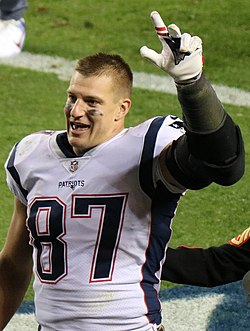
Quarterback Tom Brady and head coach Bill Belichick were the pillars of the Patriots dynasty throughout the 2000s and 2010s. During that period (2001–2019), they led the Patriots to nine Super Bowl appearances, winning six. They are widely regarded as the greatest QB-HC tandem of all time.Tight end Rob Gronkowski, nicknamed "Gronk", is widely regarded as one of the greatest TEs of all time. He was a staple of the 2010s offenses.
The Patriots made a pivotal move in 2000 by hiring Bill Belichick as head coach.[55] Belichick, previously a defensive assistant under Parcells and former head coach of the Cleveland Browns (1991–1995), quickly shaped a competitive roster using a combination of veteran free agents, such as linebacker Mike Vrabel and running back Corey Dillon, and high-value draft picks, including linebacker Tedy Bruschi and cornerback Ty Law. Under Belichick, the Patriots became one of the most consistently dominant teams in the NFL, with many describing the team as a "dynasty". In 2001, an injury to starting quarterback Drew Bledsoe allowed sixth-round pick Tom Brady to take over the offense, leading the team to a Super Bowl victory over the St. Louis Rams 20–17. Brady would go on to become one of the NFL's top quarterbacks, guiding the Patriots to additional Super Bowl victories in the 2003 season (32–29 over the Carolina Panthers) and the 2004 season (24–21 over the Philadelphia Eagles).[56][57] Their new home field, Gillette Stadium, opened in 2002 to replace the aging Foxboro Stadium.
Before the 2007 season, New England acquired All-Pro wide receiver Randy Moss, and the team set numerous offensive records while completing a perfect 16–0 regular season.[58] However, they were upset by the New York Giants in Super Bowl XLII 17–14.[59] That season was also marked by the "Spygate" controversy, in which the Patriots were penalized for videotaping the New York Jets sideline signals, resulting in fines for both Belichick and the team and the loss of a draft pick. Brady missed most of the 2008 season due to injury, and the team failed to make the playoffs despite an 11–5 record, but they returned to division-winning form in 2009. Moss was traded in 2010, yet the team remained among the league's highest-scoring offenses behind Brady, wide receiver Wes Welker, and tight end Rob Gronkowski, finishing with the AFC's best record in both 2010 and 2011, and reaching a Super Bowl rematch with the Giants, which they lost again 21–17.[60][61]
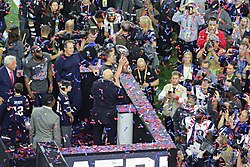
The Patriots continued to perform at a high level through the mid-2010s, recording 12–4 seasons and AFC championship appearances in 2012 and 2013. In 2014, New England again won 12 games and posted the best record in the AFC en route to winning a conference championship.[62] They won Super Bowl XLIX against the Seattle Seahawks 28–24,[63] though the season was later associated with the "Deflategate" controversy, resulting in a suspension for Brady and penalties for the team. In 2015, New England won another division title but fell in the AFC championship game. The following season, the Patriots went an NFL-best 14–2 and cruised through the postseason en route to another AFC championship. In Super Bowl LI, New England overcame a 25-point deficit against the Atlanta Falcons—the largest comeback in Super Bowl history—to secure their fifth championship, 34–28 in overtime.[64][65]
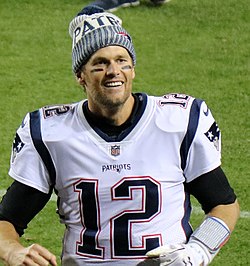
Tom Brady is seen celebrating the team's dramatic comeback victory over the Atlanta Falcons in Super Bowl LI
In 2017, the team went 13–3, advanced to Super Bowl LII, and lost narrowly to the Philadelphia Eagles 41–33, marking their fifth Super Bowl loss.[66] New England continued its dominance in 2018, earning the second seed in the AFC playoffs. After a convincing victory in the divisional round, the Patriots won a roller-coaster AFC championship game over the Kansas City Chiefs to qualify for a third straight Super Bowl. They defeated the Los Angeles Rams 13–3, in the lowest-scoring Super Bowl game in history, securing their sixth title and tying the Pittsburgh Steelers for the most Super Bowl victories in NFL history.[67][68][69] In 2019, the Patriots extended their streak of consecutive AFC East titles to 11, but were eliminated in the first round of the playoffs. In March 2020, Brady departed the team in free agency to join the Tampa Bay Buccaneers.[70]
Post-Brady era (2019–present)
Following Tom Brady's departure, the Patriots posted a losing record in 2020 and missed the playoffs for the first time since 2008.[71] The team declined further in 2023, finishing 4–13, after which Belichick parted ways with the organization.[72] In the 2024 NFL Draft, the Patriots selected quarterback Drake Maye,[73] but the team struggled again, finishing 4–13. Head coach Jerod Mayo was subsequently replaced by Mike Vrabel.[74] Under Vrabel, New England experienced a dramatic turnaround in 2025, finishing 14–3 and winning the AFC East. The 10-game improvement matched an NFL record.[75] The Patriots defeated the Denver Broncos, 10–7, in the AFC Championship Game to advance to Super Bowl LX, but lost to the Seattle Seahawks, 29–13.[76]
Logos and uniforms
Primary logos
The Patriots' primary logo used in the Sullivan era from 1961 to 1992, known as "Pat Patriot". Today, it is kept as a secondary logo, complementing the modern logo, the "Flying Elvis."
The Patriots' primary logo used since 1993, known as the "Flying Elvis". The only alteration since 1993 was the blue being darkened in 2000.
The Patriots original helmet logo was a simple tricorne hat, used only for the 1960 season. From 1961 to 1992, the Patriots used a logo of a Revolutionary War minuteman hiking a football. The Patriots wordmark logo during this time consisted of a western-style font. The minuteman logo became known as the "Pat Patriot" logo, which later became the name of the team's mascot.[77][78]
In 1979, the Patriots worked with NFL Properties to design a new, streamlined logo, to replace the complex Pat Patriot logo. The new logo featured the blue and white profile of a minuteman in a tricorne hat set against a flag showing three red stripes separated by two white stripes. Team owner Billy Sullivan decided to put the new logo up to a vote against Pat Patriot with the fans at the September 23 home game against the San Diego Chargers, using a sound level meter to judge the crowd's reaction. The new logo was decidedly rejected by the crowd in favor of Pat, and the concept was shelved.[79]
In 1993, a new logo was unveiled involving the gray face of a minuteman wearing a red, white and royal blue hat that begins as a tricorne and transitions into a flowing banner-like design. It became popularly known as the "Flying Elvis" due to many observing its resemblance to the profile of a young Elvis Presley. A new script logo was introduced as well in tandem with the "Flying Elvis", utilizing a cursive font.[78]
In 2000, the blue color used on the tricorne of the "Flying Elvis" as well as the outline of the cursive wordmark was switched from royal blue to nautical blue to coincide with the uniform change in the new millennium.[78]
On July 3, 2013, the Patriots unveiled a new wordmark to accompany the "Flying Elvis", which replaced the script of their previous cursive typeface with modernized block letters (colored in blue or white depending on the background), and modified the "Flying Elvis" to be underneath instead of flowing up-top. While appearing everywhere else, it was not applied on the uniforms until the 2015 season due to NFL uniform policies.[80]
The Patriots' wordmark used in the Sullivan era between 1960 and 1992.
The Patriots' wordmark used from 1993 to 2013, with the blue darkened in 2000. A version with the "Flying Elvis" attached to the top of the capital "P" was frequently used.
Uniforms
1960–1992
The uniforms worn by the Patriots in the Sullivan era from 1960 to 1992, with variations in the striping throughout the years in the shoulders and sleeves.
The Patriots' primary uniforms remained largely unchanged from the franchises' inaugural season until 1993. The Patriots originally wore red jerseys with white block numbering at home, and white jerseys with red block numbering on the road. Both uniforms used white pants and white helmets, first with the hat logo over the player's number, then with the "Pat Patriot" logo starting in 1961.[81] A blue stripe was added to the two red helmet stripes in 1964.[81] The numbers on both the home and away jerseys gained a blue outline in 1973.[81] In 1979, the Patriots began the first of many sporadic runs of wearing red pants with the white jerseys.[81] The red pants were dropped in 1981, but returned in 1984. After being dropped again in 1988, they were used again from 1990 to 1992.[81]
1993–1999
The uniforms worn by the Patriots in the early Kraft era from 1995 to 1999.
The Patriots underwent a complete identity overhaul before the 1993 season, starting with the introduction of the aforementioned "Flying Elvis" logo. The new uniforms consisted of a royal blue home jersey and a white away jersey.[78] The helmet was silver with the Flying Elvis logo and no additional striping.[78] Both uniforms used silver pants, originally with stripes designed to look like those flowing from the Flying Elvis, but these were changed to simple red and blue stripes after one season. When they debuted, both the home and away jerseys used red block numbers with a blue and white outline, but after one season the home uniforms switched to the now-familiar white with a red outline.[82]
In 1995, the Patriots switched the block numbers to a more modern rounded number font with a dropshadow.[82] The Patriots were one of the first adopters of custom numbers, a trend that would grow drastically over the next 20 years.[82] Along with the new number font, the Flying Elvis logos were moved from the sleeves to the shoulders.
2000–2019
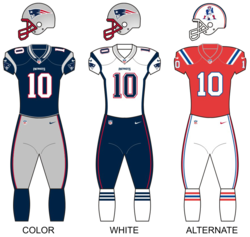
The primary uniforms worn by the Patriots in the dynasty era from 2000 to 2019.
In 2000, the Patriots then became one of the few teams at the time to drop the rounded numbers and switch back to block numbers. The shade of blue was switched for the first time in the franchises' history, from royal to nautical blue. The jerseys once again had the number on the shoulders while the logo moved back to the sleeves. "New Century" silver stripes were also added to the home jersey, with nautical blue stripes appearing on the away jersey. The Patriots, unsatisfied with the 1990s white-on-silver road look, also took the opportunity to introduce blue pants to be worn with the white jersey, offering a better contrast. To better match the blue pants, the number on the white jersey was switched from red to blue.[83]
Though the Patriots had generally worn silver pants with the blue jerseys, and navy pants with the white jerseys, they did wear an all-blue set during the 2002 season. On two consecutive home games that season, the Patriots wore blue tops with their road blue pants and white socks; they lost both games (Week 6 vs. the Packers, and Week 8 vs. the Broncos). The team would not wear an all-blue set again until the introduction of the Color Rush uniforms in 2016.[83]
Throughout the 2011 season, the Patriots wore dark patches with white lettering on their uniforms with the initials 'MHK' in honor of Myra Kraft, the late long-time spouse of owner Robert Kraft.[84]
2020–present
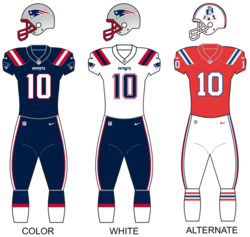
The primary uniforms worn by the Patriots in the post-dynasty era from 2020–present. Silver pants were introduced in 2024, and white pants the following year.
In 2020, the Patriots made some changes to their uniform. The all-blue "Color Rush" design became the primary home uniform, complete with a tweaked nameplate font and numbers, and blue/red/white socks. A corresponding white uniform was also unveiled, also paired with the blue pants. Both uniforms featured truncated shoulder striping as a nod to the "Pat Patriot" uniforms. Coincidentally, the arrival of new jerseys occurred with the departure of long-time quarterback, Tom Brady, from the Patriots. Brady was in New England exactly between the last uniform change in 2000, and left before the 2020 uniform change in 2019.[85][86][87]
The Patriots brought back the silver pants to pair with the current uniforms in a 2022 Week 7 home game on Monday Night Football against the Chicago Bears. Unlike the previous silver pants the team wore from 2000 to 2019, this design featured thicker red stripes, matching the same width as the middle blue stripe.[88] During a 2024 Week 7 road game at Wembley Stadium against the Jacksonville Jaguars, the Patriots paired their silver pants with the road white uniform for the first time since 1999. After their largest victory of the 2024 season in a Week 10 road game dressed again in the silver pants with the road white uniform, the Patriots quietly promoted the silver pants to full-time use with both the home and road uniform for the rest of the season.[89]
For the Patriots' 2025 Week 6 road game at the New Orleans Saints, they reintroduced white pants to the primary uniform rotation, wearing them with the road white uniform. The Patriots last wore an all-white kit in 2017. Like with the silver pants, the white pants feature red-blue-red side stripes.[90] After going 6–0 in the white-over-white look, the Patriots opted to wear the white pants and white jerseys in Super Bowl LX.[91]
Alternate uniforms
In 1994, the Patriots wore the "Pat Patriot" helmets and plain white striped pants from two seasons earlier as alternates as part of the NFL's 75th-anniversary celebration. In 2002, NFL teams were allowed to add a permanent third jersey to be worn in a maximum of two games. The Patriots reintroduced a red jersey as their alternate, complemented with the old-style "Pat Patriot" helmet.[78] In 2003, the Patriots changed their alternate to a silver jersey with blue pants. For this uniform, the "Flying Elvis" helmet was used.[78] The uniform was identical to the white jersey with any areas of white replaced by silver. These uniforms were dropped after 2007. No alternate uniform was used in 2008. In 2009, the red alternate was reintroduced, again accompanied by the "Pat Patriot" helmet. An alternate white road jersey was also worn with the older helmet for one game, using red numbers, in tribute to the 50th anniversary of the AFL. The red alternate gained a blue outline around the numbers in 2010 and this was worn through 2012. The Patriots temporarily retired their alternate red uniforms in 2013, due to a new NFL rule outlawing throwback alternate helmets, and restricting teams to one helmet shell only.[92] However, after the NFL reinstated the use of alternate helmets in 2022, the Patriots brought back the throwback red uniforms.[93]
In 2016, the Patriots took part in the NFL's Color Rush program, wearing monochrome navy uniforms on September 22 against the Houston Texans.[94] The uniform tops were patterned after the 1980s Pat Patriot-era uniforms, while the pants featured thick white stripes with red accents. They wore them a total of four times from 2016 to 2019, and were the basis of the team's current primary uniforms. In 2017, an all-white Color Rush uniform was introduced and used for the Patriots' Thursday night road game against the Tampa Bay Buccaneers.[95]
In 2025, the Patriots unveiled a "Rivalries" uniform that would be worn at home against each of their AFC East opponents over a three-year period. Dubbed the "Nor'easter", the design featured a Storm Blue base with white and navy shoulder stripes, italicized white numbers with navy drop shadows, and a new "NE" logo on the sleeves. Six red stars along the neckline represent each of New England's six states. The uniform is worn with white pants and helmets, which featured a silver-trimmed "Flying Elvis" decal without red accents.[96]
Since 2002, the Patriots' home stadium has been Gillette Stadium, located 22 miles outside Boston in Foxborough, Massachusetts.[97] A $350million facility privately financed by Robert Kraft, it houses the team's practice facilities, administrative offices, and its owning entity The Kraft Group, as well as the Kraft-owned Major League Soccer team, the New England Revolution.[98] The field's natural grass was replaced with a FieldTurf surface during the 2006 season.[99] The Patriots installed a new video board, the largest in the United States, in 2023.[100] Gillette Stadium has hosted more postseason games than any other venue except Candlestick Park's 27. From 2001 to 2019, the Patriots often played home playoff games. The Patriots had a 21–4 playoff record in this stadium after the 2025 NFL season.[101][102] Beginning in 2007, the area around the stadium was developed into a $375million "lifestyle and entertainment center" called Patriot Place; among its largest structures is a multi-floor restaurant and bar called CBS Scene.[103]
From 1971—the team's second year in the NFL after the AFL–NFL merger—to 2002, the Patriots played in the privately funded Foxboro Stadium. The final game in this stadium was the 2001 AFC Divisional Playoff game which was a 16–13 overtime win over the visiting Oakland Raiders, known for the raging snowstorm and the "tuck rule" call.[98] During the team's days in the American Football League and its first year in the NFL, the Boston Patriots were hosted by a number of fields in or around Boston.[98]
The Patriots have held their annual training camp in Foxborough, Massachusetts, since 2003, practicing on the fields adjacent to Gillette Stadium. Prior to this permanent move, the team shifted between various school campuses in Massachusetts and Rhode Island (i.e., Bryant College and the University of Massachusetts Amherst).[104]
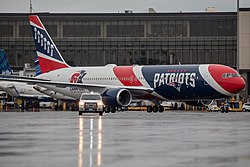
In 2017, the Patriots purchased two Boeing 767-300ERs for use as team planes, with one serving as the backup, which were ready in time for the 2017 NFL season. This made them the first team in league history to own their own planes.[105] At the time it was getting more difficult for professional sports teams to book private charter flights, with eight teams being dropped that season, as major commercial airlines were instead focusing on more profitable scheduled flights.[106] The two jet airliners, N366AA and N39367, were previously operated by American Airlines from 1991 to 2016. The planes are known affectionately as "AirKrafts" after team owner Robert Kraft.[107] Kraft lent one of the planes to transport students to the March for Our Lives demonstration in Washington, D.C. in 2018.[108]
In 2020, the New England Patriots signed an agreement with Eastern Airlines to handle the operations of their planes. In July 2023, the Patriots filed a lawsuit against Eastern Airlines over an alleged breach of contract.[109] Since February 2024, the planes are operated by Omni Air International.[110]
LB Willie McGinest (left), LB Tedy Bruschi (middle), and LB Mike Vrabel (right) are three Patriots credited for instilling and defining what was described the "Patriot Way" throughout the dynasty from 2001 to 2019.
Under head coach Bill Belichick, the Patriots employed specific on-field and off-field strategies. On the field, the Patriots typically used an "Erhardt–Perkins" offense and a "Fairbanks–Bullough" 3–4 defense, referred to commonly as a two-gap 3–4 defensive system. Under Erhardt's, Perkin's and Bullough's stints as coordinators and head coaches across the league after developing the scheme in collaboration with head coach Chuck Fairbanks, the systems developed in New England in the 1970s would begin to see historic use. Influence spread, especially under their coaching tree in Bill Parcells' schemes as head coach of the New York Giants in the mid-to-late 1980s, after serving as a linebacker coach for the Patriots in 1980. Parcells would come back to New England as head coach in 1993 and re-install the system used in the 1970s and 1980s, re-uniting with Ray Perkins as WR coach. Parcells own coaching tree would use the scheme created in New England as well, especially Belichick, once he was named as head coach after years of being an assistant to Parcells with the New York Giants, the Patriots, and the New York Jets.[116]
During Belichick's tenure, the philosophy in making personnel decisions and in game planning focused on the "team" concept,[117] stressing preparation, strong work ethic, versatility,[118] and lack of individual ego.[119]
The team culture under Belichick, dubbed the "Patriot Way", included:
A self-critical, perfectionist, and militaristic approach[120]
An emphasis on team,[121] equality among players and lack of individual ego[122]
A strong work ethic, intelligence and high level of focus and preparation for each individual game[123]
Multiple schemes intended to take advantage of their opponent's weaknesses[125][126]
Championships
Super Bowl championships
The Super Bowl banners for the Patriots' first three league championships at Gillette Stadium.A Super Bowl hero, CB Malcolm Butler made one of the greatest plays in NFL history with a game-clinching interception at the goal line in Super Bowl XLIX, ensuring the Patriots' victory in the final seconds of the game.
The New England Patriots have won six Super Bowls, the league championship of the NFL. The franchise is tied for the most all-time with the Pittsburgh Steelers. The team repeated as champions between the 2003 and 2004 NFL seasons, they are only among eight NFL franchises to accomplish the feat. Between 2001 and 2004, the Patriots became the second team in NFL history to win three Super Bowls in four years (2001, 2003, and 2004).[127]
The Patriots have won 23 division championships, which is second place for the most all-time behind the Pittsburgh Steelers and Dallas Cowboys, who are tied in first with 24. One of these divisional titles was won in the AFL in the AFL East (1963), the rest were won in the AFC East of the NFL.[1]
The Pro Football Hall of Fame has inducted six players who made their primary contribution to professional football while with the Patriots. The Patriots' total number of Pro Football Hall of Famers is 13 (12 players and one coach).[136]
Notes:
Hall of Famers who made a major part of their primary contribution for the Patriots are listed in bold.
Hall of Famers who spent only a minor portion of their career with the Patriots are listed in normal font.
New England Patriots in the Pro Football Hall of Fame
The Patriots Hall of Fame features 31 former players and four contributors as a part of the franchise's own hall of fame, founded to independently commemorate significant members of the organization within the club's history. It is referred to by the team as "the franchise's highest individual honor". It was established in 1991, with John Hannah being the inaugural member.[138]
The physical Patriots Hall of Fame building opened in 2008 outside of the stadium at Patriot Place, presented by RTX. Featuring a vast collection of game-worn gear, game-used equipment, memorabilia, trophies, in addition to multiple exhibits using audio and video technology, it is periodically renovated and updated yearly. It is described as a "modern, interactive museum".[139]
A committee of media and staff selected 11 players for enshrinement between 1991 and 2001, before a six-year span of no selections. In 2007, in advance of the grand opening of the physical Patriots Hall of Fame in 2008, the club introduced a new nomination committee to select three candidates, with the winner of an internet fan vote being enshrined in the hall of fame.[140] In order to be eligible, players and head coaches must be retired for at least four years. Beginning in 2011, and meeting every four-to-five years, a senior selection committee has the option of voting a player who has been retired for at least 25 seasons into the hall of fame, alongside the traditional inductee.[141]
Starting in 2009, long-time "contributors", which can range from roles such as assistant coaches and broadcasters, have been periodically inducted into the Patriots Hall of Fame directly by owner Robert Kraft. Former team owner and founder Billy Sullivan was posthumously inducted in March 2009, before the Patriots' 50th season, as the first contributor inducted.[142][143]
Patriots were named to the AFL All-Time Team (1960–1969), as well any NFL all-decade team after the AFL–NFL merger in 1970 (and NFL 75th and 100th Anniversary All-Time Teams, selected in 1994 and 2019, respectively).[145] Only those who spent time with New England during the respective decades are listed for all-decade team selections.
Bold indicates those elected to the Pro Football Hall of Fame.
Billy Sullivan, a Massachusetts native, brought professional football back to the state after nearly 11 years by founding the Patriots in 1959. His 27-year ownership was controversial.
The Patriots have had four owners since becoming a franchise, the first being Massachusetts native Billy Sullivan from 1959 to 1988. During Sullivan's 28 seasons of owning the club, the Patriots tallied 14 winning records, made six playoff appearances, played in the 1963 AFL Championship Game and represented the AFC in Super Bowl XX. However, he was also notoriously cheap, and would cause friction with some his high-profile players who were seeking to be respected and paid more, causing someone such as future Pro Football Hall of Famer Mike Haynes to seek an owner who was team first.[147]
After his bankruptcy, Sullivan sold the team to Remington Products owner Victor Kiam in 1988.[147] The sale did not include Foxboro Stadium, which Sullivan lost in a bankruptcy sale to paper magnate Robert Kraft, and Kiam lost money on the deal. In 1990, Lisa Olson, a Boston Herald reporter, sued Kiam and the Patriots when Zeke Mowatt allegedly exposed himself and made lewd comments to her in the team change room. The incident stirred debate over female reporters in the locker room. Kiam became the center of the controversy when he came to the defense of the players' actions.[148]
In his later career, Kiam's business interests moved on from the Patriots, so he sold them in 1992 to St. Louis businessman James Orthwein. During his ownership, Orthwein hired Bill Parcells as head coach and oversaw the drafting of first-overall draft pick quarterback Drew Bledsoe, who helped to return the moribund franchise to respectability. He planned to relocate the Patriots franchise to St. Louis, renaming the team the St. Louis Stallions. However, those plans were derailed when Boston paper magnate Robert Kraft, owner of Foxboro Stadium, refused to accept a buyout of the lease. Kraft used his ownership of the stadium to stage a hostile takeover, offering to pay $175 million for the Patriots franchise knowing that Orthwein no longer wanted the team if he could not move it to St. Louis. Although future St. Louis/Los Angeles Rams owner Stan Kroenke offered to buy the team for $200 million and move it to St. Louis, Orthwein would have been saddled with all moving expenses. He also would have been responsible for any legal expenses as well, and Kraft had already made it clear that he would go to court to enforce the lease. With no other choice, Orthwein accepted Kraft's bid on January 21, 1994.[149]
Robert Kraft, a native Bostonian and a Patriots fanatic before purchasing the team, bought the franchise in 1994.
Kraft had been a life-long fan (he was a season ticket holder since 1971) before he purchased the team and intended to support them much more than all of the previous owners did, making multiple moves that have turned New England into an admirable franchise since. The Patriots under Kraft have been the NFL's most successful franchise since 1994. Since then, the Patriots have appeared in ten Super Bowls, have won six, and had numerous league records established by the franchise.[150][151]
In September 2025, Robert Kraft agreed to sell minority stakes in the franchise: 5 percent to billionaire investor Dean Metropoulos and 3 percent to private equity firm Sixth Street. The deal, which still requires approval by NFL owners, values the team at around $9 billion. The Kraft family will retain more than 90 percent ownership.[152][153][154][155]
Bill Belichick, head coach from 2000 to 2023, led the Patriots to six Super Bowl titles.
The Patriots have had 16 head coaches throughout their history as a franchise. On January 12, 2025, the Patriots hired Mike Vrabel as their 16th head coach in franchise history, he is the second coach in the club's history to have played for the team (2001–2008).[156][157]
Bill Belichick had the longest tenure as head coach (23 seasons) with the Patriots, and coached the team from 2000 to 2023. He has been widely considered one of the greatest coaches of all time, and was named a member of the NFL 100th All-Time Anniversary Team, due to his numerous accomplishments with the Patriots.[158] He specifically led the Patriots to 17 AFC East division titles, 13 appearances in the AFC Championship Game, and nine Super Bowl appearances, with a record six wins.[159]
Belichick was acquired in a "trade" with the rival New York Jets.[163] Belichick did not want to be under Bill Parcells' authority there in 2000, with uncertainty of his role once their owner, Leon Hess, died. The initial promise was that Belichick would've been granted extreme authority over all of the Jets executive decisions, but when Hess died Parcells overruled the stipulation with loopholes, so he would remain in control as general manager, leading to Belichick's infamous resignation in 2000. Parcells, a two winning Super Bowl champion coach with the New York Giants (also was an assistant with the Patriots in the early 1980s), had joined New England's staff for the 1993 season to help resurrect the franchise from its dark early 1990s days but had conflicted interests with owner Robert Kraft.[164] In his last year with the Patriots in 1996, Parcells brought in his assistant head coach from his Giants days, Belichick, after being dismissed from coaching five seasons with the Cleveland Browns. Here, Kraft would plant the seeds of a bond between him and Belichick, as Belichick would often mediate issues between Kraft and Parcells. Although Belichick left in 1997 to once again be Parcells assistant in their Jets regime, cold feet about his long-term role there brought him back after negotiating with Kraft, even though he was still under contract with the Jets.[165] The Patriots had technically "tampered" in communicating with Belichick. For compensation, the Patriots gave the Jets their first round pick in the 2000 NFL draft, where even without their first round pick, the Patriots would coincidentally draft Tom Brady in the sixth round, widely regarded as the greatest quarterback of all time and the NFL's greatest draft steal.[166]
While Belichick led the team to nine of their eleven Super Bowl appearances, winning six of them, before him the Patriots saw some championship game appearances. Holovak, Raymond Berry and Parcells all led the Patriots to league championship games, with only one coach failing to reach the Super Bowl. Five Patriots head coaches, Holovak, Chuck Fairbanks, Berry, Parcells, and Belichick, have been named Coach of the Year by at least one major news organization. The first head coach in franchise history was Lou Saban, who coached them to a 7–12–0 record in the 1960 season.[167]
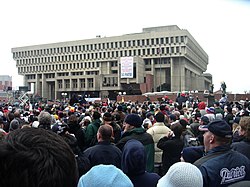
Patriots fans rallying in celebration of the team's Super Bowl XXXVIII championship in front of Boston City Hall in 2003 (left). Patriots fans in attendance for the victory parade of Super Bowl LI on Boylston St., Boston in 2017 (right).
The team's cheerleading squad performing a routine in 2007
The Patriots' professional cheerleading squad is the New England Patriots Cheerleaders which represents the team in the NFL.[168] Notable alumni of the cheerleading squad include wrestler Carmella[169] and model Camille Kostek.[170] Long-time cheerleading director Tracy Sormanti, who was the cheer director since 1994 and had been involved with the organization since 1983, died after a three-year battle with multiple myeloma in 2020.[171] She was inducted into the Patriots Hall of Fame in 2021 as a contributor.[172]
The Patriots also employ a corps known as the End Zone Militia, a group of American Revolutionary War reenactors founded in 1996 by Geoff Campbell, a reenactor for the 9th Massachusetts Regiment (26th Continental Regiment).[174] Consisting of about 30 men and women, they dress 20 for each home game and split themselves into two groups of 10 lining the back of either end zone. When the Patriots score – whether it be a touchdown, field goal, point-after-touchdown or safety – the militia behind the opposite end zone fire a volley of blanks from flintlock muskets. Per an interview with the Loren & Wally Show on WROR 105.7 FM in and around the time of Super Bowl XLIX, said shots use double the load of black powder than a regular historical reenactor does, specifically 200 grains, in order to be heard throughout the stadium. ESPN writer Josh Pahigian named this one of the top ten celebrations in the league in 2007.[175]
The Patriots' flagship radio station is WBZ-FM (98.5 FM, otherwise known as "The Sports Hub"),[179] owned by Beasley Broadcast Group.[180] The larger radio network is called the New England Patriots Radio Network, whose 37 affiliate stations span seven states.[179]Gil Santos and Gino Cappelletti were the longtime announcing team until their retirement following the conclusion of the 2012 NFL season.[181] Santos was replaced by Bob Socci.[179] Former Patriots QB Scott Zolak joined the radio team in the 2011 season as a sideline analyst, and in 2013, he replaced Cappelletti as color commentator.[179]
Any preseason games not on national television are shown on CBS's O&OWBZ-TV, who also airs the bulk of Patriots regular-season games by virtue of CBS having the rights to most AFC games; CBS also has a presence at the nearby Patriot Place with the "CBS Scene" bar and restaurant. During the regular season whenever the Patriots host an NFC team, the games are aired on Fox affiliate WFXT-TV, and NBC Sunday Night Football games are carried by Boston NBC station WBTS-CD.[179] Preseason games were broadcast on ABC affiliate WCVB-TV from 1995 until the change to WBZ in 2009 (WCVB continues to simulcast ESPN's Monday Night Football games featuring the Patriots).[179]Don Criqui was play-by-play announcer for the 1995–2012 seasons, with Randy Cross as a color commentator and Mike Lynch as a sideline reporter.[179] Lynch was replaced by WBZ reporter Steve Burton in 2009.[179]
↑Despite not technically being eligible until 2027 under the current rules, the traditional four-year waiting process was waived exclusively for Brady, directly by owner Robert Kraft, in addition to being inducted without the conventional ballot.
↑Seymour was voted into the Patriots Hall of Fame in 2020, however due to the COVID-19 pandemic his induction did not take place until 2021.
↑Sormanti, inducted as a contributor, was the only member of the class of 2021 due to the COVID-19 pandemic, as the ballot for the traditional inductee was cancelled for that year.
↑As a part of the NFL 2010s All-Decade Team, Jones was listed as a linebacker (LB) due to his time with the Arizona Cardinals, in New England however he was specifically listed as a defensive end (DE).
↑"New uniforms unveiled". Patriots.com. NFL Enterprises, LLC. May 25, 2000. Archived from the original on February 2, 2021. Retrieved August 16, 2021. Exactly what do colors Nautical Blue and New Century Silver look like? Find out Saturday evening, May 27, right here on Patriots.com. We'll show you exactly what the new uniforms look like after they are unveiled at the WBCN River Rave concert at Foxboro stadium.
↑Perillo, Paul (July 12, 2023). "The Case for Robert Kraft". Paul Perillo. New England Patriots. Archived from the original on August 16, 2022. Retrieved August 23, 2022.
12McManaman, Bob (September 6, 2015). "NFL's Dynasties by the Decade". The Arizona Republic. Archived from the original on October 24, 2023. Retrieved June 19, 2022.
↑"Boston Patriots Selected as Name". The North Adams Transcript. February 17, 1960. Archived from the original on April 14, 2021. Retrieved March 3, 2021– via Newspapers.com.
↑"Design". Gillette Stadium. Retrieved September 11, 2025. The beginning of the 2023 NFL season marked the completion of the most dramatic Gillette Stadium improvements since its opening in 2002.
123"Sports". Gillette Stadium. Archived from the original on March 2, 2014. Retrieved March 2, 2014.
Lavin, James (2005). Management Secrets of the New England Patriots: From Patsies to Triple Super Bowl Champs Vol. 1. Pointer Press. ISBN0-9762039-5-2.
Lavin, James (2005). Management Secrets of the New England Patriots: From Patsies to Triple Super Bowl Champs Vol. 2. Pointer Press. ISBN0-9762039-8-7.
Myers, Gary (2025). Brady vs. Belichick: The Dynasty Debate (First hardcovered.). New York: St. Martin's Press. ISBN9781250381194. OCLC1478323773.
This page is based on this Wikipedia article Text is available under the CC BY-SA 4.0 license; additional terms may apply. Images, videos and audio are available under their respective licenses.
 Current season