Ирæттæ, Дигорæнттæ / Irættæ, Digorænttæ | |
|---|---|
| Ossetian folk dancer in North Ossetia (Russia), 2010 | |
| Total population | |
| c. 700,000[ citation needed ] | |
| Regions with significant populations | |
| Russia | 558,515 [1] |
| (North Ossetia–Alania) | 480,310 [2] |
| South Ossetia | 51,000 [3] [4] |
| Georgia (excluding South Ossetia P.A.) | 14,385 [5] |
| Turkey | 20,000–50,000 [6] [7] [8] [9] |
| Tajikistan | 7,861 [10] |
| Uzbekistan | 5,823 [11] |
| Ukraine | 4,830 [12] |
| Kazakhstan | 4,308 [13] |
| Turkmenistan | 2,066 [14] |
| Azerbaijan | 1,170 [15] |
| Kyrgyzstan | 758 [16] |
| Syria | 700 [17] |
| Belarus | 554 [18] |
| Moldova | 403 [19] |
| Armenia | 331 [20] |
| Latvia | 285 [21] |
| Lithuania | 119 [22] |
| Estonia | 116 [23] |
| Languages | |
| Ossetian | |
| Religion | |
| Related ethnic groups | |
| Jasz, Asud, other Iranian peoples, Caucasian peoples | |
a. ^ The total figure is merely an estimation; sum of all the referenced populations. | |
The Ossetians [a] also known as Ossetes, [b] Ossets [c] and Alans , [d] are an Iranian [27] [28] [29] [30] ethnic group who are indigenous to Ossetia, a region situated across the northern and southern sides of the Caucasus Mountains. [31] [32] [33] They natively speak Ossetian, an Eastern Iranian language of the Indo-European language family, with most also being fluent in Russian as a second language.
Currently, the Ossetian homeland of Ossetia is politically divided between North Ossetia–Alania in Russia, and the de facto country of South Ossetia (recognized by the United Nations as Russian-occupied territory that is de jure part of Georgia). Their closest historical and linguistic relatives, the Jász people, live in the Jászság region within the northwestern part of the Jász-Nagykun-Szolnok County in Hungary. A third group descended from the medieval Alans are the Asud of Mongolia. Both the Jász and the Asud have long been assimilated; only the Ossetians have preserved a form of the Alanic language and Alanian identity. [34]
The majority of Ossetians are Eastern Orthodox Christians, [35] with sizable minorities professing the Ossetian ethnic religion of Uatsdin as well as Islam.
The name Ossetians and Ossetia come from Russian Osetin, which in turn borrowed the Georgian term Oseti (ოსეთი), a toponymic formation meaning 'the land of the Osi'. [36] [37] [ page needed ]
In Georgian, Osi (ოსი, pl. Osebi ოსები) has been used since the Middle Ages to refer to the Iranian-speaking population of the central Caucasus, ancestors of the modern Ossetians. The term ultimately derives from the Sarmatian ethnonym As (also attested as Ās in classical and medieval sources), the self-designation of an eastern Iranian tribe belonging to the Alanic branch of the Sarmatians. [36] [37] [ page needed ]
The root os/as- is thought to descend from an earlier form *ows/aws-. This is supported by several parallels: the archaic Georgian root ovs- (as in Ovsi, Ovseti), recorded in the Georgian Chronicles ; the gemination of s and/or lengthening of the preceding vowel in related forms (Ās, Āṣ in Middle Persian; Aas, Assi in Latin sources); and the Armenian ethnic name Ōsur- (reconstructed as *Awsowrk' ), which appears to be connected to the Jassic term *Jaszok, reflecting descendants of an Alanic branch of the Sarmatians attested near the Caucasus by the 7th century AD. [38]
The ethnonym Iasi (pronounced 'Yazi'), cognate with Hungarian Jász (designating the Jasz people), stems from the Latin Iazyges , itself a rendering of the Sarmatian tribal name *Yazig, used among among western groups related to the Alans. The name is generally traced to the Proto-Iranian root *yaz- ('to worship' or 'to sacrifice'), perhaps originally signifying 'those who perform sacrifices'. In contrast, the broader Sarmatian confederation is thought to have called themselves Arii-tai ('Aryans'), a term preserved in modern Ossetian as Irættæ ('the Aryans', also the ethnonym underlying Iron, the main Ossetian subgroup). [36] [37] [ page needed ]
Since Ossetian speakers lacked any single inclusive name for themselves in their native language beyond the traditional Iron–Digoron subdivision, these terms came to be accepted by the Ossetians as an endonym even before their integration into the Russian Empire. [39]
This practice was put into question by the new Ossetian nationalism in the early 1990s, when the dispute between the Ossetian subgroups of Digoron and Iron over the status of the Digor dialect made Ossetian intellectuals search for a new inclusive ethnic name. This, combined with the effects of the Georgian–Ossetian conflict, led to the popularization of Alania , the name of the medieval Sarmatian confederation, to which the Ossetians traced their origin and to the inclusion of this name into the official republican title of North Ossetia in 1994. [39]
The native beliefs of the Ossetian people are rooted in their Sarmatian origin, which have been syncretized with a local variant of Folk Orthodoxy, in which some pagan gods have been converted into Christian saints. [42] The Narts, the Daredzant, and the Tsartsiat, serve as the basic literature of folk mythology in the region. [43]
Ossetian folk songs are divided into 10 unique genres:
Ossetians use the following Instruments in their music:
The Ossetians descend from the Iazyges tribe of the Sarmatians, an Alanic sub-tribe, which in turn split off from the broader Scythians itself. [35] The Sarmatians were the only branch of the Alans to keep their culture in the face of a Gothic invasion (c. 200 AD) and those who remained built a great kingdom between the Don and Volga Rivers, according to Coon, The Races of Europe. Between 350 and 374 AD, the Huns destroyed the Alan kingdom in the Battle of the Tanais River and the Alan people were split in half. A few fled to the west, where they participated in the Barbarian Invasions of Rome, established short-lived kingdoms in Spain and North Africa, and settled in many other places such as Orléans, France, Iași, Romania, Alenquer, Portugal and Jászberény, Hungary. The other Alans fled to the south and settled in the Caucasus, where they established their medieval kingdom of Alania.[ citation needed ]
In the 7th century, in the well-known chronicle, Ashkharhatsuyts, the Alans were mentioned under the ethnonym Alanac, As-Digor [44]
In the 8th century, a consolidated Alan kingdom, referred to in sources of the period as Alania, emerged in the northern Caucasus Mountains, roughly in the location of the latter-day Circassia and the modern North Ossetia–Alania. At its height, Alania was a centralized monarchy with a strong military force and had a strong economy that benefited from the Silk Road.
Alania reached its peak in the 11th century under the Alanian ruler Durgulel, who established relations with the Byzantine Empire. [46]
Before the Mongol invasion, the Alans lived in the territory from the Laba (river) to the Argun River. [47] In 1220, Genghis Khan sent his commanders Subutai and Jebe on a campaign, ordering them to reach "eleven countries and peoples", among whom were the "Kibchaut" (Kipchaks), "Orusut" (Rus'), "Machjarat" (inhabitants of the city Majar), "Asut" (Alania), "Sessut" (Durdzuks), "Serkessut" (Circassians) and others [48] The Mongols, led by the generals Jebe and Subutai, met the Alans for the first time in 1222 after passing through Shirvan and Dagestan. They were confronted by a Kipchak-Alan alliance, which they defeated by scheming with the Kipchaks.
As a result of the second campaign of 1238-1239, a significant part of the Alania plain was captured by the Mongol Empire, and Alania itself ceased to exist as a political entity. [49]
After the Mongol invasions of the 1200s, the Alans migrated further into Caucasus Mountains, where they would form three ethnographical groups; the Iron, the Digoron and the Kudar. The Jassic people are believed to be a potentially fourth group that migrated in the 13th century to Hungary.
In 1292, the Alanian king Os-Bagatar attacked the territory of Georgia and captured the territory of Gori, and a significant part of Shida Kartli. He tried to restore the statehood of Alania. [50] But in 1306, Os-Bagatar died, and in 1326, George V of Georgia, after several attempts, was able to take Gori and drive the Alans out of the South Caucasus and Dvaletia. [51] [52]
In more-recent history, the Ossetians were involved in the Ossetian–Ingush conflict (1991–1992) and Georgian–Ossetian conflicts (1918–1920, early 1990s) and in the 2008 South Ossetia war between Georgia and Russia.
Key events:
Ever since de facto independence, there have been proposals in South Ossetia of joining Russia and uniting with North Ossetia.
The Ossetian language belongs to the Eastern Iranian (Alanic) branch of the Indo-European language family. [35]
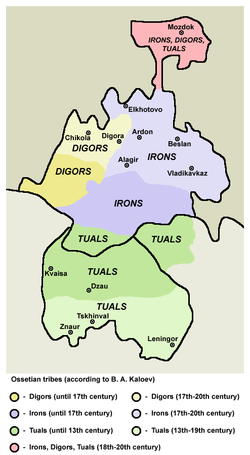
Ossetian is divided into two main dialect groups: Ironian [35] (os. – Ирон) in North and South Ossetia and Digorian [35] (os. – Дыгурон) in Western North Ossetia. In these two groups are some subdialects, such as Tualian, Alagirian and Ksanian. The Ironian dialect is the most widely spoken.
Ossetian is among the remnants of the Scytho-Sarmatian dialect group, which was once spoken across the Pontic–Caspian Steppe. The Ossetian language is not mutually intelligible with any other Iranian language.[ citation needed ]
Prior to the 10th century, Ossetians were strictly pagan, though they were partially Christianized by Byzantine missionaries in the beginning of the 10th century. [61] By the 13th century, most of the urban population of Ossetia gradually became Eastern Orthodox Christian as a result of Georgian missionary work. [35] [62] [63]
Islam was introduced shortly after, during the 1500s and 1600s, when the members of the Digor first encountered Circassians of the Kabarday tribe in Western Ossetia, who themselves had been introduced to the religion by Tatars during the 1400s. [64]
According to a 2013 estimate, up to 15% of North Ossetia’s population practice Islam. [65]
In 1774, Ossetia became part of the Russian Empire, which only went on to strengthen Orthodox Christianity considerably, by having sent Russian Orthodox missionaries there. However, most of the missionaries chosen were churchmen from Eastern Orthodox communities living in Georgia, including Armenians and Greeks, as well as ethnic Georgians. Russian missionaries themselves were not sent, as this would have been regarded by the Ossetians as too intrusive.
Today, the majority of Ossetians from both North and South Ossetia follow Eastern Orthodoxy. [35] [66]
Assianism (Uatsdin or Aesdin in Ossetian), the Ossetian folk religion, is also widespread among Ossetians, with ritual traditions like animal sacrifices, holy shrines, annual festivities, etc. There are temples, known as kuvandon, in most villages. [67] According to the research service Sreda, North Ossetia is the primary center of Ossetian Folk religion and 29% of the population reported practicing the Folk religion in a 2012 survey. [68] Assianism has been steadily rising in popularity since the 1980s. [69]
The first data on the number of Ossetians dates back to 1742. According to the Georgian Archbishop Joseph, the number of Ossetians was approximately 200 thousand [70]
Outside of South Ossetia, there are also a significant number of Ossetians living in Trialeti, in North-Central Georgia. A large Ossetian diaspora lives in Turkey and Syria. About 5,000–10,000 Ossetians emigrated to the Ottoman Empire, with their migration reaching peaks in 1860–61 and 1865. [71] In Turkey, Ossetians settled in central Anatolia and set up clusters of villages around Sarıkamış and near Lake Van in eastern Anatolia. [72] Ossetians have also settled in Belgium, France, Sweden, the United States (primarily New York City, Florida and California), Canada (Toronto), Australia (Sydney) and other countries all around the world.
The vast majority of Ossetians live in Russia (according to the Russian Census (2002)):
The Ossetians are a unique ethnic group of the Caucasus, speaking an Indo-Iranian language surrounded mostly by Vainakh-Dagestani and Abkhazo-Circassian ethnolinguistic groups, as well as Turkic tribes such as the Karachays and the Balkars.
Like many other ethnolinguistic groups in the Caucasus, the genetic heritage of the Ossetians is both diverse yet distinctive. While Ossetians share genetic traits with neighboring populations, they have retained a distinct identity. With 70% of Ossetian males belonging to the Y-chromosomal haplogroup G2, specifically the G2a1a1a1a1a1b-FGC719 subclade. Among Iron people, this percentage rises to 72.6%, compared to 55.9% among Digor people. [73] [74]
This haplogroup has been identified in Alan burials associated with the Saltovo-Mayaki culture. In a 2014 study by V. V. Ilyinsky on bone fragments from ten Alanic burials along the Don River, DNA analysis was successfully performed on seven samples. Four of these belonged to Y-DNA Haplogroup G2, while six exhibited mitochondrial DNA (mtDNA) haplogroup I. [75] [76] The shared Y-DNA and mtDNA among these individuals suggest they may have belonged to the same tribe or were close relatives. These findings strongly support the hypothesis of direct Alan ancestry for Ossetians. This evidence challenges alternative theories, such as Ossetians being Caucasian speakers assimilated by the Alans, reinforcing that Haplogroup G2 is central to their genetic lineage. [77]
The Ossetians are an Iranian people of the Caucasus.
The Ossetians are an East Iranian people, the Kalmyks and Buryats are Mongolian, and the Bashkirs are Turkic people.
For most of Georgian history, those Ossetians (formerly Alanians, an Iranian people, remnants of the Scythians)...
The Ossetians are a people of Iranian descent in the Caucasus that uniquely occupy territories on both sides of the Caucasus Mountain chain.