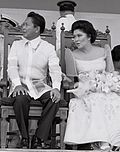
Ferdinand Marcos

Last updated

194965
Carmen Ortega (commonlaw)
(before 1954)
[4]
Imelda Romualdez
(m. 1954)
Ferdinand Marcos
Ferdinand Marcos (cropped)(2).jpg
Marcos in 1982
10th President of the Philippines
In office
December 30, 1965 February 25, 1986
Vice President
Preceded by Diosdado Macapagal
Succeeded by Corazon Aquino
Children9, including Imee, Bongbong, Irene, and Aimee
Parents
Relatives Marcos family
Alma mater University of the Philippines Manila (LL.B)
Occupation
Signature Marcos Sig.svg
Nicknames
  • Apo Lakay
  • Ferdie
  • Macoy
Military service
Allegiance
  • Philippines
  • United States [b]
Years of service1942–1945
Rank
Unit
Battles/wars World War II
Criminal charges
    • Murder
    • contempt of court
    (1939)
Criminal penalty
  • 10–17 years imprisonment
(1940)
Criminal statusAcquitted on appeal (1940)

Ferdinand Emmanuel Edralin Marcos Sr. [c] (September 11, 1917 – September 28, 1989) was a Filipino lawyer, military officer, and politician who served as the tenth and longest serving president of the Philippines from 1965 to 1986. His regime has been widely referred to as a kleptocracy. [7] [8] [9] From 1972 to 1981, Marcos ruled the Philippines under martial law as a dictator, embracing a policy of "constitutional authoritarianism." [10] [11] [12] Following the reestablishment of democracy in 1981, a wide-ranging economic crisis, and the assassination of Ninoy Aquino, Marcos was deposed in 1986 by the People Power Revolution and was succeeded as president by Aquino's widow, Corazon Aquino. He was also the father of Bongbong Marcos, the incumbent president of the Philippines since 2022.

Contents

Marcos was born in Ilocos Norte in 1917. His father, Mariano Marcos, was a lawyer and politician who was later executed by guerillas for collaboration with the Japanese Army during World War II. In 1940, Marcos and his father were convicted of assassinating a political rival, Julio Nalundasan, but the conviction was overturned on appeal. Marcos joined the United States Army after the attack on Pearl Harbor in 1941 and fought the Japanese, who held him as a prisoner of war in 1942. After the war, he practiced law and was elected to represent Ilocos Norte in the Philippines House of Representatives from 1949 to 1959. He elected to the Senate of the Philippines from 1959 to 1965, as served as Senate president from 1963 to 1965. He advanced his political career by exaggerating his military record, including claims that he was "the most decorated war hero in the Philippines." [13] [14] [15] [16] [17] [18]

In 1965, Marcos was elected to his first term as president; he was-relected in 1969. His initial policies included massive infrastructure development and construction, which made him popular but were funded by foreign lending. [19] [20] [21] [22] [23] During his second term, debt and inflation crises and growing Philippine involvement in the Vietnam War triggered domestic social unrest. [24] [25] In 1972, Marcos declared martial law, ruling the country as a dictator until 1981. [26] [27] [28] His rule was ratified through a 1973 plebscite administered and overseen by the military [29] . During this period, the constitution was revised to empower Marcos, and media outlets and opposition politicians were silenced. The Marcos regime used violence to suppress political opposition, including Muslims and suspected communists, whom he declared a threat to the Philippines. [30] [31] [32] [33] [34] [35] [36] He referred to his ideology during this period as the "movement for a new society" and founded the political party Kilusang Bagong Lipunan to advance his ideas.

After the formal end of martial law in 1981, Marcos was elected to a third term. His popularity suffered in 1983, however, due to an economic collapse and the assassination of Ninoy Aquino, leader-in-exile of the opposition. Disapproval manifested in the resurgence of the political opposition in the 1984 parliamentary elections. Subsequent investigative reporting on his family's extensive overseas financial holdings and false war records led Marcos to call snap elections in 1986. He was challenged by Aquino's widow, Corazon Aquino. Although official results declared Marcos the victor, allegations of mass electoral fraud, political turmoil, and human rights abuses led to the People Power Revolution of February 1986, which ultimately removed him from power after two decades. On advice from United States president Ronald Reagan, the Marcos family fled to Hawaii, where he died in 1989. [37] [38] [39] [40] [41] [42]

Marcos remains a controversial figure in the Philippines, with his period of rule widely condemned as a kleptocracy and infamous for corruption, extravagance, and brutality. [43] [44] His wife, Imelda Marcos, became infamous in her own right for the excesses that characterized their "conjugal dictatorship," coining the term Imeldific , [45] [46] [47] [48] [49] [50] and the family allegedly stole as much as $10 billion from the Central Bank of the Philippines during his rule. [7] [8] [12] [30] [51] [52] [53] [54] [55] [56] [57] [58] [59] [60] [61] [62] [63] Despite his removal from office and death in exile, many members of the Marcos regime remained in politics, including Fidel Ramos, who succeeded Aquino as president in 1992. [64] Though his children, Imee and Bongbong Marcos, remain active in Philippine politics, with Bongbong serving as president since 2022, they have sought to distance themselves from their parents' legacy and views.

Early life and education

Ferdinand Emmanuel Edralin Marcos was born in Sarrat, Ilocos Norte on September 11, 1917. His father, Mariano Marcos (1897–1945), was a lawyer who represented Ilocos Norte in the House of Representatives of the Philippines from 1925 to 1931. [65] His mother, Josefa Edralin Marcos (1893–1988), was a schoolteacher. [66] Marcos was of Chinese mestizo descendant. [67] He later claimed to be descended from revolutionary hero Antonio Luna, a claim since debunked by genealogist Mona Magno-Veluz. [68] [69] Marcos also claimed descent from Limahong (Chinese: 林阿鳳), a 16th-century pirate who used to raid the coasts of the South China Sea. [70] [71]

Education

From 1923 to 1929, Marcos attended Sarrat Elementary School, Shamrock Elementary School (in Laoag), and Ermita Elementary School (in Manila). He received his secondary education at University of the Philippines High School and attended University of the Philippines Manila, studying liberal arts before studying law at University of the Philippines College of Law. [72] At the College of Law, he joined Upsilon Sigma Phi, where he first met many of his future colleagues and critics. He excelled in his studies and in extracurricular activities, joining the university's swimming, boxing, wrestling, and rifle teams. He was a national rifle champion and an accomplished orator, debater, and writer for the student newspaper. [73] [ page needed ] [74] [ page needed ] Marcos served as a battalion commander in the Reserve Officers' Training Corps (ROTC) and was commissioned as a third lieutenant in the Philippine Constabulary Reserve. [75]

In 1939, Marcos took the bar exam; he was a top scorer with a score of 92.35 percent. [76] He graduated cum laude in the top ten of his class. [77] [78] He was elected to the Pi Gamma Mu and the Phi Kappa Phi international honor societies. [79] Marcos received an honorary Doctor of Laws (LL.D.) ( honoris causa ) degree in 1967 from Central Philippine University. [80]

Assassination of Julio Nalundasan

In 1934, Mariano Marcos lost his campaign for re-election to the House of Representatives to Julio Nalundasan. Mariano Marcos challenged Nalundasan again in the 1935 election but was defeated. On the day after the election, September 21, 1935, Nalundasan was killed by a single rifle shot at his home in Batac. [81] In December 1938, two witnesses accused Ferdinand Marcos, Mariano, and Ferdinand's uncles Pio Marcos and Quirino Lizardo, of conspiring to assassinate Nalundasan. [82] [83] At the time, Ferdinand was still studying law and a national champion as a member of the university rifle team. [75] On the night of the assassination, Ferdinand's rifle was in its rack in the ROTC armory. However, the rifle of team captain Teodoro Kalaw was missing, and Ferdinand had access to the armory. A National Bureau of Investigation concluded that Kalaw's rifle was the murder weapon. [81] Ferdinand and his uncle Quirino were convicted of murder, and Ferdinand was sentenced to 10 to 17 years in prison. [84]

He appealed his conviction to the Supreme Court of the Philippines. [85] The Supreme Court overturned the lower court's decision on October 22, 1940, acquitting both men of all charges except contempt of court. [86] [87] Justice Jose P. Laurel, who wrote the majority decision, persuaded his colleagues to acquit Marcos. Laurel himself had been convicted of frustrated murder as a young man after he almost killed a rival during a youthful brawl but was acquitted after his own appeal to the Supreme Court. [81]

Military service and early political career

World War II

Marcos's military service record, and his alleged exaggeration of it, have been the source of controversy and confusion. [88] [89] Near the end of his presidency, researchers found that most stories about Marcos's military service were inaccurate or untrue. [90] [91] [92] [93] [94] [95]

Following the attack on Pearl Harbor and Japanese invasion of the Philippines in December 1941, Marcos was called into service in the United States Army. He fought with the United States until April 1942, when he was taken prisoner by the Japanese at the Battle of Bataan. Official Army records show that he was assigned to the intelligence service in the 21st Infantry Division under Mateo M. Capinpin. [88] [89] [96] Despite his later claims of heroism at the battle, there are no contemporaneous records of any awards or decorations received by Marcos, and his commander and other officers did not corroborate his claims. However, official dispatches reference Marcos bringing a wounded officer to the rear and note that the 21st Infantry Division did not receive sufficient recognition for their actions at Bataan. [97]

After surrendering, Marcos survived the Bataan Death March. [98] According to Marcos's own account, he was released by the Japanese on August 4, 1942. This claim later became controversial when it was cited as evidence that Marcos's father had served as a Japanese collaborator, as the Japanese only released prisoners who had severe health problems or whose families had cooperated with Japanese authorities. [99] [100] [98] In 1945, his father was executed by Filipino guerillas by drawing and quartering using carabaos. His remains were left hanging on a tree. [101] [102] [103] At least one contemporary Japanese official recorded Ferdinand himself as a Japanese propagandist. [104]

After his release, Marcos claimed to have led a guerrilla force of nine thousand in northern Luzon; these claims have been contradicted and ruled criminal by the United States Army investigators. [105] [106] According to Primitivo Mijares, Marcos also filed a fraudulent war reparations claim for millions of dollars in cattle. [107] Military records show that Marcos rejoined U.S. forces in December 1944 until his discharge with the rank of major in May 1945. [108] [109]

Political rise (1949–1965)

After World War II, Philippines gained political independence from the United States on July 4, 1946. [110] [111] Marcos was appointed as one of eleven special prosecutors, tasked to prosecute those accused of collaboration with the Japanese. [112] Leveraging this appointment and his exaggerated war record, Marcos eventually entered politics as a member of the new Liberal Party. In 1949, Marcos ran for his father's former seat in Ilocos Norte's 2nd congressional district. He won and was re-elected to the House of Representatives twice, serving until 1959. [113]

The Liberal Party had split from the Nacionalista Party in 1946. Marcos later became the party's economic spokesman and chaired the House Committee on Commerce and Industry. He also served on the committees on Defense, Ways and Means; Industry; Banks Currency; War Veterans; Civil Service; and Corporations and Economic Planning. He was also a member of the Special Committee on Import and Price Controls, the Special Committee on Reparations, and the House Electoral Tribunal. [113]

After serving three terms in the House, Marcos was elected to the Senate in 1959. He became minority floor leader in the Senate in 1960 and served as party president from 1961 to 1964. From 1963 to 1965, he was Senate President. He introduced significant bills, many of which were enacted. [113] [ clarification needed ] During his 1962 campaign, Marcos claimed to be the most decorated Filipino veteran of World War II, having garnered almost every medal and decoration awarded by the American or Philippine government, including the Distinguished Service Cross and Medal of Honor. [114] [115] The Liberal Party later confirmed that many of the medals were awarded to Marcos in 1962 to aid in his Senate election campaign. [46] [116]

Presidential styles of
Ferdinand Marcos
Sagisag ng Pangulo ng Pilipinas FM.png
Reference style His Excellency
Spoken styleYour Excellency
Alternative styleMr. President

Presidency (1965–1986)

First term (1965–1969)

1965 presidential campaign

In 1965, Marcos expected incumbent president Diosdado Macapagal to step aside and support his campaign for president. Marcos had managed Macapagal's 1961 campaign in exchange for Macapagal's support in 1965. Stung by Macapagal's broken promise, Marcos left the Liberal Party to join the Nacionalista Party and run for president on a populist platform. [117] With the support of Faustino del Mundo, leader of the Hukbalahap guerrilla remnants and organized crime in Pampanga and southern Tarlac, Marcos was able to mobilize resources and utilize coercive violence to win Central Luzon, which was crucial to the election. [117] On October 13, 1965, at least one person was killed and five wounded in a clash between gangs supporting Macapagal and Marcos. [117]

Marcos won the election and was inaugurated as the 10th president of the Philippines on December 30, 1965. [118]

Domestic infrastructure and education policies

As president, Marcos launched an aggressive program of infrastructure development funded by foreign loans. From 1966 to 1970, Marcos increased infrastructure spending in the Philippines by 70 percent, and as of 2011, Marcos had spent more annually on infrastructure than any other president of the Philippines. [118] :128 [119] Major projects included the construction of the Cultural Center of the Philippines complex. Critics have referred to the Marcos policy of major construction and infrastructure building to curry public support as an "edifice complex." [120] [121] [122] [123]

Projects completed during Marcos's rule from 1965 to 1986 included major healthcare infrastructure, including the leading centers for heart, lung, and kidney care in the Philippines, and transportation infrastructure, including the Marcos Bridge between Leyte and Samar, the Pan-Philippine Highway, and the Manila Light Rail Transit. [124] [125] These projects were typically constructed on a rush basis, often compromising their structural safety. [126] :169 [127] Marcos also emphasized educational infrastructure, including public school buildings and roads to connect communities to them, during his first presidential term. [118] :128 Ultimately, forty-seven colleges and universities were established during Marcos's term in office from 1965 to 1986. [128]

Spending during his first term outpaced tax revenues, but Marcos continued to promise "rice, roads, and school buildings" as the cornerstone of his 1969 re-election campaign. Marcos covered the gap with foreign lending, leading to a 72 percent increase in the budget deficit over Macapagal's term in office. Although he remained popular for most of his first term, [24] [25] [118] these policies created long-term economic instability and required that Marcos rely on foreign support to preserve his rule. [118] [129] [122] [123] [130] :89

Marcos also used construction projects to advance the political and public profile of his wife, Imelda Marcos. [126] :169 In 1966, he announced the Cultural Center of the Philippines Complex by executive order, with Imelda serving as its chair. [131] [132] Other cultural and heritage cites constructed by Marcos included the Nayong Pilipino, Philippine International Convention Center and the Manila Film Center. By 1977–1980, projects in the "conspicuous capital outlays" category had ballooned to account for 20 percent of the Philippines' capital outlays. [130] :"88–89"

Vietnam War, foreign policy, and militarism

Marcos (pictured here with Lady Bird Johnson, his wife Imelda, and Lyndon B. Johnson) maintained strong relations with the United States during the Cold War. The Marcoses and the Johnsons dancing.jpg
Marcos (pictured here with Lady Bird Johnson, his wife Imelda, and Lyndon B. Johnson) maintained strong relations with the United States during the Cold War.

As president, Marcos pursued a close relationship with the United States, protecting and maintaining U.S. military bases in the Philippines as part of the ongoing Cold War conflict. Marcos relied on the relationship to sustain his regime. [133] Marcos also leveraged U.S. interests to advance his political career; for example, Marcos threatened to search every visiting American naval vessel during his 1969 presidential campaign. However, Marcos secretly assured the United States that he had no desire for American withdrawal; in response, the United States injected millions into the Philippine government's banking system, boosting his popularity and re-election campaign. [134] Marcos repeatedly took public stands critical of United States influence, leveraging the implied threat to secure increased aid. [135]

Under pressure from the Lyndon B. Johnson administration in the 1960s, Marcos reversed his prior position by permitting Philippine involvement in the Vietnam War in the form of the Philippine Civic Action Group (PHILCAG), a combat engineer unit, despite some opposition within the Philippine Congress. [136] [137] [138] PHILCAG were involved from the middle of 1966, growing to a strength of 1,600 troops by 1968. Between 1966 and 1970, over 10,000 Filipino soldiers served in Vietnam, mainly involved in civilian infrastructure projects. [139] : 102–103 [140] Marcos secretly assured the US he had no desire for an American withdrawal. He had received warnings from the Philippine embassy that US aid was at risk in Congress. Marcos returned to the implied threats. In one speech, he stated that the bases were a threat to regional peace and security, while reminding the US of its "solemn obligation" to continue aid. [135] In the last weeks of the Ford administration, Marcos rejected the US offer of $1 billion in mixed grants and loans as too small.[ citation needed ]

Despite his alignment with the United States, Marcos also pursued informal alignment with the Soviet Union within the Sino-Soviet split. The Partido Komunista ng Pilipinas-1930 (PKP-1930), which had supported his 1965 election and was Soviet-aligned, was challenged by the Communist Party of the Philippines, which was Maoist, in 1968. Although PKP-1930 was officially illegal, Marcos appointed some members to positions within his government as salaried researchers, and they were then used as an informal channel of negotiation with the Soviet Union and the Eastern Bloc. [141] [142]

Despite his general anticommunism and opposition to the People's Republic of China under Mao Zedong, Marcos softened his tone in 1969, publicly asserting the need for the Philippines to establish a diplomatic relationship with the People's Republic of China. [143] In his January 1969 State of the Nation Address, he said, [144]

We, in Asia must strive toward a modus vivendi with Red China. I reiterate this need, which is becoming more urgent each day. Before long, Communist China will have increased its striking power a thousand fold with a sophisticated delivery system for its nuclear weapons. We must prepare for that day. We must prepare to coexist peaceably with Communist China.

During his first term, Marcos developed close relationships with Philippine military officers and significantly expanded the armed forces by allowing loyal generals to remain in their positions past their age of retirement. Loyal officers who did retire were granted positions in his government. He also significantly expanded the military budget, utilizing military personnel for civic projects such as school construction. In an unprecedented move, Marcos chose to concurrently serve as his own defense secretary, giving him direct control over the military. In 1968, Senator Ninoy Aquino accused Marcos of trying to establish a "garrison state." [118] [145]

Jabidah massacre and Moro conflict

In March 1968, Jibin Arula testified that he had been the lone survivor of a group of Moro army recruits that had been executed en masse on Corregidor by the Armed Forces of the Philippines on March 18, 1968, which came to be known as the Jabidah massacre. [146] [147] Arula's allegations were the subject of a critical exposé by Ninoy Aquino and became a major catalyst of the Moro insurgency. [147] [148] [149] When none of the officers implicated in the massacre were convicted, many Filipino Muslims, especially intellectuals and educated youth, were enraged. They came to believe that the Manila government had little regard for their safety or interests, and efforts at integration and accommodation were abandoned. [147] [150] [151] [152] [ page needed ] [153] Dissent led to the formation of the Muslim Independence Movement in 1968, which later consolidated with the Bangsamoro Liberation Organization to form the Moro National Liberation Front in October 1972. [154]

Second term (1969–1972)

Marcos's second term was characterized by social unrest, beginning with the 1969 balance of payments crisis, which was triggered by exuberant infrastructure spending. [118] Opposition groups began to form, with moderate opposition calling for political reform and radicals espousing revolutionary ideology. [155] [156] [157] A period of unrest and political violence culminated in Marcos's 1972 declaration of martial law, ending his term early and establishing himself as the constitutional dictator of the Philippines. [26]

Official portrait, 1969 Ferdinand Marcos' official portrait during his second term (1969).jpg
Official portrait, 1969

1969 presidential campaign and balance of payments crisis

Assassination plot and social unrest

Early in Marcos's second term, Philippine and United States government officials alleged that a group composed mostly of retired military officers, headed by Liberal Party official Terry Adevoso, had organized a revolutionary junta which sought to discredit and kill Marcos. The plot allegedly included Vice President Fernando Lopez. [158] [159] [ non-primary source needed ] [160] [ non-primary source needed ]

In addition to private opposition seeking to supplant Marcos, citizens concerned with the economic crisis and Marcos's spending policies challenged his political program. [161] In addition to the student revolts, political opposition to the Marcos government grew. Opposition senators Lorenzo Tañada, Jovito Salonga, and Jose W. Diokno accused Marcos of seeking to exceed the two-term constitutional limitation and of increasing authoritarianism. [118] [161] Organizations opposing Marcos during this period included the NUS, National Students League, and the Movement of Concerned Citizens for Civil Liberties (MCCCL), led by Diokno. The MCCCL staged mass rallies, attracting as many as 50 thousand attendees. [156] [157] Media reports classified the various opposition groups as either "moderate" or "radical." [156] Moderates included Catholic organizations, civil libertarians, and nationalist politicians who sought political reforms. [155] Radicals included labor and student groups who wanted more systemic social and economic reform. [155] [157]

By 1970, campus study sessions on Marxism–Leninism in the Philippines had become common, and many students joined organizations associated with the National Democracy movement, included the Kabataang Makabayan (led by Jose Maria Sison), Samahang Demokratiko ng Kabataan, and Malayang Pagkakaisa ng Kabataang Pilipino. [155] [157] [162] [163] [164] The Marcos administration often made no distinction between the moderate political opposition and the student revolutionaries. [165] Consistent with the Cold War geopolitical framework, in which the Philippines was a key regional ally of the United States against the Chinese Communist Party, Marcos broadly labeled his opposition as communist or more specifically, Maoist. With the participation of the armed forces, Marcos waged a campaign to eliminate the Communist Party of the Philippines. emphasizing it as a threat to Philippine society. [161] [166] :43 [167] [168] According to Richard J. Kessler,[ who? ] Marcos "mythologized the group, investing it with a revolutionary aura that only attracted more supporters."[ citation needed ]

Marcos responded to the civil unrest in his January 26, 1970 State of the Nation address. During the address, the National Union of Students (NUS) organized a protest outside Congress, inviting other students to join. As Marcos and his wife Imelda left the building, the students threw stones, a stuffed alligator, and a coffin at them. [169] Opposition groups quickly grew on campuses. Students declared a week-long boycott of classes and instead met to organize rallies. [155] [156] Protests led by student groups continued through the end of the university semester in March, and Marcos deployed military force to quell the demonstrators. This period became known as the First Quarter Storm. [157] [170] [166] Another major protest took place on January 30, in front of the presidential palace. Activists rammed through the palace gate with a fire truck and charged the grounds, tossing rocks, pillboxes, and Molotov cocktails. At least two activists were killed, and several were injured by police. [171] Further major protests included a rally on February 12; a rally on February 18 which set fire to the lobby of the United States embassy; a demonstration on February 26; and marches on March 3 and 17. Some media accounts collectively called these the "seven deadly protests of the First Quarter Storm." [172] [173]

In total, the protests included 50 to 100 thousand participants. The violent response to the protest further radicalized some moderate students against the Marcos government. [173] [174] [ better source needed ] [175] [ better source needed ] A significant number of activists did join the Communist Party of the Philippines, and began to relocate from the cities to be more extensively deployed in rural areas, where some became guerillas. [176] [177] On December 29, 1970, Philippine Military Academy instructor Victor Corpus defected from the armed forced to join the armed wing of the Communist Party, the New People's Army (NPA), in a raid on the academy armory, capturing rifles, machine guns, grenade launchers, a bazooka and thousands of rounds of ammunition. [178] In 1972, Mao Zedong supplied 1,200 M14 and AK-47 rifles to the NPA aboard the MV Karagatan to aid its campaign to defeat the government, part of the people's war doctrine. [179] [180] [181]

1971 constitutional convention

Statesmen and politicians opposed to the Marcos administration mostly focused on political and legal reform, including reform of elections and a call for Marcos to comply with the constitutional two-term limit. [118] [157] During his first term, on March 16, 1967, opposition politicians in the Philippine Congress had passed Resolution No. 2, calling for a constitutional convention to address these reforms. Marcos surprised his critics by endorsing the move; historians later noted that Marcos hoped the convention would eliminate the two-term limit on the presidency. [118] [182] [183] On November 10, 1970, a special election was held to elect 320 convention delegates. Prominent delegates included former senators Raul Manglapus and Roseller T. Lim. Other notable figures who would have careers in politics included Hilario Davide Jr., Marcelo Fernan, Sotero Laurel, Nene Pimentel, Teofisto Guingona Jr., Raul Roco, Edgardo Angara, Dick Gordon, and Margarito Teves. [118] :130 [184]

The convention met on June 1, 1971 at Quezon City Hall. [185] However, its proceedings were marred by politics and delay. The convention also suffered a serious blow to its credibility in May 1972, when a delegate exposed a bribery scheme implicating First Lady Imelda Marcos, in which delegates were paid to vote for Marcos's position. [118] :133 [186] The convention and the investigation into the bribery scheme were eventually shelved when Marcos declared martial law in September 1972 and had eleven opposition delegates arrested. [187]

Plaza Miranda bombing and false flag allegations

On August 21, 1971, a fatal bombing occurred at Plaza Miranda in Quiapo, Manila, where the Liberal Party was holding a political campaign rally. The government blamed the bombing on the Communist Party, and Marcos issued Proclamation No. 889, assuming emergency powers and suspending the writ of habeas corpus . [188] [189] During this period, the government ignored any distinction between moderates and radicals. In response to political persecution, many moderates to join the radicals, massively expanding the underground socialist resistance. [157] [175] [173] [190] [ page needed ] After the end of military rule, unnamed former Communist officials blamed the Plaza Miranda bombing on Jose Maria Sison, whom they said had calculated the bombings to provoke Marcos into further political repression. Sison has denied these claims or any involvement by Aquino or the Communist Party, and the Communist Party has never offered official confirmation. [191] [192] [193] Some historians claim Marcos was responsible for the Plaza Miranda bombing, as he is known to have used false flag operations as a pretext for martial law. [194] [195] United States intelligence documents declassified in the 1990s contained evidence implicating Marcos, provided by a Central Intelligence Agency mole within the armed forces. [196]

In 1972, a series of bombings in Metro Manila occurred. Marcos again blamed the communists, although the only suspects caught were linked to the Philippine Constabulary. The government also claimed that Ninoy Aquino was involved in the plot. [197] [198] The first of these bombings took place on March 15, 1972, and the last took place on September 11, 1972, [199] twelve days before martial law was announced on September 23 of that year. Martial law was put to a vote in the 1973 Philippine martial law referendum which was marred with controversy [29] :191 [139] resulting in 90.77% support. Marcos

Another alleged false flag attack occurred in 1972, when the government staged an attempted assassination of defense minister Juan Ponce Enrile.

Military dictatorship (1972–1981)

September 24, 1972, issue of the Sunday edition of the Philippine Daily Express Marcos Declares Martial Law.jpg
September 24, 1972, issue of the Sunday edition of the Philippine Daily Express

On the evening of September 23, 1972, shortly after the attempted assassination of Enrile, Marcos declared martial law in the Philippines and extended his rule beyond the two-term constitutional limit. [26] [27] [200] [201] Although martial law was formally lifted on January 17, 1981, this marked the beginning of a 14-year period of autocracy lasting until Marcos fled into exile on February 25, 1986. After 1981, Marcos retained virtually all of his constitutional authority until he was ousted. [202] As president of the United States, Richard Nixon approved Marcos's subsequent martial law initiative. [196]

Marcos ruled by decree during this period, inhibiting freedom of the press and other civil liberties, abrogating Congress, and arresting opposition leaders and militant activists, including Ninoy Aquino, Jovito Salonga and Jose W. Diokno. [203] [204] Most were detained without charges, although Aquino was formally charged with murder, illegal possession of firearms, and subversion alongside leaders of the New People's Army. [205] Eventually, Marcos claimed that martial law was the prelude to creating a bagong lipunan or "new society" based on new social and political values.[ citation needed ]

The early years of martial law met public approval, [206] [207] :217 as it was believed to have caused crime rates to drop. [208]

Bagong Lipunan

One of Marcos's rationalizations for martial law stated that there was a need to "reform society" by placing it under the control of a "benevolent dictator" who could guide the undisciplined populace through a period of chaos. [197] :29 [197] :66 [209] He referred to this social engineering exercise as the bagong lipunan or "new society." [210] :13 His administration produced propaganda materials, including speeches, books, lectures, slogans, and numerous songs to promote it. [210] :13 [211] [212] According to Marcos's own book, titled Notes on the New Society, his movement urged the poor and the privileged to work as one for the common goals of society and to achieve the liberation of the Filipino people through self-realization.[ citation needed ]

Bagong Lipunan marked the first major restructuring of Philippine education since the Treaty of Paris. [213] It reoriented the teaching of civics and history to entrench constitutional authoritarianism. [212] [213] [214] [215] :414 In addition, it attempted to synchronize the curriculum with the administration's economic strategy of labor exportation. [213] In order to support the new regime, Marcos also established a youth organization, Kabataang Barangay, which was led by Marcos's eldest daughter Imee. Presidential Decree 684, enacted in April 1975, encouraged youths aged 15 to 18 to go to camps and do volunteer work. [216] [217] : 130 The Bagong Lipunan was also intensely anti-Chinese. To instill patriotism among Filipino citizens and prevent the growing number of Chinese schools from propagating foreign ideologies, Marcos issued Presidential Decree No. 176, preventing educational institutions from being established exclusively for foreigners or from offering curriculum exclusively for foreigners and restricting Chinese language instruction to not more than 100 minutes per day. [218] [219] [220]

In October 1974, Marcos and PKP-1930 entered into a "national unity agreement," through which PKP-1930 would support certain Bagong Lipunan programs such as land reform, trade union reform, and revitalized relations with the Soviet bloc. [217] :230 [221]

Metro Manila Commission

In 1975, Marcos issued Presidential Decree No. 824, placing Manila, Quezon City, two other cities, twelve municipalities of Rizal, and Valenzuela in Bulacan under the administration of the Metro Manila Commission (MMC). [222] He appointed his wife, Imelda, as the head of the MMC in 1976; she would serve until her election to the Batasang Pambansa in 1978. [223] [224] The office was the second most powerful in the Philippine Republic, with its jurisdiction covering around 20 percent of the population and 70 percent of the economic output of the Philippines, and its budget was second only to that of the national government. [165] [ better source needed ] Carlos P. Romulo described Imelda as the "de facto vice president" during this period. [224]

Militarism

Marcos established a group of key advisors and administrators within the military establishment, knowing as the Rolex 12. His closest advisors and chief administrators were Enrile, Fidel Ramos, and Fabian Ver were the chief administrators of martial law. Other members included Danding Cojuangco and Lucio Tan.

Between 1972 and 1976, Marcos increased the size of the Philippine military from 65,000 to 270,000 personnel, in response to the fall of South Vietnam and other communist victories in the region. Military officers were placed on the corporate boards of the media, public utilities, development projects, and other private corporations. Marcos also supported the growth of a domestic weapons manufacturing industry and increased military spending. [225] Marcos organized the Civilian Home Defense Force to battle communist and Islamic insurgencies. Along with other elements of the Marcos regime, it was accused of inflicting human rights violations on leftists, the NPA, Muslim insurgents, and rebels. [226]

Under martial law, the Communist Party of the Philippines, the NPA, and the National Democratic Front (NDF) grew significantly. [166] :43 [161] Despite Marcos's claims in 1981 that the conflict was "substantially contained, the NPA had established a foothold in urban areas, while the NDF formed relationships with legal opposition organizations. [139] : 73 [227] In the early 1980s, key communist leaders in Davao City were killed, leading the administration to claim the Party's "backbone" in the south had broken. [228] However, remaining leaders began a campaign of urban insurrection which led the international press to label Davao as the "Killing Fields" and the "Murder Capital" of the Philippines. [229] The violence reached its peak in 1985, with 1,282 military and police deaths and 1,362 civilian deaths. [230]

Foreign policy

By 1977, the armed forces had quadrupled in size, and over 60,000 Filipinos had been arrested for political reasons. He retained the active support of the United States throughout the period of martial law. From 1972 until 1983, the United States government provided $2.5 billion in bilateral military and economic aid to the Marcos regime, and about $5.5 billion was provided by multilateral institutions such as the World Bank. [231]

In June 1975, Marcos visited Beijing and signed a joint communication normalizing relations with the People's Republic of China. Among other things, Marcos endorsed the one China policy. In turn, Chinese premier Zhou Enlai pledged that China would not intervene in the internal affairs of the Philippines nor seek to impose its policies in Asia, a move that isolated the local communist movement that China had financially and militarily supported. [232] [230] The government subsequently captured New People's Army leaders Bernabe Buscayno in 1976 and Jose Maria Sison in 1977. [191] [230]

During the presidency of Jimmy Carter in the United States, Philippines–United States relations soured somewhat when Carter targeted the Philippines in his human rights campaign. Despite this, the Carter administration maintained the policy of military aid to the Marcos regime to retain U.S. military bases and guard American oil supply lines from the Middle East. [133] Carter successfully pressured Marcos to release Ninoy Aquino. [233] [234] :168 A 1979 US Senate report stated that U.S. officials were aware as early as 1973 that Philippine government agents were in the United States to harass Filipino dissidents. In June 1981, two anti-Marcos labor activists were assassinated outside a union hall in Seattle. On at least one occasion, CIA agents blocked FBI investigations of Philippine agents. [235]

1978 parliamentary election and prime ministry

In response to international pressure, including from the Carter administration, Marcos announced that the 1978 Philippine parliamentary election would be held on April 7 to elect 166 regional representatives (out of 208) to an interim Batasang Pambansa. [234] :168 Marcos established a new party, the Kilusang Bagong Lipunan (KBL) to support his social reform policies. Aquino and his supporters formed Lakas ng Bayan (LABAN), fielding 21 candidates in the Metro Manila region, including Aquino, Neptali Gonzales, Teofisto Guingona Jr., Ramon Mitra Jr., Nene Pimentel, journalist Napoleon Rama, publisher Alejandro Roces, and poet-playwright Soc Rodrigo. [236] However, LABAN's campaign was restricted and Marcos refused to allow Aquino out of prison to campaign. [207]

Official results showed the KBL winning 137, while Pusyon Bisaya won 13 seats. LABAN received zero seats. The election was marred by allegations of "prestuffed ballot boxes, phony registration, 'flying voters', manipulated election returns, and vote buying." [207] :306 As a result, Marcos became Prime Minister of the Philippines, the first to hold the position since the American occupation. Under Article 9 of the 1973 constitution, Marcos was granted broad executive powers as the official head of government, head of the National Economic Development Authority, and commander-in-chief of the armed forces. All of the powers of the president from the 1935 Constitution were transferred to the prime minister.

Among the candidates elected to the Batasang Pambansa in 1978 was Imelda Marcos, who took a leave of absence as governor of the MMC from February 17 to June 12. During that time, Ferdinand served as acting MMC governor. [237]

Energy and heavy industry policy

In 1979, Marcos added eleven heavy industrialization projects to his economic agenda, prioritizing the production of aluminum, copper, steel, cement, coconut, phosphatic fertilizer, and paper, [238] [239] as well as energy projects, including the development of petrochemicals, diesel engines, alcogas, and hydroelectric, geothermal, and nuclear power. [240] [241] [242] The Marcos regime ultimately built seventeen hydroelectric and geothermal plants, with the Philippines becoming the world's second largest geothermal producer in 1983. [243] [244] [245] [246]

Although six nuclear power plants were planned, only the Bataan Nuclear Power Plant (BNPP) was completed. Its construction was paused in 1979 following the Three Mile Island accident, and the BNPP was closed shortly after its 1985 completing following the Chernobyl disaster. Safety reviews have revealed over 4,000 defects, and the site lies near Mount Pinatubo and three geological faults. [247] [127] The construction loans used to build BNPP were only paid off in April 2017, and maintanence costs have exceeded ₱40 million per year. [127] [248]

Agricultural and food policy

The World Bank reported that crops (rice, corn, coconut, sugar), livestock and poultry and fisheries in the Philippines grew at an average rate of 6.8%, 3% and 4.5%, respectively from 1970 to 1980, and while the forestry sector declined by an annual average rate of 4.4% through the 1970s. [249] Marcos's signature agricultural program, Masagana 99, was launched on May 21, 1973, [250] [251] to address a rice shortage. [252] Its goal was to raise yield from 40 to 99 cavans (4.4 tons) per hectare. [253] The program pushed farmers to use high-yield seeds, fertilizer, and herbicides. [252] Initial success came from encouraging farmers to plant IR8, a "miracle rice" funded by the Rockefeller and Ford foundations and the UPLB CAFS through the International Rice Research Institute, [254] [255] :7 which had been under development since 1962. [256] This increased rice production from 3.7 to 7.7 million tons in two decades and made the Philippines a rice exporter for the first time in the 20th century. [257] [258] [253] However, the switch to IR8 required more fertilizers and pesticides, primarily profiting multinationals agricultural concerns rather than the majority of small, peasant farmers, who often remained in poverty. [259]

Third term and ouster (1981–1986)

End of martial law and 1981 presidential election

Marcos on a visit to the United States in 1982 MarcosinWashington1983.jpg
Marcos on a visit to the United States in 1982

On January 17, 1981, Marcos issued Proclamation 2045, lifting martial law without restoring habeas corpus for rebellion and subversion-related crimes. The proclamation was timed to precede a state visit from Pope John Paul II and the presidential inauguration of Ronald Reagan in the United States to minimize international opposition. [139] : 73 [227] [260] Marcos scheduled presidential elections and a referendum on barangay elections for June 16, six months after the proclamation. Marcos stood for re-election, but the major opposition parties, led by LABAN, boycotted the election under the banner of the United Nationalist Democratic Organization (UNIDO). He easily defeated token opposition. [261]

Marcos' third inauguration took place on Tuesday, June 30, 1981, at the Quirino Grandstand in Manila. [262] Attendees included Singaporean prime minster Lee Kuan Yew, future Chinese president Yang Shangkun and Thai prime minister Prem Tinsulanonda. American vice president George H. W. Bush also attended and praised Marcos for his "adherence to democratic principles and to the democratic processes". [d] [267]

Economic recession

During the martial law period, the Philippine economy continued to expand as it had in the decade prior, fueled by the administration's continued reliance on foreign lending, which allowed it to defy international price shocks as a results of the 1973 and 1979 energy crises. From 1964 to 1982, the gross domestic product of the Philippines grew from $5.27 billion to $37.14 billion, with approximately 9 percent growth in each of 1973 and 1976. However, external debt also grew from $360 million in 1962 to $17.2 billion in 1980. This debt-driven growth left the nation vulnerable. [268] When the United States raised interested rates from 1980 to 1982 in response to high inflation, the Philippine economy went into decline beginning in 1981, producing the worst recession in history by 1985. The economy contracted by 7.3 percent for two consecutive years in 1984 and 1985. [269] [270] Poverty rates reached 49 percent. [270] American economist James K. Boyce has referred to the Philippine economy under Marcos as an example of "immiserizing growth", paradoxically worsening the economy through growth in which the rich get absolutely richer and the poor become absolutely poorer. [271] [ better source needed ]

In particular, the commercial logging and timber industry, which had accounted for five percent of GDP during the first half of the 1970s. Timber products were a top export. [272] [273] [274] [275] [276] However, in the early 1980s, the forestry industry collapsed because most accessible forests had been depleted. Of 12 million hectares of forest land, about 7 million had been harvested at a rate of 300,000 per year for the prior two decades. [275] [276] In 1981, the Food and Agriculture Organization classified 2 million hectares of Philippine forests "severely degraded and incapable of regeneration." [277]

Economic troubles undermined efforts at a second educational restructuring in 1981. [213]

Manila Film Center collapse

Construction on the Manila Film Center began in January 1981 at a cost of $25 million. [127] [278] In order to meet the January 1982 deadline ahead of the Manila International Film Festival, four thousand workers were employed to work in around-the-clock shifts. The lobby was constructed in 72 hours by 1,000 workers. [127] A scaffolding collapsed on November 17, 1981, killing multiple workers. Rescuers and ambulances were kept away for 9 hours after the incident. [127] The collapse became an infamous example of the rushed construction and the Marcoses' edifice complex.

Ninoy Aquino assassination

On August 21, 1983, opposition leader Ninoy Aquino was assassinated on the tarmac at Manila International Airport upon his return to the country after three years in exile in the United States, where he had a heart bypass operation after Marcos allowed him to seek medical care. [205] The opposition primarily accused Marcos of ordering the assassination through Fabian Ver, while others blamed the military, Danding Cojuangco, or Imelda Marcos, who had become more influential since her husband's illness. [279] Ver and other high-ranking military officers were charged with the murder, but they were acquitted in 1985. Their trials were widely seen as a miscarriage of justice.[ citation needed ] After Marcos was deposed, a reinvestigation of the assassination led to a conviction of sixteen military personnel for the murder, with the Sandiganbayan ruling that one of the escorts assigned to Aquino, Rogelio Moreno, had fired the fatal shot. [280] [281] [282]

Although government-sanctioned torture declined following the formal end of martial law, killing and disappearances rose after 1981, according to the Task Force Detainees of the Philippines. [161]

Attempted impeachment

By 1984, Marcos also faced significant public and international scrutiny over the widespread reporting into his family's vast international financial holdings, and United States president Ronald Reagan started distancing himself from the Marcos regime. [283] In August 1985, 56 Assemblymen signed a resolution calling for Marcos to be impeached for allegedly diverting United States aid for personal use, [196] : 167–168 citing a July 1985 San Jose Mercury News exposé. The impeachment filing included in the complaint the misuse and misapplication of funds "for the construction of the Manila Film Center, where X-rated and pornographic films are exhibited, contrary to public morals and Filipino customs and traditions."[ citation needed ] The effort gained little traction, however, and the committee to which the impeachment resolution was referred did not recommend it. Any momentum for removing Marcos under constitutional processes soon died.[ citation needed ]

1986 snap election

In late 1985, in the face of escalating public discontent and under pressure from foreign allies, Marcos called a snap election with more than a year left in his term. He selected Arturo Tolentino as his running mate. The opposition to Marcos united behind two American-educated leaders, Aquino's widow, Corazon, and her running mate, Salvador Laurel. [284] [285]

Corazon Aquino, widow of the assassinated opposition leader Benigno Aquino Jr., takes the Oath of Office on February 25, 1986. Corazon Aquino inauguration.jpg
Corazon Aquino, widow of the assassinated opposition leader Benigno Aquino Jr., takes the Oath of Office on February 25, 1986.

Marcos's World War II medals were first questioned by the foreign press during this campaign. During a campaign in Manila's Tondo district, Marcos retorted: [286]

You who are here in Tondo and fought under me and who were part of my guerrilla organization—you answer them, these crazy individuals, especially the foreign press. Our opponents say Marcos was not a real guerrilla. Look at them. These people who were collaborating with the enemy when we were fighting the enemy. Now they have the nerve to question my war record. I will not pay any attention to their accusation.

Ferdinand Marcos, January 1986

Marcos was referring to both presidential candidate Corazon Aquino's father-in-law Benigno Aquino Sr. and vice presidential candidate Salvador Laurel's father, former president José P. Laurel.

The elections were held on February 7, 1986. [287] The official election canvasser, the Commission on Elections (COMELEC), declared Marcos the winner. The final tally of the COMELEC had Marcos winning with 10,807,197 votes against Aquino's 9,291,761 votes. On the other hand, the partial 69% tally of the National Movement for Free Elections (NAMFREL), an accredited poll watcher, had Aquino winning with 7,502,601 votes against Marcos's 6,787,556 votes. Cheating was reported on both sides. [288] This electoral exercise was marred by widespread reports of violence and election tampering.

The fraud culminated in the walkout of 35 COMELEC computer technicians to advance their claim that the official election results were manipulated to favor Ferdinand Marcos, according to their testimonies, which were never validated. The walkout was led by Linda Kapunan [289] and the technicians were protected by Reform the Armed Forces Movement (RAM) officers led by her husband, Lt. Col. Eduardo "Red" Kapunan.

In the last months of Marcos's administration, the Soviet Union stepped up relations and was the only major country to officially congratulate Marcos on his disputed election victory. [290] [291] Marcos had provided favors to the Soviets such as allowing the banned Philippine Communist Party to visit the Soviet Union for consultations. [290] [292] [141] A UPI article from March 1986 reported, "Diplomats in Moscow believe the Soviet government totally misjudged Marcos' power to control events. They speculate that Moscow considered his control of legal bodies and his readiness to be 'ruthless' would thwart any popular opposition." [290]

1986 RAM coup and People Power Revolution

The election gave a decisive boost to the "People Power movement". Enrile and Ramos later abandoned Marcos, switched sides and sought protection behind the 1986 People Power Revolution, backed by fellow-American educated Eugenio Lopez Jr., Jaime Augusto Zobel de Ayala, and the old political and economic elites. RAM, led by Lt. Col. Gregorio "Gringo" Honasan and backed by Enrile had plotted a coup d'état to seize Malacañang and kill Marcos and his family. [293]

At the height of the revolution, Enrile claimed that a purported ambush attempt against him years earlier was in fact faked, in order for Marcos to have a pretext for imposing martial law. Enrile later retracted this statement, and in 2012, he claimed that the ambush was real. [294] Marcos continually maintained that he was the duly elected president for a fourth term, but was unfairly and illegally deprived of his right to serve it. On February 25, 1986, rival presidential inaugurations were held, [295] but as Aquino supporters overran parts of Manila and seized state broadcaster PTV-4, Marcos was forced to flee. [296]

Human rights abuses

The Marcos regime committed documented human rights abuses against a long list of opponents, particularly after the institution of martial law in 1972. These included student activists, [297] farmers, [298] journalists, [299] [300] legal political opponents, [301] [302] [236] and priests and nuns.[ citation needed ] Victims were commonly accused of supporting communist rebels or other leftists, or of joining or sympathizing with insurrectionist groups, including the Communist Party, NPA, or Moro National Liberation Front. [303] [304] [226] Many were rounded up without an arrest warrant and indefinitely detained without charge. [161] According to Rappler, others were arrested under color of law through Arrest Search and Seizure Orders (ASSO), which permitted the military or police to detain citizens. [305] [306] [307] [308]

Victims were often taken to safehouses where they were tortured, often blindfolded. [161] [302] [309] [310] [311] According to activist and abductee Edgar Jopson, "Safehouses usually have their windows always shut tight. They are usually covered with high walls. One would usually detect [safehouses] through the traffic of motorcycles and cars, going in and out of the house at irregular hours. Burly men, armed with pistols tucked in their waists or in clutch bags, usually drive these vehicles." [312]

In many cases, victims were summarily executed, and mutiliated remains were dumped along roadsides to instill fear and intimidate opponents. [312] [313] [314] In many cases, opponents of the regime suddenly went missing, without a trace, and their bodies were never recovered. [315] Prominent persons executed or disappeared by the regime included Liliosa Hilao, [316] Archimedes Trajano, Juan Escandor, [161] both Primitivo Mijares and his son Boyet, [317] Tish Pascual-Ladlad, Hermon Lagman, [161] [318] Rizalina Ilagan, Jessica Sales, [319] Carlos Tayag, [320] Christina Catalla, NPA commander Alex Boncayao, [321] Macli-ing Dulag, Tulio Favali, [302] Liliosa Hilao, Evelio Javier, and Emmanuel Lacaba.

In 1976, Amnesty International identified 88 government torturers, including members of the Constabulary and the Army. [58] [322] According to journalist Rigoberto Tiglao, nearly all abuses were committed by Philippine Constabulary units, especially its Security Units, which reported directly to Fidel Ramos. [30] [161] [306] [323]

Estimates

It is difficult to develop a precise accounting of the abuses under the Marcos regime due to heavy press censorship at the time. [324]

Estimates of the scale and scope of the human rights abuses under the Marcos regime vary, but estimates generally include approximately 1,500 to 4,000 documented extrajudicial killings or disappearances through targeted assassination or massacres, in addition to the thousands killed in the Moro conflict. [30] [161] [325] [326] [327] [328] [329] Tens of thousands more were imprisoned or tortured for political reasons. [30] [326] [327] [330] In addition, ten thousand Muslims were killed in the Moro conflict by the Army, Constabulary, and paramilitary groups, many in massacres. [331]

Denial by Marcos family and allies

Members of the Marcos family deny any responsibility for human rights violations. [332] Bongbong Marcos has described claims of human rights abuses as "self-serving statements by politicians, self-aggrandizement narratives, pompous declarations, and political posturing and propaganda." [333] [334]

Imee called the allegations political accusations. According to her, "If what is demanded is an admission of guilt, I don't think that's possible. Why would we admit to something we did not do?" [335]

Civilian massacres

Civilian massacres
LocationDateGroupPerpetratorCasualties
Guinayangan, Quezon February 1, 19813,000 coconut farmers protesting the coco levy fund scam Philippine military2 dead [336] and 27 wounded [161] [337] [338]
Tudela, Misamis Occidental August 24, 1981The Gumapons Subanon familyParamilitary members of the "Rock Christ", a fanatical pseudo-religious sect10 killed [338] [339]
Las Navas, Northern Samar September 15, 1981 Sag-od massacre 18 armed security men of the San Jose Timber Corp. (owned by Enrile) who were also members of the Special Forces of the Civilian Home Defense Force (CHDF) and allied with the Lost Command (a paramilitary group pursuing insurgents)45 dead [161] [338]
Culasi, Antique December 19, 1981400+ protestors against the Philippine Constabulary and the taxes cutsPhilippine military5 dead and several injured [338]
Talugtug, Nueva Ecija January 3, 1982alleged communistsPhilippine military5 dead [338]
Dumingag, Zamboanga del Sur February 12, 1982alleged NPA members Ilaga 12 dead [338]
Hinunangan, Southern Leyte March 23, 1982Masaymon barrio357th Philippine Constabulary company8 dead [338]
Bayog, Zamboanga del Sur May 25, 1982Barangay DimalinaoAirplanes bombed the community because communist rebels killed 23 soldiers two days earlier.5 dead, 8 injured [161]
Daet, Camarines Norte June 14, 1982protestors denouncing "fake elections" and Cocofed and demanding increased copra pricesPhilippine military6 dead, 50+ injured [338]
Pulilan, Bulacan June 21, 1982Peasant organizers175th Philippine Constabulary company5 dead [338]
Labo, Camarines Norte June 23, 1982Unidentified men45th Infantry, Mabilo detachment5 dead. [338]
Roxas, Zamboanga del Norte family members [161] [338] Philippine military8 dead
Gapan, Nueva Ecija Bautista familyunidentified men in camouflaged uniforms5 dead [161] [338]
Escalante, Negros Occidental September 20, 1985 Escalante massacre [340] 5000 farmers, students, fisherfolk, and religious clergy50 firemen, Regional Special Action Forces (RSAF) and Civilian Home Defense Force (CHDF)20-30 dead [161] and 30 wounded [340]

Massacres during Moro conflict

Known massacres of Moros
NameDatePerpetratorCasualties
Jabidah massacre March 1968Philippine military11 to 68 killed
21 militia massacres [341] [331] 197071pro-government militias, such as the Ilaga 518 dead, 184 injured and 243 houses burned down
Tacub massacre [342] October 24, 1971Philippine militarydozens dead
Manili massacre [341] June 19, 1971suspected Ilaga and Philippine Constabulary70-79 dead
Burning of Jolo, Sulu [324] [343] [344] February 7–8, 1974Philippine military1,000-20,000 dead
Palimbang massacre [341] September 24, 1974Philippine Constabulary1,500 dead, 3,000 women and children detained, and about 300 women raped
Pata Island massacre [341] 198182Philippine military3,000 Tausug civilians, including women and children, dead
Tong Umapoy massacre [345] 1983Philippine navy57 dead

Exile (1986–1989)

Flight to Hawaii

Ferdinand and Imelda Marcos at the White House with US president Ronald Reagan in 1982 President Ronald Reagan with President of the Philippines Ferdinand Marcos and Imelda Marcos.jpg
Ferdinand and Imelda Marcos at the White House with US president Ronald Reagan in 1982

At 15:00 PST (GMT+8) on February 25, 1986, Marcos talked to United States senator Paul Laxalt, a close associate of President Reagan, asking for advice. Laxalt advised him to "cut and cut cleanly", to which Marcos expressed his disappointment. [346] In the afternoon, Marcos talked to Enrile, asking for safe passage for him and his family, including close allies such as General Ver. Finally, at 9:00 p.m., the Marcos family was transported by four Sikorsky HH-3E helicopters [347] to Clark Air Base in Angeles City, about 83 kilometers north of Manila, before boarding US Air Force C-130 planes bound for Andersen Air Force Base in Guam, and finally to Hickam Air Force Base in Hawaii where Marcos arrived on February 26. [348] He also brought with him 22 crates of cash valued at $717 million, 300 crates of assorted jewelry, $4 million worth of unset precious gems, 65 Seiko and Cartier watches, a 12 by 4 ft box full of pearls, a 3 ft solid gold statue covered in diamonds and other precious stones, $200,000 in gold bullion, nearly $1 million in Philippine pesos, and deposit slips to banks in the United States, Switzerland, and the Cayman Islands worth $124 million. [349] His mother, Josefa, was left in Malacañang Palace. She died in 1988. [350]

Initially, there was confusion in Washington as to what to do with Marcos and the 90 members of his entourage. [351] Given the special relations Marcos nurtured with Reagan, the former had expectations of favorable treatment. However, Reagan kept his distance. The State Department in turn assigned former deputy chief of mission to Manila, Robert G. Rich Jr. to be the point of contact. The entourage was first billeted inside the housing facilities of Hickam Air Force Base. The State Department announced the Marcoses were not immune from legal charges, and within weeks hundreds of cases had been filed against them. [352]

Throughout his stay in Hawaii, he and his family enjoyed a high life, living in a luxurious house in Makiki Heights, as Imelda entertained guests at parties, [353] while Filipinos back in the Philippines suffered under the debt Marcos incurred. [354]

When protestors stormed Malacañang Palace shortly after their departure, it was notoriously discovered that Imelda had left behind over 2,700 pairs of shoes. [355] The protesters looted and vandalized the palace, many stole documents, jewelry, food, typewriters, etc. [356]

The Catholic hierarchy and Manila's middle class were crucial to the success of the revolution. Contrary to the widely-held notion that the protests were limited to Manila, protests against Marcos also occurred in the provinces and on the islands of Visayas and Mindanao. [357] [358]

Plans to return and "The Marcos Tapes"

More than a year after the revolution, it was revealed to the United States House Foreign Affairs subcommittee in 1987 that Marcos held an intention to return to the Philippines and overthrow the Aquino government. American attorney Richard Hirschfeld and business consultant Robert Chastain, both of whom posed as arms dealers, gained knowledge of a plot by gaining Marcos's trust and secretly recorded their conversations with the ousted leader.

According to Hirschfeld, he was first invited by Marcos to a party held at the latter's family residence in Honolulu. After hearing that one of Hirschfeld's clients was Saudi Sheikh Mohammad Fassi, Marcos's interest was piqued because he had done business with Saudis in the past. A few weeks later, Marcos asked for help with securing a passport from another country, in order to travel to the Philippines while bypassing travel restrictions imposed by the Philippines and United States governments. This failed, however, and subsequently Marcos asked Hirschfeld to arrange a $10-million loan from Fassi.

On January 12, 1987, Marcos stated to Hirschfeld that he required another $5-million loan "in order to pay 10,000 soldiers $500 each as a form of "combat life insurance". When asked by Hirschfeld if he was talking about an invasion of the Philippines, Marcos responded, "Yes". Hirschfeld stated that Marcos said that he was negotiating with several arms dealers to purchase up to $18 million worth of weapons, including tanks and heat-seeking missiles, and enough ammunition to "last an army three months".

Marcos had thought of flying to his hometown in Ilocos Norte and initiating a plot to kidnap Corazon Aquino. "What I would like to see happen is we take her hostage", Marcos told Chastain. "Not to hurt her ... no reason to hurt her ... to take her."

Learning of this plan, Hirschfeld contacted the US Department of Justice, and was asked for further evidence. This information eventually reached President Ronald Reagan, who placed Marcos under "island arrest", further limiting his movement. [359] [360]

Within two weeks of his arrival to the United States, hundreds of criminal and civil cases against the Marcos clique were filed in Hawaii, San Francisco, and New York. [352] Marcos made personal appeals to Reagan to put a stop to these cases. In June 1988 National Security Advisor Colin Powell recommended proceeding with indictments of the Marcoses, as he reviewed the cases as forwarded by United States Attorney for the Southern District of New York Rudy Giuliani. Reagan tacitly approved. [361] On August 4, Marcos stated that he had head of state immunity to resist subpoenas by a federal grand jury to produce his finger and palm prints, and failed to consent to investigators to review his bank accounts. By August 18, a bench warrant of arrest was issued against the Marcoses. By October of that year, Reagan personally wrote to Marcos informing him that he believed in his innocence of the charges against him, but reminding him that the case was out of his hands. He assured him that they would have every opportunity to prove their innocence. [362]

Giuliani pressed for indicting the Marcoses for violating the Racketeer Influenced and Corrupt Organizations Act (RICO). The RICO Act focuses specifically on racketeering and allows the leaders of a syndicate to be tried for the crimes they ordered others to do or assisted them in doing. For example, before RICO, a person who instructed someone else to murder could be exempt from prosecution because they did not personally commit the crime. In his next letter to President Reagan on October 20, Marcos complained that Giuliani was giving them nothing but an ultimatum to plead guilty, and even to testify against others, including his own family. [362]

Personal life

Ferdinand was baptized and raised into the Philippine Independent Church. [139] :23

Marriages and children

Marcos lived with a common-law wife, Carmen Ortega, an Ilocana mestiza who was 1949 Miss Press Photography. They had three children and resided for about two years at 204 Ortega Street in San Juan. In August 1953, their engagement was announced in Manila dailies. [4] Not much is known about what happened to Ortega and their children.

He subsequently converted to Catholicism in later life to marry Imelda Trinidad Romualdez. [363] They married on April 17, 1954, 11 days after they first met. They had three biological children: Imee, Bongbong and Irene Marcos. [364] Marcos's fourth child with Ortega was born after his marriage to Imelda. [46] Marcos and Imelda later adopted a daughter, Aimee. [365]

Extramarital affairs

Marcos had an affair with American actress Dovie Beams from 1968 to 1970. According to reports by the Sydney Morning Herald , Marcos also had an affair with former Playboy model Evelin Hegyesi around 1970 and sired a child with her, Analisa Josefa. [366] [367]

Death and burial

The body of Ferdinand Marcos was stored in a refrigerated crypt at the Ferdinand E. Marcos Presidential Center in Batac, Ilocos Norte until 2016. Ferdinand E. Marcos Presidential Center sign.jpg
The body of Ferdinand Marcos was stored in a refrigerated crypt at the Ferdinand E. Marcos Presidential Center in Batac, Ilocos Norte until 2016.

Marcos was admitted to the hospital on January 15, 1989, with pneumonia and underwent a series of operations. [368] In his dying days, Marcos was visited by Vice President Salvador Laurel. [369] During the visit, Marcos offered to return 90% of his ill-gotten wealth to the Filipino people in exchange for a burial in the Philippines beside his mother, an offer also disclosed to Enrique Zobel. However, Marcos's offer was rebuffed by the Aquino government and by Imelda. [370] [371] [372]

Marcos died at St. Francis Medical Center in Honolulu at 12:40 a.m (HST) on September 28, 1989, of kidney, heart, and lung ailments, 17 days after his 72nd birthday. [373] Moments after, the younger Ferdinand eulogised his late father by stating, "Hopefully friends and detractors alike will look beyond the man to see what he stood for: his vision, his compassion and his total love of country". [374]

Marcos was interred in a private mausoleum at Byodo-In Temple on the island of Oahu.

The Aquino government refused to allow Marcos's body to be brought back to the Philippines, which ultimately happened four years later. [375]

From 1993 to 2016, Marcos's remains were interred inside a refrigerated, frozen crypt in Batac, Ilocos Norte, where his son, Ferdinand Jr., and eldest daughter, Imee, became the local governor and congressional representative, respectively.

A large bust of Ferdinand Marcos (inspired by Mount Rushmore) was commissioned by the tourism minister, Jose Aspiras, and carved into a hillside in Benguet. It was subsequently destroyed, allegedly by left-wing activists, members of a local tribe who had been displaced by construction of the monument, and looters hunting for the legendary Yamashita treasure. [376]

Students of the Ateneo de Manila University protesting the burial of Marcos Marcos burial Ateneans protest.jpg
Students of the Ateneo de Manila University protesting the burial of Marcos

On November 18, 2016, his remains were reburied at the Libingan ng mga Bayani ordered by President Rodrigo Duterte despite opposition from various groups. On the morning of November 18, using Philippine Armed Forces helicopters, his family and their supporters flew his remains from Ilocos to Manila for a private burial. This account was challenged and the physical location of his remains is disputed. [1] Various groups protested the burial. [377] [378]

Posthumous lawsuits

Roxas v. Marcos

Rogelio Roxas, a Filipino treasure hunter, discovered a 3-foot-tall golden Buddha statue in tunnels under the Baguio General Hospital in 1971. Roxas was later arrested and tortured by members of the military, and the statue was taken away. Upon exile of the Marcoses, Roxas assigned his rights to a friend in the United States and formed the Golden Buddha Corporation (GBC) who pursued the case against the former president. In 1996, the lower court awarded US$22 billion in favor of GBC, making this the largest award in a civil case in US history. In November 1998, the Hawaii Supreme Court overturned the ruling, but maintained an award of US$6 million for the illegal arrest and torture experienced by Roxas. [379] [380]

Sandiganbayan, Supreme Court, and international trials

Ferdinand Marcos with Emmanuel Pelaez Ferdinand Marcos with Emmanuel Pelaez.jpg
Ferdinand Marcos with Emmanuel Pelaez

On November 9, 2018, Imelda Marcos was found "guilty beyond reasonable doubt" by the Sandiganbayan of seven counts of graft for private organizations set up in Switzerland during her time as a government official from 1968 to 1986. In less than 20 days however, the Sandiganbayan listed Imelda's "advanced age" and health condition as considerations for allowing the accused to post bail. The Fifth Division's (of the Sandiganbayan) ruling read that "the fact that she is of advanced age and for health reasons, consistent with the doctrine in Enrile vs Sandiganbayan, bail is allowed for these seven cases". [381] The Supreme Court of the Philippines affirmed that the family's assets, beyond their government salaries, are considered as ill-gotten wealth. In 1998 the Court acquitted Imelda Marcos of corruption charges from a previous graft conviction in 1993.

The US Ninth Circuit Court of Appeals confirmed a contempt judgement in relation to the assets of Imelda and her son Bongbong. Although on a different matter, this judgement awarded $353.6 million to human rights victims, which was arguably the largest contempt award ever affirmed by an appellate court.

Wealth and reparations

From 1989 to 1996, a series of civil suits were filed against Marcos and his daughter Imee, alleging that they bore responsibility for executions, torture, and disappearances under his regime. A jury award for US$2 billion was overturned on June 12, 2008 by the Supreme Court of the United States in Republic of Philippines v. Pimentel . The Court ruled 7–2 that

In 1995, some 10,000 Filipinos won a US class-action lawsuit filed against the Marcos estate. The claims were filed by victims or their surviving relatives consequent on torture, execution, and disappearances. [382] [383]

The Swiss government, initially reluctant to respond to allegations that stolen funds were held in Swiss accounts, [384] returned $684 million of Marcos' holdings. [385] [386] [387]

Corazon Aquino repealed many of the repressive laws enacted during Marcos's dictatorship. She restored the right of habeas corpus, repealed anti-labor laws and freed hundreds of political prisoners. [29] :361

From 1989 to 1996, a series of suits were brought before US courts against Marcos and his daughter Imee, alleging that they bore responsibility for executions, torture, and disappearances. A jury in the Ninth Circuit Court awarded US$2 billion to the plaintiffs and to a class composed of human rights victims and their families. [388] On June 12, 2008, in Republic of Philippines v. Pimentel the US Supreme Court ruled 7–2 that, "The judgment of the Court of Appeals for the Ninth Circuit is reversed, and the case is remanded with instructions to order the District Court to dismiss the interpleader action." The court dismissed the interpleader lawsuit filed to determine the rights of 9,500 Filipino human rights victims (1972–1986) to recover US$35 million, part of a US$2 billion judgment in US courts against the Marcos estate, because the Philippines government is an indispensable party, protected by sovereign immunity. The Philippines government claimed ownership of the funds transferred by Marcos in 1972 to Arelma S.A., which invested the money with Merrill Lynch, Pierce, Fenner & Smith Inc., in New York. [389] [390] [391] In July 2017, the Philippine Court of Appeals rejected the petition seeking to enforce the United States court decision. [392]

In 2013, Philippine Congress passed Republic Act 10368 or the Human Rights Victims Reparation and Recognition Act of 2013. [393] The law created the Human Rights Violations Claims Board and provided reparations to victims of summary execution, torture, enforced disappearances, and other human rights violations. [394] Compensation came from P10 billion of stolen wealth seized by the government from the Marcoses. [395] A total of 11,103 victims received compensation in 2018. [393] A bill filed in Congress in 2020 proposed to compensate tens of thousands of people still not officially recognized as victims of state-sponsored violence. [394]

In 2012, the Philippine Supreme Court ruled all Marcos assets beyond legally declared earnings/salary to be ill-gotten wealth [396] and such wealth to have been forfeited to the government or human rights victims. [397]

According to the Presidential Commission on Good Government (PCOG), the Marcos family and their cronies looted so much wealth from the Philippines that investigators have not determined precisely how many billions were stolen. [398] PCOG estimated that Marcos stole around $5 billion to $10 billion, [399] [400] [401] [402] while earning an annual salary equivalent to US$13,500. [403]

Among the sources of the Marcos wealth are alleged to be diverted foreign aid, military aid (including to Marcos for sending Filipino troops to Vietnam) and kickbacks from public works contracts. [404]

In 1990, Imelda Marcos was acquitted of charges that she raided the Philippine treasury by a US jury. She was acquitted because the jury deemed that US did not have jurisdiction. [405] [406] In 1993, she was convicted of graft in Manila for entering into three unfavourable lease contracts between a government-run transportation agency and another government-run hospital. [407] In 1998, the Philippine Supreme Court overturned her conviction. [408] In 2008, Philippine trial court judge Silvino Pampilo acquitted Imelda of 32 counts of illegal money transfer [409] from the 1993 graft conviction. [410] In 2010, she was ordered to repay the Philippine government almost $280,000 for funds taken in 1983. [411] In 2012, a US Court of Appeals of the Ninth Circuit upheld a contempt judgement against Imelda and Bongbong for violating an injunction barring them from dissipating their assets, and awarded $353.6 million to human rights victims. [412] As of October 2015, she faced 10 graft charges, and 25 civil cases, [413] [414] down from 900 in the 1990s, as most cases were dismissed for lack of evidence. [415] [ needs update ]

In the 2004 Global Corruption Report, Marcos appeared in the list of the world's most corrupt leaders, behind Suharto. [416] One of Marcos's former ministers of industry, Vicente Paterno, [417] noted that while the amount stolen by Marcos's regime probably fell short of Suharto, Marcos invested outside the Philippines, whereas Suharto mostly invested at home. [417]

The International Consortium of Investigative Journalists' (ICIJ) exposé of offshore leaks accused Imee of hiding wealth in tax havens in the British Virgin Islands. [418] [419]

In 2014, Imelda's former secretary Vilma Bautista was sentenced to prison for conspiring to sell a Monet, Sisley, and other masterpieces. [420] [421]

On May 9, 2016, ICIJ released the Panama Papers. [422] Imee and Irene [423] were named, along grandsons Fernando Manotoc, Matthew Joseph Manotoc, and Ferdinand Richard Manotoc, his son-in-law Gregorio Maria Araneta III, [424] including his son-in-law Tommy Manotoc's relatives Ricardo Gabriel Manotoc and Teodoro Kalaw Manotoc. [425]

On September 3, 2017, then President Rodrigo Duterte said the Marcos family was ready to transfer their wealth to the government. [426] In January 2018, a draft House Bill proposing a settlement and immunity for the Marcoses was received by the Duterte government in July 2017. [427] [428]

Publications

Marcos published various books during his term from 1970 to 1983, and a final offering was published posthumously, in 1990. [429] Apparently these books were written by ghostwriters, notably Adrian Cristobal. [430] [431] [432]

Recognition

Historical marker installed in 2017 in Marcos's hometown of Sarrat Ferdinand E. Marcos NHCP historical marker.webp
Historical marker installed in 2017 in Marcos's hometown of Sarrat

Electoral history

Electoral history of Ferdinand Marcos
YearOfficePartyVotes receivedResult
Total%P. Swing
1949 Representative (Ilocos Norte–2nd) Liberal N/aN/a1stN/aWon
1953 N/aN/a1stN/aWon
1957 N/aN/a1stN/aWon
1959 Senator of the Philippines 2,661,15341.62%1stN/aWon
1965 President of the Philippines Nacionalista 3,861,32451.94%1stN/aWon
1969 5,017,34362.24%1st+10.30Won
1981 KBL 18,309,36088.02%1st+25.78Won
1986 7,376,59948.26%2nd-39.76Lost

See also

Notes

  1. The Philippines was an unincorporated territory of the United States known as the Philippine Islands at the time of Marcos's birth.
  2. During the Commonwealth era, the US controlled the Philippines as a protectorate.
  3. Pronunciation:
  4. There is some disagreement between sources about whether President Bush said principle [263] [264] or principles [265] [266]

References

  1. 1 2 Merez, Arianne (November 19, 2016). "DLSU law dean: Was Marcos' body really buried at LNMB?". ABS-CBN News. Archived from the original on April 27, 2023. Retrieved November 7, 2023.
  2. Pedroza, Stephen (August 31, 2016). "Are we really burying Marcos' 'body'". Archived from the original on October 15, 2023. Retrieved November 7, 2023.
  3. Zambrano, Chiara (July 4, 2011). "Marcos in mausoleum-Wax or real?". ABS-CBN News. Archived from the original on April 23, 2023. Retrieved November 7, 2023.
  4. 1 2 Reyes, Miguel Paolo P.; Ariate, Joel F. (July 18, 2021). "Ferdie and Meldy's House of love, lies, and loot". Vera Files. Archived from the original on December 16, 2022. Retrieved November 7, 2023.
  5. Jones, Daniel (2011). Roach, Peter; Setter, Jane; Esling, John (eds.). "Marcos". Cambridge English Pronouncing Dictionary (18th ed.). Cambridge University Press. p. 305. ISBN   978-0-521-15255-6.{{citation}}: CS1 maint: work parameter with ISBN (link)
  6. The New Websters Dictionary of the English Language. Lexicon Publications, Inc. 1994. p. 609. ISBN   0-7172-4690-6.
  7. 1 2 David, Chaikin; Sharman, J.C. (2009). "The Marcos Kleptocracy". Corruption and Money Laundering: A Symbiotic Relationship. Palgrave Series on Asian Governance. New York: Palgrave Macmillan. pp. 153–186. doi:10.1057/9780230622456_7. ISBN   978-0-230-61360-7. Archived from the original on November 7, 2023. Retrieved September 18, 2021.
  8. 1 2 Roa, Ana (September 29, 2014). "Regime of Marcoses, cronies, kleptocracy". Philippine Daily Inquirer. Archived from the original on June 28, 2018. Retrieved March 2, 2016.
  9. Root, Hilton L. (2019). "Lootable Resources and Political Virtue: The Economic Governance of Lee Kuan Yew, Ferdinand Marcos, and Chiang Kai-shek Compared". In Mendoza, Ronald U.; Beja, Edsel L. Jr.; Teehankee, Julio C.; La Viña, Antonio G. M.; Villamejor-Mendoza, Maria Fe (eds.). Building Inclusive Democracies In ASEAN. Singapore: World Scientific Publishing Co. Pte. Ltd. pp. 225–241. doi:10.1142/9789813236493_0013. ISBN   978-981-3236-50-9. S2CID   158645388. Archived from the original on April 16, 2022. Retrieved March 13, 2022.
  10. Bonner, William; Bonner, Raymond (1987). Waltzing with a Dictator: The Marcoses and the Making of American Policy. Times Books. ISBN   978-0-8129-1326-2.
  11. Fuentecilla, Jose V. (April 1, 2013). Fighting from a Distance: How Filipino Exiles Helped Topple a Dictator. University of Illinois Press. ISBN   978-0-252-09509-2. Archived from the original on November 20, 2021. Retrieved September 30, 2021.
  12. 1 2 "Marcos: Rise and fall of a dictator". Philippine Daily Inquirer. November 19, 2016. Archived from the original on July 2, 2022. Retrieved January 26, 2018.
  13. Bueza, Michael (August 20, 2016). "Marcos' World War II 'medals' explained". Rappler. Archived from the original on October 10, 2017. Retrieved July 20, 2017.
  14. "Marcos flees at last". Philippine Daily Inquirer. Archived from the original on October 10, 2017. Retrieved June 29, 2017.
  15. Maynigo, Benjamin. "Marcos fake medals redux (Part II)". Asian Journal USA. Archived from the original on March 5, 2016.
  16. Bondoc, Jarius (April 8, 2011). "Suspicions resurface about Marcos heroism". The Philippine Star. Archived from the original on March 6, 2016. Retrieved February 27, 2016.
  17. Gerth, Jeff; Brinkley, Joel (January 23, 1986). "Marcos's wartime role discredited in U.S. files". The New York Times. Archived from the original on January 4, 2018. Retrieved February 7, 2017.
  18. Maynigo, Benjamin. "Marcos fake medals redux (Part I)". Asian Journal USA. Archived from the original on February 8, 2017.
  19. "Under Marcos dictatorship unemployment worsened, prices soared, poverty persisted". IBON Foundation. November 25, 2016. Archived from the original on June 17, 2020. Retrieved June 17, 2020.
  20. de Dios, Emmanuel S. (November 16, 2015). "The truth about the economy under the Marcos regime". Business World. Archived from the original on May 6, 2020. Retrieved June 17, 2020.
  21. Yamsuan, Cathy (December 12, 2011). "Open records of Marcos' spy agency, Enrile urges". Philippine Daily Inquirer. Archived from the original on November 7, 2023. Retrieved July 11, 2018.
  22. Mendoza, Ronald (February 26, 2016). "Ferdinand Marcos' economic disaster". Rappler. Archived from the original on September 22, 2021. Retrieved February 25, 2021.
  23. Galang, Ping (February 21, 2011). "The economic decline that led to Marcos' fall". GMA News. Archived from the original on May 29, 2018. Retrieved May 29, 2018.
  24. 1 2 Balbosa, Joven Zamoras (1992). "IMF Stabilization Program and Economic Growth: The Case of the Philippines". Journal of Philippine Development. XIX (35).
  25. 1 2 Cororaton, Cesar B. "Exchange Rate Movements in the Philippines". DPIDS Discussion Paper Series 97-05: 3, 19.
  26. 1 2 3 "Declaration of Martial Law". Official Gazette of the Republic of the Philippines. Archived from the original on October 15, 2023. Retrieved November 7, 2023.
  27. 1 2 "FM Declares Martial Law". Official Gazette of the Republic of the Philippines. Philippines Sunday Express. September 24, 1972. Archived from the original on September 25, 2022. Retrieved November 7, 2023.
  28. Lacsamana, Leodivico Cruz (1990). Philippine History and Government (Second ed.). Phoenix Publishing House, Inc. ISBN   971-06-1894-6. p. 189.
  29. 1 2 3 Schirmer, Daniel B.; Shalom, Stephen Roskamm (1987). The Philippines Reader: A history of Colonialism, Neocolonialism, Dictatorship and Resistance . South End Press. ISBN   978-0-89608-275-5.
  30. 1 2 3 4 5 "Alfred McCoy, Dark Legacy: Human rights under the Marcos regime". Ateneo de Manila University. September 20, 1999. Archived from the original on September 1, 2022. Retrieved November 7, 2023.
  31. Rivett, Rohan (March 13, 1973). "The Mark of Marcos – Part I: A deafening silence in the Philippines". The Age . Archived from the original on November 30, 2022. Retrieved September 3, 2020.
  32. Kushida, Kenji (2003). "The Political Economy of the Philippines Under Marcos – Property Rights in the Philippines from 1965 to 1986" (PDF). Stanford Journal of East Asian Affairs. Archived from the original (PDF) on August 1, 2014.
  33. Panti, Llanesca (October 16, 2018). "Imee done with apologizing for atrocities during Marcos regime". GMA News. Archived from the original on June 17, 2020. Retrieved June 17, 2020.
  34. "Philippine Church Leaders Fear Failure of Government-Muslim Negotiations". UCA News. February 10, 1987. Archived from the original on June 26, 2020. Retrieved June 17, 2020.
  35. Cortez, Kath M. (September 21, 2019). "Martial Law veterans recall fighting dark days of dictatorship". Davao Today. Archived from the original on November 6, 2020. Retrieved September 22, 2020.
  36. "Why the Late Philippine Dictator Was No Hero". Human Rights Watch. November 8, 2016. Archived from the original on November 30, 2022. Retrieved June 17, 2020.
  37. "From Aquino's Assassination to People's Power". Federal Research Division of the Library of Congress. Archived from the original on October 10, 2017. Retrieved March 2, 2016.
  38. Hoffman, David; Cannon, Lou; Coleman, Milton; Dewar, Helen; Goshko, John M.; Oberdorfer, Don; W, George C. (February 26, 1986). "In Crucial Call, Laxalt Told Marcos: 'Cut Cleanly'". The Washington Post. Archived from the original on August 22, 2016. Retrieved November 7, 2023.
  39. Reaves, Joseph A. (February 26, 1986). "Marcos Flees, Aquino Rules – Peaceful Revolt Ends In Triumph". Chicago Tribune . Archived from the original on March 6, 2014.
  40. Benigno Aquino Jr. (August 21, 1983). "The undelivered speech of Senator Benigno S. Aquino Jr. upon his return from the U.S., August 21, 1983". Official Gazette of the Republic of the Philippines. Archived from the original on October 7, 2023. Retrieved November 7, 2023.
  41. Laurie, Jim (August 21, 1983). "Last interview with and footage of Ninoy Aquino assassination". YouTube. Archived from the original on December 11, 2021. Retrieved June 30, 2010.
  42. Kashiwara, Ken (October 16, 1983). "Aquino's Final Journey". The New York Times Magazine . Archived from the original on November 11, 2017. Retrieved February 7, 2017.
  43. Bonner, William; Bonner, Raymond (1987). Waltzing with a Dictator: The Marcoses and the Making of American Policy. Times Books. ISBN   978-0-8129-1326-2.
  44. Fuentecilla, Jose V. (April 1, 2013). Fighting from a Distance: How Filipino Exiles Helped Topple a Dictator. University of Illinois Press. ISBN   978-0-252-09509-2. Archived from the original on November 20, 2021. Retrieved September 30, 2021.
  45. Macapendeg, Mac (September 21, 2012). "Martial Law fashion: The Imeldific and the Third World look". GMA News. Archived from the original on July 1, 2015. Retrieved March 6, 2016.
  46. 1 2 3 Mijares, Primitivo (1976). The Conjugal Dictatorship of Ferdinand and Imelda Marcos-1 (PDF). San Francisco: Union Square Publications. Archived (PDF) from the original on February 18, 2018. Retrieved November 27, 2016.
  47. Warde, Ibrahim (May 25, 2011). "From Marcos to Gaddafi: Kleptocrats, Old and New". The World Post. Archived from the original on October 10, 2017. Retrieved February 20, 2020.
  48. Doyo, Ma. Ceres P. (October 12, 2014). "'Imeldific' collection of artworks (partial list)". Philippine Daily Inquirer. Archived from the original on August 1, 2017. Retrieved March 6, 2016.
  49. Mogato, Manuel (February 24, 2016). "Philippines still seeks $1 billion in Marcos wealth 30 years after his ouster". Reuters . Archived from the original on August 2, 2017. Retrieved July 26, 2017.
  50. Heilprin, John (April 13, 2015). "Political Will guides Marcos case in Philippines". Swiss Broadcasting Corporation. Archived from the original on July 11, 2015. Retrieved February 28, 2016.
  51. Shleifer, Andrei; Vishny, Robert W. (August 1, 1993). "Corruption*" . The Quarterly Journal of Economics. 108 (3): 599–617. Bibcode:1993QJEco.108..599S. doi:10.2307/2118402. ISSN   0033-5533. JSTOR   2118402. S2CID   265951232 . Retrieved March 13, 2022.
  52. Quah, Jon S.T. (2010). "Curbing Corruption in the Philippines: Is this an Impossible Dream". Philippine Journal of Public Administration. 54 (1–2): 1–43. Archived from the original on September 25, 2021. Retrieved September 1, 2020 via University of the Philippines Diliman.
  53. Hodess, Robin; Inowlocki, Tania; Rodriguez, Diana; Wolfe, Toby, eds. (2004). Global Corruption Report 2004 (PDF). Sterling, VA, USA: Pluto Press in association with Transparency International. pp. 13, 101. ISBN   0-7453-2231-X. Archived (PDF) from the original on May 13, 2022. Retrieved September 18, 2021.
  54. Traywick, Catherine (January 16, 2014). "Shoes, Jewels, and Monets: The Immense Ill-Gotten Wealth of Imelda Marcos". Foreign Policy . Archived from the original on August 16, 2017. Retrieved August 27, 2017.
  55. "The weird world of Imelda Marcos". The Independent . February 25, 1986. Archived from the original on September 23, 2018. Retrieved July 9, 2017.
  56. Laurie, Jim (1986). "Excerpt – Imelda Marcos from ABC 20/20 March 1986". ABC News. Archived from the original on December 11, 2021.
  57. Conde, Carlos H. (July 8, 2007). "Marcos family returning to the limelight in the Philippines". The New York Times . Archived from the original on June 28, 2018. Retrieved February 7, 2017.
  58. 1 2 "Report of an Amnesty International Mission to the Republic of the Philippines 22 November – 5 December 1975" (PDF). Amnesty International Publications. September 1976.
  59. Pazzibugan, Dona Z. (February 13, 2014). "PCGG recovers $29M from Marcos loot". Philippine Daily Inquirer. Archived from the original on August 2, 2017. Retrieved February 28, 2016.
  60. Tantiangco, Aya; Bigtas, Jannielyn Ann (February 25, 2016). "What Marcoses brought to Hawaii after fleeing PHL in '86: $717-M in cash, $124-M in deposit slips". GMA News. Archived from the original on February 8, 2017. Retrieved March 1, 2016.
  61. Root, Hilton L. (2019). "Lootable Resources and Political Virtue: The Economic Governance of Lee Kuan Yew, Ferdinand Marcos, and Chiang Kai-shek Compared". In Mendoza, Ronald U.; Beja, Edsel L. Jr.; Teehankee, Julio C.; La Viña, Antonio G. M.; Villamejor-Mendoza, Maria Fe (eds.). Building Inclusive Democracies In ASEAN. Singapore: World Scientific Publishing Co. Pte. Ltd. pp. 225–241. doi:10.1142/9789813236493_0013. ISBN   978-981-3236-50-9. S2CID   158645388. Archived from the original on April 16, 2022. Retrieved March 13, 2022.
  62. "Hail to the thief". The Economist. November 12, 2016. Archived from the original on August 4, 2017. Retrieved July 9, 2017.
  63. "Chronology of the Marcos Plunder". Asian Journal. Archived from the original on October 23, 2015. Retrieved March 1, 2016.
  64. McCoy, Alfred. "Dark Legacy: Human rights under the Marcos regime". www.hartford-hwp.com. Kim Scipes / extracts from "Closer Than Brothers: Manhood at the Philippine Military Academy" (New Haven: Yale University Press). Retrieved June 29, 2017.
  65. "Families Remain Strong in Congress, but their Influence is Waning". Archived from the original on December 10, 2015. Retrieved October 16, 2019.
  66. Steinberg, David Joel (2000). The Philippines: A Singular and a Plural Place. Basic Books. pp.  115–116. ISBN   978-0-8133-3755-5.[ permanent dead link ]
  67. Tan, Antonio S. (1986). "The Chinese Mestizos and the Formation of the Filipino Nationality". Archipel. 32: 141–162. doi:10.3406/arch.1986.2316. Archived from the original on October 20, 2021. Retrieved October 20, 2021 via Persée.
  68. Ocampo, Ambeth (2010). Looking Back. Anvil Publishing, Inc. pp. 20–22. ISBN   978-971-27-2336-0.
  69. "FACT CHECK: Ferdinand Marcos Sr. is a descendant of General Antonio Luna #FactsFirstPH". The Baguio Chronicle. May 8, 2022. Archived from the original on December 19, 2022. Retrieved July 7, 2022.
  70. White, Lynn (2014). Philippine Politics: Possibilities and Problems in a Localist Democracy. Routledge. p. 16. ISBN   9781317574224. Archived from the original on November 7, 2023. Retrieved November 7, 2023.
  71. Mijares (1976) , p. 255.
  72. Biography of Senate President Marcos - Senate of the Philippines
  73. Elefan, Ruben S. (1997). Fraternities, sororities, societies : secrets revealed. Metro Manila, Philippines: St. Pauls. ISBN   978-9715048477. OCLC   41049366.
  74. Spence, Hartzell (1964). For every tear a victory. McGraw Hill. OCLC   251371498.
  75. 1 2 Killen, Patrick J. (February 2, 1986). "Marcos overcame murder conviction". United Press International. Archived from the original on September 20, 2021. Retrieved June 30, 2021.
  76. "Vera Files Fact Check: Post revives FALSE claim ex-president Marcos scored 98.01% in bar exams". Vera Files. January 31, 2021. Archived from the original on February 12, 2021. Retrieved February 8, 2021.
  77. "Chief Justice Felix V. Makasiar". Archived from the original on October 15, 2023. Retrieved November 7, 2023.
  78. "Ferdinand Edralin Marcos". Senate of the Philippines. Archived from the original on October 27, 2021. Retrieved September 19, 2021.
  79. See page 32, "Archived copy" (PDF). Archived from the original (PDF) on December 27, 2010. Retrieved February 6, 2011.{{cite web}}: CS1 maint: archived copy as title (link)
  80. Nelson, Larry A.; Herradura, Elma (1981). Scientia et Fides: The Story of Central Philippine University. Iloilo City: National Press. p. 265.
  81. 1 2 3 Mijares, Primitivo (2017). The Conjugal Dictatorship of Ferdinand and Imelda Marcos. Ateneo de Manila University Press. ISBN   9789715508117. OCLC   1020636692.
  82. Mijares (1976) , p. 237.
  83. "Chan Robles Virtual Law Library: Philippine Supreme Court Decisions On-Line". chanrobles.com. Archived from the original on October 15, 2023. Retrieved November 7, 2023.
  84. "Convicted of Murder". Honolulu Star-Bulletin. January 11, 1940. p. 5. Retrieved November 16, 2023.
  85. "Marcos overcame murder conviction". UPI Archives. Archived from the original on September 20, 2021. Retrieved September 21, 2023.
  86. Justice Jose P. Laurel penned the ponencia (in People vs. Mariano Marcos, et al., 70 Phil. 468 Archived April 13, 2009, at the Wayback Machine ) with which Chief Justice Ramón Avanceña, Justices Imperial, Díaz and Horilleno all concurred.
  87. Ocampo, Ambeth (August 7, 2015). "'Puppet president'". Philippine Daily Inquirer. Archived from the original on July 9, 2021. Retrieved June 30, 2021.
  88. 1 2 Matsuzawa, Mikas (September 2016). "Imagined heroism: 31 years of amnesia". newslab.philstar.com. Retrieved June 13, 2021.
  89. 1 2 "Truth or Dare?: Marcos during WWII". SubSelfie.com. September 10, 2020. Retrieved June 13, 2021.
  90. "Marcos medals: Only 2 of 33 given in battle". Global Balita. April 28, 2011. Archived from the original on July 14, 2014.
  91. Inquirer.net Opinion piece citing Bonifacio Gillego's book critical of Marcos's wartime history: Conrado de Quiros (July 8, 2014). "Sunset Boulevard". Philippine Daily Inquirer.
  92. Bulatlat piece questioning the Marcos exploits during the war: ARTURO P. GARCIA. "The Real Heroes of Bessang Pass". Bulatlat. V (19).
  93. Orlando Sentinel article which claims the Marcos war history records as untrue: "U.s. Army Years Ago Labeled Marcos' Wwii Tales As Lies". Orlando Sentinel. January 23, 1986.
  94. PCIJ.ORG article about which claims Marcos's wartime history as propaganda: "PCIJ findings: What's flawed, fuzzy with drug war numbers?". Philippine Center for Investigative Journalism. June 8, 2017.
  95. Asian Journal San Diego which has an article also claiming Marcos's exploits during world war two as untrue: "Marcos Fake Medals Redux (Part III)". Asian Journal. May 13, 2017. Archived from the original on July 14, 2014.
  96. Sharkey, John. "New Doubts on Marcos' War Role". The Washington Post . January 24, 1986
  97. Sharkey, John (December 18, 1983). "The Marcos Mystery: Did the Philippine Leader Really Win the U.S. Medals for Valor?He Exploits Honors He May Not Have Earned". Washington Post. Retrieved June 15, 2021.
  98. 1 2 Mijares 1976, pp. 246–254.
  99. Sharkey, John (January 24, 1986). "New Doubts on Marcos' War Role". The Washington Post . ISSN   0190-8286.
  100. Sharkey, John (December 18, 1983). "The Marcos Mystery: Did the Philippine Leader Really Win the U.S. Medals for Valor? He Exploits Honors He May Not Have Earned". The Washington Post.
  101. Sharkey, John (January 24, 1986). "New Doubts on Marcos' War Role". The Washington Post . ISSN   0190-8286. Archived from the original on November 5, 2021. Retrieved August 15, 2016.
  102. "File No. 60: A family affair". Philstar.com. Archived from the original on May 31, 2021. Retrieved November 7, 2023.
  103. Robert Lapham, Bernard Norling (December 6, 2013). Lapham's Raiders: Guerrillas in the Philippines, 1942–1945. University Press of Kentucky. ISBN   9780813145709. Archived from the original on November 7, 2023. Retrieved October 25, 2020.
  104. Sharkey, John (January 24, 1986). "New Doubts on Marcos' War Role". Washington Post. Retrieved June 8, 2021.
  105. Scott, William Henry (1992). Looking for the Prehispanic Filipino and Other Essays in the Philippine History. Quezon City: New Day Publishers. ISBN   971-10-0524-7.
  106. McCoy, Alfred W. (1999). Closer than brothers: manhood at the Philippine Military Academy. Yale University Press. pp.  167–170. ISBN   978-0-300-07765-0.
  107. Primitivo, Mijares (2017). The conjugal dictatorship of Ferdinand and Imelda Marcos : revised and annotated (Revised ed.). Quezon City. ISBN   9789715507813. OCLC   988749288.{{cite book}}: CS1 maint: location missing publisher (link)
  108. Sharkey, John (January 24, 1986). "New Doubts on Marcos' War Role". The Washington Post . ISSN   0190-8286.
  109. Capt. E.R. Curtis, “Check Sheet, Subject:Ferdinand E. Marcos” sent to Lt. Col. W.M. Hanes, 24 March 1948, in AMM-GURF. As cited inWhy Ferdinand E. Marcos Should Not Be Buried at the Libingan ng mga Bayani. Manila: National Historical Commission of the Philippines. July 12, 2016.
  110. Wood, Robert Everett (1986). From Marshall Plan to debt crisis : foreign aid and development choices in the world economy. Berkeley: University of California Press. ISBN   978-0520055261. OCLC   13358314.
  111. Roman Dubsky (1993). Technocracy and development in the Philippines. Diliman, Quezon City: University of the Philippines Press. ISBN   978-9715420167. OCLC   30679756.
  112. Hofileña, Saul Jr. (2011). Under the Stacks. Philippines. p. 312. ISBN   978-971-95130-2-5.{{cite book}}: CS1 maint: location missing publisher (link)
  113. 1 2 3 Ferdinand Edralin Marcos Archived February 24, 2009, at the Wayback Machine . Philippines Senate
  114. Mijares (1976) , p. 246.
  115. Reaves, Joseph A. (September 29, 1989). "Marcos Was More Than Just Another Deposed Dictator". Chicago Tribune . Archived from the original on September 3, 2014. Retrieved August 31, 2014. "US Department of Defense official database of Distinguished Service Cross recipients". Archived from the original on August 23, 2020. Retrieved November 28, 2014.
  116. Abinales, P.N. (2000). Making Mindanao: Cotabato and Davao in the formation of the Philippine nation-state. Ateneo de Manila University Press. p. 156. ISBN   978-971-550-349-5.
  117. 1 2 3 "Philippines: How Ferdinand Marcos' 1965 election campaign turned Central Luzon into a war zone - Europe Solidaire Sans Frontières". www.europe-solidaire.org. Retrieved March 13, 2026.
  118. 1 2 3 4 5 6 7 8 9 10 11 12 Magno, Alexander R., ed. (1998). "Democracy at the Crossroads". Kasaysayan, The Story of the Filipino People Volume 9:A Nation Reborn. Hong Kong: Asia Publishing Company Limited.
  119. Sicat, Gerardo P. (November 2011). "The Economic Legacy of Marcos". Discussion Paper. University of the Philippines School of Economics. Archived from the original on April 8, 2016.
  120. Villa, Kathleen de (September 16, 2017). "Imelda Marcos and her 'edifice complex'". Archived from the original on November 11, 2018. Retrieved December 17, 2020.
  121. Lico, Gerard (January 30, 2003). Edifice Complex: Power, Myth And Marcos State Architecture. Ateneo de Manila University Press.
  122. 1 2 Sudjic, Deyan (November 3, 2015). The Edifice Complex: How the Rich and Powerful Shape the World. The Penguin Press HC. ISBN   978-1-59420-068-7.
  123. 1 2 Lapeña, Carmela G.; Arquiza, Yasmin D. (September 20, 2012). "Masagana 99, Nutribun, and Imelda's 'edifice complex' of hospitals". GMA News.
  124. TIEZA (March 22, 2018). "San Juanico, Eastern Visayas' iconic bridge, to be lit up by end of 2018". Philippine Information Agency. Retrieved April 19, 2019.
  125. Lingin, Roel R. "7 in 10 ODA projects fail to deliver touted benefits". Philippine Center for Investigative Journalism. Archived from the original on October 12, 2009. Retrieved April 19, 2019.
  126. 1 2 Magno, Alexander R., ed. (1998). "Life Under Marcos". Kasaysayan, The Story of the Filipino People Volume 9:A Nation Reborn. Hong Kong: Asia Publishing Company Limited.
  127. 1 2 3 4 5 6 Afinidad-Bernardo, Deni Rose M. "Edifice complex: 31 years of amnesia". The Philippine Star. Retrieved April 18, 2019.
  128. Arillo, Cecilio (November 7, 2015). "Marcos's unmatched legacy: Education". BusinessMirror .
  129. Eduardo C. Tadem (November 24, 2016). "The Marcos debt". Philippine Daily Inquirer.
  130. 1 2 Romero, Jose V. (2008). Philippine Political Economy Volume 2: The Marcos Years (1965–1986). Quezon City, Philippines: Central Book Supply. ISBN   978-971-691-889-2. OCLC   302100329.
  131. "Cultural Center of the Philippines". PEA. Archived from the original on January 21, 2021. Retrieved April 18, 2019.
  132. de Villa, Kathleen. "Imelda Marcos and her 'edifice complex'". Philippine Daily Inquirer. Retrieved April 18, 2019.
  133. 1 2 Kessler, Richard J. (1986). "Marcos and the Americans". Foreign Policy (63): 40–57. doi:10.2307/1148755. ISSN   0015-7228. JSTOR   1148755.
  134. Leifer, Michael; Thompson, W. Scott (1977). "Unequal Partners. Philippine and Thai Relations With the United States, 1965–75". Pacific Affairs. 50 (1): 168. doi:10.2307/2756162. ISSN   0030-851X. JSTOR   2756162.
  135. 1 2 "Speech by Ferdinand E. Marcos before the UP Law Alumni Association". Presidential Speeches. Manila. 1979. pp. 275–277.{{cite book}}: CS1 maint: location missing publisher (link)
  136. McMahon, Robert J. (1999). The Limits of Empire: The United States and Southeast Asia Since World War II. Columbia University Press. p. 141. ISBN   9780231108812. Archived from the original on November 7, 2023. Retrieved September 3, 2020.
  137. Jagel, Matthew. ""Showing Its Flag": The United States, The Philippines, and the Vietnam War" (PDF). Northern Illinois University. Archived (PDF) from the original on July 31, 2020. Retrieved July 5, 2019.
  138. Agoncillo, Teodoro (1990). History of the Filipino People (8th ed.). Quezon City: C & E Publishing.
  139. 1 2 3 4 5 Celoza, Albert F. (1997). Ferdinand Marcos and the Philippines: The Political Economy of Authoritarianism. Praeger Publishers. ISBN   978-0-275-94137-6. Archived from the original on November 7, 2023. Retrieved November 7, 2023.
  140. Lieutenant General Larsen, Stanley Robert (1985) "Chapter III: The Philippines" Archived January 5, 2008, at the Wayback Machine in Allied Participation in Vietnam, US Department of the Army
  141. 1 2 Morris, Stephen J (1994). "The Soviet Union and the Philippine Communist Movement" . Communist and Post-Communist Studies. 27 (1): 77–93. doi:10.1016/0967-067X(94)90031-0. ISSN   0967-067X. JSTOR   45301887. Archived from the original on October 15, 2023. Retrieved November 7, 2023.
  142. Scalice, Joseph (June 28, 2021). "Cadre as informal diplomats: Ferdinand Marcos and the Soviet Bloc, 1965–1975" . History and Anthropology. 33 (3): 355–371. doi:10.1080/02757206.2021.1946053. ISSN   0275-7206. S2CID   237790445. Archived from the original on November 7, 2023. Retrieved November 7, 2023.
  143. Zhao, Hong (2012). "Sino-Philippines Relations: Moving beyond South China Sea Dispute?". Journal of East Asian Affairs. 26 (2): 57–76. ISSN   1010-1608. JSTOR   23595518. Archived from the original on September 14, 2021. Retrieved September 14, 2021.
  144. "Ferdinand E. Marcos, Fourth State of the Nation Address". Official Gazette of the Republic of the Philippines. Government of the Philippines. January 27, 1969. Archived from the original on May 23, 2022. Retrieved November 7, 2023.
  145. "PHL marks 29th anniversary of Aquino's assassination on Tuesday". Office of the President of the Philippines. August 20, 2012. Archived from the original on February 8, 2016.
  146. Marites Dañguilan Vitug; Glenda M. Gloria (March 18, 2013). "Jabidah and Merdeka: The inside story". Rappler. Archived from the original on September 13, 2015. Retrieved September 13, 2015.
  147. 1 2 3 T. J. S. George (1980). Revolt in Mindanao: The Rise of Islam in Philippine Politics. Oxford University Press. ISBN   978-0-19-580429-4.
  148. Senator Benigno S. Aquino Jr. (March 28, 1968). "Jabidah! Special Forces of Evil?". Official Gazette of the Republic of the Philippines. Government of the Philippines. Archived from the original on December 25, 2021. Retrieved November 7, 2023.
  149. Nasser A. Marohomsalic (2001). Aristocrats of the Malay Race: A Historic of the Bangsa Moro in the Philippines. N.A. Marohomsalic.
  150. William Larousse (2001). A Local Church Living for Dialogue: Muslim-Christian Relations in Mindanao-Sulu, Philippines : 1965–2000. Gregorian Biblical BookShop. ISBN   978-88-7652-879-8. Archived from the original on November 7, 2023. Retrieved November 7, 2023.
  151. Cesar Adib Majul (October 1985). The contemporary Muslim movement in the Philippines. Mizan Press. ISBN   978-0-933782-16-7.
  152. Macapado Abaton Muslim; Philippines. Office of the President; Mindanao State University. College of Public Affairs (1994). The Moro armed struggle in the Philippines: the nonviolent autonomy alternative. Office of the President and College of Public Affairs, Mindanao State University. ISBN   978-971-11-1130-4.
  153. Paul J. Smith (March 26, 2015). Terrorism and Violence in Southeast Asia: Transnational Challenges to States and Regional Stability: Transnational Challenges to States and Regional Stability. Taylor & Francis. pp. 5–. ISBN   978-1-317-45886-9.
  154. Yegar, Moshe (2002). Between Integration and Secession: The Muslim Communities of the Southern Philippines, Southern Thailand and Western Burma/Myanmar. Lexington Books. pp. 267–268.
  155. 1 2 3 4 5 Talitha Espiritu Passionate Revolutions: The Media and the Rise and Fall of the Marcos Regime Athens, OH: Ohio University Press, 2017.
  156. 1 2 3 4 Daroy, Petronilo Bn. (1988). "On the Eve of Dictatorship and Revolution". In Javate -de Dios, Aurora; Daroy, Petronilo Bn.; Kalaw-Tirol, Lorna (eds.). Dictatorship and revolution : roots of people's power (1st ed.). Metro Manila: Conspectus. ISBN   978-9919108014. OCLC   19609244.
  157. 1 2 3 4 5 6 7 "A History of the Philippine Political Protest". Official Gazette of the Republic of the Philippines. Archived from the original on July 5, 2017. Retrieved December 10, 2018.
  158. Finney, John W. (February 18, 1973). "U.S. Killer Reported Hired In a Plot Against Marcos". The New York Times. Archived from the original on September 19, 2017. Retrieved February 7, 2017.
  159. Foreign relations of the United States, 1969–1976, V. 20: Southeast Asia. Government Printing Office. ISBN   9780160876387. Archived from the original on November 7, 2023. Retrieved October 25, 2020.
  160. "Foreign Relations of the United States, 1969–1976, Volume XX, Southeast Asia, 1969–1972 – Office of the Historian". history.state.gov. Archived from the original on December 20, 2016. Retrieved December 6, 2016.
  161. 1 2 3 4 5 6 7 8 9 10 11 12 13 14 15 16 17 Robles, Raissa (2016). Marcos Martial Law: Never Again. Quezon City: Filipinos for a Better Philippines, Inc. ISBN   978-621-95443-1-3. Archived from the original on February 9, 2020. Retrieved July 19, 2017.
  162. Torrevillas-Suarez, Domini (March 29, 1970). "Finishing the Unfinished Revolution". Philippine Panorama.
  163. Guillermo, Ramon (February 6, 2013). "Signposts in the History of Activism in the University of the Philippines". University of the Philippines . Archived from the original on November 27, 2016. Retrieved November 19, 2016.
  164. "Samahang Demokratiko ng Kabataan: some basic information". Europe Solidaire Sans Frontières. Archived from the original on July 31, 2020. Retrieved April 7, 2020.
  165. 1 2 Aquino, Ninoy (1989). Testament from a Prison Cell. Los Angeles: Philippine Journal, Incorporated. ISBN   978-0962169502.
  166. 1 2 3 Kessler, Richard John (1989). Rebellion and repression in the Philippines . New Haven: Yale University Press. ISBN   978-0300044065. OCLC   19266663.
  167. Toussaint, Eric (October 7, 2014). "The World Bank and the Philippines". www.cadtm.org. Archived from the original on November 9, 2009. Retrieved June 14, 2018.
  168. Sen, Rabindra (June 2005). "Philippines – U.S. Special Relationship: Cold War and Beyond". Jadavpur Journal of International Relations. 9 (1): 85–92. doi:10.1177/0973598405110005. ISSN   0973-5984. S2CID   157525312.
  169. Rodis, Rodel. "Remembering the First Quarter Storm". Philippine Daily Inquirer. Archived from the original on January 31, 2015. Retrieved November 27, 2018.
  170. Aureus, Leonor J., ed. (1985). The Philippine Press Under Siege II.
  171. Santos, Reynaldo Jr. (February 27, 2014). "Timeline: First Quarter Storm". Rappler. Archived from the original on November 27, 2018. Retrieved November 27, 2018.
  172. Dacanay, Barbara Mae Naredo (February 24, 2020). "The 7 deadly protests of the First Quarter Storm". ABS CBN News and Public Affairs. Archived from the original on February 28, 2020. Retrieved February 28, 2020.
  173. 1 2 3 Lacaba, Jose F. (1982). Days of Disquiet, Nights of Rage: The First Quarter Storm & Related Events. Manila: Salinlahi Pub. House. pp. 11–45, 157–178.
  174. "Historic role and contributions of Kabataang Makabayan » NDFP". November 29, 2014. Archived from the original on August 2, 2017. Retrieved December 6, 2016.
  175. 1 2 Rodis, Rodel. "Remembering the First Quarter Storm". Philippine Daily Inquirer. Archived from the original on January 31, 2015. Retrieved January 27, 2020.
  176. "The Communist Insurgency in the Philippines: Tactics and Talks" (PDF). International Crisis Group. February 14, 2011. Archived (PDF) from the original on September 19, 2021. Retrieved September 19, 2021.
  177. Santos, Soliman M. Jr.; Santos, Paz Verdades M.; Dinampo, Octavio A.; Kraft, Herman Joseph S.; Paredes, Artha Kira R.; Quilop, Raymund Jose G. (2010). Rodriguez, Diana (ed.). Primed and Purposeful: Armed Groups and Human Security Efforts in the Philippines. Geneva: Small Arms Survey, Graduate Institute of International and Development Studies. pp. 3, 17–35. ISBN   978-2-940415-29-8.
  178. "Victor Corpus and Jose Almonte: The righteous spies". Asia Times .{{cite web}}: CS1 maint: deprecated archival service (link)
  179. "AK-47: NPA rebels' weapon of choice". Rappler. Archived from the original on September 19, 2016. Retrieved September 20, 2016.
  180. "MV Karagatan, The Ship of the Chinese Communist". I-Witness. YouTube. GMA 7. November 18, 2013. Archived from the original on December 11, 2021.
  181. "Untold story of Karagatan in I-Witness". The Philippine Star. Archived from the original on September 28, 2016. Retrieved September 20, 2016.
  182. Bautista, Andy (October 11, 2014). "Chartering change (II)". The Philippine Star. Archived from the original on July 25, 2018. Retrieved July 25, 2018.
  183. R.E. Diaz. "G.R. No. L-32432 – Manuel B. Imbong vs. Jaime Ferrer". www.chanrobles.com. Archived from the original on July 25, 2018. Retrieved July 25, 2018.
  184. De Leon, Hector S.; Lugue, Emilio Jr. E. (1984). Textbook on the new Philippine Constitution. Rex Book Store.
  185. Pedroso, Kate; Generalao, Minerva (September 21, 2016). "September 1972: Recalling the last days and hours of democracy". Philippine Daily Inquirer. Archived from the original on July 19, 2018. Retrieved October 20, 2018.
  186. "Quintero, Eduardo T. – Bantayog ng mga Bayani". Bantayog ng mga Bayani. May 16, 2016. Archived from the original on June 21, 2018. Retrieved June 2, 2018.
  187. "In 1971 and 2006, new Charters designed to keep embattled presidents in power". Philippine Center for Investigative Journalism Website. May 1, 2006. Archived from the original on July 25, 2018. Retrieved July 25, 2018.
  188. Simafrania, Eduardo D. (August 21, 2006). "Commemorating Ninoy Aquino's assassination". The Manila Times . Archived from the original on October 18, 2007. Retrieved October 27, 2007.
  189. "Proclamation No. 889, s. 1971". Official Gazette of the Republic of the Philippines. August 21, 1971. Archived from the original on March 9, 2021. Retrieved June 2, 2020.
  190. Pimentel, Benjamin (2006). U.G. an underground tale : the journey of Edgar Jopson and the first quarter storm generation. Pasig: Anvil Publishing, Inc. ISBN   978-9712715907. OCLC   81146038.
  191. 1 2 "Ex-Communists Party Behind Manila Bombing". The Washington Post. August 4, 1989. Archived from the original on July 31, 2020. Retrieved April 15, 2020.
  192. Distor, Emere. "The Left and Democratisation in the Philippines". Archived from the original on October 31, 2007. Retrieved October 27, 2007.
  193. Gonzales, Yuji Vincent. "Joma Sison: CPP, Ninoy have no role in Plaza Miranda bombing". Philippine Daily Inquirer. Archived from the original on February 1, 2018. Retrieved January 31, 2018.
  194. Donnelly, Jack; Howard-Hassmann, Rhoda E. (1987). International Handbook of Human Rights. ABC-CLIO. pp. 280–281. ISBN   9780313247880. Archived from the original on November 7, 2023. Retrieved January 31, 2018.
  195. Ciment, James (March 10, 2015). World Terrorism: An Encyclopedia of Political Violence from Ancient Times to the Post-9/11 Era: An Encyclopedia of Political Violence from Ancient Times to the Post-9/11 Era. Routledge. ISBN   9781317451518. Archived from the original on November 7, 2023. Retrieved January 31, 2018.
  196. 1 2 3 Blitz, Amy (2000). The Contested State: American Foreign Policy and Regime Change in the Philippines. Rowman & Littlefield. pp. 106–112. ISBN   9780847699346. Archived from the original on November 7, 2023. Retrieved January 31, 2018.
  197. 1 2 3 Brillantes, Alex B. Jr. (1987). Dictatorship & martial law : Philippine authoritarianism in 1972. Quezon City, Philippines: University of the Philippines Diliman School of Public Administration. ISBN   978-9718567012.
  198. Overholt, William H. (1986). "The Rise and Fall of Ferdinand Marcos" . Asian Survey. 26 (11): 1137–1163. doi:10.2307/2644313. ISSN   0004-4687. JSTOR   2644313. Archived from the original on October 15, 2023. Retrieved November 7, 2023.
  199. Minerva Generalao; Kate Pedroso (September 21, 2016). "September 1972: Recalling the last days and hours of democracy". Philippine Daily Inquirer. Archived from the original on October 15, 2023. Retrieved November 7, 2023.
  200. Doronila, Amando (September 24, 2014). "The night Marcos declared martial law". Philippine Daily Inquirer. Archived from the original on July 11, 2018. Retrieved February 28, 2016.
  201. Mendoza Jr, Amado (2009). "'People Power' in the Philippines, 1983–1986". In Roberts, Adam; Ash, Timothy Garton (eds.). Civil resistance and power politics: the experience of non-violent action from Gandhi to the present. Oxford University Press. p. 181. ISBN   978-0-19-955201-6.
  202. Francisco, Katerina (September 22, 2016). "Martial Law, the dark chapter in Philippine history". Rappler. Archived from the original on September 23, 2016. Retrieved June 29, 2018.
  203. Brands, H.W. (1992). Bound to empire: the United States and the Philippines . Oxford University Press. p.  298. ISBN   978-0-19-507104-7.
  204. Dolan, Ronald E., ed. (1991). "28. Proclamation 1081 and Martial Law". Philippines: A Country Study. Washington: GPO for the Library of Congress. Archived from the original on April 18, 2012. Retrieved January 24, 2011.
  205. 1 2 "Max Soliven recalls Ninoy Aquino: Unbroken". Philippines Star. October 10, 2008. Archived from the original on October 16, 2013. Retrieved August 30, 2013.
  206. The Situation and Outlook in the Philippines: Hearings Before the Subcommittee on Asian and Pacific Affairs of the Committee on Foreign Affairs, House of Representatives, Ninety-eighth Congress, Second Session, September 20 and October 4, 1984. U.S. Government Printing Office. 1985. p. 7. Retrieved March 27, 2022.{{cite book}}: |work= ignored (help)
  207. 1 2 3 Case, William (September 13, 2013). Politics in Southeast Asia: Democracy or Less. Routledge. ISBN   978-1-136-87121-4. Archived from the original on November 7, 2023. Retrieved October 25, 2020.
  208. Vreeland, Nena (1976). Area Handbook for the Philippines. U.S. Government Printing Office. pp. 382–383. Retrieved March 27, 2022.
  209. Beltran, J. C. A.; Chingkaw, Sean S. (October 20, 2016). "On the shadows of tyranny". The Guidon. Archived from the original on July 31, 2020. Retrieved June 20, 2020.
  210. 1 2 Onyebadi, Uche (February 14, 2017). Music as a platform for political communication. Hershey, PA. ISBN   978-1-5225-1987-4. OCLC   972900349.{{cite book}}: CS1 maint: location missing publisher (link)
  211. "Listen to 'Bagong Silang,' the Most Famous of Marcos-Era Propaganda Songs". Esquire Philippines . September 11, 2018. Archived from the original on July 31, 2020. Retrieved June 20, 2020.
  212. 1 2 Navera, G.S. (2019). "Metaphorizing Martial Law: Constitutional Authoritarianism in Marcos's Rhetoric (1972–1985)". Philippine Studies. 66 (4). doi:10.13185/2244-1638.4362.
  213. 1 2 3 4 Maca, Mark (April 2018). "Education in the 'New Society' and the Philippine Labour Export Policy (1972–1986)". Journal of International and Comparative Education. 7 (1): 1–16. doi: 10.14425/jice.2018.7.1.1 . Maca, 2018.
  214. Abueva, Jose (1979). "Ideology and Practice in the 'New Society'". In Rosenberg, David (ed.). Marcos and Martial Law in the Philippines. Ithaca: Cornell University Press. pp. 35–36.
  215. Ricklefs, M. C. (2010). New History of Southeast Asia. Palgrave Macmillan. ISBN   978-1-137-01554-9. OCLC   965712524.
  216. McCoy, Alfred W. (2009). An Anarchy of Families: State and Family in the Philippines. University of Wisconsin Press. p. 17. ISBN   978-0-299-22984-9.
  217. 1 2 Wurfel, David (1988). Filipino Politics: Development and Decay. Cornell University Press. p. 130. ISBN   978-0-8014-9926-5.
  218. Suryadinata, Leo (January 26, 2017). Rise of China and the Chinese Overseas. Flipside Digital Content Company Inc. ISBN   978-981-4762-66-3. Archived from the original on November 7, 2023. Retrieved May 3, 2022.
  219. Lee, Khoon Choy (March 26, 2013). Golden Dragon And Purple Phoenix: The Chinese And Their Multi-ethnic Descendants In Southeast Asia. World Scientific. p. 86. ISBN   978-981-4518-49-9. Archived from the original on November 7, 2023. Retrieved May 3, 2022.
  220. "Presidential Decree No. 176, s. 1973". Official Gazette of the Republic of the Philippines. April 16, 1973. Archived from the original on September 3, 2017. Retrieved May 3, 2022.
  221. Quimpo, Susan F.; Quimpo, Nathan Gilbert (July 29, 2016). Subversive Lives: A Family Memoir of the Marcos Years. Ohio University Press. ISBN   978-0-89680-495-1. Archived from the original on November 7, 2023. Retrieved November 7, 2023. The PKP viewed Marcos as a "nationalist capitalist" exercising a degree of independence from Washington. It made a negotiated settlement with Marcos in 1974. Thereafter, Marcos publicly announced the agreement as the surrender of the PKP. On the other hand, the PKP said that it achieved legality that it had long sought.
  222. "Presidential Decree No. 824 November 7, 1975. Creating the Metropolitan Manila and the Metropolitan Manila Commission and for Other Purposes". The LawPhil Project. Arellano Law Foundation. November 7, 1975. Archived from the original on March 12, 2016. Retrieved March 27, 2015.
  223. Cruz, Elfren (October 31, 2015). "MMDA is NOT MMC". Philstar.com . Retrieved July 31, 2018.
  224. 1 2 Butterfield, Fox (February 24, 1976). "Governorship of Manila Is Increasing Powers of Imelda Marcos". The New York Times. ISSN   0362-4331 . Retrieved June 11, 2020.
  225. Moran, Jon (June 1999). "Patterns of Corruption and Development in East Asia". Third World Quarterly. 20 (3): 579. doi:10.1080/01436599913695.
  226. 1 2 Cesar Lumba (November 6, 2015). Once Upon a Blue Dot. AuthorHouse. ISBN   9781504959117. Archived from the original on November 7, 2023. Retrieved November 7, 2023.
  227. 1 2 "Proclamation No. 2045, s. 1981". Official Gazette of the Republic of the Philippines. January 17, 1981. Archived from the original on February 2, 2020. Retrieved June 2, 2020.
  228. "Communist backbone in south broken". Vol. X, no. 336. Times Journal. Philippine News Agency. September 23, 1982.
  229. Chapman, William (May 19, 1985). "A Philippine Laboratory Of Revolution". Washington Post. ISSN   0190-8286. Archived from the original on April 1, 2023. Retrieved January 7, 2024.
  230. 1 2 3 Cassman, Daniel. "Communist Party of the Philippines–New People's Army – Mapping Militant Organizations". web.stanford.edu. Archived from the original on December 30, 2017. Retrieved September 18, 2021.
  231. Bello, Walden (Winter 1985–1986). "Edging toward the Quagmire: The United States and the Philippine Crisis". World Policy Journal. 3 (1): 31. JSTOR   40468561.
  232. Benito Lim (September 1999). "The Political Economy of Philippines-China Relations" (PDF). Discussion Paper. Philippine APEC Study Center Network. Archived (PDF) from the original on November 4, 2016. Retrieved September 21, 2016.
  233. "Carter Asks for No Cut in Arms Aid to Marcos Despite Negative Human-Rights Report". The New York Times. February 6, 1978.
  234. 1 2 Franco, Jennifer (2001). Elections and Democratization in the Philippines. Routledge. ISBN   978-1-136-54191-9. Archived from the original on November 7, 2023. Retrieved September 3, 2020.
  235. Shalom, Stephen R. (1993). Imperial alibis: rationalizing U.S. intervention after the cold war . South End Press. p.  149. ISBN   978-0-89608-448-3.
  236. 1 2 Roces, Alejandro R. "Lakas ng Bayan candidates". The Philippine Star. Archived from the original on October 5, 2016. Retrieved September 25, 2016.
  237. "Official Month in Review". Official Gazette . 74 (19). Bureau of Public Printing: lx. May 8, 1978. Retrieved May 29, 2025. He [Ferdinand Marcos] also announced that since February 17, when the First Lady, Metro Manila Governor Imelda Romualdez Marcos filed her certificate of candidacy for the IBP, she had taken a leave of absence as governor and that he - the President - has automatically become the governor of Metro Manila.
  238. "A range of 11 big industrial projects is in the works". Christian Science Monitor. September 19, 1980.
  239. "Our Story". PASAR.
  240. "Philippine National Oil Company". PNOC. Archived from the original on February 3, 2017. Retrieved September 11, 2016.
  241. "Magat". www.snaboitiz.com.
  242. "First Gen – Our Power Plants". www.firstgen.com.ph. Archived from the original on April 19, 2017. Retrieved September 11, 2016.
  243. "The Energy Development Corporation – Who We Are". www.energy.com.ph. March 2022.
  244. "APRI Plants". Archived from the original on March 7, 2021. Retrieved April 3, 2021.
  245. Arillo, Cecilio (October 30, 2015). "Marcos's unmatched legacy: Energy". BusinessMirror .
  246. "Energy Development Corporation Milestones". lopezlink.ph.
  247. "The Bataan plant – The sequel". World Information Service on Energy. Archived from the original on July 31, 2020. Retrieved April 19, 2019.
  248. "The $2.2 Billion Nuclear Fiasco". Fortune . September 1, 1986. Retrieved April 19, 2019.
  249. Cielito F. Habito; Roehlano M. Briones. Philippine Agriculture over the Years: Performance, Policies and Pitfalls (PDF) (Report). World Bank. Archived from the original (PDF) on January 27, 2009. Retrieved July 22, 2017.
  250. Magsaysay, Bettina (October 27, 2016). "Farmers oppose revival of Marcos' 'Masagana 99'". ABS-CBN News. Retrieved September 19, 2017.
  251. "Presidential Decree No. 27, s. 1972". Official Gazette of the Republic of the Philippines. October 21, 1972. Retrieved June 2, 2020.
  252. 1 2 Reyes, Miguel Paolo P.; Ariate, Joel F. Jr.; Del Mundo, Lara Vinda. "'Success' of Masagana 99 all in Imee's head – UP researchers". Vera Files. Archived from the original on May 24, 2020. Retrieved May 24, 2020.
  253. 1 2 Smith, Kenneth (1989). "Palay, Policy, and Public Administration: The 'Masagana 99' Program Revisited". Philippine Journal of Public Administration. XXXIII (1): 69–71.
  254. Rowlatt, Justin (December 1, 2016). "IR8: The miracle rice which saved millions of lives". BBC News. Retrieved December 5, 2016.
  255. Chandler, Robert Flint (1982). An Adventure in Applied Science: A History of the International Rice Research Institute (PDF). International Rice Research Institute. ISBN   9789711040635.
  256. Ganzel, Bill (2007). "The Development of "Miracle Rice" Varieties". Wessels Living History Farm. Ganzel Group. Archived from the original on June 5, 2017. Retrieved September 19, 2017.
  257. "Rice paddies". FAO Fisheries & Aquaculture. Archived from the original on January 21, 2009. Retrieved March 20, 2011.
  258. "Agronomy: Rice of the Gods". Time . June 14, 1968. Archived from the original on September 4, 2007. Retrieved February 27, 2017.
  259. Nadeau, Kathleen M. (2002). Liberation theology in the Philippines: faith in a revolution. Greenwood Publishing Group. p. 21. ISBN   978-0-275-97198-4.
  260. "In many tongues, pope championed religious freedoms". St. Petersburg Times . Archived from the original on April 24, 2005. Retrieved August 21, 2006.
  261. Steinberg, David Joel (2000). The Philippines: a singular and a plural place. Westview Press. p. 135. ISBN   978-0-8133-3755-5.
  262. Third Inaugural Address of President Marcos, June 30, 1981 (Speech). Official Gazette of the Republic of the Philippines. June 30, 1981. Retrieved June 2, 2023.
  263. Smith, Tony (2012). America's Mission: The United States and the Worldwide Struggle for Democracy. Princeton University Press. p. 281. ISBN   978-1-4008-4202-5.
  264. Shain, Yossi (1999). Marketing the American Creed Abroad: Diasporas in the U.S. and Their Homelands. Cambridge University Press. p. 79. ISBN   978-0-521-64225-5.
  265. Schmitz, David F. (2006). The United States and Right-Wing Dictatorships, 1965–1989. Cambridge University Press. p. 232. ISBN   978-1-139-45512-1.
  266. Cheevers, Jack; Sherman, Spencer A. (June 1983). "The Palace Plot". Mother Jones : 35. ISSN   0362-8841.
  267. Time (magazine) A Test for Democracy
  268. "Recession of 1981–82 | Federal Reserve History". www.federalreservehistory.org. Retrieved March 8, 2024.
  269. Guido, Edson Joseph; de los Reyes, Che (2017). "The best of times? Data debunk Marcos's economic 'golden years'". ABS-CBN News. Archived from the original on November 3, 2018. Retrieved November 29, 2018.
  270. 1 2 Balisacan, Arsenio M.; Pernia, Enresto. Poverty, Growth, and Institutions in Developing Asia. Palgrave Macmillan. pp. 219–246. ISBN   978-1-349-51389-5 . Retrieved April 16, 2022.
  271. "Marcos' Green Revolution". The Manila Times. February 22, 2016. Retrieved April 19, 2019.
  272. Colin, Kahl; Kahl, Colin H. (2006). States, Scarcity, and Civil Strife in the Developing World. Princeton University Press. p. 85. ISBN   978-0-691-12406-3 . Retrieved January 22, 2021.
  273. Dauvergne, Peter (1997). Shadows in the Forest: Japan and the Politics of Timber in Southeast Asia. MIT Press. pp. 134–135. ISBN   978-0-262-54087-2.
  274. The State of the Environment in Asia: 2002/2003. Springer Science & Business Media. December 6, 2012. pp. 106–107. ISBN   978-4-431-67945-5 . Retrieved January 22, 2021.{{cite book}}: |work= ignored (help)
  275. 1 2 Crewdson, John (March 23, 1986). "Marcos Graft Staggering – Investigators Trace Billions In Holdings". Chicago Tribune.
  276. 1 2 Boyce, James K. (2002). The political economy of the environment. Edward Elgar Publishing. pp. 43–44. ISBN   978-1-84376-108-2.
  277. Panela, Shaira (September 21, 2012). "Greener on the other side: Deforestation in the wake of Martial Law". GMA News. Archived from the original on January 10, 2019. Retrieved June 11, 2020.
  278. Manahan, Tats (November 2015). "The enduring nightmare of the Manila Film Center". rogue.ph. Archived from the original on November 22, 2018. Retrieved April 18, 2019.
  279. Rodis, Rodel (August 19, 2009). "Who ordered the hit on Ninoy Aquino?". Philippine Daily Inquirer. Archived from the original on August 22, 2009.
  280. Grande, Gigi (August 20, 2018). "A tale of two triggermen". ABS-CBN News. Archived from the original on May 6, 2021. Retrieved May 6, 2021.
  281. Panganiban, Artemio V. (August 26, 2018). "Who masterminded Ninoy's murder?". Inquirer. Archived from the original on May 6, 2021. Retrieved May 6, 2021.
  282. Gavilan, Jodesz (August 20, 2016). "Look Back: The Aquino assassination". Rappler. Archived from the original on October 30, 2020. Retrieved May 6, 2021.
  283. Pace, Eric (September 29, 1989). "Autocrat With a Regal Manner, Marcos Ruled for 2 Decades". The New York Times. Retrieved January 24, 2011.{{cite news}}: CS1 maint: deprecated archival service (link)
  284. Pollard, Vincent Kelly (2004). Globalization, democratization and Asian leadership: power sharing, foreign policy and society in the Philippines and Japan. Ashgate Publishing. p. 50. ISBN   978-0-7546-1539-2.
  285. Parnell, Philip C. (2003). "Criminalizing Colonialism: Democracy Meets Law in Manila". In Parnell, Philip C.; Kane, Stephanie C. (eds.). Crime's power: anthropologists and the ethnography of crime. Palgrave-Macmillan. p. 214. ISBN   978-1-4039-6179-2.
  286. "Marcos Blasts U.S. Reports He Was a Phony War Hero: American Records Fail to Back Him". Los Angeles Times. January 23, 1986. Archived from the original on October 10, 2017. Retrieved February 20, 2020.
  287. Zunes, Stephen; Asher, Sarah Beth; Kurtz, Lester (November 5, 1999). Nonviolent Social Movements: A Geographical Perspective. Wiley. p. 129. ISBN   978-1-57718-076-0. Archived from the original on November 7, 2023. Retrieved May 14, 2016.
  288. "NAMFREL". www.namfrel.com.ph. Archived from the original on August 9, 2016. Retrieved September 20, 2016.
  289. "The Final Report of the Fact-Finding Commission: IV: Military Intervention in the Philippines: 1986 – 1987". Official Gazette of the Republic of the Philippines. Official Gazette of the Government of the Philippines. October 3, 1990. Archived from the original on October 21, 2017. Retrieved July 22, 2017.
  290. 1 2 3 "Collapes of Marcos regime ends Soviet courtship". UPI. Archived from the original on March 11, 2023. Retrieved September 2, 2022.
  291. "MARCOS REPORTS SOVIET GREETINGS". The New York Times. February 20, 1986. ISSN   0362-4331. Archived from the original on October 15, 2023. Retrieved September 2, 2022.
  292. "IN SOVIET, A SHIFT TO INCREASING SUPPORT FOR MARCOS". The New York Times. February 23, 1986. ISSN   0362-4331. Archived from the original on October 15, 2023. Retrieved September 2, 2022.
  293. "Gringo plotted to kill Marcos – Almonte". Rappler. Archived from the original on January 28, 2017. Retrieved September 11, 2016.
  294. Robles, Raïssa (November 6, 2012). "Enrile retracts 'Act of Contrition' he made when he thought he was facing death in 1986". ABS-CBN News. Archived from the original on June 17, 2020. Retrieved June 17, 2020.
  295. Crisostomo, Isabelo T. (April 1, 1987), Cory, Profile of a President: The Historic Rise to Power of Corazon, Branden Books, p. 257, ISBN   978-0-8283-1913-3, archived from the original on November 7, 2023, retrieved December 3, 2007.
  296. Paul Sagmayao Mercado; Francisco S. Tatad (1986), People Power: The Philippine Revolution of 1986: An Eyewitness History, Manila, Philippines: The James B. Reuter, S.J., Foundation, OCLC   16874890
  297. Quimpo, Susan (September 20, 2015). "I saw martial law up close and personal". Philippine Daily Inquirer .
  298. "So Why Samar?". Philippine Commission on Human Rights with the help of Swiss Embassy Manila. October 4, 2015. Archived from the original on December 11, 2021.
  299. Teodoro, Luis (September 20, 1999). Forgetting, Or Not Knowing: Media and Martial Law (Speech). Memory, Truth-telling and the Pursuit of Justice: A Conference on the Legacies of the Marcos Dictatorship. Ateneo de Manila University. Retrieved July 22, 2017.
  300. "Writers, journalists as freedom heroes". Philippine Daily Inquirer . August 29, 2016.
  301. Claudio, Lisandro (August 18, 2010). "Ninoy networked with everyone, Reds included". GMANews.
  302. 1 2 3 Chua, Michael Charleston (2012). "TORTYUR: Human Rights Violations During The Marcos Regime, published in 'For Democracy & Human Rights, Rekindling Lessons from Martial Law & People Power Revolt'". Center for Youth Advocacy and Networking, Friedrich Ebert Foundation.
  303. Butterfield, Fox (March 2, 1986). "Nuns and Priests Working With Communists Divide Church". The New York Times.
  304. Risse-Kappen, Thomas; Ropp, Stephen C.; Sikkink, Kathryn (August 5, 1999). The Power of Human Rights: International Norms and Domestic Change. Cambridge University Press. ISBN   9780521658829 via Google Books.
  305. Robles, Raissa (February 19, 2017). "Why we should worry about martial law". ABS-CBN News.
  306. 1 2 Francisco, Katerina (September 21, 2016). "Look Back: The Philippine Constabulary under Marcos". Rappler .
  307. Robles, Alan (March 27, 2000). "What Martial Law was like". Hot Manila. Archived from the original on January 1, 2018. Retrieved July 20, 2017.
  308. Robles, Raissa (July 22, 2011). "– About me". www.raissarobles.com.
  309. Cardinoza, Gabriel (September 22, 2014). "Most unsafe in military safe house". Philippine Daily Inquirer .
  310. Sorio, Christopher (September 9, 2011). "Detention and torture by Marcos military". Philippine Reporter. Archived from the original on October 10, 2017. Retrieved July 22, 2017.
  311. Pasion, Patty (September 21, 2016). "A Martial Law victim's story of healing". Rappler .
  312. 1 2 Pimentel, Benjamin (December 9, 2014). "Atenista who exposed the Marcos torture machine". Philippine Daily Inquirer .
  313. Pimentel, Benjamin (September 12, 2012). "To young Filipinos who never knew martial law and dictatorship". Philippine Daily Inquirer .
  314. Ela, Nathan. "On Salvaging". Task Force Detainees of the Philippines . Retrieved July 19, 2017.
  315. Panti, Llanesca (November 2, 2016). "No grave, no justice for martial law victims". The Manila Times.
  316. Pedroso, Kate; Medina, Marielle (September 1, 2015). "Liliosa Hilao: First Martial Law detainee killed". inquirer.net.
  317. Zamora, Fe (February 19, 2017). "Family secret: How Primitivo Mijares disappeared". Philippine Daily Inquirer .
  318. Cepeda, Cody (September 16, 2016). "44 years too long: The martial-law victims, 'desaparecidos' and the families left behind". BusinessMirror .
  319. "And many disappeared in the prime of youth". Philippine Daily Inquirer . September 3, 2015.
  320. "Souvenir issue: Annual celebration in honor of martyrs and heroes". Bantayog Ng Mga Bayani (Souvenir Issue). Bantayog ng mga Bayani Foundation: 16–29. December 7, 1999.
  321. "Alex Boncayao Brigade (ABB) – Dictionary definition of Alex Boncayao Brigade (ABB) – Encyclopedia.com: FREE online dictionary". www.encyclopedia.com.
  322. "Why not ask Ramos and Enrile about Martial Law". The Manila Times. February 28, 2016. Retrieved June 29, 2017.
  323. "It is Ramos who should apologize over Martial Law 'abuses'". The Manila Times. November 15, 2016.
  324. 1 2 Tan, Michael L. (April 9, 2014). "War, peace and valor". Philippine Daily Inquirer .
  325. Magsaysay, Jing (1999). "Karinyo militar". ABS-CBN News. The Correspondents.
  326. 1 2 Tiongson, Lito (1997). "Batas militar: A documentary about martial law in the Philippines". Foundation for World Wide People Power. Archived from the original on December 11, 2021.
  327. 1 2 Reyes, Rachel (April 12, 2016). "3,257: Fact checking the Marcos killings, 1975–1985". The Manila Times.
  328. Oliveros, Benjie (September 17, 2006). "The Specter of Martial Law". Bulatalat. Retrieved November 19, 2007.
  329. Pumipiglas: Political Detention and Military Atrocities in the Philippines 1981–1982. Task Force Detainees of the Philippines. 1986.
  330. "NTG: 'Subversive Lives,' libro tungkol sa pinagdaanan ng Pamilya Quimpo noong Martial Law". GMA News. September 23, 2014. Archived from the original on September 2, 2020.
  331. 1 2 Mariveles, Julius D. (February 3, 2015). "Mindanao: A memory of massacres". Philippine Center for Investigative Journalism. Archived from the original on February 7, 2016.
  332. "Vera Files Fact Check: Bongbong Marcos falsely claims martial law horrors fabricated". Vera Files. January 17, 2020.
  333. Tan, Kimberly Jane (September 21, 2012). "Martial Law in the eyes of the late strongman Marcos' son". GMA News.
  334. Quimpo, Susan (October 14, 2012). "Enrile's memoir gives me sleepless nights". GMA News.
  335. Gonzales, Cathrine (October 16, 2018). "Imee says HR abuses during father's rule are just 'political accusations'". Philippine Daily Inquirer .
  336. "Massacres, incidents of violence against farmers". October 23, 2018.
  337. "Marcos and the First Quarter Storm Part II: Of Pillboxes and Firearms". Vera Files. March 11, 2020.
  338. 1 2 3 4 5 6 7 8 9 10 11 12 Doyo, Ma. Ceres P. (September 22, 2016). "Martial law massacres". Philippine Daily Inquirer .
  339. Report of an Amnesty International Mission to the Republic of the Philippines, 11 – 28 November 1981 (PDF) (Report). Amnesty International. November 28, 1981.
  340. 1 2 Ombion, Karl G. (September 19, 2004). "19 Years After 'Bloody Thursday,' Terror Still Stalks Escalante". www.bulatlat.com. Retrieved June 14, 2018.
  341. 1 2 3 4 Maulana, Nash B. (August 28, 2016). "Moros recall massacres under Marcos". Philippine Daily Inquirer .
  342. Mawallil, Amir (October 7, 2016). "Before Martial Law, there was the Tacub Massacre".
  343. Tan, Michael L. (May 26, 2017). "From Jolo to Marawi". Philippine Daily Inquirer .
  344. "The Burning of Jolo". No. Third Week. Philippines Dispatch. April 1986. Retrieved October 9, 2017.
  345. "Vera Files Fact Sheet: Palimbang massacre and Marcos' other transgressions against the Bangsamoro". Vera Files. September 24, 2017.
  346. de Lama, George; Collin, Dorothy (February 26, 1986). "Marcos Flees, Aquino Rules". Chicago Tribune. Archived from the original on October 10, 2017. Retrieved February 3, 2014.
  347. Halperin, Jonathan J. (1987). The Other Side: How Soviets and Americans Perceive Each Other. Transaction Publishers. p. 63. ISBN   978-0-88738-687-9. Archived from the original on November 7, 2023. Retrieved September 3, 2020.
  348. Mydans, Seth (February 26, 1986). "Marcos Flees and is Taken to Guam; U.S. Recognizes Aquino As President". The New York Times. Archived from the original on September 15, 2020. Retrieved September 11, 2020.
  349. "What Marcoses brought to Hawaii after fleeing PHL in '86: $717-M in cash, $124-M in deposit slips". GMA News Online. February 25, 2016. Archived from the original on February 8, 2017. Retrieved November 7, 2023.
  350. "Marcos's Mother, and Her Hospital Bill, Are Left Behind". The New York Times. March 30, 1986. ISSN   0362-4331. Archived from the original on December 17, 2018. Retrieved December 17, 2018.
  351. "List of Marcos' Companions Released With PM-Philippines Bjt". Associated Press. March 11, 1986. Archived from the original on June 11, 2021. Retrieved June 11, 2021.
  352. 1 2 "The End of an Era—Handholding Ferdinand Marcos in Exile". Association for Diplomatic Studies & Training. Association of Diplomatic Studies & Training. February 18, 2015. Archived from the original on June 11, 2021. Retrieved June 11, 2021.
  353. Wills, Kendall J. (November 16, 1988). "Marcos and Wife Enjoy The High Life in Hawaii". The New York Times. Archived from the original on March 2, 2021. Retrieved September 11, 2020.
  354. "'We'll pay Marcos debt until 2025'". INQUIRER.net. March 18, 2016. Archived from the original on September 13, 2020. Retrieved September 11, 2020.
  355. "Ferdinand E. Marcos". Encyclopædia Britannica. Archived from the original on May 12, 2008. Retrieved November 19, 2007.
  356. "Jubilant Filipinos loot Marcos' Malacanang palace". UPI. Archived from the original on May 7, 2021. Retrieved November 7, 2023.
  357. Maglana, Mags Z. (March 7, 2021). "REFLECTIONS: EDSA from the Eyes of a Mindanawon". Archived from the original on March 8, 2021. Retrieved March 11, 2021.
  358. "People Power was not just on Edsa". Mindanao Gold Star Daily . February 28, 2020. Archived from the original on May 31, 2021. Retrieved March 11, 2021.
  359. "Former Philippine President Marcos Reveals Plan to Invade Homeland". AP News. Archived from the original on July 8, 2018. Retrieved July 8, 2018.
  360. GETLIN, JOSH (July 10, 1987). "10,000 Troops, Billions in Gold: House Panel Hears Tapes of Marcos Plotting coup". Los Angeles Times. ISSN   0458-3035. Archived from the original on November 7, 2023. Retrieved July 8, 2018.
  361. "Collection: WHORM Subject Files Folder Title:CO 125 (Philippines) 560000-574999 Box 153" (PDF). Ronald Reagan Presidential Library. Ronald Reagan Presidential Library Digital Library Collections. Archived (PDF) from the original on June 14, 2021. Retrieved June 14, 2021.
  362. 1 2 "Folder Title:CO 125 (Philippines) 589090 (1) Box: 153" (PDF). Ronald Reagan Presidential Library. Archived (PDF) from the original on June 14, 2021. Retrieved June 14, 2021.
  363. "Ferdinand Marcos". Harvard University official website. Religious and Public Life, Harvard Divinity School. Archived from the original on November 21, 2022. Retrieved November 21, 2022.
  364. "Ferdinand E. Marcos". GOVPH. Archived from the original on August 26, 2012. Retrieved March 10, 2016.
  365. "A dynasty on steroids". The Sydney Morning Herald. November 24, 2012. Archived from the original on March 18, 2016. Retrieved March 10, 2016.
  366. "Hunt for tyrant's millions leads to former model's home". The Sydney Morning Herald. July 24, 2004. Archived from the original on December 16, 2022. Retrieved November 7, 2023.
  367. Abad, Michelle (January 11, 2025). "Marcos Jr.'s alleged half-sister banned from drinking on planes after mid-air brawl". Rappler . Manila, Philippines: Rappler Inc. Retrieved January 11, 2025. Reports say Analisa works as an interior designer and photographer in Australia.
  368. "The Glasgow Herald – Google News Archive Search". news.google.com. Archived from the original on April 30, 2022. Retrieved September 22, 2020.
  369. "Aquino's Vice President Asks Sympathy for Ailing Marcos". The New York Times. February 4, 1989. Archived from the original on February 8, 2017. Retrieved February 7, 2017.
  370. "Two Great Activities in the Philippines". doylaurel.ph. Archived from the original on November 21, 2016. Retrieved July 22, 2017.[ verification needed ]
  371. "Doy on Macoy". The Philippine Star. Archived from the original on September 24, 2016. Retrieved September 20, 2016.
  372. "Marcos' message to Mrs. Aquino". CNN iReport. Archived from the original on October 10, 2017. Retrieved September 11, 2016.
  373. "Manila Standard – Google News Archive Search". news.google.com. September 29, 1989. Archived from the original on November 27, 2022. Retrieved September 28, 2025.
  374. Donnelly, Christine (September 29, 1989). "Marcos Dies in Exile at 72; 'Father's Not Here Anymore'". Associated Press . Archived from the original on April 20, 2021. Retrieved October 13, 2021.
  375. Drogin, Bob (July 20, 1993). "4 Years After Death, Marcos' Body to Go Home for Burial". Los Angeles Times. Archived from the original on October 10, 2017. Retrieved February 20, 2020.
  376. "Philippines blast wrecks Marcos bust". BBC News. December 29, 2002. Archived from the original on December 14, 2007. Retrieved November 19, 2007.
  377. "Galawang Hokage: Youth protest sudden Marcos burial at LNMB". GMA News.
  378. "Solons hit dictator's burial, suspect Duterte knew of Marcos plans". Philippine Daily Inquirer. November 18, 2016. Hanggang huling hantungan, galawang magnanakaw pa rin itong si Marcos. Sa salita nga ng mga millennial, galawang Hokage (Up to his final resting place, Marcos moves like a thief. Or in the words of the millennial, moves like a Hokage)
  379. Tighe, Michael. "$22B Award Against Marcos Reversed". Associated Press. Retrieved June 11, 2021.
  380. "Roxas v. Marcos". uniset.ca.
  381. "Sandiganbayan defends grant of bail to Imelda Marcos". The Philippine Star. Retrieved April 19, 2019.
  382. Brysk, Alison (2005). Human rights and private wrongs: constructing global civil society. Psychology Press. p. 82. ISBN   978-0-415-94477-9.
  383. Hranjski, Hrvoje (September 12, 2006). "No hero's resting place as Imelda Marcos finds site for husband's grave". The Scotsman. UK. Archived from the original on January 5, 2008. Retrieved November 19, 2007.
  384. Larmour, Peter; Wolanin, Nick, eds. (2001). Corruption and anti-corruption. Asia-Pacific Press. pp. 99–110. ISBN   978-0-7315-3660-3.
  385. "Stolen Asset Recovery Initiative: Ferdinand and Imelda Marcos (Switzerland)". World Bank. Archived from the original on April 15, 2016. Retrieved March 2, 2016.
  386. "Marcos victims seek accounting of funds". INQ7.net. Philippine Daily Inquirer, GMA News. Archived from the original on September 11, 2004.
  387. "Hunt for tyrant's millions leads to former model's home". Sydney Morning Herald. Australia. July 4, 2004. Retrieved October 20, 2008.
  388. Stephens, Beth (2008). International human rights litigation in U.S. courts. BRILL. p. 13. ISBN   978-1-57105-353-4.
  389. "jurist.law.pitt.edu, Supreme Court rules in Marcos assets". Archived from the original on January 3, 2009.
  390. "supremecourt.gov, Republic of Philippines et al. v. Pimentel, June 12, 2008, No. 06–1204" (PDF).
  391. "Court ruling hinders Marcos victims seeking funds". USA Today. June 12, 2008.
  392. "CA rejects Marcos victims' claims for $2B damages". GMA News.
  393. 1 2 Gavilan, Jodesz (May 10, 2021). "11,103 victims of human rights violations under Martial Law to get compensation". Rappler. Retrieved July 6, 2021.
  394. 1 2 Subingsubing, Krixia (October 19, 2020). "Marcos victims push for second claims board". Inquirer. Retrieved July 6, 2021.
  395. Agoncillo, Jodee A. (May 9, 2018). "Final list of Marcos victims qualified for funds released". Inquirer. Retrieved July 6, 2021.
  396. Imelda Romualdez-Marcos, vs. Republic of the Philippines, G.R. No. 189505 (Supreme Court of the PhilippinesApril 25, 2012).
  397. "Marcoses lose US appeal". Philippine Daily Inquirer.
  398. Mydans, Seth (March 31, 1991). "Hunt for Marcos's Billions Yields More Dead Ends Than Hard Cash". The New York Times.
  399. Hunt, Luke (January 8, 2013). "End of 30-Year Hunt for Marcos Billions?". The Diplomat, Asian Beat section.
  400. Komisar, Lucy (August 2, 2002). "Marcos' Missing Millions". In These Times .
  401. Ezrow, Natasha M.; Franz, Erica (2011). Dictators and Dictatorships: Understanding Authoritarian Regimes and Their Leaders. Continuum Publishing. p. 135. ISBN   978-1-4411-7396-6.
  402. Henry, James S.; Bradley, Bill (2005). "Philippine Money Flies". The Blood Bankers: Tales from the Global Underground Economy. Basic Books. p. 43. ISBN   978-1-56025-715-8.
  403. Nick Davies (May 7, 2016). "The $10bn question: what happened to the Marcos millions?". The Guardian . Archived from the original on May 8, 2016. Retrieved September 16, 2016.
  404. Lirio, Gerry. "Time taking its toll on martial law victims". ABS-CBN News.
  405. Glaberson, William (July 3, 1990). "The Marcos Verdict; The 'Wrong' Court". The New York Times.
  406. Wolff, Craig (July 3, 1990). "The Marcos Verdict; Marcos Is Cleared of All Charges In Racketeering and Fraud Case". The New York Times.
  407. "Marcos Convicted of Graft in Manila". The New York Times. September 24, 1993.
  408. "Imelda Marcos acquitted". news.bbc.co.uk.
  409. "Imelda Marcos Acquitted, Again". The New York Times. March 11, 2008.
  410. "Marcos Convicted of Graft in Manila". The New York Times. September 24, 1993.
  411. "Imelda Marcos Fast Facts". CNN. January 24, 2013.
  412. Gil Cabacungan (October 29, 2012). "Marcoses lose US appeal". Philippine Daily Inquirer.
  413. Sandique-Carlos, Rhea (March 7, 2013). "Hunt for Marcos Riches Winds Down". Wall Street Journal. Retrieved November 9, 2018.
  414. Cayabyab, Marc Jayson. "Imelda Marcos allowed to travel to Singapore despite graft cases". Philippine Daily Inquirer.
  415. "Imelda Marcos and her road to vindication". GMA News. April 10, 2010. Retrieved August 25, 2013.
  416. "Global Corruption Report" (PDF). Transparency International. Archived from the original (PDF) on July 4, 2007. Retrieved August 6, 2009.
  417. 1 2 Paterno, Vicente (2014). On My Terms. Anvil.
  418. "Secret Files Expose Offshore's Global Impact". ICIJ. Retrieved April 4, 2013.
  419. "BIR chief ready to investigate Pinoys with offshore accounts". Archived from the original on December 4, 2015. Retrieved October 22, 2013.
  420. "Imelda Marcos' ex-secretary sentenced over stolen masterpieces". Philippine Daily Inquirer. December 6, 2017.
  421. Mckinley, James C. Jr. (January 13, 2014). "Former Marcos Aide Sentenced in Art Sale". The New York Times.
  422. Guevara, Marina Walker (May 9, 2016). "ICIJ releases database revealing thousands of secret offshore companies". icij.org.
  423. "Search results for marcos". icij.org.
  424. "Search results for araneta". icij.org.
  425. "Search results for kalaw". icij.org.
  426. "Duterte: Marcoses offer settlement on family wealth". CNN Philippines. Archived from the original on September 3, 2017.
  427. Bacungan, VJ (January 2, 2018). "Marcos loyalist proposes deal with gov't on Marcos wealth". CNN Philippines. Archived from the original on January 4, 2018.
  428. "Facebook Gallery: Draft Bill on Compromise Deal Between Marcos and Duterte Government". Friends of Alecks Pabico. Archived from the original on February 26, 2022.
  429. "Ferdinand Marcos". University of the Philippines Integrated Library System. Archived from the original on December 12, 2017. Retrieved August 31, 2015.
  430. Reyes, Miguel Paolo (June 2018). "Producing Ferdinand E. Marcos, the Scholarly Author" . Philippine Studies: Historical and Ethnographic Viewpoints . 66 (2). Ateneo de Manila University: 173–218. doi:10.1353/phs.2018.0017. S2CID   149840669 . Retrieved April 30, 2020.
  431. "Presidential Communications Reforms". Official Gazette of the Republic of the Philippines. Archived from the original on March 25, 2018. Retrieved June 19, 2020.
  432. Curaming, Rommel Argamosa (October 10, 2019). "2. Genesis of Tadhana Project (Footnote 47)". Power and knowledge in Southeast Asia : state and scholars in Indonesia and the Philippines. Abingdon, Oxon. ISBN   978-0-429-79630-2. OCLC   1110656244.{{cite book}}: CS1 maint: location missing publisher (link)
  433. "Briefer on the Philippine Legion of Honor". Official Gazette of the Republic of the Philippines.
  434. "Ferdinand E. Marcos, Man of the Year, 1965". The Philippine Free Press. January 1, 1966.
  435. "Our Story". Knights of Rizal. Archived from the original on June 15, 2021. Retrieved January 24, 2022.
  436. "Marcos arrives for Japan visit". Stars and Stripes. September 30, 1966.
  437. "President's Week in Review: April 7 – April 13, 1975". Official Gazette of the Republic of the Philippines. Archived from the original on June 6, 2021. Retrieved May 22, 2020.
  438. "Prime Minister (PM) Lee Kuan Yew and Mrs Lee posing for photograph with President Ferdinand Marcos of the Philippines and Mrs Imelda Marcos at state dinner at Malacanang Palace". National Archives of Singapore. Archived from the original on August 3, 2020. Retrieved August 3, 2020. the President conferring on PM Lee the Ancient Order of Sikatuna, rank of Rajah, and PM Lee giving him the Order of Temasek
  439. "Decree 3249/1969, 22 December". BOE. December 23, 1969.
  440. Redmon, Larry J. "An Overview of the Orders, Decorations, and Medals of the Kingdom of Thailand" (PDF). The Journal of the Orders and Medals Society of America. 51: 19. Retrieved August 4, 2020.
  441. Video Kunjungan Presiden Filipina Ferdinand E. Marcos Sr. di Indonesia Tahun 1968 (in Indonesian), January 14, 2024, retrieved February 15, 2024
  442. The Guinness Book of World Records 1989. Bantam. 1988. p.  400. ISBN   978-0-553-27926-9.
  443. "Greatest robbery of a Government". Guinness World Records . Archived from the original on February 21, 2022. Retrieved January 7, 2021.

Further reading