American imperialism is the exercise of power by the United States outside its borders. The US expanded its territory initially via conquest, later shifting to controlling/influencing other countries without conquest, using techniques such as alliances; aid; gunboat diplomacy; treaties; trade; support for preferred political factions; regime change; economic influence via private companies; and cultural influence.[1][2] American expansion ended in the late 19th century, with the exception of some Caribbean and Western Pacific islands.[3] While the US does not typically identify itself and its territorial possessions as an empire, commentators such as Max Boot, Arthur M. Schlesinger Jr., and Niall Ferguson have done so.[4]
Following Columbus, the European and then American presence steadily expanded across what became the US, driving Native Americans out by treaty or by force, including multiple wars. Many Native American settlements were depopulated by unwittingly imported diseases, such as smallpox. Native Americans became citizens in 1924 and experience a form of tribal sovereignty.
US acquisitions on the North American continent became states, and their residents became citizens. Residents of Hawaii voted for statehood in 1959. Other island jurisdictions remain territories, namely Guam, Puerto Rico, the US Virgin Islands, American Samoa, and the Northern Mariana Islands, but their residents are also citizens. The remainder of US territories eventually became independent, including three freely associated states that participate in US government programs in exchange for military basing rights, to Cuba, which severed diplomatic relations with the US during the Cold War.
The US was a public advocate of European decolonization after World War II (completing a ten-year independence transition for its Philippines territory in 1944). The US often came in conflict with national liberation movements.[5]
Caricature by Louis Dalrymple showing Uncle Sam lecturing four children labeled Philippines, Hawaii, Puerto Rico, and Cuba, in front of children holding books labeled with various US states and territories. A black boy is washing windows, a Native American sits separate from the class, and a Chinese boy is outside the door. The caption reads: "School Begins. Uncle Sam (to his new class in Civilization): Now, children, you've got to learn these lessons whether you want to or not! But just take a look at the class ahead of you, and remember that, in a little while, you will feel as glad to be here as they are!"
In 1786, then-private citizen George Washington described the new nation as an "infant empire".[6] Then-Minister Plenipotentiary Thomas Jefferson asserted that year that the US "must be viewed as the nest from which all America, North & South is to be peopled. [...] The navigation of the Mississippi we must have".[7]
The notion of manifest destiny was a popular 19th century rationale for US expansion.[8] Discontent with British rule came in part from the Royal Proclamation of 1763, which barred settlement west of the Appalachian Mountains.[9]
The Indian Wars featured British (initially) and later US militaries battling Native American sovereign groups.[10] That sovereignty was repeatedly undermined by US state policy (usually involving unequal or broken treaties) and the ever-expanding settlements.[11] Following the Dawes Act of 1887, Native American systems of land tenure ended in favor of private property.[12] This resulted in the loss of some 100 million acres of land from 1887 to 1934.[13]
Settlement of California accelerated, including the California genocide. Estimates of deaths vary from 2,000[17] to 100,000.[18] The discovery of gold drew many miners and settlers who formed militias to kill and displace Native Americans.[19] The California government supported expansion and settlement through the passage of the Act for the Government and Protection of Indians which legalized the forced indenture (effectively enslavement) of Native Americans.[20][21] Some California towns offered and paid bounties for the killing of Native Americans.[22]
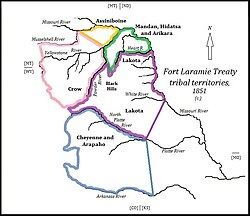
Indian land as defined by the Treaty of Fort Laramie
American expansion in the Great Plains spurred conflict between many western tribes and the US. The 1851 Treaty of Fort Laramie gave the Cheyenne and Arapaho tribes territory from the North Platte River in present-day Wyoming and Nebraska southward to the Arkansas River in what became Colorado and Kansas. The land was initially not wanted by settlers, but following the discovery of gold in the region, settlers came in volume. In 1861, six chiefs of the Southern Cheyenne and four of the Arapaho signed the Treaty of Fort Wise, surrendering 90% of their land.[23] The refusal of various warriors to recognize the treaty led settlers to expect war. The subsequent Colorado War included the Sand Creek Massacre in which up to 600 Cheyenne were killed, mostly children and women. On October 14, 1865, the chiefs of what remained of the Southern Cheyenne and Arapahos agreed to move south of the Arkansas, sharing land that belonged to the Kiowas,[24] and thereby relinquished all claims in Colorado territory.
Map showing the Great Sioux Reservation and current reservations
Following Red Cloud's victory in Red Cloud's War, the Treaty of Fort Laramie was signed. This treaty led to the creation of the Great Sioux Reservation. However, the discovery of gold in the Black Hills resulted in a settlement surge. The gold rush was profitable for settlers and the government: the Black Hill Mine produced $500 million in gold.[25] Attempts to purchase the land failed, triggering the Great Sioux War. Despite initial success by Native American forces, most notably the Battle of the Little Bighorn, the government won and carved the reservation into smaller tracts.[26]
In the southwest, settlers waged war against native tribes.[27] By 1871, Tucson had a population of three thousand, including "saloon-keepers, traders and contractors who had profited during the Civil War". In the Camp Grant Massacre of 1871, up to 144 Apache were killed, mostly women and children. Up to 27 Apache children were captured and sold by Christianized Papago Indians into slavery in Mexico.[28] In the 1860s, the Navajo faced deportation, which became known as the Long Walk of the Navajo. The journey started in spring 1864. Navajo led by the US Army were relocated from eastern Arizona Territory and western New Mexico Territory to Fort Sumner. Around 200 died during the walk. New Mexican slavers, assisted by Utes, attacked isolated bands, killing the men, taking the women and children, and capturing horses and livestock. As part of these raids, Navajo were sold throughout the region.[29]
The American Colossus (1880), shown connected to the US, Mexico, and NicaraguaBig Foot's camp three weeks after Wounded Knee Massacre; with bodies of four Lakota Sioux wrapped in blankets in the foreground
In older historiography mercenary William Walker's attempts to create private colonies epitomized antebellum American imperialism. His brief seizure of Nicaragua in 1855 followed his attempt to expand slavery into Central America and establish colonies in Mexico. Walker failed in his escapades and never had US backing. Historian Michel Gobat claimed that Walker was invited by Nicaraguan liberals seeking modernization and liberalism. Walker's government included those liberals, as well as Yankee colonizers and European radicals.[31]
This cartoon reflects the view of Judge magazine regarding America's imperial ambitions following McKinley's quick victory in the Spanish–American War of 1898. The American flag flies from the Philippines and Hawaii in the Pacific to Cuba and Puerto Rico in the Caribbean.
In the late 19th century, Great Britain, France, Germany and Belgium rapidly expanded their territorial possessions, particularly in Africa. The US expanded also, annexing Pacific Islands such as Hawaii.
One causal factor was racism, evidenced by philosopher Fiske's belief in "Anglo-Saxon" racial superiority and clergyman Strong's call to "civilize and Christianize" other peoples. The concepts were related to Social Darwinism in some schools of American thought.[39][40][41]
Industry and trade were other justifications. American intervention in Latin America and Hawaii supported investments, including sugar, pineapple, and bananas. When the US annexed a territory, it achieved trade access there. In 1898, Senator Albert Beveridge claimed that market expansion was necessary, writing "American factories are making more than the American people can use; American soil is producing more than they can consume. Fate has written our policy for us; the trade of the world must and shall be ours."[42][43]
His 128th birthday, Puck magazine, 1904. Political cartoon illustrates a bald eagle standing on the "U.S.A." portion of North America, with its wings extending from "Panama" and "Porto Rico" (Puerto Rico) on the right side of the image to the "Philippines" on the left.
The US claimed to intervene in Cuba in the name of freedom: "We are coming, Cuba, coming; we are bound to set you free! We are coming from the mountains, from the plains and inland sea! We are coming with the wrath of God to make the Spaniards flee! "(lyrics to "Cuba Libre", 1898). Cuba became independent in 1898 following the Spanish–American War.[44] However, from 1898 until the Cuban revolution, the US directly influenced the Cuban economy. By 1906, up to 15% of Cuba was owned by Americans.[45]
The 1901 Platt Amendment prevented Cuba from entering into agreements with foreign nations and granted the US the right to build naval stations on Cuban soil.[44]
One of the New York Journal's most infamous cartoons, depicting Philippine–American War General Jacob H. Smith's order "Kill Everyone over Ten," from the front page on May 5, 1902
In 1899, Filipino revolutionary General Emilio Aguinaldo remarked: "The Filipinos fighting for Liberty, the American people fighting them to give them liberty. The two peoples are fighting on parallel lines for the same object."[46]
A map of "Greater America" c.1900, including overseas territories
The US established dozens of military bases, including some that were large. Philippine independence was gated by American legislation. For example, the Bell Trade Act provided a mechanism whereby US import quotas could be established on Philippine goods that competed with US products. It further required US citizens and corporations be granted equal access to Philippine natural resources.[52] In 1946, Assistant Secretary of State for Economic Affairs William L. Clayton described the law as "clearly inconsistent with the basic foreign economic policy of this country" and "clearly inconsistent with our promise to grant the Philippines genuine independence."[53] Philippine independence came on July 4, 1946.[54]
In the 1800s the US became concerned that Great Britain or France might have colonial ambitions for the Hawaiian Kingdom. In 1849 the US and the Kingdom signed a friendship treaty. In 1885, King David Kalākaua, Hawaii's last king, signed a treaty with the US allowing tariff-free sugar exports to the US mainland. On July 6, 1887, the Hawaiian League, an illegal secret society, threatened the king and forced him to enact a new constitution that stripped him of much of his power. King Kalākaua died in 1891 and was succeeded by his sister Queen Lili'uokalani. In 1893 with support from marines from the USS Boston, the Queen was deposed in a bloodless coup. Hawaii became a US territory and later became the 50th US state in 1959.
Congress' procedure for annexing territory was explained in an 1898 report by the Senate Foreign Relations Committee in the context of Hawaii: "If, in the judgment of Congress, such a measure is supported by a safe and wise policy, or is based upon a natural duty that we owe to the people of Hawaii, or is necessary for our national development and security, that is enough to justify annexation, with the consent of the recognized government of the country to be annexed."[55]
I was a racketeer, a gangster for capitalism. I suspected I was just part of a racket at the time. Now I am sure of it...I helped make Mexico, especially Tampico, safe for American oil interests in 1914. I helped make Haiti and Cuba a decent place for the National City Bank boys to collect revenues in. I helped in the raping of half a dozen Central American republics for the benefits of Wall Street... Looking back on it, I feel that I could have given Al Capone a few hints. The best he could do was to operate his racket in three districts. I operated on three continents.[59]
The US invaded Haiti on July 28, 1915, and administered it until 1934.[60] Haiti had been independent before the intervention. The Haitian government agreed to US terms, including American oversight.
At the start of World War II, the US administered multiple Pacific territories. The majority of these territories hosted military bases, such as Midway, Guam, Wake Island, and Hawaii. Japan's surprise attack on Pearl Harbor brought the US into the war. Japan occupied Guam, Wake Island, and other American territories. By early 1942 Japan had conquered the Philippines. Many battles were needed to retake allied territory and other Japanese-occupied territories. The US liberated the Philippines; Japanese troops surrendered in August 1945. The maximum extension of American direct control came after the war, and included the occupations of Germany and Austria in May and Japan and Korea in September 1945.
Grand Area concept
The US began planning for the post-war world at the war's outset. This vision originated in the Council on Foreign Relations (CFR), an economic organization that worked closely with government leaders. CFR's War and Peace Studies group offered its services to the State Department in 1939 and a secret partnership developed. CFR leaders Hamilton Fish Armstrong and Walter H. Mallory saw World War II as a "grand opportunity" for the US to emerge as "the premier power in the world".[62]
In an October 1940 report to Roosevelt, geographer Isaiah Bowman, a key liaison between the CFR and the State Department, wrote, "...the US government is interested in any solution anywhere in the world that affects American trade. In a wide sense, commerce is the mother of all wars." In 1942 this economic globalism was articulated as the "Grand Area" concept in secret documents. Under that policy the US would have sought control over the "Western Hemisphere, Continental Europe and Mediterranean Basin (excluding Russia), the Pacific Area and the Far East, and the British Empire (excluding Canada)." The Grand Area encompassed all known major oil-bearing areas outside the Soviet Union.[63]
Bowman's "American economic Lebensraum" (lebensraum is a German word advanced by the Nazis as one reason for conquering Europe):
Better than the American Century or the Pax Americana, the notion of an American Lebensraum captures the specific and global historical geography of U.S. ascension to power. After World War II, global power would no longer be measured in terms of colonized land or power over territory. Rather, global power was measured in directly economic terms. Trade and markets now figured as the economic nexuses of global power, a shift confirmed in the 1944 Bretton Woods agreement, which not only inaugurated an international currency system but also established two central banking institutions—the International Monetary Fund and the World Bank—to oversee the global economy. These represented the first planks of the economic infrastructure of the postwar American Lebensraum.[62]
Protest against the deployment of Pershing II missiles in Europe, The Hague, Netherlands, 1983
Prior to his death in 1945, President Roosevelt was planning to withdraw all US forces from Europe. Soviet actions in Poland and Czechoslovakia led his successor Harry Truman to reconsider. Heavily influenced by George Kennan, Washington policymakers decided that the Soviet Union was an expansionary dictatorship that threatened the free world. In their view, Moscow's weakness was that it had to keep expanding to survive; and that, by containing or stopping its growth, European stability could be achieved. The result was the Truman Doctrine (1947). Initially regarding only Greece and Turkey, NSC-68 (1951) extended it to the entire non-Communist world.[64] Thus, the Truman Doctrine was described as globalizing the Monroe Doctrine.[65][66]:1186
A second consideration was the need to restore the world economy, which required rebuilding Europe and Japan. This was the main rationale for the 1948 Marshall Plan.
Europe’s requirements for the next three or four years of foreign food and other essential products... are so much greater than her present ability to pay that she must have substantial additional help or face economic, social, and political deterioration of a very grave character.[67]
A third factor was the acceptance, especially by Britain and Benelux, that American military involvement was needed to contain the USSR.[citation needed]
Latin America
American involvement in Panama began as a result of its interest in building a canal there, and led to its support for Panamanian independence (from Colombia) in 1903.[68] The US funded the construction and maintained ownership of the Panama Canal Zone until President Carter ceded it to Panama as of the end of 1999.[69] After an attack on the US Embassy in mid-1987, the indictment of Manuel Noriega on drug charges, and Noriega's annulment of the 1989 election (alleging US fraud), the US invaded and deposed and arrested him, withdrawing its forces the following month.[70] Some of the ports on either end of the canal were then purchased by Chinese company Hutchison Whampoa,[71] before Black Rock purchased the rights following President Trump's objections to its continued ownership.[72]
Following the Guatemalan Revolution, Guatemala expanded labor rights and land reforms that granted property to landless peasants.[73] Lobbying by the United Fruit Company, whose profits were damaged by these policies, as well as fear of Communist influence, culminated in US support for Operation PBFortune to overthrow Guatemalan President Jacobo Árbenz in 1952. The US provided weapons to exiled Guatemalan military officer Carlos Castillo Armas, who was to lead an invasion from Nicaragua.[74] This culminated in the 1954 Guatemalan coup d'état. The subsequent military junta assumed dictatorial powers, banned opposition parties and reversed the social reforms. After the coup, American influence grew in the country, in the government and the economy.[75] The US continued to support Guatemala throughout the Cold War, including during the Guatemalan genocide in which up to 200,000 people were killed.[76]
A 1949 U.S. National Security Council study stated that the US should find ways of "exerting economic pressures" on countries that do not accept their assigned role as suppliers of "strategic commodities and other basic materials".[77][78] According to Noam Chomsky, following World War II, the U.S. sought to reestablish the former colonial world as a service appendage to the global capitalist system. Each region was allocated a specific “function” for the “welfare of the global capitalist system.” Policy documents framed the main danger as “economic nationalism”—also labeled “radical” or “ultra-nationalism,” which “embraces policies designed to bring about a broader distribution of wealth and to raise the standard of living of the masses,” and insists that “the first beneficiaries of the development of a country’s resources should be the people of that country.” Such developments were viewed as unacceptable and had to be curbed. Instead, the principal beneficiaries must be U.S. investors and their international partners, who seek an investment-friendly environment offering favorable terms and unrestricted access to labor and raw materials. In the Middle East, U.S. policymakers feared that local populations might attempt to be the beneficiaries of the region’s vast wealth, which planners expected to flow instead to the United States and its allies. These assumptions were stated openly in internal planning papers.[79]
In the post-WWII era, the global capitalist system faced significant instability. The international expansion of socialism saw numerous revolutionary governments adopt Soviet-inspired planned economies and public ownership, allowing them to achieve early industrialization and build independent national economies.[80] These revolutionary governments dismantled feudal landownership and implemented comprehensive programs for health, education, housing, and employment. By addressing the legacies of colonial exploitation and extreme poverty, these initiatives resulted in a historically unprecedented rise in the standard of living for hundreds of millions of people.[81]
To counter these developments, the U.S. launched a global counter-revolution involving direct military interventions,[82] coups, funding of opposition figures, and the cultivation of paramilitary militias.[83] Political scientist Dov Levin notes that the U.S. interfered in the elections of 81 countries between 1946 and 2000.[84] Furthermore, in the Middle East, North Africa, and South Asia, the U.S. and the U.K. launched covert and overt campaigns to encourage and strengthen fundamentalist Islamist movements. These Islamists were viewed as a hedge against potential expansion by the Soviet Union, and as a counterweight against nationalists and socialists who were seen as a threat to Western interests.[85][86][87][88][89]
President Eisenhower believed that "we should work toward building up King Saud as a major figure in the Middle Eastern area." John Foster Dulles, U.S. secretary of state under President Dwight D. Eisenhower, viewed King Saud of Saudi Arabia as "the only figure in the area with sufficient presence and potential assets to serve as a counterpoise to Nasser."[92] An internal U.S. State Department memo reporting a meeting between President Eisenhower with US Secretary of State John F. Dulles and the Joint Chiefs of Staff in 1957 stated the following:
The President said he thought we should do everything possible to stress the “holy war” aspect. Mr. Dulles commented that if the Arabs have a “holy war” they would want it to be against Israel. The President recalled, however, that Saud, after his visit here, had called on all Arabs to oppose Communism.[93]
The U.S.-backed, Saudi-led conservative monarchies established an alliance to suppress the influence of the Egypt-led secular socialistArab nationalist republics through both direct and indirect means.[94] Thus, the U.S. forged an alliance with the region’s most regressive regimes, placing itself at odds with the most progressive ones.[95] This regional ideological and political rivalry, dubbed the Arab Cold War by political scientist Malcolm H. Kerr,[96] was militarized through proxy warfare. This struggle reached its peak during the 1962–1970 North Yemen Civil War, which pitted the conservative monarchies against the revolutionary republics in a violent contest for regional dominance.[97]
As secular Arab nationalism gained momentum, the Saudi monarchy utilized religious ideology as a strategic tool to safeguard Western interests and its own regional standing. Rashid Khalidi notes that the socialistArab nationalist wave "seemed to place the United States and its allies in a highly unfavorable position. To this apparently unbalanced situation, Saudi Arabia brought the powerful ideological weapon of Islam."[98] Saudi Arabia leveraged Islamic organizations to challenge the spread of the Arab nationalist ideology and its secularsocialist appeal.[99][100][101] According to some estimates, between the 1960s and 2016, the Saudis funnelled over $100 billion into spreading Wahhabism/Salafism.[102] According to political scientist Alex Alexiev, the impetus for the international propagation of Salafism and Wahhabism was "the largest worldwide propaganda campaign ever mounted",[103]David A. Kaplan described it as "dwarfing the Soviets' propaganda efforts at the height of the Cold War".[103] In 2018, Saudi Arabia's de facto ruler, Mohammed bin Salman, acknowledged that Saudi Arabia's international propagation of the Salafi movement and Wahhabism campaign was "rooted in the Cold War, when allies asked Saudi Arabia to use its resources to prevent inroads in Muslim countries by the Soviet Union."[104] However, this strategy ultimately carried global repercussions; by 2013, the European Parliament identified Wahhabism as a primary source of global terrorism.[105]
While ideological efforts were ongoing, it was military might that ultimately broke the back of the Arab nationalist movement. The 1967 Six-Day War, initiated with Israeli surprise airstrikes against Egyptian airfields,[106] dealt a fatal blow to secularArab nationalism, as the humiliating defeat of Egypt and its allies shattered Nasser’s revolutionary legitimacy. This ideological vacuum was soon filled by the rise of Yasser Arafat and the autonomous PLO, who replaced the discredited state-led movement as the new symbol of Arab resistance. However, the movement faced a double crisis in September 1970: the death of Nasser—the cause’s most charismatic figure—and 'Black September,' the Jordanian monarchy's crushing military onslaught against the Palestinian fedayeen of the PLO and other militant Palestinian organizations in Jordan's refugee camps. Together, these events marked the end of secularsocialistArab nationalist dominance in the region and paved the way for the emergence of militant Islamism.[107]
Despite the intense U.S. Cold War rhetoric regarding the spread of 'international communism' in the Middle East, the socialistArab nationalist regimes were never drawn to communism. In reality, these regimes were deeply anti-communist and embraced variations of semi-socialism; the only genuine exception throughout the Cold War was South Yemen.[108][109]James Petras categorized certain intermediate regimes, such as the Arab socialist states, as state-capitalist.[110] According to Ali Kadri, the term "state-capitalist" generally referred to socialist governments that maintained the wage-labor system while implementing much more aggressive asset redistribution than their capitalist counterparts, leading to greater social equality.[111]Adam Hanieh asserts that the socialistArab nationalists "focused on Arab unity, consciously downplayed the reality of class struggle", a strategy which ultimately resulted in the growth of domestic capitalist classes.[112]
Beyond the official rhetoric, critics argue that U.S. interventions are primarily driven by economic interests. According to William Blum, in almost all U.S. interventions in the Third World since World War II, the target was overthrowing "a policy of 'self- determination': the desire, born of perceived need and principle, to pursue a path of development independent of US foreign policy objectives."[113] Stephen Gowans asserts that the aim of every U.S. regime change operation is the "promotion of US free enterprise".[114] As Thomas Friedman famously admitted, the "hidden hand" of the market requires a "hidden fist" to function, noting that "McDonald’s cannot flourish without McDonnell Douglas" and that the global success of Silicon Valley is ultimately secured by the "US Army, Air Force, Navy and Marine Corps."[115] Historian Mark Curtis strips away the ideological justifications for U.S. interventions, arguing that:
In the earlier postwar period, the major threat of nationalism was countered by a mix of economic policies, covert action to remove wayward governments and outright military intervention. The constant pretext was the Soviet threat. The chief proponents of the nationalist threat were 'radical' governments (that is, those independent of the West) and liberation movements. In the era of globalisation, independent forces are being countered primarily by economic instruments like the WTO and by military/political strategies like the 'war on terrorism'. The latter is aimed at bolstering friendly regimes (under the guise of anti-terrorism) and provides a cover for a new phase of global intervention to remove unwanted governments.[116]
Complementing direct force, the Washington Consensus agenda is advanced through structural mechanisms: the IMF, the World Bank, and the WTO serve as the primary agents in auditing and reshaping the internal economic landscapes of the Global South.[117]David Harvey sees that the systematic seizure of wealth, or accumulation by dispossession, is executed by the IMF and WTO through the forced liberalization of world markets. These institutions exert the necessary pressure to dismantle economic barriers, a process consistently reinforced by American power.[118] Walden Bello contends that neoliberalism promoted by the U.S., the World Bank, and the IMF in the Third World aims to weaken producers by removing protectionist barriers to Western imports, eliminating regulations on foreign investment, eroding labor protections, and integrating the local economies into a Western-dominated global system.[119] According to the UN Sub-Commission on the Promotion and Protection of Human Rights, the WTO’s rules are fundamentally unfair and predicated on a false premise of equality between trading partners. By ignoring the dominance of powerful multinational enterprises, the system serves to reinforce existing corporatist monopolies.[120] Stephen Gowans echoes this conclusion, noting that "While the Open Door is portrayed as a level playing field, in reality,the pre-existing economic supremacy of US firms tilts the field decisively in their favor."[121] Chris Doran sees that the U.S. has promoted neoliberalism domestically and internationally "to restore the class power to the uber-wealthy and take back the gains they had lost under Keynesianism and its government-focused policies of wealth distribution."[122] Richard Peet observes that the Washington Consensus promoted by the 'Unholy Trinity'—IMF, World Bank, and WTO—has:
[E]stablished, protected and reinforced a neoliberal policy regime that served to deregulate the world economy (in terms of national state intervention), freeing the way for global, and particularly US, corporations, the trading of industrial commodities without interference, and the movement of capital assets across national boundaries that have been reduced in significance.[123]
The dominant economic theory currently imposed upon the Global South, the Washington Consensus, stands at odds with the historical facts of economic development.[124] As Noam Chomsky observes, successful development has historically required the radical violation of free-market doctrine promoted by the U.S. and the international financial institutions—a conclusion that holds true for every major economy, including England, the U.S., and the economic miracles of East Asia.[125] Economist Joseph Stiglitz asserts that the 'free trade' orthodoxy ignores a core historical truth: today’s advanced nations, like the U.S. and Japan, built their wealth by protecting infant industries until they were globally competitive. Today, the IMF and World Bank demand the opposite, forcing vulnerable economies to open their markets to heavily subsidized Western goods. This doesn't create growth; it kills jobs. When small-scale farmers and local manufacturers are crushed by foreign competition without the support of low interest rates or social welfare, 'liberalization' becomes a mechanism for producing misery rather than prosperity.[126] Economist Ha-Joon Chang further exposes this double standard, noting that all developed countries, during their development, from the 14th century until the East Asian newly industrialized countries in the late 20th century, used activist state-interventionist industrial, trade and technology policies to promote infant industries and economic development. Consequently, the free-market package of 'good policies' that is promoted by the developed countries and the international development policy establishment they control is at odds with historical experience.[127]Ha-Joon Chang underscores that, despite the importance of tariff protection in the development of most Now Developed Countries:
[I]t was - I repeat - by no means the only, nor even necessarily the most important, policy tool used by these countries in promoting infant industries. There were many other tools, such as export subsidies, tariff rebates on inputs used for exports, conferring of monopoly rights, cartel arrangements, directed credits, investment planning, manpower planning, R&D supports and the promotion of institutions that allow public-private cooperation.[128]
Economic growth rates in developing nations during the period of state-led industrialization were significantly higher than those achieved under the market-oriented neoliberal reforms.[129]World Bank data cited by Economist Alice Amsden, indicates a historic milestone between 1950 and 1980: for the first time in recorded history, developing economies outpaced developed economies, achieving an average annual income growth of over 5% compared to the latter's 4%. She described this era as "a period of unprecedented expansion in living standards, per capita income, wages, and poverty reduction."[130] Similarly, World Bank data shows the Middle East saw robust economic growth between 1964 and 1974, with GDP rising by 7.5% and GDP per capita by 4.8%. However, these figures plummeted during the 1985–1995 period, falling to just 2.9% and 0.3%, respectively.[131] Statistical evidence reveals that the shift from state-led industrialization to neoliberal orthodoxy resulted in a significant deceleration of economic progress in the Global South, with growth rates falling from 3.0% to a mere 1.7%.[132]
Saudi Arabia
President Donald J. Trump, joined by Crown Prince of Saudi Arabia Mohammed bin Salman, shows informational boards showing how much business the Kingdom of Saudi Arabia generates in the United States economy, at their meeting in the Oval Office at the White House, Tuesday, March 20, 2018, in Washington, D.C.
The strategic importance of controlling Middle Eastern oil has been a cornerstone of American foreign policy for nearly a century. In 1945, a US State Department analysis concluded that Saudi Arabia's oil resources "constitute a stupendous source of strategic power, and one of the greatest material prizes in world history."[133] In 1943, U.S. President Franklin Roosevelt stated that "the defense of Saudi Arabia is vital to the defense of the United States."[134] In 1980, President Carter told a joint session of Congress that "An attempt by any outside force to gain control of the Persian Gulf region will be regarded as an assault on the vital interests of the United States of America."[135] In 1990, Secretary of Defense Dick Cheney testified before the Senate Armed Services Committee that anyone controlling the flow of Middle Eastern oil would possess a “stranglehold” over the U.S. economy, as well as “on that of most of the other nations of the world as well.”[136]
Beyond simple resource extraction, U.S. strategy in the Middle East is widely analyzed as a mechanism for maintaining global political leverage and financial dominance. Former CIA intelligence analyst Kenneth M. Pollack posits that the U.S. seeks more than just the continuous flow of Persian Gulf oil; it also aims to prevent any hostile actor from dominating the region's resources to build a power base or exert global blackmail.[137]Noam Chomsky contends that by controlling Middle Eastern oil, the U.S. gains a strategic stranglehold that allows it to effectively blackmail industrial rivals; he identifies this strategy of keeping Europe and East Asia dependent on corporate America as “one of the main reasons the United States has been so interested in Middle Eastern oil.” He added, “We didn’t need the oil for ourselves;” until the early 1970s “North America led the world in oil production. But we do want to keep our hands on this lever of world power,"[138] further, a secondary objective is to ensure that "the flow of petrodollars should be largely funnelled to the U.S. through military purchases, construction projects, bank deposits, investment in Treasury securities, etc."[139]
The most significant historical challenge to this system of imperial control came from the rise of socialist Arab nationalism, which sought to reclaim the region's wealth for the Arab people. During the Arab Cold War and beyond, socialistArab nationalists were viewed as the main threat to the Saudi monarchy. Nasser’s slogan ‘Arab oil for the Arabs’ epitomized this challenge, while the Ba’athists of Syria and Iraq similarly rejected Saudi stewardship of a resource they deemed the collective the patrimony of all Arabs. The U.S. has actively worked to undermine socialistArab nationalists, with Israel playing a key regional role.[140] Consequently, Chomsky identifies Israel as "a crucial part of the elaborate U.S. base and backup system for the Rapid Deployment Force [the precursor to CENTCOM] ringing the Middle East oil producing regions."[141]
U.S. officials and military leaders have long characterized Israel an indispensable strategic asset for maintaining regional dominance. A 1958 National Security Council memorandum, since declassified, observed that "if we choose to combat radical Arab nationalism and to hold Persian Gulf oil by force if necessary, a logical corollary would be to support Israel as the only strong pro-West power left in the Near East."[148] In 1986, then-Senator Biden asserted that Israel "is the best $3 billion investment we make. If there weren't an Israel, the United States of America would have to invent an Israel to protect her interests in the region."[149] US Secretary of State General Alexander Haig described Israel as "the largest American aircraft carrier in the world that cannot be sunk, does not carry even one American soldier, and is located in a critical region for American national security."[150] General John Keegan, a former chief of US Air Force Intelligence, concluded that the value of Israeli intelligence provided to the United States is "equal to five CIA s." Similarly, Senator Daniel Inouye, who chaired the Senate Appropriations and Intelligence Committees, stated that "The intelligence received from Israel exceeds the intelligence received from all NATO countries combined."[151]
Critical analysts argue that the U.S.–Israel alliance functions as a structural mechanism designed to enforce Western economic hegemony and suppress regional sovereignty. Noam Chomsky contends that the U.S. views Israel as a strategic asset vital for securing its interests in the Middle East—chiefly the control of oil and petrodollar flows,[152] while also protecting U.S.-backed reactionary Arab states and simultaneously acting as a constant deterrent to them to ensure these regimes remain aligned with U.S. policy.[153] Stephen Gowans posits that Israel and U.S. capitalist interests share a mutual hostility toward local movements for independence and national assertiveness "that would, if they could, take their land, markets, labor, and natural resources into their own hands, and use them for their own benefit." Israel and the U.S. want Arab submission to two forms of dispossession: Zionism demands the recognition of Israel’s "right to exist" as a mandate to accept the seizure of Palestinian land, while Wall Street demands control over Arab markets, labor, and, most crucially, their oil.[154]
On March 15, 1951, the Iranian parliament passed legislation proposed by Mohammad Mosaddegh to nationalize the Anglo-Persian Oil Company, whose revenues from Iranian oil were greater than the Iranian government budget. Mosaddegh was elected Prime Minister by the Majlis. Mosadeggh's support by the Tudeh as well as a boycott by various businesses against the nationalized industry produced fears in the UK and the US that Iran would turn to Communism. America officially remained neutral, but the CIA covertly supported various candidates in the 1952 Iranian legislative election.[155]
In late 1952, with Mosaddegh in power, the CIA launched a coup via Operation Ajax with UK support.[156][157][158] The coup increased the monarchy's power. In the aftermath of the coup, Shah Reza Pahlavi replaced the Anglo-Iranian Oil Company with a consortium—British Petroleum and eight European and American oil companies. In 1979, the Iranian Revolution ended the rule of the Shah and American influence in the country. In August 2013, the US formally acknowledged its role in the coup, including bribing Iranian politicians, security, and army officials, as well as pro-coup propaganda.[159]
1945–1970: Asia-Pacific
Japan
The US occupied Japan after WWII until 1952, and maintained control of Okinawa Prefecture until 1972, before returning control to Japan.[160]
After Japan surrendered the land they had ruled since 1910, the US and the USSR divided the Korean peninsula along the 38th parallel, with the Southern end occupied by the US and the Northern end by the USSR. The two countries agreed to grant Korean independence in 1950. Kim Ku and Syngman Rhee led the anti-trusteeship movement against the US and the USSR.[161][162] The USAMGIK banned strikes on December 8 and outlawed the PRK Revolutionary Government and People's Committees on December 12.[163] Following further unrest, the USAMGIK declared martial law.[164] The UN decided to hold an election to create an independent Korea. The Soviets and Korean communists refused to participate. Due to concerns about division caused by an election without North Korea's participation, many South Korean politicians boycotted it.[165][166] The 1948 South Korean general election was held in May.[167] The resultant South Korean government promulgated a national political constitution on July 17 and elected Rhee as president. The Republic of Korea (South Korea) was established on August 15. The 1948 Jeju uprising was violently suppressed and led to the deaths of 14,000-30,000 people, mostly civilians.[168][169][170][171]:139,193 The North invaded the South in June 1950, launching the bloody Korean War that killed millions of Koreans.[172][173] Based on National Security Council document 68, the US adopted a policy of "rollback" against communism in Asia.[174]
Vietnam
The US initially supported France's counterinsurgency program, but not its continued rule. US support was in response to China's support for Vietnam's communists. After Điện Biên Phủ, the US pressured France to free the pro-French government.[175] The US assumed military and financial support for South Vietnam following France's defeat in the First Indochina War. The US and South Vietnam refused to sign agreements at the 1954 Geneva Conference arguing that fair elections weren't possible in North Vietnam.[176][177] Beginning in 1965, the US sent forces to protect the South from invasions by the North and local insurgencies. In part the Vietnam War was a proxy war between the USSR and the US.[178] The Paris Peace accords triggered the departure of US troops by March 1973, while 150,000-200,000 Northern soldiers remained in the South in violation of the accords. Peace continued until the US slashed aid to the South by 70% in 1974. The North launched its final offensive in March 1975, and Saigon fell on April 30.[179]
In 1991 the US and allies invaded Iraq to force it to withdraw from Kuwait, which Iraq had conquered the year before. The Gulf War lasted 9 days before the two parties accepted a ceasefire and Iraq withdrew its forces. The Bush Administration noted that possession of Kuwait would give Iraq control of 45% of global oil production.[197][198] While the US gained no direct control of territory or (oil or other) assets, it strengthened relations with Kuwait and neighboring countries (save for Iran). The US established no-fly zones over Iraq following the conflict, with the announced purpose of protecting Iraqi Kurds in the north and Shia Muslims in the south.[199]
The US invaded Iraq again in 2003 in the aftermath of 9/11. One outcome of Iraq's rapid defeat was Order 39, which privatized the Iraqi economy and permitted 100% foreign ownership of Iraqi assets.[200] International oil companies from the US, Europe, and China secured technical service contracts (but not ownership of reserves) starting in 2009, and invested billions of dollars that increased production from ~1.5 million barrels per day (mb/d) in 2003 to ~4.6 mb/d by 2023. 75%+ of the resulting revenues went to the Iraqi National Oil Company.[201]
The United States including Canada, Greenland and the former Panama Canal Zone according to various threats made by Donald Trump
Asked: Are there limits on your global power?
Yeah, there is one thing. My own morality. My own mind. It's the only thing that can stop me. I don't need international law. I'm not looking to hurt people.
New York Times White House correspondents wrote that "Mr. Trump's assessment... was the most blunt acknowledgment yet of his worldview. At its core is the concept that national strength, rather than laws, treaties and conventions, should be the deciding factor as powers collide."[205]
During both of his presidencies, U.S. President Donald Trump expressed a desire to expand the United States' territory through both land purchases and military means.
Trump's determination to treat the Western Hemisphere as a U.S. sphere of influence has been characterized as a revival of the Monroe Doctrine in what became known as the Donroe Doctrine. Numerous politicians outside of the United States have criticized Trump's annexation comments. The Democratic Party has introduced bills to curb Trump from invading countries without Congress's approval.
On January 3, 2026, the United States launched Operation Absolute Resolve, a strike on Venezuela. After bombing military installations there, US Special Forces captured Venezuelan President Nicolás Maduro and his wife, Cilia Flores, charging them with narco-terrorism. Trump said that the US would temporarily "run" Venezuela and exploit its oil resources, which are among the world's largest.[208] Critics and experts described the attack as illegal and as "resource imperialism".[209]The New York Times editorial board called it an act of "latter-day imperialism" which lacked "any semblance of international legitimacy".[210]
Strategy
Military alliances
A map of America and its military alliances around the world
Kennan designed in 1948 a globe-circling system of alliances embracing non-Communist countries.[211] Disregarding George Washington's dictum of avoiding entangling alliances, in the early Cold War the US established 44 formal alliances and other relationships with nearly 100 countries.[212] The enthusiasm was reciprocal. Most of the world was interested to ally with the US. In the early 1940s, observing the attitudes of other nations, Isaiah Bowman,[213]Henry Luce,[214] and Wendell Willkie[215] stressed the potential of such relationships. This unprecedented scale was aided by the eagerness with which America was welcomed.[216]
A federation however in which the federal units are not equal, in which one of them leads ... and holds the decisive instrument of material power, is in reality an empire. The word ... would in practice doubtless never be employed. Whatever the words, it is well also to know the reality. In reality, the only alternative to the Communist World Empire is an American Empire which will be, if not literally worldwide in formal boundaries, capable of exercising decisive world control.[217]
Zbigniew Brzezinski listed three goals of US geostrategy: "to prevent collusion and maintain security dependence among the vassals, to keep tributaries pliant and protected and to keep the barbarians from coming together."[218]Toynbee[219] and Ostrovsky[220] associated US alliances with the Roman client system during the late Roman Republic. Cicero defended the strategy, claiming that by defending its allies, Rome gained world dominion.[221]
However, American influence was largely welcomed.[222][223][224] Ostrovsky claimed that although all earlier empires, especially persistent empires, were in some measure by bargain, cooperation and invitation, in the post-1945 world this took an extreme form.[225] In 1989, political scientist Huntington stated that most democratic states entered "hegemonic" alliances,[226] while Krauthammer stated that "[Western] Europe achieved the single greatest transfer of sovereignty in world history",[227]:49 as Eastern Europe followed suit.
Russell theorized about the "military unification of the world" led by the Anglo-American powers.[228]
Since President Dwight Eisenhower, US administrations claimed that the US carried a disproportionate share of the military and financial burden for maintaining NATO. In 2025, President Trump announced that he wanted NATO countries to raise their contributions from 2 to 5% of their respective GDPs,[229] to which they later agreed.[230] The Trump administration also pushed allies and others over trade and investment, a shift from decades of advocating free trade and the rule of law. Trump made (possibly chimerical) territorial claims on Greenland and Canada.[231] Canada and others engaged in designing an anti-hegemonic "common front" with the Europeans, particularly with Denmark, and Latin America, particularly Mexico and Panama.[232][233][234]
US military presence around the world in 2007. As of 2013, the US had many bases and troops stationed globally. Their presence has generated controversy and opposition.
During World War II, Roosevelt promised that the American eagle will "fly high and strike hard." "But he can only do so if he has safe perches around the world."[238][239] After the war, the US established a network of bases. NCS-162/2 of 1953 stated, "The military striking power necessary to retaliate depends for the foreseeable future on having bases in allied countries."[240]:349 No foreign bases were present on US soil.[241]
In his New Frontier speech in 1960, future President John F. Kennedy noted that America had established "frontiers" on every continent.[242]:71 On Guam, a common joke had it that few people other than Kremlin nuclear targeters knew about their island.[243]
As of 2024, the US deployed approximately 160,000 active-duty personnel outside the US and its territories.[246] In 2015 the Department of Defense reported that its bases numbered 587,[247] while an independent look reported 800, including 174 in Germany, 113 in Japan, and 83 in South Korea. Some bases, such as Rammstein Air Base, are city-sized, with schools, hospitals and power plants.[248][241]
The US network of military alliances and bases is coordinated by the Unified combatant command (UCC).[249][250][bettersourceneeded][251] The UCC system is rooted in WWII. The UCC was founded to contain the USSR, but outlived it and expanded. As of 2025, the US operated six geographic commands.[252]:69
Dick Cheney served as Secretary of Defense during the end of the Cold War, and afterwards recommended, "The strategic command, control and communication system should continue to evolve toward a joint global structure..."[253] In 1998, the US assigned Russia, the former Soviet Republics and its former satellite states in Europe to EUCOM and those of the Central Asia to CENTCOM.[252]
In 2002, for the first time, the US divided the entire Earth among US commands. The final unassigned region—Antarctica—fell to PACOM, which included the half of the globe covered by the Pacific Ocean.[citation needed]
No other nation has anything approaching the US network of overseas bases, forward deployed forces and military relationships.[254]
US cultural exports have dominated key cultural sectors since the advent of movies in the early 20th century. The US introduced many new cultural sectors, and at least initially dominated them. US cultural products (video, video games, music, literature, science, fashion) typically spread ideas of individualism, innovation, and consumerism, often welcomed as modern/aspirational. In 2025 their share varied by medium and region. As of 2025:[255]
US films account for 60–70% of box-office sales in Europe and many other markets.
American musical artists lead streaming charts; US labels hold ~40–50% of global market share.
In territories such as Hawaii, missionaries dedicated themselves to converting locals to Christianity and teaching them English (while creating a written form of the Hawaiian language). In the 19th century the indigenous dance culture of Hula was banned. for a time. In 1896 territorial authorities eliminated Hawaiian from schools.[255] The 1970s Hawaiian Renaissance restored Hawaiian culture across many institutions.[citation needed]
Art
The art and media that emerged in the 1800s was often concerned with westward expansion.
Landscape painting by Edward D. Nelson - A View to the River, 1861
The Hudson River School was a romantic-inspired art movement that formed in 1826 that depicted landscapes and natural scenes. These paintings admired the marvels of American territory and portrayed the US as a promised land.[256] Common themes included: discovery; exploration; settlement and promise.
These themes resurfaced in other artistic expression of the time. John Gast, known for his 1872 painting American Progress, displayed themes of discovery and the beneficial prospects of American expansion.[257]Manifest destiny appeared in some art of the time. Art was also used to justify the belief that the new nation was inevitably destined to grow.[258]
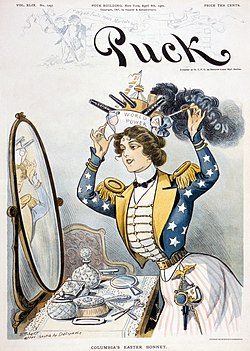
On the cover of Puck published on April 6, 1901, in the wake of gainful victory in the Spanish–American War, Columbia—the National personification of the US—preens herself with an Easter bonnet in the form of a warship bearing the words "World Power" and the word "Expansion" on the smoke coming out of its stack.
American exceptionalism is the belief that the US is unique among nations based on its values, political system, and historical development.[263]Tocqueville was the first to identify the US as qualitatively unique. Reagan notably celebrated US exceptionalism, tying it to Winthrop's "city on a hill" sermon.[264] One facet of that exceptionalism is America's self concept as a protector of freedom, democracy, and free markets.[265]
Economic interests
1903 cartoon, "Go Away, Little Man, and Don't Bother Me", depicts President Roosevelt intimidating Colombia to acquire the Panama Canal Zone.
The arms industry, petroleum, and finance industries, in alliance with military and political bureaucracies. have been accused of benefiting from war profiteering and exploiting natural resources.[266] The US ($5.3T) was second to China ($6.2T) in world trade (2024).[267] The US dominated arms exports, although this represented less than 15% of its export total.[citation needed]
A key role for the US military is to protect trade routes, with spillover benefits to other trade-dependent nations such as China. For example, the Strait of Malacca is the main shipping route between the Indian and Pacific Oceans and has at times faced piracy.[268] It carries nearly 100,000 ships/year.[269]
An older argument that the Global North (Europe, Japan, Canada, and the US) had arrayed itself against the Global South became less salient as more of the latter countries began exporting significant amounts of industrial goods, such as airplanes (Brazil), electronics (Vietnam), vehicles (India), and container ships (China).[270]
Security
President Kennedy's news conference in March 1961
The advent of nuclear weapons led multiple US administrations to discount the effectiveness of the oceanic moat that had made invading the US impractical for the world's other powerful, later ballistic missile/nuclear, nations. Presidents Truman,[271] Kennedy,[272] and Clinton[273] accepted this conclusion. Thus they sought other means to ensure national security.[citation needed]
One facet of this was to prevent the Eurasian land mass from coming under control of any single power or combination of powers.[274][275][276][218] However, this containment strategy, designed for the Cold War, long outlived it.[277]
In 2005, the US Army War College initiated a study of empires. It classed the American Empire as accidental and defensive (rather than intentional and aggressive), driven by the need for defense against Soviet Communism.[278] In the process the US acquired enormous influence, but did not do so deliberately.[279]:XXIV
September 11 created a security crisis that triggered intervention,[6]:3 accompanied by heated debates. It was the first significant attack on American soil since Pearl Harbor (the 1993 bombing led by Pakistani terrorist Ramzi Yousef did not do enough damage to trigger a major response).[280]
Views
The extent to which US actions are properly described as imperialism and the US as an empire have been debated since the country's founding, complicated by the lack of standard definitions of the terms and their applicability to the rapidly evolving ways in which nations form and interact.
Annexation is the traditional way empires expand. The US expanded westward via repeated annexations, conquests, and purchases of lands claimed by other nations. The last time the US annexed territory was the Philippines in 1899, then a Spanish colony. Thereafter, the US limited itself to other means.
In 1980 Williams claimed that prosperity, liberty and security were merely justifications for imperial behavior.[282]
Author Miller stated that the public's sense of innocence limited popular recognition of US imperial conduct.[283]
Historian LaFeber saw the Spanish-American War as a culmination of US westward expansion.[284]
In 1988 linguist/activist Chomsky argued systematic propaganda had been used to establish support for the concept of exceptionalism and provide alternative descriptions of what he viewed as imperialism.[285] In 2008 he stated, "the US is the one country...that was founded as an empire explicitly".[286][287]
Historians such as Meinig (1993)[288] and Beard[citation needed] considered the US' entire westward expansion to be imperialism. By contrast, in 1999 Buchanan, a pundit, contrasted the US' later drive to empire with the earlier expansion.[289]
Historian Bacevich argued in 2004 that the US had not fundamentally changed its foreign policy following the Cold War, and continued to attempt to expand its span of control.[290]
Chalmers Johnson claimed in 2004 that America's version of the colony was the military base, despite the reduced footprint that the bases provide.[292] He argued that the resistance to occupying foreign territory led to other means, including governing other countries via surrogates or puppet regimes, where domestically unpopular governments survived only through US support.[293]
After September 11 criticisms also continued, as geographer Neil Smith called the official war on terror a third attempt at empire.[62]:XI–XII
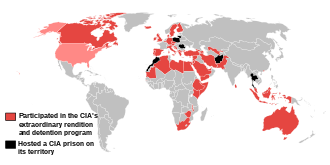
The CIA's extraordinary rendition and detention program – countries involved in the Program, according to the 2013 Open Society Foundation's report on torture
Petrodollar warfare (coined by William R. Clark) or oil currency war refers to the alleged US foreign policy of preserving by force the status of the US dollar as the world's reserve currency and as the currency in which oil is priced. Clark cited the 2003 Iraq invasion, 2011 intervention in Libya, and use of force against Iran as examples.[295]
Paul Kramer noted the resemblance between US policies in the Philippines and European actions in their colonies in Asia and Africa during this period.[296]
In 1899, Uncle Sam balances his new possessions which are depicted as savage children. The figures are Puerto Rico, Hawaii, Cuba, Philippines and "Ladrone Island" (Guam, largest of the Mariana Islands, which were formerly known as the Ladrones Islands).
Matteo Capasso claimed that the 2011 military intervention in Libya was US-led imperialism and the conclusion of a war begun in the 1970s, fought via "gunboat diplomacy, military bombings, international sanctions and arbitrary use of international law". Capasso argued that the war was intended to strip Libya of its autonomy and resources and weaken and fragment the African/Arab political position.[298]
Educator Kieh claimed that strategic factors such as a fear of subsequent invasion of Saudi Arabia and other local pro-American monarchies drove the US response in the Gulf War. Iraqi control was feared to threaten a major corridor of international trade. Kieh also noted various economic factors.[197]
William Robinson claimed that the US was aiding transnational capitalist groups, a form of economic imperialism. He claimed that the goal was economic subjugation.[citation needed]
Historian Kennedy asserted, "From the time the first settlers arrived in Virginia from England and started moving westward, this was an imperial nation, a conquering nation."[299]
Sociologist Robinson characterized American empire since the 1980s as a front for the imperial designs of the American capitalist class, arguing that Washington D.C. had become the seat of the 'empire of capital' from which nations are colonized and re-colonized.[200]
Following the September 11 attack, the conversation about "American empire" shifted from decrying US overseas actions as imperial. Instead, multiple authors started to call for the US to explicitly seek imperial power.[300] Historian Maier stated that it had become acceptable to ask whether the US had become a conventional empire.[301]Ferguson noted that post-9/11, various commentators had started using the term "American empire" ambivalently or positively.[302]:pp. 3–4 He concluded that US military and economic power had elevated the US into history's most powerful empire. He supported this, claiming that it worked to promote global economic growth, enhance the rule of law and promote representative government, while fearing that the US lacked the long-term commitment to maintain it.[302]
Boot advocated for the US to explicitly seek empire.[303] Journalist Lowry recommended "low-grade colonialism" to topple dangerous regimes beyond Afghanistan.[304] The phrase "American empire" appeared more than 1000 times in news stories from November 2002 – April 2003.[305] Academic publications also surged.[306]:222 In 2005, two notable journals, History and Theory and Daedalus, each devoted a special issue to empires.
Historian Hopkins argued that traditional economic imperialism was obsolete, noting that major oil companies opposed the 2003 US invasion of Iraq. Instead, anxieties about globalization were driving support for US interventions.[307][308]:95
Boot located the beginning of US imperialism to "at least 1803", claiming, "US imperialism has been the greatest force for good in the world during the past century. It has defeated communism and Nazism and has intervened against the Taliban and Serbian ethnic cleansing."[309][310] Other neoconservatives, such as British historian Paul Johnson and writers D'Souza and Steyn and some liberal hawks, such as political scientists Zbigniew Brzezinski and Michael Ignatieff have supported it.[311]
Ferguson stated, "the US is an empire and [...] this might not be wholly bad."[302]:21 He cited parallels between the British Empire and the US in the late 20th and early 21st centuries, though he likens the US more to the Roman Empire. Ferguson argues that these empires had both positive and negative aspects, and that if it continues to learn from history, the US' positives will far outweigh the negatives.[302]:286–301
US not an empire
Rosen defined an empire as a political unit that has overwhelming military superiority and uses that power to control the internal behavior of other states. Because the US did not govern or control others' territory, he termed it an "indirect" empire.[312]
On April 28, 2003, then-Secretary of Defense Donald Rumsfeld stated, "We don't seek empires. We're not imperialistic. We never have been."[313] Many–perhaps most–scholars[who?] claim that the US lacks the essentials of an empire. For example, while despite American military bases around the world, America does not rule those countries, and the US government does not send out governors or permanent settlers like all the historic empires did.[314] Historian Maier says the traditional understanding of "empire" does not apply, because the US does not exert formal control over other nations or engage in systematic conquest. He advanced the term "hegemon" instead. Its enormous influence through high technology, economic power, and impact on popular culture gives it an international outreach that stands in sharp contrast to the inward direction of historic empires.[315][316]
Historian Pagden stated that America's unmatched military capability did not demonstrate that it is imperial. Unlike European empires, it has no significant settler populations in its overseas territories and exercises no direct rule anywhere else. It reliably attempts to leave when circumstances permit,[317]:p 52–53 as in Iraq in 2011[317] and Afghanistan in 2021 after withdrawing most of its forces in 2014.[318]
Historian Bemis argued that Spanish–American War expansionism was an "aberration", different than that of earlier American history.[319]
Historian Mary Renda claimed that the goal was to create political stability, rather than expansion or exploitation.[320]
A US soldier stands guard duty near a burning oil well in the Rumaila oil field, Iraq, April 2003.
Geographer Harvey argued that three empires had emerged by the twenty-first century, based on geographical blocs and unequal development.[321] He named the US, the European Union, and Asia (China and Russia) as the imperial blocs,[322][verification needed][323] but did not include the Iranian version.[324] This 'new' imperialism align the interests of business and politicians, preventing the rise of economic and political rivals.[325]
Thorton claimed that the term had been widely abused, writing, "imperialism is more often the name of the emotion that reacts to a series of events than a definition" of them".[326] Liberal internationalists argued that even though the post-Cold War era was dominated by the US, that dominance was not imperial. International relations scholar Ikenberry claimed that international institutions had taken the place of empire.[327]
Walzer claimed that hegemony is a better term than empire to describe the US,[328] as its dominates external relations, but not internal affairs.[329]Keohane rejected word 'empire' for the US, because it conflated it with the territorial British and Soviet empires,[330]:435 also preferring hegomony or hegemonic stability.
Nexon and Wright claimed that neither 'empire' nor 'hegemony' properly describes foreign relations of the US. They concluded that US foreign relations has moved away from imperialism.[331]:266–267
Scholars such as Layne, Art, Lundestad, and Tunander claimed that they were instruments through which the US perpetuated its "hegemonic" role.[332][333][334][335] Before he predicted the Clash of Civilizations, Huntington had concluded that since 1945 most democratic countries had become members of the "alliance system" within which the "position of the US was 'hegemonic'".[226]
Historical analogies
According to Ostrovsky, the pattern known as "defensive imperialism" in Roman studies[336][337][338] may apply to the US. It involved isolationism via geographic barriers followed by growing imperialism in response to growing external threats.[339]
Kaplan draws parallels between the US bases and Roman garrisons that were established to defend the frontiers and for surveillance of the areas beyond.[340] Ostrovsky and Falk saw it differently: "This time there are no frontiers and no areas beyond. The global strategic reach is unprecedented in world history."[225]:233 "The US is by circumstance and design an emerging global empire, the first in the history of the world."[341]Kagan inscribed over a map of US bases: "The Sun never sets." an ironic commentary on a common description of the 19th century British Empire.[342]
Ostrovsky concluded that, disregarding national pride, many states, some of them recent great powers, "surrender their strategic sovereignty en mass[sic]".[225] They hosted US bases, partly covered their expenses,[343]:938–939,942[344] integrated their strategic forces,[345][346][347] contributed 1-2% of their GDP, and tipped military, economic and humanitarian contributions in aid of the hegemonic operations worldwide.[348][343]:938,942,960[349][350]:8 Unlike economic globalization, Ostrovsky claimed that military globalization involved centralization—integration under a central command.[225]:299
Historians Preston and Rossinow claimed that while the Monroe Doctrine contained a commitment to resist European colonialism, it included no limiting principles on US action. Sexton stated that the tactics implementing the doctrine were modeled after those employed by European imperial powers during the 17th and 18th centuries.[357]
↑"Manifest Destiny | History, Examples, & Significance". Encyclopædia Britannica. Retrieved September 17, 2019. Despite disagreements about Manifest Destiny's validity at the time, O'Sullivan had stumbled on a broadly held national sentiment. Although it became a rallying cry as well as a rationale for the foreign policy that reached its culmination in 1845–46, the attitude behind Manifest Destiny had long been a part of the American experience.
↑Williams, Walter L. (1980). "United States Indian Policy and the Debate over Philippine Annexation: Implications for the Origins of American Imperialism". The Journal of American History. 66 (4): 810–831. doi:10.2307/1887638. JSTOR1887638.
↑Blansett, Kent (2015). Crutchfield, James A.; Moutlon, Candy; Del Bene, Terry (eds.). The Settlement of America: An Encyclopedia of Westward Expansion from Jamestown to the Closing of the Frontier. Routledge. pp.161–162. ISBN978-0-7656-1984-6.
↑"Land Tenure History". iltf.org. Indian Land Tenure Foundation. Retrieved February 6, 2026.
↑Field, James A. Jr. (June 1978). "American Imperialism: The Worst Chapter i Almost Any Book". The American Historical Review. 83 (3): 644–668. doi:10.2307/1861842. JSTOR1861842.
↑Nazaryan, Alexander (August 17, 2016). "California Slaughter: The State-Sanctioned Genocide of Native Americans". Newsweek Magazine. Retrieved August 16, 2023. The foremost of these critics is Gary Clayton Anderson, a professor at the University of Oklahoma. Anderson insists that what happened to Native Americans during colonization was ethnic cleansing, not genocide. "If we get to the point where the mass murder of 50 Indians in California is considered genocide, then genocide has no more meaning," he says. Anderson tells me that, by his estimate, no more than 2,000 Native Americans were killed in California.
↑Madley, Benjamin (Autumn 2008). "California's Yuki Indians: Defining Genocide in Native American History". Western Historical Quarterly. 39 (3): 303–332. doi:10.1093/whq/39.3.303. JSTOR25443732.
↑Dobak, William A.; Greene, Jerome A. (July 1, 2005). "Washita: The U.S. Army and the Southern Cheyennes, 1867-1869". The Western Historical Quarterly. 36 (2): 27. doi:10.2307/25443175. ISSN0043-3810. JSTOR25443175.
↑Paiz, Alfonso (1970). "The 'Third Government of the Revolution' and Imperialism in Guatemala". Science & Society. 34 (2): 151. doi:10.1177/003682377003400202. JSTOR40401478.
↑Chomsky, Noam (2003). Middle East illusions: including peace in the Middle East?: reflections on justice and nationhood. Lanham, MD: Rowman & Littlefield Publishers. pp.164–165. ISBN978-0-7425-2699-0.
↑ariana (December 19, 2023). "The Third Wave of Socialism". Tricontinental: Institute for Social Research. Retrieved February 23, 2026.
↑Parenti, Michael (2020). Blackshirts and Reds: rational fascism and the overthrow of communism. San Francisco: City Lights Books. p.26. ISBN978-0-87286-329-3.
↑Parenti, Michael (1997). Blackshirts & reds: rational fascism & the overthrow of communism. San Francisco, Calif: City Lights Books. pp.23–25. ISBN978-0-87286-330-9.
↑Dreyfuss, Robert (2005). Devil's game: how the United States helped unleash fundamentalist Islam. The American empire project. New York: A Holt Paperback. pp.1–4. ISBN978-0-8050-7652-3.
↑Davidson, Christopher M. (2016). Shadow Wars: The Secret Struggle for the Middle East. La Vergne: Oneworld Publications. pp.43–45. ISBN978-1-78607-002-9.
↑Curtis, Mark (2012). Secret affairs: Britain's collusion with radical Islam (New updated versioned.). London: Serpent's Tail. pp.65–68. ISBN978-1-84668-764-8.
↑Gowans, Stephen (2019). Israel, a Beachhead in the Middle East: From European Colony to US Power Projection Platform (1sted.). Québec: Baraka Books. pp.73–74. ISBN978-1-77186-183-0.
↑Khalidi, Rashid (2009). Sowing Crisis: The Cold War and American Dominance in the Middle East. Boston: Beacon Press. pp.20–21. ISBN978-0-8070-0311-4.
↑Gold, Dore (2003). Hatred's kingdom: how Saudi Arabia supports the new global terrorism. Washington/D.C: Regnery Publishing. p.75. ISBN978-0-89526-135-9.
↑Hanieh, Adam (2013). Lineages of revolt: issues of contemporary capitalism in the Middle East. Chicago, Illinois: Haymarket Books. p.25. ISBN978-1-60846-325-1.
↑Bronson, Rachel (2008). Thicker Than Oil: America's Uneasy Partnership with Saudi Arabia. Cary: Oxford University Press, Incorporated. ISBN978-0-19-536705-8.
↑Gold, Dore (2003). Hatred's kingdom: how Saudi Arabia supports the new global terrorism. Washington/D.C: Regnery Publishing. p.75. ISBN978-0-89526-135-9.
↑Gowans, Stephen (2019). Israel, a Beachhead in the Middle East: From European Colony to US Power Projection Platform (1sted.). Québec: Baraka Books. p.180. ISBN978-1-77186-183-0.
↑"Writings". www.aub.edu.lb. Archived from the original on June 9, 2000. Retrieved February 24, 2026.
↑Hanieh, Adam (2013). Lineages of revolt: issues of contemporary capitalism in the Middle East. Chicago, Illinois: Haymarket Books. p.28. ISBN978-1-60846-325-1.
↑Khalidi, Rashid (2009). Sowing Crisis: The Cold War and American Dominance in the Middle East. Boston: Beacon Press. p.19. ISBN978-0-8070-0311-4.
↑Karam, Jeffrey G., ed. (2024). The Middle East in 1958: reimagining a revolutionary year (1sted.). London New York: I.B. Tauris. p.88. ISBN978-0-7556-0680-1.
↑Hiro, Dilip (2013). Holy Wars (Routledge Revivals): The Rise of Islamic Fundamentalism. Routledge Revivals. Hoboken: Taylor and Francis. pp.203–204. ISBN978-0-415-82444-6.
↑Hanieh, Adam (2013). Lineages of revolt: issues of contemporary capitalism in the Middle East. Chicago, Illinois: Haymarket Books. p.28. ISBN978-1-60846-325-1.
↑Kadri, Ali (2019). The unmaking of Arab socialism. Anthem frontiers of global political economy. London; New York: Anthem Press. p.38. ISBN978-1-78527-122-9.
↑Hanieh, Adam (2013). Lineages of revolt: issues of contemporary capitalism in the Middle East. Chicago, Illinois: Haymarket Books. p.25. ISBN978-1-60846-325-1.
↑Blum, Wlliam (2012). Killing Hope: U.S. Military and C.I.A. Interventions Since World War II (2nded.). Monroe, ME 04951: Common Courage Press. p.17. ISBN978-1-56751-409-4.{{cite book}}: CS1 maint: location (link)
↑Harvey, David (2020). The new imperialism. Oxford scholarship online. Oxford: Oxford University Press. p.181. ISBN978-0-19-927808-4.
↑Bello, Walden F.; Cunningham, Shea; Rau, Bill (1999). Dark victory: the United States and global poverty. Transnational Institute series (2nded.). London: Oakland, Calif.: Amsterdam: Pluto Press; Food First; Transnational Institute. p.5. ISBN978-0-935028-76-8.
↑Doran, Chris, ed. (2012). Making the world safe for capitalism: how Iraq threatened the US economic empire and had to be destroyed. London New York: Pluto Press. p.240. ISBN978-1-84964-669-7.
↑Peet, Richard (2009). Unholy trinity: the IMF, World Bank, and WTO (2nded.). London, England: Zed Books. pp.20–21. ISBN978-1-84813-252-8.
↑Bairoch, Paul (1995). Economics and world history: myths and paradoxes (Paperback ed., [Nachdr.]ed.). Chicago: Univ. of Chicago Press. pp.53–55. ISBN978-0-226-03463-8.
↑Stiglitz, Joseph E. (2003). Globalization and its discontents. New York: W.W. Norton. pp.16–17. ISBN978-0-393-32439-6.
↑Chang, Ha-Joon (2002). Kicking away the ladder: development strategy in historical perspective. London: Anthem press. pp.125–127. ISBN978-1-84331-027-3.
↑Chang, Ha-Joon (2002). Kicking away the ladder: development strategy in historical perspective. London: Anthem press. p.65. ISBN978-1-84331-027-3.
↑Chang, Ha-Joon (2002). Kicking away the ladder: development strategy in historical perspective. London: Anthem. p.129. ISBN978-1-84331-027-3.
↑Amsden, Alice H. (2007). Escape from empire: the developing world's journey through heaven and hell. Cambridge, Mass: MIT Press. pp.5–6. ISBN978-0-262-01234-8.
↑Kadri, Ali (2019). The unmaking of Arab socialism. Anthem frontiers of global political economy. London New York: Anthem Press. p.61. ISBN978-1-78527-122-9.
↑Chang, Ha-joon (2019). Bad samaritans: the myth of free trade and the secret history of capitalism (1sted.). New York London Oxford New Delhi Sydney: Bloomsbury Publishing. p.10. ISBN978-1-59691-598-5.
↑Sifry, Micah L.; Cerf, Christopher, eds. (2003). The Iraq war reader: history, documents, opinions. New York: Touchstone. p.399. ISBN978-0-7432-5347-5.
↑Pollack, Kenneth M. (July 1, 2003). "Securing the Gulf". Foreign Affairs. Vol.82, no.4. ISSN0015-7120. Retrieved February 23, 2026.
↑Chomsky, Noam; Naiman, Arthur; Barsamian, David (2011). How the world works: four classic bestsellers in one affordable volume. Real story series. Berkeley, Calif.: Soft Skull Press. p.27. ISBN978-1-59376-427-2.
↑Chomsky, Noam (2016). Fateful Triangle: The United States, Israel, and the Palestinians (2nded.). Pluto Press. p.20. ISBN978 1 7837 1249 6.
↑Gowans, Stephen (2019). Israel, a Beachhead in the Middle East: From European Colony to US Power Projection Platform (1sted.). Québec: Baraka Books. p.64. ISBN978-1-77186-183-0.
↑Chomsky, Noam (2016). Fateful Triangle: The United States, Israel, and the Palestinians (2nded.). Pluto Press. p.26. ISBN978 1 7837 1249 6.{{cite book}}: CS1 maint: date and year (link)
↑Chomsky, Noam (September 2016). Fateful Triangle: The United States, Israel, and the Palestinians (Updateded.). United Kingdom: Pluto Press. p.26. ISBN9781783712502.
↑Chomsky, Noam (2003). Towards a new cold war: U.S. foreign policy from Vietnam to Reagan. New York: New Press. pp.334–335. ISBN978-1-56584-859-7.
↑Gowans, Stephen (2019). Israel, a Beachhead in the Middle East: From European Colony to US Power Projection Platform (1sted.). Québec: Baraka Books. p.214. ISBN978-1-77186-183-0.
↑Robinson, Geoffrey B. (2018). The Killing Season: A History of the Indonesian Massacres, 1965–66. Princeton University Press. p.203. ISBN978-1-4008-8886-3. a US Embassy official in Jakarta, Robert Martens, had supplied the Indonesian Army with lists containing the names of thousands of PKI officials in the months after the alleged coup attempt. According to the journalist Kathy Kadane, "As many as 5,000 names were furnished over a period of months to the Army there, and the Americans later checked off the names of those who had been killed or captured." Despite Martens later denials of any such intent, these actions almost certainly aided in the death or detention of many innocent people. They also sent a powerful message that the US government agreed with and supported the army's campaign against the PKI, even as that campaign took its terrible toll in human lives.
↑Melvin, Jess (2018). The Army and the Indonesian Genocide: Mechanics of Mass Murder. Routledge. pp.9–10. ISBN978-1-138-57469-4. The exact role played by the United States in the genocide remains unclear, as U.S. government archives relating to Indonesia from the period remain sealed. It is known, however, that at a minimum, in addition to openly celebrating Suharto's rise to power, the United States supplied money and communications equipment to the Indonesian military that facilitated the killings, gave fifty million rupiah to the military-sponsored KAP-Gestapu death squad, and provided the names of thousands of PKI leaders to the military, who may have used this information to hunt down and kill those identified.
↑Good, Aaron (2022). American Exception. New York: Skyhorse Publishing. p.290. ISBN978-1-5107-6913-7. In 1973, CIA-psychological operatives in Chile scrawled graffiti on the sides of buildings that read "Jakarta se acerca" – "Jakarta is coming." This was a reference to the massive CIA orchestrated 1965 bloodletting in Indonesia which overthrew Sukarno and made the country safe for US corporations like Freeport Sulphur. The American and Indonesian governments have never acknowledged the truth of those events. But we must confront these sorts of dark truths if we are to move forward as a civilization.
↑Melvin, Jess (October 20, 2017). "Telegrams confirm scale of US complicity in 1965 genocide". Indonesia at Melbourne. University of Melbourne. Retrieved October 21, 2017. The new telegrams confirm the US actively encouraged and facilitated genocide in Indonesia to pursue its own political interests in the region, while propagating an explanation of the killings it knew to be untrue.
12Kieh, George (1992). "Western Imperialism in the Middle East: The Case of the United States' Military Intervention in the Persian Gulf". Arab Studies Quarterly. 14 (1): 10. JSTOR41858004.
↑Kieh, George (1992). "Western Imperialism in the Middle East: The Case of the United States' Military Intervention in the Persian Gulf". Arab Studies Quarterly. 14 (1): 11. JSTOR41858004.
↑Iadicola, Peter (2008). "Globalization and Empire"(PDF). International Journal of Social Inquiry. 1 (2): 12.
↑Dufour, Jules (July 1, 2007). "The worldwide network of US military bases". Global Research.{{cite web}}: Missing or empty |url= (help)(Source is blacklisted)
↑Wiggins, J. Russell; Merk, Frederick; Merk, Lois Bannister (December 1963). "Manifest Destiny and Mission in American History: A Reinterpretation". The New England Quarterly. 36 (4): 528. doi:10.2307/363114. ISSN0028-4866. JSTOR363114.
↑Ikenberry, G. John; Mandelbaum, Michael (2006). "The Case for Goliath: How America Acts as the World's Government in the Twenty-First Century". Foreign Affairs. 85 (2): 188. doi:10.2307/20031925. ISSN0015-7120. JSTOR20031925.
↑Meinig, Donald W. (1993). The Shaping of America: A Geographical Perspective on 500 Years of History, Volume 2: Continental America, 1800–1867. Yale University Press. pp.22–23, 170–196, 516–517. ISBN0-300-05658-3.
↑Lundestad, Geir (1986). "Empire by Invitation? The United States and Western Europe, 1945–1952". Journal of Peace Research. 23 (3): 263–277. CiteSeerX10.1.1.689.5556. doi:10.1177/002234338602300305. JSTOR423824. S2CID73345898. If this American expansion created what we could call an American empire, this was to a large extent an empire by invitation...In semi-occupied Italy the State Department and Ambassador James Dunn in particular actively encouraged the non-communists to break with the communists and undoubtedly contributed to the latter being thrown out of the government in May 1947. In more normal France the American role was more restrained when the Ramadier government threw out its communists at about the same time. After the communists were out, Washington worked actively, through overt as well as covert activities, to isolate them as well as leftist socialists... US economic assistance was normally given with several strings attached.
↑Easton, Nina J. (December 2001). "Thunder on the Right". American Journalism Review. 23: 320.
↑Lake, David A. (2007). "Escape from the State of Nature: Authority and Hierarchy in World Politics". International Security. 32: 47–79. doi:10.1162/isec.2007.32.1.47. S2CID57572519.
↑Hopkins, A. G. (2007). "Capitalism, Nationalism and the New American Empire". The Journal of Imperial and Commonwealth History. 35 (1): 95–117. doi:10.1080/03086530601143412. S2CID143521756.
↑Vuoto, Grace (2007). "The Anglo-American Global Imperial Legacy: Is There a Better Way?". Canadian Journal of History. 42 (2): 259–270. doi:10.3138/cjh.42.2.259.
↑Nexon, Daniel H.; Wright, Thomas (2007). "What's at Stake in the American Empire Debate". American Political Science Review. 101 (2): 253–271. doi:10.1017/S0003055407070220. S2CID17910808.
↑Lebow, Richard Ned; Kelly, Robert (October 2001). "Thucydides and hegemony: Athens and the United States". Review of International Studies. 27 (4): 593–609. doi:10.1017/s0260210501005939. ISSN0260-2105. SSRN2384772.
Bacevich, Andrew J., "The Old Normal: Why we can't beat our addiction to war", Harper's Magazine, vol. 340, no. 2038 (March 2020), pp.25–32. "In 2010, Admiral Michael Mullen, chairman of the Joint Chiefs of Staff, declared that the national debt, the prime expression of American profligacy, had become 'the most significant threat to our national security.' In 2017, General Paul Selva, Joint Chiefs vice chair, stated bluntly that 'the dynamics that are happening in our climate will drive uncertainty and will drive conflict." (p.31.)
Bacevich, Andrew J., "The Reckoning That Wasn't: Why America Remains Trapped by False Dreams of Hegemony", Foreign Affairs, vol. 102, no. 2 (March/April 2023), pp.6–10, 12, 14, 16–21. "Washington... needs to... avoid needless war... and provide ordinary citizens with the prospect of a decent life.... The chimera of another righteous military triumph cannot fix what ails the United States." (p.21.)
Boot, Max (2002). The Savage Wars of Peace: Small Wars and the Rise of American Power. Basic Books. ISBN0-465-00721-X.
Brown, Seyom (1994). Faces of Power: Constancy and Change in United States Foreign Policy from Truman to Clinton. New York: Columbia University Press. ISBN0-231-09669-0.
Gaddis, John Lewis (2005). Strategies of Containment: A Critical Appraisal of Postwar American National Security Policy (2nded.). New York: Oxford University Press. ISBN0-19-517447-X.
Hampf, Michaela (2019). Empire of Liberty (in German). De Gruyter Oldenbourg. ISBN978-3-11-065774-6.
Hansen, Suzy, "Twenty Years of Outsourced War" (review of Phil Klay, Uncertain Ground: Citizenship in an Age of Endless, Invisible War, Penguin Press, 2022, 252 pp.; and Phil Klay, Missionaries, Penguin, 2020, 407 pp.), The New York Review of Books, vol. LXX, no. 16 (October 19, 2023), pp.26–28. "Klay remains transfixed by the idea that in Iraq and Afghanistan, and in all contemporary American wars, there have been not only no definable diplomatic or political objectives, but also no definable military objectives. No one has any clue what they're fighting for or even 'clear benchmarks of success.' That means that there is no obvious enemy, or that one's perception of the enemy keeps shifting. 'If you think the mission your country keeps sending you on is pointless or impossible and that you're only deploying to protect your brothers and sisters in arms from danger,' Klay writes, 'then it's not the Taliban or al-Qaeda or ISIS that's trying to kill you, it's America.'" (p.28.)
Immerwahr, Daniel, "Everything in Hand: the C.I.A.'s covert ops have mattered – but not in the way that it hoped", The New Yorker, June 17, 2024, pp.53–57. "After the Second World War, the United States set out to direct politics on a global scale. This mission was unpopular, hence the cloak-and-dagger secrecy, and difficult, hence the regular fiascoes. [...] 'We knew nothing,' the onetime C.I.A. director Richard Helms remembered. [...] Ivy League professors were tasked with steering top students toward intelligence careers. [Particularly] literature students. [...] Something about sorting through ambiguity, paradox, and hidden meanings equipped students for espionage." (p.54.) "[In the 1950s] hundreds of the CIA's foreign agents were sent to their deaths in [Albania,] Russia, Poland, Romania, Ukraine, and the Baltic states... [I]ntelligence officers [then] shifted their attention to [...] the Third World, today more often called the Global South. [But t]he U.S. lacked the generations-deep, place-based colonial knowledge that Britain and France had." (p.55.) "The Lawrencian fantasy was that U.S. agents would embed themselves in foreign lands. In reality [...] ambitious foreigners infiltrat[ed] the United States. [A long] list of world leaders [...] trained Stateside [...[. [...] The C.I.A. interfered constantly in foreign politics, but its typical mode wasn't micromanaging; it was subcontracting. [...] For all the heady talk of promoting democracy, more than two-thirds of U.S. covert interventions during the Cold War were in support of authoritarian regimes..." (p.56.) "As the [1990s] wore on, U.S. leaders grew increasingly alarmed about [Iraq dictator] Saddam's continued military capacities. But intelligence was wanting. [...] The combination of scant knowledge and overweening concern created demand, and [Ahmad] Chalabi arrange[d] the supply. He promoted sources who [falsely] claimed that Saddam was stockpiling chemical and biological weapons and had kept working toward nuclear ones. [...] In the end, the C.I.A. has the power to break things, but not the skill to build them. [...] The heart of the issue is the United States' determination to control global affairs." (p.57.)
Immerwahr, Daniel, "Fort Everywhere: How did the United States become entangled in a cycle of endless war?" (review of David Vine, The United States of War: A Global History of America's Endless Conflicts, from Columbus to the Islamic State, University of California Press, 2020, 464 pp.), The Nation, December 14/21, 2020, pp.34–37.
Immerwahr, Daniel (2019). How to Hide an Empire: A History of the Greater United States. Farrar, Straus and Giroux. ISBN978-0-374-17214-5.
Kerry, Richard J. (1990). The Star-Spangled Mirror: America's Image of Itself and the World. Savage, MD: Rowman & Littlefield. ISBN0-8476-7649-8.
Khalili, Laleh, "Collective Property, Private Control" (review of Alexander C. Karp and Nicholas W. Zamiska, The Technological Republic: Hard Power, Soft Belief and the Future of the West, Bodley Head, February 2025, 295 pp.; and Raj M. Shah and Christopher Kirchhoff, Unit X: How the Pentagon and Silicon Valley Are Transforming the Future of War, Scribner, August 2024, 319 pp.), London Review of Books, vol. 47, no. 10 (June 5, 2025), pp.21–23. "The United States... has waged a war of some sort in every year of its existence. Silicon Valley knows that war is good for business. And many of its most powerful people want us to stop worrying about frivolities like ethics or ecology and love the bomb.... For the armchair techno-warriors of Silicon Valley, the barbarians at the gate are a useful solution." (p.23.)
Krugman, Paul, "The American Way of Economic War: Is Washington Overusing Its Most Powerful Weapons?" (review of Henry Farrell and Abraham Newman, Underground Empire: How America Weaponized the World Economy, Henry Holt, 2023, 288 pp.), Foreign Affairs, vol. 103, no. 1 (January/February 2024), pp.150–156. "The [U.S.] dollar is one of the few currencies that almost all major banks will accept, and... the most widely used... As a result, the dollar is the currency that many companies must use... to do international business." (p.150.) "[L]ocal banks facilitating that trade... normally... buy U.S. dollars and then use dollars to buy [another local currency]. To do so, however, the banks must have access to the U.S. financial system and... follow rules laid out by Washington." (pp.151–152.) "But there is another, lesser-known reason why the [U.S.] commands overwhelming economic power. Most of the world's fiber-optic cables, which carry data and messages around the planet, travel through the United States." (p.152.) "[T]he U.S. government has installed 'splitters': prisms that divide the beams of light carrying information into two streams. One... goes on to the intended recipients, ... the other goes to the National Security Agency, which then uses high-powered computation to analyze the data. As a result, the [U.S.] can monitor almost all international communication." (p.154) This has allowed the US "to effectively cut Iran out of the world financial system... Iran's economy stagnated... Eventually, Tehran agreed to cut back its nuclear programs in exchange for relief." (pp.153–154.) "[A] few years ago, American officials... were in a panic about [the Chinese company] Huawei... which... seemed poised to supply 5G equipment to much of the planet [thereby possibly] giv[ing] China the power to eavesdrop on the rest of the world – just as the [U.S.] has done.... The [U.S.] learned that Huawei had been dealing surreptitiously with Iran – and therefore violating U.S. sanctions. Then, it... used its special access to information on international bank data to [show] that [Huawei]'s chief financial officer, Meng Wanzhou (... the founder's daughter), had committed bank fraud by falsely telling the British financial services companyHSBC that her company was not doing business with Iran. Canadian authorities, acting on a U.S. request, arrested her... in December 2018. After... almost three years under house arrest... Meng... was allowed to return to China... But by [then] the prospects for Chinese dominance of 5G had vanished..." (pp.154–155.) Farrell and Newman, writes Krugman, "are worried about the possibility of [U.S. Underground Empire] overreach. [I]f the [U.S.] weaponizes the dollar against too many countries, they might... band together and adopt alternative methods of international payment. If countries become deeply worried about U.S. spying, they could lay fiber-optic cables that bypass the [U.S.]. And if Washington puts too many restrictions on American exports, foreign firms might turn away from U.S. technology." (p.155.)
Lears, Jackson, "The Forgotten Crime of War Itself" (review of Samuel Moyn, Humane: How the United States Abandoned Peace and Reinvented War, Farrar, Straus and Giroux, 2021, 400 pp.), The New York Review of Books, vol. LXIX, no. 7 (April 21, 2022), pp.40–42. "After September 11 [2001] no politician asked whether the proper response to a terrorist attack should be a US war or an international police action. [...] Debating torture or other abuses, while indisputably valuable, has diverted Americans from 'deliberating on the deeper choice they were making to ignore constraints on starting war in the first place.' [W]ar itself causes far more suffering than violations of its rules." (p.40.)
Lears, Jackson, "Imperial Exceptionalism" (review of Victor Bulmer-Thomas, Empire in Retreat: The Past, Present, and Future of the United States, Yale University Press, 2018, ISBN978-0-300-21000-2, 459 pp.; and David C. Hendrickson, Republic in Peril: American Empire and the Liberal Tradition, Oxford University Press, 2017, ISBN978-0-19-066038-3, 287 pp.), The New York Review of Books, vol. LXVI, no. 2 (February 7, 2019), pp.8–10. Bulmer-Thomas writes: "Imperial retreat is not the same as national decline, as many other countries can attest. Indeed, imperial retreat can strengthen the nation-state just as imperial expansion can weaken it." (NYRB, cited on p.10.)
Lundestad, Geir (1998). Empire by Integration: The United States and European Integration, 1945–1997. New York: Oxford University Press. ISBN0-19-878212-8.
Shaw, Tamsin, "Ethical Espionage" (review of Calder Walton, Spies: The Epic Intelligence War Between East and West, Simon and Schuster, 2023, 672 pp.; and Cécile Fabre, Spying Through a Glass Darkly: The Ethics of Espionage and Counter-Intelligence, Oxford University Press, 251 pp., 2024), The New York Review of Books, vol. LXXI, no. 2 (February 8, 2024), pp.32, 34–35. "[I]n Walton's view, there was scarcely a US covert action that was a long-term strategic success, with the possible exception of intervention in the Soviet–Afghan War (a disastrous military fiasco for the Soviets) and perhaps support for the anti-Soviet Solidarity movement in Poland." (p.34.)
Shawn, Wallace, "The End of a Village", The New York Review of Books, vol. LXXI, no 15 (October 3, 2024), pp.16–17. "[In 1967] Jonathan Schell published 'The Village of Ben Suc' in ... The New Yorker, [describing U.S. troops' destruction of that Vietnamese village]. [p. 16.] [The soldiers had] been dropped ... into a land that for them was alien [and] strange ... where they were surrounded by people whose words, gestures, and expressions they couldn't interpret. ... [T]hey had no idea why they were there, and they didn't really know what they were supposed to do there. ... The Vietnamese revolutionaries were fighting for their own country, for their own families. The Americans were not.... Schell's [subsequent] book could have ... led American policymakers to realize that quasi-imperial American interventions [like this] could not succeed in the contemporary world ... [M]aybe a million ... Vietnamese lives could have been saved, along with the lives of 50,000 American soldiers, along with countless lives in Afghanistan and Iraq." (p.17.)
Tobar, Héctor, "The Truths of Our American Empire" (review of Jonathan Blitzer, Everyone Who Is Gone Is Here: The United States, Central America, and the Making of a Crisis, Penguin Press, 523 pp.), The New York Review of Books, vol. LXXI, no. 7 (April 18, 2024), pp.43–44, 46. "Blitzer ... illustrates the timidity and opportunism of the US political class, which has repeatedly blocked reforms that would allow an orderly and safe flow of workers and their families across the border. After all, our postpandemic economy remains desperately short of workers. ... [E]ven if every unemployed person in [the US] found work, roughly three million jobs would go unfilled." (p.44, 46.) "The use and abuse of immigrant labor as tools of nation building and race engineering is a long-established element of the American normal. Only if you step outside of history does it look like a 'crisis.'" (p.46.)
Wertheim, Stephen, "The Price of Primacy: Why America Shouldn't Dominate the World", Foreign Affairs, vol. 99, no. 2 (March/April 2020), pp.19–22, 24–29. "The United States should abandon the quest for armed primacy in favor of protecting the planet and creating more opportunity for more people." (p.20.) "The United States should [...] rally the industrialized world to provide developing countries with technology and financing to bypass fossil fuels." (p.24.) "[T]he United States should cease acting as a partisan in disputes such as Yemen's civil war and the Israeli–Palestinian conflict [...]." (p.27.)
Wertheim, Stephen, "Iraq and the Pathologies of Primacy: The Flawed Logic That Produced the War Is Alive and Well", Foreign Affairs, vol. 102, no. 3 (May/June 2023), pp.136–52. "Washington is still in thrall to primacy and caught in a doom loop, lurching from self-inflicted problems to even bigger self-inflicted problems, holding up the latter while covering up the former. In this sense, the Iraq war remains unfinished business for the United States." (p.152.)
This page is based on this Wikipedia article Text is available under the CC BY-SA 4.0 license; additional terms may apply. Images, videos and audio are available under their respective licenses.