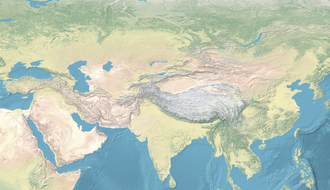
From the 16th to the 17th centuries, the Kazakh Khanate ruled and expanded its territories to eastern Cumania (modern-day West Kazakhstan), most of Uzbekistan, Karakalpakstan and the Syr Darya river with military confrontation as far as Astrakhan and Khorasan, which are currently in Russia and Iran, respectively. The Khanate was later weakened by a series of Oirat and Dzungar invasions in the 17th and 18th centuries. These resulted in a decline and further disintegration into three jüz, which gradually lost their sovereignty and were incorporated to the expanding Russian Empire in the 19th century.
Name
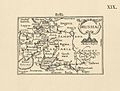
Kosaki Orda (Kazakh Khanate) on Sebastian Münster's map, published in 1600
In Eastern sources, one encounters such names as “Ulus of the Kazakhs,” “Kazakh Ulus,” “Kazakh El-Ulus,” “the yurt of the Urus” (i.e., of Urus Khan), “Ulus of Jochi,” or the earlier geographical term “Desht-i-Kipchak.”[3] The name “Kazakhstan” (Persian: قزاقستان) is also attested.[4] In Russian sources of the 15th century, the designations “Kazatskaya Orda,” “Kazatskaya Horde,” and “Kazachya Orda”[5] were used; in the 18th century, the term “Kirgiz-Kaisak Horde” appears.[5]
In 16th-century Mongolian sources, the name “Togmak” or “Tokmak” (a Mongolian designation for Desht-i-Kipchak) occurs.[6] In European sources, the names “Kozaksche Orda,” “Kassachy Horda,” “Kasaki Orda,” and “Casatschia Orda”[7], “Casatschia Orda”[8] were used.
Eastern authors of the 15th–16th centuries often referred to the Kazakh Khanate by the region it occupied “Desht-i-Kipchak,” or “Tatar Ulus/Uzbek Ulus” as the Golden Horde was named after the population inhabiting it. Central Asian authors of this period collectively called the Kazakhs, the Shaybanids, and the Nogais “Uzbeks,” in honor of the Golden Horde khan Özbeg Khan,[9][10] while European authors knew the population of the Ulus of Jochi as “Tatars”.[11]
Issues with the date of the khanate's establishment
There is no consensus among medieval historians regarding the place and time of the formation of the early Kazakh Khanate[12]. Russian historiography follows the dating proposed by Tursun Sultanov. He considers the death of Abulkhair-khan in 875 AH (1470–1471) as the date of the formation of the Kazakh Khanate.[13]
In Kazakh historiography, the year 1465 is commonly accepted as the date of the establishment of the Kazakh Khanate. This date is mentioned in the work of the medieval author Muhammad Haidar Dughlat Tarikh-i Rashidi.[12]
In the 17th century[14], three separate orda (horde), or zhuz, emerged: the Senior (Greater), Middle (Central), and Junior, each with its own territory for nomadic movements. After the death of Khan Tauke in 1715[15] or 1718[13], the zhuzes essentially became independent khanates.[15] Thus, the history of the Kazakh Khanate ends and the history of the Kazakh Khanates begins.[13]
Ablai Khan was able to reunite all Kazakhs and skillfully navigated his politics between Russia and China, but after his death in 1781, the khanate once again fractured into three zhuzs, whose khans were appointed by the Russian government. In 1822–1824, the institution of the Khanate in the Russian Empire was abolished by the Statutes concerning the Siberian and Orenburg Kazakhs.[15]
The abolition of the khan's power led to the uprising of Sultan Kasym in 1824–1827. The last attempt to restore khan's authority in the territory of the Kazakh zhuzs was made by Sultan Kenesary Qasymuly, whose rebellion against Russian authorities began in 1837. He declared himself khan and waged armed struggle with varying success until his death in 1847.[15]
"Kasaccia Horda" (Kazakh Khanate) on a British world map (1780)
In 1227, the White Horde, a proto-Kazakh state, was formed within the Golden Horde in the steppe. After its separation from the Golden Horde in 1361, the White Horde became an independent state for a certain period of time, sometimes uniting with the Blue Horde to reestablish the Golden Horde. However, after the death of Khan of the Golden Horde, Barak Khan, in 1428, the Golden Horde became fragmented, and the White Horde itself was divided into the Uzbek Khanate and the Nogai Horde (descendants of ruling Mongol tribes); the remaining land was divided between Mustafa Khan in the south and Mohammed Khan in the north. The Uzbek Khanate, which dominated most of present-day Kazakhstan, was ruled by Abu'l-Khayr Khan, who conspired in killing Barak Khan. Under Abu’l-Khayr Khan's leadership, the Uzbek Khanate became a corrupt, unstable, and weak state that often dealt with internal problems. To make matters worse, the khanate itself was raided by Oirats who pillaged nomadic settlements and major cities where they were looted, damaged, and had civilians massacred. Peace was made in 1457 between the Uzbeks and the Oirats where Abu’l-Khayr Khan suffered a severe defeat which made him lose reputation among the Uzbeks.
A 2015 Kazakhstani stamp commemorating the 550th anniversary of the Kazakh Khanate's establishment
The formation of the Kazakh Khanate began in 1459, when several Kazakh tribes dissatisfied with Abu’l-Khayr's rule, led by the great-grandsons of Urus Khan, Janibek and Kerei, fled the Uzbek Khanate in an event known as the Great Migration. The two cousins led the nomads towards Moghulistan, eventually settling and establishing an independent state. The Khan of Moghulistan, Esen Buqa II, united with them, offering them support against their opponents. Around 200,000 nomads joined Janibek Khan and Kerei Khan's movement, which had had a huge power and influence that it sparked fear in Abu'l-Khayr. The new khanate soon became a buffer state between the Moghulistan and the Uzbek Khanate. Although both Janibek Khan and Kerei Khan were considered the founding rulers of the Kazakh Khanate, it was Janibek Khan who initially wielded the most power. Eager to liberate his land from Abu’l Khayr Khan, Janibek invaded the Uzbek Khanate in 1468, sparking the Kazakh War of Independence. Abu’l Khayr, in response, launched a campaign against the Kazakhs, but died on his way to Jetysu. Upon the death of Kerei Khan in 1473/74, Janibek Khan became the sole ruler.
The early years of the Kazakh Khanate were marked by struggles for control of the steppe against Abu'l-Khayr's grandson, Muhammad Shaybani. In 1470, the Kazakhs defeated Shaybani at the city of Iasy (present-day Turkistan), forcing the Uzbeks to retreat south to Samarkand and Bukhara.
In 1480, Kerei Khan's son Burunduk became khan. During his reign, the Kazakhs were able to muster an army of 50,000 ghazis and to repeatedly defeat the forces of Muhammad Shaybani along the Syr Darya river. It was during his reign, that the Uzbeks concluded peace with the Kazakhs in 1500, and the Kazakh Khanate gains its sovereignty from Uzbek control. All the former Uzbek Khanate lands in the north of Syr Darya were transferred to the Kazakh Khanate.
Regarding these events, 16th century Khaidar Duglati in his Tarikh-i Rashidi reports:[16]
At that time, Abulkhair Khan exercised full power in Dasht-i-Kipchak. He had been at war with the Sultánis of Juji; while Jáni Beg Khán and Karáy Khán fled before him into Moghulistán. Isán Bughá Khán received them with great honor, and delivered over to them Kuzi Báshi, which is near Chu, on the western limit of Moghulistán, where they dwelt in peace and content. On the death of Abulkhair Khán the Ulus of the Uzbegs fell into confusion, and constant strife arose among them. Most of them joined the party of Karáy Khán and Jáni Beg Khán. They numbered about 200,000 persons, and received the name of Uzbeg-Kazák. The Kazák Sultáns began to reign in the year 870 [A.H.; 1465–1466 A.D.] (but God knows best), and they continued to enjoy absolute power in the greater part of Uzbegistán, till the year 940 [1533–1534 A.D.].
Kasym, son of Janibek, became the khan in 1511 and from that point only the descendants of Janibek Khan ruled Kazakh khanate until its fall. Under his rule, the Kazakh Khanate reached its greatest strength so much that the Nogai Horde, which occupied the territory of modern Western Kazakhstan, became its number one enemy. Kasym successfully captured the Nogai capital Saray-Juk in 1520, pushing the Nogai Horde to the Astrakhan Khanate. Under Kasym Khan, the borders of the Kazakh Khanate expanded and the population reached 1 million people. It was during the reign of Kasym Khan that the Kazakh Khanate gained fame and political weight in the modern Euro-Asian arena. Kasym Khan also became a major patron of the arts, literature, and religion, allowing Islam to hold great political and sociocultural importance among Kazakh society. Under his reign, the Tsardom of Russia also became the first major state to establish diplomatic relations with the Kazakh Khanate. Upon doing so, Kasym Khan established his reputation as a successful leader, as his empire became known in Western Europe as an up-and-coming political entity.
The manuscript of "Tarikh-Safavi", written in Persian by Persian historians, wrote about Kasym Khan, bringing most of the Dasht-i-Kipchak under his absolute control. The manuscript also describes how a Kazakh army of eight thousand soldiers helped Sheibani Khan of Bukhara annex the Iranian city of Khorasan.
Kasym Khan also instituted the first Kazakh code of laws in 1520, called "Қасым ханның қасқа жолы" (transliterated, "Qasym hannyñ qasqa joly" – "Bright Road of Kasym Khan"). Kasym Khan also ratified his alliance with the Timurid leader Babur, particularly after the fall of the Shaybanids, and was thus praised by the Mughals and the populace of Samarqand.
Although a truce had been concluded, the Kazakhs soon returned to active warfare and carried out repeated raids into Transoxiana, targeting the domains of Shaybani Khan. By this time the most powerful ruler in Central Asia, Shaybani Khan responded with several punitive campaigns against the Kazakhs, but with no lasting result. In 1510, however, Kasym Khan inflicted a major defeat on a large Uzbek force, a blow that contributed in part to the eventual fall of Muhammad Shaybani Khan.[17]
Accordingly, Kasym Khan was described by Mirza Muhammad Haidar Dughlat as the most powerful ruler of the Qipchaq Steppe or the Jochid Ulus since the reign of Jochi Khan, possessing an army numbering over one million men.[17]
Mirza Muhammad Haidar wrote in his Tarikh-i-Rashidi that:[18][19]
Kásim Khán became the absolute ruler over all of Dasht-i-Kipchák. His army numbered more than a million men, gaining such fame and power as no one had since Juji Khán.
Following the death of Kasym Khan around 1521, the Kazakh Khanate entered a period of rapid decline under the rule of his son Mamash Khan (1521/1522) and subsequently under Tahir Khan and Buydash Khan, the sons of his brother Adiq Sulṭan. Mamash Khan was killed in combat, while Tah Khan lost the support of most of his followers and was eventually abandoned by them. In the aftermath, the Manghits reasserted their control over the Qipchaq Steppe. After Buydash Khan’s reign, internal fragmentation and political weakness reached such an extent that Muḥammad Ḥaidar Dughlāt observed that after the year 940 AH (1533–1534), “the Kazakhs were completely uprooted.”[17]
The Kazakh Khanate regained its control over the eastern Qipchaq Steppe during the reign of Haqnazar, a son of Kasym Khan (r. around 1538–1581)[17]
Padishah (Emperor) of Dast-i Qipchaq, (1550). Possible portrait of Kazakh khan.
Under Haqnazar Khan, also known as Haq-Nazar or Khaknazar Khan[21] or Ak Nazar Khan,[22] The Kazakh Khanate regained control over the eastern Qipchaq Steppe during the reign of Haqq Nazar, a son of Kasym Khan (r. around 1538–1581), successfully defeating the Manghits (Nogai Horde). The Kazakhs dealt several significant defeats to the Manghits. For example, in 1557, they captured the brothers and relatives of the Manghit leader Ismail. By 1569, Haqq Nazar, along with about twenty other Kazakh princes, launched raids against the Manghits, and as a result, the Manghit nomads living east of the Ural River were absorbed into the Kazakh state.[23]
Haqnazar Khan began to liberate the occupied Kazakh lands. He returned the northern regions of Sary-Arka to the Kazakh Khanate.[citation needed] Having begun a campaign against the Nogai Horde, Haqnazar reconquered Sarai-Jk from the Nogai Horde and the surrounding Kazakh territories as well.[citation needed] In the fight against the Khivans, the Kazakhs conquered the Mangyshlak peninsula[citation needed] but were defeated by the Oirats and the Moghuls in the 1560's when Haqnazar attempted to capture Jeitsu.[24]
At the same time, the Kazakhs attempted to take Tashkent from the Shibanid Uzbeks. The English traveler Anthony Jenkinson, who visited Bukhara in 1558, noted that the city was frequently raided by the Kazakhs.[26] Haqq Nazar also became involved in a dispute between two Abu al-Khairid leaders: Abdallah, who had been the effective ruler of Bukhara since 1561, and Baba Sultan, the governor of Tashkent and son of the former Abu al-Khairid khan Nauruz Ahmad (1552–1556). Initially, the Kazakhs supported Baba Sultan, but they later switched their allegiance to Abdallah. Haqq Nazar and several Kazakh princes plotted against Baba Sultan, but he launched a counterattack and defeated them. Haqq Nazar was killed while trying to escape.[27]
Shygai Khan (1580–1582)
Shygai Khan, a son of Adiq Sultan and grandson of Janibek Khan, succeeded Haqq Nazar Khan around 1581. He supported Abdallah Khan II in his conflict with Baba Sultan of Tashkent. Shygai went to Bukhara with his son Tawakkul and swore allegiance to Abdallah. In 1582, Shygai and Tawakkul led the vanguard of Abdallah’s army during the campaign against Baba Sultan.[citation needed] Tawakkul caught up with Baba Sultan while he was fleeing and killed him.[citation needed] He was initially rewarded by Abdallah, but their alliance deteriorated after Tawakkul executed Baba Sultan’s son without Abdallah’s approval.[28]
After succeeding his father, Tawakkul Khan challenged Abdallah Khan II, who was emerging as the most powerful ruler in the eastern Islamic world in the late 16th century. By 1582, Abdallah had subdued all other Abu al-Khairid rival sultans and formally became khan in 1583 after the death of his father, Iskandar. Abdallah expanded his territories, capturing Badakhshan from the Timurid Mughals under Akbar in 1584 and Khorasan from the Safavids under Shah Abbas I by 1589. Khorezm was also annexed into his empire in 1594–1595.[23]
In 1597, when Abdallah’s son Abd al-Mu’min revolted, Tawakkul invaded Tashkent and defeated the Uzbek relief forces (see Kazakh invasion of Northern Bukhara). Abdallah personally led an army against Tawakkul, who retreated to the steppe. Abdallah Khan II died before confronting him. After Abd al-Mu’min was assassinated in 1598, Tawakkul and his brother Ishim launched another campaign in Transoxiana. The Kazakhs captured Tashkent, Turkistan, Andijan, and Samarqand but failed to take Bukhara. They were eventually defeated in subsequent battles by the Uzbeks, including forces led by Baki Muhammad, the founder of the Toqay-Timurid (Astrakhanid) dynasty. Tawakkul retreated to Tashkent but soon died from his injuries.[23]
After the death of Tawakkul Khan, Sultan Esim (Yessim), the son of Shygai Khan, became the ruler. His reign marked a period of the Kazakh Khanate’s third major rise in power, following the eras of Qasim Khan and Haqq Nazar Khan. Yesim Khan moved the capital of the Khanate from Sygnak to the city of Turkestan. He suppressed a rebellion by the Karakalpaks, who had seized Tashkent, and in 1613 forced them to leave the middle reaches of the Syr Darya.
During this period, the ruling elite in the Bukhara Khanate changed: power shifted from the Shaybanids to the Astrakhanids. Upon consolidating his rule, Yesim Khan concluded a truce with the Astrakhanid representatives. As a result, the cities of Turkestan and Tashkent, along with their surrounding districts, became part of the Kazakh Khanate for 200 years, and Fergana was temporarily incorporated as well.[29] However, the truce did not end the struggle between the Kazakh rulers and the Astrakhanids over Tashkent, and competition for control of Turkestan continued later with mixed results.[30]
During his reign, Yesim actively fought against the Bukhara rulers Baki Muhammad and Imam-Quli for control over key cities in the Syr Darya region, including Tashkent, which he captured twice, in 1611 and 1613.[31]
Coins of Tursun Khan, who minted his coins in Tashkent
Yesim also strongly opposed the separatist ambitions of certain Kazakh sultans and sought to create a centralized state with a strong khan’s authority. However, in the mid-1610s, after Sultan Tursun usurped the khan’s throne, Yesim was forced to leave Kazakh territories and take refuge in Moghulistan, choosing Turkestan as his residence. There, he united some Kyrgyz tribes and established an alliance with Abd ar-Rahim, the ruler of Chalish and Turfan. Yesim also made several attempts to recover cities captured by the Moghulistan rulers, including Aksu.[31]
During these periods, conflicts also emerged within the Kazakh Khanate among the representatives of supreme power. One figure in particular stood out: Tursun Muhammad Khan. Later, in 1613/14, with the support of the Astrakhanid Imam-Quli Khan, Tursun Khan ascended to the throne of the Kazakh Khanate. In the early years of his reign, the Khanate retained its military and political strength. Sources note that even the warlike Oirat tribes were reluctant to wage war against the Kazakhs, “because Tursun the Tsar is strong”.[32]
However, the strengthening of the state was hampered by ongoing internecine wars, which escalated particularly when Yesim, after spending several years in the Moghul state, decided to return to the steppes.[32]
In 1626/27, according to Bahr al-Asrar, Tursun Muhammad Khan and Yesim Khan “forgave each other and renewed the bonds of friendship.” Presumably, Yesim recognized Tursun’s authority as the senior Chinggisid by age. The Shaybanid Abu-l-Ghazi Bahadur Khan, who was visiting Turkestan at the time, also noted that Yesim treated him with respect.[33]
Nevertheless, peace between the two Kazakh rulers was short-lived. When Yesim set out on campaigns against the Oirats, Tursun Khan took advantage of the opportunity and plundered the khan’s camp. He then attempted to intercept Yesim’s forces “to catch him by surprise and seize him en route.” However, in the battle near Sayram, Tursun’s army suffered a severe defeat. In Tashkent, at the critical moment, Tursun’s own subjects killed their khan and submitted to Yesim Khan. Following these events, Yesim became the undisputed ruler of the Kazakh Khanate.[33]
After this, Yesim reclaimed the title of khan of all Kazakhs and restored authority over the territories that had been lost. He destroyed the Katagan clan, which had supported Tursun, and secured from Imam-Quli a renunciation of claims over the Syr Darya cities. At the same time, he faced raids by Oirat tribes, who attacked Kazakh lands. Yesim managed to defeat the Oirats and temporarily bring them under his authority.[31]
His name is also associated with an important legal achievement: the creation of the Kazakh legal code “Yesim Salghan Eski Zhol”, which became the foundation for later legal frameworks, including the code of laws “Jety-Zhargy”, adopted during the reign of Yesim’s grandson, Khan Tauke. Yesim was buried in the Yesim Khan Mausoleum in Turkestan.[31]
Major battle began in the winter of 1643 with the attack of Erdeni Batur on the Kazakh lands. The Dzungars conquered a large part of the Jetisu Region and captured about ten thousand people. Salqam-Jangir Khan marched along the Orbulak River with 600 soldiers to repel the Zunghars. The famous Battle of Orbulaq took place here. Jalangtos Bahadur, the ruler of Samarkand, came to help Jangir Khan with 20,000 soldiers. Thanks to the help of Jalangtos Bahadur, Jangir Khan won this battle. Erdeni Batur was forced to retreat. The defeated Zunghars lost about ten thousand people in this battle. According to the preserved historical data, in this battle, Salqam-Jangir Khan showed great commanding talent and military skill.
In 1652, in the third major battle between the Kazakhs and the Dzungars, the Kazakh troops were defeated, and Salqam-Jangir Khan was killed.
The Kazakh Khanate saw a significant rise during the reign of Khan Tauke, whose rule marked an era of important reforms and strengthening of the state. One of his most notable achievements was the creation of a codified system of customary law for the Kazakhs, known as the "Jeti Zhargy" (Seven Laws).[15]
Tauke made the first significant change to the system of power relations. He organized the activities of the biy (judges), making the meetings of the council of biy regular and constant. The bii councils became an important state body, serving as a vital communication channel within the system of governance. As a result, the authority of the rulers among the common people grew rapidly, enabling the political situation in the country to develop dynamically. During Tauke's reign, Kazakh-Russian conflicts began. The conflict began due to raids by the Bashkirs, Ural Cossacks, and Kalmyks.
Tauke aimed to strengthen his power within the Kazakh Khanate. One of his key initiatives was the reorganization of the council of biy (the Khan's advisors). He turned it into a permanent body with the authority to make decisive and final rulings.[34]
Additionally, Tauke carried out several measures to improve the military strength of the Kazakhs. He significantly increased the number of troops, which could reach up to 80,000 men during wartime. An important step in this effort was the creation of the "Jeti Zhargy" legal code, which regulated various aspects of life and law in the Khanate.[34]
Tauke was actively engaged in foreign policy, seeking to strengthen relations with neighboring states. He formed an alliance with the Kyrgyz and Karakalpaks to combat the Dzungar Khanate. He also maintained peaceful relations with the Bukhara Khanate.[34]
Between 1686 and 1693, Tauke sent several diplomatic missions to Russia, and in 1694, he received Russian envoys at his court. After the suppression of the Bulavin Rebellion, he defeated the Cossacks who had participated in the uprising and attacked the Kazakh nomads.[34]
In the final years of Tauke's reign, centrifugal forces strengthened within the Kazakh Khanate. Internal conflicts and rivalry between the khans came to the forefront, particularly between the khans Kaiyp and Abulkhair in the Junior Juz and others.[34]
After Tauke's death in 1715/1718, the Kazakh Khanate lost its unity, and the Juzes essentially became separate khanates.[15]
Ablai Khan (1771–1781)
Ablai Khan was a khan of the Middle jüz or Horde who managed to extend his control over the other two jüzes to include all of the Kazakhs. Before he became khan, Ablai participated in the Kazakh-Dzungar Wars and proved himself a talented organizer and commander. He led numerous campaigns against the Kokand Khanate and the Kyrgyz. In the latter campaign, his troops liberated many cities in Southern Kazakhstan and even captured Tashkent. During his actual reign, Ablai Khan did his best to keep Kazakhstan as independent as possible from the encroaching Russian Empire and the Chinese Qing dynasty. He employed a multi-vector foreign policy to protect the tribes from Chinese and Dzungar aggressors. He also sheltered the Dzungar OirattaishasAmursana and Dawachi from attacks by the Dzungar Khan Lama Dorji, as the Dzungar Khanate fractured following the death of Galdan Tseren in 1745. However, once Amursana and Dawachi were no longer allies, Ablai Khan took the opportunity to capture herds and territory from the Dzungars.[35]
Kenesary Khan (1841–1847)
"Cossack raid on a native settlement." Nikolai Karazin
Kenesary Khan was the last Kazakh Khan who defeated Shergazi Muhammad Khan (khan of the Junior jüz) and Gubaidullah Khan (khan of the Elder jüz) to unite the Kazakhs one last time. Following his rule, he became the leader of the national liberation movement that resisted the capture of Kazakh lands and segregation policies by the Russian Empire. He was the grandson of Ablai Khan and is largely regarded as the last ruler of the Kazakh Khanate.
By the mid 19th century, the Kazakhs fell under the full control of the Russian Empire and were banned from electing their own leader or even given representation in the empire's legislative structures. All fiscal/tax collections were also taken away from local Kazakh representatives and given to Russian administrators. Kenesary Khan fought against the Russian imperial forces until his death in 1847.
In 1841, at an all-Kazakh Kurultai, Kenesary was elected as Khan (supreme leader) by all Kazakh representatives. The ceremony of coronation followed all Kazakh traditions.
As a freedom fighter and popular as a leading voice against the increasingly aggressive and forceful policies of the Russian Empire, Kenesary was ruthless in his actions and unpredictable as a military strategist. By 1846, however, his resistance movement had lost momentum as some of his rich associates had defected to the Russian Empire, having been bribed and been promised great riches. Betrayed, Kenesary Khan grew increasingly suspicious of the remaining members of the Resistance, possibly further alienating them. In 1847, the Khan of the Kazakhs met his death in Kyrgyz lands during his assault on northern Kyrgyz tribes. He was executed by Ormon Khan, the Kyrgyz khan who was subsequently rewarded by the Russians with a larger estate and an official administrative role. Kenesary Khan's head was cut off and sent to the Russians.
Over the last decade, Kenesary Khan has been increasingly regarded as a hero in Kazakh literature and media. A monument to Kenesary Khan can be seen on the shore of the river Esil in the capital of Kazakhstan, Astana.
Approximate areas occupied by the three Kazakh jüzes in the early 20th century. Green represents the Junior (Kışı) Jüz, orange represents the Middle (Orta) Jüz and red represents the Senior (Ūly) Jüz.
Gradual decline, disintegration and accession of Kazakh territories into the Russian Empire began in the mid-18th and ended in the second part of the 19th century. By the mid-18th century, as a result of long-lasting armed conflicts with Dzungars and Oirats, the Kazakh Khanate had started to decline and further disintegrate into three Jüzes, which formerly constituted the Kazakh Khanate in a confederate form.
On October 10, 1731, the khan of the Junior Jüz, Abu'l Khayr, swore fealty to Anna of Russia to obtain Russian help against his rival Sultan Qayip and to secure economic stability.[36] Shortly thereafter the Middle Jüz's Khan Semeke agreed to suzerainty under the same terms.[37] Neither khan remained very loyal to the Russians, but from this point Russian sovereigns began to assert the right to appoint the khans of the Junior and Middle Jüzes and to exert greater influence on them. The Kazakhs in turn began to view the khanate with greater suspicion, as khans increasingly sought Russian help against their rivals within the Khanate.[38]
Following the rule of Abu'l-Mansur Khan's death in 1781, the Middle Jüz was nominally ruled by his son Vali, but Vali never achieved control of the entire jüz. In an attempt to establish some order in 1798, Russia created a tribunal at Petropavlovsk to resolve disputes among the Kazakhs, but it was ignored by the Kazakhs. Following Vali's death in 1817 and his rival Bukei's death in 1818, Russia abolished the Khanate of the Middle Jüz.[39] In 1822, Russia began to refer to the land until then occupied by the Middle Jüz as the territory of the Siberian Kirgiz and introduced a set of administrative reforms, some of them intended to encourage the Kazakhs to become farmers, but the Kazakhs remained nomadic.[40]
1827–28 saw the first serious Kazakh resistance to the Russians, as Qayip Ali led fighters of the Bukey Horde against a Russian garrison blocking them from crossing the Ural River to find needed grazing land.[41] In the following years, Qayip Ali helped Isatay Taymanuly build a resistance movement designed to free his people from both the khan of the Bukey Horde and the Russians. The movement was crushed in July 1838.[42]
By 1837 some tribes of the Middle jüz led by Kenesary Kasymov started war with the Russian occupiers. Support for the resistance was fueled by Russians' refusal to allow them much-needed additional grazing land, taxes, and the feeling that they were being exploited by Russian merchants. Kasymov managed to unite the entire Middle jüz for the last time in popular opposition to the Russians.[43] The resistance came to an end when Russia deployed sufficient forces to make Kenesary surrender in 1846. He died the next year fighting Kokand forces in Kirgizia.[44]
Russian colonial policies/strategies brought military fortresses, many settlements, and externally imposed rules into Kazakh lands. A series of laws were introduced by the Russian Empire, abolishing local indigenous government in the form of Khan rule, instituting segregationist settlement policies, etc., resulting in numerous uprisings against colonial rule. Significant resistance movements were led by leaders such as Makhambet Utemisuly (1836–1838) and Eset Kotibaruli (1847–1858).
Meanwhile, the Senior Jüz sided with the Emirate of Bukhara and the Khanate of Kokand from the south, and started opposing the expansion of the Russian Empire.
Full Russian rule over all Kazakh lands was established in the second half of the 19th century, after the southern towns of Aq-Meshit, Shymkent, Aulie-Ata and others were taken by the Russian Imperial Army.
Located at the middle of the Silk Road its main source of income was trading horses, cattle, pottery, fur etc. By the mid 18th century, the Russian Empire had expanded into Siberia, and Russian settlements started to appear along the Volga and Yaik rivers. The Kazakh–Russian relationship at the border regions was tense, which often resulted in mutual raids by Russian Cossacks on Kazakh lands and Kazakhs on Russian settlements.
During the 18th century, raids by Kazakhs on Russia's territory of Orenburg were common; the Kazakhs captured many Russians and sold them as slaves in the Central Asian market. The Volga Germans were also victims of Kazakh raids; they were ethnic Germans living along the River Volga in the region of southeastern European Russia around Saratov.
In 1717, 3,000 Russian slaves, men, women, and children, were sold in Khiva by Kazakh and Kyrgyz tribesmen.[45]
In 1722, they stole cattle, robbed from Russian villages and people trapped in captivity and sold in the slave markets of Central Asia (in 1722 in Bukhara there were over 5,000 Russian prisoners). In the middle of the 17th century, 500 Russians were annually sold to Khiva by Kazakhs.[citation needed]
In 1730, the Kazakhs' frequent raids into Russian lands were a constant irritant and resulted in the enslavement of many of the Tsar's subjects, who were sold on the Kazakh steppe.[46]
In 1736, urged on by Kirilov, the Kazakhs of the Lesser and Middle Hordes launched raids into Bashkir lands, killing or capturing many Bashkirs in the Siberian and Nogay districts.[47]
In 1743, an order was given by the Senate in response to the failure to defend against the Kazakh attack on a Russian settlement, which resulted in 14 Russians killed, 24 wounded. In addition, 96 Cossacks were captured by Kazakhs.[48]
In 1755, Nepliuev tried to enlist Kazakh support by ending the reprisal raids and promising that the Kazakhs could keep the Bashkir women and children living among them (a long-standing point of contention between Nepliuev and Khan Nurali of the Junior Jüz).[citation needed] Thousands of Bashkirs would be massacred or taken captive by Kazakhs over the course of the uprising, whether in an effort to demonstrate loyalty to the Tsarist state, or as a purely opportunistic maneuver.[49]
In the period between 1764 and 1803, according to data collected by the Orenburg Commission, twenty Russian caravans were attacked and plundered. Kazakh raiders attacked even big caravans which were accompanied by numerous guards.[50]
In spring 1774, the Russians demanded the Khan return 256 Russians captured by a recent Kazakh raid.[47]
In summer 1774, when Russian troops in the Kazan region were suppressing the rebellion led by the Cossack leader Pugachev, the Kazakhs launched more than 240 raids and captured many Russians and herds along the border of Orenburg.[47]
In 1799, the biggest Russian caravan which was plundered at that time lost goods worth 295,000 rubles.[51]
By 1830, the Russian government estimated that two hundred Russians were kidnapped and sold into slavery in Khiva every year.[52]
There were accounts of Russian Cossack raids that captured Kazakh families, which were then taken to Petropavlovsk and Omsk, where they were sold to wealthy Russian land owners into serfdom.[53]
By the end of 18th century, the lands of Kazakh Junior Jüz (or Junior Horde) were incorporated into the Russian Empire, and raids by Kazakhs on Russian colonies had gradually declined and stopped.[51][self-published source]
On May 23, 1808, Governor Peter Kaptzevich signed an order that freed all slave or serf Kazakhs of both genders who reached the age of 25.[53]
Abolition of slavery
At major markets in Bukhara, Samarkand, Karakul, Karshi and Charju, slaves consisted mainly of Iranians and Russians, and some Kalmuks; they were brought there by Turkmen, Kazakh and Kyrgyz.[54] A notorious slave market for captured Russian and Persian slaves was centered in the Khanate of Khiva from the 17th to the 19th century.[55] During the first half of the 19th century alone, some one million Persians, as well as an unknown number of Russians, were enslaved and transported to Central Asian khanates.[56][57] When Russian troops took Khiva in 1873 there were 29,300 Persian slaves, captured by Turkoman raiders.[citation needed] According to Josef Wolff (Report of 1843–1845) the population of the Khanate of Bukhara was 1,200,000, of whom 200,000 were Persian slaves.[citation needed]
↑Lee (2019), p.2: "In 15th-century Central Asia, the nomads of the Jochid Ulus, including those who founded the Kazakh Khanate, were collectively called Uzbeks due to their conversion to Islam under Uzbek Khan (r. 1313–1341)
↑Lee 2019, p.2: "These Uzbeks (also called Tatars by the Muscovites and Ottomans) arose from the merging of the Mongols and various Turkic groups in the 13th and 14th centuries in the Mongol states of the Qipchaq Steppe.
↑Ремилева, Е. (2005). Ойрат-монголы: Обзор истории европейских калмыков[Oirat-Mongols: A Review of the History of the European Kalmyks] (in Russian). Е. Ремилева. p.74.
↑Lee 2019, p.5: "Kazakhs captured the brothers and relatives of the Manghit leader Ismāʿīl and by 1569, Ḥaqq Naẓar and twenty other princes raided the Manghits. As a result, the Manghit nomads residing to the east of the Yayïq (Ural) River were incorporated into the Kazakh state. The Kazakhs also attempted to seize Tashkent from the Shibanid Uzbeks. The 16th-century English traveler Anthony Jenkinson, who visited Bukhara in 1558, noted that the Kazakhs were constantly raiding the city"
↑Mayhew, Bradley (1989). Fabled Cities of Central Asia: Samarkand, Bukhara, Khiva: Robin Magowan, Vadim E. Gippenreiter. Abbeville Press. ISBN0896599647.
Arapov, Dmitriy; Kadyrbaev, Alexander (2017). "Kazakh Khanate". Big Russian Encyclopedia (in Russian). Archived from the original on 2022-10-21.
Arapov, Dmitry (2007). "Yesim". Big Russian Encyclopedia (in Russian). Vol.9. p.709.
Atygaev, Nurlan (2023). The Kazakh Khanate: Essays on the Foreign Policy History of the 15th–17th Centuries (in Russian). Almaty: Eurasian Research Institute of Khoja Akhmet Yassawi International Kazakh-Turkish University. ISBN978-601-7805-24-1.
Kadyrbaev, Alexander (2016). "Tauke Khan". Big Russian Encyclopedia (in Russian). Vol.9.
Klyashtorny, Sergey; Sultanov, Tursun (1992). S. G. Klyashtorny, T. I. Sultanov (ed.). Kazakhstan: Chronicle of Three Millennia (in Russian). Alma-Ata: Rauan. p.376.
Nesterov, Alexander (2016). The Golden Horde in World History. Tataria Magna (in Russian). Kazan: Institute of History named after Sh. Mardzhani, Academy of Sciences of the Republic of Tatarstan. pp.851–853.
1These are traditional areas of settlement; the Turkic group has been living in the listed country/region for centuries and should not be confused with modern diasporas. 2State with limited international recognition.
This page is based on this Wikipedia article Text is available under the CC BY-SA 4.0 license; additional terms may apply. Images, videos and audio are available under their respective licenses.