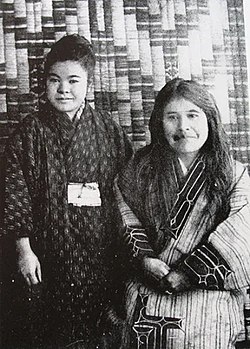
A picture of Imekanu, right, with her niece Yukie Chiri, a famous Ainu Japanese transcriber and translator of Ainu epic tales. (1922)
The origins of the Ainu have long been of interest to scholars from Japan, Europe, and the USA. While historically there were inquiries into them being closely related to Europeans, modern analysis shows that they are related to other nearby Asian groups, and originated from local ancestral populations.
The exact origins of the early Ainu remain unclear, but it is generally agreed to be linked to the Satsumon culture of the Epi-Jōmon period, with later influences from the nearby Okhotsk culture.[2][3] The Ainu culture may be better described as an "Ainu cultural complex", taking into account the regional variable subgroups of Ainu peoples. While the Ainu can be considered a continuation of the indigenous Jomon culture, they also display links to surrounding cultures, pointing to a larger cultural complex flourishing around the Sea of Okhotsk. Some authors have also described the development of the Ainu culture as the "resistance" of a Jomon society to the emerging Japanese state.[4][5][6]
The historical Ainu economy was based on subsistence farming as well as hunting, fishing, and gathering,[7][8] alongside trading with groups in the surrounding islands and mainland Asia.[9][10]
It has also been noted that the Okhotsk culture played a role in the formation of the later Ainu culture.[13][14] The origin of the Okhotsk culture itself is subject to research. While Okhotsk remains display affinity to the modern Nivkh people of northern Sakhalin, both also display affinities to the Jōmon peoples of Japan, pointing to a possible heterogeneous makeup of Okhotsk society. Satsumon pottery has been found among Okhotsk sites, pointing to a complex network of contacts in the wider area around the Sea of Okhotsk.[15][16]
The emergence of the Ainu culture is henceforth primarily attributed to the Satsumon culture, which later received some contributions from the Okhotsk culture via cultural contacts in northern Hokkaido after the Satsumon culture expanded northwards and into Sakhalin.[17][18][19] This view has been corroborated by later analyses.[20]
Archaeologists have considered that bear worship, which is a religious practice widely observed among the northern Eurasian ethnic groups, including the Ainu, Finns, Nivkh, and Sami, was also shared by the Okhotsk people. On the other hand, no traces of such a religious practice have ever been discovered from archaeological sites of the Jomon and Epi-Jomon periods, which were anterior to the Ainu cultural period. [...] This implies that the Okhotsk culture contributed to the forming of the Ainu culture.[21]
Relationship with the historical Emishi
A high-status Ainu man
While the view that the ancient Emishi were identical to the Ainu has been largely disproven by current research, the exact relationship between them is still under dispute.[22] It is agreed that at least some Emishi spoke Ainu languages and were ethnically related to the Ainu.[23] The Emishi may, however, have also included non-Ainu groups, which can either be associated with groups distantly related to the Ainu (Ainu-like groups) but forming their own ethnicity, or early Japonic-speakers outside the influence of the Yamato court.[24] The Emishi display clear material culture links to the Ainu of Hokkaido. Based on Ainu-like toponyms throughout Tohoku, it is argued that the Emishi, like the Ainu, descended from the Epi-Jōmon tribes and initially spoke Ainu-related languages.[25]
The term "Emishi" in the Nara period (710–794) referred to people who lived in the Tohoku region and whose lifestyle and culture differed markedly from that of the Yamato people; it was originally a highly cultural and political concept with no racial distinction.[26]
From the mid-Heian period onward, Emishi who did not fall under the governance of the Yamato Kingship were singled out as northern Emishi. They began to be referred to as "Ezo" (Emishi).[27]
The first written reference to "Ezo", which is thought to be Ainu, can be found in Suwa Daimyōjin Ekotoba, which was written in 1356. Indeed, Ainu have lived in Sakhalin, the Kuril Islands, Hokkaido, and the northern Tohoku region since the 13th century.[28]
Historically many Europeans tried to argue for an origin of the Ainu that related them to white Europeans,[30][31][32] due to perceived similarities in facial structures,[31][33] the increased presence of facial and body hair among the Ainu compared to Yamato Japanese,[34] and a perceived paler complexion.[35][36] The Ainu are also compared to Aboriginal Australians and various jungle tribes from India because they, like the Ainu, possessed phenotypes that were perceived to be closer to Europeans.[37]
An analysis of 16 Ainu male individuals found that the majority (14/16) belong to Y-DNAHaplogroup D-M55, while a minority (2/16) belongs to Haplogroup C-M217. D-M55 is found throughout the Japanese archipelago, with very high frequencies among the Ainu of Hokkaido.[38] C-M217 is found more commonly among populations from Northeast Asia.[39]
Maternal lineages
An analysis of 51 Ainu individuals found that around 51% of their mtDNA subclades are unique to the Ainu, while the remaining haplogroups are shared with other Asian populations, especially with the Nivkhs in northern Sakhalin and the Koryaks on the Kamchatka Peninsula.[40]
Of the 51 Ainu individuals, around 27% (14/51) belong to N9 (of which 10 were assigned to subclade Y and four to unclassified N9 clades), around 24% (12/51) to D, around 20% (10/51) to M7, and around 20% (10/51) to G; the minor haplogroups are A (2/51), B (1/51), F (1/51), and an unclassified subclade of M not belonging to M7, M8, CZ, D, or G.[41]
Autosomal DNA
Admixture graph based on the genomic data of Okhotsk (NAT002), Jomon (F23), and modern populations
The Ainu are closely related to the Jōmon peoples of Japan. According to genetic analyses of Jōmon remains, they represent a deeply diverged East Asian lineage. This lineage arose after the divergence between Tianyuan and Hoabinhian lineages but diverged from Ancient East Asians before they split into Ancient Northern East Asians and Ancient Southern East Asians.[43] However, the Jōmon consistently form a clade with Ancient Northern East Asians and Ancient Southern East Asians[44][45] and exhibit a high degree of genetic homogeneity.[46][47][48][49][50] Several studies model the Jōmon as a mixture of Onge-related (44%) and Tianyuan-related (56%) ancestries[51] or as a mixture of Onge-related (51.6%) and Early Neolithic Xiaogao-related (48.4%) ancestries, with the latter having Tungusic affinities.[52]
Beyond their broad affinity with Eastern Asian lineages, the Jomon display a weak affinity for Ancient North Eurasians (ANE), which may be associated with the introduction of microblade technology to Northeast Asia and northern East Asia during the Last Glacial Maximum via the ANE or Ancient Paleo-Siberians.[53][54][55] Other studies, however, suggest no direct gene flow from ANE-like (MA-1) sources into the Jōmon[56] or that it was mediated by Northern East Asian populations who themselves were mixed with ANE.[57] According to a 2025 study, whilst the Jōmon have the lowest Denisovan ancestry among East Asians like West Eurasians, it is not attributed to either West Eurasian or Hoabinhian admixture, which is not found in the Jōmon. However, the Jōmon most likely inherited their Denisovan ancestry from the same ancestral populations that ANE-related and Tianyuan-related populations inherited their Denisovan ancestry from.[58]
The genetic makeup of the Ainu represents a "deep branch of East Asian diversity". Compared to contemporary East Asian populations, the Ainu share "a closer genetic relationship with northeast Siberians".[59] In addition, the Ainu display relatively closer affinities with "lowland East Asians" than "highland East Asians", suggesting gene flow between Ainu and "lowland East Asians".[60] To exemplify, the Ainu might have contributed some ancestry to surrounding populations around the Sea of Okhotsk. Differences in the frequency of the derived EDAR gene variant between the Ainu and contemporary East Asians suggest that the ancestors of the Ainu may not have shared the selective pressures with other Ancestral East Asian populations.[61] The Ainu, however, share two variants in the ADH gene cluster with other East Asians at high frequency, unlike Tibetans and Sherpa, "raising the possibility that selective pressure on these variants was different in the high-altitude environments."[61]
Among modern populations, the Ainu are most closely related to the Ryukyuans of southern Japan, followed by contemporary Japanese people.[62][63] Compared to other East Asian populations, the Ainu are an outgroup, pointing to long-lasting isolation after their divergence. By analyzing the SNP loci of Ainu individuals, it was found that they carry genes associated with facial structure found among Europeans and hair and tooth morphology found among East Asians.[64] The Ainu also exhibit strong influence from Northeast Asian populations.[65][66] Genetic analyses of HLA I and HLA II genes as well as HLA-A, B, and DRB1 gene frequencies placed the Ainu in an intermediate position between indigenous peoples of the Americas and contemporary Northeast Asians.[67][68] Other studies show that there was better preservation of phenotypes associated with the Jōmon, including Ainu people, and Yayoi populations in the southernmost regions of Japan due to less influence from recent Northeast Asian migrations.[69] The Jōmon remains also exhibit homogeneity in terms of their craniofacial features although there's evidence of variation in terms of their neurocraniums. Variation also exists within the same phases and geographic regions.[70][71]
Studies on modern-day Ainu estimate that they derive between 66% and 79.3% of their ancestry from the Jōmon lineage.[72][73] Another study shows that modern Ainu people derive c. 28.1–29% or 44% of their ancestries from mainland Japanese, depending on whether they're modeled as a mixture of Jōmon, Okhotsk and mainland Japanese peoples or Jōmon and mainland Japanese peoples respectively, which were both acceptable. An ancient Okhotsk-related individual (NAT002) had Northeastern Asian-related ancestry (24.6%), East Asian-related ancestry (15.8%), Jōmon-related ancestry (33.2%) and ancestry related to Itelmen and Koryaks (26.4%). These admixture proportions are similar to what's found in Lower Amur populations, including the Nivkh and Ulch.[74] Ainu from central and eastern Hokkaido also have higher Jōmon affinities than those from western Hokkaido, who have more mainland Japanese affinities.[75]
↑Lee & Hasegawa (2013): "In this paper, we reconstructed spatiotemporal evolution of 19 Ainu language varieties, and the results are in strong agreement with the hypothesis that a recent population expansion of the Okhotsk people played a critical role in shaping the Ainu people and their culture. Together with the recent archaeological, biological and cultural evidence, our phylogeographic reconstruction of the Ainu language strongly suggests that the conventional dual-structure model must be refined to explain these new bodies of evidence. The case of the Ainu language origin we report here also contributes additional detail to the global pattern of language evolution, and our language phylogeny might also provide a basis for making further inferences about the cultural dynamics of the Ainu speakers [44,45]."
↑Smale, Joran (June 2014). End of Okhotsk? A Peer Polity Interaction approach to the interaction, exchange and decline of a Northeast-Asian maritime culture on Hokkaido, Japan (Master thesis). Leiden University, Faculty of Archaeology. p.73. hdl:1887/28236. Evidence that mainly Satsumon culture is ancestral to Ainu culture still stands. However, it is clear that there is some continuity between Okhotsk and Ainu culture in the veneration of the bear in Hokkaido.
Osada & Kawai (2021), p.48: "Most Southeast, East, and Northeast Asian populations, including Jomon, are nearly equally distant from the Tianyuan individual, supporting the hypothesis that the Tianyuan population are diverged from the lineage basal to all East and Northeast Asians."
↑Cooke et al. (2021): "However, we note no dilution of Jomon ancestry in the Japanese population (15.0 ± 3.8%), relative to the Kofun individuals (13.1 ± 3.5%) (fig. S22)"
↑Ishiya, Koji; Mizuno, Fuzuki; Gojobori, Jun; Kumagai, Masahiko (2024). "High-coverage genome sequencing of Yayoi and Jomon individuals shed light on prehistoric human population history in East Eurasian". bioRxiv10.1101/2024.08.09.606917.
↑Kato, Masahiko; Mizuno, Fuzuki; Taniguchi, Yasuhiro; Kondo, Osamu (2025). "High-Coverage Jomon Genomes Provide Insights into Population Structure and Genetic Traits of Ancient Japanese Hunter-Gatherers". bioRxiv10.64898/2025.12.14.694187.
de Boer et al. (2020), p.8: "Ancient northern Siberian ancestry prevalent during the Palaeolithic notable for both its closer relationship with European-related rather than Asian-related ancestry and its impact on Native American ancestry is not found in mainland East Asians or the Jōmon, which emphasizes that the connections are specific to coastal mainland East Asians and the Jōmon."
Gakuhari et al. (2020), p.4: "Therefore, there was no detectable signature of gene flow from MA-1 to the ancient/present-day Southeast/East Asians including IK002."
Abood & Oota (2025), p.6: "However, the fact that no evidence of gene flow from Mal'ta was detected in the genome of the Ikawazu Jomon individual was a novel discovery. To what extent did the genome of the northern route influence the Jomon people? In the genome of the Ikawazu Jomon individual, no evidence of gene flow from the northern route was detected. Sufficient DNA was extracted from one of the two Jomon skeletons excavated from the Funadomari site in Hokkaido, allowing for the determination of a complete genome sequence. The Funadomari Jomon genome sequence had a high depth of coverage, and analysis revealed a remarkable genetic similarity to the Ikawazu Jomon. Including this Funadomari Jomon sequence, genome sequence data from approximately 10 Jomon individuals have been registered in public databases and are available for analysis. To date, the conclusion remains unchanged."
↑Kura, Kenya; Armstrong, Elijah L.; Templer, Donald I. (May 2014). "Cognitive function among the Ainu people". Intelligence. 44: 149–154. doi:10.1016/j.intell.2014.04.001.
↑Nakao, Hisashi; Kaneda, Akihiro; Tamura, Kohei; Noshita, Koji; Yoshida, Mayu; Nakagawa, Tomomi (2025). "Continuous and widespread population interactions in the Jōmon society via geometric morphometrics on 3D data of human crania". bioRxiv10.1101/2025.02.09.637294.
Bennett, Andrew E.; Liu, Yichen; Fu, Qiaomei (2025). Reconstructing the Human Population History of East Asia through Ancient Genomics. doi:10.1017/9781009246675. ISBN978-1-009-24667-5.
Hennessey, John L. (2024). "Overlooking whiteness? Discourses of race and primitiveness in accounts of the Ainu by Benjamin Douglas Howard and Henry Savage Landor (1893)". History and Anthropology. 35 (4): 893–908. doi:10.1080/02757206.2023.2164926.
Hirano, Katsuya (2017). "Settler colonialism in the making of Japan's Hokkaidō". In Cavanagh, Edward; Veracini, Lorenzo (eds.). The Routledge Handbook of the History of Settler Colonialism. Routledge. doi:10.4324/9781315544816_22 (inactive 17 September 2025). ISBN978-1-315-54481-6.{{cite book}}: CS1 maint: DOI inactive as of September 2025 (link)
Komai, Eléonore (7 July 2021). "The Ainu and Indigenous Politics in Japan: Negotiating Agency, Institutional Stability, and Change". Journal of Race, Ethnicity, and Politics. 7 (1): 141–164. doi:10.1017/rep.2021.16. ISSN2056-6085. S2CID237755856.
Leeming, David Adams; Leeming, Margaret Adams (2009). A Dictionary of Creation Myths (Oxford Reference Onlineed.). Oxford University Press.
Li, Yu-Chun; Gao, Zong-Liang; Liu, Kai-Jun; Tian, Jiao-Yang; Yang, Bin-Yu; Rahman, Zia Ur; Yang, Li-Qin; Zhang, Su-Hua; Li, Cheng-Tao; Achilli, Alessandro; Semino, Ornella; Torroni, Antonio; Kong, Qing-Peng (May 2023). "Mitogenome evidence shows two radiation events and dispersals of matrilineal ancestry from northern coastal China to the Americas and Japan". Cell Reports. 42 (5) 112413: 1–14. doi:10.1016/j.celrep.2023.112413. PMID37164007.
Low, Morris (April 2012). "Physical Anthropology in Japan: The Ainu and the Search for the Origins of the Japanese". Current Anthropology. 53: S57–S68. doi:10.1086/662334.
Siddle, Richard M. (2008). "The Ainu: Indigenous people of Japan". In Weiner, Michael (ed.). Japan's Minorities: The illusion of homogeneity (2nded.). Routledge. pp.21–39. ISBN978-0-203-88499-7.
Yang, Jiaqi; Iasi, Leonardo N. M.; Fu, Qiaomei; Cooke, Niall P.; Kelso, Janet; Peyrégne, Stéphane; Peter, Benjamin M. (October 2025). "An early East Asian lineage with unexpectedly low Denisovan ancestry". Current Biology. 35 (20): 4898–4908.e4. doi:10.1016/j.cub.2025.08.051. PMID41118724.
This page is based on this Wikipedia article Text is available under the CC BY-SA 4.0 license; additional terms may apply. Images, videos and audio are available under their respective licenses.