Australia men's national soccer team

Last updated

Australia
Australia national football team badge.svg
Nickname Socceroos
Association Football Australia
Confederation AFC (Asia; 2006–present)
OFC (Oceania; 1966–1972, 1978–2006) [1]
Sub-confederation AFF (Southeast Asia)
Head coach Tony Popovic
Captain Mathew Ryan
Most caps Mark Schwarzer (109)
Top scorer Tim Cahill (50)
Home stadium Various
FIFA code AUS
Kit left arm aus25h.png
Kit left arm.svg
Kit body aus25h.png
Kit body.svg
Kit right arm aus25h.png
Kit right arm.svg
Kit shorts aus25h.png
Kit shorts.svg
Kit socks aus25hl.png
Kit socks long.svg
First colours
Kit left arm aus25a.png
Kit left arm.svg
Kit body aus25a.png
Kit body.svg
Kit right arm aus25a.png
Kit right arm.svg
Kit shorts aus25a.png
Kit shorts.svg
Kit socks aus25al.png
Kit socks long.svg
Second colours
FIFA ranking
Current 26 Decrease2.svg 1 (19 November 2025) [2]
Highest14 (September 2009)
Lowest102 (November 2014)
First international
Flag of New Zealand.svg  New Zealand 3–1 Australia  Flag of Australia (converted).svg
(Dunedin, New Zealand; 17 June 1922)
Biggest win
Flag of Australia (converted).svg  Australia 31–0 American Samoa  Flag of American Samoa.svg
(Coffs Harbour, Australia; 11 April 2001)
(World record for senior international matches) [3]
Biggest defeat
Flag of Australia (converted).svg  Australia 0–8 South Africa  Flag of South Africa (1928-1982).svg
(Adelaide, Australia; 17 September 1955)
World Cup
Appearances7 (first in 1974 )
Best resultRound of 16 (2006, 2022)
Asian Cup
Appearances5 (first in 2007 )
Best resultChampions (2015)
OFC Nations Cup
Appearances6 (first in 1980 )
Best resultChampions (1980, 1996, 2000, 2004)
Confederations Cup
Appearances4 (first in 1997 )
Best resultRunners-up (1997)
Website socceroos.com.au

The Australia men's national soccer team represents Australia in international men's soccer. Officially nicknamed the Socceroos, [4] the team is controlled by the governing body for soccer in Australia, Football Australia, which is affiliated with the Asian Football Confederation (AFC) and the regional ASEAN Football Federation (AFF).

Contents

The team played its first match in 1922 and originally participated in the Oceania Football Confederation (OFC). In this confederation, Australia won the OFC Nations Cup four times between 1980 and 2004, and dominated many FIFA World Cup qualification campaigns during earlier rounds. The team won 31–0 against American Samoa in a FIFA World Cup qualification match, achieving the world record for the largest victory in a senior international match. Despite this, the team only managed to qualify for the FIFA World Cup twice in 11 attempts while in this confederation, due to Oceania's single qualification berth always leading to an intercontinental playoff, and thus, not guaranteeing straight qualification. The team moved to the AFC in 2006, winning the AFC Asian Cup once in 2015 (as hosts) and finishing runners-up in 2011. By winning this competition, Australia became the only team in the world to have won two different confederation cups. [5] Since moving confederations, the team has also qualified for the World Cup in every attempt, qualifying five additional times for an overall seven qualifications. Australia has made appearances in the World Cup knockout stages twice, having progressed to this stage in 2006 and 2022. Despite being part of the AFF, Australia has not joined the ASEAN Championship due to mutual agreement.

The team additionally represented Australia at the now-defunct FIFA Confederations Cup four times, winning a silver and bronze medal in 1997 and 2001 respectively. Mark Schwarzer has the most caps for Australia, with 109 to his name, while Tim Cahill has the most goals scored, with 50. Australia initially developed a rivalry with New Zealand and a rivalry with Uruguay, and, after joining the AFC, has developed a fierce rivalry with Japan.

History

Early years

The first Australia soccer team (wearing light blue shirts) of 1922 Australia soccer team 1922.jpg
The first Australia soccer team (wearing light blue shirts) of 1922

The first Australia national team was constituted in 1922 for a tour of New Zealand, [6] which included two defeats and a draw. For the next 36 years, Australia, New Zealand and South Africa became regular opponents in tour (exhibition) matches. [7] During that period, Australia also competed against Canada and India during their tours of Australia in 1924 and 1938 respectively. [8] [9] Australia recorded their worst ever defeat on 30 June 1951 as they lost 17–0 in a match to a touring England side. [10] The country had a rare opportunity to compete on the world's stage during the team's first major international tournament as hosts of the 1956 Melbourne Olympics. However, an inexperienced squad proved to be reason for the team's disappointing performance, including a 4–2 loss to India in the quarterfinals. [11] With the advent of cheap air travel, Australia began to diversify its range of opponents, [7] but its geographical isolation continued to play a role in its destiny for the next 30 years. [7] Australia won the 1967 South Vietnam Independence Cup against seven other nations, but this gained little recognition domestically. [12]

After failing to qualify for the FIFA World Cup in 1966 and 1970, losing in play-offs to North Korea and Israel respectively, Australia finally appeared at their first World Cup in West Germany in 1974. [13] After managing only a draw from Chile and losses from East Germany and West Germany, the team, which was made up of mostly amateur players, was eliminated at the end of the first round, finishing last in their group without scoring a goal. It would prove to be the only appearance for the Australian team until the World Cup returned to Germany more than three decades later in 2006. [13] Over a 40-year period, the Australian team was known for its near misses in its attempts to qualify for the World Cup; they lost play-offs in 1966 to North Korea, 1970 to Israel, 1986 to Scotland, 1994 to Argentina, 1998 to Iran and 2002 to Uruguay.

First successes and "golden generation"

The team's previously poor record in World Cup competition was not reflected in their reasonable performances against strong European and South American sides. In 1988, Australia defeated reigning world champions Argentina 4–1 in the Australian Bicentennial Gold Cup. [14] [15] In 1997, Australia drew with reigning world champions Brazil 0–0 in the group stage and then defeated Uruguay 1–0 in the semi-finals to reach the 1997 FIFA Confederations Cup final. [16]

In 2001, after a victory against reigning world champions France in the group stage, Australia finished the 2001 FIFA Confederations Cup in third place after defeating Brazil 1–0 in the third-place match. [17] Australia defeated England 3–1 at West Ham United's Boleyn Ground in 2003 as Wayne Rooney made his international debut. [18]

In early 2005, it was reported that Football Australia had entered into discussions to join the Asian Football Confederation (AFC) and end an almost 40-year association with the Oceania Football Confederation (OFC). [19] Many commentators and fans, including soccer broadcaster and former Australian captain Johnny Warren, felt that the only way for Australia to progress was to abandon Oceania. [20] On 13 March, the AFC executive committee made a unanimous decision to invite Australia to join the AFC. [21] After the OFC executive committee unanimously endorsed Australia's proposed move, FIFA approved the move on 30 June 2005. [21] Australia joined Asia, with the move taking effect on 1 January 2006, though until then, Australia had to compete for a 2006 FIFA World Cup position as an OFC member country. [21]

After a successful campaign, the team took the first steps towards qualification for the 2006 World Cup. [22] After coach Frank Farina stood down from the position after Australia's dismal performance at the 2005 FIFA Confederations Cup, Guus Hiddink was announced as the new national coach. [22] Australia, ranked 49th, would then have to play the 18th ranked Uruguay in a rematch of the 2001 qualification play-off for a spot in the 2006 FIFA World Cup. After a 5–0 friendly win against Jamaica, [23] the first leg of the play-off tournament was lost (1–0), with the return leg still to be played in Australia four days later in Sydney on 16 November 2005. [24]

Australia playing Uruguay at Stadium Australia to determine the last qualifying spot for the 2006 FIFA World Cup. AUS-URU Nov 05 ET.jpg
Australia playing Uruguay at Stadium Australia to determine the last qualifying spot for the 2006 FIFA World Cup.

The second leg of the qualifying play-off was played in front of a crowd of 82,698 at Stadium Australia. [25] Australia led Uruguay 1–0 after 90 minutes following a goal by Mark Bresciano in the first half. The aggregate was tied, and extra time was played. Neither team scored after two periods of extra time, bringing the game to a penalty shootout. Australia won the penalty shootout 4–2, making Australia the first ever team to qualify for a World Cup via a penalty shootout. [26] Australian goalkeeper Mark Schwarzer made two saves, with John Aloisi scoring the winning penalty for a place in the World Cup, Australia's first qualification in 32 years. [24]

Australia went into the 2006 World Cup as the second lowest-ranked side. Although their ranking vastly improved in subsequent months after a series of exhibition matches against high-profile teams, including a 1–1 draw against the Netherlands, and a 1–0 win at the sold-out 100,000 capacity Melbourne Cricket Ground against the then European champions Greece [27] for the 2006 World Cup, Australia was placed into Group F, along with Japan, Croatia and defending champions Brazil. In their opening group game, Australia defeated Japan 3–1, with Tim Cahill scoring two goals (84', 89') and John Aloisi scoring one (90+2') in the last eight minutes. The goals were the first ever scored by Australia's men's soccer team in a World Cup and it was also the first victory of an Oceanian team in the tournament's history, as well as all three goals being scored in the last seven minutes of the game, which was never before done in a World Cup match. [28] Australia met Brazil in their second group game, which Australia lost to Brazil 2–0. The Socceroos faced Croatia in their third match. The final score (2–2) was enough to see Australia proceed to the round of 16, where they were eliminated from the competition after a 1–0 defeat by the eventual champions Italy after conceding a controversial penalty in the 93rd minute. [29] [30] The loss marked the official end of Hiddink's tenure as Australia's national coach. [31] The success achieved at the 2006 World Cup later saw the team named AFC National Team of the Year, [32] as well as being dubbed the "golden generation" in the history of the Socceroos. [33]

Later success

Led by coach Graham Arnold, Australia went to their first AFC Asian Cup in 2007, sending a strong squad which included 15 players from the previous year's World Cup team. In Group A they played against Oman (a 1–1 draw), Thailand (a 4–0 win) and eventual champions Iraq (a 3–1 loss), assuring Australia's progression to the quarter-final stage of the tournament. After drawing 1–1 with Japan with 120 minutes played, Australia exited the tournament on penalties at the quarter-final stage. An international friendly on 11 September 2007 against Argentina (a 1–0 loss) was Graham Arnold's last game as head coach, with the position eventually being filled by Pim Verbeek on 6 December 2007. [34]

Australia began their 2010 FIFA World Cup campaign in the third round of qualification, drawn into a group consisting of Qatar, Iraq and China PR, in which Australia finished first. Australia eventually saw progression through to the tournament in South Africa after comfortably winning the fourth round of qualification in a group consisting of Japan, Bahrain, Qatar and Uzbekistan. [35] Australia's qualification was already assured before the final two games, finally topping its group ahead of Japan by five points.

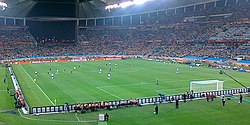
Australia against Germany in Moses Mabhida Stadium, at the 2010 FIFA World Cup FIFA World Cup 2010 Germany Australia.jpg
Australia against Germany in Moses Mabhida Stadium, at the 2010 FIFA World Cup

Australia was drawn into Group D in the World Cup, which featured three-time world champion Germany, Ghana and Serbia. On 14 June, Australia faced Germany. Pim Verbeek's surprising decision to play without a recognised striker saw Australia comprehensively defeated 4–0. Verbeek received heavy criticism for his tactics, [36] with SBS (Australia's World Cup broadcaster) chief soccer analyst Craig Foster calling for his immediate sacking. [37] Australia's second group match against Ghana resulted in a 1–1 draw, and their third and final group match against Serbia resulted in a 2–1 win. Ultimately, Australia were eliminated on goal difference behind Ghana. Pim Verbeek completed his term as Australian coach at the end of the 2010 World Cup and was soon replaced by Holger Osieck. [38]

In 2010, Australia qualified for their second AFC Asian Cup, topping their qualification group. A successful campaign at the 2011 Asian Cup saw Australia become runners-up to Japan, after losing in the Final 1–0 in extra time. [39]

In 2012, Australia agreed to compete in the East Asian Cup. [40] Australia travelled to Hong Kong to compete in a series of qualification matches with the hopes of qualifying for the 2013 East Asian Cup. Despite handing several debuts and fielding an in-experienced squad, Australia was successful, finishing ahead of Hong Kong, North Korea, Guam and Chinese Taipei to progress to the 2013 East Asian Cup, where Australia eventually finished last behind Japan, South Korea and China PR. [41] [42] On 26 August 2013, Australia became full members of the ASEAN Football Federation [43] but as part of their entrance agreement with the sub-confederation, their national team is barred from participating in the AFF Championship due to their perceived wide gap in playing standards between Australia and the rest of the region. [44]

Australia against Chile in Arena Pantanal, Cuiaba, at the 2014 FIFA World Cup. Chile vs. Australia en el Arena Pantanal de Cuiaba.JPG
Australia against Chile in Arena Pantanal, Cuiabá, at the 2014 FIFA World Cup.

Australia's 2014 FIFA World Cup qualification campaign began with a series of friendlies against the United Arab Emirates (0–0), Germany (a 2–1 win), New Zealand (a 3–0 win), Serbia (0–0) and Wales (a 2–1 win). [45] Australia's World Cup campaign started in the third round of qualification, with Australia topping their group to progress to the fourth round. After winning their last fourth round-game, Australia finished as runners-up in their group, qualifying for the finals tournament in Brazil on 18 June 2013. [46]

Shortly after achieving qualification to the World Cup, Australia played a series of friendly matches against Brazil and France, suffering consecutive 6–0 defeats. This along with previous poor performances during the 2014 World Cup qualification campaign resulted in manager Holger Osieck's sacking, bringing his four-year tenure as Australia's manager to an end. [47]

New generation: the 2015 AFC Asian Cup triumph

Australia match against Kuwait in 2015 AFC Asian Cup opening match 2015 AFC Asian Cup opening match Australia Kuwait, 9 January 2015 (3).jpg
Australia match against Kuwait in 2015 AFC Asian Cup opening match

After a two-week search for a new manager, Ange Postecoglou was eventually appointed in the position. [48] Postecoglou was tasked with regenerating the Australian national team, which was deemed to have been too reliant on members of their Golden Generation of 2006, subsequently leading to a stagnation of results, culminating in successive 6–0 defeats to Brazil and France. [49] In his first game as Australia's manager, a home friendly match against Costa Rica, Australia won 1–0 courtesy of a goal from Tim Cahill. [50]

At the World Cup, Australia were drawn in Group B alongside defending world champions Spain, 2010 runners-up Netherlands and Chile. [51] Their first match was off to a lacklustre start, having conceded two goals in the opening 15 minutes from Alexis Sánchez and Jorge Valdivia. Despite a goal from Tim Cahill that inspired a late resurgence from Postecoglou's team, they ultimately lost to Chile 3–1. Their second match against the Netherlands was a close one, with the Socceroos giving up a 2–1 lead, eventually resulting in a 3–2 loss, thus earning their early exit along with the Spanish. In the end, Australia finished Group B with a third consecutive defeat to Spain, 3–0. Australia's competitive World Cup performances in a difficult group led to believe that a new Golden Generation was about to begin. [52] [53]

In their first international match after the World Cup, Australia played 2014 quarter-finalists Belgium in Liège, with Australia going down 2–0. Four days later, Australia achieved their first international win in ten months, and just their second win under Ange Postecoglou, with a 3–2 victory over Saudi Arabia in London. After drawing against the United Arab Emirates, and suffering successive losses against Qatar and Japan, combined with previous poor results earlier in the year, Australia slipped to 94 and 102 in the FIFA World Rankings, their lowest-ever ranking. [54]

Australia playing in the 2015 AFC Asian Cup final where they would go on to lift the cup after defeating South Korea 2-1 in extra time 2015 Asian Cup Final.jpg
Australia playing in the 2015 AFC Asian Cup final where they would go on to lift the cup after defeating South Korea 2–1 in extra time

The new year saw Australia host the 2015 AFC Asian Cup, with the team making their third consecutive appearance in the tournament. Australia won their first two group matches against Kuwait and Oman comfortably, with scorelines of 4–1 and 4–0 respectively. This guaranteed their qualification for the knockout stage, despite losing their final group match against South Korea in Brisbane 1–0. [55] They faced China PR in the quarter-finals and won 2–0, courtesy of a second-half brace from Tim Cahill. In the semi-finals, Australia won 2–0 over the United Arab Emirates and advanced to the final for the second time in a row. They faced South Korea in the final on 31 January at Stadium Australia, winning 2–1 after extra time to claim their first Asian title and qualify for the 2017 FIFA Confederations Cup. [56] [57]

After Australia qualified for the 2018 FIFA World Cup in November 2017, Ange Postecoglou resigned from his position as coach; [58] and former manager of the Netherlands national team, Bert van Marwijk, was subsequently appointed as his replacement. [59] [60] [61] On 8 March 2018, after van Marwijk's first squad announcement, the FFA announced that Graham Arnold will take the coaching role from after the 2018 World Cup until the 2022 World Cup. [62]

With van Marwijk, Australia was grouped with Denmark, France and Peru. The Socceroos' first group match against eventual world champions France was praised by a valiant effort, in which Australia only lost 1–2 by a virtual own goal from Aziz Behich. [63] After the defeat to France, Australia produced another outstanding performance, drawing Denmark 1–1. [64] However, in the crucial match against already eliminated Peru, Australia lost 0–2 and crashed out from the World Cup with only a point, becoming the only team from the AFC to be winless in the 2018 World Cup. [65] Subsequently, van Marwijk left his post and Arnold replaced him as the new coach of the Socceroos.

Under Graham Arnold, Australia started their 2019 AFC Asian Cup in hope of defending the title, being grouped with Jordan, Syria and Palestine, but their hope was shattered by a shocking 0–1 defeat to Jordan. [66] Australia soon returned to the race by beating Palestine 3–0 [67] before winning an important encounter with a hard-fought 3–2 win over Syria, [68] eliminating both Palestine and Syria in the process. The win gave Australia to qualify for the round of sixteen, where they overcame Uzbekistan after winning on penalties 4–2, having drawn 0–0 for 120 minutes. [69] In the quarter-finals, however, in the Hazza bin Zayed Stadium, where Australia had lost their opening match against Jordan, Australia once again failed to register a win in the same ground, losing to the host United Arab Emirates 0–1 due to a mistake from Miloš Degenek, eventually failing to defend the title. [70]

2022 FIFA World Cup resurgence

Australia took part in the 2022 FIFA World Cup qualification, which they entered in the second round, in which they faced Kuwait, Jordan, Nepal and Chinese Taipei. [71] Australia dominated the group with eight wins out of eight to reach the third round, where it faced Saudi Arabia, Japan, China, Oman and Vietnam. [72] After a start with three straight wins over China, Vietnam and Oman, Australia then won only one game, against Vietnam, in their final seven matches, being held thrice and losing three more, finishing third in the group. It then had to rely on fourth round playoffs. [73] Due to the COVID-19 pandemic, all of Australia's playoffs were centralised in Doha. The Socceroos began their quest with a 2–1 win over the United Arab Emirates, to face fifth place CONMEBOL qualification finisher Peru, a rematch of the 2018 FIFA World Cup. [74] This time around, Australia held Peru goalless, before winning on penalties to qualify for the FIFA World Cup in Qatar.

Australia was drawn in group D along with France, Denmark and Tunisia. [75] Australia's qualification also meant that the Asian confederation had the largest number of teams in their FIFA World Cup history, with six countries qualifying. [76]

Australia before their match against France in the 2022 FIFA World Cup opening match 2022 FIFA World Cup France 4-1 Australia - (5).jpg
Australia before their match against France in the 2022 FIFA World Cup opening match

As preparation for the 2022 FIFA World Cup, Australia played two friendlies against neighbouring New Zealand, winning both games. [77] [78] It began its World Cup quest on 23 November against France, losing 4–1 after initially taking the lead with goal from Craig Goodwin. [79] Three days later Australia registered its first World Cup win since 2010, overcoming Tunisia with a header from Mitchell Duke to seal a 1–0 win, sending Australia from bottom to second place. [80] Four days later, against UEFA Euro 2020 semi-finalists Denmark, Australia won 1–0, thanks to a Mathew Leckie goal. Australia finished the group stage in second place behind France on goal difference, making Australia the first Asian representative to reach the knockout stage in Qatar 2022. [81] Australia's resurgence in the group stage was widely watched and followed by Australian supporters. Mass celebrations occurred after the upsets over Tunisia and Denmark, and Prime Minister Anthony Albanese called the achievement "magnificent". [82] [83] [84] In the round of 16, Australia lost 2–1 to Argentina, with Lionel Messi opening the scoring and Julián Álvarez getting the second after dispossessing Mathew Ryan. Australia pulled one back when Goodwin's shot deflected into goal off Enzo Fernández and Garang Kuol almost scored the equaliser in injury time, but his shot was smothered by Argentinian goalkeeper Emiliano Martínez. [85]
2026 World Cup qualification

On 20 September 2024, Graham Arnold announced he was stepping down as head coach, two games into the third round of 2026 FIFA World Cup qualifying. [86] The Socceroos had only picked up one point from two matches. On 23 September 2024, James Johnson announced that Football Australia had appointed Tony Popovic as head coach. [87] Popovic led the Socceroos to wins over Japan and Saudi Arabia, and Australia eventually ensured direct qualification to the FIFA World Cup for the first time since 2014, and their sixth consecutive World Cup appearance. [88]

Team image

Media coverage

Australian matches are broadcast by Paramount+ and on free-to-air by Network 10. [89]

Previous coverage has been provided by Fox Sports (2018–2021), [90] Ten network on its 10 Bold channel, ABC, [91] SBS until 2016 and Nine on its 9Go! channel (2016–2017).

The national team has set multiple ratings records for both subscription and free-to-air television. Australia's final 2006 FIFA World Cup qualifying match against Uruguay was the highest rating program in SBS history with an audience of 3.4 million viewers, [92] while a 2010 World Cup qualifying match against Uzbekistan set a record for the highest subscription television audience, with an average of 431,000 viewers. [93] The 2015 AFC Asian Cup final against South Korea had a total reach of 5.3 million Australians overall. [94]

Kit

As of 2025, the Socceroos kit is designed by Reko Rennie, a First Nations artist. [95] The kit is used across all of Australia's national football teams, including the Matildas. The home shirt is predominantly yellow and light green chevron patterning. The shorts are a solid dark green, along with the collar, side, and cuffs of the shirt. They are usually worn with white socks. The away kit is predominantly black, with a light green collar and cuffs on the shirt. It is also adorned with pink and green chevron patterning on its sides. [96]

Kit left arm.svg
Kit body collarwhite.png
Kit body.svg
Kit right arm.svg
Kit shorts.svg
Kit socks band claret.png
Kit socks long.svg
Australia's first national kit, 1922

Australia's first kit was sky blue with a maroon hoop on the socks, the colours representing the states of New South Wales and Queensland, a look that was reminiscent of the Australian national rugby league team's strips of the period. [97] They wore the predominantly light blue kit until 1924 when they changed to green and gold, Australia's national colours. [98]

Australia has worn a yellow jersey, usually accompanied by green shorts, and yellow socks since the 1960s. The colour of the socks altered throughout the 1970s, 1980s, and 1990s from white to the same green as the shorts to the same yellow colour as the jersey.

Rather than displaying the logo of Football Australia, Australia's jersey traditionally features the coat of arms of Australia over the left breast. The team first wore the traditional green and yellow colours in 1924. [99]

Australia's kits have been produced by manufacturers including Umbro, Adidas, KingRoo, and since 2004 by Nike. [100] Australia's 1974 World Cup kits were produced by Adidas as were all other national team kits in the tournament, with Adidas sponsoring the event. The kits, however, contained Umbro branding, due to the manufacturer's Australian partnership at the time. [101] Nike renewed the kit manufacturer deal with FFA for another 11 years in 2012, handing them the rights to make national team kits until 2022. [102] In the lead-up to the 2014 World Cup, the new kits to be worn by the team were revealed. The design of the new kits included a plain yellow shirt with a green collar, plain dark green shorts and white socks, a tribute to the 1974 Socceroos. Inside the back of the neck also had woven the quote, "We Socceroos can do the impossible", from Peter Wilson, the captain of the 1974 Australian team. [103] This kit was well received.[ citation needed ] In March 2016, FFA revealed the new Socceroos kit, which featured a yellow jersey, yellow shorts and green socks. This was reportedly in accordance with a FIFA directive, instructing all national teams to have matching shirts and shorts. [104] [105] This kit was met with wide public contention, primarily due to the colour change of the shorts from the traditional green to yellow. [104] [105] [106] [107] [108]

Kit suppliers

Kit supplierPeriodNotes
Flag of the United Kingdom.svg Umbro 1974–19831974 FIFA World Cup jerseys were manufactured by Adidas but featured an Umbro logo.
Flag of Germany.svg Adidas 1983–1989
Flag of Australia (converted).svg Kingroo1990–1993
Flag of France.svg Patrick 1993
Flag of Germany.svg Adidas 1993–2004
Flag of the United States.svg Nike 2004–presentCurrent deal runs until 2033 after extending for another 10 years in 2023. [109]

Nickname

Socceroos livery on a Qantas 747-400 QANTAS 747, Hong Kong, Sept. 2010 - Flickr - PhillipC.jpg
Socceroos livery on a Qantas 747–400

Australia's nickname, "Socceroos", was coined in 1967 by Sydney journalist Tony Horstead in his coverage of the team on a goodwill tour to South Vietnam during the Vietnam War. [110] It is commonly used by both the Australian people and the governing body, the FFA. [111] The nickname represents a cultural propensity for the use of colloquialisms in the country. It also represents the Australian English use of the sport's name. [112] [113]

The name itself is similar to most other Australian national representative sporting team nicknames; used informally when referring to the team, in the media or in conversation. Similarly, the name is derived from a well-known symbol of Australia, in this case, the kangaroo. The words soccer and kangaroo are combined into a portmanteau word as soccer-roo; such as Olyroos for the Australia Olympic soccer team [114] or Hockeyroos for the Australian national women's hockey team.

Naming rights and sponsorship

The team has been branded the "CommBank Socceroos" since 1 September 2025, after Commonwealth Bank (who also have the naming rights for the women's national team) took over the naming rights from restaurant chain Subway, whose previous deal started in 2022. [115] [116]

Previously, they were known as the "Caltex Socceroos" under the sponsorship of Caltex Australia from 2017 to 2019. [117] [118] During the 2018 FIFA World Cup, some of Caltex's service stations were re-branded as "Cahilltex" as a nod to Socceroos player Tim Cahill. [119] [120]

Football Australia has been sponsored by Qantas as its official airline since 2004. [121]

Rivalries

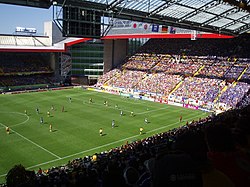
One of the matches of the 2006 World Cup was a group stage match between Australia and Japan at Fritz-Walter-Stadion in Kaiserslautern, Germany. Australia v Japan.jpg
One of the matches of the 2006 World Cup was a group stage match between Australia and Japan at Fritz-Walter-Stadion in Kaiserslautern, Germany.

New Zealand

Australia's longtime rivals are trans-Tasman neighbours New Zealand. [122] The two teams' history dates back to 1922, where they first met in both their international debuts. The rivalry between the Socceroos and the All Whites (New Zealand) is part of a wider friendly rivalry between the neighbours Australia and New Zealand, which applies not only to sport but to the culture of the two countries. The rivalry was intensified when Australia and New Zealand were both members of the OFC, regularly competing in OFC Nations Cup finals and in FIFA World Cup qualifications, where only one team from the OFC progressed to the World Cup. Since Australia joined the AFC in 2006, competition between the two teams has been infrequent, with the occasional match still receiving much media and public attention. [123]

Japan

After joining the AFC, Australia began to develop a fierce rivalry with fellow Asian powerhouse Japan. [124] The rivalry began at the 2006 FIFA World Cup, where the two countries were grouped together. The rivalry continued with the two countries meeting regularly in various AFC competitions, including the 2011 Asian Cup final and qualification for the 2010, 2014, 2018, 2022, and 2026 World Cups.[ citation needed ]

South Korea

Another major rival within Asia is South Korea, who Australia came up against in three World Cup qualification campaigns in the 1970s and, since joining the AFC, have met regularly, including the 2015 Asian Cup final. [125]

Uruguay

A rivalry exists with Uruguay since their first meeting on the eve of the 1974 FIFA World Cup. Both nations have faced each other in consecutive FIFA World Cup play-offs in 2001 and 2005 with each nation winning a playoff final each to progress through to the World Cup. Australia and Uruguay also faced off in the 1997 Confederations Cup in Saudi Arabia, with Australia progressing through to the final against Brazil via a golden goal winner from Harry Kewell. [126]

Supporters

The main supporter group of the Australian national team is Australian Active Support (AAS). [127] AAS, then known as Socceroos Active Support (SAS), was founded in January 2015 as an independent group, [128] who uses social media to organise and keep in touch. This replaced the former active support group Terrace Australis, [129] who were founded by Football Federation Australia and fans in 2013, during Australia's 2014 World Cup qualification campaign. [130] Its establishment came in the wake of poor off-field action and minimal community engagement. [131] Previously, the emergence of Terrace Australis saw the Green and Gold Army relinquish its role as a hub for active support, which it had claimed since its establishment in 2001. [132] [133] Since the 2015 AFC Asian Cup triumph, the supporters had encouraged people in Australia to focus more on the national team, and the nation's soccer pride.

Home stadium

Australia does not have a dedicated national stadium; instead, the team plays at different venues throughout the country for exhibition or tournament purposes. In recent years, major international matches have usually been rotated around various large grounds, including Stadium Australia in Sydney, Hunter Stadium in Newcastle and Docklands Stadium in Melbourne. International matches have also been played at the Melbourne Cricket Ground and Melbourne Rectangular Stadium in Melbourne and Canberra Stadium in Canberra.

Australia has played at the Gabba in Brisbane, which hosted Australia's first international match on home soil in 1923, a 2–1 win over New Zealand. It was the fourth Australian team match overall, with the first three internationals played in New Zealand. [134] Other venues which regularly hosted international home matches included Olympic Park Stadium in Melbourne, the Sydney Cricket Ground, Sydney Sports Ground, Sydney Showground, and Sydney Football Stadium in Sydney, and Subiaco Oval in Perth.

Games in England

Since the 2003 friendly against England, the Socceroos have also played a significant number of games in England, especially London, since a high proportion of the senior team play in European leagues. This includes games at Madejski Stadium in Reading (Reading Football Club's home ground in 2003 against Jamaica, Loftus Road in Shepherd's Bush (Queens Park Rangers' home ground) in 2004 and 2008 against South Africa, 2006 against Ghana, and 2007 against Denmark.

Craven Cottage in Fulham (Fulham Football Club's home ground) hosted Australia's matches against Norway in 2004, New Zealand and Jamaica in 2005. Craven Cottage also hosted Australia's matches against Jamaica in 2007, 2013 against Canada, 2014 against Saudi Arabia, and 2018 against Colombia, while Australia played at The Den in Bermondsey (Millwall Football Club's home ground) in 2014 against Ecuador, and Brentford Community Stadium in Brentford (Brentford Football Club's home ground) in 2023 against New Zealand.

Results and fixtures

The following is a list of match results in the last 12 months, as well as any future matches that have been scheduled.

  Win  Draw  Loss  Fixture

2025

20 March 2026 World Cup Qualifiers Round 3 Australia  Flag of Australia (converted).svg5–1Flag of Indonesia.svg  Indonesia Sydney, Australia
20:10  UTC+11
Report
Stadium: Sydney Football Stadium
Attendance: 35,241
Referee: Adham Makhadmeh (Jordan)
5 June 2026 World Cup Qualifiers Round 3 Australia  Flag of Australia (converted).svg1–0Flag of Japan.svg  Japan Perth, Australia
19:00  UTC+8
Report Stadium: Perth Stadium
Attendance: 57,226
Referee: Qasim Al-Hatmi (Oman)
5 September Soccer Ashes Australia  Flag of Australia (converted).svg1–0Flag of New Zealand.svg  New Zealand Canberra, Australia
19:45  UTC+10
Report Stadium: GIO Stadium
Attendance: 19,115
Referee: Donald Robertson (Scotland)
9 September Soccer Ashes New Zealand  Flag of New Zealand.svg1–3Flag of Australia (converted).svg  Australia Auckland, New Zealand
19:00  UTC+12
Report
Stadium: Go Media Stadium
Attendance: 18,213
Referee: Donald Robertson (Scotland)
10 October Friendly Canada  Flag of Canada (Pantone).svg0–1Flag of Australia (converted).svg  Australia Montreal, Canada
19:30  UTC−4 Report Stadium: Saputo Stadium
Attendance: 23,112
Referee: Steven Madrigal (Costa Rica)
14 October Friendly United States  Flag of the United States.svg2–1Flag of Australia (converted).svg  Australia Denver, United States
21:00  UTC−4
Report
Stadium: Dick's Sporting Goods Park
Attendance: 18,218
Referee: Pierre-Luc Lauziere (Canada)
18 November Friendly Colombia  Flag of Colombia.svg3–0Flag of Australia (converted).svg  Australia New York City, United States
20:30  UTC−4
Report Stadium: Citi Field
Referee: Tori Penso (United States)

2026

13 June 2026 World Cup GS Australia  Flag of Australia (converted).svgvFlag.svg UEFA Path C winner Vancouver, Canada
21:00  UTC−7 Report Stadium: BC Place
19 June 2026 World Cup GS United States  Flag of the United States.svgvFlag of Australia (converted).svg  Australia Seattle, United States
12:00  UTC−7 Report Stadium: Lumen Field
25 June 2026 World Cup GS Paraguay  Flag of Paraguay.svgvFlag of Australia (converted).svg  Australia Santa Clara, United States
19:00  UTC−7 Report Stadium: Levi's Stadium

Coaching staff

Current coaching staff

As of September 2024 [135] [136] [137]
RoleName
Head coach Flag of Australia (converted).svg Tony Popovic
Assistant coaches Flag of Australia (converted).svg Hayden Foxe
Flag of Australia (converted).svg Paul Okon
Director of football Flag of Australia (converted).svg Gary Moretti
Goalkeeping coach Flag of Australia (converted).svg Frank Juric
Team analyst Flag of Australia (converted).svg Michael Mantikos
Sports dietician Flag of Australia (converted).svg Julie Meek

Players

Current squad

The following players were called up for friendlies against Venezuela and Colombia on 14 and 18 November 2025, respectively. [138] [139]
Caps and goals correct as of 19 November 2025, after the match against Colombia.

No.Pos.PlayerDate of birth (age)CapsGoalsClub
11 GK Mathew Ryan (1992-04-08) 8 April 1992 (age 33)1010 Flag of Spain.svg Levante
121 GK Paul Izzo (1995-01-06) 6 January 1995 (age 30)40 Flag of Denmark.svg Randers
181 GK Patrick Beach (2003-08-06) 6 August 2003 (age 22)10 Flag of Australia (converted).svg Melbourne City

22 DF Miloš Degenek (1994-04-28) 28 April 1994 (age 31)541 Flag of Serbia.svg TSC
32 DF Lewis Miller (2000-08-24) 24 August 2000 (age 25)191 Flag of England.svg Blackburn Rovers
42 DF Kye Rowles (1998-06-24) 24 June 1998 (age 27)281 Flag of the United States.svg D.C. United
52 DF Callum Elder (1995-01-27) 27 January 1995 (age 30)30 Flag of England.svg Derby County
152 DF Kai Trewin (2001-05-18) 18 May 2001 (age 24)20 Flag of Australia (converted).svg Melbourne City
192 DF Jason Geria (1993-05-10) 10 May 1993 (age 32)110 Flag of Japan.svg Albirex Niigata
212 DF Cameron Burgess (1995-10-21) 21 October 1995 (age 30)230 Flag of Wales (1959-present).svg Swansea City
242 DF James Overy (2007-11-09) 9 November 2007 (age 18)00 Flag of England.svg Manchester United
252 DF Jack Iredale (1996-05-02) 2 May 1996 (age 29)00 Flag of Scotland.svg Hibernian

83 MF Connor Metcalfe (1999-11-05) 5 November 1999 (age 26)321 Flag of Germany.svg FC St. Pauli
133 MF Aiden O'Neill (1998-07-04) 4 July 1998 (age 27)270 Flag of the United States.svg New York City
143 MF Riley McGree (1998-11-02) 2 November 1998 (age 27)331 Flag of England.svg Middlesbrough
163 MF Max Balard (2000-11-20) 20 November 2000 (age 25)51 Flag of the Netherlands.svg NAC Breda
173 MF Cameron Devlin (1998-06-07) 7 June 1998 (age 27)40 Flag of Scotland.svg Heart of Midlothian
203 MF Paul Okon-Engstler (2005-01-24) 24 January 2005 (age 20)20 Flag of Australia (converted).svg Sydney FC
223 MF Jackson Irvine (1993-03-07) 7 March 1993 (age 32)8014 Flag of Germany.svg FC St. Pauli

64 FW Martin Boyle (1993-04-25) 25 April 1993 (age 32)4010 Flag of Scotland.svg Hibernian
74 FW Nestory Irankunda (2006-02-09) 9 February 2006 (age 19)113 Flag of England.svg Watford
94 FW Mohamed Toure (2004-03-26) 26 March 2004 (age 21)82 Flag of Denmark.svg Randers
114 FW Al Hassan Toure (2000-05-30) 30 May 2000 (age 25)10 Flag of Australia (converted).svg Sydney FC
234 FW Craig Goodwin (1991-12-16) 16 December 1991 (age 33)327 Flag of Australia (converted).svg Adelaide United
4 FW Nicholas D'Agostino (1998-02-25) 25 February 1998 (age 27)40 Flag of Norway.svg Viking

Recent call-ups

The following players have also been called up within the last 12 months.

Pos.PlayerDate of birth (age)CapsGoalsClubLatest call-up
GK Joe Gauci (2000-07-04) 4 July 2000 (age 25)80 Flag of England.svg Port Vale v. Flag of the United States.svg  United States , 14 October 2025
GK Tom Glover (1997-12-24) 24 December 1997 (age 27)00 Unattached Soccer Ashes, 9 September 2025

DF Jordan Bos (2002-10-29) 29 October 2002 (age 23)232 Flag of the Netherlands.svg Feyenoord v. Flag of the United States.svg  United States , 14 October 2025
DF Alessandro Circati (2003-10-10) 10 October 2003 (age 22)90 Flag of Italy.svg Parma v. Flag of the United States.svg  United States , 14 October 2025
DF Jacob Italiano (2001-07-30) 30 July 2001 (age 24)20 Flag of Austria.svg Grazer AK v. Flag of the United States.svg  United States , 14 October 2025
DF Hayden Matthews (2004-06-19) 19 June 2004 (age 21)10 Flag of England.svg Portsmouth v. Flag of the United States.svg  United States , 14 October 2025
DF Fran Karačić (1996-05-12) 12 May 1996 (age 29)151 Flag of Croatia.svg Hajduk Split v. Flag of Canada (Pantone).svg  Canada , 10 October 2025 INJ
DF Aziz Behich (1990-12-16) 16 December 1990 (age 34)813 Flag of Australia (converted).svg Melbourne City v. Flag of Saudi Arabia.svg  Saudi Arabia , 10 June 2025
DF Kasey Bos (2004-05-08) 8 May 2004 (age 21)00 Flag of Germany.svg Mainz 05 v. Flag of Saudi Arabia.svg  Saudi Arabia , 10 June 2025
DF Jason Davidson (1991-06-29) 29 June 1991 (age 34)231 Flag of Australia (converted).svg Melbourne Victory Abu Dhabi Training Camp, 16 May 2025
DF Alex Gersbach (1997-05-08) 8 May 1997 (age 28)60 Flag of Australia (converted).svg Western Sydney Wanderers Abu Dhabi Training Camp, 16 May 2025
DF Ryan Strain (1997-04-02) 2 April 1997 (age 28)60 Flag of Scotland.svg Dundee United Abu Dhabi Training Camp, 16 May 2025 INJ
DF Alex Bonetig (2002-08-20) 20 August 2002 (age 23)00 Flag of Australia (converted).svg Western Sydney Wanderers Abu Dhabi Training Camp, 16 May 2025
DF Sebastian Esposito (2005-04-21) 21 April 2005 (age 20)00 Flag of Australia (converted).svg Melbourne Victory Abu Dhabi Training Camp, 16 May 2025
DF Alex Grant (1994-01-23) 23 January 1994 (age 31)00 Flag of Australia (converted).svg Sydney FC v. Flag of the People's Republic of China.svg  China , 25 March 2025

MF Ajdin Hrustic (1996-07-05) 5 July 1996 (age 29)344 Flag of the Netherlands.svg Heracles Almelo v. Flag of the United States.svg  United States , 14 October 2025
MF Patrick Yazbek (2002-04-05) 5 April 2002 (age 23)80 Flag of the United States.svg Nashville SC v. Flag of the United States.svg  United States , 14 October 2025
MF Alexander Robertson (2003-04-17) 17 April 2003 (age 22)20 Flag of Wales (1959-present).svg Cardiff City v. Flag of the United States.svg  United States , 14 October 2025
MF Ryan Teague (2002-01-24) 24 January 2002 (age 23)40 Flag of Belgium (civil).svg Mechelen Soccer Ashes, 9 September 2025
MF Anthony Kalik (1997-11-05) 5 November 1997 (age 28)00 Flag of Croatia.svg Hajduk Split Soccer Ashes, 9 September 2025
MF Anthony Caceres (1992-09-29) 29 September 1992 (age 33)40 Flag of Australia (converted).svg Macarthur FC v. Flag of Saudi Arabia.svg  Saudi Arabia , 10 June 2025
MF Keanu Baccus (1998-06-07) 7 June 1998 (age 27)211 Flag of Scotland.svg St Mirren Abu Dhabi Training Camp, 16 May 2025

FW Deni Jurić (1997-09-03) 3 September 1997 (age 28)00 Flag of Poland.svg Wisła Płock v. Flag of Venezuela (state).svg  Venezuela , 14 November 2025 INJ
FW Mitch Duke (1991-01-18) 18 January 1991 (age 34)5013 Flag of Japan.svg Machida Zelvia v. Flag of the United States.svg  United States , 14 October 2025
FW Daniel Arzani (1999-01-04) 4 January 1999 (age 26)111 Flag of Hungary.svg Ferencváros v. Flag of the United States.svg  United States , 14 October 2025
FW Samuel Silvera (2000-10-25) 25 October 2000 (age 25)80 Flag of England.svg Middlesbrough Soccer Ashes, 9 September 2025
FW Nicolas Milanovic (2001-11-14) 14 November 2001 (age 24)20 Flag of Scotland.svg Aberdeen Soccer Ashes, 9 September 2025
FW Noah Botic (2002-01-11) 11 January 2002 (age 23)00 Flag of Austria.svg Austria Wien Soccer Ashes, 9 September 2025
FW Adrian Segečić (2004-06-01) 1 June 2004 (age 21)00 Flag of England.svg Portsmouth Soccer Ashes, 9 September 2025
FW Adam Taggart (1993-06-02) 2 June 1993 (age 32)217 Flag of Australia (converted).svg Perth Glory v. Flag of Saudi Arabia.svg  Saudi Arabia , 10 June 2025
FW Brandon Borrello (1995-07-25) 25 July 1995 (age 30)162 Flag of Australia (converted).svg Western Sydney Wanderers v. Flag of Saudi Arabia.svg  Saudi Arabia , 10 June 2025
FW Marco Tilio (2001-08-23) 23 August 2001 (age 24)100 Flag of Austria.svg Rapid Wien v. Flag of Saudi Arabia.svg  Saudi Arabia , 10 June 2025
FW Kusini Yengi (1999-01-15) 15 January 1999 (age 26)116 Flag of Scotland.svg Aberdeen Abu Dhabi Training Camp, 16 May 2025
FW Nishan Velupillay (2001-05-07) 7 May 2001 (age 24)53 Flag of Australia (converted).svg Melbourne Victory v. Flag of the People's Republic of China.svg  China , 25 March 2025

Notes
  • INJ = Injured

Individual records

Australia currently hold the world record for the largest win and the most goals scored by a player in an international match. [140] Both records were achieved during the 2002 FIFA World Cup qualification match against American Samoa on 11 April 2001. Australia won 31–0 with Archie Thompson scoring 13 goals and David Zdrilic scoring eight. [140] [141] Two days before the 31–0 win, Australia broke the record for largest win with a 22–0 win over Tonga. [142] With 13 and 8 goals respectively, both Thompson and Zdrilic broke the previous record jointly held by another Australian, Gary Cole, who scored seven goals against Fiji in 1981, [143] and Iranian Karim Bagheri, who also scored seven goals against Maldives in 1997. [144]

As of 19 November 2025 [145] [146]
Players in bold are still active with Australia.

Most appearances

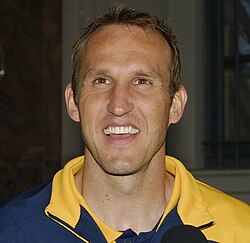
Goalkeeper Mark Schwarzer is the most capped player in the history of Australia with 109 caps. Mark Schwarzer.jpg
Goalkeeper Mark Schwarzer is the most capped player in the history of Australia with 109 caps.
RankNameCapsGoalsPositionCareer
1 Mark Schwarzer 1090GK1993–2013
2 Tim Cahill 10850FW2004–2018
3 Mathew Ryan 1010GK2012–present
4 Lucas Neill 961DF1996–2013
5 Brett Emerton 9520MF1998–2012
6 Alex Tobin 872DF1988–1998
7 Mark Bresciano 8413MF2001–2015
Paul Wade 8410MF1986–1996
9 Aziz Behich 813DF2012–present
10 Jackson Irvine 8014DF2013–present
Mark Milligan 806MF2006–2019
Luke Wilkshire 808DF2004–2014

Top goalscorers

Tim Cahill is Australia's top scorer with 50 goals. 2017 Confederation Cup - CHIAUS - Tim Cahill.jpg
Tim Cahill is Australia's top scorer with 50 goals.
RankNameGoalsCapsRatioCareer
1 Tim Cahill (list)501080.462004–2018
2 Damian Mori 29450.641992–2002
3 Archie Thompson 28540.522001–2013
4 John Aloisi 27550.491993–2008
5 John Kosmina 25600.421977–1988
Attila Abonyi 25610.411967–1977
7 David Zdrilic 20310.651997–2010
Mile Jedinak 20790.252008–2018
Brett Emerton 20950.211998–2012
10 Graham Arnold 19560.341985–1997

Most clean sheets

RankNameClean sheetsCapsRatioCareer
1 Mark Schwarzer 441090.41993–2013
2 Mathew Ryan 381010.382012–present
3 Zeljko Kalac 24540.441992–2006
4 Jeff Olver 13370.351985–1989
5 Robert Zabica 12270.441990–1994

Competitive record

FIFA World Cup

FIFA World Cup record Qualification record
YearRoundPos.PldWDLGFGASquadPos.PldWDLGFGA
Flag of Uruguay.svg 1930 Not a member of FIFANot a member of FIFA
Flag of Italy (1861-1946) crowned.svg 1934
Flag of France (1794-1815).svg 1938
Flag of Brazil (1960-1968).svg 1950
Flag of Switzerland (Pantone).svg 1954
Flag of Sweden.svg 1958
Flag of Chile.svg 1962
Flag of England.svg 1966 Did not qualify Final Round 200229
Flag of Mexico.svg 1970 Final Round 9351128
Flag of Germany.svg 1974 Group stage14th301205 Squad Final Round 115512110
Flag of Argentina.svg 1978 Did not qualify 4th 126242011
Flag of Spain.svg 1982 2nd 8422229
Flag of Mexico.svg 1986 1st (PO) 8431204
Flag of Italy.svg 1990 2nd 6222117
Flag of the United States.svg 1994 1st (PO) 10712217
Flag of France (lighter variant).svg 1998 1st (PO) 8620345
Flag of South Korea (1997-2011).svg Flag of Japan.svg 2002 1st (PO) 8701734
Flag of Germany.svg 2006 Round of 1616th411256 Squad 1st (PO) 9711315
Flag of South Africa.svg 2010 Group stage21st311136 Squad 1st 14932194
Flag of Brazil.svg 2014 Group stage30th300339 Squad 2nd 148422512
Flag of Russia.svg 2018 Group stage30th301225 Squad 3rd (PO) 2214625118
Flag of Qatar.svg 2022 Round of 1611th420246 Squad 3rd (PO) 2013434512
Flag of Canada (Pantone).svg Flag of Mexico.svg Flag of the United States.svg 2026 Qualified 2nd 161141387
Flag of Morocco.svg Flag of Portugal (official).svg Flag of Spain.svg 2030 To be determinedTo be determined
Flag of Saudi Arabia.svg 2034
TotalRound of 167/2320441217371751044427442131
Draws include knockout matches decided via penalty shoot-out.
From 1966 to 2006 played as a full member of the OFC.
Since 2010 played as a full member of the AFC.

AFC Asian Cup

AFC Asian Cup record Qualification record
YearRoundPos.PldWDLGFGASquadPos.PldWDLGFGA
Flag of Hong Kong (1955-1959).svg 1956 Not an AFC memberNot an AFC member
Flag of South Korea (1949-1984).svg 1960
Flag of Israel.svg 1964
State flag of Iran (1964-1980).svg 1968
Flag of Thailand.svg 1972
State flag of Iran (1964-1980).svg 1976
Flag of Kuwait.svg 1980
Flag of Singapore.svg 1984
Flag of Qatar.svg 1988
Flag of Japan (1870-1999).svg 1992
Flag of the United Arab Emirates.svg 1996
Flag of Lebanon.svg 2000
Flag of the People's Republic of China.svg 2004
Flag of Indonesia.svg Flag of Malaysia.svg Flag of Thailand.svg Flag of Vietnam.svg 2007 Quarter-finals7th412175 Squad 1st 430173
Flag of Qatar.svg 2011 Runners-up 2nd6411132 Squad 1st 632164
Flag of Australia (converted).svg 2015 Champions 1st6501143 Squad Qualified as hosts
Flag of the United Arab Emirates.svg 2019 Quarter-finals7th521264 Squad 1st 8701294
Flag of Qatar.svg 2023 Quarter-finals6th531193 Squad 1st 8800282
Flag of Saudi Arabia.svg 2027 Qualified 1st 6600220
Total1 Title6/1926155649173227239213
 Champions    Runners-up    Third place  
Draws include knockout matches decided via penalty shoot-out.
Red border colour indicates tournament was held on home soil.
Australia played their 2007 matches in Thailand and Vietnam.

FIFA Confederations Cup

FIFA Confederations Cup record
YearRoundPos.PldWDLGFGASquad
Flag of Saudi Arabia.svg 1992 No OFC representative invited
Flag of Saudi Arabia.svg 1995
Flag of Saudi Arabia.svg 1997 Runners-up 2nd521248 Squad
Flag of Mexico.svg 1999 Did not qualify
Flag of South Korea (1997-2011).svg Flag of Japan.svg 2001 Third place3rd530242 Squad
Flag of France (lighter variant).svg 2003 Did not qualify
Flag of Germany.svg 2005 Group stage8th3003510 Squad
Flag of South Africa.svg 2009 Did not qualify
Flag of Brazil.svg 2013
Flag of Russia.svg 2017 Group stage6th302145 Squad
TotalRunners-up4/10165381725

OFC Nations Cup

OFC Nations Cup record
YearRoundPos.PldWDLGFGASquad
Flag of New Zealand.svg 1973 Did not participate
Flag of France.svg 1980 Champions 1st4400244
1996 Champions 1st4310140
Flag of Australia (converted).svg 1998 Runners-up 2nd4301233 Squad
Flag of French Polynesia.svg 2000 Champions 1st4400260 Squad
Flag of New Zealand.svg 2002 Runners-up 2nd5401232 Squad
Flag of Australia (converted).svg 2004 Champions 1st7610324 Squad
2008–presentNot OFC member
Total4 Titles6/728242214213

Summer Olympics

Summer Olympics recordQualification record
YearRoundPos.PldWDLGFGASquadPldWDLGFGA
Flag of the United Kingdom.svg 1908 Did not participateDid not participate
Flag of Sweden.svg 1912
Flag of Belgium (civil).svg 1920
Flag of France.svg 1924
Flag of the Netherlands.svg 1928
Flag of Germany (1935-1945).svg 1936
Flag of the United Kingdom.svg 1948
Flag of Finland.svg 1952
Flag of Australia (converted).svg 1956 Quarter-finals5th210144 Squad Qualified as host
Flag of Italy.svg 1960 WithdrewWithdrew
Flag of Japan.svg 1964 Did not enterDid not enter
Flag of Mexico.svg 1968
Flag of Germany.svg 1972
Flag of Canada (Pantone).svg 1976
Flag of the Soviet Union.svg 1980
Flag of the United States.svg 1984
Flag of South Korea.svg 1988 Quarter-finals7th420226 Squad 8620184
1992 to presentSee Australia men's national under-23 soccer team
TotalQuarter-finals2/1763036108620184

Minor tournaments

YearPos.PldWDLGFGA
Flag of New Zealand.svg 1922 Soccer Ashes 2nd301237
Flag of Australia (converted).svg 1923 Soccer Ashes 2nd310258
Flag of Australia (converted).svg 1933 Soccer Ashes 1st3300148
Flag of New Zealand.svg 1936 Soccer Ashes 1st3300212
Flag of New Zealand.svg 1948 Soccer Ashes 1st4400170
Flag of Australia (converted).svg 1954 Soccer Ashes 1st320194
Flag of South Vietnam.svg 1967 South Vietnam Independence Cup 1st5500156
Flag of Singapore.svg 1982 Merlion Cup 1st4400142
Flag of Australia (converted).svg Flag of New Zealand.svg 1983 Trans-Tasman Trophy 2nd200214
Flag of Singapore.svg 1983 Merlion Cup1st4301105
Flag of the People's Republic of China.svg 1984 China–Australia Ampol Cup2nd100123
Flag of the People's Republic of China.svg 1985 China–Australia Ampol Cup1st110030
Flag of Australia (converted).svg Flag of New Zealand.svg 1986 Trans-Tasman Trophy 1st211032
Flag of the People's Republic of China.svg 1986 China–Australia Ampol Cup1st110020
Flag of South Korea.svg 1987 President's Cup 2nd321021
Flag of Australia (converted).svg Flag of New Zealand.svg 1987 Trans-Tasman Trophy 2nd201112
Flag of Australia (converted).svg 1988 Australia Bicentenary Gold Cup 2nd420274
Flag of Australia (converted).svg Flag of New Zealand.svg 1988 Trans-Tasman Trophy 1st220041
Flag of Indonesia.svg 1990 Independence Cup1st110030
Flag of Australia (converted).svg Flag of New Zealand.svg 1991 Trans-Tasman Trophy 1st220031
Flag of South Korea.svg 1991 President's Cup2nd101000
Flag of Indonesia.svg 1992 Independence Cup3rd210131
Flag of Japan.svg 1994 Kirin Cup 2nd201112
Flag of Australia (converted).svg Flag of New Zealand.svg 1995 Trans-Tasman Trophy 1st211030
Flag of South Africa.svg 1996 Simba Cup2nd320162
Flag of Chile.svg 2000 Copa Ciudad de Valparaíso4th302123
Flag of the United Arab Emirates.svg 2000 LG Cup (UAE)3rd210134
Flag of Japan.svg 2001 AFC–OFC Challenge Cup 2nd100103
Total14 Titles694291715075

All-time record

FIFA Rankings

2040608010019901995200020052010201520202025yAustralia Year-end Placements in the FIFA Wo...
A line chart depicting the history of Australia's year-end placements in the FIFA World Rankings.

Last update was on 5 September 2025 Source: [147]

 Best Ranking   Worst Ranking   Best Mover   Worst Mover  

Australia's FIFA world rankings
RankYearGames
Played
BestWorst
RankMoveRankMove
242025524Increase2.svg -26Decrease2.svg -
2620241623Increase2.svg 226Decrease2.svg 2
252023825Increase2.svg 229Decrease2.svg 2
2720221327Increase2.svg 842Decrease2.svg 6
3520211032Increase2.svg 641Decrease2.svg 2
412020041Increase2.svg 142Decrease2.svg 1
4220191041Increase2.svg 246Decrease2.svg 3
4120181132Increase2.svg 443Decrease2.svg 7
3820171338Increase2.svg 755Decrease2.svg 10
4720161040Increase2.svg 1768Decrease2.svg 9
5720151457Increase2.svg 37100Decrease2.svg 2
  10020141153Increase2.svg 4102Decrease2.svg 14
5820131236Increase2.svg 759Decrease2.svg 7
3620121320Increase2.svg 236Decrease2.svg 9
2320111719Increase2.svg 526Decrease2.svg 2
2620101319Increase2.svg 426Decrease2.svg 6
 2120091214Increase2.svg 1332Decrease2.svg 10
2820081328Increase2.svg 1048Decrease2.svg 5
4820071039Increase2.svg 452Decrease2.svg 6
3920061333Increase2.svg 948Decrease2.svg 4
4820051248Increase2.svg 960Decrease2.svg 4
 5820041249Increase2.svg 4089Decrease2.svg 9
822003345Increase2.svg 682Decrease2.svg 13
502002443Increase2.svg 450Decrease2.svg 3
4820011646Increase2.svg 1877Decrease2.svg 5
7320001563Increase2.svg 2992Decrease2.svg 6
89199905089Decrease2.svg 11
391998932Increase2.svg 339Decrease2.svg 6
3519971931Increase2.svg 1736Decrease2.svg 4
5019961248Increase2.svg 961Decrease2.svg 9
511995947Increase2.svg 1158Decrease2.svg 8
581994644Increase2.svg 258Decrease2.svg 6
4919931049Increase2.svg 1265Decrease2.svg 13

Honours

Global

Intercontinental

Continental

Friendly

Awards

Summary

CompetitionGold medal icon.svgSilver medal icon.svgBronze medal icon.svgTotal
FIFA Confederations Cup 0112
AFC Asian Cup 1102
OFC Nations Cup 4206
AFC–OFC Challenge Cup 0101
Total55111

See also

Notes

    References

    1. "OFC History". Oceania Football Confederation. 18 March 2006. Archived from the original on 18 March 2006. Retrieved 2 July 2024.
    2. "The FIFA/Coca-Cola Men's World Ranking". FIFA. 19 November 2025. Retrieved 19 November 2025.
    3. "Aussie footballers smash world record". BBC Sport. 11 April 2001. Archived from the original on 20 November 2017. Retrieved 10 June 2012.
    4. Rugari, Vince (22 September 2022). "Fresh deal: Socceroos ink record-breaking sponsorship deal". The Sydney Morning Herald .
    5. "Socceroos lift Asian Cup after dramatic extra-time win over South Korea". The Guardian . 31 January 2015.
    6. "Australia Vs New Zealand 1922". OzFootball. Archived from the original on 6 July 2014. Retrieved 27 April 2013.
    7. 1 2 3 "Australian Socceroos". australiansocceroos.com. Archived from the original on 1 January 2014. Retrieved 29 April 2013.
    8. "1924 Matches". OzFootball. Archived from the original on 12 February 2014. Retrieved 29 September 2013.
    9. "1938 Matches". OzFootball. Archived from the original on 6 August 2018. Retrieved 29 September 2013.
    10. "Australia Vs England 1951". ozfootball.net. Archived from the original on 15 July 2013. Retrieved 31 March 2016.
    11. "1956 Olympics". OzFootball. Archived from the original on 6 July 2014. Retrieved 12 December 2013.
    12. Hay, Roy (9 November 2017). "As Socceroos face moment of truth, let's remember our football triumph of 1967". The Conversation. Archived from the original on 5 December 2020. Retrieved 28 September 2020.
    13. 1 2 "Timeline of Australian Football". NSW Migration Heritage Centre and Powerhouse Museum. Archived from the original on 17 December 2014. Retrieved 27 April 2013.
    14. "The Forgotten Story of ... Australia's defeat to Fiji – Vince Rugari". The Guardian. 10 November 2014. Archived from the original on 25 March 2015. Retrieved 11 December 2016.
    15. "Socceroo Internationals for 1988". OzFootball. Archived from the original on 4 February 2014. Retrieved 27 April 2013.
    16. "Socceroo Internationals for 1997". OzFootball. Archived from the original on 3 March 2016. Retrieved 27 April 2013.
    17. "Socceroo Internationals for 2001". OzFootball. Archived from the original on 4 February 2014. Retrieved 27 April 2013.
    18. Dan Silkstone (14 February 2013). "Socceroos win 3–1 against England". The Age. Archived from the original on 31 October 2008. Retrieved 5 October 2017.
    19. "Goal at last: Australia joining Asia". The Sydney Morning Herald. 11 March 2005. Archived from the original on 6 November 2013. Retrieved 29 April 2013.
    20. "Johnny Warren". worldwardiary.com. Archived from the original on 5 March 2016. Retrieved 29 April 2013.
    21. 1 2 3 "Goodbye Oceania, Hallo Asia Australia FINALLY gets its wish". Socceroo Realm. Retrieved 29 April 2013.
    22. 1 2 "Hope hinges on Guus Hiddink". People's Daily Online. Archived from the original on 17 May 2013. Retrieved 29 April 2013.
    23. "Australia crushes Jamaica". The Age. 10 October 2005. Archived from the original on 4 November 2012. Retrieved 29 April 2013.
    24. 1 2 "Aloisi ends Aussie wait". FIFA.com. FIFA. Archived from the original on 9 February 2013. Retrieved 8 October 2013.
    25. "Uruguay 0, Australia 82,698". The Age. 17 November 2005. Archived from the original on 1 September 2015. Retrieved 29 April 2013.
    26. "From the Terraces: It's Us Against The World". Jay Nair. homepagedaily.com. Archived from the original on 25 October 2012. Retrieved 29 April 2013.
    27. "G, it's a sellout for World Cup send-off". Herald Sun . 5 April 2006. Archived from the original on 10 April 2006.
    28. "Australia 3–1 Japan". BBC Sport. 12 June 2006. Archived from the original on 26 September 2015. Retrieved 13 June 2006.
    29. Landler, Mark (27 June 2006). "A Tumble, a Whistle and a Controversial Victory for Italy". The New York Times . Archived from the original on 29 January 2021. Retrieved 18 March 2021.
    30. Tongue, Steve (1 April 2009). "Italy 1 Australia 0: Totti makes most of referee's penalty present". The Independent . Archived from the original on 20 September 2023. Retrieved 18 March 2021.
    31. "A Beautiful Mind". The Sydney Morning Herald. Archived from the original on 27 October 2013. Retrieved 7 January 2014.
    32. "Australia Wins AFC Men's Team of the Year". refsroom.ausref.com. Archived from the original on 11 December 2013. Retrieved 30 September 2013.
    33. "Socceroos' golden generation has much to teach our youth". The Sydney Morning Herald. 21 July 2012. Archived from the original on 6 November 2013. Retrieved 25 September 2013.
    34. "Verbeek is new Socceroos coach". The Sydney Morning Herald. 6 December 2007. Archived from the original on 8 December 2007. Retrieved 29 April 2013.
    35. "2010 World Cup Qualification History: Group D". soccerlens.com. 24 March 2010. Archived from the original on 9 November 2014. Retrieved 29 April 2013.
    36. "Verbeek takes blame for Socceroos defeat". The Sydney Morning Herald. Sydney. 14 June 2010. Archived from the original on 8 November 2012. Retrieved 8 November 2010.
    37. Hilferty, Tim (16 June 2010). "Craig Foster – sack Pim Verbeek immediately". The Australian. Archived from the original on 29 April 2011. Retrieved 8 November 2010.
    38. "Holger Osieck named Socceroos coach". Fox Sports Australia. Retrieved 29 April 2013.
    39. "Australia 0–1 Japan (AET)" . Daily Telegraph. London. 29 January 2011. Archived from the original on 11 January 2022. Retrieved 2 February 2011.
    40. "Australia sets sights on East Asia Cup". The World Game. Special Broadcasting Service. Archived from the original on 28 September 2013. Retrieved 29 April 2013.
    41. "Rookie Socceroos selected for East Asian Cup". ABC News. Australian Broadcasting Corporation. Archived from the original on 14 May 2014. Retrieved 29 April 2013.
    42. "Osieck: East Asian Cup was valuable". The World Game. Special Broadcasting Service. Archived from the original on 28 September 2013. Retrieved 25 September 2013.
    43. "Australia joins ASEAN Football Federation". Goal Ghana. 27 August 2013. Archived from the original on 7 November 2017. Retrieved 30 October 2017.
    44. Bossi, Dominic (31 January 2019). "Socceroos seeking entrance into 2020 Suzuki Cup". The Sydney Morning Herald. Archived from the original on 31 January 2019. Retrieved 27 January 2019.
    45. "Socceroo Internationals for 2011". OzFootball. Archived from the original on 4 February 2014. Retrieved 29 April 2013.
    46. "Super-sub Kennedy sends Australia to Brazil". The World Game. Special Broadcasting Service. Archived from the original on 5 December 2013. Retrieved 18 June 2013.
    47. "Holger Osieck's contract terminated". Football Federation Australia. Archived from the original on 14 October 2013. Retrieved 12 October 2013.
    48. "Ange Postecoglou appointed Socceroos coach". Football Federation Australia. Archived from the original on 29 October 2013. Retrieved 23 October 2013.
    49. Andrew Webster (12 June 2014). "World Cup 2014: Ange Postecoglou's Socceroos regeneration has FFA backing". Smh.com.au. Archived from the original on 13 June 2014. Retrieved 20 February 2015.
    50. "Positive signs emerge for Socceroos as bold new era begins in earnest". The Sydney Morning Herald. 19 November 2013. Archived from the original on 23 December 2013. Retrieved 8 January 2014.
    51. "Australia in a nightmare 'Group of Death' for Brazil World Cup". The Sydney Morning Herald. 6 December 2013. Archived from the original on 12 January 2014. Retrieved 8 January 2014.
    52. "Exciting times for new golden generation: Milligan | Football Federation Australia". Footballaustralia.com.au. Archived from the original on 8 January 2015. Retrieved 20 February 2015.
    53. "Welcome our new 'Golden Generation' | Football Federation Australia". Footballaustralia.com.au. Archived from the original on 8 January 2015. Retrieved 20 February 2015.
    54. "FIFA rankings: Socceroos hit their first century as Japan emerges as Asia's top side". foxsports.com.au. Retrieved 19 August 2015.
    55. "Asian Cup 2015: Outstanding Australia beats Oman 4–0 to secure quarter-final place – Asian Cup 2015 (Australian Broadcasting Corporation)". ABC News. Abc.net.au. 13 January 2015. Archived from the original on 20 May 2016. Retrieved 20 February 2015.
    56. "Asian Cup: Australia wins first title with 2–1 extra-time win over South Korea". Australian Broadcasting Corporation. 31 January 2015. Archived from the original on 2 February 2015. Retrieved 31 January 2015.
    57. "Australia beat South Korea after extra time". BBC Sport. 31 January 2015. Archived from the original on 23 January 2016. Retrieved 2 February 2015.
    58. "Ange Postecoglou quits as Socceroos coach". The Guardian . 22 November 2017. Archived from the original on 6 February 2018. Retrieved 21 November 2017.
    59. "Van Marwijk appointed new Socceroos coach". The World Game. AAP. 25 January 2018. Archived from the original on 1 February 2018. Retrieved 1 February 2018.
    60. "Socceroos name former Netherlands boss Bert Van Marwijk as coach for 2018 World Cup". ABC News . Australia. 25 January 2018. Archived from the original on 2 February 2018. Retrieved 1 February 2018.
    61. Bossi, Dominic (25 January 2018). "FIFA World Cup 2018: Bert van Marwijk appointed new Socceroos coach". Sydney Morning Herald . Archived from the original on 1 February 2018. Retrieved 1 February 2018.
    62. Howcroft, Jonathan (8 March 2018). "No surprises as Graham Arnold takes on impossible Socceroos job". The Guardian . Archived from the original on 8 March 2018. Retrieved 8 March 2018.
    63. Howcroft, Jonathan (16 June 2018). "France 2–1 Australia: World Cup 2018 – as it happened". The Guardian. Archived from the original on 26 June 2019. Retrieved 11 February 2019 via www.theguardian.com.
    64. "Denmark vs. Australia 2018 World Cup: A 1–1 tie keeps the Socceroos alive". The Washington Post. 21 June 2018. Archived from the original on 12 February 2019. Retrieved 8 February 2019.
    65. "Football news: Andre Carrillo and Luis Advíncula both get an 8 as Peru cruise past Australia 2–0 on World Cup bow – Article – Sport360". sport360.com. Archived from the original on 9 February 2019. Retrieved 11 February 2019.
    66. "AFC Asian Cup 2019: Australia 0 Jordan 1: Champions stunned in Group B opener". Mykhel. 6 January 2019. Archived from the original on 9 February 2019. Retrieved 11 February 2019.
    67. "Australia bounce back from opening loss with easy victory". AS.com. 17 January 2019. Archived from the original on 9 February 2019. Retrieved 11 February 2019.
    68. Butterworth, Liam (16 January 2019). "Socceroos hold out spirited Syria 3–2 to progress in Asian Cup". ABC News. Archived from the original on 25 January 2019. Retrieved 11 February 2019.
    69. "Australia 0 Uzbekistan 0 (aet, 4–2 on penalties): Ryan heroics see holders hobble onwards". beIN SPORTS. 21 January 2019. Archived from the original on 9 February 2019. Retrieved 8 February 2019.
    70. "Asian Cup 2019: UAE v Australia as it happened – UAE win 1–0 thanks to Ali Mabkhout strike". The National. 25 January 2019. Archived from the original on 9 February 2019. Retrieved 11 February 2019.
    71. "Australia to face Jordan, Chinese Taipei, Kuwait, and Nepal in combined qualifiers". Socceroos. 17 July 2019. Archived from the original on 2 December 2022. Retrieved 2 December 2022.
    72. "Soccer-China handed tough draw in World Cup preliminaries". Reuters. 1 July 2021. Archived from the original on 2 December 2022. Retrieved 2 December 2022.
    73. "Australia's World Cup road now rocky after dispiriting draw at Oman". ESPN.com. 1 February 2022. Archived from the original on 2 December 2022. Retrieved 2 December 2022.
    74. "United Arab Emirates 1–2 Australia: Australians set up Peru clash for place at World Cup finals". Sky Sports. Archived from the original on 2 December 2022. Retrieved 2 December 2022.
    75. "Australia book World Cup place on penalties". BBC Sport. Archived from the original on 2 December 2022. Retrieved 2 December 2022.
    76. "Australia edge Peru on penalties for historical sixth Qatar 2022 spot". the-afc. Asian Football Confederation. 14 June 2022. Archived from the original on 30 May 2023. Retrieved 30 May 2023.
    77. "Mabil on target as Socceroos defeat NZ in friendly international in Brisbane". ABC News. 22 September 2022. Archived from the original on 2 December 2022. Retrieved 2 December 2022.
    78. "Garang Kuol and Jason Cummings shine on debut as Socceroos beat New Zealand". the Guardian. 25 September 2022. Archived from the original on 25 September 2022. Retrieved 2 December 2022.
    79. "France 4–1 Australia: Olivier Giroud scores record-equalling goal as Kylian Mbappe helps holders shrug off early scare in World Cup Group D". Sky Sports. Archived from the original on 2 December 2022. Retrieved 2 December 2022.
    80. "Tunisia 0–1 Australia: Mitchell Duke header boosts Socceroos' knockout hopes at World Cup in Qatar". Eurosport. 26 November 2022. Retrieved 2 December 2022.
    81. "More than outsiders: AFC shines at the 2022 FIFA World Cup with unprecedented achivements". FIFA. 6 December 2022. Archived from the original on 5 January 2023. Retrieved 5 January 2023.
    82. "'The best game of football': Fans react as Socceroos win first World Cup game in 12 years". SBS News. 26 November 2022. Archived from the original on 2 December 2022. Retrieved 2 December 2022.
    83. "Wild scenes erupt as sensational Socceroos break 16-year World Cup drought". skynews. 30 November 2022. Archived from the original on 2 December 2022. Retrieved 2 December 2022.
    84. "'A magnificent win': Australia's World Cup victory sparks wild celebrations back home". the Guardian. 30 November 2022. Archived from the original on 2 December 2022. Retrieved 2 December 2022.
    85. Rugari, Vince (4 December 2022). "Messi genius and a Ryan mistake: Argentina end Socceroos' World Cup". The Sydney Morning Herald . Archived from the original on 4 December 2022. Retrieved 4 December 2022.
    86. Rugari, Vince (20 September 2024). "Muscat out of the running as Socceroos begin hunt for Arnold's replacement". The Age. Retrieved 22 September 2024.
    87. "Popovic named as new Socceroos coach ahead of crucial World Cup qualifiers". ABC News. 23 September 2024. Retrieved 23 September 2024.
    88. "World Cup 2026: Australia qualify with win over Saudi Arabia". ESPN. 10 June 2025. Retrieved 13 June 2025.
    89. "Football Australia reaches landmark media rights agreement with 10 ViacomCBS". Football Australia . 15 June 2021. Archived from the original on 12 November 2021. Retrieved 12 November 2021.
    90. "How to watch the AFC Asian Cup 2019 in Australia". Socceroos. 20 December 2018. Archived from the original on 25 December 2018. Retrieved 25 December 2018.
    91. "ABC TV to broadcast the Socceroos at Asian Cup". Socceroos. 26 October 2014. Archived from the original on 20 October 2018. Retrieved 20 October 2018.
    92. "Socceroos score record television audience". ABC News. Australian Broadcasting Corporation. Archived from the original on 10 November 2012. Retrieved 29 April 2013.
    93. "FOX SPORTS SETS NEW SUBSCRIPTION TV RECORD WITH SOCCEROOS LAST NIGHT" (PDF). Fox Sports Australia. Archived (PDF) from the original on 11 November 2013. Retrieved 11 November 2013.
    94. "Socceroos score for ABC and Foxtel". Archived from the original on 18 April 2015. Retrieved 2 February 2015.
    95. "Meet the Kamilaroi artist behind the national soccer teams' new jerseys". NITV. 24 February 2025. Retrieved 19 June 2025.
    96. "Nike and Football Australia unveil first Australian National Football Team Collection designed by a First Nations artist | Socceroos". www.socceroos.com.au. 21 February 2025. Retrieved 19 June 2025.
    97. "Wanganui – Birthplace of the Socceroos". austadiums.com. Archived from the original on 28 September 2013. Retrieved 26 September 2013.
    98. "Fashion and the game". The Evening News . Sydney. 10 May 1924. Archived from the original on 20 September 2023. Retrieved 22 February 2016 via National Library of Australia.
    99. "To-day's Diary – Fashion and the Game". The Evening News . 10 May 1924. Archived from the original on 20 September 2023. Retrieved 19 February 2014.
    100. "Nike's New 11-Year Socceroo Deal". Australian FourFourTwo. Archived from the original on 28 September 2013. Retrieved 28 April 2013.
    101. "FIFA World Cup 1974 Group 1". historicalkits.co.uk. Archived from the original on 21 September 2013. Retrieved 27 September 2013.
    102. "Nike renewed as FFA kit manufacturer". 15 October 2012. Archived from the original on 13 July 2014. Retrieved 16 March 2014.
    103. "Nike reveals Socceroos World Cup kit". Archived from the original on 16 March 2014. Retrieved 16 March 2014.
    104. 1 2 James Matthey. "People weren't impressed with the new Socceroos kit". news.com.au. Archived from the original on 22 March 2016. Retrieved 22 March 2016.
    105. 1 2 James McGrath (31 March 2016). "Why everybody lost their minds over a pair of yellow shorts". theturf.com. Archived from the original on 21 September 2021. Retrieved 8 October 2016.
    106. James Maasdorp (22 March 2016). "Socceroos, Matildas release new kit: looking back at Australia's best and worst kits". abc.net.au. Archived from the original on 9 October 2016. Retrieved 8 October 2016.
    107. Michael Lynch (22 March 2016). "Socceroos, Matildas unveil new kits". smh.com.au. Archived from the original on 26 November 2016. Retrieved 8 October 2016.
    108. Mike Hytner (22 March 2016). "New Socceroos and Matildas strips unveiled to mixed reviews". theguardian.com. Archived from the original on 10 October 2016. Retrieved 8 October 2016.
    109. "Football Australia and Nike unveil ten-year partnership extension". Socceroos. Football Australia. 17 November 2023. Retrieved 18 November 2023.
    110. "Origins of the Socceroos". Football Federation Australia. Archived from the original on 2 December 2013. Retrieved 29 September 2013.
    111. "O'Neill wants to lose Roos in the name of progress". The Sydney Morning Herald. 14 January 2005. Archived from the original on 4 May 2014. Retrieved 26 September 2013.
    112. "Soccer's Australian name change". The Age. 16 December 2004. Archived from the original on 14 November 2013. Retrieved 26 September 2013.
    113. Hill, Simon (1 October 2012). "Mainstream Aussie press finally adopting the term football as soccer seen as thing of the past". News.com.au. Archived from the original on 22 March 2019. Retrieved 10 September 2013.
    114. "National Teams". Football Federation Australia. Archived from the original on 2 September 2007. Retrieved 23 November 2007.
    115. "CommBank and Football Australia sign landmark deal to lift Australia's biggest game to new heights | Socceroos". www.socceroos.com.au. 19 June 2025. Retrieved 19 June 2025.
    116. "Football Australia and Subway® Australia announce Socceroos naming rights sponsorship agreement to conclude | Football Australia". www.footballaustralia.com.au. 15 June 2025. Retrieved 19 June 2025.
    117. Rugari, Vince; Bossi, Dominic (26 December 2019). "Socceroos on the hunt for new naming rights sponsor". The Sydney Morning Herald. Retrieved 19 June 2025.
    118. "Caltex Australia with the Socceroos all the way | Socceroos". www.socceroos.com.au. 3 March 2016. Retrieved 19 June 2025.
    119. "Caltex turns into Cahilltex to mark Tim Cahill / World Cup partnership via TLA Worldwide". Campaign Brief. 15 May 2018. Retrieved 19 June 2025.
    120. "Caltex honours Tim Cahill transforming into 'Cahilltex' ahead of FIFA World Cup | Socceroos". www.socceroos.com.au. 15 May 2018. Retrieved 19 June 2025.
    121. "Football Australia renews partnership with Qantas | Socceroos". www.socceroos.com.au. 27 March 2023. Retrieved 19 June 2025.
    122. "All Whites backing derby rivalry to get them through". nzfootball.co.nz. Archived from the original on 15 October 2013. Retrieved 30 September 2013.
    123. "Tell us your top Socceroos-All Whites games as a precursor to another trans-Tasman showdown". Fox Sports Australia. Retrieved 30 September 2013.
    124. "Australia, Japan rivalry hits new heights". Football Federation Australia. Archived from the original on 17 May 2014. Retrieved 30 September 2013.
    125. John Greco (21 August 2018). "A long standing rivalry: Caltex Socceroos' history against Korea Republic". Football Federation Australia. Archived from the original on 28 November 2020. Retrieved 26 September 2020.
    126. "From the Archives, 1997: Socceroos storm into Confederation Cup final". 19 December 2022. Archived from the original on 17 April 2023. Retrieved 18 April 2023.
    127. "Australian Active Support". Australian Active Support. Archived from the original on 15 January 2016. Retrieved 29 December 2023.
    128. "About Socceroos News". Australia Football. 31 January 2015. Archived from the original on 7 July 2017. Retrieved 5 September 2015.
    129. "Support new Active Support Group". Terrace Australis. 5 February 2012. Archived from the original on 15 January 2016. Retrieved 5 September 2015.
    130. "Super winter for Australian football". Football Federation Australia. Archived from the original on 7 October 2013. Retrieved 29 September 2013.
    131. "Introducing Terrace Australis, the new active support group trying to re-build Socceroos atmosphere". Fox Sports Australia. Retrieved 29 September 2013.
    132. "Terrace Australis is born..." Australian FourFourTwo. Archived from the original on 28 September 2013. Retrieved 15 June 2013.
    133. "About". GGArmy.com. Green & Gold Army Pty Ltd. Archived from the original on 17 June 2013. Retrieved 15 June 2013.
    134. "Socceroo Internationals for 1923". OzFootball. Archived from the original on 12 February 2014. Retrieved 23 April 2014.
    135. "Luke Wilkshire joins Subway Socceroos coaching staff". Socceroos. Football Australia. 8 August 2024. Retrieved 20 September 2024.
    136. "Teams". Socceroos.com.au. Retrieved 28 November 2023.
    137. Clarke, George (20 September 2024). "Arnold resigns as Socceroos coach, saying it's 'best for the nation'". Australian Financial Review. Retrieved 20 September 2024.
    138. "Eleven changes for CommBank Socceroos' November matches". Socceroos . Football Australia. 6 November 2025.
    139. "CommBank Socceroos Squad Update for November Matches". Socceroos . Football Australia. 13 November 2025.
    140. 1 2 Davies, Christopher (11 April 2001). "Australia score 31 without loss in record win" . Telegraph.co.uk. London: Telegraph Media Group Limited. Archived from the original on 11 January 2022. Retrieved 5 August 2009.
    141. "Samoans lose 31–0 – or was it 32–0?". The Guardian. 11 April 2001. Archived from the original on 10 October 2016. Retrieved 6 October 2016.
    142. "Tonga routed as Socceroos hit 22" . The Telegraph. 9 April 2001. Archived from the original on 11 January 2022. Retrieved 6 October 2016.
    143. Lynch, Michael (12 December 2004). "The all-important Cole difference". The Age. Melbourne. Archived from the original on 16 November 2013. Retrieved 4 August 2009.
    144. "Iran fanatics keep close eye on the Valley". The Guardian. London: Guardian News and Media Limited. 30 December 2000. Archived from the original on 24 June 2009. Retrieved 4 August 2009.
    145. "Appearances for Australia National Team". Rec.Sports.Soccer Statistics Foundation. Archived from the original on 10 July 2022. Retrieved 20 December 2019.
    146. "Socceroos Honours Board". Socceroos. 27 May 2021. Archived from the original on 6 August 2021.
    147. "Australia Men's Ranking" . Retrieved 13 April 2024.