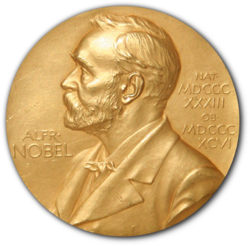
Since the first award in 1901, conferment of the Nobel Prize has engendered controversy and criticism.[1][2] After his death in 1896, the will of Swedish industrialist Alfred Nobel established that an annual prize be awarded for service to humanity in the fields of physics, chemistry, physiology or medicine, literature, and peace. Similarly, the Sveriges Riksbank Prize in Economic Sciences in Memory of Alfred Nobel, first awarded in 1969, is awarded along with the Nobel Prizes.[3] Nobel sought to reward "those who, during the preceding year, shall have conferred the greatest benefit on mankind". Awards committees have historically rewarded discoveries over inventions.[4][5]
No Nobel Prize was established for mathematics and many other scientific and cultural fields.[6] An early theory that envy or rivalry led Nobel to omit a prize to mathematician Gösta Mittag-Leffler was refuted because of timing inaccuracies.[7][8] Another myth that states that Nobel's spouse had an affair with a mathematician (sometimes attributed as Mittag-Leffler) has been equally debunked: Nobel was never married.[9][10] A more likely explanation is that Nobel did not consider mathematics as a practical discipline, and too theoretical to benefit humankind, as well as his personal lack of interest in the field and the fact that an award to mathematicians given by Oscar II already existed at the time.[9][10][11][12] Both the Fields Medal and the Abel Prize have been described as the "Nobel Prize of mathematics".[13][14]
The most notorious controversies have been over prizes for Literature,[15][16][17][18] Peace,[19] and Economics.[20][21] Beyond disputes over which contributor's work was more worthy, critics most often discerned political bias and Eurocentrism in the result.[22][23][24][25] The interpretation of Nobel's original words concerning the Literature prize has also undergone repeated revisions.[citation needed]
A major controversies-generating factor for the more recent scientific prizes (Physics, Chemistry, and Medicine) is the Nobel rule that each award can not be shared by more than two different researches and no more than three different individuals each year.[26] While this rule was adequate in 1901, when most of the science research was performed by individual scientists working with their small group of assistants in relative isolation, in more recent times science research has increasingly become a matter of widespread international cooperation and exchange of ideas among different research groups, themselves composed of dozens or even hundreds of researchers, spread over the years of effort needed to hypothesize, refine and prove a discovery. This has led to glaring omissions of key participants in awarded researchers.
Multiple commentators have noted that the three person limit, and no prizes to organizations, is mentioned nowhere in Nobel's will. These limitations were added by the award committee, and could be easily changed. The Nobel Peace Prize has already done this, and the prize is commonly granted to organizations. This would certainly have been appropriate for the physics discoveries made by huge research consortiums such as ATLAS/CMS (2013) or LIGO (2017).[27][28]
Chemistry
1918
The 1918 Nobel Prize in Chemistry was awarded to Fritz Haber for his invention of the Haber–Bosch process, which allowed for the efficient synthesis of ammonia, leading to the economical mass production of chemical fertilizers. The award was controversial, as Haber had overseen Germany's chemical weapons program during World War I. The Nobel Prize committee considered his war activities but noted his ammonia synthesis process was "the greatest benefit to mankind".[29][30]
1922–1946
From 1922 to 1946, the American scientist Gilbert N. Lewis, who was widely known for his coining of the covalent bond, electron pair, Lewis structure and other seminal contributions that have become near-universal conventions in chemistry, was nominated 41 times for the Nobel Prize in Chemistry but never won.[31][32] It has been speculated that while working in Walther Nernst's lab, Lewis developed a lifelong enmity with Nernst. In the following years, Lewis started to criticize and denounce his former teacher on many occasions, calling Nernst's work on his heat theorem "a regrettable episode in the history of chemistry".[33] A friend of Nernst's, Wilhelm Palmær[sv], was a member of the Nobel Chemistry committee. There is evidence that he used the Nobel nominating and reporting procedures to block a Nobel Prize for Lewis in thermodynamics by nominating Lewis for the prize three times, and then using his position as a committee member to write negative reports.[34]
2003
Peter Agre was awarded the 2003 prize "for the discovery of water channels". Agre published his study about aquaporin in 1988; Gheorghe Benga had shown the existence of a protein water channel in the red blood cell membrane in 1986.[35][36] The omission of Benga from the 2003 prize has been called a mistake in the awarding of Nobel Prizes.[37][38] Agre acknowledged the contribution of Benga and others to the field discovery of aquaporins in his Nobel Lecture: "Their [aquaporins] existence was suggested by a group of pioneers in the water transport field who preceded us by decades".[39]
2007
Gerhard Ertl, who was the sole recipient of the 2007 Nobel Prize in Chemistry for his studies of the catalytic effects of metal surfaces, has expressed surprise[40] and disappointment[41] that Gábor Somorjai, a foundational pioneer in modern surface science and catalysis, did not share the prize. Somorjai and Ertl had previously shared the Wolf Prize for Chemistry in 1998. The Nobel Prize committee's decision to exclude Somorjai was criticized in the surface-science community[42].
2008
The 2008 prize was awarded to Osamu Shimomura, Martin Chalfie and Roger Y. Tsien for their work on green fluorescent protein (GFP). A fourth potential recipient, Douglas Prasher, was the first to clone the GFP gene and suggest its use as a biological tracer; however, he had left academia and was working as a courtesy shuttle bus driver - a fact which received considerable media coverage.[43][44] Lack of support for Prasher's work, and failure to get tenure at the Woods Hole Oceanographic Institute in Massachusetts where he was employed, caused Prasher to leave this field of research in 1992, but not before he offered samples of the gene to any interested researchers, including Chalfie and Tsien.[45] Tsien noted the prize is usually awarded for "specific discoveries" and that he had put forward Shimomura and Prasher to the Nobel Committee in 2004.[43] Chalfie stated, "Douglas Prasher's work was critical and essential for the work we did in our lab. They could've easily given the prize to Douglas and the other two and left me out."[46] Roger Tsien had offered Prasher a job when his academic career stalled. Eventually, Prasher accepted the offer and moved in 2013 to UCSD to join Tsien's lab.[43]
2019
When the 2019 prize was awarded, numerous scientific societies reacted to Rachid Yazami's omission for his co-invention of the lithium-ion battery with Stanley Whittingham who was recognized. Whittingham shared the prize with John Goodenough for their cathodes and Akira Yoshino for the first working prototype unlike the importance of the working graphite anode invented by Yazami. Due to the Nobel Prize's limitation of up to three recipients, Yazami believes the committee had to make a difficult decision between Whittingham and himself. He nevertheless congratulated the three recipients of the prize.[47][48]
Dmitri Mendeleyev, the original creator of the periodic table of the elements, never received a Nobel Prize. He completed his first periodic table in 1869. However, a year earlier, another chemist, Julius Lothar Meyer, had reported a somewhat similar table. In 1866, John Alexander Reina Newlands presented a paper that first proposed a periodic law. However, none of these tables were correct—the 19th-century tables arranged the elements in order of increasing atomic weight (or atomic mass). It was left to the English physicist Henry Moseley to base the periodic table on the atomic number (the number of protons). Mendeleyev died in 1907, six years after the first Nobel Prizes were awarded. He came within one vote of winning in 1906, but died the next year. István Hargittai claimed that Mendeleyev's omission was due to behind-the-scenes machinations of one dissenter on the Nobel Committee who disagreed with his work.[54]
The 1976 prize was awarded to Milton Friedman "for his achievements in the fields of consumption analysis, monetary history and theory and for his demonstration of the complexity of stabilisation policy". The award caused international protests because of Friedman's association with Chilean dictator Augusto Pinochet. During March 1975, Friedman visited Chile and gave lectures on inflation, meeting with Pinochet and other government officials.[55]
1994
The 1994 prize to John Forbes Nash and others "for their pioneering analysis of equilibria in the theory of non-cooperative games" caused controversy within the selection committee because of Nash's mental illness and alleged antisemitism.[56] The controversy resulted in a change to the governing committee: members served three-year instead of unlimited terms[57] and the prize's scope expanded to include political science, psychology, and sociology.[57][58]
From 1901 to 1912, the committee's work reflected an interpretation of the "ideal direction" stated in Nobel's will as "a lofty and sound idealism", which caused Tolstoy, Ibsen, Twain and Émile Zola to be rejected. Sweden's historic antipathy towards Russia was cited as the reason neither Tolstoy nor Anton Chekhov took the prize. During World War I and its immediate aftermath, the committee adopted a policy of neutrality, favouring writers from non-combatant countries.[61]
The heavy focus on European authors, and Swedes in particular, is the subject of mounting criticism, including from major Swedish newspapers.[62] The majority of the laureates for the Nobel Prize in Literature have been European. Swedes in particular have received more prizes in this category than all of Asia. In 2008, Horace Engdahl, then the permanent secretary of the academy, declared that "Europe still is the center of the literary world" and said that American writers did not win often (the most recent at the time was Toni Morrison, 15 years prior) because "the US is too isolated, too insular. They don't translate enough and don't really participate in the big dialogue of literature." David Remnick replied, "You would think that the permanent secretary of an academy that pretends to wisdom but has historically overlooked Proust, Joyce, and Nabokov, to name just a few non-Nobelists, would spare us the categorical lectures." Remnick cited Philip Roth, John Updike and Don DeLillo as counterexamples to Engdahl's claim, along with "many younger writers, some of them sons and daughters of immigrants writing in their adopted English."[63]Adam Kirsch wrote: "When Saul Bellow learned that he had won the Nobel Prize for literature in 1976, he reacted to the news in the only way a great writer can or should: He tried hard not to care. 'I'm glad to get it,' Bellow admitted, but 'I could live without it.' This month, as the Swedish Academy prepares for its annual announcement, Bellow's heirs in the top ranks of American literature—Roth, Updike, Pynchon, DeLillo—already know they're going to live without the Nobel Prize."[64] In 2009, Engdahl's replacement, Peter Englund, rejected his sentiment ("In most language areas ... there are authors that really deserve and could get the Nobel Prize and that goes for the United States and the Americas, as well"), and acknowledged the Eurocentric bias of the selections, saying that, "I think that is a problem. We tend to relate more easily to literature written in Europe and in the European tradition."[65]
1901–1910
Leo Tolstoy was nominated for the Nobel Prize in Literature every year from 1902 to 1906 but never won, and in 1901 he was not even nominated, resulting in a major controversy.[66][67]The 1901 prize went instead to French poet Sully Prudhomme, and the year after to German historian Theodor Mommsen. Reports suggest that Tolstoy did not receive the prize because of the jury's reservations towards his political and religious positions as well as Sweden's historical enmity towards Russia.[68][69][70] In 1901, 42 Swedish writers, including August Strindberg, wrote Tolstoy a letter following the announcement, expressing their dissatisfaction with the decision.[67][71]
While some of their prize decisions were well received at the time, the Swedish Academy's handling of the Nobel prize in its early history has been heavily criticized. Nobel committee chairman Carl David af Wirsén was known to fiercely oppose that authors he disliked, such as Henrik Ibsen and Selma Lagerlöf, be awarded the prize. The choice of the insignificant German philosopher Rudolf Christoph Eucken as a compromise winner of the prize in 1908 was heavily criticized at the time, and has been described as one of the worst mistakes in the history of the Nobel Prize in Literature.[72][73]
In 1926, George Bernard Shaw first declined the 1925 Nobel Prize (which was awarded a year later) stating "I can forgive Nobel for inventing dynamite, but only a fiend in human form could have invented the Nobel prize". He later changed his mind and accepted the honour, but refused to receive the prize money.[75][verification needed][76] Shaw recommended that the prize money instead be used to fund the translation of works by Swedish playwright August Strindberg to English.[76]
Following the international success of the novel Doctor Zhivago, Boris Pasternak was awarded the 1958 Nobel Prize in Literature, which angered the Soviet Union authorities. Pasternak first accepted the prize, but was forced by the authorities to decline it. After Doctor Zhivago was finally published in Russian in 1988, Pasternak's son accepted the prize on his father's behalf.[77]
Jean-Paul Sartre declined the Nobel Prize in Literature, claiming that he refused official distinctions and did not want to be institutionalised and for fear that it would limit the impact of his writing.[78] While Sartre's statement to the Swedish press was polite, he revealed in the 1976 documentary filmSartre par lui-même (Sartre by Himself) quite opposite reasons for rejecting the Nobel Prize, stating: "Because I was politically involved, the bourgeois establishment wanted to cover up my past errors. Now there's an admission! And so they gave me the Nobel Prize. They pardoned me and said I deserved it. It was monstrous!"[79]
The 1970 prize was awarded to Soviet dissidentAleksandr Solzhenitsyn, who did not attend the ceremony in Stockholm for fear that the Soviet Union would prevent his return. His works there were available only in samizdat-published, clandestine form. After the Swedish government refused to hold a public award ceremony and lecture at its Moscow embassy, Solzhenitsyn refused the award altogether, commenting that the conditions set by the Swedes (who preferred a private ceremony) were "an insult to the Nobel Prize itself". Solzhenitsyn later accepted the award on 10 December 1974, after the Soviet Union banished him.[80] Critics suggest that Solzhenitsyn was awarded the prize because of his political stance, not his writing.[81]
The 1997 prize went to Italian actor-playwright Dario Fo, who was initially considered "rather lightweight" by some critics, as he was seen primarily as a performer and had previously been censured by the Roman Catholic Church.[84]Salman Rushdie and Arthur Miller had been favoured to receive the prize, but a committee member was later quoted as saying that they would have been "too predictable, too popular".[85]
The 2004 prize was awarded to Elfriede Jelinek. Academy member Knut Ahnlund, who had been inactive since 1996, resigned, alleging that selecting Jelinek had caused "irreparable damage" to the prize's reputation.[86][87]
The 2005 prize went to Harold Pinter, "who in his plays uncovers the precipice under everyday prattle and forces entry into oppression's closed rooms". The award was delayed for some days, apparently due to Knut Ahnlund's resignation. In turn, this renewed speculation about a "political element" existing in the Swedish Academy's awarding of the Prize.[88] Although poor health prevented him from giving his controversial Nobel Lecture, "Art, Truth and Politics", in person, Pinter appeared on video, which was simultaneously transmitted on Britain's Channel Four.[89] The issue of "political stance" was also raised in response to Orhan Pamuk and Doris Lessing, prizewinners in 2006 and 2007, respectively.[90]
The 2009 prize awarded to Herta Müller was criticized because many U.S. literary critics and professors had never heard of Müller before.[91] This reignited criticism that the committee was too Eurocentric.[92][93]
In 2010, the prize was awarded to the Peruvian writer Mario Vargas Llosa. Some people, including the poet Antonio Cisneros, stated that he would have been awarded the prize earlier if not for his political views.[94]
The 2012 prize awarded to the Chinese author Mo Yan caused controversy. Several Chinese dissidents criticized Mo Yan, saying he voiced support for the Chinese government's system of censorship in his Nobel lecture.[95]
The 2016 prize awarded to Bob Dylan was controversial, since it marked the first time that a songwriter-musician had been awarded the prize. Many writers and commentators, mostly novelists, objected, feeling it cheapened the prize. Scottish novelist Irvine Welsh stated "I'm a Dylan fan, but this is an ill-conceived nostalgia award wrenched from the rancid prostates of senile, gibbering hippies",[96] while Lebanese novelist Rabih Alameddine argued that "Bob Dylan winning a Nobel in Literature is like Mrs Fields being awarded 3 Michelin stars."[97] However, others noted that poetry has long been recognized by the committee and speculated that the popularity of Dylan's work was the true motive behind those objecting. Songwriter Leonard Cohen said that awarding Dylan the prize was "like pinning a medal on Mount Everest for being the highest mountain".[98]
In a live webchat hosted by The Guardian, Norwegian writer Karl Ove Knausgård said that "I'm very divided. I love that the Nobel committee opens up for other kinds of literature – lyrics and so on. I think that's brilliant. But knowing that Dylan is the same generation as Thomas Pynchon, Philip Roth, Cormac McCarthy, makes it very difficult for me to accept it."[99] An article in Slate magazine found multiple parts of Dylan's Nobel lecture that closely resembled the analysis of Moby-Dick on the study guide website SparkNotes. According to an Associated Press analysis, the two texts contained more than 20 "identical phrases and similar phrasing", but "no verbatim sentences".[100][101][102]The New York Times wrote that plagiarism allegations were "nothing new" for Dylan, who had defended borrowing material as "a rich and enriching tradition" in folk music.[103]
Czech writer Karel Čapek's War With the Newts was considered too offensive[when?] to the German government, and he declined to suggest a non-controversial publication that could be cited in its stead ("Thank you for the good will, but I have already written my doctoral dissertation").[111] He never received a prize. French novelist and intellectual André Malraux was considered for the Literature prize in the 1950s, according to Swedish Academy archives studied by the newspaper Le Monde on their opening in 2008. Malraux was competing with Albert Camus, but was rejected several times, especially in 1954 and 1955, "so long as he does not come back to the novel", while Camus won the prize in 1957.[60] Argentine writer Jorge Luis Borges was nominated several times but never won. Edwin Williamson, Borges' biographer, stated that the author's support of Argentine and Chilean right-wing military dictators may have been a factor.[112] The academy's refusal to express support for Salman Rushdie in 1989, after AyatollahRuhollah Khomeini issued a fatwā calling for his death, led two Academy members to resign.[113][114]
Ronald Ross was awarded basically for his discovery of the life cycle of malarial parasite (as the citation goes: "for his work on malaria, by which he has shown how it enters the organism"). In 1897, independent of Ross, Giovanni Battista Grassi, along with his Italian associates, had established the developmental stages of malaria parasites in anopheline mosquitoes; and they described the complete life cycles of P. falciparum, P. vivax and P. malariae the following year.[115][116] The initial opinion of the Nobel Committee was that the prize should be shared between Ross and Grassi. Then Ross made a defamatory campaign accusing Grassi of deliberate fraud. The weight of favour ultimately fell on Ross, largely upon the influences of Robert Koch, the appointed "neutral arbitrator" in the committee; as reported, "Koch threw the full weight of his considerable authority in insisting that Grassi did not deserve the honor".[117] The indelible irony was that Ross was definitely the first to show that malarial parasite was transmitted by the bite of infected mosquitoes, in his case the avian Plasmodium relictum. But Grassi's work was much more directly relevant to human health as he demonstrated that human malarial parasites were infected only by female Anopheles (Ross never identified the mosquito species, not being a zoologist; "grey mosquito with dappled wings" was all that he could offer). Grassi identified the species correctly, and in 1898 who first established the complete life cycle of P. falciparum, the first human malarial parasite for which the entire cycle was determined. By today's standard, they should have undoubtedly shared the Nobel.[118][119]
1906
Camillo Golgi and Santiago Ramón y Cajal were jointly awarded "in recognition of their work on the structure of the nervous system". However, their interpretations of discoveries were directly in opposition. Much as Golgi made significant contributions to the techniques in the study of nervous system in terms of actual structure, he made a completely erroneous conclusion that nervous system is nothing but a single continuous network, the notion called reticular theory. On the other hand, Ramón y Cajal described nervous system as composed of interlinking nerve cells or neurons as suggested by a theory called the neuron doctrine. Golgi strongly advocated the reticular theory such that even his Nobel lecture was a direct attack on Cajal's work and the neuron doctrine, and even depicted a diagram of continuous network which he claimed was "an exact reproduction after life".[120][121][122] Therefore, recognising a work on wrong conclusion is inappropriate. The controversy and rivalry between the two scientists lasted even after the award of the Nobel Prize.[123] The award is even dubbed as creating the "storm center of histological controversy". Cajal even commented that: "What a cruel irony of fate of pair, like Siamese twins united by the shoulders, scientific adversaries of such contrasting character!"[124] The neuron doctrine turned out to be a more correct description, and Golgi was proved wrong with the development of electron microscopy in the 1950s by which it was clearly demonstrated that neurons are individual cells in the nervous system, and that they are interconnected through gaps called synapses.[125] Recent studies suggest that there are notable exceptions. Electrical synapses are more common in the central nervous system than previously thought. Thus, rather than functioning as individual units, in some parts of the brain large ensembles of neurons may be active simultaneously to process neural information.[126][127]
1923
The 1923 prize was awarded to Frederick Banting and John Macleod "for the discovery of insulin". Banting clearly deserved the prize, but the choice of Macleod as co-winner was controversial. Banting felt that Charles Best was the proper corecipient, while Macleod had merely given them laboratory space at the University of Toronto while Macleod was away for the summer. On his return, though, Macleod pointed out some flaws in their experimental design and gave them advice about directions in which to work. Banting's original method of isolating insulin required performing surgery on living dogs, which was too labor-intensive to produce insulin on a large scale. Best then set about finding a biochemical extraction method, while James Collip, a chemistry professor on sabbatical from the University of Alberta, joined Macleod's team and worked in parallel with Best. The two of them succeeded within days of each other. When Banting agreed to receive the prize, he decided to give half of his prize money to Best. Macleod, in turn, split his half of the prize money with Collip.[128]
1926
In 1926, no prize was awarded because the works of the two nominees Johannes Andreas Grib Fibiger and Katsusaburo Yamagiwa were considered undeserving. Fibiger had demonstrated that he could induce stomach cancer in rats using a roundworm Gongylonema neoplasticum that he discovered (but which he preferred to call Spiroptera carcinoma). Yamagiwa followed suit and induced cancer in rabbit by applying coal tar on the rabbit's ears. Theirs were the first experimental induction of cancer.[129] One of the assessors Hilding Bergstrand concluded that "one cannot, at this point, find much support for the possibility that the work of Fibiger and Yamagiwa will have great importance in the solving of the riddle of cancer. Under such circumstances I do not consider these discoveries worthy of the Nobel Prize."[130] In 1927, Fibiger was again nominated alongside Otto Heinrich Warburg and Julius Wagner-Jauregg; but Yamagiwa was excluded. The Nobel Committee decided to award the 1926 prize jointly to Fibiger and Warburg, and the 1927 prize to Wagner-Jauregg. But at the final selection, Karolinska Institute rejected Warburg. The 1926 prize went solely to Fibiger "for his discovery of the Spiroptera carcinoma". Fibiger's "finding" was discredited by other scientists shortly thereafter.[131][132][133][134][135] Particularly after the last major experiment in 1952, it was established that the roundworm is not carcinogenic, and that cancers developed in Fibiger's experiments were due to vitamin A deficiency.[136] Yamagiwa's exclusion was also criticised, because his experiment was a valid finding.[137] Coal tar (and substances containing polycyclic aromatic hydrocarbons, or PAHs) are now known to be true carcinogens. Yamagiwa's work has become the primary basis for this line of research.[138]Encyclopædia Britannica's guide to Nobel Prizes in cancer research mentions Yamagiwa's work as a milestone without mentioning Fibiger.[139]
1935
The 1935 prize was awarded to Hans Spemann "for his discovery of the organizer effect in embryonic development". In 1991 Howard M. Lenhoff, then Professor of Developmental and Cell Biology at the University of California, published a paper pointing out that Ethel Browne Harvey should have shared in Spemann's Nobel Prize, because, as a graduate student, she had made a similar discovery many years earlier and understood its significance.[140][141] Her work, done in 1909, preceded the experiments in 1924 by Spemann and Hilde Mangold that are credited with discovering the "organizer" — the work that was the basis of the Nobel Prize.[141] Lenhoff noted there is evidence that Spemann knew about Ethel Browne Harvey's work, as she had sent a copy of her paper to Spemann, and in his copy the portion that discussed the significance of her work had been underlined.[140]
1952
The 1952 prize was awarded to Selman Waksman "for his discovery of streptomycin, the first antibiotic effective against tuberculosis". Albert Schatz, who was a graduate student working under Waksman's direction at the time of discovery in 1943, petitioned the Nobel committee saying he had done all the work in isolating the antibiotic properties of Streptomyces griseus.[142] Schatz, who two years earlier had successfully sued Waksman and Rutgers University for his share in the discovery, patent, and resulting royalties, was turned down by the Nobel committee. It was a reflection of the times when department heads were normally awarded the prize and has been looked on as a considerable mistake.[143][144][145]
1993
The 1993 prize went to Phillip Allen Sharp and Richard J. Roberts "for their discoveries of split genes", the discovery of introns in eukaryoticDNA, and the mechanism of gene splicing. Several other scientists, such as Norman Davidson and James Watson, argued that Louise T. Chow, a China-born Taiwanese researcher[146] who collaborated with Roberts, should have had part of the prize.[147] In 1976, as a scientist with her own grants, Chow carried out the studies of the genomic origins and structures of adenovirus transcripts that led directly to the discovery of RNA splicing and alternative RNA processing at Cold Spring Harbor Laboratory on Long Island in 1977. Norman Davidson, a Caltech expert in electron microscopy under whom Chow studied as a PhD student, affirmed that Chow was the crucial experiment's sole designer, using electron microscopy techniques she had developed, and that "only she could have interpreted those data".[148] Chow's analysis of the complex gene patterns refuted Roberts' original hypothesis and deciphered the split genes.[149] On Sharp's side, credit was excluded for Susan Berget, who at the time was a postdoctoral fellow who conducted the experiments and contributed analyses leading to the discovery.[149][150]
1997
The 1997 prize was awarded to Dr. Stanley B. Prusiner for his discovery of prions. This award caused a long stream of polemics. Critics attacked the validity of the work and questioned whether prions exist at all.[151] The existence of prions was not fully accepted by the scientific community for at least a decade after the awarding of the prize.[152]
1998
The Nobel Prize for Physiology or Medicine was awarded in 1998 to Robert Furchgott, Louis Ignarro and Ferid Murad "for their discoveries concerning nitric oxide as a signalling molecule in the cardiovascular system". There followed protest by the scientific community due to the omission of Salvador Moncada, who was internationally recognized as the major contributor to the discovery of this field together with Robert Furchgott.[153][154]
2003
The 2003 prize was awarded to Paul Lauterbur and Sir Peter Mansfield "for their discoveries concerning magnetic resonance imaging" (MRI). Two independent alternatives have been alleged,[155] each of whom pioneered an important component of what became MRI imaging. Raymond Damadian showed magnetic differences between tissues could be medically significant, and made crude images. However these images were not medically useful due to impractically low speed and resolution. Herman Y. Carr pioneered the use of gradients in imaging, but only in one dimension and not on medical samples. Practical medical imaging uses a combination of these techniques, and more.
Damadian first reported that nuclear magnetic resonance (NMR) could distinguish in vitro between cancerous and non-cancerous tissues on the basis of different proton relaxation times.[156] He later translated this into the first human scan, though it was very slow (5 hours) and low resolution (106 pixels). Damadian's original report motivated Lauterbur to develop NMR into the present method. Damadian took out large advertisements in an international newspapers protesting his exclusion.[157] There has been speculation that Damadian was disfavored by the Nobel committee because he was an outspoken supporter of creationism.[158] Overall, some believe that Damadian's work deserved at least a portion of the prize.[159]
Carr both pioneered the NMR gradient technique and demonstrated rudimentary (one dimensional) MRI imaging in the 1950s. The Nobel prize winners had almost certainly seen Carr's work, but did not cite it. Consequently, the prize committee very likely was unaware of Carr's discoveries,[citation needed] a situation likely abetted by Damadian's campaign.[160][161][162]
Mansfield himself said in his autobiography that "the person who really missed out" the prize was Erwin Hahn for his contribution to the principles of spin echoes.[163]
2006
The 2006 prize went to Andrew Fire and Craig C. Mello "for their discovery of RNA interference—gene silencing by double-stranded RNA". Many of the discoveries credited by the committee to Fire and Mello, who studied RNA interference in Caenorhabditis elegans, had been previously studied by plant biologists, and it was suggested that at least one plant biologist, such as David Baulcombe, should have been awarded a share of the prize.[164]
2008
The 2008 prize was awarded in part to Harald zur Hausen "for his discovery of human papilloma viruses (HPV) causing cervical cancer". The Swedish police anticorruption unit investigated charges of improper influence by AstraZeneca, which had a stake in two lucrative HPV vaccines. The company had agreed to sponsor Nobel Media and Nobel Web and had strong links with two senior figures in the process that chose zur Hausen.[165] The other half of the 2008 prize was split between Luc Montagnier and Françoise Barré-Sinoussi "for their discovery of human immunodeficiency virus". The omission of Robert Gallo was controversial: 106 scientists signed a letter to the journal Science stating that "While these awardees fully deserve the award, it is equally important to recognize the contributions of Robert C. Gallo", which "warrant equal recognition".[166] Montagnier said that he was "surprised" that the award had not been shared with Gallo.[167]
2009
When the 2009 Nobel Prize in Physiology or Medicine was awarded to Elizabeth Blackburn, Carol Greider and Jack Szostak for their work in cell-ageing and telomeres it was pointed out in Russian media that Alexey Olovnikov should have been co-awarded the Prize for his work in the same field in 1971. Olovnikov recognized the problem of telomere shortening, predicted the existence of telomerase, and suggested the telomere hypothesis of aging and the relationship of telomeres to cancer.[168][169][170][171][172][173][174]
2010
The decision to award the 2010 Nobel Prize for Physiology or Medicine to Robert Edwards for developing the technique of in vitro fertilisation was bitterly denounced by the Catholic Church,[175] which objects to all artificial methods of human conception and fertilization as well as to contraception. One Vatican official called the award "out of order",[176] and the International Federation of Catholic Medical Associations issued a statement saying that the use of human embryos, created and discarded "as experimental animals destined for destruction, has led to a culture where they are regarded as commodities rather than the precious individuals which they are".[177][178]
2011
The 2011 prize was awarded in part to Ralph Steinman, who had died of cancer days before the award, a fact unknown to the Nobel committee at the time. Committee rules prohibit posthumous awards, and Steinman's death created a dilemma unprecedented in the history of the award. The committee ruled that Steinman remained eligible for the award despite his death, under the rule that allows awardees to receive the award who die between being named and the awards ceremony.[179]
Others
Oswald Theodore Avery, best known for his 1944 demonstration that DNA is the cause of bacterial transformation and potentially the material of which genes are composed, never received a Nobel Prize, although two Nobel laureates, Joshua Lederberg and Arne Tiselius, praised him and his work as a pioneering platform for further genetic research. According to John M. Barry, in his book The Great Influenza, the committee was preparing to award Avery, but declined to do so after the DNA findings were published, fearing that they would be endorsing findings that had not yet survived significant scrutiny.[citation needed]Carlos Chagas' 1909 discovery of the tropical parasitic disease which bears his name, Chagas disease, has been looked on by some historical researchers as worthy of a Nobel prize (he received one nomination in 1913 and again in 1921), but may have been denied it because of misunderstandings and infighting between him and his colleagues and government officials.[180][181][182] The Nobel Committee does not rescind prizes, even when their validity is eventually disproven. For example, António Egas Moniz received the prize in 1949 for the prefrontal lobotomy which was bestowed despite protests from the medical establishment.
Laureates who declined the prize
Forced refusals
Forced refusals under Nazi Germany
In 1936, the Nobel Foundation offended Adolf Hitler when it awarded the 1935 Nobel Peace Prize to Carl von Ossietzky, a German writer who publicly opposed Hitler and Nazism.[183] (The prize was awarded the following year.) Hitler reacted by issuing a decree on 31 January 1937 that forbade German nationals from accepting any Nobel Prize. Awarding the peace prize to Ossietzky was itself considered controversial. While fascism had few supporters outside Italy, Spain, and Germany, those who did not necessarily sympathize felt that it was wrong to (deliberately) offend Germany.[184][185] Hitler's decree prevented three Germans from accepting their prizes: Gerhard Domagk (1939 Nobel Prize in Physiology or Medicine), Richard Kuhn (1938 Nobel Prize in Chemistry), and Adolf Butenandt (1939 Nobel Prize in Chemistry). The three later received their certificates and medals, but not the prize money.[186]
On 19 October 1939, about a month and a half after World War II had started, the Nobel Committee of the Karolinska Institutet met to discuss the 1939 prize in physiology or medicine.[187] The majority favoured Domagk and someone leaked the news, which traveled to Berlin. The Ministry of Culture in Berlin replied with a telegram stating that a Nobel Prize to a German was "completely unwanted" (durchaus unerwünscht).[188] Despite the telegram, a large majority voted for Domagk on 26 October 1939.[189] Once he learned of the decision, hopeful that it only applied to the peace prize, Domagk sent a request to the Ministry of Education in Berlin asking permission to accept the prize.[190] Since he did not receive a reply after more than a week had passed, Domagk felt it would be impolite to wait any longer without responding, and on 3 November 1939 he wrote a letter to the institute thanking them for the distinction, but added that he had to wait for the government's approval before he could accept the prize.[191]
Domagk was subsequently ordered to send a copy of his letter to the Ministry for Foreign Affairs in Berlin, and on 17 November 1939, was arrested by the Gestapo.[192][193] He was released after one week, then arrested again. On 28 November 1939, he was forced by the Ministry of Culture to sign a prepared letter, addressed to the institute, declining the prize.[191][194] Since the institute had already prepared his medal and diploma before the second letter arrived, they were able to award them to him later, during the 1947 Nobel festival. Domagk was the first to decline a prize. Due to his refusal, the procedures changed so that if a laureate declined the prize or failed to collect the prize award before 1 October of the following year, the money would not be awarded.[195]
On 9 November 1939, the Swedish Royal Academy of Sciences awarded the 1938 Prize for Chemistry to Kuhn and half of the 1939 prize to Butenandt.[189][196] When notified of the decision, the German scientists were forced to decline by threats of violence.[196][197] Their refusal letters arrived in Stockholm after Domagk's refusal letter, helping to confirm suspicions that the German government had forced them to refuse the prize.[192][196][197] In 1948, they wrote to the academy expressing their gratitude for the prizes and their regret for being forced to refuse them in 1939. They were awarded their medals and diplomas at a ceremony in July 1949.
Other forced refusals
Boris Pasternak at first accepted the 1958 Nobel Prize in Literature, but was forced by Soviet authorities to decline, because the prize was considered a "reward for the dissident political innuendo in his novel, Doctor Zhivago."[186][198] Pasternak died without ever receiving the prize. He was eventually honoured by the Nobel Foundation at a banquet in Stockholm on 9 December 1989, when they presented his medal to his son. The 2010 Nobel Peace Prize was awarded to Liu Xiaobo while he was serving a prison sentence for "subversion of the state", with the Chinese government not allowing him or his family members to attend the ceremony.
Voluntary refusals
Two laureates have voluntarily declined the Nobel Prize. Jean-Paul Sartre declined the 1964 prize for Literature, stating, "A writer must refuse to allow himself to be transformed into an institution, even if it takes place in the most honourable form."[199][200] The second person who refused the prize is Lê Đức Thọ, who was awarded the 1973 Peace Prize for his role in the Paris Peace Accords, which sought to end the Vietnam War. He declined, saying there was no actual peace in Vietnam.[199] The war resumed four months after he was declared the winner.
Mistakes in the award notification
Chemistry, 1987: The Nobel Committee mistakenly phoned Southern California carpet cleaner Donald O. Cram, trying to award him the Nobel Prize in Chemistry. They meant to call the Southern California chemist Donald J. Cram.[201][202][203]
Nobel rumors
1915 saw a newspaper rumor,[204] starting with a 6 November Reuters report from London, along the lines that the Nobel Prize in Physics was to be awarded to both Thomas Edison and Nikola Tesla. The story had gone to press in many publications before a 15 November Reuters story from Stockholm with the announcement that the prize that year was being awarded to William Henry Bragg and William Lawrence Bragg "for their services in the analysis of crystal structure by means of X-rays".[205][206][207] There were unsubstantiated rumors at the time that Tesla and Edison had won the prize and that the Nobel committee had changed recipients when Tesla and/or Edison refused the award (a claim also made many years later attributed to Tesla).[207] The Nobel Foundation declined to comment on the rumors other than saying, "Any rumor that a person has not been given a Nobel Prize because he has made known his intention to refuse the reward is ridiculous", further stating a recipient could only decline a Nobel Prize after he is announced a winner.[207]Otto Heinrich Warburg, a German national who won the 1931 Nobel Prize in Physiology and Medicine, was rumored to have been selected for the 1944 prize but forbidden to accept it. According to the Nobel Foundation, this story is not true.[208]
Multiple primary fields of human intellectual endeavor—such as mathematics, philosophy and social studies—were not included among the Nobel Prizes, because they were not part of Alfred Nobel's will. When Jakob von Uexkull approached the Nobel Foundation with a proposal to establish two new awards for the environment and for the lives of the poor, he was turned down. He then established the Right Livelihood Award. In 2003 purportedly a new Nobel-equivalent Award was also created especially for mathematics, the Abel Prize, though the older Fields Medal is often considered as the mathematical Nobel equivalent.[209]
The Nobel Committee allowed the creation of the Nobel Memorial Prize in Economics. Many people have opposed this expansion, including the Swedish human rights lawyer Peter Nobel, a great-grandnephew of Alfred Nobel.[210] In his speech at the 1974 Nobel banquet, awardee Friedrich Hayek stated that had he been consulted whether to establish an economics prize, he would "have decidedly advised against it"[58][211] primarily because "the Nobel Prize confers on an individual an authority which in economics no man ought to possess... This does not matter in the natural sciences. Here the influence exercised by an individual is chiefly an influence on his fellow experts; and they will soon cut him down to size if he exceeds his competence. But the influence of the economist that mainly matters is an influence over laymen: politicians, journalists, civil servants and the public generally."[211]
Following the announcement of the award of the 2010 Nobel Peace Prize to incarcerated Chinese dissident Liu Xiaobo, the Chinese tabloid Global Times created the Confucius Peace Prize. The award ceremony was deliberately organized to take place on 8 December, one day before the Nobel ceremony. Organizers said that the prize had no relation to the Chinese government, the Ministry of Culture or Beijing Normal University.[212] The German National Prize for Art and Science was Hitler's alternative to the Nobel Prize.[citation needed] The Ig Nobel Prize is an American parody of the Nobel Prize.
↑Lars Gårding & Lars Hörmander (1985). "Why is there no nobel prize in Mathematics?". The Mathematical Intelligencer. 7 (3): 73–74. doi:10.1007/BF03025815. S2CID123295837.
↑"Nobel Prize – Prizes". Encyclopædia Britannica. 2007. Retrieved 15 January 2009. The Nobel Prizes for Physics, Chemistry, and Physiology or Medicine have generally been the least controversial, whereas those for Literature and Peace have been, by their very nature, the most exposed to critical differences. The Peace Prize has been the prize most frequently reserved or withheld.
↑Irwin Abrams (2001). The Nobel Peace Prize and the laureates: an illustrated biographical history, 1901–2001. Science History Publications/USA. pp.xiv. ISBN0-88135-388-4.
↑Benga, Gheorghe; Popescu, Octavian; Pop, Victor I.; Holmes, Ross P. (1986). "p-(Chloromercuri)benzenesulfonate binding by membrane proteins and the inhibition of water transport in human erythrocytes". Biochemistry. 25 (7): 1535–8. doi:10.1021/bi00355a011. PMID3011064.
↑Benga, Gheorghe; Popescu, Octavian; Borza, Victoria; Pop, Victor I.; Muresan, A; Mocsy, I; Brain, A; Wrigglesworth, JM (1986). "Water permeability of human erythrocytes. Identification of membrane proteins involved in water transport". European Journal of Cell Biology. 41 (2): 252–262. PMID3019699.
↑Benga, G. (2006). "Water channel proteins: from their discovery in 1985 in Cluj-Napoca, Romania, to the 2003 Nobel Prize in Chemistry". Cellular and Molecular Biology (Noisy-Le-Grand, France). 52 (7): 10–19. PMID17543216.
↑Haulică, I. (2006). "A regrettable mistake in the award of the 2003 Nobel Prize in Chemistry: the omission of Gheorghe Benga, the first discoverer of the water channel protein in the red blood cell membrane". Cellular and Molecular Biology (Noisy-Le-Grand, France). 52 (7): 8–9. PMID17543215.
↑Matters of Conscience: Conversations With Sterling M. McMurrin on Philosophy, Education, and Religion by Sterling M. McMurrin & L. Jackson Newell, Signature Books, 1996
↑Alex Duval Smith (14 October 2005). "A Nobel Calling: 100 Years of Controversy". The Independent. UK. Archived from the original on 24 December 2007. Retrieved 26 April 2008. Not many women, a weakness for Anglo-Saxon literature and an ostrich-like ability to resist popular or political pressure. Alex Duval Smith reports from Stockholm on the strange and secret world of the Swedish Academy
↑Neil Smith (13 October 2005). "'Political element' to Pinter Prize". BBC News. Retrieved 26 April 2008. Few people would deny Harold Pinter is a worthy recipient of the 2005 Nobel Prize for Literature. As a poet, screenwriter and author of more than 30 plays, he has dominated the English literary scene for half a century. However, his outspoken criticism of US foreign policy and opposition to the war in Iraq undoubtedly make him one of the more controversial figures to be awarded this prestigious honour. Indeed, the Nobel academy's decision can be read to have an inescapably political element. 'There is the view that the Nobel Literature Prize often goes to someone whose political stance is found to be sympathetic at a given moment', said Alan Jenkins, deputy editor of the Times Literary Supplement. 'For the last 10 years he has been more angry and vituperative, and that cannot have failed to be noticed.' However, Mr Jenkins insists that, though Pinter's political views may have been a factor, the award is more than justified on artistic criteria alone. 'His dramatic and literary achievement is head and shoulders above any other British writer. He is far and away the most interesting, the best, the most powerful and most original of English playwrights.'
↑Baccetti B (2008). "History of the early dipteran systematics in Italy: from Lyncei to Battista Grassi". Parassitologia. 50 (3–4): 167–172. PMID20055226.
↑Stolt, C.-M.; Klein, G.; Jansson, A. T. R. (2004). "An Analysis of a Wrong Nobel Prize—Johannes Fibiger, 1926: A Study in the Nobel Archives". In Woude, G. F. V.; Klein, G. (eds.). Advances in cancer research. California (US): Elsevier Academic Press. pp.1–13. ISBN9780080522296.
↑Clemmesen, J. (1978). "Johannes Fibiger. Gongylonema and vitamin A in carcinogenesis". Acta Pathologica et Microbiologica Scandinavica. Suppl. 270 (270): 1–13. PMID362817.
↑Stolley PD, Lasky T (1992). "Johannes Fibiger and his Nobel Prize for the hypothesis that a worm causes stomach cancer". Annals of Internal Medicine. 116 (9): 765–769. doi:10.7326/0003-4819-116-9-765. PMID1558350. S2CID32269200.
↑Petithory JC, Théodoridès J, Brumpt L (1997). "A challenged Nobel Prize: Johannes Fibiger, 1926". Histoire des Sciences Médicales. 31 (1): 87–95. PMID11625107.
↑Modlin, I. M.; Kidd, M. & Hinoue, T. (2001). "Of Fibiger and fables: a cautionary tale of cockroaches and Helicobacter pylori". Journal of Clinical Gastroenterology. 33 (3): 177–179. doi:10.1097/00004836-200109000-00001. PMID11500602.
↑Hitchcock, Claude R.; Bell, E. T. (1952). "Studies on the nematode parasite, Gongylonema Neoplasticum (Spiroptera Neoplasticum), and avitaminosis a in the forestomach of rats: Comparison with Fibiger's results". Journal of the National Cancer Institute. 12 (6): 1345–1387. doi:10.1093/jnci/12.6.1345. PMID14939031.
↑Bartholomew, James R."Katsusaburo Yamagiwa's Nobel candidacy: Physiology or medicine in the 1920s". explores the candidacy of Yamagiwa, who had developed the world's first efficient method for producing cancer artificially in the laboratory by swabbing coal tar on rabbits' ears, which had stimulated activity among cancer researchers worldwide. Johannes Fibiger of Denmark, who discovered how to use parasites to cause cancer in rats two years before Yamagiwa's achievement, received the prize, probably because nominations were often greatly influenced by acquaintanceship, geography, and the marginalization that distance from other centres imposed on the Japanese.
↑"Katsusaburo Yamagiwa (1863–1930)". CA: A Cancer Journal for Clinicians. 27 (3): 172–173. 1977. doi:10.3322/canjclin.27.3.172. PMID406017. Yamagiwa, then Director of the Department of Pathology at Tokyo Imperial University Medical School, had theorized that repetition or continuation of chronic irritation caused precancerous alterations in previously normal epithelium. If the irritant continued its action, carcinoma could result. These data, publicly presented at a special meeting of the Tokyo Medical Society and reprinted below, focused attention on chemical carcinogenesis. Further more, his experimental method provided researchers with a means of producing cancer in the laboratory and anticipated investigation of specific carcinogenic agents and the precise way in which they acted. Within a decade, Keller and associates extracted a highly potent carcinogenic hydrocarbon from coal tar. Dr. Yamagiwa had begun a new era in cancer research.
↑Wainwright, M. (1991). "Streptomycin: discovery and resultant controversy". Journal of the History and Philosophy of the Life Sciences. 13 (1): 97–124. PMID1882032.
↑Milton Wainwright (2005). "A Response to William Kingston, 'Streptomycin, Schatz versus Waksman, and the balance of credit for discovery'". Journal of the History of Medicine and Allied Sciences. 60 (2): 218–20, discussion 221. doi:10.1093/jhmas/jri024. PMID15737959.
↑Ruse, M. "The Nobel Prize in Medicine—Was there a religious factor in this year's (non) selection?", Metanexus Online Journal, March 16, 2004, reproduced at . Also quoted in Edmond Y. Azadian "Why Not Aznavour?" The Armenian Mirror Spectator October 20, 2016
↑J. P. Sierra-Iglesias (1990). Salvador Mazza – su vida y su obra – redescobridor de la enfermedad de Chagas. San Salvador de Jujuy: Universidad Nacional de Jujuy.
↑Coutinho, Marília (7 February 1999). "O Nobel perdido". Folha de S. Paulo (in Portuguese). Retrieved 17 September 2016.
↑Bestetti RB, Martins CA, Cardinalli-Neto A (May 2009). "Justice where justice is due: A posthumous Nobel Prize to Carlos Chagas (1879–1934), the discoverer of American Trypanosomiasis (Chagas' disease)". International Journal of Cardiology. 134 (1): 9–16. doi:10.1016/j.ijcard.2008.12.197. PMID19185367.
↑Braun, Stephen (15 October 1987). "Nobel for Rug Cleaner? It's a Prize Foul-Up". The Los Angeles Times. Retrieved 10 January 2023. "Now, I do a good job on carpets, but this seemed a little excessive" the 'other' Donald Cram said
Hager, Thomas (2006). The Demon under the Microscope: from battlefield hospitals to Nazi labs, one doctor's heroic search for the world's first miracle drug. New York: Harmony Books. ISBN1-4000-8213-7..
1 Nobel Memorial Prize (not one of the original Nobel Prizes).
This page is based on this Wikipedia article Text is available under the CC BY-SA 4.0 license; additional terms may apply. Images, videos and audio are available under their respective licenses.