Kodagu district (Kodava:[koɖɐɡɨ,-ʋɨ], also known by its former name Coorg, Kodava: koḍagï, koḍavï) is an administrative district in the Karnataka state of India. Before 1956, it was an administratively separate Coorg State at which point it was merged into an enlarged Mysore State.[4][5]
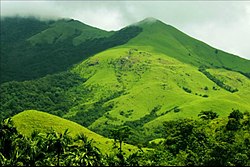
Kodagu is located on the eastern slopes of the Western Ghats. It has a geographical area of 4,102km2 (1,584sqmi).[7] The district is bordered by Dakshina Kannada district to the northwest, Hassan district to the north, Mysore district to the east, Kasaragod district of Kerala in west and Kannur district of Kerala to the southwest, and Wayanad district of Kerala to the south. It is a hilly district, the lowest elevation being 50 metres (160ft) above sea-level near makutta. The highest peak, Tadiandamol, rises to 1,750 metres (5,740ft), with Pushpagiri, the second highest, at 1,715 metres (5,627ft). The main river in Kodagu is the Kaveri (Cauvery), which originates at Talakaveri, located on the eastern side of the Western Ghats, and with its tributaries, drains the greater part of Kodagu.[8]
Kodagu district receives majority of its rainfall from Southwest Monsoon winds. Kodagu's annual rainfall average is 4th highest in Karnataka. The amount of rainfall varies significantly due to the effects of El-nino and La-nina.
In the year 2018, Kodagu received 29% excess rainfall of 3,737 millimetres (147.1in),[9]3,040 millimetres (120in) in 2019,[10]2,541 millimetres (100.0in) in 2020,[11] and 2,656 millimetres (104.6in) in 2021.[12]
In the year 2022, Kodagu received 11% Above-Normal rainfall of 3,036 millimetres (119.5in).[13]
In the year 2023, it received 38% deficit rainfall of 1,690 millimetres (67in).[14]
In the year 2024, Kodagu on an average received 3,052.2 millimetres (120.17in) of annual rainfall.[15]
Economy of Kodagu is dependent on agriculture. Major crops grown here are Paddy,[17][18]Coffee, Rubber, Pepper, Cardamom, Coorg Oranges and Honey production.[19] Tea, Ginger and Cocoa are also grown in smaller quantities.[20]
Coffee and pepper production
Kodagu is the largest coffee and pepper producing district in India. Karnataka produces nearly 70% of the total coffee production in India, out of which 33% is contributed by Kodagu district alone.[21] Kodagu also produces nearly a quarter of India's black pepper.[22][23]
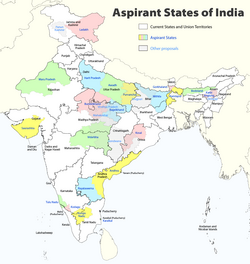
The Codava National Council and Kodava Rashtriya Samiti are campaigning for autonomy to Kodagu district which would have made Coorg more prosperous and independent.[24][25]
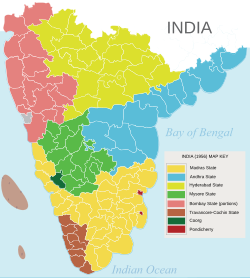
Map of South Indian states prior to the States Reorganisation Act, 1956. Kodagu (then called Coorg) is in dark green.
The Kodavas were the earliest inhabitants and agriculturists in Kodagu, having lived there for centuries. Kodavas being a warrior community as well, they carried arms during times of war and had their own chieftains.[26]
The earliest mention about Coorg can be seen in the works those date back to Sangam period (300 BCE - 300 CE). The Ezhimala dynasty had jurisdiction over two Nadus - The coastal Poozhinadu and the hilly eastern Karkanadu.[27] According to the works of Sangam literature, Poozhinadu consisted much of the coastal belt between Mangalore and Kozhikode.[28]Karkanadu consisted of Wayanad-Gudalur hilly region with parts of Kodagu (Coorg).[29]
The Haleri dynasty, an offshoot of the Keladi Nayakas, ruled Kodagu between 1600 and 1834. Later the British ruled Kodagu from 1834, after the Coorg War, until India's independence in 1947. A separate state (called Coorg State) until then, in 1956 Kodagu was merged with the Mysore State (now Karnataka).[30][31][32]
Coorg in British India
In 1834, the East India Company annexed Kodagu into British India, after deposing Chikka Virarajendra of the Kodagu kingdom, as 'Coorg'.[33] British rule led to the establishment of educational institutions, introduction of scientific coffee cultivation, better administration and improvement of the economy.[34][35][36] This reference notwithstanding - we should remember that the colonial rule by the British in India was about exploitation of resources and Kodagu provided a lot of scope for economic benefits to a colonising empire.
Demographics
Kodavas, 1875, from: "The people of India: A series of photographic illustrations..." (New York Public Library).
According to the 2011 census of India, Kodagu has a population of 554,519,[2] roughly equal to the Solomon Islands[38] or the US state of Wyoming.[39] This ranks it 539 out of 640 districts in India in terms of population.[2] The district has a population density of 135 inhabitants per square kilometre (350/sqmi).[2] Its population growth rate over the decade 2001–2011 was 1.13%.[2] Kodagu has a sex ratio of 1019 females for every 1000 males,[citation needed] and a literacy rate of 82.52%. 14.61% of the population lives in urban areas. Scheduled Castes and Scheduled Tribes make up 13.27% and 10.47% of the population respectively.[2]
Hindus are the vast majority. They include the Kodava people, other Kodava language speakers, Arebhashe Gowdas, Brahmins, most Yeravas and Kurubas. A huge minority of Muslims dot the Coorg district, especially the towns of Kushalnagar, Virajpet and Mercara. A sizeable of them are the Nawayaths who shifted in the eighties from Bhatkal and Murdeshwar in order to pursue coffee & arecanut plantations and textile business. The numerous mosque dotting the landscape is the testimony of Muslim presence in the district.
A small number of Mangalorean Catholics are also found in Coorg.[quantify] They are mostly descended from those Konkani Catholics who fled the roundup and, later, captivity by Tippu Sultan. These immigrants were welcomed by Raja Veerarajendra (himself a former captive of Tippu Sultan, having escaped six years of captivity in 1788) who realising their usefulness and expertise as agriculturists, gave them lands and tax breaks and built a church for them.[41]
According to Karnataka Kodava Sahitya Academy (Karnataka's Kodava Literary Academy), apart from Kodavas, and their related groups, the Amma Kodavas, the Kodava Peggade (Kodagu Heggade) and the Kodava Maaple (Kodava Muslims), 18 other smaller-numbered ethnic groups speak Kodava Takk in and outside the district including the Iri (Airi, or the carpenters and the village smiths), the Koyava, the Banna, the Kodagu Madivala (washermen), the Kodagu Hajama (barber, also called Nainda), the KembattiPoleya (household servants and labourers) and the Meda (basket and mat weavers and drummers).[45]
Among other Kodava speaking communities are: the Heggades, cultivators from shimogga; the Kodava Nair, cultivators from Kerala State; the Ayiri, who constitute the artisan caste; the Medas, who are basket and mat-weavers and act as drummers at feasts; the Binepatta, originally wandering musicians from Malabar, now farmers; and the Kavadi, cultivators settled in Yedenalknad (Virajpet). All these groups speak the Kodava language and conform generally to Kodava customs and dress.[44]
The Arebhashe gowdas,[46] or Kodagu Gowdas, and Tulu Gowdas, are an ethnic group of Dakshina Kannada and Kodagu. They live in Sulya (in Dakshina Kannada) and in parts of Somwarpet, Kushalanagar, Bhagamandala and Madikeri. They speak a language known as Arebhashe a dialect of Kannada. Guddemane Appaiah Gowda along with many other freedom fighters from different communities revolted against the British in an armed struggle which covered entire Kodagu and Dakshina Kannada. This was one of the earliest freedom movements against the British[47] called "Amara Sulliada Swantantrya Sangraama"[48] (Amara Sulya Dhange[47] formally called the 'Coorg Rebellion' by the British) started in 1837.[49][50][51][52]
Tourism
Kaveri River in KushalnagaraTibetan Buddhist Golden temple, in Bylakuppe near Kushalanagar
Kodagu is rated as one of the top hill station destinations in India. Some of the most popular tourist attractions in Kodagu include Talakaveri, Bhagamandala, Nisargadhama, Mallalli Falls, Abbey Falls, Dubare, Nagarahole National Park, Iruppu Falls, and the Tibetan Buddhist Golden Temple.[53]
Talakaveri is the place where the River Kaveri originates.[54] The temple on the riverbanks here is dedicated to Lord Brahma, and is one of only two temples dedicated to Brahma in India and Southeast Asia. Bhagamandala is situated at the Sangama (confluence) of two rivers, the Kaveri and the Kannika. A third river, the Sujyothi, is said to join from underground, and hence this spot is called the Triveni Sangama. Iruppu Falls is a sacred Kodagu Hindu spot in South Kodagu in the Brahmagiri hill range. The Lakshmana Tirtha River, with the waterfalls, flows nearby and has a Rameshwara temple on its banks. It is said that this sacred river was created when Laxmana, prince of Ayodhya and younger brother of Lord Rama, shot an arrow into nearby hill, the Brahmagiri hill. Chelavara falls and Thadiandamol peak are also in South Kodagu. Nagarahole is a national park and wildlife resort.
Madikeri is the capital of the district and Raja's Seat park is popular with tourists.[55] Kootu Poley dam is also popular among tourists. Omkareshwara Temple is a beautiful temple built in the Indo-Sarcenic style in Coorg. A legend is associated with the temple, built by Lingarajendra II in 1820 CE. The king put to death a pious Brahmin who dared to protest against his misdeeds. The spirit of the dead man began to plague the king day and night. On the advice of wise men, the king built this temple and installed a Shivalinga procured from Kashi, North India. St. Mark's Church is located within the Mercara Fort and was raised in 1859, by the officers and men of the East India Company. The building was funded by the Government of Madras,[56] and placed under the Church of England in India, Diocese of Madras.[57] The Church was closed after Indian independence, and taken over by the Government of Karnataka in 1971.[58] The building now houses the Madikeri Fort Museum, managed by the Karnataka State Archaeological Department.[59]
Dubare is mainly an elephant-capturing and training camp of the Forest Department at the edge of Dubare forest; on the bank of the river Kaveri along the Kushalanagara – Siddapura road.[60]Nisargadhama is a man-made island and picnic spot near Kushalanagara, formed by the river Kaveri. The Tibetan Buddhist Golden Temple is at Bylakuppe(Mysore district) near Kushalnagara, in the Tibetan refugee settlement.
Abbey Falls is a scenic waterfall 5km from Madikeri. Mallalli falls is 25km from Somawarapet, downhill of the Pushpagiri hills.[61] Mandalapatti is 28km from Madikeri. On the way to Abbey Falls, before 3km from Abbey Falls take right, from there 25km. Kote Betta temple, Kote Abbey falls are also in North Kodagu. Abbi waterfall and other waterfalls are best during monsoon season, typically some days after it starts raining in June up to the end of rainy season, while there is more water gushing in the streams and rivers.[62]
C. G. Somiah was the first IAS Officer from Coorg to rise to be the Home Secretary, Chief Vigilance Commissioner (CVC) and Comptroller and Auditor General.[74]
↑Herbert Feis (December 1926). "The Mechanism of Adjustment of International Trade Balances". The American Economic Review. 16 (4). American Economic Association: 593–609. JSTOR1.
↑"Museums in Karnataka". Government of Karnataka: Department of Archaeology, Museums and Heritage. 2015. Archived from the original on 18 October 2015. Retrieved 21 August 2015.
↑Kamath (1993). Karnataka State gazetteer, Volume 20. Bangalore: Director of Print, Stationery and Publications at the Government Press. p.659. Retrieved 11 October 2014.
This page is based on this Wikipedia article Text is available under the CC BY-SA 4.0 license; additional terms may apply. Images, videos and audio are available under their respective licenses.




 India
India  Karnataka