Lamar County, Georgia

Last updated

Lamar County, Georgia
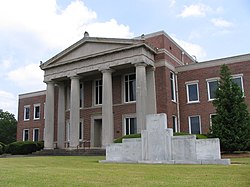
Lamar County Georgia Courthouse.jpg
Lamar County courthouse in Barnesville
Lamar CountyGAlogo.png
Map of Georgia highlighting Lamar County.svg
Location within the U.S. state of Georgia
Coordinates: 33°04′N84°08′W / 33.07°N 84.14°W / 33.07; -84.14
CountryFlag of the United States.svg United States
StateFlag of Georgia (U.S. state).svg Georgia
Founded1920;105 years ago (1920)
Named after Lucius Quintus Cincinnatus Lamar II
Seat Barnesville
Largest cityBarnesville
Area
  Total
186 sq mi (480 km2)
  Land184 sq mi (480 km2)
  Water2.3 sq mi (6.0 km2)  1.3%
Population
 (2020)
  Total
18,500
  Density101/sq mi (39/km2)
Time zone UTC−5 (Eastern)
  Summer (DST) UTC−4 (EDT)
Congressional district 3rd
Website lamarcountyga.com

Lamar County is a county in the West Central region of the U.S. state of Georgia. As of the 2020 census, the population was 18,500. [1] The county seat is Barnesville. [2]

Contents

History

The Georgia General Assembly proposed the constitutional amendment to create the county on August 17, 1920, and the citizens of the state voted in favor of the amendment on November 2, 1920. [3] Land from Pike County and Monroe County was then transferred to create Lamar County. Lamar County was named after Confederate Democrat Lucius Quintus Cincinnatus Lamar II. [4]

Geography

According to the U.S. Census Bureau, the county has a total area of 186 square miles (480 km2), of which 184 square miles (480 km2) is land and 2.3 square miles (6.0 km2) (1.3%) is water. [5] It is located in the Piedmont region of the state.

The western third of Lamar County, west of a line from Orchard Hill through Milner and Barnesville, is located in the Upper Flint River sub-basin of the ACF River Basin (Apalachicola-Chattahoochee-Flint River Basin). The eastern majority of the county is located in the Upper Ocmulgee River sub-basin of the Altamaha River basin. [6]

Major highways

Adjacent counties

Communities

Cities

Towns

Demographics

Historical population
CensusPop.Note
1930 9,745
1940 10,0913.6%
1950 10,2421.5%
1960 10,2400.0%
1970 10,6884.4%
1980 12,21514.3%
1990 13,0386.7%
2000 15,91222.0%
2010 18,31715.1%
2020 18,5001.0%
2024 (est.)20,690 [7] 11.8%
U.S. Decennial Census [8]
1790-1880 [9] 1890-1910 [10]
1920-1930 [11] 1930-1940 [12]
1940-1950 [13] 1960-1980 [14]
1980-2000 [15] 2010 [16] 2020 [17]
Lamar County, Georgia – Racial and ethnic composition
(NH = Non-Hispanic)
Note: the US Census treats Hispanic/Latino as an ethnic category. This table excludes Latinos from the racial categories and assigns them to a separate category. Hispanics/Latinos may be of any race.
Race / EthnicityPop 2000 [18] Pop 2010 [16] Pop 2020 [17] % 2000% 2010% 2020
White alone (NH)10,68311,94312,34467.14%65.20%66.72%
Black or African American alone (NH)4,8065,6214,88830.20%30.69%26.42%
Native American or Alaska Native alone (NH)4234130.26%0.19%0.07%
Asian alone (NH)59681020.37%0.37%0.55%
Pacific Islander alone (NH)1240.01%0.01%0.02%
Other race alone (NH)1422480.09%0.12%0.26%
Mixed race or Multiracial (NH)1352866260.85%1.56%3.38%
Hispanic or Latino (any race)1723414751.08%1.86%2.57%
Total15,91218,31718,500100.00%100.00%100.00%

2020 census

As of the 2020 census, there were 18,500 people, 6,897 households, and 3,746 families residing in the county. [19] [20]

The median age was 40.2 years, 21.4% of residents were under the age of 18, and 18.3% of residents were 65 years of age or older. For every 100 females there were 92.0 males, and for every 100 females age 18 and over there were 89.0 males age 18 and over. [20]

36.9% of residents lived in urban areas, while 63.1% lived in rural areas. [21]

The racial makeup of the county was 67.4% White, 26.6% Black or African American, 0.1% American Indian and Alaska Native, 0.6% Asian, 0.0% Native Hawaiian and Pacific Islander, 1.1% from some other race, and 4.2% from two or more races. Hispanic or Latino residents of any race comprised 2.6% of the population. [19]

There were 6,897 households in the county, of which 31.5% had children under the age of 18 living with them and 29.3% had a female householder with no spouse or partner present. About 25.9% of all households were made up of individuals and 12.5% had someone living alone who was 65 years of age or older. [20]

There were 7,561 housing units, of which 8.8% were vacant. Among occupied housing units, 69.3% were owner-occupied and 30.7% were renter-occupied. The homeowner vacancy rate was 1.4% and the rental vacancy rate was 6.3%. [20]

Politics

As of the 2020s, Lamar County is a strongly Republican voting county, voting 72.75% for Donald Trump in 2024. For elections to the United States House of Representatives, Lamar County is part of Georgia's 3rd congressional district, currently represented by Brian Jack. For elections to the Georgia State Senate, Lamar County is part of District 16. [22] For elections to the Georgia House of Representatives, Lamar County is part of districts 134 and 135. [23]

United States presidential election results for Lamar County, Georgia [24]
Year Republican Democratic Third party(ies)
%%%
1924 385.72%59489.46%324.82%
1928 12615.79%67284.21%00.00%
1932 334.38%71494.69%70.93%
1936 697.59%83992.30%10.11%
1940 858.86%86990.62%50.52%
1944 14312.35%1,01587.65%00.00%
1948 16412.92%90971.63%19615.45%
1952 42921.66%1,55278.34%00.00%
1956 55526.61%1,53173.39%00.00%
1960 47926.00%1,36374.00%00.00%
1964 1,57050.30%1,54849.60%30.10%
1968 57520.50%79028.16%1,44051.34%
1972 1,84473.47%66626.53%00.00%
1976 84723.32%2,78576.68%00.00%
1980 1,29833.91%2,45364.08%772.01%
1984 2,19857.80%1,60542.20%00.00%
1988 2,03557.83%1,41640.24%681.93%
1992 1,70738.71%2,06546.83%63814.47%
1996 1,98843.75%2,12546.76%4319.49%
2000 2,91255.68%2,19441.95%1242.37%
2004 4,02761.96%2,43237.42%400.62%
2008 4,87363.24%2,75235.72%801.04%
2012 4,89964.36%2,60234.18%1111.46%
2016 5,19067.87%2,27029.68%1872.45%
2020 6,33169.99%2,62028.97%941.04%
2024 7,57572.75%2,79526.84%420.40%

Education

All of the county is in the Lamar County School District. [25]

See also

References

  1. "Census - Geography Profile: Lamar County, Georgia". United States Census Bureau . Retrieved December 27, 2022.
  2. "Find a County". National Association of Counties. Archived from the original on May 31, 2011. Retrieved June 7, 2011.
  3. GeorgiaInfo - Carl Vinson Institute of Government
  4. Gannett, Henry (1905). The Origin of Certain Place Names in the United States. Government Printing Office. p.  180.
  5. "US Gazetteer files: 2010, 2000, and 1990". United States Census Bureau. February 12, 2011. Retrieved April 23, 2011.
  6. "Georgia Soil and Water Conservation Commission Interactive Mapping Experience". Georgia Soil and Water Conservation Commission. Archived from the original on October 3, 2018. Retrieved November 20, 2015.
  7. "County Population Totals and Components of Change: 2020-2024". United States Census Bureau. Retrieved August 22, 2025.
  8. "Decennial Census of Population and Housing by Decades". United States Census Bureau.
  9. "1880 Census Population by Counties 1790-1800" (PDF). United States Census Bureau. 1880.
  10. "1910 Census of Population - Georgia" (PDF). United States Census Bureau. 1910. Archived from the original (PDF) on January 16, 2024.
  11. "1930 Census of Population - Georgia" (PDF). United States Census Bureau. 1930.
  12. "1940 Census of Population - Georgia" (PDF). United States Census Bureau. 1940.
  13. "1950 Census of Population - Georgia -" (PDF). United States Census Bureau. 1950.
  14. "1980 Census of Population - Number of Inhabitants - Georgia" (PDF). United States Census Bureau. 1980.
  15. "2000 Census of Population - Population and Housing Unit Counts - Georgia" (PDF). United States Census Bureau. 2000.
  16. 1 2 "P2: Hispanic or Latino, and Not Hispanic or Latino by Race – 2010: DEC Redistricting Data (PL 94-171) – Lamar County, Georgia". United States Census Bureau. Retrieved January 26, 2024.
  17. 1 2 "P2: Hispanic or Latino, and Not Hispanic or Latino by Race – 2020: DEC Redistricting Data (PL 94-171) – Lamar County, Georgia". United States Census Bureau. Retrieved January 26, 2024.
  18. "P004: Hispanic or Latino, and Not Hispanic or Latino by Race – 2000: DEC Summary File 1 – Lamar County, Georgia". United States Census Bureau. Retrieved January 26, 2024.
  19. 1 2 "2020 Decennial Census Redistricting Data (Public Law 94-171)". United States Census Bureau. 2021. Retrieved 13 December 2025.
  20. 1 2 3 4 "2020 Decennial Census Demographic Profile (DP1)". United States Census Bureau. 2021. Retrieved 13 December 2025.
  21. "2020 Decennial Census Demographic and Housing Characteristics (DHC)". United States Census Bureau. 2023. Retrieved 13 December 2025.
  22. "Georgia General Assembly". www.legis.ga.gov. Retrieved November 28, 2025.
  23. "Georgia General Assembly". www.legis.ga.gov. Retrieved November 28, 2025.
  24. Leip, David. "Dave Leip's Atlas of U.S. Presidential Elections". uselectionatlas.org. Retrieved March 20, 2018.
  25. "2020 CENSUS - SCHOOL DISTRICT REFERENCE MAP: Lamar County, GA" (PDF). U.S. Census Bureau . Retrieved September 24, 2024. - Text list

33°04′N84°08′W / 33.07°N 84.14°W / 33.07; -84.14