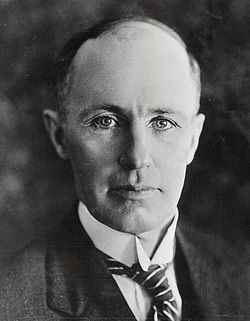
The two-day-old government of Canadian Prime Minister Arthur Meighen was defeated in Parliament by one vote, 96 to 95[1] on a motion challenging the legality of Meighen's attempt to circumvent normal Parliamentary procedure by assembling a Cabinet consisting exclusively of acting ministers without portfolio. The votes against Meighen's government included 14 of his fellow Conservatives. Though the vote was not strictly a motion of no confidence, Meighen accepted the result as such and asked the Governor-General to dissolve Parliament and schedule a new election.[2]
The Swedish Air Force (the Flygvapnet) was founded by a merger of the aviation units of Sweden's Army and Navy.[3]
The largest chain of grocery stores in the western United States was created by merger of the 322 stores of the Safeway chain, and the 673 stores of the Skaggs Companies, all of which had been purchased by stockbroker Charles E. Merrill, with the 995 stores to be under the Safeway brand.[4]
The world's longest suspension bridge up that time, the 9,650 feet (2,940m) long Delaware River Bridge linking Philadelphia to Camden, New Jersey, was opened three days before the celebration of the sesquicentennial of United States independence. At 1:00 in the afternoon, "three little girls" cut red, white and blue cords at the Philadelphia entrance and thousands of pedestrians began crossing the Delaware River from both sides.[5] Pedestrian traffic closed at 7:00 and the motor vehicle traffic was allowed at midnight.[6] The bridge would be renamed for Benjamin Franklin in 1955.[7]
The Dominion of Canada returned to the gold standard, and allowed Dominion notes to be redeemed for gold to back its currency, after having chosen to abandon the standard on August 22, 1914. After the Great Depression, Canada abandoned the gold standard again on October 31, 1931.[8]
The town of Venice, Florida, was incorporated after Dr. Fred H. Albee, an orthopedic surgeon, had purchased 112 acres (45ha) for development of the infrastructure and government buildings over a period of two years.[9]
Alexander del Mar, 89, the first Director of the Bureau of Statistics at the U.S. Treasury Department[13]
July 2, 1926 (Friday)
President Calles
President Plutarco Elías Calles of Mexico published the Calles Law, effective July 31, which banned religious education, foreign priests and political commentary in religious publications. Additionally, all church property was to become government property and worship could only be conducted inside of churches and under the supervision of local officials.[14]
The U.S. Congress created the Distinguished Flying Cross, modeled after the British honor created in 1918 for members of all U.S. armed services "single acts of heroism or extraordinary achievement while participating in aerial flight.[18]
Born:
Yoshihisa Okumura, Japanese electronics engineer whose 1968 study of urban and rural environments determined the Okumura model, the international standards for placement and height of mobile phone cell towers, and set the 800 megahertz band as the most efficient frequency for mobile phones; in Kanazawa City, Isikawa Prefecture (d.2023)[19]
Died:Émile Coué, 79, French psychologist known for the "Coué Method" of self-improvement, and coiner of the mantra "Tous les jours à tous points de vue je vais de mieux en mieux", which has been translated in English-speaking nations as "Every day, in every way, I'm getting better and better."[22][23]
July 3, 1926 (Saturday)
Nine days after an attempted coup d'etat against the government of Prime Minister Miguel Primo de Rivera, King Alfonso XIII of Spain issued a royal decree giving Primo de Rivera discretionary powers to impose "sanctions that are within his powers", including banishments and deportations that the premier deemed necessary, "whatever their number and the quality of the persons who deserve it", based on the good of the country. The King also provided that, to the extent that an act was not within Primo de Rivera's powers, the premier could ask King Alfonso XIII for an exception.[24]
Sammy Mandell won the world lightweight boxing championship, outpointing defending champion Rocky Kansas in 10 rounds at an outdoor bout at Chicago's Comiskey Park.[26] The match was fought before a crowd of 15,000 boxing fans during a drizzling rain.[27]
Evelyn Anthony (pen name for Evelyn Ward-Thomas), British novelist known for The Tamarind Seed; in Lambeth, London (d.2018)[28]
July 4, 1926 (Sunday)
The Nazi Party staged its 2nd Party Congress in Weimar. The Grossdeutsche Jugendbewegung (Greater German Youth Movement) was rebranded Hitler Jugend Bund der deutschen Arbeiterjugend (Hitler Youth League of German Worker Youth), commonly referred to as the Hitler Youth.[29]
The Sesquicentennial of the United States was celebrated to commemorate the 150th anniversary of the signing of the Declaration of Independence and the founding of the United States. A violent storm struck the city during and damaged the Sesquicentennial Exposition, particularly the Palace of Agriculture, where water accumulated on the building roof and workmen cut holes directly over the exhibit for the U.S. state of Maryland, damaging it with a rush of water.[30] On this day, Poland chose to honour this sesquicentennial by collecting signatures for the Polish Declarations of Admiration and Friendship for the United States. This collection of 111 volumes of signatures and greetings was eight months later to President Calvin Coolidge to acknowledge American participation and aid to Poland during World War I. It comprised submissions from nearly one-sixth of the population of Poland as it then existed, including those of approximately 5.5 million school children.[31]
Knoebels Amusement Resort, the largest amusement park in the U.S. to have no admission fee (with rides paid for individually) opened in Elysburg, Pennsylvania on the U.S. sesquicentennial day with a large swimming pool and its first mechanical ride (a steam-powered carousel)[32]
Katherine Bowes Lyon, British special needs cousin of Queen Elizabeth II of the United Kingdom, institutionalized at Royal Earlswood Hospital from 1941 (with her sister Nerissa) until her death in 2014; in Chelsea, London[36]
Died:Amy Ella Blanchard, 72, American writer of children's literature, known for the Four Corners six-book series (from 1907 to 1914) and the four-book A Dear Little Girl series from 1910 to 1913), died of a stroke (apoplexy) at her desk while writing a poem. [37]
July 5, 1926 (Monday)
Pope Pius XI designated August 1, the feast day of St. Peter ad Vincula, as a day of special prayers for the "deliverance of Mexican Catholics from persecution and for pardon for their persecutors."[38]
July 6, 1926 (Tuesday)
Caillaux
French Finance Minister Joseph Caillaux spoke before the Chamber of Deputies, outlining the severity of the country's economic problems and asking for emergency powers to address them.[39]
July 7, 1926 (Wednesday)
Joseph Caillaux's request of the previous day for special powers was widely attacked in the Chamber of Deputies. Léon Blum proclaimed, "Such action would be a veritable abdication of Parliament and violate the national sovereignty."[40]
In Britain, fist fighting broke out in the House of Lords as it passed the Coal Mines Regulation Act 1908 (8 Edw. 7. c. 57), which permitted an extra hour of work per day in coal mines. Before Britain's miners were locked out they usually worked seven hours.[41]
A grand jury convened in the Aimee Semple McPherson kidnapping case to question McPherson about some questionable details that had arisen in her account of what had happened to her.[42]
The Soviet Union passed a law forbidding the transportation of the chervonets, worth 10 new rubles, out of the nation, a move to prevent smugglers from paying for foreign goods with what had become a more stable unit of money on foreign currency exchanges. The Soviets would follow on March 10, 1928, with another law barring the conversion of imported chervonets to rubles, making the currency worthless to foreign sellers.[43][44]
A solar eclipse was visible from Earth, with totality at 23:06:02 UTC. With the exception of the Hawaiian Islands at 1:02 in the afternoon local time, the path of the eclipse was over mostly uninhabited portions of the Pacific Ocean.[49] The phenomenon was rare, in that the Moon was almost at apogee (its shortest distance from Earth) and, therefore, completely obscured the Sun during totality. Because of the International Date Line, the eclipse began on July 10 at 10:05 in the morning local time west of the date line
In a 4 a.m. vote following an all-night session, France's Chamber of Deputies voted to approve granting Finance Minister Joseph Caillaux the extraordinary powers he sought to address the country's economic crisis. The matter was then to go to the Finance Committee.[51]
A bolt of lightning struck the Lake Denmark Naval Ammunition Depot near the Picatinny Arsenal in New Jersey.[52] The resulting fire caused several million pounds of explosives to blow up in the next three days, killing 19 people[53] and destroying 187 of 200 buildings in and near Lake Denmark.
Born:Fred Gwynne, American television and film actor known for The Munsters and My Cousin Vinny; in New York City (d. 1993)
July 11, 1926 (Sunday)
An estimated 20,000 French veterans of World War One paraded silently through the rainy streets of Paris to protest the Mellon-Berenger Agreement. Blind and maimed veterans led the procession to the Place des États-Unis where they laid wreaths, as well as plaques explaining their position that the debt settlement would ruin France.[55]
The first German Grand Prix auto race was staged at the AVUS (Automobil-Verkehrs- und Übungsstrasse) highway for a total distance of 390 kilometres (240mi) in Berlin, with a variety of 44 sports cars due to the lack of automobiles that met the Grand Prix standards. During the inaugural race, the timekeeper was killed and two other persons injured when a car driven by Adolf Rosenberger crashed into one of the race marshal's stands.[57] The event was won by Rudolf Caracciola.[58]
Bob Backus, American track and field athlete who set the world record in the hammer throw (45 feet, 2 inches in the 56-pound throw in 1957 and 66'2¾" for the 35 pound throw in 1959) after overcoming disabilities caused by spinal meningitis; in Boston (d. 1999)[61]
Died:James Clark, an African-American chauffeur for a traveling salesman, was arrested in the town of Eau Gallie, Florida (near Melbourne after being accused of rape by a white girl, then turned over to a mob of 10 white men who carried out his lynching. After a noose was placed around his neck, the mob pulled him up over a tree limb, then shot him while he was being hanged. The crime was not investigated, and nobody was ever prosecuted for Clark's murder.[63][64]
General Motors acquired the Flint Institute of Technology in Michigan and renamed it the General Motors Institute of Technology. Today it is known as Kettering University.
Died:
Gertrude Bell, 57, English archaeologist, writer, spy, and administrator and founder of the Iraq Museum, nicknamed "The Uncrowned Queen of Mesopotamia", died from an overdose of sleeping pills.[66]
John W. Weeks, 66, American banker and politician who served as U.S. Secretary of War from 1921 to 1925, and U.S. Senator for Massachusetts from 1913 to 1919.[67][68]
In Florence, King Victor Emmanuel III of Italy took a boy who had just been hit by a train into his auto and rushed the boy to the hospital. The boy died in the car.[73]
Died: Major General Littleton Waller, 69, U.S. Marine Corps officer known for service in multiple wars and for being court-martialed for the disastrous Samar expedition in the Philippine–American War and the summary execution of 11 Filipino civilian porters at Lanang for mutiny in 1902[75]
July 14, 1926 (Wednesday)
Hursit
As hangings of Izmir Plot conspirators continued, former member of parliament Ziya Hurşit was executed after being convicted of conspiring to assassinate President Mustafa Kemal, along with Laz İsmail, Gürcü Yusuf, Çopur Hilmi, Şükrü Bey, "Ayıcı" Arif, Miralay Rasim Bey, and Halis Turgut Bey.
In New York, Linton Wells and Edward Steptoe Evans completed their flight around the world in 28 days, 14 hours and 37 minutes, beating the old record of 35 days set by John Henry Mears in 1913.[76][77]
A royal decree was issued by Spain's King Alfonso XIII, holding that chiefs and officers who were passed over for promotion were not entitled to an appeal, nor to know the reasons for the denial of advancement.[78]
In the U.S., a fire at the Twilight Inn at Haines Falls, New York killed 14 people at the Twilight Inn in the Catskills, including a night watchman who woke up and evacuated numerous guests, and 21 were injured.[79]
The Belgian government granted King Albert of Belgium six months of practically unlimited powers to try to stop the country's worsening inflation problem.[80]
France's Prime Minister Aristide Briand and his cabinet of ministers resigned after the Chamber of Deputies voted a lack of confidence in the Briand government, 285 to 243, on a motion introduced by the Chamber's president, Édouard Herriot. The motion followed after Finance Minister Caillaux's final demand for power to decree the value of the French franc.[83]
In Mexico City, a meeting of Catholics resolved to organize a nationwide boycott to protest the Calles Law. The boycott covered items that constituted a large part of government income (such as lottery tickets), items subject to heavy excise duties (such as stamps), and items subject to heavy import duties.[84]
An anonymous editorial titled "Pink Powder Puffs" was published in the Chicago Daily Tribune which blamed actor Rudolph Valentino for the installation of a face-powder dispenser in a new men's public washroom and implied that he was responsible for the feminization of American men. Valentino was enraged.[85]
Rudolph Valentino responded to the previous day's editorial in the Tribune with an essay of his own for the Chicago Herald-Examiner, challenging the writer to come forward and face him in a boxing or wrestling match. The author did not come forward, to Valentino's disappointment.[86]
Rumored dissensions among the crew of the airship Norge in the recent North Pole expedition fell into the public sphere as Umberto Nobile shot back at a statement Lincoln Ellsworth had made which denied that Nobile had piloted the airship. Nobile insisted that he steered the entire flight and asserted that Ellsworth was "just a passenger."[87]
Born:Helen Gallagher, American actress; in New York City (d. 2024)
July 20, 1926 (Tuesday)
Édouard Herriot took office as the new Prime Minister of France and his new Finance Minister Anatole de Monzie worked on presentation for his plans to save the franc, which had continued to plummet, down to 49.22 against the U.S. dollar.[88][89]
The grand jury in the Aimee Semple McPherson case adjourned, finding insufficient evidence to indict McPherson and her mother on charges of manufacturing evidence and giving false testimony to police.[42]
Died:Felix Dzerzhinsky, 48, Soviet Russian Bolshevik revolutionary and former head of Cheka and the OGPU
July 21, 1926 (Wednesday)
In the first vote of confidence on the new government of France's Prime Minister Édouard Herriot, who had taken office the day before, brought down the Herriot government. The Chamber of Deputies voted 290 against and only 237 in favor. Herriot delivered the note of resignation of his government to President Doumergue. The vote of defeat occurred following a report from Finance Minister Anatole de Monzie to the Chamber, that the nation's Treasury was on the verge of bankruptcy and had only $1.2 million left in its reserve.[90] With the news of the fall of the new government, the value of the French franc fell to the lowest in its history, worth less than $0.02 (two cents) against the American dollar, rising to a dollar being worth 51 cents.[91]
Sim (stage name for Simon Berryer), French comedian and character actor on TV and film, known for law enforcement roles and for portraying "Geriatrix" in two of the Asterix films at the age of 73 and 82; in Cauterets, Hautes-Pyrénéesdépartement (d.2009) [93]
At Fremantle in the state of Western Australia, during flooding of the Swan River, an officer from the harbour tender Reliance noticed that the north railway bridge over the river was on the verge of collapse. While George Henderson was inspecting an increased gap on the bridge, a passenger train that included a group of schoolchildren came across at 1:12 in the afternoon. Henderson "was horrified to see that the gap open to a width of five or six inches" and alerted rail officials to stop all train traffic. Five minutes after the 1:12 train crossed, a 50 feet (15m) section of the bridge fell into the floodwaters below. All traffic was stopped before another train, the 1:50 train from Fremantle to Perth, came over the line.[98]
A heat wave set a record which would still stand 99 years later in the U.S. state of New York, as the temperature reached 108°F (42°C) in Troy[100]. Ten people died from heat-related illness, and another 43 required medical treatment.[101]
New revelations came out in the Aimee Semple McPherson kidnapping mystery, as claims surfaced that McPherson had been around Carmel-by-the-Sea, California, living in a rented cottage with a man named Kenneth Ormiston during the time she was allegedly kidnapped.[42]
Kurt Wüsthoff, 29, German flying ace with 27 confirmed victoriies in World War One, died five days after crashing while at a flying show practicing aerobatics. The air show was in commemoration of the death of Max Immelmann, another German flying ace, who had been killed when his airplane crashed after being shot down.[112]
Kaneko Fumiko, 23, Japanese anarchist, died of an apparent suicide in her jail cell after rejecting a commutation of her death sentence to life imprisonment for plotting an assassination of the Emperor.[113]
Charles Avery (stage name for Charles Avery Bradford), 53, American silent film director and actorm known for being one of the original seven Keystone Cops
An episcopal letter to the churchgoers of Mexico was published in newspapers around the country, announcing that after the Calles Law goes into effect on July 31, religious services would no longer be held in the churches as an expression of protest.[114]
Raymond Poincaré of France announced his plan to stabilize the franc by rebalancing the budget with new business taxes, as well as tariffs aimed at protecting imports from French colonies. Markets responded favourably as the franc rebounded to 39 against the U.S. dollar.[115]
The legislature of the Philippines adopted a plebiscite resolution on independence, but it was vetoed by the governor.[54]
Britain reached an agreement with Lincoln Clark Andrews, the chief of Prohibition enforcement in the United States, to thwart liquor smuggling into the U.S.[76]
The United States and Panama signed the Panama Canal Treaty, allowing the American military to conduct peacetime maneuvers on Panamanian territory and obligating Panama to go to war if the U.S. ever did. The treaty was very unpopular in Panama.[54]
Born:Walt Brown, American politician, in Los Angeles
July 29, 1926 (Thursday)
Two thousand pilgrims from Milan attempting to visit the church of the Madonna del Sasso in Locarno were barred entry into Switzerland by Italian authorities. Mussolini had ordered Italians to spend their money within Italy.[116]
July 30, 1926 (Friday)
Nine were wounded in Mexico City when police fired on churchgoers who refused to leave the San Rafael church. It was reported throughout the city that fire fighters used water cannons to disperse angry crowds who were throwing stones at authorities.[117]
The "Calles Law", an anticlerical executive decree by Mexico's President Plutarco Elías Calles for strict regulation of religion (including government licensing of Roman Catholic priests) went into effect after having been announced on June 14.[118] The Catholic Archbishop of Mexico, José Mora y del Rio, directed the nation's priests to go on strike, and rioting broke out with three people dying, others injured more than 50 arrested.[119] Four days later, on August 3, the Cristero War, an uprising by the LNDLR (Liga Nacional Defensora de la Libertad Religiosa), nicknamed Los Cristeros), would begin as a peasant uprising against the Calles government.[118]
By a margin of 295 to 188, the French Chamber of Deputies voted overwhelmingly in favour of Prime Minister Raymond Poincaré's drastic tax increase plan to save the nation from bankruptcy by adding 2.5 billion francs (equivalent to $62 million U.S.) to the nation's treasury in 1926 and nine billion francs (90 million U.S. dollars) in 1927. Poincare warned deputies that every day of delay in passage would cost the French Treasury 16 million francs.[120][121]
Rupert Neve, British born American electronics engineer and Grammy Award winner known as "the father of modern studio recording"; in Newton Abbot, Devonshire (d.2021)[123]
Ian Moffitt, Australian journalist and novelist knwon for the bestselling The Retreat of Radiance; in Sydney (d.2000)
References
↑Meighen Government Defeated in Ottawa; New Administration Loses by One Vote -- Dissolution of Parliament Expected, The New York Times, July 2, 1926, p.21
↑Martínez, Anne M. (2014). Catholic Borderlands: Mapping Catholicism onto American Empire 1905–1935. Board of Regents of the University of Nebraska. pp.151–152. ISBN978-0-8032-4877-9.
↑Governor Dissolves Ottawa Parliament; Acts on the Recommendation of Meighen, Whose Ministry Loses Vote of Confidence, The New York Times, July 3, 1926, p.15
↑Lt. Col. John F. Shiner, "From Air Service to Air Corps: The Era of Billy Mitchell", in Winged Shield, Winged Sword: A History of the United States Air Force Vol. I, pp.102-103 ISBN0-16-049009-X
↑"Kinsey Bows to Borotra; American Keeps Rival Away From Net, but Loses in Final, 8-6, 6-1,6-3", The New York Times, July 3, 1926, p.8
↑"Yoshihisa Okumura, contributor to the practical application of mobile phones, passes away at age 96" (Japan Broadcasting Corporation, February 19, 2023)
↑González Calleja, Eduardo (2005). La España de Primo de Rivera. La modernización autoritaria 1923-1930[The Spain of Primo de Rivera: Authoritarian Modernization 1923-1930] (in Spanish). Madrid: Alianza Editorial. p.57. ISBN84-206-4724-1.
↑"Mrs. Godfree Is a Victor— Conquers Senorita de Alvarez in Wimbledon Final", The New York Times, July 4, 1926, p.S-1
↑Klee, Ernst (2005). Das Personenlexikon zum Dritten Reich. Wer war was vor und nach 1945[The Person Encyclopedia of the Third Reich. Who was what before and after 1945] (in German). Frankfurt am Main: Fischer Taschenbuch Verlag. p.294. ISBN978-3-59616-048-8.
↑"Philadelphia Fair Is Damaged by Rain; Buildings Leak During Storm, Wrecking Some of the Sesquicentennial Exhibits", The New York Times, July 5, 1926, p.13
↑Andrea Chandler, Institutions of Isolation: Border Controls in the Soviet Union and Its Successor States, 1917-1993 ISBN 9780773567122 (McGill-Queen's University Press, 1998) p.52
↑"Central Banking and the Russian Monetary System", in Russian Currency and Finance: A Currency Board Approach to Reform ed. by Steve H. Hanke, et. al (Taylor & Francis, 2005) ISBN 9781134863693
↑"Huge Area Is Under fire; Houses Torn From Their Foundations and Cars Blown Off Roads— First Shock Felt 30 Miles; Exploding Shells Fall on Army Arsenal at Picatinny Half a Mile Away", The New York Times, July 11, 1926, p.1
↑John W. Weeks Dies in Mountain Home; Ex-Secretary of War Passes From Coma to Death, With Family at Bedside— New Hampshire Village Half Masts Flags for Farmer Lad Who Became Cabinet Member.
↑"Boy Run Over by Train Dies in King of Italy's Auto". Chicago Daily Tribune. July 14, 1926. p.1.
↑"Dr. Joseph E. Bogen, 78; Epilepsy Research Led to Breakthroughs on Right, Left Brain", by Thomas H. Maugh II, The Los Angeles Times, April 30, 2005, p.B14
↑"General Waller of Marines Dead; Took Part in Almost Every Campaign of the Corps for Forty Years", The New York Times, July 14, 1926, p.21
↑González Calleja, Eduardo (2005). La España de Primo de Rivera. La modernización autoritaria 1923-1930 (in Spanish). Madrid: Alianza Editorial. pp.76–78. ISBN84-206-4724-1.
↑Eschapasse, Baudouin (November 22, 2025). "Le résistant Robert Birenbaum est mort"[The resistance leader Robert Birenbaum is dead]. Le Point (in French). Retrieved 24 November 2025.
↑Franks, Norman; Bailey, Frank; Guest, Russell (1993). Above the lines: the German aces and fighter units of the German Air Service, Naval Air Service and Flanders Marine Corps 1914 - 1918. London: Grub Street. p.234. ISBN978-0-948817-73-1.
This page is based on this Wikipedia article Text is available under the CC BY-SA 4.0 license; additional terms may apply. Images, videos and audio are available under their respective licenses.