Teller County, Colorado | |
|---|---|
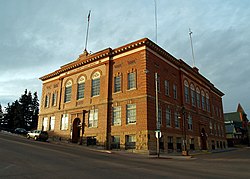
| Teller County Court House in Cripple Creek | |
| Location within the U.S. state of Colorado | |
| Coordinates: 38°53′N105°09′W / 38.88°N 105.15°W | |
| Country | |
| State | |
| Founded | March 23, 1899 |
| Named after | Henry M. Teller |
| Seat | Cripple Creek |
| Largest city | Woodland Park |
| Area | |
• Total | 559 sq mi (1,450 km2) |
| • Land | 557 sq mi (1,440 km2) |
| • Water | 1.9 sq mi (4.9 km2) 0.3% |
| Population (2020) | |
• Total | 24,710 |
• Estimate (2024) | 24,862 |
| • Density | 44.4/sq mi (17.1/km2) |
| Time zone | UTC−7 (Mountain) |
| • Summer (DST) | UTC−6 (MDT) |
| Congressional district | 7th |
| Website | www |
Teller County is a county located in the U.S. state of Colorado. As of the 2020 census, the population was 24,710. [1] The county seat is Cripple Creek, [2] and the most populous city is Woodland Park. Teller County is included in the Colorado Springs metropolitan area.
A few years after gold was discovered in Cripple Creek, political differences between area miners and mine owners, many of whom lived in Colorado Springs, resulted in the division of El Paso County. [3] Created in 1899, Teller County was carved from the western slope of Pikes Peak, and was named after United States Senator Henry M. Teller. Within five years of its formation, Teller County became the scene of a dramatic labor struggle called the Colorado Labor Wars.
According to the U.S. Census Bureau, the county has a total area of 559 square miles (1,450 km2), of which 557 square miles (1,440 km2) is land and 1.9 square miles (4.9 km2) (0.3%) is water. [4]
| Census | Pop. | Note | %± |
|---|---|---|---|
| 1900 | 29,002 | — | |
| 1910 | 14,351 | −50.5% | |
| 1920 | 6,696 | −53.3% | |
| 1930 | 4,141 | −38.2% | |
| 1940 | 6,463 | 56.1% | |
| 1950 | 2,754 | −57.4% | |
| 1960 | 2,495 | −9.4% | |
| 1970 | 3,316 | 32.9% | |
| 1980 | 8,034 | 142.3% | |
| 1990 | 12,468 | 55.2% | |
| 2000 | 20,555 | 64.9% | |
| 2010 | 23,350 | 13.6% | |
| 2020 | 24,710 | 5.8% | |
| 2024 (est.) | 24,862 | [5] | 0.6% |
| U.S. Decennial Census [6] 1790-1960 [7] 1900-1990 [8] 1990-2000 [9] 2010-2020 [1] | |||
As of the 2020 census, the county had a population of 24,710. Of the residents, 16.9% were under the age of 18 and 24.3% were 65 years of age or older; the median age was 51.6 years. For every 100 females there were 102.7 males, and for every 100 females age 18 and over there were 101.5 males. 39.9% of residents lived in urban areas and 60.1% lived in rural areas. [10] [11] [12]
The racial makeup of the county was 87.3% White, 0.5% Black or African American, 0.7% American Indian and Alaska Native, 0.9% Asian, 0.0% Native Hawaiian and Pacific Islander, 1.6% from some other race, and 8.9% from two or more races. Hispanic or Latino residents of any race comprised 6.9% of the population. [12]
There were 10,621 households in the county, of which 22.0% had children under the age of 18 living with them and 18.9% had a female householder with no spouse or partner present. About 24.6% of all households were made up of individuals and 10.8% had someone living alone who was 65 years of age or older. [11]
There were 13,316 housing units, of which 20.2% were vacant. Among occupied housing units, 82.2% were owner-occupied and 17.8% were renter-occupied. The homeowner vacancy rate was 1.9% and the rental vacancy rate was 8.4%. [11]
At the 2000 census there were 20,555 people in 7,993 households, including 5,922 families, in the county. The population density was 37 people per square mile (14 people/km2). There were 10,362 housing units at an average density of 19 units per square mile (7.3 units/km2). The racial makeup of the county was 94.92% White, 0.55% Black or African American, 0.97% Native American, 0.58% Asian, 0.08% Pacific Islander, 0.90% from other races, and 2.00% from two or more races. 3.49% of the population were Hispanic or Latino of any race. [13] Of the 7,993 households 33.60% had children under the age of 18 living with them, 64.20% were married couples living together, 6.60% had a female householder with no husband present, and 25.90% were non-families. 19.60% of households were one person and 4.00% were one person aged 65 or older. The average household size was 2.56 and the average family size was 2.94.
The age distribution was 25.90% under the age of 18, 5.60% from 18 to 24, 31.20% from 25 to 44, 29.80% from 45 to 64, and 7.50% 65 or older. The median age was 39 years. For every 100 females there were 102.70 males. For every 100 females age 18 and over, there were 100.90 males.
The median income for a household in the county was $50,165, and the median family income was $57,071. Males had a median income of $37,194 versus $26,934 for females. The per capita income for the county was $23,412. About 3.40% of families and 5.40% of the population were below the poverty line, including 6.90% of those under age 18 and 4.20% of those age 65 or over.
Teller County is solidly Republican. The last time the county voted for the Democratic nominee for president was in 1964, in Lyndon B. Johnson's landslide win.
| Year | Republican | Democratic | Third party(ies) | |||
|---|---|---|---|---|---|---|
| № | % | № | % | № | % | |
| 1900 | 4,738 | 32.51% | 9,659 | 66.27% | 178 | 1.22% |
| 1904 | 5,595 | 55.51% | 4,398 | 43.63% | 87 | 0.86% |
| 1908 | 3,014 | 40.45% | 4,192 | 56.26% | 245 | 3.29% |
| 1912 | 676 | 11.64% | 3,027 | 52.11% | 2,106 | 36.25% |
| 1916 | 1,693 | 31.00% | 3,515 | 64.37% | 253 | 4.63% |
| 1920 | 1,552 | 57.89% | 1,010 | 37.67% | 119 | 4.44% |
| 1924 | 1,283 | 48.78% | 592 | 22.51% | 755 | 28.71% |
| 1928 | 1,184 | 52.04% | 1,037 | 45.58% | 54 | 2.37% |
| 1932 | 752 | 30.21% | 1,534 | 61.63% | 203 | 8.16% |
| 1936 | 940 | 27.91% | 2,349 | 69.74% | 79 | 2.35% |
| 1940 | 1,268 | 37.60% | 2,084 | 61.80% | 20 | 0.59% |
| 1944 | 829 | 50.24% | 808 | 48.97% | 13 | 0.79% |
| 1948 | 748 | 48.35% | 779 | 50.36% | 20 | 1.29% |
| 1952 | 1,042 | 63.89% | 572 | 35.07% | 17 | 1.04% |
| 1956 | 977 | 66.42% | 494 | 33.58% | 0 | 0.00% |
| 1960 | 723 | 53.60% | 622 | 46.11% | 4 | 0.30% |
| 1964 | 577 | 45.65% | 685 | 54.19% | 2 | 0.16% |
| 1968 | 722 | 52.39% | 403 | 29.25% | 253 | 18.36% |
| 1972 | 1,440 | 70.45% | 535 | 26.17% | 69 | 3.38% |
| 1976 | 1,410 | 55.93% | 986 | 39.11% | 125 | 4.96% |
| 1980 | 2,457 | 66.28% | 802 | 21.63% | 448 | 12.09% |
| 1984 | 3,460 | 75.84% | 1,043 | 22.86% | 59 | 1.29% |
| 1988 | 3,760 | 68.36% | 1,656 | 30.11% | 84 | 1.53% |
| 1992 | 3,050 | 44.11% | 1,873 | 27.09% | 1,991 | 28.80% |
| 1996 | 4,458 | 57.93% | 2,312 | 30.05% | 925 | 12.02% |
| 2000 | 6,477 | 65.78% | 2,750 | 27.93% | 620 | 6.30% |
| 2004 | 8,094 | 68.35% | 3,556 | 30.03% | 192 | 1.62% |
| 2008 | 8,146 | 63.12% | 4,513 | 34.97% | 247 | 1.91% |
| 2012 | 8,702 | 64.59% | 4,333 | 32.16% | 438 | 3.25% |
| 2016 | 9,745 | 67.47% | 3,603 | 24.94% | 1,096 | 7.59% |
| 2020 | 11,241 | 66.36% | 5,278 | 31.16% | 420 | 2.48% |
| 2024 | 10,856 | 66.45% | 5,065 | 31.00% | 417 | 2.55% |
There are two school districts covering sections of the county: Cripple Creek-Victor School District RE-1 and Woodland Park School District RE-2. [15]