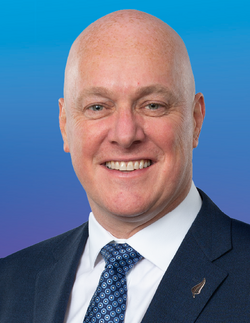
Christopher Mark Luxon (born 19 July 1970) is a New Zealand politician and businessman who has served as the 42nd prime minister of New Zealand since 2023. A member of the National Party, he has been member of Parliament (MP) for Botany since 2020 and previously served as leader of the Opposition from 2021 to 2023. Prior to entering politics, he was the chief executive officer (CEO) of Air New Zealand from 2013 to 2019.
Luxon grew up in Howick in East Auckland before studying commerce at the University of Canterbury. He joined Unilever in 1993 and held senior roles at Unilever Canada, becoming president and CEO of the subsidiary in 2008. In 2011, he left Unilever Canada and joined Air New Zealand as group general manager and became CEO in 2013. After stepping down as CEO of Air New Zealand in 2019, Luxon won the pre-selection for the safe National Party seat of Botany in East Auckland. He won the National Party leadership unopposed on 30 November 2021, eight months after giving his maiden speech, after the ousting of his predecessor. Luxon led his party to a plurality of seats at the 2023 general election. Luxon signed a coalition deal with ACT New Zealand and New Zealand First to form a majority, and was sworn in as prime minister on 27 November 2023.
Under Luxon's premiership, the Sixth National Government of New Zealand has shrunk New Zealand's civil service and attempted to boost the economy through international tourism. The government introduced cuts to healthcare expenditure, reintroduced the three-strikes sentencing law and a pilot military-style boot camp for youth offenders, and enacted NZ$14.7 billion in tax cuts. The government replaced the Three Waters reform programme with the Local Water Done Well policy, and minimised co-governance initiatives while discouraging the use of the Māori language alongside the English language in the public service. His government has contributed to the construction of the City Rail Link metro system in Central Auckland, and agreed to support the controversial Treaty Principles Bill to its first reading. In foreign policy, his government has increased military spending and Five Eyes cooperation in a general pro-United States shift. Luxon's coalition dynamics with his deputy prime ministers Winston Peters and David Seymour have proved controversial, given they have openly challenged his authority.[1][2]
Early life
Christopher Mark Luxon[3] was born in Christchurch on 19 July 1970,[4] to a Roman Catholic family of Irish, Scottish and English descent.[5] His father, Graham Luxon, worked for Johnson & Johnson as a sales executive. His mother, Kathleen Luxon (née Turnbull), was a receptionist but subsequently enrolled in a Diploma of Social Work the same year that Chris started at university. She eventually worked as a psychotherapist and counsellor.[6][5]
He always wanted to be a businessman and said: "If you met me at 12 years old I'd be having window washing rounds, lawn mowing rounds and deck painting. I just loved it."[11] During his high school and university years, Luxon worked part-time at McDonald's and as a porter at the Parkroyal Hotel.[12]
Business career
Unilever
Luxon worked for Unilever from 1993 to 2011, starting in Wellington as a management trainee for two years, leaving for Sydney in 1995. He worked his way up in the company, working in Sydney until 2000, in London from 2000 to 2003, and then Chicago from 2003 to 2008, becoming "Global Deodorants and Grooming Category" Director.[13] In 2008 when Unilever restructured, he became president of the company's Canadian operations, based in Toronto.[12][14] Altogether, he worked overseas for 16 years before returning to New Zealand.[15]
Air New Zealand
Luxon joined Air New Zealand as group general manager in May 2011 and was named the chief executive officer on 19 June 2012, taking up the role at the end of that year.[4][16] During his eight-year leadership, Air New Zealand profits grew to record levels. Important contributors to this were a booming tourism market; the company's decision to stop operating under-performing regional routes; and the cutting of hundreds of jobs.[17] The company was named Australia's most trusted brand several times.[10]
In 2014, Luxon joined the board of Virgin Australia representing Air New Zealand, which was then a major shareholder.[18][19] In 2016, Air NZ decided it was no longer in its best interest to maintain a close connection with another airline so it sold its 25.9% stake in Virgin Australia. Luxon consequently left the Virgin board.[20][21][22]
Luxon resigned from Air NZ in 2019, and hinted at a possible career with the National Party.[23] He was encouraged in this by his close friend, former Prime Minister John Key, who said Luxon would be a "world class candidate" for the National Party.[24]
Personal wealth
As at March 2024, his net worth was estimated to be between NZ$21 million and NZ$30 million, which makes him the second-wealthiest leader of the National Party, after former Prime Minister John Key. He then owned seven properties, including a home in Remuera valued at NZ$7.68 million, and other assets collectively valued at over NZ$21 million.[25] In late 2024, Luxon stated, "Let's be clear, I'm wealthy," in response to questions about his property sales and financial position.[26]
After becoming prime minister, Luxon stayed in his own Wellington apartment and claimed a NZ$52,000 accommodation allowance, to which he said he was entitled. After public scrutiny began, he quickly changed his position, saying: "It's clear that the issue of my accommodation allowance is becoming a distraction" and "As such, I have decided today that I will no longer claim the allowance and will repay anything I have received since I became Prime Minister."[27]
Luxon sold three of his properties in 2024 with Stuff estimating he could have made up to $769,500 in profit.[28][29]
In November 2019, Luxon secured the National Party candidacy for the Botany electorate - which has always been won by National and was regarded as a safe seat for them[30] - after Jami-Lee Ross resigned from the Party.[31]
Amid a sweep of National seats lost to Labour in the 2020 general election, Luxon won Botany with 52% of the vote.[32][33][34] He was appointed as the spokesperson for local government, research, science, manufacturing and land information, as well as associate spokesperson for transport in the Shadow Cabinet of Judith Collins.[35] After Collins was removed as party leader on 25 November, Luxon was cited as a potential replacement.[36] On 30 November, after Bridges's withdrew from the National Party leadership election, Luxon was announced as the party's leader.[37]
As Leader of the Opposition, Luxon used public funding to pay for Māori language (te reo) lessons. He defended using taxpayer money to pay for his Māori language lessons, stating that "developing better skills in te reo was highly relevant to his role as Opposition leader and a potential Prime Minister.[38][39] Once he became Prime Minister, the National-led coalition government considered discontinuing incentive payments for public servants to learn the Māori language.[38]
Prime Minister (2023–present)
Premiership of Christopher Luxon 27 November 2023–present
In the 2023 general election,[40][41] Luxon retained his Botany electorate seat with 67% of the vote.[42] The National Party won 38.1% of the party vote and 48 seats –the most of any party but not enough to govern outright.[43]
Formation of coalition government
National required support from at least two other parties to form a government. They negotiated with ACT and New Zealand First for six weeks to produce New Zealand's first formal three-party coalition government.[44] The negotiations took until 24 November[45] and involved two separate coalition agreements –one between National and ACT,and one between National and New Zealand First –with each junior party formally committing to support the other's key priorities.[46] Luxon was sworn in as prime minister by Governor-General Dame Cindy Kiro on 27 November.[47][48]
Economic growth
On 18 February 2024 Luxon delivered his first State of the Nation address,in which he blamed the previous Labour Government for what he called the "precarious state of the economy". Luxon claimed that economic growth is the central theme of his government's agenda,that it is the solution to New Zealand's problems and key to improving living standards for all New Zealanders. He said his Government would restore the economy by cutting taxes (by $14.7 billion),[49][50] reducing public spending and "red tape".[51]
However,under his government,the economy entered a protracted recession,with per capita GDP falling 4.6% since September 2022 due to tight monetary policy combating inflation that peaked at 7.3%. Unemployment rose from 3.7% in June 2023 to 5.2% by late 2025 and would have been higher if thousands of workers had not moved to Australia.[52]
As part of reducing Government spending,Luxon's government began implementing significant cutbacks to New Zealand's public service in late 2023. Radio New Zealand reported in May 2025 that the coalition had cut 9,500 public sector jobs.[53] More than 240 government programmes have been scaled down or scrapped,particularly those initiated under the previous Labour government.[54] Luxon has consistently articulated the rationale for these cuts,amounting to about $6 billion,[55] and publicly defended the scale of job losses.[56] At Kāinga Ora,hundreds of staff were laid off,and plans to build 3,500 new homes were scrapped.[57]
Health sector
New Zealand's health system faced severe strains before the coalition government came to power,primarily from workforce shortages,financial mismanagement,and long wait times for many services. Core problems included a significant shortage in the number of GPs leading to a massive increase in visits to hospital emergency departments plus financial mismanagement. Health NZ posted a $722 million deficit in 2023,driven by vague savings plans and uncontrolled spending.[58]
In response,the government replaced the board of Health NZ with a commissioner to improve performance and accountability.[59] This was followed by multiple high-profile resignations,including the Director-General of Health,the Chief Executive of Health NZ,and the Director of Public Health.[60] In January 2025,Luxon announced that Simeon Brown would replace Shane Reti as Minister of Health.[61]
Despite these frequent changes in personnel,little progress has been made. Emergency departments have experienced increased wait times and staffing shortages.[62] GP shortages remain acute,with over 250,000 unregistered patients and productivity losses exceeding $1 billion annually,unchanged from pre-coalition levels. Efforts to recognize overseas qualifications and plans for a third medical school are targeted at additional recruitment,but so far have had little impact. Overcrowding in emergency department persists,due to the shortage of GPs and primary care. Concerns have even been raised about the sustainability of general practice.[63][64]
Luxon seems unconcerned about long waiting lists. He told Kerre Woodham on NewstalkZB that if he had an infection,he would rather see a nurse practitioner than a GP.[65]
$1 billion tax from cigarettes
Under the coalition agreement with ACT and NZ First,Luxon agreed to repeal New Zealand's world leading smoke-free legislation that would have made it illegal for anyone born in 2008 or later to legally purchase tobacco. The repeal will return around $1 billion in tax revenue per annum,[66][67] enabling the Government to implement other tax cuts –although Luxon claimed his government remained "deeply committed" to lowering smoking rates.[68] Researchers from the University of Otago warned that thousands of New Zealanders will die needlessly,and that the repeal "flies in the face of robust research evidence."[69] Chris Hipkins suggested the government is "firmly in the pocket of the tobacco industry."[70]
Law and order
Luxon’s government promised on a “tough on crime”agenda based on tougher sentencing,expanded police powers and targeted measures on gangs and youth offending. His government:
brought back the controversial three strikes regime,increasing mandatory sentencing for specified serious repeat offenders;[71]
brought back the boot‑camp model for serious and persistent young offenders,despite multiple studies,official data,and expert commentary spanning several decades which indicate that boot camps do not reduce reoffending.[72][73] 80% of the participants in the pilot re-offended within 12-months which is the same rate of youth re-offending without intervention.[74]
banned gang patches in public and made gang membership an aggravating factor in sentencing;[75]
announced an extra $1.9 billion for Corrections to expand prison capacity and hire around 700 more Corrections officers;[76]
committed to recruiting 500 additional frontline police officers by the end of 2025 (a target the Government has struggled to fully meet on time)[77]
stopped funding for section 27 cultural reports[78] which Chief Justice Heemi Taumaunu said "provided "the court valuable information about the defendant."[79]
provided $78 million to extend rehabilitation programs to prisoners on remand.[80]
As the prison population approached 11,000 in November 2025,Luxon publicly endorsed policies which lead to higher prisoner numbers as “a good thing”as it keeps offenders off the streets. He is also unconcerned about the economic impact saying:"The cost will be what the cost will be."[81]
He also defended the boot camp programme,saying:"I don't care what you say about whether it does or doesn't work. We can have that intellectual conversation all day long,but we are,dammit,going to try something different because we cannot carry on getting the results that we've been getting."[82]
Treaty Principles Bill
As part of the coalition agreement with David Seymour,Luxon agreed to support the Treaty Principles Bill at its first reading and send it to a select committee. Luxon made it clear that National would not support the bill beyond that stage or allow it to become law. He has emphasised that the bill does a disservice to the Treaty of Waitangi by oversimplifying 184 years of complex debate and discussion around the Treaty.[83] The bill sparked heated debate in Parliament with MPs describing it as "divisive" and a "wrecking ball" to Crown-Māori relations.[84]
Environmental issues
In early December 2023,Luxon along with Cyclone Recovery Minister Mark Mitchell and Transport and Local Government Minister Simeon Brown,visited Hawke's Bay to meet with local leaders and local National MPs Katie Nimon and Catherine Wedd to discuss government support for post-flood and Cyclone Gabrielle relief efforts in the region.[85][86] During the visit,Luxon confirmed that the Government would pause work on restoring the Napier-Wairoa railway line to focus on repairing State Highway 2.[86]
On 11 February 2024,Luxon and Emergency Management and Recovery Minister Mark Mitchell announced that the Government would contribute NZ$63 million to aid the removal of sediment and debris caused by Cyclone Gabrielle in the Hawke's Bay and Gisborne District.[87]
During Local Government New Zealand's annual conference held on 21 August 2024,Luxon called on local and regional councils to focus on rubbish collection,water infrastructure and other local assets. He also criticised so-called "nice to have projects" such as the Tākina convention centre. Luxon also confirmed that Cabinet had agreed to revise the Local Government Act and scrap the four wellbeing provisions in that legislation.[90]
In early August 2024,Luxon and Education MinisterErica Stanford announced plans to introduce a new mathematics curriculum from early 2025 with a focus on raising student standards and achievement.[92] In response,the New Zealand Educational Institute expressed concerns that rapid changes to the maths and literacy curriculum and the short teaching training timeframe would strain the teaching workforce without delivering on its goals.[93]
On 10 November 2024,Luxon delivered the New Zealand Government's national apology to survivors of abuse in state and faith-based care at Parliament,stating "it was horrific. It was heartbreaking. It was wrong. And it should never have happened.."[95] Luxon also announced that the Government was introducing legislation to combat abuse in care including banning strip searches on children and strengthening security checks for people working with children.[96]
Social welfare
In August 2022,Luxon warned young unemployed people their "free ride" under Labour would come to an end if he won the 2023 election,saying:"To young people who don't want to work you might have a free ride under Labour,but under National,it ends". He further stated National would make sweeping cuts to the Ministry of Social Development in favour of privatised employment agencies and "not keep funding failure".[97]
In August 2024,Luxon and Louise Upston,announced a "traffic light" regime for welfare was introduced,setting out escalating consequences for beneficiaries who fail to meet job-seeking or other obligations. From early 2025,jobseeker beneficiaries are required to reapply for their benefit every six months,instead of annually,and a new community work sanction was introduced requiring beneficiaries to "build skills and confidence."[98] When interviewed shortly afterwards on TVNZ and then on RNZ's Morning Report,Luxon was unable to answer questions about how much beneficiaries actually receive.[99]
In October 2025,Luxon and Upston confirmed that the Government would tighten welfare eligibility criteria for 18 and 19-year old teenagers;with those having parents earning over NZ$65,000 being ineligible for Jobseeker and other emergency benefits from November 2026. 18 and 19 year olds,with dependent children,or who were estranged from their parents would still be eligible for welfare assistance. He said:
We're here to help and support as much as we can, but you also have to take responsibility for that and actually just consigning you to a life of welfare for 18 years is unacceptable.[100]
Foreign affairs
Luxon with American president Donald Trump in Gyeongju, 29 October 2025Luxon with British prime minister Keir Starmer in London, 22 April 2025
Since becoming prime minister, Luxon has made overseas trips to Australia, the Pacific, south east Asia, Japan, the United States where he also met Chinese leaders. Details of these trips are described here:
According to The Economist and Foreign Policy magazine, New Zealand foreign policy under the National-led coalition government had shifted away from China in favour of closer relations with its traditional Five Eyes partners, the United States, United Kingdom, Australia and Canada.[101] During an interview with The Economist, Luxon said that he was looking to "diversify New Zealand's diplomatic and trade relationships away from its reliance on China." The magazine described this shift as New Zealand's biggest pivot since the ANZUS dispute in 1986 that was triggered by New Zealand's nuclear-free policy.[102][101]
Luxon with Japanese prime minister Fumio Kishida, 19 June 2024
In late August 2024, Luxon expressed support for Taiwan's participation in the Pacific Islands Forum in response to Chinese plans to lobby for member states to exclude Taiwan from attending the Forum's 2025 event.[104]
Defence spending
In April 2025, Luxon announced the Government will allocate $12 billion into defence spending over the next four years. Luxon said it was time New Zealand "pulls its weight" internationally. This will bring New Zealand's spending on defence up to 2% of its GDP, up from 1%.[105] The Child Poverty Action Group pointed out that the $12 billion allocated for defence matches the Treasury's estimate needed to halve child poverty by 2028. The group notes the auditor-general's criticism of Luxon's government for its lack of a coherent plan to address rising child poverty, underscoring public concerns about resource allocation between defence and social welfare.[106][107]
Australia
On 20 December 2023, Luxon made his first state visit as head of government to Sydney where he met Australian prime ministerAnthony Albanese. During his visit, Luxon affirmed New Zealand's nuclear-free policy but expressed openness to joining the non-nuclear pillar of the AUKUS agreement, but also stated that New Zealand was keen to do its share of "heavy lifting" in the Australia–New Zealand defence relationship. Luxon and Albanese also talked about the contribution of New Zealander Australians to Australia.[108]
Luxon has consistently expressed strong opposition to Australia's 501 deportation policy, particularly when it results in people with minimal ties to New Zealand being deported. He has repeatedly called the policy "regrettable" and "not right." He has expressed disappointment that Australia reversed its previous, more lenient approach, which took into account the length of time someone had lived in Australia and their family connections before deporting them.[112] He has stated, "It's just not right that people who have no connection to New Zealand are deported to New Zealand."[113]
Following his discussions with Albanese, Luxon said: "We respect the fact that Australia has its own policies around deportation," but hoped that common sense would prevail.[108]
Coalition dynamics
Luxon's leadership and ability to govern effectively have been challenged by the roles and actions of his coalition partners, David Seymour (ACT) and Winston Peters (NZ First). A recurring concern is his perceived lack of control over his coalition partners.[1] A poll in April 2024 found that 51% of respondents say Luxon is the decision maker in government.[2]
David Seymour has openly challenged Luxon's authority, particularly around contentious issues like the Treaty Principles Bill. Seymour's public skepticism about Luxon's commitments and his willingness to contradict the prime minister in public have reinforced perceptions of Luxon's weak leadership.[114] Seymour even asserts that Luxon cannot unilaterally sack ACT ministers which highlights the limits of Luxon's executive power within the coalition.[2]
On the other hand, Winston Peters is seen as an unpredictable and influential force, who has not hesitated to critique government policy or his own coalition's fiscal plans. In March 2024, he undercut finance minister Nicola Willis by claiming a $5.6b fiscal hole would result from her intended tax cuts.[115]
Communication style
Luxon's background as a corporate executive is often cited as influencing his communication style, sometimes to his detriment. He has been criticised for using business jargon – such as referring to voters as "customers"- and for appearing out of touch with ordinary New Zealanders.[116][117] Janet Wilson, former chief press secretary for the National Party said he memorises talking points and sounds like a 'talking robot'.[118]
Luxon has also been repeatedly criticised for avoiding direct answers to straightforward questions, particularly in high-profile media interviews. A notable example occurred during the Andrew Bayly resignation saga, where Luxon was pressed multiple times by Mike Hosking to state whether he would have sacked Bayly if he had not resigned. Luxon sidestepped the question for several minutes, eventually conceding that he would have "demoted" Bayly and that "you can call it sacked" – a performance that was widely described as evasive.[119]
Luxon's approach to coalition management and controversial legislation has also drawn criticism for being diffident and weak. His handling of the ACT Party's Treaty Principles Bill – supporting its introduction, but pledging to vote against it later – has been seen by some as lacking conviction and clarity, further reinforcing perceptions of indecisiveness. Luxon claimed that allowing the Treaty Principles Bill a first reading was "worth it to form government".[120]
Public opinion
In April 2024, a 1News-Verianpoll was released, showing the National-ACT-New Zealand First coalition government convincingly behind the left bloc of Labour, the Green Party and Te Pāti Māori. It also cast doubt on the strength of Luxon's leadership compared to that of his coalition partners Winston Peters and David Seymour, with 51% of respondents believing Luxon was the decision-maker in the government.[121]
A subsequent poll by Talbot Mills suggested a Labour-led government would have a bare majority of 62 seats, while Roy Morgan found 54% of those they surveyed believed New Zealand was heading in "the wrong direction", with just 35% believing it was in the right direction.[122][123][124] In June, a poll showed Luxon fall behind opposition leader Chris Hipkins in net favourability for the first time.[125]
Opinion polls show that Luxon's lack of popularity has deepened over his first 18 months in office. His net favourability is notably lower than previous first-term Prime Ministers such as Helen Clark, John Key, and Jacinda Ardern. Max Rashbrooke, senior research associate at the Institute for Governance and Policy Studies at Victoria University of Wellington, says a common criticism is "Luxon's inability to articulate what he stands for" or what he is trying to achieve for the country.[1] Six months later, in October 2025, The Post/Freshwater Strategy poll found that 27% of voters view Luxon positively, while 51% have an unfavourable view.[126]
Political positions
My faith is personal to me. It is not in itself a political agenda. I believe no religion should dictate to the State, and no politician should use the political platform they have to force their beliefs on others. As MPs, we serve the common cause of all New Zealanders—not one religion, not one group, not one interest. A person should not be elected because of their faith, nor should they be rejected because of it.
In November 2019, Luxon said he was against abortion, euthanasia, and legalising recreational cannabis, though at the same time he supported medicinal use of cannabis.[137][138] He also at the time supported a "no jab, no pay" policy for sanctioning welfare beneficiaries who did not vaccinate their children;[139] however, following his election as leader of the National Party, Luxon said he did not support cutting the benefits of parents who do not vaccinate their children against COVID-19.[140] Luxon has also firmly stood against efforts to reform New Zealand's water system.
Abortion
Luxon's views on abortion received media attention following his election as National's leader. He confirmed that his personal views are anti-abortion, but said National will not contest the Abortion Legislation Act 2020 should he become prime minister.[141] After previously declining to answer when asked if he believes abortion to be tantamount to murder,[142] he said in an interview with Newshub that he is "a pro-life person," and when asked again about the murder comparison, he responded "that's what a pro-life position is."[143][144]
Gaza war
In response to the Gaza war, Luxon stated that he was shocked and saddened by Hamas's October 7 attacks against Israel. Luxon condemned Hamas' attacks and stated that Israel had a right to defend itself.[145]
He later committed New Zealand to active military support, saying "I want us to be in lockstep with our partners who have common interests and actually be right there with them at that time."[146] In January 2024, he authorised deployment of 6 NZDF personnel to support military action against Houthi forces in the Red Sea, saying "it's about us standing up for things that we believe in, and we can either talk about them or we can actually do something about it as well and make sure that we put real capability alongside our words".[146]
On 30 January 2024, Luxon announced that New Zealand would be suspending its annual NZ$1 million aid to UNRWA (the United Nations Relief and Works Agency for Palestinian Refugees in the Near East) following allegations that several UNRWA workers had participated in the October 7 attacks.[147] His announcement followed a decision by the Ministry of Foreign Affairs and Trade to review New Zealand's aid to UNRWA.[148] On 29 February 2024, Luxon announced New Zealand's designation of Hamas in its entirety as a terrorist entity.[149]
As the war on Gaza unfolded, Luxon's position changed. On 2 December 2024, Luxon confirmed that New Zealand would comply with an International Criminal Court (ICC) arrest warrant in the event that Israeli Prime MinisterBenjamin Netanyahu visited New Zealand. During a press conference, he stated, "We believe in the international rules-based system, we support the ICC, and we would be obligated to do so."[150] In June 2025, he described New Zealand's sanctions on Israeli ministers Bezalel Smotrich and Itamar Ben-Gvir as "entirely appropriate".[151]
On 9 August 2025, Luxon and Australian Prime Minister Anthony Albanese called for a ceasefire in Gaza and opposed Israeli plans to occupy Gaza City.[152] On 13 August 2025, Luxon made remarks in Parliament criticising Israel's conduct during the Gaza war, describing it as "utterly, utterly appalling." He also said that "I think Netanyahu has gone way too far. I think he has lost the plot."[153]
Although Luxon frequently criticised the Labour Government's strategy for managing the COVID-19 pandemic, on 8 January 2022, he stated that the National Party strongly supports COVID-19 vaccination, and described vaccination as the best protection for people and their families.[160]
Defence and security
In response to US president Donald Trump's announcement during the 2025 APEC Summit that the United States would resume nuclear testing, Luxon expressed disapproval of US plans to resume nuclear testing and reiterated his commitment to New Zealand's nuclear-free policy.[161]
Extending parliamentary term
On 20 September 2024, Luxon said that the coalition government was open to holding a referendum to extend the parliamentary term from three to four years at the 2026 general election.[162] On 27 February 2025, the government introduced the Term of Parliament (Enabling 4-year Term) Legislation Amendment Bill to conduct a referendum.[163]
Immigration
On 3 May 2023, Luxon acknowledged the historical sensitivity around the dawn raids of the 1970s which disproportionately targeted Pasifika New Zealanders. However, he stated that Immigration New Zealand needed to "reserve the option" to use police raids against individuals involved in serious criminal offending or who posed a security risk to New Zealand. Luxon also stated there were 14,000 overstayers in New Zealand. Luxon's remarks came in response to media coverage of the agency's recent dawn raid tactics against visa overstayers, which had attracted criticism from Deputy Prime Minister Carmel Sepuloni for re-traumatising the Pasifika community.[164]
On 11 December 2023, Luxon stated that New Zealand's 118,000 annual net migration rate was unsustainable and that infrastructure needed to be managed better to support growth. Luxon made these remarks after the Australian Government announced a new migration strategy to address pressure on housing and infrastructure in Australia.[165]
Māori issues
In late January 2023, Luxon stated that National opposed co-governance in the delivery of public services such as health, education and critical infrastructure. Nevertheless, he expressed support for "self-driven" initiatives within the Māori community such as Whānau Ora, kohanga reo and charter schools.[166][167] On 25 January, Luxon stated that the existence of Māori seats "doesn't make a lot of sense."[168][169]
During Waitangi Day on 6 February 2023, Luxon described the Treaty of Waitangi as a "challenging, imperfect but ultimately inspiring document through which New Zealand had sought to understand what was intended by those who signed it." While acknowledging that the New Zealand Crown had not upheld the Treaty's promises and obligations, he expressed hope that the Treaty settlement process would be completed by 2030.[170]
During a Question Time in Parliament on 20 August 2024, Luxon said that he believed that Māori ceded sovereignty to the New Zealand Crown by signing the Treaty of Waitangi. When questioned by Green co-leader Chlöe Swarbrick, Luxon reiterated that the Treaty was New Zealand's founding document and said that it had protected both Māori and Crown interests.
On 19 December 2024, Luxon confirmed that he would not be attending events at the Waitangi Treaty Grounds on 4 February 2025, stating that it was his intention to celebrate Waitangi Day around New Zealand with different iwi. National Waitangi Trust chairperson Pita Tipene expressed disappointment with Luxon's decision while Labour leader Chris Hipkins said that Luxon was "running away from problems of his own creation."[171]
Monarchy
Luxon has described himself as a "soft republican" and believes that New Zealand will "ultimately" become a republic, but that the change would not happen "in my Government and in my time."[172]
School meals
On 1 March 2025, Luxon said that the school lunch programme was experiencing "teething issues" in response to quality and delivery issues with the Government's new school lunch programme. He added that Associate Education Minister Seymour "will work his way through those issues... and I expect he will [find a solution]."[173] On 4 March, Luxon stated during a press conference that parents who were dissatisfied with the school lunch programme should "make a marmite sandwich and put an apple in a bag".[174] Luxon's remarks drew criticism from Hora Hora School principal and Tai Tokerau Principals' Association spokesman Pat Newman, Child Poverty Action Group executive officer Sarita Divis, East Otago High School principal Helen Newcombe, who argued that school lunches were needed to improve the health and educational outcomes of students and combat child poverty.[175][176] In response to criticism, Luxon defended his remarks and reiterated the Government's commitment to addressing problems with the school lunch programme.[177]
Sex education
While Luxon regards sex education as important to the school curriculum, in February 2024 he stated that it should be age appropriate and that parents should be able to withdraw their children from sex education classes if they choose.[178]
Luxon met his wife Amanda at a church youth group[7] and they married on 8 January 1994[182] when he was 23.[183] They have a son and daughter. The couple share the same faith, saying "it quietly guides what they care about".[184]
In late July 2022, Luxon confirmed he was on a family holiday in Hawaii during the parliamentary recess when a Facebook video post published on 21 July implied he was visiting Te Puke at that time. Luxon attributed the confusion to a delay in his social media team updating his whereabouts over the previous week, which he said was a mistake.[185][186]
Luxon had a Catholic upbringing,[183] but describes himself as a non-denominational Christian.[187] After he returned to New Zealand in 2011 he attended the Upper Room church in Auckland. He now does not go to a regular church, adding that he doesn't even go to church every Sunday.[183] In his maiden speech in Parliament, he said “My faith is personal to me. It is not in itself a political agenda.” [188]
Luxon has said that he has never drunk alcohol in his life. He made that decision at the age of about seven or eight and has cited his grandfather's drinking problems as his reason.[189]
Luxon has a long-standing friendship with former Prime Minister John Key and used to ask Key questions about the pros and cons of being a prime minister.[196] In an interview with podcaster Dom Harvey, Luxon said the friendship includes their wives. The four of them spend quite a bit of time together and try to catch up every weekend. Luxon said they were mates long before he went into politics and described his friendship with Key as a "really special relationship... and that as Prime Minister, its really special to have one of your mates who was Prime Minister as well." However, he says that when they talk, they're "mates first, and politics is second."[197]
In 2017, while Luxon was chief executive at Air New Zealand, John Key was appointed as an Air New Zealand director. They both resigned from Air New Zealand in 2019.[198]
Awards
In 2015, Luxon was named the Deloitte Top 200 CEO of the Year for his leadership at Air New Zealand.[199]
In 2019, Luxon won a BLAKE Award for his sustainability initiatives at Air New Zealand.[200]
123Luxon, Christopher; Mallard, Trevor: Maiden Statements CHRISTOPHER LUXON (National—Botany), New Zealand Parliament Hansard, Wellington, 24 March 2021
↑Cooke, Henry (5 November 2019). "Christopher Luxon backs no-jab-no-pay further than the National Party". Stuff. Archived from the original on 10 November 2019. Retrieved 10 August 2020. He was asked by RNZ's Susie Ferguson whether he supported the policy of withdrawing sole parent support benefits for parents that don't vaccinate their children – currently just a 'proposal' by National, not an actual policy. Luxon said he supported the idea, and even indicated some support for it extending to Working For Families benefits.
This page is based on this Wikipedia article Text is available under the CC BY-SA 4.0 license; additional terms may apply. Images, videos and audio are available under their respective licenses.