This article is about the general history of Egypt from prehistoric times to the present. For the history of Egypt before recorded history, see Prehistoric Egypt. For the history of Egypt from 3150 BC to 30 BC, see History of ancient Egypt. For the history of Egypt from 640 AD to 1517 AD, see Egypt in the Middle Ages. For the history of Egypt from 1517 to present day, see History of modern Egypt.
The history of Egypt spans several millennia. Egypt, one of the oldest civilizations in human history, is considered the longest-lasting continuous civilization in human history.[1] In general, Egypt has the longest continuous history of a country in the world, dating back to more than 7000 BC.[2][3]
Prehistoric Egypt's history goes back to the vast stretch of time from the first human occupation of the Nile Valley culminating the rise of the first Egyptian civilization. In the 4th millennium BC, King Narmerunified Egypt, and Memphis was declared the capital city of Egypt.[4] The Egyptians established a great civilization centered around the Nile River, maintaining an enduring culture, a strong religious system, and a solid political structure.[5][6] The Egyptian civilization became famous for its Pharaohs, its Great Pyramids, and its advancements in science, engineering, industry, medicine, arts, literature, and its enduring legacy.[7] Egyptians provided humanity the principles of Maat, the moral and cosmic constitution by which the ancient Egyptian citizens lived,[8] representing concepts of right, justice, and cosmic order.[9][10]Ancient Egypt is considered the first nation to possess one of the earliest professional, standing armies in human history and is known for having one of the oldest and most effective military traditions in the world. The Egyptian military fought numerous battles throughout history to secure their borders in the Nile Valley, and the Levant.[11][12] Alongside Egypt's rise as a dominant empire for thousands of years, other rising civilizations emerged after it, becoming new empires one after another.[13][14]
In the Middle Ages, Egypt experienced a renaissance as a pivotal center of the Islamic world. With the founding of Cairo, which became the Egyptian capital, the city flourished, witnessing the construction of Al-Azhar Mosque and its university, one of the oldest universities in the world.[15] This era was characterized by rapid progress and the rule of prominent military dynasties.[16] During this period, Medieval Egypt thrived as a trading power linking the Mediterranean Sea to the Indian Ocean, maintaining its leading role and regional influence.[17] It was also a beacon of knowledge in the Islamic world. In the Modern era, Egypt has witnessed steady progress, undergoing a multifaceted cultural and political renaissance that began in this era and continues in various forms to this day.[18] This period has focused on integrating ancient Egyptian heritage with modernity, strengthening national identity, and engaging with the world, particularly through the arts, literature, and large-scale projects.[19][20]Modern Egypt also experienced an industrial and military renaissance during this time, maintaining its pivotal role in Africa and the Islamic world.[21] Egypt has maintained its historic borders to this day, engaging in numerous conflicts from antiquity through the modern era, primarily to secure borders,[22] and maintained a strong standing army with a high success rate across many different historical periods.[23][24]
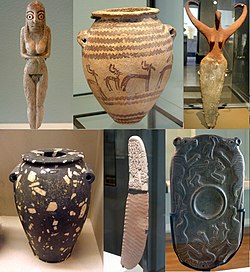
Artifacts of Egypt from the prehistoric period, from 4400 to 3100 BC. First row from top left: a Badarian ivory figurine, a Naqada II jar, a Bat figurine. Second row: a diorite vase, a flint knife, a cosmetic palette.
By about 6000 BC, a Neolithic culture had taken root in the Nile Valley.[29] During the Neolithic era, several predynastic cultures developed independently in Upper and Lower Egypt. The Badari culture and the successor Naqada series are generally regarded as precursors to dynastic Egypt. The earliest known Lower Egyptian site, Merimde, predates the Badarian by about seven hundred years. Contemporaneous Lower Egyptian communities coexisted with their southern counterparts for more than two thousand years, remaining culturally distinct, but maintaining frequent contact through trade. The earliest known evidence of Egyptian hieroglyphic inscriptions appeared during the predynastic period on Naqada III pottery vessels, dated to about 3200 BC.[30]
In Upper Egypt, the predynastic Badari culture was followed by the Naqada culture (Amratian),[31] being closely related to the Lower Nubian;[32][33][34][35] other northeast African populations,[36] with some affinities with other coastal communities from the Maghreb,[37][38] some tropical African groups,[39] and possibly inhabitants of the Middle East.[40] Upper Egypt is considered to have formed the pre-dominant basis for the cultural development of Pharaonic Egypt and the Proto-dynastic kings emerged from the Naqada region.[41][42]
Historical scholarship has generally regarded the peopling of the Egyptian Nile Valley from archaeological and biological data, to be the result of interaction between coastal northern Africans, "neolithic" Saharans, Nilotic hunters, and riverine proto-Nubians with some influence and migration from the Levant (Hassan, 1988).[43][44]
As of 2025, the earliest full-genome analysis of an ancient Egyptian is that of Old Kingdom individual (NUE001) (2855–2570 BCE), with implications for the genetic makeup of Early Dynastic Egyptians in general: the study shows that the genetic profile of this individual was most closely represented by a two-source model, in which 77.6% ± 3.8% of the ancestry corresponded to genomes from the Middle Neolithic Moroccan site of Skhirat-Rouazi (SKH, dated to 4780–4230 BCE), itself consisting of predominantly Levant Neolithic ancestry (76.4 ± 4.0%) and minor Iberomaurusian ancestry (22.4 ± 3.8%), with the remaining (22.4% ± 3.8%) most closely related to known genomes from Neolithic Mesopotamia (dated to 9000-8000 BCE).[45]
In 3150 BC onwards, Ancient Egypt was a dominant superpower for long periods of its three-thousand-year history.[46] As a wealthy and highly organized civilization with fortified borders, Egypt exerted significant political and cultural influence over the ancient world. The Old Kingdom (c. 2613–2181 BC), was known as the "Age of the Pyramids," featuring the construction of the Giza pyramids while the Middle Kingdom (c. 2055–1650 BC) was a period of reunification, economic growth, and artistic, literary expansion after a period of instability.[47] The City of Thebes became the capital of Egypt (c. 2040 BC) at the start of the Middle Kingdom and again in (c. 1550 BC) at the start of the New Kingdom. It served as the central political and religious hub, replacing Memphis during these major historical periods.
The Egyptians waged numerous wars and battles to defend their borders, most notably its campaigns against the Hyksos (c. 1550 BC), waging a successful war of liberation, capturing the Hyksos.[48] A victory that heralded the dawn of the New Kingdom and the zenith of Egyptian military power. This era witnessed the emergence of advanced weaponry such as the horse-drawn chariot. Egypt also fought the Battle of Megiddo (c. 1457 BC) which further expanded its influence.[49] However, the Battle of Kadesh (c. 1274 BC) remains the most famous battle of this period. It is considered one of the largest chariot battles in history, which led to Egyptian–Hittite peace treaty, the first recorded peace treaty in human history.[50][51] Egypt is considered the longest-lasting continuous empire in human history, and after its three-thousand-year dominance, other rising civilizations emerged, becoming one after another the new empire of the world.[52][53][54]
A unified kingdom was formed in 3150 BC by King Menes, leading to a series of dynasties that ruled Egypt for the next three millennia. Egyptian culture flourished during this long period and remained distinctively Egyptian in its religion, arts, language and customs.
The First Intermediate Period ushered in a time of political upheaval for about 150 years.[56] Stronger Nile floods and stabilization of government, however, brought back renewed prosperity for the country in the Middle Kingdom c. 2040 BC, reaching a peak during the reign of Pharaoh Amenemhat III. A second period of disunity heralded the arrival of the first foreign ruling dynasty in Egypt, that of the Semitic-speakingHyksos. The Hyksos migrants[56][57] took over much of Lower Egypt around 1650 BC and founded a new capital at Avaris. They were driven out by an Upper Egyptian force led by Ahmose I, who founded the Eighteenth Dynasty and relocated the capital from Memphis to Thebes.
New Kingdom, Third Intermediate Period and Late Period
The New Kingdom (c. 1550–1070 BC) began with the Eighteenth Dynasty, marking the rise of Egypt as an international power that expanded during its greatest extension to an empire from Syria to Upper Nubia. This period is noted for some of the most well known Pharaohs, including Hatshepsut, Thutmose III, Akhenaten and his wife Nefertiti, Tutankhamun and Ramesses II. The first historically attested expression of monotheism came during this period as Atenism, although some[who?] consider Atenism to be a form of monolatry rather than of monotheism. Frequent contacts with other nations brought new ideas to the New Kingdom. The country was later ruled and invaded by Libyans, Nubians and Assyrians, but native Egyptians eventually drove them out and regained control of their country.[58]
Achaemenid rule
Egyptian soldier of the Achaemenid army, c.470 BCE. Xerxes I tomb relief.
Following the Achaemenid Empire's short lived First Achaemenid conquest of Egypt in 525 BC, early resistance emerged, starting in the Dakhla Oasis, while the Egyptian Second Revolt (487–486 BC) was significant enough that an Egyptian rebel king ruled parts of Egypt.[60] Revolts continued and [61][62] in 404 BC, the Egyptians defeated the Achaemenids and succeeded in driving them out, and Egypt regained its independence, which it maintained for the beginning of the 5th century BC.
Egyptian independence
Amyrtaeus' successful rebellion ended the first Achaemenid rule and inaugurated Egypt's last significant phase of independence under native rulers. The Thirtieth Dynasty was the last native ruling dynasty during the Pharaonic epoch.[59] It fell to the Persians again in 343 BC after the last native Pharaoh, King Nectanebo II, was defeated in battle.[59]
Second Achaemenid conquest
In 339 BC, the Achaemenids defeated Egyptian rebels in the Second Achaemenid conquest of Egypt, a short lived occupation ended in 16 years, before the Macedonians with the help of Egyptian rebels expelled the Achaemenids in 323 BC, establishing the Ptolemaic Egypt in 305 BC. Alexandria was declared the new Egyptian capital. The Thirty-first Dynasty of Egypt, also known as the Second Egyptian Satrapy, was effectively a short-living province of the Achaemenid Empire between 343 BC to 332 BC.[63] After an interval of independence, during which three indigenous dynasties reigned (the 28th, 29th and 30th dynasty), Artaxerxes III (358–338 BC) reconquered the Nile valley for a brief second period (343–332 BC), which is called the Thirty-first Dynasty of Egypt, thus starting another period of pharaohs of Persian origin.[64]
A team led by Johannes Krause managed the first reliable sequencing of the genomes of 90 mummified individuals in 2017. Whilst not conclusive, because of the non-exhaustive time frame and restricted location that the mummies represent, their study nevertheless showed that these Ancient Egyptians "closely resembled ancient and modern Near Eastern populations, especially those in the Levant, and had almost no DNA from sub-Saharan Africa. What's more, the genetics of the mummies remained remarkably consistent even as different powers—including Nubians, Greeks, and Romans—conquered the empire".[65]
The Ptolemaic Kingdom was a powerful Hellenistic state extending from southern Syria in the east, to Cyrene to the west, and south to the frontier with Nubia. Alexandria became the capital city and a center of Greek culture and trade. To gain recognition by the native Egyptian populace, they named themselves as the successors to the Pharaohs. The later Ptolemies took on Egyptian traditions, had themselves portrayed on public monuments in Egyptian style and dress, and participated in Egyptian religious life.[66][67]
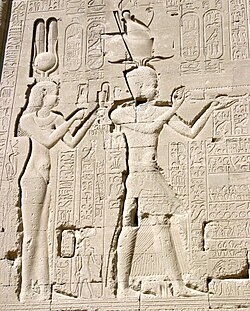
The last ruler from the Ptolemaic dynasty was Cleopatra VII, who committed suicide following the burial of her lover Mark Antony, who had died in her arms (from a self-inflicted stab wound) after Augustus had captured Alexandria and her mercenary forces had fled.
The Ptolemies faced rebellions of native Egyptians, often caused by an unwanted foreign rule, and were involved in foreign and civil wars that led to the decline of the kingdom and its annexation by Rome. The most significant was the Great Revolt (205–186 BC), which established an autonomous state ruled by native pharaohs in Upper Egypt. Egyptian leaders seized control of Thebes and much of Upper Egypt by 205 BC, severely weakening Ptolemaic control over Egypt. The Ptolemaic forces were defeated by the Roman Empire in the Battle of Actium (30 BC), marking the Conquest of Egypt. Nevertheless, Hellenistic culture continued to thrive in Egypt well after the Muslim conquest. The native Egyptian/Coptic culture continued to exist as well (the Coptic language itself was Egypt's most widely spoken language until at least the 10th century).
Egypt quickly became the Empire's breadbasket supplying the greater portion of the Empire's grain in addition to flax, papyrus, glass and many other finished goods. The city of Alexandria became a key trading outpost for the Roman Empire (by some accounts, the most important for a time). Shipping from Egypt regularly reached India and Ethiopia among other international destinations.[68] It was also a leading (perhaps the leading) scientific and technological center of the Empire. Scholars such as Ptolemy, Hypatia, and Heron broke new ground in astronomy, mathematics, and other disciplines. Culturally, the city of Alexandria at times rivaled Rome in its importance.[69]
Upper Egypt
Upper Egypt frequently operated with a degree of de facto independence due to its distance from Alexandria, its strong local priesthoods, and active resistance to Roman rule, like the Revolt of Thebes (c. 30–29 BC), which took place immediately following the war.[70][71] The region near the southern border maintained a unique position, acting as a bridge to Nubia, with local elites sometimes exerting control over the Eastern Desert.[72] Other revolts broke out against the Roman Empire, including those of the 2nd century AD that led to the Bucolic War (172 AD), in which the Egyptians achieved a crushing victory over the Romans in a decisive battle.[73] They nearly captured Alexandria, which briefly made Egypt semi-independent before the war finally ended in 185 AD.[74][75] The Alexandrian Revolts (215 AD) took place when Egyptians revolted and major riots occurred causing major unrest.[76][77][78] Later, Egyptian revolts in (292–293 AD) followed by other revolts (297–298 AD) resulted in the Siege of Alexandria.[79][80]
Upper Egypt, was frequently governed by Egyptians who managed local affairs with limited interference from the central Byzantine administration. The southern border, a vital border, was managed by Egyptian military commanders or elite families who developed their local forces to protect the area and exploit the eastern desert. The region's economy was increasingly dominated by large monastic estates and local landowners, rather than state-run enterprises.[81] A cultural de-hellenization was established in Upper Egypt, while Greek remained the language of the bureaucracy, southern Egypt saw a resurgence in the use of the Egyptian language and maintaining the Egyptian identity that was not influenced by Byzantine Greek culture.[82]
The Hanging Church of Cairo, first built in the 3rd or 4th century, is one of the most famous Coptic Orthodox churches in Egypt.
Christianity reached Egypt relatively early in the evangelist period of the first century (traditionally credited to Mark the Evangelist).[83] Alexandria, Egypt and Antioch, Syria quickly became the leading centers of Christianity.[84]Diocletian's reign marked the transition from the classical Roman to the late antique/Byzantine era in Egypt, when a great number of Egyptian Christians were persecuted. The New Testament had by then been translated into Egyptian. After the Council of Chalcedon in AD 451, a distinct Egyptian Coptic Church was firmly established.[85]
Revolts
In the 4th and 5th centuries, groups of Egyptian communities, rose in revolt against attempts to suppress the cult of Isis and to forcefully convert their temples into churches. This period saw major tension between the Byzantine-led church and the Egyptians. Despite major military efforts from the Byzantines, Egyptian rebels continued to cause unrest.
Sassanid Conquest of Egypt
Sasanian Egypt (known in Middle Persian sources as Agiptus) refers to the brief rule of Egypt and parts of Libya by the Sasanian Empire, which lasted from 619 to 629,[86] until the Sasanian rebel Shahrbaraz made an alliance with the Byzantine emperor Heraclius and had control over Egypt returned to him.[86]
Medieval Egypt was a pivotal period in the Islamic world, transforming into a major cultural and economic center. Its most significant phases included the Arab conquest, the establishment of an independent state under the Tulunids, the Fatimid Caliphate with the founding of Cairo as its new capital in 969, the Ayyubid era, and the Mamluk Sultanate. Egypt flourished as a vital trading hub connecting the Mediterranean Sea to the Indian Ocean and became a center of Islamic scholarship. This period saw a gradual increase in the number of Egyptian Muslims, while many remained Coptic Christians. As a dynamic regional economic center, Egypt was a vital and wealthy trading power linking Europe and Asia, and it also possessed a powerful army.
The Byzantines were able to regain control of the country after a brief Persian invasion early in the 7th century, until 639–642, when Egypt was invaded and conquered by the Arab Islamic Empire. The final loss of Egypt was of incalculable significance to the Byzantine Empire, which had relied on Egypt for many agricultural and manufactured goods.
When they defeated the Byzantine armies in Egypt, the Arabs brought Sunni Islam to the country. Early in this period, Egypt endured a period of political and security instability, specifically in the 6th and 7th centuries, with its transformation to an Islamic state, wile Egyptians began to blend their new faith with their Christian traditions as well as other indigenous beliefs and practices, leading to various Sufi orders that have flourished to this day.[83] These earlier rites had survived the period of Coptic Christianity.[87][pageneeded]
Bashmurid State
Egypt experienced a period of political and security unrest, particularly in the 6th and 7th centuries, with few organized, large-scale nation-wide rebellions against Byzantine rule in the early 7th century and with its transformation to an Islamic state. The Bashmurian revolts by Egyptian rebels against the Arabs in the 8th and 9th centuries are often cited as major uprisings, with major military conflicts took place in (720–832 CE), establishing an independent Bashmurid state. Later, Egypt became autonomous and experienced a renaissance as a pivotal center of the Islamic world in the tenth century.[88][89]
Egypt experienced a renaissance as a pivotal center of the Islamic world starting from the 9th century CE. With the founding of Cairo in 969 CE, which became the Egyptian capital, the city flourished, witnessing the construction of Al-Azhar Mosque and its university (980 CE), one of the oldest universities in the world.[90] This era was characterized by rapid progress and the rule of prominent military dynasties, although most were not Egyptian.[91][92] During this period, Egypt thrived as a trading power linking the Mediterranean Sea to the Indian Ocean, maintaining its leading role and regional influence.[93] It was also a beacon of knowledge in the Islamic world, a period marked by the emergence of numerous Egyptian chemists, scholars, priests, physicists, mathematicians, historians, writers, Engineers and poets. At the beginning of the eleventh century, Egypt thrived as a trading power linking the Mediterranean Sea to the Indian Ocean, maintaining its leading role and regional influence. It was also a beacon of knowledge in the Islamic world, a period marked by the emergence of numerous Egyptian chemists, scientists, priests, physicists, mathematicians, historians, writers, and poets.[94][95] Meanwhile, the European Renaissance developed a fascination with ancient Egypt, importing Egyptian obelisks and adopting Egyptian motifs, leading to a lasting obsession with Egypt despite a limited understanding of Egyptian language.[96] This period solidified Egypt's position as a sovereign and independent state, with a marked improvement in living standards and significant rise of Egyptians figures in the political, military, economic, and cultural life of their country.[97]
Muslim rulers nominated by the Islamic Caliphate remained in control of Egypt for the next six centuries, with Cairo as the seat of the Caliphate under the Fatimids.[dubious–discuss] With the end of the KurdishAyyubid dynasty, the Mamluks, a Turco-Circassian military caste, took control about AD 1250. By the late 13th century, Egypt linked the Red Sea, India, Malaya, and East Indies.[98] The Greek and Coptic languages and cultures went into a steep decline in favor of Arabic culture (though Coptic managed to last as a spoken language until the 17th century and remains a liturgical language today).
Egypt's strong economic growth supported a strong military establishment, and Egyptians fought several battles during this era, perhaps the most notable being the victory over the Seljuk Empire in the 11th century CE. The most significant was the Battle of Fariskur (1250 CE), where Egyptian forces triumphed over the Seventh Crusade.[99] However, the Battle of Ain Jalut (1260 CE) is considered the most important and pivotal battle, a turning point in history, where the Egyptian army defeated the Mongols and halted their advance into Africa, Arabia, and Europe.[100][101] The mid-14th-century Black Death killed about 40% of the population of Egypt.[102] Despite Egypt's victories in most of its battles in later centuries, including its victory over the Ottoman Empire in the Ottoman-Mamluk War (1485-1491), it was ultimately defeated in the Ottoman-Mamluk War (1516-1617), resulting in its occupation by the Ottoman Empire.[73][73][103]
After the 15th century, the Ottoman invasion pushed the Egyptian system into decline. The defensive militarization damaged its civil society and economic institutions.[98] The weakening of the economic system combined with the effects of the plague left Egypt vulnerable to foreign invasion. Portuguese traders took over their trade.[98] Egypt suffered six famines between 1687 and 1731.[104] The 1784 famine cost it roughly one-sixth of its population.[105]
During Ottoman rule, Egyptians revolted several times against Ottoman Empire, the Rebellion of 1605 was a significant uprising where autonomous Egyptian forces and local military commanders challenged Ottoman authority, culminating in the assassination of the Ottoman viceroy Maktul Hacı Ibrahim Pasha. In the 18th century, specifically in 1768, Egypt gained de facto independence from the Ottoman Empire establishing the Beylik of Egypt, a short lived state, before the Ottoman rule being restored in 1786, though the central authority was greatly weakened.
The brief unsuccessful French invasion of Egypt led by Napoleon Bonaparte began in 1798. The campaign eventually led to the discovery of the Rosetta Stone, creating the field of Egyptology. Despite early victories and an initially successful expedition into Syria, Napoleon and his Armée d'Orient were eventually defeated and forced to withdraw, especially after suffering the defeat of the supporting French fleet at the Battle of the Nile.
At the beginning of the 19th century, Egypt gained its independence while retaining the characteristics of a semi-autonomous, self-governing Ottoman state. Since then, the country has witnessed steady progress, undergoing a multifaceted cultural and political renaissance that began in this era and continues in various forms to this day. This period has focused on integrating ancient Egyptian heritage with modernity, strengthening national identity, and engaging with the world, particularly through the arts, literature, and large-scale projects. Egypt also experienced an industrial and military renaissance during this time, maintaining its pivotal role in Africa and the Islamic world. The Egyptian Army waged several successful campaigns in the Levant, Arabian Peninsula.
The expulsion of the French in 1801 by Ottoman, Mamluk, and British forces was followed by four years of anarchy in which Ottomans, Mamluks, and Albanians — who were nominally in the service of the Ottomans – wrestled for power. Out of this chaos, the commander of the Albanian regiment, Muhammad Ali (Kavalali Mehmed Ali Pasha) emerged as a dominant figure and in 1805 was acknowledged by the Sultan in Istanbul as his viceroy in Egypt; the title implied subordination to the Sultan but this was in fact a polite fiction: Ottoman power in Egypt was finished and Muhammad Ali, an ambitious and able leader, established a dynasty that was to rule Egypt until the revolution of 1952. After 1882 the dynasty became a British puppet.[106]
Egypt experienced an industrial and military renaissance during this time, maintaining its pivotal role in Africa and the Islamic world. Since then, the country has witnessed steady progress, undergoing a multifaceted cultural and political renaissance that began in this era and continues in various forms to this day. This period has focused on integrating ancient Egyptian heritage with modernity, strengthening national identity, and engaging with the world, particularly through the arts, literature, and large-scale projects. The introduction in 1820 of long-staple cotton, the Egyptian variety of which became notable, transformed its agriculture into a cash-crop monoculture before the end of the century. The social effects of this were enormous: land ownership became concentrated and many foreigners arrived, shifting production towards international markets.[107] Egypt gained de facto independence from Ottoman rule, under the Muhammad Ali dynasty, thanks to its military campaigns against the empire, and its ability to raise large armies, enabling it to control parts of North Africa and the Middle East. Muhammad Ali's primary focus was military: he annexed Northern Sudan (1820–1824), Syria (1833), and parts of Arabia and Anatolia; even defeating the Ottoman Empire in the Egyptian–Ottoman War (1831–1833).[108] but in 1841 the European powers, fearful lest he topple the Ottoman Empire itself, forced him to return most of his conquests to the Ottomans. He kept the Sudan and his title to Egypt was made hereditary. A more lasting result of his military ambition is that it required him to modernize the country. Eager to adopt the military (and therefore industrial) techniques of the great powers, he sent students to the West and invited training missions to Egypt. He built industries, a system of canals for irrigation and transport, and reformed the civil service.[107]
Muhammad Ali was succeeded briefly by his son Ibrahim (in September 1848), then by a grandson Abbas I (in November 1848), then by Said (in 1854), and Isma'il (in 1863). Abbas I was cautious. Said and Ismail were ambitious developers, but they spent beyond their means. The Suez Canal, built in partnership with the French, was completed in 1869. The cost of this and other projects had two effects: it led to enormous debt to European banks, and caused popular discontent because of the onerous taxation it required. In 1875, Ismail sold Egypt's 44% share in the canal to the British Government. Ismail also tried to conquer the Ethiopian Empire and was defeated twice at Gundet in 1875 and again at the Battle of Gura in 1876.
Within three years this led to the imposition of British and French controllers who sat in the Egyptian cabinet, and, "with the financial power of the bondholders behind them, were the real power in the Government."[109]
Local dissatisfaction with Ismail and with European intrusion led to the formation of the first nationalist groupings in 1879, with Ahmad Urabi a prominent figure. In 1882 he became head of a nationalist-dominated ministry committed to democratic reforms including parliamentary control of the budget. Fearing a reduction of their control, Britain and France intervened militarily, bombarding Alexandria and crushing the Egyptian army at the battle of Tel el-Kebir.[110] They reinstalled Ismail's son Tewfik as the figurehead of a de facto British protectorate.[111][112] In 1914, the Protectorate was made official. The khedive, was changed again to sultan. Abbas II was deposed as khedive and replaced by his uncle, Hussein Kamel, as sultan.[113] While Egyptians struggled for independence, launching serious of revolts leading to the organized 1919 Revolution. Unlike the Urabi military revolt, this was a popular movement involving all social classes, including significant participation by Egyptian women and both Muslims and Christians. The rebellion against the British included numerous armed conflicts with the Black Hand armed organization that arose at this period, founded out of the secret apparatus of the 1919 Egyptian revolution.
After gaining full independence in 1922, becoming a kingdom. However, British forces remained on Egyptian soil, and the country waged numerous popular struggles against the British to expel them.[114] These struggles culminated in the Egyptian revolution of 1952, the abolition of the monarchy, the declaration of the republic in 1953, and the British withdrawal in 1954.[115]
On 18 June 1953, the Egyptian Republic was declared, with General Muhammad Naguib as the first President of the Republic. Naguib was forced to resign in 1954 by Gamal Abdel Nasser–the real architect of the 1952 movement–and was later put under house arrest.
Nasser assumed power as president in June 1956. British forces completed their withdrawal from the occupied Suez Canal Zone on 13 June 1956. He nationalized the Suez Canal on 26 July 1956, prompting the 1956 Suez Crisis.
In 1958, Egypt and Syria formed a sovereign union known as the United Arab Republic. The union was short-lived, ending in 1961 when Syria seceded, thus ending the union. During most of its existence, the United Arab Republic was also in a loose confederation with North Yemen (the Mutawakkilite Kingdom of Yemen) known as the United Arab States.
Sadat switched Egypt's Cold War allegiance from the Soviet Union to the United States, expelling Soviet advisors in 1972. He launched the Infitah economic reform policy, while clamping down on religious and secular opposition.
Egyptian vehicles crossing the Suez Canal on October 7, 1973, during the Yom Kippur WarSadat and Ahmad Ismail Ali attending the re-opening ceremony of Suez Canal after the Yom Kippur war, June 5, 1975
In the months before the 1973 war Sadat engaged in a diplomatic offensive and by the fall of 1973 had support for a war of more than a hundred states, including most of the countries of the Arab League, Non-Aligned Movement, and Organization of African Unity. Syria agreed to join Egypt in attacking Israel.
In October 1973, the Egyptian Armed Forces achieved significant successes in crossing and capturing the Bar-Lev Line, advancing 15 kilometers along the Sinai Peninsula and reaching the depth of the Egyptian Air Force's safe air cover. After repelling the Syrian forces, the Syrian government urged Sadat to move his troops deeper into Sinai. Without air cover, the Egyptian army suffered some losses. Despite these losses, the army continued its advance, creating a breach in the lines. A tank division under Ariel Sharon exploited this breach, and he and his tanks managed to break through the line and reach the city of Suez, but they failed to capture it completely. Egyptian forces remained in Sinai after the war ended. In the meantime, the United States initiated a strategic airlift to provide replacement weapons and supplies to Israel and appropriate $2.2 billion in emergency aid. OPEC oil ministers, led by Saudi Arabia retaliated with an oil embargo against the US. A UN resolution supported by the United States and the Soviet Union called for an end to hostilities and for peace talks to begin. On 4 March 1974 Israel withdrew the last of its troops from the west side of the Suez Canal and 12 days later Arab oil ministers announced the end of the embargo against the United States.[116] For the Egyptians, this war was much more a victory than a draw, as the military objective of capturing a foothold of the Sinai was achieved. This victory restored national pride and broke the myth of Israeli invincibility.
Sadat made a historic visit to Israel in 1977, which led to the 1979 peace treaty in exchange for Israeli withdrawal from Sinai. Sadat's initiative sparked enormous controversy in the Arab world and led to Egypt's expulsion from the Arab League, but it was supported by most Egyptians.[117] On 6 October 1981, Sadat and six diplomats were assassinated while observing a military parade commemorating the eighth anniversary of the October 1973 War. He was succeeded by Hosni Mubarak.
Mubarak's presidency
Hosni Mubarak succeeded Sadat in a 1981 referendum in which he was the sole candidate.[118] He maintained Egypt's peace treaty with Israel and improved relations with Arab neighbours. Domestically, he faced widespread poverty, high unemployment, and urban overcrowding. The 1986 Security Police riots, sparked by reports of extended military service, led to violent protests, destruction of businesses, and 107 deaths.[119]
Mubarak maintained Egypt's commitment to the Camp David peace process, while at the same time re-establishing Egypt's position as an Arab leader. Egypt was readmitted to the Arab League in 1989. Egypt also has played a moderating role in such international forums as the UN and the Nonaligned Movement.
A section of present-day Cairo, as seen from the Cairo Tower. From 1991, Mubarak undertook an ambitious domestic economic reform program to reduce the size of the public sector and expand the role of the private sector. During the 1990s, a series of International Monetary Fund arrangements, coupled with massive external debt relief resulting from Egypt's participation in the Gulf War coalition, helped Egypt improve its macroeconomic performance. The economy of Egypt flourished during the 1990s and 2000s. The Government of Egypt tamed inflation bringing it down from double-digit to a single digit. Gross domestic product (GDP) per capita based on purchasing-power-parity (PPP) increased fourfold between 1981 and 2006, from US$1355 in 1981, to US$2525 in 1991, to US$3686 in 2001 and to an estimated US$4535 in 2006.
In 1980s, 1990s, and 2000s, terrorist attacks in Egypt became numerous and severe, and began to target Copts and foreign tourists as well as government officials.[121] Some scholars and authors have credited Islamist writer Sayyid Qutb, who was executed in 1967, as the inspiration for the new wave of attacks.[122][123]
The 1990s saw an Islamist group, al-Gama'a al-Islamiyya, engage in an extended campaign of violence, from the murders and attempted murders of prominent writers and intellectuals, to the repeated targeting of tourists and foreigners. Serious damage was done to the largest sector of Egypt's economy—tourism[124]—and in turn to the government, but it also devastated the livelihoods of many of the people on whom the group depended for support.[125]
Victims of the campaign against the Egyptian state from 1992 to 1997 exceeded 1,200[126] and included the head of the counter-terrorism police (Major General Raouf Khayrat), a speaker of parliament (Rifaat el-Mahgoub), dozens of European tourists and Egyptian bystanders, and over 100 Egyptian police.[127] At times, travel by foreigners in parts of Upper Egypt was severely restricted and dangerous.[128] On 17 November 1997, 62 people, mostly tourists, were killed near Luxor. The assailants trapped the people in the Mortuary Temple of Hatshepsut. During this period, Al-Gama'a al-Islamiyya was given support by the governments of Iran and Sudan, as well as al-Qaeda.[129][failed verification] The Egyptian government received support during that time from the United States.[129]
In 2003, the Kefaya ("Egyptian Movement for Change"), was launched to oppose the Mubarak regime and to establish democratic reforms and greater civil liberties.
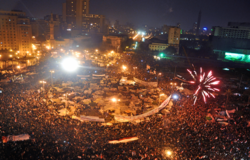
On 25 January 2011, widespread protests began against Mubarak's government. The objective of the protest was the removal of Mubarak from power. These took the form of an intensive campaign of civil resistance supported by a very large number of people and mainly consisting of continuous mass demonstrations. By 29 January, it was becoming clear that Mubarak's government had lost control when a curfew order was ignored, and the army took a semi-neutral stance on enforcing the curfew decree.
On 11 February 2011, Mubarak resigned and fled Cairo. Vice President Omar Suleiman announced that Mubarak had stepped down and that the Egyptian military would assume control of the nation's affairs in the short term.[130][131] Jubilant celebrations broke out in Tahrir Square at the news.[132] Mubarak may have left Cairo for Sharm el-Sheikh the previous night, before or shortly after the airing of a taped speech in which Mubarak vowed he would not step down or leave.[133]
On 13 February 2011, the high level military command of Egypt announced that both the constitution and the parliament of Egypt had been dissolved. The parliamentary election was to be held in September.[134]
A constitutional referendum was held on 19 March 2011.[135] On 28 November 2011, Egypt held its first parliamentary election since the Mubarak regime fell. Turnout was high and there were no reports of violence, although members of some parties broke the ban on campaigning at polling places by handing out pamphlets and banners.[136] There were, however, complaints of irregularities.[137]
The first round of a presidential election was held in Egypt on 23 and 24 May 2012. Mohamed Morsi won 25% of the vote and Ahmed Shafik, the last prime minister under deposed leader Hosni Mubarak, 24%. A second round was held on 16 and 17 June. On 24 June 2012, the election commission announced that Mohamed Morsi had won the election, making him the first democratically elected president of Egypt. According to official results, Morsi took 51.7 percent of the vote while Shafik received 48.3 percent.[138] On 30 June 2012, Mohamed Morsi was sworn in as Egypt's new president.[139]
On 8 July 2012, Egypt's new president Mohamed Morsi announced he was overriding the military edict that dissolved the country's elected parliament and called lawmakers back into session.[140]
On 10 July 2012, the Supreme Constitutional Court of Egypt negated the decision by Morsi to call the nation's parliament back into session.[141] On 2 August 2012, Egypt's Prime Minister Hisham Qandil announced his 35-member cabinet, including 28 newcomers, of whom four came from the influential Muslim Brotherhood while six and the former interim military ruler Mohamed Hussein Tantawi as the Defence Minister came from the previous Government.[142]
On 22 November 2012, Morsi issued a declaration immunizing his decrees from challenge and seeking to protect the work of the constituent assembly drafting the new constitution.[143] The declaration also requires a retrial of those accused in the Mubarak-era killings of protesters, who had been acquitted, and extends the mandate of the constituent assembly by two months. Additionally, the declaration authorizes Morsi to take any measures necessary to protect the revolution. Liberal and secular groups previously walked out of the constitutional constituent assembly because they believed that it would impose strict Islamic practices, while Muslim Brotherhood backers threw their support behind Morsi.[144]
The move was criticized by Mohamed ElBaradei, the leader of Egypt's Constitution Party, who stated "Morsi today usurped all state powers & appointed himself Egypt's new pharaoh" on his Twitter feed.[145] The move led to massive protests and violent action throughout Egypt.[146] On 5 December 2012, Tens of thousands of supporters and opponents of Egypt's president clashed, hurling rocks and Molotov cocktails and brawling in Cairo's streets, in what was described as the largest violent battle between Islamists and their foes since the country's revolution.[147] Six senior advisors and three other officials resigned from the government and the country's leading Islamic institution called on Morsi to stem his powers. Protesters also clamored from coastal cities to desert towns.[148]
Morsi offered a "national dialogue" with opposition leaders but refused to cancel a 15 December vote on a draft constitution written by an Islamist-dominated assembly that has ignited two weeks of political unrest.[148]
A constitutional referendum was held in two rounds on 15 and 22 December 2012, with 64% support, and 33% against.[149] It was signed into law by a presidential decree issued by Morsi on 26 December 2012.[150] On 3 July 2013, the constitution was suspended by order of the Egyptian army.[151]
On 30 June 2013, on the first anniversary of the election of Morsi, millions of protesters across Egypt took to the streets and demanded the immediate resignation of the president. On 1 July, the Egyptian Armed Forces issued a 48-hour ultimatum that gave the country's political parties until 3 July to meet the demands of the Egyptian people. The presidency rejected the Egyptian Army's 48-hour ultimatum, vowing that the president would pursue his own plans for national reconciliation to resolve the political crisis. On 3 July, General Abdel Fattah el-Sisi, head of the Egyptian Armed Forces, announced that he had removed Morsi from power, suspended the constitution and would be calling new presidential and Shura Council elections and named Supreme Constitutional Court's leader, Adly Mansour as acting president.[152] Mansour was sworn in on 4 July 2013.[153]
During the months after the coup d'état, a new constitution was prepared, which took effect on 18 January 2014.[154] After that, presidential and parliamentary elections have to be held in June 2014. On 24 March 2014, 529 Morsi's supporters were sentenced to death, while the trial of Morsi himself was still ongoing.[155] Having delivered a final judgement, 492 sentences were commuted to life imprisonment with 37 death sentences being upheld. On 28 April, another mass trial took place with 683 Morsi supporters sentenced to death for killing 1 police officer.[156] In 2015, Egypt participated in the Saudi Arabian-led intervention in Yemen.[157]
In the elections of June 2014 El-Sisi won with a percentage of 96.1%.[158] On 8 June 2014, Abdel Fatah el-Sisi was officially sworn in as Egypt's new president.[159] Egypt has implemented a rigorous policy of controlling the border to the Gaza Strip, including the dismantling of tunnels between the Gaza strip and Sinai.[160]
In April 2018, El-Sisi was re-elected by landslide in election with no real opposition.[161] In April 2019, Egypt's parliament extended presidential terms from four to six years. President Abdel Fattah al-Sisi was also allowed to run for third term in next election in 2024.[162]
Under El-Sisi Egypt is said to have returned to authoritarianism. New constitutional reforms have been implemented, meaning strengthening the role of military and limiting the political opposition.[163] The constitutional changes were accepted in a referendum in April 2019.[164]
In December 2020, final results of the parliamentary election confirmed a clear majority of the seats for Egypt's Mostaqbal Want (Nation's Future) Party, which strongly supports president El-Sisi. The party even increased its majority, partly because of new electoral rules.[165]
During the 2020–2021 Tigray War, Egypt was also involved. On 19 December 2020, an EEPA report stated, based on testimonials of three Egyptian officials and one European diplomat, that the UAE used its base in Assab (Eritrea) to launch drones strikes against Tigray. The investigative platform Bellingcat confirmed the presence of Chinese-produced drones at the UAE's military base in Assab, Eritrea. Egyptian officials were concerned about strengthening ties between the UAE and Israel. They fear that both countries will collaborate in the construction of an alternative to the Suez Canal, starting from Haifa in Israel.[166] On 19 December 2020, Egypt was reportedly encouraging Sudan to support the TPLF in Tigray. It wants to strengthen a joint position in relation to negotiations on the GERD Dam, which impacts both countries downstream.[166]
↑Zakrzewski, Sonia R. (April 2007). "Population continuity or population change: Formation of the ancient Egyptian state". American Journal of Physical Anthropology. 132 (4): 501–509. Bibcode:2007AJPA..132..501Z. doi:10.1002/ajpa.20569. PMID17295300. When Mahalanobis D2 was used, the Naqadan and Badarian Predynastic samples exhibited more similarity to Nubian, Tigrean, and some more southern series than to some mid- to late Dynasticseries from northern Egypt (Mukherjee et al., 1955). The Badarian have been found to be very similar to a Kerma sample (Kushite Sudanese), using both the Penrose statistic (Nutter, 1958) and DFA of males alone (Keita,1990). Furthermore, Keita considered that Badarian males had a southern modal phenotype, and that together with a Naqada sample, they formed a southern Egyptian cluster as tropical variants together with a sample from Kerma
↑Mokhtar, Gamal, ed. (1981). Ancient Civilizations of Africa. UNESCO International Scientific Committee for the Drafting of a General History of Africa; Heinemann Educational Books; University of California Press. pp.20–21, 148. ISBN978-0-520-03913-1. The difference in behaviour between two populations of similar ethnic composition throws significant light on an apparently abnormal fact: one of them adopted and perhaps even invented, a system of writing, while the other, which was aware of that writing, disdained it
↑Herrmann, Dietmar (2022), Herrmann, Dietmar (ed.), "Alexandria", Ancient Mathematics: History of Mathematics in Ancient Greece and Hellenism, Berlin, Heidelberg: Springer, pp.117–130, doi:10.1007/978-3-662-66494-0_9, ISBN978-3-662-66494-0, retrieved 8 April 2026{{citation}}: CS1 maint: work parameter with ISBN (link)
↑Bianquis, Thierry (1998), Petry, Carl F. (ed.), "Autonomous Egypt from Ibn Tūlūn to Kāfūr, 868–969", The Cambridge History of Egypt: Volume 1: 640–1517, The Cambridge History of Egypt, vol.1, Cambridge: Cambridge University Press, pp.86–119, ISBN978-0-521-47137-4, retrieved 8 April 2026{{citation}}: CS1 maint: work parameter with ISBN (link)
↑N.), Kennedy, Hugh (Hugh (2004). The Prophet and the age of the Caliphates: the Islamic Near East from the sixth to the eleventh century (2nded.). Harlow, England: Pearson/Longman. ISBN0582405254. OCLC55792252.{{cite book}}: CS1 maint: multiple names: authors list (link)
↑Murphy, Caryle Passion for Islam: Shaping the Modern Middle East: the Egyptian Experience, Scribner, 2002, p.4
↑Murphy, Caryle Passion for Islam: Shaping the Modern Middle East: the Egyptian Experience, Scribner, 2002, p.57
↑Kepel, Gilles, Muslim Extremism in Egypt by Gilles Kepel, English translation published by University of California Press, 1986, p. 74
↑"Solidly ahead of oil, Suez Canal revenues, and remittances, tourism is Egypt's main hard currency earner at $6.5 billion per year." (in 2005) ... concerns over tourism's futureArchived 24 September 2013 at the Wayback Machine . Retrieved 27 September 2007.
↑As described by William Dalrymple in his book From the Holy Mountain (1996, ISBN0 00 654774 5) pp. 434–54, where he describes his trip to the area of Asyut in 1994.
24Claimed in 1908; territory formed 1962; overlaps portions of Argentine and Chilean claims, borders not enforced but claim not renounced under the Antarctic Treaty.
This page is based on this Wikipedia article Text is available under the CC BY-SA 4.0 license; additional terms may apply. Images, videos and audio are available under their respective licenses.




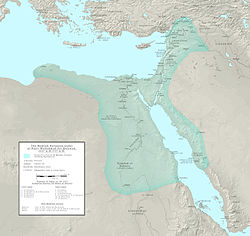

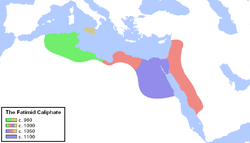 Evolution of the Fatimid Caliphate
 Ayyubid Sultanate of Egypt (in pink) at the death of Saladin in 1193
 Egyptportal