Bonavista, Newfoundland and Labrador

Last updated

Bonavista
Town
Bonavista Harbour August 2nd 2022.jpg
An aerial photograph of the Bonavista Harbour
Canada Newfoundland location map.svg
Red pog.svg
Bonavista
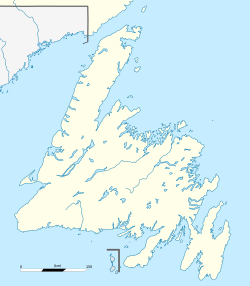
Location of Bonavista in Newfoundland
Coordinates: 48°39′35″N53°07′15″W / 48.65972°N 53.12083°W / 48.65972; -53.12083
CountryCanada
Province Newfoundland and Labrador
Government
  TypeMunicipal Government
  MayorJohn Norman
  Deputy MayorReginald Butler
Area
 (2021) [1]
  Land31.5 km2 (12.2 sq mi)
Population
 (2021) [1]
  Total
2,979 [2]
  Density109.4/km2 (283/sq mi)
Time zone UTC−03:30 (NST)
  Summer (DST) UTC−02:30 (NDT)
Area code 709
Highways NL Route 230.svg Route 230
NL Route 235.svg Route 235
NL Route 238.svg Route 238
Website townofbonavista.com OOjs UI icon edit-ltr-progressive.svg

Bonavista (2021 population: 2979 [1] ) is a town on the Bonavista Peninsula, Newfoundland in the Canadian province of Newfoundland and Labrador. Unlike many Newfoundland coastal settlements, Bonavista was built on an open plain, not in a steep cove; thus, the community had room to expand to its current area of 31.5 km2 (12.2 sq mi). [3] Bonavista is located approximately 300 km by road from the provincial capital of St. John's.

Contents

History

John Cabot (Giovanni Caboto), a freelance Italian explorer, was contracted by England's Henry VII to find new lands, and a sea route to the Orient. Cabot set sail from Bristol, England in his ship the Matthew in 1497. When Cabot first saw land he reputedly said "O Buon Vista" ("Oh, Happy Sight!") [4] [5] giving rise to the name of the town and nearby Cape Bonavista. Cabot landed with "a crucifix and raised banners with the arms of the Holy Father and those of the King of England". [6] The land was inhabited, as the expedition found a trail leading inland, a site where a fire had been, and "a stick half a yard long pierced at both ends, carved and painted with brazil". [7] The harbour was not ideal, eventually requiring the construction of several breakwaters. Despite this Bonavista became one of the most important towns in Newfoundland due to its proximity to the rich fishing and sealing grounds to the north of the peninsula. The Spanish, Portuguese, Dutch, French and English fished off Cape Bonavista during the 16th century, but the Spanish and Portuguese presence soon declined, leaving the French and English as the dominant powers. [8] Tension between the French and English sometimes resulted in military action, including an unsuccessful attempt in 1704 by the French to burn the town. [9] The French Shore, which had Bonavista as its eastern terminus, was established by the Treaty of Utrecht in 1713. Fishing rights in the area continued to be a source of tension between the French and English. [10]

Bonavista was a major commercial centre and the evidence for this is preserved at the Ryan Premises, a National Historic Site maintained by Parks Canada. It is a restored example of a large fish merchant's operation.

Bonavista's status was further enhanced by the development of the Fishermen's Protective Union in the early 20th century, and the creation of nearby Port Union. During the peak years of 1891–1901, the Bonavista Peninsula's population of about 20,000 was centred in Bonavista. The Bonavista Cold Storage Co. fish plant, now a Fishery Products International [11] operation, became the centre of fishery production after the decline of salt fish markets.

In 1722, the first school in Newfoundland was built in Bonavista by Rev. Henry Jones.

In the late 19th and early 20th centuries, Bonavista became a primary center for the Loyal Orange Association in Newfoundland. [12] Founded as Bonavista Loyal Orange Lodge (LOL), No. 4, the organization grew to become the largest Orange Lodge in British North America, boasting a membership of over 470 men by the early 1900s. [13]

The Lodge played a role in the community’s social safety net, functioning as a mutual aid society that provided insurance and support for families of fishermen lost at sea. In 1907, the Lodge commissioned local master builder Ronald Strathie to construct the Bonavista Orange Hall. [14] The massive two-and-a-half-story wooden structure, topped by a distinctive four-story domed tower, served as a vital navigational landmark for the local fishing fleet. It is believed to be the largest wooden gathering hall ever constructed in Canada. [15]

The Hall was also a site of significant political history. In 1912, it hosted the convention of the Fishermen's Protective Union (FPU), where leader William Coaker delivered the "Bonavista Platform." This manifesto demanded radical reforms to the Newfoundland fishery and governance, marking a turning point in the province's labor movement. [16]

The building was designated a Registered Heritage Structure in 1997. [17] Today, it stands as a symbol of the "Orange and Black" tradition, which referres to the senior Royal Black Preceptory, No. 1162, which also met there and the town's historical prominence as a Protestant merchant and fishing hub. [18]

In 1964, the settlement of Bonavista was incorporated into the town of Bonavista. [19]

In 2010, discussions were held about the potential annexation of Elliston by Bonavista. The proposal arose from concerns about the economic sustainability and administrative challenges of smaller municipalities in the region. A feasibility study was conducted to explore the benefits and drawbacks of merging services and governance. However, the idea was met with mixed reactions from residents, and the annexation did not proceed. Elliston continues to operate as an independent municipality. [20]

In the 20th century, the town's economy switched to being tourism-focused. In 2023, it was reported that up to 80,000 visited each summer, leading to many houses to be converted into vacation rentals (more than 120 in 2023). These conversions flipped the housing market of the town, which twenty years earlier had seen many vacant houses, into one of shortage. As of 2023 a freeze on new vacation rental conversions was declared. [21]

Demographics

Historical populations
Bonavista, NL
YearPop.±%
18913,551    
19513,718+4.7%
19564,078+9.7%
19614,186+2.6%
19664,192+0.1%
19714,215+0.5%
19764,299+2.0%
19814,460+3.7%
19864,605+3.3%
19914,597−0.2%
19964,526−1.5%
2001 4,021−11.2%
2006 3,764−6.4%
2011 3,589−4.6%
2016 3,448−3.9%
2021 3,190−7.5%
[22] [3] [23]

In the 2021 Census of Population conducted by Statistics Canada, Bonavista had a population of 3,190 living in 1,470 of its 1,732 total private dwellings, a change of

Climate

Bonavista has a subarctic climate (Dfc) due to its cold water temperatures surrounding the location, keeping June temperatures below 10 °C (50 °F) in terms of mean temperatures. Although winters are relatively mild by Canadian standards, there is heavy snowfall and frequent cold days. Winter lasts from December through April.

Bonavista is one of the windiest places in Canada with an average wind speed of 32.6 km/h (20.3 mph). [25]

Climate data for Bonavista Canadian Climate Normals 1981-2010 Station Data
MonthJanFebMarAprMayJunJulAugSepOctNovDecYear
Record high humidex 17.513.113.024.026.932.936.237.033.027.921.915.737.0
Record high °C (°F)14.9
(58.8)
11.8
(53.2)
13.4
(56.1)
21.5
(70.7)
25.6
(78.1)
28.8
(83.8)
30.6
(87.1)
30.1
(86.2)
26.1
(79.0)
22.8
(73.0)
17.8
(64.0)
14.4
(57.9)
30.6
(87.1)
Mean daily maximum °C (°F)−1.3
(29.7)
−2.1
(28.2)
0.2
(32.4)
4.7
(40.5)
9.7
(49.5)
13.9
(57.0)
18.8
(65.8)
19.5
(67.1)
15.3
(59.5)
10.2
(50.4)
5.6
(42.1)
1.0
(33.8)
8.0
(46.4)
Daily mean °C (°F)−4.8
(23.4)
−5.9
(21.4)
−3.1
(26.4)
1.5
(34.7)
5.7
(42.3)
9.5
(49.1)
14.4
(57.9)
15.5
(59.9)
11.9
(53.4)
7.3
(45.1)
2.8
(37.0)
−1.9
(28.6)
4.4
(39.9)
Mean daily minimum °C (°F)−8.2
(17.2)
−9.5
(14.9)
−6.4
(20.5)
−1.8
(28.8)
1.6
(34.9)
5.1
(41.2)
10.0
(50.0)
11.5
(52.7)
8.4
(47.1)
4.4
(39.9)
0.0
(32.0)
−4.8
(23.4)
0.9
(33.6)
Record low °C (°F)−24.4
(−11.9)
−24.7
(−12.5)
−24.3
(−11.7)
−13.6
(7.5)
−6.7
(19.9)
−2.8
(27.0)
−2.2
(28.0)
2.8
(37.0)
0.8
(33.4)
−3.3
(26.1)
−11.6
(11.1)
−22.2
(−8.0)
−24.7
(−12.5)
Record low wind chill −37.0−41.0−42.0−23.0−16.0−8.0−7.00.00.0−12.0−23.0−37.0−42.0
Average precipitation mm (inches)100.7
(3.96)
104.3
(4.11)
103.4
(4.07)
83.2
(3.28)
75.7
(2.98)
89.6
(3.53)
82.1
(3.23)
79.4
(3.13)
107.7
(4.24)
115.2
(4.54)
104.5
(4.11)
107.2
(4.22)
1,152.9
(45.39)
Average rainfall mm (inches)34.7
(1.37)
42.8
(1.69)
53.1
(2.09)
59.8
(2.35)
68.7
(2.70)
89.0
(3.50)
82.1
(3.23)
79.4
(3.13)
107.7
(4.24)
111.2
(4.38)
81.0
(3.19)
54.3
(2.14)
863.8
(34.01)
Average snowfall cm (inches)67.8
(26.7)
63.0
(24.8)
47.9
(18.9)
21.7
(8.5)
6.5
(2.6)
0.6
(0.2)
0.0
(0.0)
0.0
(0.0)
0.0
(0.0)
3.4
(1.3)
22.8
(9.0)
50.5
(19.9)
284.3
(111.9)
Average precipitation days (≥ 0.2 mm)17.516.418.517.017.516.815.114.016.818.819.620.0208.0
Average rainy days (≥ 0.2 mm)7.17.110.312.516.417.015.114.016.818.115.510.7160.6
Average snowy days (≥ 0.2 cm)14.913.713.17.93.10.20.00.00.01.77.614.576.6
Average relative humidity (%)77.577.077.478.274.475.572.971.774.775.877.979.776.1
Source: Environment and Climate Change Canada [25]

Attractions

Bonavista lighthouse Cape Bonavista Lighthouse 01.jpg
Bonavista lighthouse

Notable people

See also

References

  1. 1 2 3 "Bonavista, T [Census subdivision], Newfoundland and Labrador and Division No. 7, CDR [Census division], Newfoundland and Labrador (table) Census Profile". 2016 census . Statistics Canada. 8 February 2017. Retrieved 9 December 2021.{{cite web}}: CS1 maint: url-status (link)
  2. "Bonavista". Statistics Canada. Statistics Canada. Retrieved 9 December 2025.
  3. 1 2 "Bonavista, T [Census subdivision], Newfoundland and Labrador and Division No. 7, CDR [Census division], Newfoundland and Labrador (table) Census Profile". 2016 census . Statistics Canada. 8 February 2017. Archived from the original on 29 July 2020. Retrieved 9 October 2017.
  4. "Bonavista". The Canadian Encyclopedia. Historica Foundation of Canada. Archived from the original on 5 May 2010. Retrieved 17 July 2011.
  5. Whiffen, Bruce, Prime Berth: An Account of Bonavista's Early Years. Harry Cuff Publications Limited, St John's, A1C 2H2. 1993. ISBN   0-921191-82-0. page 4: "There are no contemporary documents to directly support this story."
  6. John Day's letter to Columbus, quoted in Whiffen, op. cit. page 6.
  7. John Day's letter, as above.
  8. "The International Fishery of the 16th Century". Newfoundland and Labrador Heritage Web Site Project, Memorial University of Newfoundland. 1997. Archived from the original on 26 January 2008. Retrieved 26 January 2008.
  9. Bernard Ransom (1991). "Museum Notes: A Century of Armed Conflict in Newfoundland". The Rooms, Newfoundland Provincial Museum. Archived from the original on 3 March 2008. Retrieved 26 January 2008.
  10. J.K. Hiller (2001). "The French Treaty Shore". Newfoundland and Labrador Heritage Web Site Project, Memorial University of Newfoundland. Archived from the original on 26 January 2021. Retrieved 26 January 2008.
  11. Fishery Products International
  12. "Orange Order in Canada". thecanadianencyclopedia.ca. Retrieved 9 January 2026.
  13. "Orange Hall in Bonavista, Newfoundland and Labrador". www.explorenewfoundlandandlabrador.com. Retrieved 9 January 2026.
  14. "Loyal Orange Lodge #4, Bonavista, NL". www.heritage.nf.ca. Retrieved 9 January 2026.
  15. "Loyal Orange Association Hall Bonavista Newfoundland - Photo & Travel Idea Canada". www.canada-photos.com. Retrieved 9 January 2026.
  16. Baker, Melvin (2019). "Fishery Reforms and William Coaker's Speech at the 1917 Social Service Congress". Newfoundland & Labrador Studies. 34 (1): 158–171. ISSN   1715-1430.
  17. "Heritage Foundation of Newfoundland & Labrador Loyal Orange Lodge LOL #4 Municipal Heritage Site". heritagenl.ca. Retrieved 9 January 2026.
  18. "HistoricPlaces.ca - HistoricPlaces.ca". www.historicplaces.ca. Retrieved 9 January 2026.
  19. https://www.thecanadianencyclopedia.ca/en/article/bonavista
  20. https://www.townofelliston.ca/history/timeline/2000-present
  21. Paul Haavardsrud (26 February 2023). "The Holy Grail for the EV Revolution". The Cost of Living (Podcast). CBC Radio One. Event occurs at 2:30. Archived from the original on 1 March 2023. Retrieved 1 March 2023.
  22. "Population and dwelling counts". Statistics Canada. 2006. Archived from the original on 10 October 2017. Retrieved 15 July 2009.
  23. "1976 Census of Canada. Volume 1, Population, geographic distributions" (PDF). Statistics Canada. 1977. Archived (PDF) from the original on 23 November 2022. Retrieved 9 April 2023.
  24. "Population and dwelling counts: Canada, provinces and territories, census divisions and census subdivisions (municipalities), Newfoundland and Labrador". Statistics Canada. 9 February 2022. Archived from the original on 30 April 2022. Retrieved 15 March 2022.
  25. 1 2 "Canadian Climate Normals 1981-2010 Station Data". Environment and Climate Change Canada. 25 September 2013. Archived from the original on 28 January 2022. Retrieved 17 August 2019.