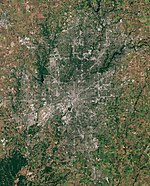
Marion County, Indiana

Last updated

Marion County, Indiana
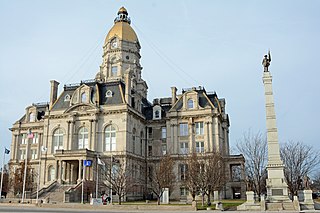
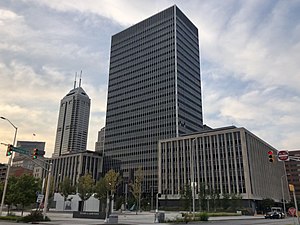
City-County Building (Indianapolis) exterior.jpg
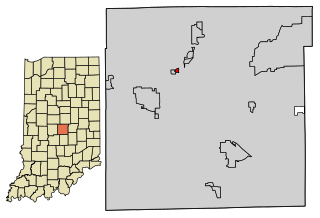
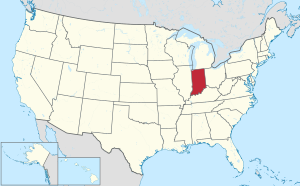
Map of Indiana highlighting Marion County.svg
Location within the U.S. state of Indiana
Coordinates: 39°47′N86°08′W / 39.78°N 86.14°W / 39.78; -86.14
CountryFlag of the United States.svg United States
StateFlag of Indiana.svg Indiana
FoundedApril 1, 1822
Named after Francis Marion
Seat Indianapolis
Largest cityIndianapolis
Area
  Total
403.01 sq mi (1,043.8 km2)
  Land396.30 sq mi (1,026.4 km2)
  Water6.71 sq mi (17.4 km2)
Population
 (2020)
  Total
977,203
  Estimate 
(2023)
968,460 Decrease2.svg
  Density2,465.8/sq mi (952.06/km2)
Time zone UTC−5 (Eastern)
  Summer (DST) UTC−4 (EDT)
Congressional districts 6th, 7th
Website www.indy.gov/eGov/County
  • Indiana county number 49
  • Most populous county in Indiana
  • Currently only Unigov county in Indiana

Marion County is located in the U.S. state of Indiana. The 2020 United States census reported a population of 977,203, [1] making it the 54th-most populous county in the U.S., the most populous county in the state, and the main population center of the 11-county Indianapolis–Carmel–Greenwood MSA in central Indiana. Indianapolis is the county seat, the state capital, and most populous city. [2] Marion County is consolidated with Indianapolis through an entity known as Unigov.

Contents

Geography

The low rolling hills of Marion County have been cleared of trees, and the area is completely devoted to municipal development or to agriculture, except for wooded drainages. [3] The highest point (920 feet/280 meters ASL) is a small ridge at the county's northwest corner. [4]

According to the 2010 census, the county has an area of 403.01 square miles (1,043.8 km2), of which 396.30 square miles (1,026.4 km2) (or 98.34%) is land and 6.71 square miles (17.4 km2) (or 1.66%) is water. [5]

The White River flows southwestward through the central part of the county; it is joined by Eagle Creek and Fall Creek, both of which have dams in the county forming Eagle Creek Reservoir and Geist Reservoir, respectively.

Marion County has two Indiana State Parks, Fort Harrison State Park and White River State Park, as well as many municipal parks.

Adjacent counties

History

Marion County was created on April 1, 1822, from part of the "New Purchase" lands that had been obtained from its inhabitants, the Lenape, by the Treaty of St. Mary's. [6] It is named for Francis Marion, a brigadier general from South Carolina in the American Revolutionary War. [7]

The state capital was moved to Indianapolis in Marion County from Corydon on January 10, 1825. This began a period of rapid growth in population. [8]

Climate and weather

Indianapolis, Indiana
Climate chart (explanation)
J
F
M
A
M
J
J
A
S
O
N
D
 
 
3.1
 
 
36
21
 
 
2.4
 
 
41
24
 
 
3.7
 
 
52
34
 
 
4.3
 
 
64
43
 
 
4.8
 
 
73
54
 
 
5
 
 
82
63
 
 
4.4
 
 
86
66
 
 
3.2
 
 
84
65
 
 
3.1
 
 
78
57
 
 
3.2
 
 
66
46
 
 
3.5
 
 
52
35
 
 
2.9
 
 
40
26
Average max. and min. temperatures in °F
Precipitation totals in inches
Source: The Weather Channel [9]
Metric conversion
J
F
M
A
M
J
J
A
S
O
N
D
 
 
79
 
 
2
−6
 
 
62
 
 
5
−4
 
 
94
 
 
11
1
 
 
110
 
 
18
6
 
 
121
 
 
23
12
 
 
126
 
 
28
17
 
 
112
 
 
30
19
 
 
81
 
 
29
18
 
 
80
 
 
26
14
 
 
82
 
 
19
8
 
 
88
 
 
11
2
 
 
74
 
 
4
−3
Average max. and min. temperatures in °C
Precipitation totals in mm

In recent years, average temperatures in Indianapolis have ranged from a low of 20 °F (−7 °C) in January to a high of 86 °F (30 °C) in July, although a record low of −22 °F (−30 °C) was recorded in January 1985 and a record high of 104 °F (40 °C) was recorded in June 1988. Average monthly precipitation ranged from 2.05 inches (52 mm) in January to 4.78 inches (121 mm) in July. [9]

Demographics

Age and gender distribution in Marion County USA Marion County, Indiana age pyramid.svg
Age and gender distribution in Marion County
Historical population
CensusPop.Note
1830 7,192
1840 16,080123.6%
1850 24,10349.9%
1860 39,85565.4%
1870 71,93980.5%
1880 102,78242.9%
1890 141,15637.3%
1900 197,22739.7%
1910 263,66133.7%
1920 348,06132.0%
1930 422,66621.4%
1940 460,9269.1%
1950 551,77719.7%
1960 697,56726.4%
1970 792,29913.6%
1980 765,233−3.4%
1990 797,1594.2%
2000 860,4547.9%
2010 903,3935.0%
2020 977,2038.2%
2023 (est.)968,460 [10] −0.9%
US Decennial Census [11]
1790-1960 [12] 1900–1990 [13]
1990-2000 [1]

Racial and ethnic composition

Marion County, Indiana – Racial and ethnic composition
Note: the US Census treats Hispanic/Latino as an ethnic category. This table excludes Latinos from the racial categories and assigns them to a separate category. Hispanics/Latinos may be of any race.
Race / Ethnicity (NH = Non-Hispanic)Pop 2000 [14] Pop 2010 [15] Pop 2020 [16] % 2000% 2010% 2020
White alone (NH)592,540537,905493,66568.86%59.54%50.52%
Black or African American alone (NH)206,716238,454265,65924.02%26.40%27.19%
Native American or Alaska Native alone (NH)1,8241,9541,7520.21%0.22%0.18%
Asian alone (NH)12,19818,11939,8271.42%2.01%4.08%
Pacific Islander alone (NH)3083333740.04%0.04%0.04%
Other race alone (NH)1,6762,3205,3730.19%0.26%0.55%
Mixed race or Multiracial (NH)11,90219,84241,2671.38%2.20%4.22%
Hispanic or Latino (any race)33,29084,466129,2863.87%9.35%13.23%
Total860,454903,393977,203100.00%100.00%100.00%

2020 census

As of the 2020 census, the county had a population of 977,203. The median age was 34.7 years. 24.0% of residents were under the age of 18 and 12.9% of residents were 65 years of age or older. For every 100 females there were 94.0 males, and for every 100 females age 18 and over there were 90.9 males age 18 and over. [17] [18]

The racial makeup of the county was 52.5% White, 27.5% Black or African American, 0.5% American Indian and Alaska Native, 4.1% Asian, <0.1% Native Hawaiian and Pacific Islander, 7.7% from some other race, and 7.6% from two or more races. Hispanic or Latino residents of any race comprised 13.2% of the population. [18]

99.1% of residents lived in urban areas, while 0.9% lived in rural areas. [19]

There were 398,062 households in the county, of which 30.0% had children under the age of 18 living in them. Of all households, 35.5% were married-couple households, 22.4% were households with a male householder and no spouse or partner present, and 33.3% were households with a female householder and no spouse or partner present. About 32.7% of all households were made up of individuals and 9.9% had someone living alone who was 65 years of age or older. [17]

There were 436,998 housing units, of which 8.9% were vacant. Among occupied housing units, 52.9% were owner-occupied and 47.1% were renter-occupied. The homeowner vacancy rate was 1.7% and the rental vacancy rate was 10.3%. [17]

2010 census

As of the 2010 U.S. census, there were 903,393 people, 366,176 households, and 218,338 families in the county. [20] The population density was 2,279.6 inhabitants per square mile (880.2/km2). There were 417,862 housing units at an average density of 1,054.4 per square mile (407.1/km2). [5] The racial makeup of the county was 62.7% white, 26.7% black or African American, 2.0% Asian, 0.3% American Indian, 0.1% Pacific islander, 5.4% from other races, and 2.8% from two or more races. Those of Hispanic or Latino origin made up 9.3% of the population. [20] In terms of ancestry, 18.9% were German, 11.8% were Irish, 8.4% were English, 6.6% were American, and 5.2% were Subsaharan African. [21]

Of the 366,176 households, 32.3% had children under the age of 18 living with them, 36.9% were married couples living together, 17.1% had a female householder with no husband present, 40.4% were non-families, and 32.0% of all households were made up of individuals. The average household size was 2.42 and the average family size was 3.08. The median age was 33.9 years. [20]

The median income for a household in the county was $47,697 and the median income for a family was $54,142. Males had a median income of $42,215 versus $34,169 for females. The per capita income for the county was $24,498. About 13.5% of families and 17.3% of the population were below the poverty line, including 25.7% of those under age 18 and 9.0% of those age 65 or over. [22]

Cities and towns

Marion County has a consolidated city-county government, known as Unigov, in which only four municipalities retain full government autonomy (including a mayor and city council) as "excluded cities". The remaining municipalities within the county are "included towns" and exercise very limited authority, mainly in zoning and appointing their own police departments and maintaining some of their own municipal services and town identities. They retain the ability to levy taxes for these purposes.

Municipalities

Excluded cities and town

Included towns

Townships

Marion County has nine townships roughly organized into a grid-like, three-by-three pattern. This arrangement can be seen below, with the top being north.

Pike Washington Lawrence
Wayne Center Warren
Decatur Perry Franklin

Politics

The northern two-thirds of Marion County is in Indiana's 7th congressional district, which is held by Democrat André Carson. Indiana's 6th congressional district, which runs along the southern third of the county, is held by Republican Jefferson Shreve. The county is represented by 15 seats in the Indiana House of Representatives, 86th through 100th districts, with ten seats held by Democrats and five by Republicans. In the State Senate Marion County is divided among nine districts, which are held by two Democrats and seven Republicans. The Senate districts are numbered 28 through 36.

The Indianapolis City-County Council is the combined legislative body of Indianapolis and Marion County. The consolidated government, known as Unigov, was formally established in 1970 upon the merger of the city government with the county government. The council passes ordinances for the city and county, and makes appointments to certain boards and commissions.

County elected officials
Marion County
Sheriff's Office
Jurisdictional structure
Operations jurisdictionMarion County, Indiana, United States
Legal jurisdictionAs per operations jurisdiction
General nature
Operational structure
Agency executive
  • Kerry J. Forestal, Sheriff

The Auditor, Assessor, and Treasurer form the county's Board of Commissioners.

For most of the 20th century, Marion County was considered one of the most conservative urban counties in the nation. Between 1896 and 2000, it went Democratic only four times, in the national landslides of 1932, 1936 and 1964 as well as 1912 when Woodrow Wilson won a plurality in the county. The Republican edge narrowed considerably in the 1990s, and in 2004 John Kerry became the first Democrat since Lyndon B. Johnson in 1964 to carry the county. The trend continued in 2008 and 2012 with Barack Obama showing strongly in Marion County, winning 63% and 60% of the vote respectively. In the former case, Obama's showing in the county was enough to deliver Indiana to the Democrats for the first time since 1964, while John McCain became the first Republican since 1912 to win less than 40 percent of the county's vote. Hillary Clinton won it with 58 percent in 2016, and Joe Biden took 63 percent in 2020. Biden's 247,772 votes is the highest number of votes a candidate has ever received in the county. It is now one of the few Democratic bastions in traditionally heavily Republican central Indiana, and in the 2020 and 2024 elections, it was the most Democratic county in the entire state. [23]

The six northern and central townships lean more Democratic, especially Center Township containing Downtown Indianapolis, and Pike Township in the northwestern corner with an African-American majority. In contrast, the three less populated southern townships with a higher Caucasian population (Decatur, Perry and Franklin) lean more Republican. [24]

United States presidential election results for Marion County, Indiana [25]
Year Republican Democratic Third party(ies)
No.%No.%No.%
1888 17,13948.82%17,51549.89%4561.30%
1892 19,55147.77%20,42649.91%9492.32%
1896 27,35355.98%20,65442.27%8531.75%
1900 29,27254.24%23,66043.84%1,0341.92%
1904 35,10358.54%22,33637.25%2,5244.21%
1908 34,35148.67%34,07848.28%2,1513.05%
1912 12,28018.22%29,80544.22%25,32337.57%
1916 40,69951.50%35,04344.34%3,2884.16%
1920 79,95754.93%61,46042.22%4,1542.85%
1924 95,13559.13%59,49836.98%6,2473.88%
1928 109,63059.55%73,30939.82%1,1610.63%
1932 98,25646.20%106,66150.15%7,7473.64%
1936 87,79840.54%124,96157.71%3,7911.75%
1940 124,84550.43%121,90749.25%7870.32%
1944 116,42152.01%106,38247.53%1,0340.46%
1948 103,60350.78%97,91547.99%2,4951.22%
1952 164,46660.48%106,38739.12%1,0860.40%
1956 162,56661.97%99,10237.78%6790.26%
1960 166,20257.67%121,33642.10%6680.23%
1964 143,01548.25%152,41851.43%9480.32%
1968 162,50352.26%115,71537.22%32,70410.52%
1972 206,06566.52%102,16632.98%1,5350.50%
1976 177,76754.60%145,27444.62%2,5350.78%
1980 168,68053.67%126,10340.13%19,4866.20%
1984 184,88058.29%130,18541.05%2,0830.66%
1988 184,51958.56%128,62740.82%1,9490.62%
1992 141,36943.66%122,23437.75%60,18718.59%
1996 133,32947.24%124,44844.10%24,4378.66%
2000 137,81049.23%134,18947.94%7,9042.82%
2004 156,07248.65%162,24950.57%2,5170.78%
2008 134,31335.34%241,98763.67%3,7901.00%
2012 136,50937.92%216,33660.10%7,1271.98%
2016 130,36035.53%212,89958.03%23,6206.44%
2020 134,17534.30%247,77263.35%9,1872.35%
2024 124,32735.08%221,71962.57%8,3222.35%

Education

School districts include: [26]

It also has the following state-operated schools:

Transportation

Major highways

Transit

Airports

See also

References

  1. 1 2 "Marion County QuickFacts". US Census Bureau. Retrieved January 31, 2022.
  2. "Find a County". National Association of Counties. Retrieved June 7, 2011.
  3. Marion County IN (Google Maps, accessed 31 August 2020)
  4. Marion County High Point, Indiana (PeakBagger.com, accessed 31 August 2020)
  5. 1 2 "Population, Housing Units, Area, and Density: 2010 - County". US Census Bureau. Archived from the original on February 12, 2020. Retrieved July 10, 2015.
  6. Divita, James J. (1994). "Demography and Ethnicity". In Bodenhamer, David J.; Barrows, Robert G. (eds.). The Encyclopedia of Indianapolis. Bloomington and Indianapolis: Indiana University Press. pp. 51–52. ISBN   0-253-31222-1 . Retrieved July 30, 2013.
  7. Baker, Ronald L.; Marvin Carmony (1995). Indiana Place Names. Bloomington: Indiana University Press. p. 98. ISBN   0-253-28340-X.
  8. De Witt Clinton Goodrich & Charles Richard Tuttle (1875). An Illustrated History of the State of Indiana. Indiana: R. S. Peale & co. p.  566.
  9. 1 2 "Monthly Averages for Indianapolis IN". The Weather Channel. Retrieved January 27, 2011.
  10. "Annual Estimates of the Resident Population for Counties: April 1, 2020 to July 1, 2023". United States Census Bureau. Retrieved April 2, 2024.
  11. "US Decennial Census". US Census Bureau. Retrieved July 10, 2014.
  12. "Historical Census Browser". University of Virginia Library. Retrieved July 10, 2014.
  13. "Population of Counties by Decennial Census: 1900 to 1990". US Census Bureau. Retrieved July 10, 2014.
  14. "P004: Hispanic or Latino, and Not Hispanic or Latino by Race – 2000: DEC Summary File 1 – Marion County, Indiana". United States Census Bureau .
  15. "P2: Hispanic or Latino, and Not Hispanic or Latino by Race – 2010: DEC Redistricting Data (PL 94-171) – Marion County, Indiana". United States Census Bureau .
  16. "P2: Hispanic or Latino, and Not Hispanic or Latino by Race – 2020: DEC Redistricting Data (PL 94-171) – Marion County, Indiana". United States Census Bureau .
  17. 1 2 3 "2020 Decennial Census Demographic Profile (DP1)". United States Census Bureau. 2021. Retrieved December 30, 2025.
  18. 1 2 "2020 Decennial Census Redistricting Data (Public Law 94-171)". United States Census Bureau. 2021. Retrieved December 30, 2025.
  19. "2020 Decennial Census Demographic and Housing Characteristics (DHC)". United States Census Bureau. 2023. Retrieved December 30, 2025.
  20. 1 2 3 "Profile of General Population and Housing Characteristics: 2010 Demographic Profile Data". US Census Bureau. Archived from the original on February 13, 2020. Retrieved July 10, 2015.
  21. "Selected Social Characteristics in the US – 2006-2010 American Community Survey 5-Year Estimates". US Census Bureau. Archived from the original on February 14, 2020. Retrieved July 10, 2015.
  22. "Selected Economic Characteristics – 2006-2010 American Community Survey 5-Year Estimates". US Census Bureau. Archived from the original on February 14, 2020. Retrieved July 10, 2015.
  23. "Dave Leip's Atlas of U.S. Presidential Elections". US Election Atlas. Retrieved August 5, 2025.
  24. Park, Alice; Smart, Charlie; Taylor, Rumsey; Watkins, Miles (February 2, 2021). "An Extremely Detailed Map of the 2020 Election". The New York Times. ISSN   0362-4331 . Retrieved January 23, 2022.
  25. Leip, David. "Atlas of US Presidential Elections". uselectionatlas.org.
  26. "2020 Census - School District Reference Map: Marion County, IN" (PDF). U.S. Census Bureau . Retrieved July 20, 2022. - Text list
  27. Eagle Creek Airpark (Google Maps, accessed 31 August 2020)
  28. Post Air Airport (Google Maps, accessed 31 August 2020)

39°47′N86°08′W / 39.78°N 86.14°W / 39.78; -86.14