President of Pakistan

Last updated

President of Pakistan
صدرِ پاکستان
s̤adr-e Pākistān
Coat of arms of Pakistan.svg
Flag of the President of Pakistan.svg
Asif Ali Zardari - 2024 (cropped 2).jpg
Incumbent
Asif Ali Zardari
since 10 March 2024
Head of state of the Islamic Republic of Pakistan
Executive branch of the Government of Pakistan
Style Honourable President
(formal)
His Excellency [1]
(diplomatic)
Mr President (informal)
Type Head of state
Commander-in-chief
Residence Aiwan-e-Sadr
Seat Islamabad
Appointer Electoral College
Term length Five years,
renewable once
Constituting instrument Constitution of Pakistan (1973)
Precursor Monarch of Pakistan
Inaugural holder Iskander Mirza
Formation23 March 1956;69 years ago (1956-03-23)
Succession Line of succession
Deputy Chairman of the Senate
Salary 847,000 per month [2] [3]
Website President of Pakistan

The President of Pakistan [a] is the head of state of the Islamic Republic of Pakistan. The president is the nominal head of the executive and the federal parliament, the first citizen of the country, and the supreme commander of the Pakistan Armed Forces. Serving as the ceremonial head of the federation, the president is bound to act on advice of the prime minister and the federal cabinet. Asif Ali Zardari is the 14th and current president, having assumed the presidency on 10 March 2024.

Contents

The office of president was created upon the proclamation of Islamic Republic on 23 March 1956. The then serving governor-general, Major General Iskander Mirza, assumed office as the first president. Following the 1958 coup d'etat, the office of prime minister was abolished, leaving the Presidency as the most powerful office in the country. This position was further strengthened when the 1962 Constitution was adopted. It turned Pakistan into a Presidential Republic, giving all executive powers to the president. In 1973, the new Constitution established Parliamentary democracy and reduced the president's role to a ceremonial one. Nevertheless, the military takeover in 1977 reversed the changes. The 8th Amendment turned Pakistan into a semi-presidential republic and in the period between 1985 and 2010, the executive power was shared by the president and prime minister. The 18th Amendment in 2010 restored Parliamentary Democracy in the country, and reduced the presidency to a ceremonial position. [4]

The constitution prohibits the president from directly running the government. [5] Instead, the executive power is exercised on his behalf by the prime minister who keeps him informed on all matters of internal and foreign policy, as well as all legislative proposals. [6] The Constitution however, vests the President with the powers of granting pardons, reprieves, and the control over military; however, all appointments at higher commands of the military must be made by the President on a "required and necessary" basis, upon consultation and approval from the prime minister. [7] [8] [9]

The president is indirectly elected by the Electoral College for a five-year term. The Constitution requires the president to be a "Muslim of not less than forty five (45) years of age". The president resides in an estate in Islamabad known as Aiwan-e-Sadar (President's House). In his absence, the chairman of Senate exercises the responsibilities of the post, until the actual president resumes office, or the next office holder is elected.

There have been a total of 14 presidents. The first president was Iskander Ali Mirza who entered office on 23 March 1956. The current President is Asif Ali Zardari, who took charge on 10 March 2024, following his controversial victory in the 2024 election.

Powers and authority

Role of the President

The Official Residence and the Workplace of the President is Aiwan-e-Sadr— the presidential palace located in northeastern Islamabad. The presidency forms the vital institutional organ of state and is part of the bicameral Parliament. [10]

Powers to exercise the authority are limited to the ceremonial figurehead, and required to address the Parliament to give a direction for national policies before being informed of its key decisions. [11] [12] [13]

In addition, the president is also a civil commander-in-chief of the Pakistan Armed Forces, with Chairman of the joint chiefs being its chief military adviser to maintain the civilian control of the Pakistani military. [14] After a thorough confirmation comes from the Prime minister, the President confirms the judicial appointments in the national court system. [15] [16] In addition, the Constitution allows the president to grant pardons, reprieves, and clemency in cases recommended to him by the executive and the judiciary. [17] The president himself has absolute constitutional immunity from criminal and civil proceedings, and no proceedings can be initiated or continued against him during the term of his office. [18]

There shall be a President of Pakistan who shall be the Head of State and shall represent the "unity of the Republic."

Article 41 in Chapter 1: The President of Part III: The Federation of Pakistan in the Constitution of Pakistan, source [19]

The Ceremonial guard of honour at the Aiwan-e-Sadr. Pakistan cavalry honor guard.jpeg
The Ceremonial guard of honour at the Aiwan-e-Sadr.

Legislative powers

Executive powers

Judicial powers

Appointing powers

Military powers

Emergency powers

Article 232: Emergency due to war, external or internal disturbance:

Article 233: Suspension of Fundamental Rights:

Article 234: Emergency due to the breakdown of constitutional machinery:

Article 235: Financial Emergency:

President can impose governor rule in any province. He can run provincial government directly.

He can use emergency powers on advice of Prime Minister and cabinet.

From 2000 until 2009, the President was the Chairman of the National Security Council who had authority and control over the nuclear and strategic arsenals; however, the chairmanship and the powers transferred back to the prime minister. [20] Furthermore, the presidential powers have significantly declined with Pakistan's government reversed to a parliamentary democratic republic. [21]

Powers before the 18th Amendment

Before the 18th Amendment to the constitution in 2010, the President was quite powerful. [22]

He had the constitutional authority to choose and appoint the Prime Minister in his discretion who got majority votes from the National Assembly.

Due to Article 58-2(b), he had the authority to dissolve the National Assembly in his discretion when the Government of Federation cannot be carried according to the provisions of the Constitution. President Zia Ul Haq, Ghulam Ishaq Khan and Farooq Leghari used this constitutional provision to dissolve the elected Prime Minister's Government. The President is the ceremonial head of state, while the Prime Minister is head of the executive, although this provision made the President more powerful than the Prime Minister, making the PM subordinate to him. If there is any misunderstanding or disagreement between the President and the Prime Minister, the President may use these powers to dismiss the Prime Minister and dissolve National Assembly. Pakistan's Parliamentary system was changed to a Semi-presidential government as a consequence.

Eligibility and selection process

The Constitution of Pakistan sets the principle qualifications that the candidate must meet to be eligible to the office of the president. [23] A president has to be:

Whenever the Aiwan-e-Sadr becomes vacant, the selection of president is done by the electoral college, which consists of both houses of Parliament (the Senate and National Assembly) and the four provincial assemblies. [24] The chief election commissioner has to conduct elections to the office of the president in a special session. [25] Voting takes place in secrecy. [26]

Each elector casts a different number of votes. [26] The general principle is that the total number of votes cast by members of Parliament equals the total number of votes cast by provincial legislators. [26] Each of the provincial legislatures has an equal number of votes to each other, based on the number of members of the smallest legislature, which is the Balochistan Assembly (65 seats). [26]

The constitution further states that election to the office of president will not be held earlier than sixty days and not later than thirty days before the expiration of the term of the president in office. [26]

Election and oath

The president is elected indirectly for a term of five years. [27] The incumbent president is eligible for re-election to that office, but cannot hold that office for more than two consecutive terms. [28] The president is required to make and subscribe in the presence of the chief justice—, an oath or affirmation that the president shall protect, preserve and defend the Constitution as follows:

I, (The name of the President-elect), do solemnly swear that I am a Muslim and believe in the Unity, and Oneness of Almighty Allah, the Books of Allah, the Holy Qur'an being the last of them, the Prophethood of Muhammad (peace be upon him) as the last of the Prophets and that there can be no Prophet after him, the Day of Judgment, and all the requirements and teachings of the Holy Quran and Sunnah :

That I will bear true faith and allegiance to Pakistan:

That, as President of Pakistan, I will discharge my duties, and perform my functions, honestly, to the best of my ability, faithfully in accordance with the Constitution of the Islamic Republic of Pakistan and the law, and always in the interest of the sovereignty, integrity, solidarity, well- being and prosperity of Pakistan:

That I will not allow my personal interest to influence my official conduct or my official decisions:

That I will preserve, protect and defend the Constitution of the Islamic Republic of Pakistan:

That, in all circumstances, I will do right to all manner of people, according to law, without fear or favour, affection or ill- will:

And that I will not directly or indirectly communicate or reveal to any person any matter which shall be brought under my consideration or shall become known to me as President of Pakistan, except as may be required for the due discharge of my duties as President.

May Allah Almighty help and guide me (Ameen). [29]

Line of succession and removal

The Constitution discusses the possibility of an acting president. [30] Certain office-holders, however, are permitted to stand as presidential candidates in case of vacancy as the constitution does not include a position of vice president:

The president may be removed before the expiry of the term through impeachment. The president can be removed for violation of the Constitution of Pakistan. [32]

The impeachment process may start in either of the two houses of the Parliament. The house initiates the process by leveling the charges against the president. [33] The charges are contained in a notice that has to be signed by either the chairman or the speaker of the National Assembly through a two-thirds majority. [33] The notice is sent up to the president, and 14 days later it is taken up for consideration. [34]

A resolution to impeach the president has to be passed by the two-thirds majority. [35] The speaker of the National Assembly then summons the joint session not earlier than seven days. [36] The president has the right to defend oneself. [37]

If the resolution is passed by the two-thirds majority at the joint session declaring that the president is unfit to hold the office due to incapacity or is guilty of violating the Constitution or of gross misconduct, then the president shall cease to hold office immediately on the passing of the resolution. [38]

No president has been impeached. However, the proceedings have been used in 2008 in an attempt to impeach former president Pervez Musharraf who tendered the resignation after the proceedings above were used. [39]

List of presidents

Key for presidents list
Party name
Republican Party
Muslim League (C)
Armed Forces
Independent
Pakistan Muslim League (Q)
Pakistan People's Party
Pakistan Muslim League (N)
Pakistan Tehreek-e-Insaf
No.PortraitName
(Birth–Death)
Term of officePolitical partyElectedRef.
Took officeLeft officeTime in office
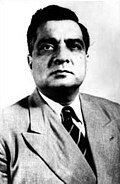
1 Iskander Mirza.jpg Iskandar Ali Mirza
(1899–1969)
23 March 195627 October 19582 years, 218 days Republican 1956 [40]
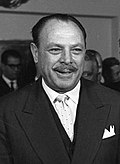
2 Muhammed Ayub Khan.JPG Ayub Khan
(1907–1974)
27 October 1958 8 June 19623 years, 224 days Army
8 June 1962 25 March 1969 6 years, 290 days PMLC 1965
3 Yahya Khan portrait.png Yahya Khan
(1917–1980)
25 March 1969 20 December 1971 2 years, 270 days Army [40] [41] [ page needed ]
4 Z A Bhutto (President of Pakistan).jpg Zulfikar Ali Bhutto
(1928–1979)
20 December 197114 August 19731 year, 237 days PPP 1970 [40]
5
Fazal Ilahi Chaudhry portrait.png
Fazal Ilahi Chaudhry
(1904–1982)
14 August 197316 September 19785 years, 33 days PPP 1973
6 President Mohammad Zia Ul Haq.jpg Muhammad Zia-ul-Haq
(1924–1988)
16 September 1978 17 August 19889 years, 336 days Army
7 Ghulam Ishaq Khan (cropped).JPG Ghulam Ishaq Khan
(1915–2006)
17 August 198818 July 19934 years, 335 days IND 1988
Wasim Sajjad.png Wasim Sajjad
(born 1941)
acting
18 July 199314 November 1993119 days PMLN
8 Farooq Leghari (cropped).jpg Farooq Leghari
(1940–2010)
14 November 19932 December 19974 years, 18 days PPP 1993
Wasim Sajjad.png Wasim Sajjad
(born 1941)
acting
2 December 19971 January 199830 days PMLN
9 Pride of Performance Award by President of Pakistan (cropped head).jpg Muhammad Rafiq Tarar
(1929–2022)
1 January 199820 June 20013 years, 170 days PMLN 1997
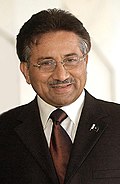
10 Pervez Musharraf 2004.jpg Pervez Musharraf
(1943–2023)
20 June 200115 October 20076 years, 117 days Army 2004 [40] [42]
19 November 2007 18 August 2008 273 days PML(Q) 2007 [40]
Muhammad Mian Soomro.jpg Muhammad Mian Soomro
(born 1950)
acting
18 August 20089 September 200822 days PML(Q)
11 Asif Ali Zardari.jpg Asif Ali Zardari
(born 1955)
9 September 20089 September 20135 years PPP 2008
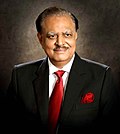
12 President Mamnoon Hussain.jpg Mamnoon Hussain
(1940–2021)
9 September 20139 September 20185 years PMLN 2013
13 President of Pakistan Dr Arif Alvi (cropped).jpg Arif Alvi
(born 1949)
9 September 201810 March 20245 years, 183 days PTI 2018
14 President Asif Ali Zardari 2024.jpg Asif Ali Zardari
(born 1955)
10 March 2024Incumbent1 year, 275 days PPP 2024
Asif Ali ZardariArif AlviMamnoon HussainMuhammad Mian SoomroPervez MusharrafMuhammad Rafiq TararWasim SajjadFarooq LeghariGhulam Ishaq KhanMuhammad Zia-ul-HaqFazal Ilahi ChaudhryZulfikar Ali BhuttoYahya KhanAyub Khan (general)Fazlul Qadir ChaudhryMohammad Afzal CheemaIskander MirzaPresident of Pakistan

Political background

Presidential standard (1956-1967) Presidential Standard of Pakistan (1956-1967).svg
Presidential standard (1956–1967)

Early origins

From 1947 until 1956, the governor-general of Pakistan acted for the head of state: King George VI (until 1952) and Queen Elizabeth II (from 1952). With the promulgation of the first constitution, Pakistan became an Islamic republic in 1956, and the governor-general was replaced with the presidency. The incumbent governor-general, Iskander Mirza, became Pakistan's first president by 1956 Pakistani presidential election. He reportedly suspended the Constitution of Pakistan of 1956 on 7 October 1958, and appointed Commander-in-Chief of the Pakistan Army General Ayub Khan as the first Chief Martial Law Administrator. Two weeks later, Ayub Khan subsequently carried out the 1958 Pakistani coup d'etat and assumed the presidency.

Iskander Mirza became the 1st President of Pakistan in 1956 Iskander Mirza.jpg
Iskander Mirza became the 1st President of Pakistan in 1956

The Constitution of Pakistan of 1962 introduced by President Ayub Khan, turned the country into a presidential republic without direct elections. Succumbing to internal and international pressure, however, Khan held the 1965 Pakistani presidential election. Khan successfully campaigned against his opponent, Fatima Jinnah, for a second term, but some have alleged that elections were rigged in favour of Ayub Khan.

Presidential standard (1974-1998) Presidential standard of Pakistan (1974-1998).svg
Presidential standard (1974–1998)

Controversy regarding the U-2 incident (1960), privatization (1963), and war with India (1965), fueled a fierce left-wing opposition movement led by Zulfikar Ali Bhutto of the PPP and Bengali nationalist Sheikh Mujibur Rahman who, with the support of demonstrators, aimed to further weaken the presidency. Suffering from paralysis and declining health, Ayub Khan handed over the presidency to army chief General Yahya Khan, who imposed martial law and announced that national elections would be held in 1970. Eventually, general elections were held in 1970 which saw the PPP gaining a majority of seats in West Pakistan (current-day Pakistan) and the Awami League gaining a majority in East Pakistan (current-day Bangladesh).

After he was unable to reach a compromise between the PPP and the Awami League, President Yahya Khan invited Nurul Amin of the Pakistan Muslim League to become the prime minister, and also appointed him as the first vice president. The growing instigated violence against Pakistanis in East Pakistan forced President Yahya Khan to use force in order to maintain order there, which further escalated Bengali resistance (1970). Preemptive strikes against India led to another war in 1971, which freed East Pakistan and created Bangladesh.

Taking personal responsibility for the political isolation and devastation of Pakistan after the fall of East Pakistan, President Yahya Khan stepped down and ceded power to Zulfikar Ali Bhutto. President Bhutto created the current Constitution of Pakistan in 1973, transforming Pakistan into a parliamentary democracy, and reducing presidential powers to that of a ceremonial figurehead.

Past Interventions

The general elections held in 1977 resulted in an atmosphere of civil unrest instigated by the right-wing alliance, the Pakistan National Alliance. The events leading to it resulted in military intervention by chief of army staff General Zia-ul-Haq and Chairman Joint Chiefs Admiral Mohammad Shariff. Suspending the Constitution in 1977, General Zia-ul-Haq took over the presidency in 1978. Zia's presidency oversaw the modern growth of far-right ideas in the country. Succumbing to domestic pressure to restore the Constitution, President Zia-ul-Haq held a referendum (1984) and called for general elections in 1985. President Zia-ul-Haq appointed Mohammad Junejo as prime minister and assumed more powers through the constitutional amendment. After dismissing Prime Minister Junejo, President Zia-ul-Haq announced that new general elections would be held, but President Zia died in a plane crash in 1988.

The general elections held in 1988 witnessed the victory of PPP in 1988 and appointed Senate chairman Ghulam Ishaq Khan to the presidency. The conflict between Prime Minister Benazir Bhutto and President Ghulam Ishaq Khan arose in two areas regarding the issues of appointments. President Ghulam Ishaq Khan repeatedly intervened in government matters and leveled charges against Prime Minister Benazir Bhutto; thus dismissing Prime Minister Prime Minister Benazir Bhutto in 1990. After holding general elections in 1990, Nawaz Sharif brought up an ideologically conservative government and President Ghulam Ishaq Khan unsuccessfully tried to dismiss Sharif. After a successful intervention by Supreme Court and Chairman of the Joint Chiefs General Shamim Allam, President Ghulam Ishaq Khan and Prime Minister Nawaz Sharif tendered resignations in 1993.

Following the new elections held in 1993, Prime Minister Benazir Bhutto established a strong government after appointing loyalist Farooq Leghari to the presidency. However, the corruption charges and the controversial death of Murtaza Bhutto in 1996 resulted in President Farooq Leghari dismissing Prime Minister Benazir Bhutto. In 1997, President Farooq Leghari could not overcome the heavy mandate bestowed on Prime Minister Nawaz Sharif by the public in 1997. President Leghari unsuccessfully supported Chief Justice Sajjad Ali Shah— both of them resigned, ending the conflict between the Judiciary, the Executive, and the Parliament. After appointing Rafiq Tarar, the Parliament successfully passed constitutional amendment to decisively limit the presidency. After staging a controversial self coup in 1999, General Pervez Musharraf dismissed Prime Minister Nawaz Sharif and President Rafiq Tarar in 2001 while assuming more powers to the presidency. In January 2004, the Electoral College elected Musharraf, and as a result he was, according to the Constitution, "deemed to be elected". [43]

President Musharraf's repeated unconstitutional intervention resulted in a standoff with the Judiciary, and declared a state of emergency in 2007, after dismissing the senior justices of the Supreme Court. Although Musharraf was elected in 2007, the constitutional legality of Musharraf's rule was found dubious. A populist constitutional movement eventually resulted in Musharraf's departure. On 22 August 2008, the electoral commission called for presidential nominations to be delivered by 26 August 2008 and for elections to be held on 6 September 2008. [44] [45]

Figurehead overview

President Arif Alvi visits Maritime Ministry, flanked by Ali Zaidi and Rizwan Ahmed Pakistani President Arif Alvi visits Maritime Ministry, flanked by Minister Ali Zaidi and Federal Secretary Rizwan Ahmed.jpg
President Arif Alvi visits Maritime Ministry, flanked by Ali Zaidi and Rizwan Ahmed

After the presidential election held in 2008, Asif Ali Zardari lobbied for constitutional amendment to restore the Constitution as it was in 1973. [46] [47] [48] [49] In 2010, the Parliament unanimously and with a large majority, passed the eighteenth amendment of the constitution. It revoked the presidential powers and changed Pakistan from a semi-presidential system of government to a parliamentary republic, with great hopes of governmental stability in the future.

See also

Notes

  1. Urdu: صدرِ پاکستان, romanized: s̤adr-e Pākistān

References

  1. Gupta, K. R., ed. (2006). India-Pakistan relations with special reference to Kashmir. New Delhi: Atlantic Publ. and Distributors. ISBN   8126906723.
  2. "Govt wants to double president's salary". The Express Tribune. 29 May 2018.
  3. "Data" (PDF). www.na.gov.pk. Retrieved 9 June 2020.
  4. "Pakistan moves to roll back presidential powers". Los Angeles Times. 2 April 2010.
  5. Article 43(1)–43(2) Archived 2016-02-04 at the Wayback Machine in Chapter 1: The President, Part III: The Federation of Pakistan in the Constitution of Pakistan.
  6. Article 46 Archived 2016-02-04 at the Wayback Machine in Chapter 1: The President, Part III: The Federation of Pakistan in the Constitution of Pakistan.
  7. Article 243(2) Archived 2015-03-21 at the Wayback Machine in Chapter 2: The Armed Forces. Part XII: Miscellaneous in the Constitution of Pakistan.
  8. Article 243(3) Archived 2015-03-21 at the Wayback Machine in Chapter 2: The Armed Forces. Part XII: Miscellaneous in the Constitution of Pakistan.
  9. 1 2 Article 41(1) Archived 2016-02-04 at the Wayback Machine in Chapter 1: The President, Part III: The Federation of Pakistan in the Constitution of Pakistan.
  10. Article 50 Archived 2016-02-04 at the Wayback Machine in Chapter 2:The Parliament of Part III: The Federation of Pakistan in the Constitution of Pakistan.
  11. Article 46 Archived 2016-02-04 at the Wayback Machine in Chapter 2:The Parliament of Part III: The Federation of Pakistan in the Constitution of Pakistan.
  12. Article 54 Archived 2016-02-04 at the Wayback Machine in Chapter 2:The Parliament of Part III: The Federation of Pakistan in the Constitution of Pakistan.
  13. Article 56 Archived 2016-02-04 at the Wayback Machine in Chapter 2:The Parliament of Part III: The Federation of Pakistan in the Constitution of Pakistan.
  14. Article 243(3) in Chapter 2: The Armed Forces. Part XII: Miscellaneous in the Constitution of Pakistan.
  15. Article 175A(3) Archived 2014-07-04 at the Wayback Machine in Chapter 2:The Parliament of Part III: The Federation of Pakistan in the Constitution of Pakistan.
  16. Article 177A(1) Archived 2015-05-28 at the Wayback Machine in Chapter 2:The Supreme Court of Pakistan of Part VII in the Constitution of Pakistan
  17. Article 45 Archived 2016-02-04 at the Wayback Machine in Chapter 2:The Parliament of Part III: The Federation of Pakistan in the Constitution of Pakistan.
  18. Article 248(1) Archived 2014-06-03 at archive.today in Chapter 4:General of Part XII: Miscellaneous in the Constitution of Pakistan.
  19. Article 41 Archived 2016-02-04 at the Wayback Machine in Chapter 1: The President of Part III: The Federation of Pakistan in the Constitution of Pakistan
  20. Govt. of Pakistan (3 March 2010). "The National Command Authority Act, 2010" (PDF). Islamabad: National Assembly press. National Assembly press. Archived (PDF) from the original on 5 March 2016. Retrieved 6 May 2015.
  21. See: The XVIII Amendment to the Constitution of Pakistan.
  22. "Constitution (Eighteenth Amendment) Act, 2010". www.pakistani.org. Retrieved 30 December 2023.
  23. 1 2 3 4 Article 41(2) Archived 2016-02-04 at the Wayback Machine in Chapter 1: The President, Part III: The Federation of Pakistan in the Constitution of Pakistan.
  24. Crilly, Rob (10 May 2013). "Pakistan election guide: How does it work?". Telegraph, Pakistan Bureau. Telegraph. Archived from the original on 14 February 2016. Retrieved 18 May 2015.
  25. Article 41(3) Archived 2016-02-04 at the Wayback Machine in Chapter 1: The President in Part III: The Federation of Pakistan in the Constitution of Pakistan.
  26. 1 2 3 4 5 APP, Associate Press of Pakistan (25 July 2013). "706 Electoral College members to elect 12th President of Pakistan". News International, 2013. News International. Archived from the original on 2 August 2013. Retrieved 18 May 2015.
  27. Article 44(1)-(2) Archived 2016-02-04 at the Wayback Machine in Chapter 1: The President in Part III: The Federation of Pakistan in the Constitution of Pakistan.
  28. Article 44(2) Archived 2016-02-04 at the Wayback Machine in Chapter 1: The President in Part III: The Federation of Pakistan in the Constitution of Pakistan.
  29. Article 42 in Chapter 1: The President in Part III: The Federation of Pakistan in the Constitution of Pakistan
  30. Article 49(1)-(2) Archived 2016-02-04 at the Wayback Machine in Chapter 1: The President, Part III: The Federation of Pakistan in the Constitution of Pakistan.
  31. Article 49(1) Archived 2016-02-04 at the Wayback Machine in Chapter 1: The President, Part III: The Federation of Pakistan in the Constitution of Pakistan.
  32. Article 47(1)-(2) Archived 2016-02-04 at the Wayback Machine in Chapter 1: The President, Part III: The Federation of Pakistan in the Constitution of Pakistan.
  33. 1 2 Article 47(3) Archived 2016-02-04 at the Wayback Machine in Chapter 1: The President, Part III: The Federation of Pakistan in the Constitution of Pakistan.
  34. Article 47(5) Archived 2016-02-04 at the Wayback Machine in Chapter 1: The President, Part III: The Federation of Pakistan in the Constitution of Pakistan.
  35. Article 47(6) Archived 2016-02-04 at the Wayback Machine in Chapter 1: The President, Part III: The Federation of Pakistan in the Constitution of Pakistan.
  36. Article 47(6) Archived 2016-02-04 at the Wayback Machine in Chapter 1: The President of Part III: The Federation of Pakistan in the Constitution of Pakistan.
  37. Article 47(7) Archived 2016-02-04 at the Wayback Machine in Chapter 1: The President, Part III: The Federation of Pakistan in the Constitution of Pakistan.
  38. Article 47(8) Archived 2016-02-04 at the Wayback Machine in Chapter 1: The President, Part III: The Federation of Pakistan in the Constitution of Pakistan.
  39. See: Movement to impeach Pervez Musharraf
  40. 1 2 3 4 5 "Presidents". National Assembly of Pakistan . 11 August 2023. Archived from the original on 11 August 2023. Retrieved 22 October 2023.
  41. Burki, Shahid Javed; Baxter, Craig (1991). Pakistan Under The Military: Eleven Years Of Zia Ul-haq. Westview Press. ISBN   978-0813379852.
  42. Waldman, Amy (2 January 2004). "Pakistan gives Musharraf confidence vote as president". The New York Times. Retrieved 20 January 2013.
  43. Waldman, Amy (2 January 2004). "Pakistan Gives Musharraf Confidence Vote as President" . The New York Times. Archived from the original on 15 May 2013.
  44. "Pakistan presidential poll on September 6". Times of India. 22 August 2008.
  45. "Pakistan to choose president on 6 September". Radio Netherlands. 22 August 2008. Archived from the original on 24 September 2008.
  46. "Pakistan's presidential poll today, Zardari front runner". Times of India. 6 September 2008. Archived from the original on 3 January 2009.
  47. "Bhutto's widower set to become Pakistan president". Google News. AFP. 2008. Archived from the original on 9 September 2008. Retrieved 8 January 2014.
  48. "Zardari wins Pakistan presidential election: officials". Google News. AFP. 5 September 2008. Archived from the original on 7 July 2009.
  49. Perlez, Jane; Masood, Salman (7 September 2008). "Bhutto's Widower Wins Pakistani Presidency" . The New York Times. Archived from the original on 22 July 2016.