Fort St. James

Last updated

Fort St. James
District of Fort St. James [1]
FORT ST. JAMES NATIONAL HISTORIC SITE , BRITISH COLUMBIA.jpg
Fort St. James, British Columbia Location.png
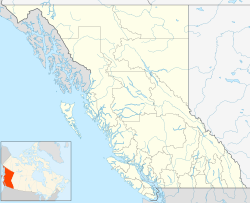
Location of Fort St. James in British Columbia
Canada British Columbia location map 2.svg
Red pog.svg
Fort St. James
Canada location map 2.svg
Red pog.svg
Fort St. James
Coordinates: 54°26′35″N124°15′15″W / 54.44306°N 124.25417°W / 54.44306; -124.25417
CountryCanada
Province British Columbia
Region Omineca Country
Regional district Regional District of Bulkley Nechako
Founded1806
Incorporated1952
Government
  Governing bodyMunicipal Council
  MayorMartin Elphee
Area
  Total
23.47 km2 (9.06 sq mi)
Elevation
700 m (2,300 ft)
Population
 (2016)
  Total
1,598
  Density72/km2 (190/sq mi)
Time zone UTC−8 (PST)
  Summer (DST) UTC−7 (PDT)
Postal code span
Area codes +250, +778
Highways 27
Waterways Stuart Lake, Stuart River, Necoslie River, Nahounli Creek
Website www.fortstjames.ca
Official nameFort St. James National Historic Site of Canada
Designated1948

Fort St. James is a district municipality and former fur trading post in northern central British Columbia, Canada. It is located on the south-eastern shore of Stuart Lake in the Omineca Country, at the northern terminus of Highway 27, which connects to Highway 16 at Vanderhoof.

Contents

It is home to the John Prince Research Forest which features abundant wildlife. [2] This community celebrated its bicentennial in 2016 and is incorporated as a district municipality.

Fort St. James National Historic Site

Founded by the North West Company explorer and fur trader Simon Fraser in 1806, it came under the management of the Hudson's Bay Company in 1821 with the forced merger of the two battling fur companies. Also known historically as Stuart Lake Post, it is one of British Columbia's oldest permanent European settlements and was the administrative centre for the Hudson's Bay Company's New Caledonia fur district. [3] The fort, rebuilt four times, continued as an important trading post well into the twentieth century. Now the fort is a National Historic Site of Canada [4] [5] with some buildings dating to the 1880s.

History

Fort St. James National Historic Site FortSt.James-NHS-2008.jpg
Fort St. James National Historic Site

As part of his commission from the North West Company, Fraser and his assistants John Stuart and James McDougall explored potential river routes to the Pacific Ocean from 1805 through 1808. Explorations in the Winter of 1805-06 by McDougall resulted in the discovery of Carrier's Lake, now known as Stuart Lake. In the heart of territory inhabited by the Carrier or Dakelh First Nation, this proved to be a lucrative locale for fur trading and so a post – Fort St. James – was built on its shore in 1806. In 1821, the fort came under the control of the Hudson's Bay Company, when the North West Company merged with it. It subsequently became the administrative headquarters of the company's vast New Caledonia District.

The fur trade was slow to take root in the area, since the economy of the Dakelh people had been based on the fishery, rather than on trapping. In addition, there were customary and ceremonial restrictions which placed obstacles in the way of an efficient fur economy. Nonetheless, eventually the post became profitable, and continued to function until its closure in 1952.

The community is located on the south-eastern shore of Stuart Lake, at the head of the Stuart River. Both the lake and the river are named for Fraser's assistant John Stuart, who would later become head of the New Caledonia District of the North West Company.

Climate

Fort St. James is located in the sub-boreal spruce zone of British Columbia, a sub-division of the hemiboreal climate zone. It is characterised by severe, snowy winters and short, warm summers. The region is rich in wildlife. Under the Köppen climate classification Fort St. James is classified as a humid continental climate (Dfb).

Climate data for Fort St. James, 1981–2010 normals, extremes 1895–present
MonthJanFebMarAprMayJunJulAugSepOctNovDecYear
Record high °C (°F)12.0
(53.6)
13.0
(55.4)
17.1
(62.8)
24.4
(75.9)
35.0
(95.0)
33.9
(93.0)
36.7
(98.1)
35.6
(96.1)
29.5
(85.1)
26.5
(79.7)
16.1
(61.0)
11.0
(51.8)
36.7
(98.1)
Mean daily maximum °C (°F)−5.3
(22.5)
−1.7
(28.9)
4.0
(39.2)
9.9
(49.8)
15.6
(60.1)
19.6
(67.3)
21.8
(71.2)
21.7
(71.1)
16.4
(61.5)
9.0
(48.2)
0.6
(33.1)
−3.8
(25.2)
9.0
(48.2)
Daily mean °C (°F)−9.5
(14.9)
−6.8
(19.8)
−1.8
(28.8)
3.9
(39.0)
9.2
(48.6)
13.4
(56.1)
15.4
(59.7)
14.8
(58.6)
10.2
(50.4)
4.3
(39.7)
−3.0
(26.6)
−7.8
(18.0)
3.5
(38.3)
Mean daily minimum °C (°F)−13.7
(7.3)
−11.8
(10.8)
−7.7
(18.1)
−2.2
(28.0)
2.8
(37.0)
7.2
(45.0)
8.9
(48.0)
7.9
(46.2)
3.9
(39.0)
−0.5
(31.1)
−6.5
(20.3)
−11.7
(10.9)
−2.0
(28.4)
Record low °C (°F)−49.4
(−56.9)
−49.4
(−56.9)
−39.4
(−38.9)
−29.4
(−20.9)
−11.7
(10.9)
−6.1
(21.0)
−5.6
(21.9)
−7.8
(18.0)
−13.3
(8.1)
−23.0
(−9.4)
−37.8
(−36.0)
−47.2
(−53.0)
−49.4
(−56.9)
Average precipitation mm (inches)48.1
(1.89)
30.0
(1.18)
25.7
(1.01)
23.7
(0.93)
38.9
(1.53)
50.6
(1.99)
50.6
(1.99)
45.0
(1.77)
39.3
(1.55)
48.1
(1.89)
44.5
(1.75)
42.6
(1.68)
487.2
(19.18)
Average rainfall mm (inches)4.9
(0.19)
3.6
(0.14)
5.9
(0.23)
18.0
(0.71)
38.2
(1.50)
50.6
(1.99)
50.6
(1.99)
45.0
(1.77)
39.1
(1.54)
38.7
(1.52)
15.7
(0.62)
4.2
(0.17)
314.5
(12.38)
Average snowfall cm (inches)43.3
(17.0)
26.4
(10.4)
19.8
(7.8)
5.7
(2.2)
0.7
(0.3)
0
(0)
0
(0)
0
(0)
0.2
(0.1)
9.5
(3.7)
28.8
(11.3)
38.4
(15.1)
172.7
(68.0)
Average precipitation days (≥ 0.2 mm)12.78.98.68.312.412.713.711.312.114.013.111.3139.1
Average rainy days (≥ 0.2 mm)2.01.83.26.812.212.713.711.312.112.45.31.895.2
Average snowy days (≥ 0.2 cm)11.47.46.02.20.40000.082.49.010.048.8
Average relative humidity (%)81.672.657.045.044.148.047.347.752.762.979.884.260.2
Mean monthly sunshine hours 51.385.5151.3207.6245.7260.2275.3256.8177.7116.060.241.01,928.6
Percentage possible sunshine 20.831.341.349.349.550.653.455.646.435.423.517.939.6
Source: Environment Canada, [6] [7] [8] (Sunshine and humidity data from Fort St. James Airport)

Demographics

In the 2021 Census of Population conducted by Statistics Canada, Fort St. James had a population of 1,386 living in 586 of its 671 total private dwellings, a change of

About one quarter of the population of the greater Fort St. James area identify as being of First Nations origin [10] The town is surrounded by numerous, small First Nations communities and Indian reserves, including Pinchie, Tachie, and Nak'azdli.

Throughout the 1980s and 1990s, Fort St. James had the highest proportion of South Asians of any municipality in Canada, forming approximately 22% of the total population as per the 1991 census. [11] The South Asian community of Fort St. James was composed mostly of Punjabis of the Sikh faith. Gursikh Temple, the local gurdwara, was built in 1981. The Sikh population of Fort St. James declined from 435 in 1991 (21.6% of the municipality's 2,015 residents) [12] to 20 in 2021 (1.5% of the municipality's 1,330 residents), [13] as many Sikhs moved to Greater Vancouver. [14] The Gursikh Temple was donated to the Victory Christian Church in 2013. [15] [14]

Panethnic groups in the Municipality of Fort St. James (1981−2021)
Panethnic
group
2021 [16] 2016 [17] 2011 [18] 2006 [19] 2001 [20] 1996 [21] 1991 [22] [23] 1986 [24] [25] [26] :981981 [27]
Pop. %Pop.%Pop.%Pop.%Pop.%Pop.%Pop.%Pop.%Pop.%
European [a] 9258901,0559901,1951,3201,2251,1851,390
Indigenous 300555445160500295265425455
South Asian 256075165200405435335345
Other [b] 358550403025903545
Total responses1,3301,5801,6351,3551,9252,0452,0151,9802,235
Total population1,3861,5981,6911,3551,9272,0462,0581,9832,284
Religious groups in Fort St. James (1991−2021)
Religious group 2021 [16] 2011 [18] 2001 [20] 1991 [22]
Pop. %Pop.%Pop.%Pop.%
Christian 3957759701,065
Sikh 2050200435
Muslim 20000
Buddhist 100100
Hindu 0000
Jewish 0000
Other religion205500
Irreligious 855755760510
Total responses1,3301,6301,9252,015

Notable people

See also

Notes

  1. Statistic includes all persons that did not make up part of a visible minority or an indigenous identity.
  2. Statistic includes total responses of "Chinese", "Black", "Filipino", "Latin American", "Southeast Asian", "Arab", "West Asian", "Korean", "Japanese", "Visible minority, n.i.e.", and "Multiple visible minorities" under visible minority section on census.

References

  1. "British Columbia Regional Districts, Municipalities, Corporate Name, Date of Incorporation and Postal Address" (XLS). British Columbia Ministry of Communities, Sport and Cultural Development. Archived from the original on 13 July 2014. Retrieved 2 November 2014.
  2. "John Prince Research Forest".
  3. "Fort St. James (District Municipality)". BC Geographical Names .
  4. Fort St. James . Canadian Register of Historic Places . Retrieved 8 January 2012.
  5. "Fort Saint James National Historic Site". BC Geographical Names .
  6. "Fort St James". Environment Canada. 25 September 2013. Retrieved 5 March 2017.
  7. "Daily Data Report for March 2016". Environment Canada. 31 October 2011. Retrieved 5 March 2017.
  8. "Fort St James A". Environment Canada (FTP). Retrieved 5 March 2017.[dead ftp link](To view documents see Help:FTP)
  9. "Population and dwelling counts: Canada, provinces and territories, and census subdivisions (municipalities), British Columbia". Statistics Canada. 9 February 2022. Retrieved 20 February 2022.
  10. Community Profile, Statistics Canada, 2001 Canadian census [ permanent dead link ]
  11. Government of Canada, Statistics Canada (29 March 2019). "1991 Census Area Profiles Profile of Census Divisions and Subdivisions - Part B". www12.statcan.gc.ca. Retrieved 11 January 2023.
  12. "Data tables, 1991 Census". Statistics Canada . Retrieved 10 January 2023.
  13. "Census Profile, 2021 Census of Population Fort St. James, District municipality (DM) British Columbia". Statistics Canada . Retrieved 10 January 2023.
  14. 1 2 "Gursikh Temple- Fort St. James". World Gurudwaras. Retrieved 10 January 2023.
  15. "Sikh Temple sale in limbo". Caledonia Courier. 13 October 2012. Retrieved 11 August 2020.
  16. 1 2 Government of Canada, Statistics Canada (26 October 2022). "Census Profile, 2021 Census of Population". www12.statcan.gc.ca. Retrieved 22 February 2023.
  17. Government of Canada, Statistics Canada (27 October 2021). "Census Profile, 2016 Census". www12.statcan.gc.ca. Retrieved 22 February 2023.
  18. 1 2 Government of Canada, Statistics Canada (27 November 2015). "NHS Profile". www12.statcan.gc.ca. Retrieved 22 February 2023.
  19. Government of Canada, Statistics Canada (20 August 2019). "2006 Community Profiles". www12.statcan.gc.ca. Retrieved 22 February 2023.
  20. 1 2 Government of Canada, Statistics Canada (2 July 2019). "2001 Community Profiles". www12.statcan.gc.ca. Retrieved 22 February 2023.
  21. Government of Canada, Statistics Canada (4 June 2019). "Electronic Area Profiles Profile of Census Divisions and Subdivisions, 1996 Census". www12.statcan.gc.ca. Retrieved 22 February 2023.
  22. 1 2 Government of Canada, Statistics Canada (29 March 2019). "1991 Census Area Profiles Profile of Census Divisions and Subdivisions - Part B". www12.statcan.gc.ca. Retrieved 22 February 2023.
  23. Government of Canada, Statistics Canada (29 March 2019). "Data tables, 1991 Census Population by Ethnic Origin (24), Showing Single and Multiple Origins (2) - Canada, provinces and territories, census divisions and census subdivisions". www12.statcan.gc.ca. Retrieved 22 February 2023.
  24. Government of Canada, Statistics Canada (27 June 2019). "Data tables, 1986 Census Census Profile for Canada, Provinces and Territories, Census Divisions and Census Subdivisions, 1986 Census - Part A". www12.statcan.gc.ca. Retrieved 22 February 2023.
  25. Government of Canada, Statistics Canada (27 June 2019). "Data tables, 1986 Census Census Profile for Canada, Provinces and Territories, Census Divisions and Census Subdivisions, 1986 Census - Part B". www12.statcan.gc.ca. Retrieved 22 February 2023.
  26. Government of Canada, Statistics Canada (3 April 2013). "Canada's aboriginal population by census subdivisions from the 1986 Census of Canada". www12.statcan.gc.ca. Retrieved 22 February 2023.
  27. Government of Canada, Statistics Canada (26 May 2020). "Data tables, 1981 Census Profile for Canada, Provinces and Territories, Census Divisions and Census Subdivisions, 1981 Census - Part B". www12.statcan.gc.ca. Retrieved 22 February 2023.
  28. "Dylan Playfair". IMDb. Retrieved 18 August 2021.
  29. babyjeff (9 July 2020). it would be so awesome . Retrieved 11 February 2025 via YouTube.

54°26′35″N124°15′15″W / 54.44306°N 124.25417°W / 54.44306; -124.25417