Cobalt(II) fluoride

Last updated
Cobalt(II) fluoride
Fluorid kobaltnaty.PNG
Cobalt(II)-fluoride-unit-cell-3D-balls.png
Names
IUPAC name
Cobalt(II) fluoride
Other names
cobalt difluoride
Identifiers
3D model (JSmol)
ChemSpider
ECHA InfoCard 100.030.044 OOjs UI icon edit-ltr-progressive.svg
EC Number
  • 233-061-9
PubChem CID
RTECS number
  • GG0770000
UNII
  • InChI=1S/Co.2FH/h;2*1H/q+2;;/p-2 Yes check.svgY
    Key: YCYBZKSMUPTWEE-UHFFFAOYSA-L Yes check.svgY
  • InChI=1/Co.2FH/h;2*1H/q+2;;/p-2
    Key: YCYBZKSMUPTWEE-NUQVWONBAL
  • F[Co]F
Properties
Co F2
Molar mass 96.93 g/mol
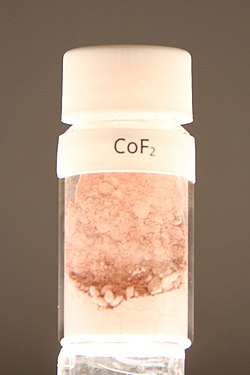
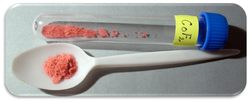
AppearanceRed crystalline solid
Density 4.46 g/cm3 (anhydrous)
2.22 g/cm3 (tetrahydrate)
Melting point 1,217 °C (2,223 °F; 1,490 K)
Boiling point 1,400 °C (2,550 °F; 1,670 K)
1.4 g/100 mL (25 °C)
Solubility soluble in HF
insoluble in alcohol, ether, benzene
+9490.0·10−6 cm3/mol
Structure
tetragonal (anhydrous)
orthorhombic (tetrahydrate)
Hazards
NFPA 704 (fire diamond)
NFPA 704.svgHealth 3: Short exposure could cause serious temporary or residual injury. E.g. chlorine gasFlammability 0: Will not burn. E.g. waterInstability 0: Normally stable, even under fire exposure conditions, and is not reactive with water. E.g. liquid nitrogenSpecial hazards (white): no code
3
0
0
Lethal dose or concentration (LD, LC):
oral (rat): 150 mg/kg
Related compounds
Other anions
cobalt(II) oxide, cobalt(II) chloride
Other cations
iron(II) fluoride, nickel(II) fluoride
Related compounds
cobalt trifluoride
Except where otherwise noted, data are given for materials in their standard state (at 25 °C [77 °F], 100 kPa).
X mark.svgN  verify  (what is  Yes check.svgYX mark.svgN ?)
Anhydrous cobalt(II) fluoride Ftorid kobal'ta.jpg
Anhydrous cobalt(II) fluoride

Cobalt(II) fluoride is an inorganic compound with the formula CoF2. It is a pink paramagnetic solid. [1] Like some other metal difluorides, CoF2 crystallizes in the rutile structure, which features octahedral Co centers and planar fluorides. [2]

Contents

Preparation and reactions

Treating anhydrous cobalt chloride with hydrogen fluoride gives cobalt(II) fluoride: [3]

CoCl2 + 2 HF → CoF2 + 2 HCl

Tetrahydrated cobalt(II) fluoride is formed by dissolving cobalt(II) in hydrofluoric acid. The anhydrous fluoride can be extracted from this by dehydration. Other synthesis can occur at higher temperatures. [4]

Cobalt(II) fluoride reacts with fluorine to give cobalt(III) fluoride:

CoF2 + 0.5 F2 → CoF3

The latter is a catalyst for fluorination reactions.

References

  1. Donaldson, John Dallas; Beyersmann, Detmar (2005). "Cobalt and Cobalt Compounds". Ullmann's Encyclopedia of Industrial Chemistry. Vol. 52. pp. 363–472. doi:10.1002/14356007.a07_281.pub2. ISBN   978-3-527-30385-4. PMC   7682369 . PMID   1960848.
  2. Stout, J. W.; Reed, Stanley A. (1954). "The Crystal Structure of MnF2, FeF2, CoF2, NiF2 and ZnF2". J. Am. Chem. Soc. 76 (21): 5279–5281. doi:10.1021/ja01650a005.
  3. W. Kwasnik; R. Sauer (1963). "Cobalt(II) Fluoride". In G. Brauer (ed.). Handbook of Preparative Inorganic Chemistry, 2nd Ed. Vol. 2. NY,NY: Academic Press. p. 267.
  4. J.C. Bailar (1973), Comprehensive Inorganic Chemistry, Pergoamon