Dinwiddie County, Virginia | |
|---|---|
| | |

| Location within the U.S. state of Virginia | |
| Coordinates: 37°05′N77°38′W / 37.08°N 77.63°W | |
| Country | |
| State | |
| Founded | 1752 |
| Named after | Robert Dinwiddie |
| Seat | Dinwiddie |
| Largest town | McKenney |
| Area | |
• Total | 507 sq mi (1,310 km2) |
| • Land | 504 sq mi (1,310 km2) |
| • Water | 3.5 sq mi (9.1 km2) 0.7% |
| Population (2020) | |
• Total | 27,947 |
| • Density | 55.5/sq mi (21.4/km2) |
| Time zone | UTC−5 (Eastern) |
| • Summer (DST) | UTC−4 (EDT) |
| Congressional district | 4th |
| Website | www |
Dinwiddie County is a largely rural United States county located in the south-central part of the Commonwealth of Virginia. Dinwiddie forms part of the Greater Richmond metropolitan statistical area, and as of the 2020 census, the county's population was 27,947. [1] The county seat is the small town of Dinwiddie, which shares the county’s name. [2]
The county was established in1752 from part of Prince George County and was named in honor of Robert Dinwiddie, the de facto head of the Virginia colony at the time. Agriculture has historically played an important role in the county's economy. [3] Dinwiddie's close proximity to the city of Petersburg and its railroad lines led to the county hosting six notable Civil War battles.
The first inhabitants of the area were Paleo-Indians, prior to 8000 BC. They are believed to have been nomadic hunter-gatherers following animal migrations. Early stone tools have been discovered in various fields within the county. At the time of European contact, Native Americans made their homes in the region.
Dinwiddie County was formed May 1, 1752, from Prince George County. The county is named for Robert Dinwiddie, Lieutenant Governor of Virginia, 1751–1758. The county raised several militia units that would fight in the American Revolution, and founding father John Banister was born here.
Dinwiddie County was the birthplace of Elizabeth (Burwell) Hobbs Keckly, a free black dressmaker who worked for two presidents' wives: Mrs. Jefferson Davis and later Mary Todd Lincoln. Thomas Day was also a native; he was well known later at Milton, North Carolina, as a free black cabinetmaker. Another native son was Dr. Thomas Stewart, perhaps America's first free black 18th-century rural physician. [4] Robert B. Pamplin was also born here, and he founded R.B. Pamplin Corporation.
During the Civil War the Battle of Lewis's Farm was fought along Quaker Road [Rt. 660]. It took place on March 29, 1865. This was the first in several attempts by Union General Ulysses S. Grant to cut Robert E. Lee's final supply line—the Southside Railroad—in the spring of 1865. Here the Union forces led by Brig. Gen. Joshua L. Chamberlain engaged Confederates under Maj. Gen. Bushrod R. Johnson. After sharp fighting, the Union troops entrenched nearby along the Boydton Plank Road, and Johnson withdrew to his lines at White Oak Road. The Union army cut the rail line four days later, after capturing Five Forks on April 1, 1865, at the Battle of Five Forks. Several other engagements were fought in Dinwiddie County, including the Battle of Dinwiddie Court House, Battle of Sutherland's Station, and Battle of White Oak Road.
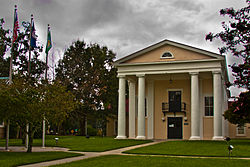
The Dinwiddie County Historical Society currently occupies the historic Dinwiddie County Court House.
Dinwiddie is located in southern Virginia, southwest of the independent city of Petersburg, which separated from the county (and adjacent Prince George County) in 1871. According to the U.S. Census Bureau, the county has a total area of 507 square miles (1,310 km2), of which 504 square miles (1,310 km2) is land and 3.5 square miles (9.1 km2) (0.7%) is water. [5] It is located between two US Army forts, Fort Gregg-Adams to the east and Fort Barfoot to the west.
| Census | Pop. | Note | %± |
|---|---|---|---|
| 1790 | 13,934 | — | |
| 1800 | 15,374 | 10.3% | |
| 1810 | 18,190 | 18.3% | |
| 1820 | 20,482 | 12.6% | |
| 1830 | 21,901 | 6.9% | |
| 1840 | 22,558 | 3.0% | |
| 1850 | 25,118 | 11.3% | |
| 1860 | 30,198 | 20.2% | |
| 1870 | 30,702 | 1.7% | |
| 1880 | 32,870 | 7.1% | |
| 1890 | 13,515 | −58.9% | |
| 1900 | 15,374 | 13.8% | |
| 1910 | 15,442 | 0.4% | |
| 1920 | 17,949 | 16.2% | |
| 1930 | 18,492 | 3.0% | |
| 1940 | 18,166 | −1.8% | |
| 1950 | 18,839 | 3.7% | |
| 1960 | 22,183 | 17.8% | |
| 1970 | 25,046 | 12.9% | |
| 1980 | 22,602 | −9.8% | |
| 1990 | 20,960 | −7.3% | |
| 2000 | 24,533 | 17.0% | |
| 2010 | 28,001 | 14.1% | |
| 2020 | 27,947 | −0.2% | |
| 2021 (est.) | 27,912 | [6] | −0.1% |
| U.S. Decennial Census [7] 1790–1960 [8] 1900–1990 [9] 1990–2000 [10] 2010 [11] 2020 [12] | |||
| Race / Ethnicity (NH = Non-Hispanic) | Pop 2010 [11] | Pop 2020 [12] | % 2010 | % 2020 |
|---|---|---|---|---|
| White alone (NH) | 17,617 | 17,346 | 62.92% | 62.07% |
| Black or African American alone (NH) | 9,134 | 8,115 | 32.62% | 29.04% |
| Native American or Alaska Native alone (NH) | 83 | 91 | 0.30% | 0.33% |
| Asian alone (NH) | 122 | 119 | 0.44% | 0.43% |
| Pacific Islander alone (NH) | 7 | 3 | 0.02% | 0.01% |
| Some Other Race alone (NH) | 18 | 102 | 0.06% | 0.36% |
| Mixed Race or Multi-Racial (NH) | 346 | 1,043 | 1.24% | 3.73% |
| Hispanic or Latino (any race) | 674 | 1,128 | 2.41% | 4.04% |
| Total | 28,001 | 27,947 | 100.00% | 100.00% |
As of the 2020 census, the county had a population of 27,947. The median age was 43.4 years. 21.3% of residents were under the age of 18 and 18.7% of residents were 65 years of age or older. For every 100 females there were 95.8 males, and for every 100 females age 18 and over there were 94.1 males age 18 and over. [13] [14]
The racial makeup of the county was 62.7% White, 29.3% Black or African American, 0.4% American Indian and Alaska Native, 0.5% Asian, 0.0% Native Hawaiian and Pacific Islander, 2.3% from some other race, and 4.9% from two or more races. Hispanic or Latino residents of any race comprised 4.0% of the population. [14]
28.3% of residents lived in urban areas, while 71.7% lived in rural areas. [15]
There were 10,925 households in the county, of which 29.9% had children under the age of 18 living with them and 27.0% had a female householder with no spouse or partner present. About 25.0% of all households were made up of individuals and 11.7% had someone living alone who was 65 years of age or older. [13]
There were 11,803 housing units, of which 7.4% were vacant. Among occupied housing units, 76.2% were owner-occupied and 23.8% were renter-occupied. The homeowner vacancy rate was 1.2% and the rental vacancy rate was 6.0%. [13]
As of the census [16] of 2000, there were 24,533 people, 9,107 households, and 6,720 families residing in the county. The population density was 49 people per square mile (19 people/km2). There were 9,707 housing units at an average density of 19 units per square mile (7.3 units/km2). The racial makeup of the county was 64.55% White, 33.66% Black or African American, 0.22% Native American, 0.31% Asian, 0.04% Pacific Islander, 0.40% from other races, and 0.82% from two or more races. 0.97% of the population were Hispanic or Latino of any race.
There were 9,107 households, out of which 32.10% had children under the age of 18 living with them, 54.80% were married couples living together, 13.90% had a female householder with no husband present, and 26.20% were non-families. 22.20% of all households were made up of individuals, and 8.50% had someone living alone who was 65 years of age or older. The average household size was 2.58 and the average family size was 3.01.
In the county, the population was spread out, with 24.00% under the age of 18, 6.70% from 18 to 24, 30.90% from 25 to 44, 26.20% from 45 to 64, and 12.20% who were 65 years of age or older. The median age was 38 years. For every 100 females, there were 98.80 males. For every 100 females age 18 and over, there were 96.00 males.
The median income for a household in the county was $41,582, and the median income for a family was $47,961. Males had a median income of $32,860 versus $24,346 for females. The per capita income for the county was $19,122. About 6.60% of families and 9.30% of the population were below the poverty line, including 11.60% of those under age 18 and 12.60% of those age 65 or over.
Dinwiddie County has leaned Republican ever since the turn of the 21st Century; originally it was solidly Democratic but began shifting to the right during the Reagan era. Democrat Jimmy Carter in 1976 was the last to obtain an absolute majority in the county, though he won it by a narrow plurality in 1980. Bill Clinton did the same in 1996, having lost the county by only 24 votes in 1992. [17] The county is currently represented by Republican Frank Ruff of the 15th district and Democrat Joe Morrissey of the 16th district in the Virginia Senate. In the Virginia House of Delegates, the county is represented by Republicans Kim Taylor of the 63rd district and Otto Wachsmann of the 75th district. The county is represented by Democrat Jennifer McClellan of Virginia's 4th congressional district in the U.S. House of Representatives.
| Year | Republican | Democratic | Third party(ies) | |||
|---|---|---|---|---|---|---|
| № | % | № | % | № | % | |
| 1912 | 58 | 8.91% | 512 | 78.65% | 81 | 12.44% |
| 1916 | 85 | 12.54% | 592 | 87.32% | 1 | 0.15% |
| 1920 | 186 | 22.57% | 636 | 77.18% | 2 | 0.24% |
| 1924 | 122 | 14.70% | 685 | 82.53% | 23 | 2.77% |
| 1928 | 332 | 26.00% | 945 | 74.00% | 0 | 0.00% |
| 1932 | 104 | 9.12% | 1,028 | 90.18% | 8 | 0.70% |
| 1936 | 127 | 8.61% | 1,343 | 91.05% | 5 | 0.34% |
| 1940 | 264 | 18.86% | 1,129 | 80.64% | 7 | 0.50% |
| 1944 | 279 | 20.26% | 1,096 | 79.59% | 2 | 0.15% |
| 1948 | 261 | 17.40% | 961 | 64.07% | 278 | 18.53% |
| 1952 | 983 | 39.77% | 1,462 | 59.14% | 27 | 1.09% |
| 1956 | 807 | 30.71% | 1,282 | 48.78% | 539 | 20.51% |
| 1960 | 935 | 34.81% | 1,714 | 63.81% | 37 | 1.38% |
| 1964 | 2,096 | 48.91% | 2,182 | 50.92% | 7 | 0.16% |
| 1968 | 1,451 | 27.60% | 1,551 | 29.50% | 2,255 | 42.90% |
| 1972 | 3,314 | 62.47% | 1,901 | 35.83% | 90 | 1.70% |
| 1976 | 2,413 | 37.28% | 3,873 | 59.83% | 187 | 2.89% |
| 1980 | 3,369 | 48.01% | 3,475 | 49.52% | 174 | 2.48% |
| 1984 | 4,547 | 56.04% | 3,485 | 42.95% | 82 | 1.01% |
| 1988 | 4,165 | 54.38% | 3,405 | 44.46% | 89 | 1.16% |
| 1992 | 3,648 | 42.43% | 3,624 | 42.15% | 1,325 | 15.41% |
| 1996 | 3,503 | 42.90% | 3,871 | 47.40% | 792 | 9.70% |
| 2000 | 4,959 | 54.28% | 4,001 | 43.79% | 176 | 1.93% |
| 2004 | 6,193 | 57.14% | 4,569 | 42.15% | 77 | 0.71% |
| 2008 | 6,526 | 50.62% | 6,246 | 48.45% | 120 | 0.93% |
| 2012 | 6,875 | 50.59% | 6,550 | 48.20% | 164 | 1.21% |
| 2016 | 7,447 | 54.86% | 5,765 | 42.47% | 363 | 2.67% |
| 2020 | 8,695 | 57.61% | 6,224 | 41.24% | 173 | 1.15% |
| 2024 | 9,549 | 61.17% | 5,942 | 38.06% | 120 | 0.77% |
The Bureau of Economic Analysis combines the independent cities of Petersburg and Colonial Heights with Dinwiddie County for statistical purposes.
Appomattox Regional Library serves as the public library for the county. It is located in Dinwiddie. Dinwiddie High School is the county high school, and Dinwiddie Middle School is the middle school. Their mascot is the Generals. There is also Dinwiddie Elementary School, Midway Elementary, Sutherland Elementary, Sunnyside Elementary, and Southside Elementary, as well as Historic Southside High School Education Center.