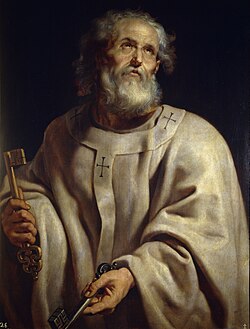
Matthew 16:18 of the New Testament records Jesus saying to Peter, one of the apostles:
And so I say to you, you are Peter, and upon this rock I will build my church,[a] and the gates of the netherworld shall not prevail against it.[8]
This, according to Catholic theology, made Peter the first pope.[9]
Jesus taught of the Kingdom of God, and that you must accept him in order to enter it. He taught that devotion to God comes before everything else, including your family and yourself. He condemned hatred, lust, murder, adultery, and divorce.[10]
Paul the Apostle has occasionally been referred to as the first Christian theologian, due to his interpretation of the life and teachings of Jesus. He referred to Jesus as the Son of God, and that he died for our sins.[12]
Controversies
Divisions within the Church had always existed. During the first century of the Church, people were debating whether gentiles could become Christian. By the end of that century, debates occurred over this in Antioch where Ignatius was the Bishop. Others claimed that Jesus was not truly a human, but a spirit, and did not actually die. Ignatius countered this by stating that if he did not die, then the resurrection could not have happened.[13] There were controversial movements such as Gnosticism that rose and threatened to split the Church. These movements were condemned by the Church Fathers, such as Irenaeus in his Against Heresies.[14][15]
The Gnostics believed that there were two gods: one from the old testament, that is inferior, and a benevolent god that was shown through Christ. Irenaeus countered using both the Old Testament (Deuteronomy 5:8) and the New Testament (1 Corinthians 8:4), which state that there is only one God who created everything. He also compared Gnosticism to cherry-picking parts of the Iliad by Homer to create an entirely different message from the one intended. As an example, the Gnostics used the phrase "the God of this world" (Corinthians 4:4) as proof of the existence of a lesser god, when in fact, the phrase was talking about Satan.[16]
Role of the Bible
Ignatius and Papias, among others, believed oral tradition was more important than the written books of the Bible. Papias wrote "information from the books would not help me as much as the word of a living and surviving voice". In the upcoming decades, as oral tradition became more difficult, the books started to get more widespread acceptance.[17]
Texts in writing became important for Christianity. The eucharist started with reading from the gospels and the Septuagint, the Greek translation of the Old Testament. There was no unanimous consensus for the Biblical cannon back then. Decisions for what books to use were often made based on tradition: books that have been more common and been in use for longer periods of time became more likely to be featured. The process for deciding what books to use was gradual, and some books were questioned, such as 2 Peter, James, Revelation, and Hebrews. [18]
Origen, a Church father, developed ideas that later became the concept of purgatory. He believed that parts of the Bible were metaphorical and not always literal. However, his teachings were condemned in the sixth century.[19]
"We believe in one God, the Father, the Almighty, maker of heaven and earth. … We believe in One Lord, Jesus Christ, the only Son of God … of one Being with the Father … [who] was made man … he suffered death and … he rose again … and is seated at the right hand of the Father. … We believe in the Holy Spirit … the giver of life, who proceeds from the Father and the Son … who has spoken through the prophets."[21]
Late Antiquity
Augustine was a Christian theologian whose "distinctive theological style shaped Latin Christianity in a way surpassed only by Scripture itself." He often used the teachings of Plato, and modern Catholicism is heavily inspired by him. He defended predestination.[22] Augustine taught that just as the trinity has three parts to it, love has three parts as well: the person that loves, the person that is being loved, and the act of love itself.[23] He, along with Paul and Plato, believed a true philosopher is a lover of God, because true wisdom is the same as God. Augustine used this to explain that the true philosophy and the true religion are the same. He heavily criticized what he called "the philosophy of this world" -- referring to Paganism, stoicism, and Platonism; he accuses them of pride, of trying to cultivate happiness through their own merits, and for rejecting Jesus and Christianity. He also developed the concept of just war theory. Augustine's teachings were unanimously accepted, not just in Catholicism, but in all of Western Christianity, until the nineteenth century.[24]
The prevalence of torture and executions during this era has been exaggerated due to propaganda produced during the renaissance and from figures such as Voltaire and Beccaria. Most criminals who were caught had received light and merciful punishment. Fines, short-term jail sentences, or exiles were far more likely to be given as a punishment than torture and execution.[27]
Almost nobody in this time period, as well as before or after it, believed that the earth was flat.[28]
Modern philosophers, starting from the Renaissance, often hated scholasticism. Hegel wrote that he would "put on seven-league boots" to skip the Middle Ages, and that he could "cry land like the sailor" when Descartes came along. However, during the Romantic era, people were very fond of scholasticism and the Middle Ages.[29]
Catholics often combined science and theology. Galileo, Copernicus, Galvani, and Pasteur were all devout Catholics. John Heilbron stated that the Catholic Church arguably gave more financial aid to astronomy than all other institutions during the Middle Ages and the centuries after. No known scientist has ever been executed by the Catholic Church due to their scientific beliefs.[30]
In the 16th and early 17th centuries, the Catholic Church launched the Counter-Reformation in opposition to the Protestant reformation. In response to criticisms from Protestants, the Catholic Church got rid of corruption and ambiguous areas in their theology.[31]
The Second Vatican Council is one of the most important events in the history of Catholicism. It occurred in 1962 - 1965, and was announced by Pope John XXIII. This was the first group that women were allowed to attend. The council condemned abortion, euthanasia, and birth control. Pope Leo XIV, elected in 2025, affirmed the importance of this council.[33]
Today, the Catholic Church opposes sex change, gender theory, surrogacy, abortion, and euthanasia, while calling out dangers in poverty, migration, and human trafficking.[34]. Catholicism supports the trinity, but that there is still notion that there is only one God,[35] who is omnipotent, beyond the universe, and created human beings in his image, meaning that all human beings have a special relationship with him, and that Catholics should emphasize treating other human beings with love and forgiveness [36]. It teaches that Jesus was both fully human and fully divine,[37] and that after he had the last supper, that he was betrayed by Judas Iscariot, put on trial by the Sanhedrin for alleged blasphemy, was crucified under Pontius Pilate, rose from the dead, and ascended into heaven; signaling not just his strength, but that his disciples should not fear death.[38] It teaches that after we die, we either go to purgatory followed by heaven, or that we go to Hell.[39]
↑The New American Bible Revised Edition writes here: "16:18 You are Peter, and upon this rock I will build my church: the Aramaic word kēpā’ meaning rock and transliterated into Greek as Kēphas is the name by which Peter is called in the Pauline letters (1 Cor 1:12; 3:22; 9:5; 15:4; Gal 1:18; 2:9, 11, 14) except in Gal 2:7–8 (“Peter”). It is translated as Petros (“Peter”) in Jn 1:42. The presumed original Aramaic of Jesus’ statement would have been, in English, “You are the Rock (Kēpā’) and upon this rock (kēpā’) I will build my church.” The Greek text probably means the same, for the difference in gender between the masculine noun petros, the disciple’s new name, and the feminine noun petra (rock) may be due simply to the unsuitability of using a feminine noun as the proper name of a male. Although the two words were generally used with slightly different nuances, they were also used interchangeably with the same meaning, “rock.” Church: this word (Greek ekklēsia) occurs in the gospels only here and in Mt 18:17 (twice). There are several possibilities for an Aramaic original. Jesus’ church means the community that he will gather and that, like a building, will have Peter as its solid foundation. That function of Peter consists in his being witness to Jesus as the Messiah, the Son of the living God. The gates of the netherworld shall not prevail against it: the netherworld (Greek Hadēs, the abode of the dead) is conceived of as a walled city whose gates will not close in upon the church of Jesus, i.e., it will not be overcome by the power of death."
This page is based on this Wikipedia article Text is available under the CC BY-SA 4.0 license; additional terms may apply. Images, videos and audio are available under their respective licenses.


 Catholic Churchportal


