In Earth's atmosphere, the ratio of 3He to 4He is 1.37×10⁻⁶.[2] However, the isotopic abundance of helium varies greatly depending on its origin, though helium-4 is always in great preponderance. In the Local Interstellar Cloud, the proportion of 3He to 4He is 1.62(29)×10−4,[4] which is about 120 times higher than in Earth's atmosphere. Rocks from Earth's crust have isotope ratios varying by as much as a factor of ten; this is used in geology to investigate the origin of rocks and the composition of the Earth's mantle.[5] The different formation processes of the two stable isotopes of helium produce the differing isotope abundances.
Equal mixtures of liquid 3He and 4He below 0.8K separate into two immiscible phases due to differences in quantum statistics: 4He atoms are bosons while 3He atoms are fermions.[6]Dilution refrigerators take advantage of the immiscibility of these two isotopes to achieve temperatures as low as a few millikelvin.
A mix of the two isotopes spontaneously separates into 3He-rich and 4He-rich regions.[7] Phase separation also exists in ultracold gas systems.[8] It has been shown experimentally in a two-component ultracold Fermi gas case.[9][10] The phase separation can compete with other phenomena as vortex lattice formation or an exotic Fulde–Ferrell–Larkin–Ovchinnikov phase.[11]
Helium-2, 2He, is unbound. The only bound atom with a mass number of 2 is deuterium.[15][16] The nucleus of 2He, a diproton, consists of two protons with no neutrons. Its instability is due to spin–spin interactions in the nuclear force and the Pauli exclusion principle, which states that within a given quantum system two or more identical particles with the same half-integer spins (fermions) cannot simultaneously occupy the same quantum state; so 2He's two protons have opposite-aligned spins and the diproton itself has negative binding energy.[17]
A rare form of radioactivity is diproton emission, where a nucleus emits two protons in a quasi-bound 1S0 configuration, which then separate.[18] In 2000, Oak Ridge National Laboratory detected two-proton emission from 18 10Ne, produced by a 17 9F ion beam onto a proton-rich target. But the experiment didn't have the sensitivity to distinguish if the emission was a decay by two separate protons, or by a diproton.[19][20] In 2008, the Istituto Nazionale di Fisica Nucleare confirmed 18Ne decayed to a diproton with a 31% branching ratio.[13][21] Several experiments have since detected diproton emission from other isotopes.[18]
The lack of a bound diproton has been used to argue for fine-tuning for the development of life due to its effect on Big Bang nucleosynthesis and stellar evolution.[22][23] Hypothetical models suggest that if the strong force was 2% greater, then diprotons would be bound (but still β+ decay to deuterium).[24] Recent studies have found that a universe with bound diprotons doesn’t preclude the development of stars and life.[24][23][16]
One impact of a hypothetical bound diproton is a change to the early steps of the proton-proton chain. In our universe, the first step of the proton-proton chain proceeds via the weak force,[25][26]
Under the influence of electromagnetic interactions, the Jaffe-Low primitives[27] may leave the unitary cut, creating narrow two-nucleon resonances, like a diproton resonance with a mass of 2000 MeV and a width of a few hundred keV.[28] To search for this resonance, a beam of protons with kinetic energy 250 MeV and an energy spread below 100 keV is required, which is feasible considering the electron cooling of the beam.
3He is the only stable isotope other than 1H with more protons than neutrons. There are many such unstable isotopes, such as 7Be and 8B. There is only a trace (~2ppm)[2] of 3He on Earth, mainly present since the formation of the Earth, although some falls to Earth trapped in cosmic dust.[5] Trace amounts are also produced by the beta decay of tritium.[29] In stars, however, 3He is more abundant, a product of nuclear fusion. Extraplanetary material, such as lunar and asteroidregolith, has traces of 3He from solar wind bombardment.
To become superfluid, 3He must be cooled to 2.5 millikelvin, ~900 times lower than 4He (2.17K). This difference is explained by quantum statistics: 3He atoms are fermions, while 4He atoms are bosons, which condense to a superfluid more easily.
The most common isotope, 4He, is produced on Earth by alpha decay of heavier elements; the alpha particles that emerge are fully ionized 4He nuclei. 4He is an unusually stable nucleus because it is doubly magic. It was formed in enormous quantities in Big Bang nucleosynthesis.
Terrestrial helium consists almost exclusively (all but ~2ppm)[2] of 4He. 4He's boiling point of 4.2K is the lowest of all known substances except 3He. When cooled further to 2.17K, it becomes a unique superfluid with zero viscosity. It solidifies only at pressures above 25 atmospheres, where it melts at 0.95K.
Helium-5
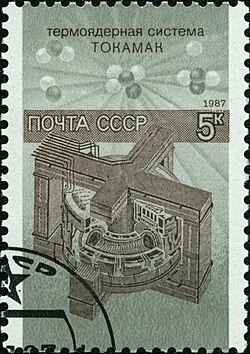
A 1987 Soviet stamp celebrating the T-15 tokamak depicts the helium-5 nucleus during deuterium–tritium fusionFusion cross sections of major reactions. Without the resonance in helium-5, the DT reaction would be similar to the DD reaction.
Helium-5 is extremely unstable, decaying to helium-4 with a half-life of 602 yoctoseconds. It is briefly produced in the favorable fusion reaction:
The reaction is greatly enhanced by the existence of a resonance. Helium-5, which has a natural spin state of -3/2 at the 0 MeV ground state, has a +3/2 excited spin state at 16.84 MeV. Because the reaction creates helium-5 nuclei with an energy level close to this state, it happens more frequently. This was discovered by Egon Bretscher, who was investigating weaponization of fusion reactions for the Manhattan Project.
The DT reaction specifically is 100 times more likely than the DD reaction at relevant energies, but would be similar without the resonance. The 2H-3He reaction benefits from a similar resonance in lithium-5, but is Coulomb-suppressed i.e. the +2 helium nucleus charge increases the electrostatic repulsion for fusing nuclei.[30]
Helium-6 and helium-8
These are the long-lived radioactive isotope of helium; helium-6 beta decays with a half-life of 806.9 milliseconds, and helium-8 with a half-life of 119.5 milliseconds, though additional particle emission is possible and significant for the latter. 6He and 8He are thought to consist of a normal 4He nucleus surrounded by a neutron "halo" (of two neutrons in 6He and four neutrons in 8He). The unusual structures of halo nuclei may offer insights into the isolated properties of neutrons and physics beyond the Standard Model.[31][32]
↑Wang, Meng; Huang, W.J.; Kondev, F.G.; Audi, G.; Naimi, S. (2021). "The AME 2020 atomic mass evaluation (II). Tables, graphs and references*". Chinese Physics C. 45 (3) 030003. doi:10.1088/1674-1137/abddaf.
↑Loveland, Walter D. (2017). Modern Nuclear Chemistry. New York Academy of Sciences Series (1sted.). Newark: John Wiley & Sons, Incorporated. ISBN978-1-119-32838-4.
↑Iliadis, Christian (2015). Nuclear Physics of Stars. New York Academy of Sciences Series (2nded.). Newark: John Wiley & Sons, Incorporated. ISBN978-3-527-33648-7.
↑Dunlap, Richard A. (2023). An Introduction to the Physics of Nuclei and Particles. IOP Ebooks Series (2nded.). Bristol: Institute of Physics Publishing. ISBN978-0-7503-6096-8.
↑Chadwick, Mark B.; Paris, Mark W.; Haines, Brian M. (2023). "DT fusion through the 5He 3/2+ "Bretscher state" accounts for ≥25% of our existence via nucleosynthesis and for the possibility of fusion energy". arXiv:2305.00647 [physics.hist-ph].
This page is based on this Wikipedia article Text is available under the CC BY-SA 4.0 license; additional terms may apply. Images, videos and audio are available under their respective licenses.