The road and rail on these bridges are often on the same level, but segregated, so that rail vehicles could operate at the same time as road vehicles (e.g., Sydney Harbour Bridge). The roadway can also be above the rail tracks, or vice versa (e.g., Øresund Bridge, Oliver Bridge).
Sometimes, the road and rail share the same carriageway on the bridge (e.g., Dom Pedro II Bridge). In these cases, road traffic usually must stop when trains are using the bridge. However, if the bridge is wide enough, both kinds of traffic can operate together as well (e.g., Bechyně Bridge).
"Rail" in this case include all types of rail transport.
Tocumwal – separated by construction of adjacent road-only bridge in 1987.[8]
Murray Bridge[9] from the opening of the railway in 1886 until a separate rail bridge was opened in 1925.
Paringa Bridge, from its opening in 1927[10][11] until the Barmera railway line closed in 1982.[12] The railway area was converted to a cycleway in 1986. Originally one lane of traffic and the railway shared the area within the truss spans, but a single-lane deck was later attached to either outer side of the trusses to separate road and rail traffic.
Echuca–Moama, opened in 1879, road only since adjacent rail-only bridge opened in 1989.[13]
Robinvale, 1927, as part of the Robinvale railway line. Road only after construction of the line was abandoned in 1943. Replaced by a new road bridge in 2006.[14]
Camden Rail bridge attached to the road bridge until line closure in 1963.
FSC Locomotive no. 22 crossing the Sigatoka Bridge (2008).
On Viti Levu, the CSR Company was obliged to provide road-rail bridges when it built bridges for the Cane Trains to their sugar mills, e.g. the two largest bridges over the Ba and Sigatoka rivers. Many are now rail-only as separate road bridges has been built.
The Ba Bridge (550ft; 170m) in Ba has 19 spans, 17 standard spans (30ft; 9.1m) and a short span at each end, and has been rail-only for many years. The Sigatoka Bridge (810ft; 250m) in Sigatoka has 27 spans. Both bridges are prone to hurricane damage due to extra flow of water; the Ba Bridge often disappears under water, but is not always damaged (see Cane Trains).
Sigatoka Bridge was washed away by storms, January 2009.[24]
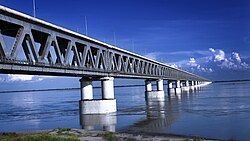
The Digha–Sonpur Bridge (JP Setu) over the Ganges, connecting the cities of Patna and Sonpur.Bogibeel Bridge, with a 3-lane road highway on its upper deck & a double broad-gauge rail line on its lower deck.
A 1930 report listed 33 bridges and estimated that the cost of bridge-keepers, extra maintenance for the decks, etc. amounted to £15,500 a year, as against £4,307 paid to NZR.[43]
The Coastal Pacific using the upper level of the Seddon bridge in April 2007. Road vehicles used the lower level until a new bridge was opened in November 2007.Section of Arahura Bridge – standing beside the new bridge as an example of this rare type of construction.
Current
Alexandra – Manuherikia River, Central Otago Line – single level, shared deck (rail closed)
Taramakau River Bridge between Greymouth and Kumara - dual use from opening in 1893 until a separate road bridge opened alongside in 2018. This bridge was the last single-level or shared carriageway bridge in the country.[49]
Rødberg Bridge, carried the now closed Numedal Line to its terminus in Rødberg, and the highway continuing to Geilo over Upsetelva in the center of Rødberg. The rails are still in place, covered by tarmac. There has been no rail traffic on Numedalsbanen since 1988. The railway is in the road, so car traffic had to stop when trains were passing.
Bruhaug Bridge, also on the Numedal Line, carried both the railway and local car traffic over the river Numedalslågen. The road surface is wood.
Fetsund Bridge, the combined road-rail bridge built in 1919.
Sarp Bridge, the original multi-level road-rail bridge in 1879.
Lidingöbron – 1km long parallel road and rail (two separate bridges). The road bridge was built 1971; before that the old bridge had road and double track railway in the same carriageway.
King George V BridgeKing George V Bridge showing the road and railway
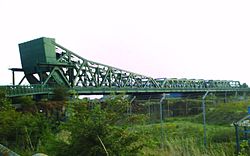
Preston Dock Swing Bridge, Lancashire. Road traffic and pedestrians controlled by barriers from the lock control room. Still used by The Ribble Steam Railway and tour trains visiting from the main line, still running in 2012 the bridge is used for delivery of bitumen by railway to the Preston Total Bitumen plant. On arrival from Total's oil refinery in Immingham, North Lincolnshire, the tankers are parked at the exchange sidings. The steam railway staff divide the trains and shunt the tankers into Total Bitumen's siding for the bitumen processing and distribution plant, later reforming the trains for their return journey to Immingham.
Britannia Bridge Robert Stephenson's famous, formerly 'tubular' railway bridge across the Menai Strait in Wales. Rebuilt as a road and rail bridge after a major fire in 1970.
Craigavon Bridge, is a double decker bridge located in Derry, Northern Ireland and is still in operation as a road bridge, it served as a rail bridge from its opening until the 1950s,
Connel Bridge, near Oban, Scotland, was shared until the railway closed in the 1960s. A cantilever bridge.
Queen Alexandra Bridge, still in road (A1231) use across the River Wear between Deptford and Southwick in Sunderland, mineral railway abandoned in 1921 after 12 years' use.
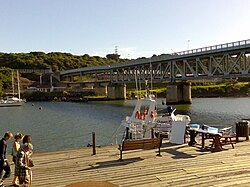
Newhaven Harbour, East Sussex, swing bridge standard gauge harbour branch shared with main coast road to Brighton, closed about 1962.
Harahan Bridge (formerly) – through truss bridge across the Mississippi River, connecting West Memphis, Arkansas to Memphis, Tennessee. Built for two railroad tracks and two one-lane "wagonways" cantilevered outside the through truss. Vehicular traffic moved to Memphis & Arkansas Bridge in 1949; though the original decks on both "wagonways" were removed, one of them was rebuilt for pedestrian/bicycle use in 2016.
Portage Lake Lift Bridge, connecting Hancock and Houghton. The world's heaviest and largest double deck vertical lift bridge. 4-lane road on upper deck, rail on lower deck (converted to trail). The lower deck was also paved so the bridge could be placed in an intermediate position to allow road traffic only.
Second Hannibal Bridge, in Kansas City, Missouri, across the Missouri River. Opened in 1917, it had a road deck until 1956, when another bridge was built, but the rail deck is presently in use. Evidence of the road deck is still plainly visible.
ASB Bridge, in Kansas City, Missouri, across the Missouri River. Opened in 1911, it carried vehicular traffic until 1987, when a new span was built. The bridge is unique in that its lower part is a vertical lift drawbridge that can be lifted without interrupting traffic on the upper deck.
Roosevelt Avenue (Flushing River) Bridge – double deck bascule span with Roosevelt Avenue on lower level and the IRT Flushing Line elevated line on upper level over the Flushing River. Completed in 1928.
Steel Bridge – a through truss, double lift bridge across the Willamette River in Portland, Oregon, carrying pedestrians, automobiles, buses, rail tracks, and the MAX Light Rail, making it one of the most multi-modal bridges in the world.
Tilikum Crossing – closed to private automobiles, this crossing in Portland carries pedestrians, buses, the MAX Light Rail and the Portland Streetcar.
Rail bridge over the Amu Darya near Hazorasp – opened in March 2004, it is the first bridge between Khorezm and Karakalpakstan. It only has one rail track, which is embedded into the tarmac. The bridge, which is 681m long, is used by cars and trains, one direction at a time. It now doubles the pontoon bridge that was the only link between Khorezm and the rest of Uzbekistan.[73]
Many Vietnamese mainline railway bridges have small paths or roads (for pedestrians, bikes, mopeds & other small vehicles that can fit) attached to one or both of their sides. Some of these paths are wider, which supports larger & heavier vehicles.
This list covers railway bridges in Vietnam that have these paths fixed on their sides (unless stated otherwise). The list may not cover all existing Vietnamese road-rail bridges & may not update future changes to the bridges listed below.
Kỳ Lam Railway Bridge in Quảng Nam, with side paths for mopeds.Thăng Long Bridge in Hà Nội, carrying road traffic on its upper deck and rail traffic on its lower deck.Bến Đền Bridge in Lào Cai.
During wartime and other emergencies, rail tracks on bridges are sometimes paved to allow road traffic to proceed. Examples include the Ludendorff Bridge at Remagen bridge in Germany.
After a landslide on the Stromeferry road in Scotland in 2012, a 150m section of the parallel railway was paved with rubber tiles to allow road traffic to avoid a 250km detour.[85]
This page is based on this Wikipedia article Text is available under the CC BY-SA 4.0 license; additional terms may apply. Images, videos and audio are available under their respective licenses.