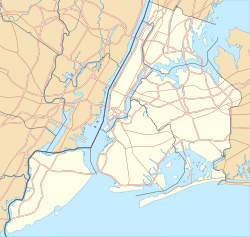
Sutton Place is a short avenue and a neighborhood on the East Side of Manhattan, in New York City. Sutton Place and Sutton Place South run through their namesake neighborhood along the East River and south of the Queensboro Bridge. Sutton Place South runs from 57th to 53rd Streets. Unlike most north–south streets in Manhattan, building address numbers along Sutton Place South increase when headed south. Sutton Place runs from 57th to 59th Streets. The greater Sutton Place neighborhood is considered among the city's most affluent, and is known for upscale apartments, townhouses and historic landmarks, much like the Upper East Side. Part of the neighborhood comprises the Sutton Place Historic District, listed on the National Register of Historic Places.
Addresses on Sutton Place and Sutton Place South do not follow the usual pattern in Manhattan. North of 59th Street, Sutton Place becomes York Avenue.
The greater Sutton Place neighborhood, which sits north of the neighborhood of Turtle Bay, runs from 53rd Street to 59th Street and is bounded on the east by the East River and on the west by either First Avenue[3] or Second Avenue.[4]Sutton Square is the cul-de-sac at the end of East 58th Street, just east of Sutton Place; Riverview Terrace is a row of townhouses on a short private driveway that runs north from Sutton Square.
History
19th century
Townhouses line the east side of Sutton Place between 58th and 57th Streets
The street that became Sutton Place was proposed as an addition to the Commissioners' Plan of 1811 for Manhattan, which designated 12 broad north–south avenues running the length of the island. The geography of Manhattan left a large area on the Upper East Side east of First Avenue without a major north–south thoroughfare, so Avenue A was added to compensate. Sutton Place, the name that applied to the whole street at the time, was originally one of several disconnected stretches of Avenue A built where space allowed, east of First Avenue.
In 1875, Effingham B. Sutton constructed a group of brownstones between 57th and 58th Streets.[5] The earliest source found by The New York Times using the term Sutton Place dates to 1883. At that time, the New York City Board of Aldermen approved a petition to change the name from "Avenue A" to "Sutton Place", covering the blocks between 57th and 60th Streets.[6][7]
1900 to 1929
444 East 58th Street, an example 1901 building in Sutton Place
Sutton House, a typical post-war Sutton Place building
The luxury apartment buildings on the lower part of Sutton Place South (below 57th Street) and the northernmost part of Sutton Place (adjacent to the Queensboro Bridge) were not developed until the 1940s and 1950s. These include:
In 1985, part of the surrounding neighborhood (1–21 Sutton Place and 4–16 Sutton Square) was added to the National Register of Historic Places as the Sutton Place Historic District.[21]
Park controversy
Sutton Place encompasses two public parks overlooking the East River, one at the end of 57th Street and another at the end of 53rd Street. The 57th Street park, named Sutton Place Park, is separated by an iron fence from the landscaped grounds behind One Sutton Place South, a neo-Georgian apartment building designed by Rosario Candela. The property behind One Sutton Place South was the subject of a dispute between the building's owners and the New York City Department of Parks and Recreation. Like the adjacent park, the rear garden at One Sutton Place South is, in fact, cantilevered over the FDR Drive, a busy parkway at Manhattan's eastern edge that is not visible from most of Sutton Place.
In 1939, city authorities took ownership of the property behind One Sutton Place South by eminent domain in connection with the construction of the FDR Drive, then leased it back to the building for $1 a year. The building's lease for its backyard expired in 1990.[22][23] The co-op tried unsuccessfully to extend the lease, and later made prospective apartment-buyers review the legal status of the backyard and sign a confidentiality agreement.[24] In June 2007, the co-op sued the city in an attempt the keep the land,[24] and on November 1, 2011, the co-op and the city reached an agreement in which the co-op ended its ownership claim to the eastern 6,000 square feet and the city relinquished its claim to the western 4,000 square feet (the land closest to the building). Each side also agreed to contribute $1 million toward the creation of a public park on the city's portion.[25]
One Sutton Place North, a townhouse at the northeast corner of Sutton Place (dead end) and East 57th Street, was built as a residence for Anne Harriman Vanderbilt, widow of William K. Vanderbilt. Next door, the official residence of the Secretary-General of the United Nations is a four-story brick townhouse that was built in 1921 for Anne Morgan, daughter of financier J.P. Morgan, and donated as a gift to the United Nations in 1972 by industrialist Arthur A. Houghton Jr.[30] The Secretary's home is 0.6 miles (0.97km) from the UN Headquarters. These townhouses have a park at the rear with FDR Drive running below (Sutton Place Tunnel) along the East River.
↑Johnston, Laurie (May 27, 1984). "If You're Thinking of Living in Sutton Place". The New York Times. Retrieved November 14, 2014. ...the name [Sutton Place] reflects its glow south to 53d Street, west to Second Avenue and even a bit farther west on 57th Street.
This page is based on this Wikipedia article Text is available under the CC BY-SA 4.0 license; additional terms may apply. Images, videos and audio are available under their respective licenses.


 FDR Drive in Lenox Hill