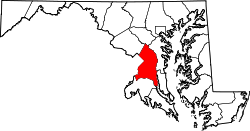
Laurel is a city in Prince George's County, Maryland United States. It is located between Washington, D.C., and Baltimore on the banks of the Patuxent River. Its population was 30,060 at the 2020 census. Founded as a mill town in the early 19th century, Laurel expanded local industry and was later able to become an early commuter town for Washington and Baltimore workers following the arrival of the Baltimore and Ohio Railroad in 1835. Largely residential today, the city maintains a historic district centered on its Main Street.
History
Natural history
Many dinosaur fossils from the Cretaceous Era are preserved in a 7.5-acre (3.0ha)park in Laurel.[3] The site, which among other finds has yielded fossilized teeth from Astrodon and Priconodon species, has been called the most prolific in the eastern United States.[4] From the Late Glacial age in 10,700 B.C. to 8,500 B.C., Laurel's climate warmed and changed from a spruce forest to a hardwood forest. In the Late Archaic period from 4,000 to 1,000 B.C., Laurel would have been covered primarily with an oak and hickory forest.[5]
Pre-20th century
Laurel was formed from land on the fall line of the Patuxent River patented by the Snowden family in 1658 as part of the 12,250-acre New Birmingham plantation, which included the later Montpelier.[6] The Washington Turnpike Road Company built Route 1 between 1796 and 1812, creating a major north–south land route. Milstead's Hotel halfway house was built in town to serve four stage lines a day in 1816.[7][8] Nicholas Snowden built a grist mill on the site circa 1811 which grew to a small cotton mill by the 1820s.[9] In 1828, a detailed survey was conducted to build a canal from Baltimore to Georgetown to connect to the proposed C&O canal. The route from Elkridge Landing to Bladensburg would have built a waterway roughly aligning with modern U.S. Route 1 and Kenilworth Avenue, with special consideration not to harm the water power for Savage Mill. The project did not go forward; the preference was to build a railroad, the B&O.[10] Nicholas Snowden died in 1831, and the mill properties transferred to Louisa Snowden and her husband Horace Capon in 1834. In 1835, coinciding with the opening of the Capital Subdivision rail line from Baltimore to Washington, the Patuxent Manufacturing Company was chartered by Horace Capon, Edward Snowden, Theodore Jenkins, W.C. Shaw, A.E. Hall, and O.C. Tiffany and the mill expanded greatly with the addition of the Avondale Mill building in 1844.[11] Mill president Horace Capron with his partners built housing for close to 300 workers, and a bigger cotton mill.[12]Cotton duck from the mill was shipped down what would become Laurel's Main Street, then by rail to Baltimore.[13] A substantial dam was built in 1850.[14] As a mill town, Laurel was somewhat unusual in Prince George's County and was surrounded by agricultural endeavors.[12]
The community was originally known as "Laurel Factory", named for its laurel trees,[15] when Edward Snowden became the first postmaster in 1837 and was a true company town, with a school and shops, and many of the mill workers' homes owned until the 1860s by the company.[12] During the 1840s, three historic churches in the community—the Methodist est. 1842,[16] St. Mary of the Mills (Roman Catholic) est. 1845,[9] and St. Philip's (Episcopal) est. 1839[17]—established what are still vigorous congregations. During the Civil War, Laurel Factory, like much of Maryland, was a divided community, but with many Southern sympathizers. Union soldiers patrolled the railroad, and for a time there was also a Union hospital. During the latter half of the 19th century, while it still operated its factories, manufacturing played a less important role in the community. Laurel evolved into an early suburban town. Many of its residents commuted by rail to jobs in Washington or Baltimore. The town was incorporated in 1870 and reincorporated in 1890 to coincide with a new electric power plant and paved streets and boarded sidewalks. By this time, the town had grown to a population of 2,080, and the city banned livestock from the streets.[18]
In 1870, the Patuxent Bank of Laurel was founded on the corner of Main Street and Washington Avenue.[19] In 1874 a delegation was sent to Annapolis to introduce legislation to make Laurel its own county of 10,000 residents with land from Prince George's, Howard, and Anne Arundel counties.[20] In 1879 Laurel Academy of Music was built along Route 1. The building was converted to a movie theatre in 1915, with a parking garage on the lower floor of the wood structure; it burned in 1917, and Academy Ford built on the same site in the late 20th century.[21] In 1888 inventor David J. Weems tested an unmanned electric train on a two-mile banked circular track near Laurel Station. The three-ton vehicle reached speeds of up to 120mph for twenty minutes.[22][23]
In 1890, Citizens National Bank opened its doors on Main Street, as Prince George's County's first nationally chartered bank. Charles H. Stanley was the bank's first president, and it remained independently managed and with the same name until acquired by PNC Financial Services in 2007.[24][25][26]Branch services are still provided from the original building. Along with those branch services being provided, there have been an additional 5 branches that were implemented.[27]
At the turn of the century, Louis Barret operated a hotel called the "Half Way House", later called the Milstead Hotel, which served as a stop for the four stage lines operating between Baltimore and Washington. In 1898, a stable fire spread to the 100-year-old hotel and burned adjacent buildings along Main Street. With only bucket brigades, Mayor Phelps telegraphed Baltimore to send a special train with fireman, horses, and engine number 10. One fireman was crushed by the rolling fire engine, and returned in a casket saved from the burning mortuary. The resulting losses inspired efforts to bring water and fire apparatus to the town.[28][29] The town was struck again by the great Laurel fire of December 14, 1899, when a twelve-building fire destroyed the Laurel Presbyterian Church (known then as Presbyterian Church at Laurel).[30]
Proposed in 1897, Laurel's seven-term mayor Edward Phelps succeeded in constructing the first high school in Prince George's County in 1899, despite several financial obstacles, by personally assuming the financial risks in doing so. The original building built for $5,000, now known as the Phelps Community Center, still stands at the northeast corner of Montgomery and Eighth Streets.[31] It was listed on the National Register of Historic Places in 1979.[32]
20th century
In 1902, the City and Suburban Railway with the City and Suburban and Washington, Berwyn, and Laurel railway started single line electric trolley service.[33]
A head-on train wreck in Laurel, July 31, 1922
The Laurel Sanitarium was built in 1905 on a 163-acre (0.66km2) farm that comprised what is now Laurel Lakes. The facility's purpose was to care for people with nervous diseases, alcohol, and drug addiction. Five buildings that were joined to a central administration building included 8-, 14-, 30-, and 36-room facilities for men and women.[34]
In March 1912, the city agreed to take out $35,000 in loans to build its first sewer system with twelve miles of line that terminated by dumping into the Patuxent River.[37]
In February 1913, Laurel was a stopping point in the Suffrage hike led by Rosalie Gardiner Jones. She was joined by a Laurel-based colored women's suffrage group and sent a parcel with a flag and message ahead to President-elect Wilson.[38]
Board track racing at Laurel, July 11, 1925
Board track racing came to Laurel in 1925 when a 1.125-mile (1.811km) wood oval track was built by Jack Prince and featured 48-degree banked turns. The Washington-Baltimore automobile speedway was short-lived, with featured races of 16 drivers at a time.[39] Despite crowds of up to 30,000, receipts did not cover the $400,000 cost of building the track on the 364-acre Avondale property which fell into receivership in 1926.[40]
Natural gas service was extended to the community in 1929.[41]
In 1931, "Angy Gerrin" built a 7,000-seat amphitheater next to the Duvall Farm between Laurel Park and Route One for an outdoor boxing venue. His company, Mid City Boxing Club Inc, held several events with low turnouts and receipts confiscated by local police. It was sold the same year to C.E. Cornell, who called it "Twin Cities Arena" or "Mid City Arena".[42] The arena was active through 1932 with the entire delegation of the National Boxing Association attending a fight with Governor Ritchie in attendance.[43] After watching the match and calling a fight to be halted in five rounds, the delegation announced efforts to drop junior lightweight and junior welterweight classes to discourage matches between young opponents.[44] Operations ceased by the end of the 1933 season in the peak of the depression.[45][46][47]
Prohibition in the United States was repealed in 1934. Wasting little time, the Prince Georges Brewing Company planned a $500,000 brewery on 100 acres next to Laurel Park, but did not follow through.[48]
In 1954, Johns Hopkins Applied Physics Laboratory built its campus west of Laurel in Howard County, using a Laurel address.[49]
By 1960, Laurel anticipated massive growth from Fort Meade and NSA. The town still used the Patuxent River to drain sewage, and filed urban grants for water and sewage infrastructure. 5,000 houses were planned in the adjacent 1,200-acre Maryland City development. City Planner Harry Susini anticipated the National Capitol Planning Commission would use clustered development to prevent tightly massed population in Laurel by the year 2000.[50]
In the late 1960s, the county was at the peak of racial tensions. The situation peaked in Laurel in July 1967 when four men and a juvenile, affiliated with the KKK, attempted to burn St. Mark's United Methodist Church and then a private residence in the predominantly African-American neighborhood of the Grove, prompting protests and police blockades. Due to cross-burning incidents, a Ku Klux Klan march, and several arsons and suspected arsons, temporary police barricades were erected throughout late July to prevent white residents from entering the Grove.[51][52] In August 1967, it was announced that the city would re-purchase a privately owned swimming pool, which had been sold to a private club in 1949. The pool, which had only been available to white residents, was to be operated as an integrated public facility open to all.[53]
On June 22, 1972, Laurel was impacted severely by Hurricane Agnes, which caused the greatest flooding ever recorded in Maryland.[54] Several bridges were destroyed and the nearby T. Howard Duckett Dam at Rocky Gorge Reservoir was at capacity and posed a huge threat.[55] In 1975, the city council passed ordinances to create a historic district around Main Street.[56]
The Elizabeth House, a nonprofit food pantry and soup kitchen, was founded in 1988 to serve low-income residents of the Laurel area. This later grew to include emergency financial aid and transportation.[58]
A former 1840s mill workers' home on the northeast corner of 9th and Main Streets was renovated and opened as the Laurel Museum on May 1, 1996. The museum features exhibits that highlight the history of Laurel and its citizens. A gift shop is available, and museum admission is free. The museum's John Calder Brennan Library is open to researchers by appointment.[59]
21st century
On September 24, 2001, a tornado passed through Laurel and left F3 property damage, including significant roof damage to the Laurel High School and the historic Harrison-Beard building.[60]
On August 29, 2005, Laurel adopted Laurel, Mississippi, as a sister city to help with Hurricane Katrina relief and recovery.[61] In the two years following adoption, "the government, businesses and residents of Laurel, Md. ... raised more than $20,000 for Laurel, Miss."[62]
Geography
Laurel is located on the bank of the Patuxent River, which was the power source for the cotton mills that were the early industry of the town.
According to the United States Census Bureau, the city has a total area of 4.33 square miles (11.21km2), of which 4.30 square miles (11.14km2) is land and 0.03 square miles (0.08km2) is water.[63]
Climate
As is typical of central Maryland, Laurel lies within the humid subtropical climate zone, featuring hot humid summers and cool to mild winters with high annual precipitation. Laurel lies within USDA plant hardiness zones 7 and 8.[64]
Laurel city, Maryland – Racial and ethnic composition Note: the US Census treats Hispanic/Latino as an ethnic category. This table excludes Latinos from the racial categories and assigns them to a separate category. Hispanics/Latinos may be of any race.
As of the census[70] of 2010, there were 25,115 people, 10,498 households, and 5,695 families residing in the city. The population density was 5,840.7 inhabitants per square mile (2,255.1/km2). There were 11,397 housing units at an average density of 2,650.5 per square mile (1,023.4/km2). The racial makeup of the city was 30.1% White, 48.9% African American, 0.4% Native American, 9.2% Asian, 0.1% Pacific Islander, 7.6% from other races, and 3.8% from two or more races. Hispanic or Latino people of any race were 15.5% of the population.
There were 10,498 households, of which 30.7% had children under the age of 18 living with them, 33.4% were married couples living together, 15.7% had a female householder with no husband present, 5.2% had a male householder with no wife present, and 45.8% were non-families. 37.6% of all households were made up of individuals, and 6.1% had someone living alone who was 65 years of age or older. The average household size was 2.37 and the average family size was 3.19.
The median age in the city was 33.7 years. 22.6% of residents were under the age of 18; 9.5% were between the ages of 18 and 24; 37.2% were from 25 to 44; 23.8% were from 45 to 64; and 7% were 65 years of age or older. The gender makeup of the city was 47.7% male and 52.3% female.
2000 census
As of the census[71] of 2000, there were 19,960 people, 8,931 households, and 4,635 families residing in the city. The population density was 5,280.2 inhabitants per square mile (2,038.7/km2). There were 9,506 housing units at an average density of 2,514.7 per square mile (970.9/km2). The racial makeup of the city was 52.24% White, 34.50% African American, 0.38% Native American, 6.89% Asian, 0.21% Pacific Islander, 2.30% from other races, and 3.47% from two or more races. Hispanic or Latino people of any race were 6.24% of the population.
There were 8,931 households, of which 26.7% had children under the age of 18, 33.9% were married couples living together, 13.3% had a female householder with no husband present, and 48.1% were non-families. 37.4% of all households were made up of individuals, and 5.2% had someone living alone who was 65 years of age or older. The average household size was 2.22 and the average family size was 2.97.
In the city, the population was spread out, with 22.0% under the age of 18, 8.6% from 18 to 24, 42.9% from 25 to 44, 19.7% from 45 to 64, and 6.7% who were 65 years of age or older. The median age was 34 years. For every 100 females, there were 93.2 males. For every 100 females age 18 and over, there were 90.3 males.
The median income for a household in the city was $49,415, and the median income for a family was $58,552. Males had a median income of $37,966 versus $35,614 for females. The per capita income for the city was $26,717. About 4.3% of families and 6.4% of the population were below the poverty line, including 7.8% of those under age 18 and 6.4% of those age 65 or over.
Arts and culture
Arts
Laurel Main Street Festival, 2007
Local performing arts outlets include the Venus Theatre, Laurel Mill Playhouse, Central Maryland Chorale (formerly Laurel Oratorio Society) and Montpelier Arts Center, which also features an art gallery. Another local exhibitor is the WSSC Art Gallery.
Events
The city government supports an annual LakeFest in May and Independence Day celebration each July. Since 1981, the Laurel Board of Trade has sponsored a Main Street Festival (held on Saturday of Mother's Day weekend) each May, and since 1995 a RiverFest each October. The Montpelier Mansion grounds have hosted an annual festival the first weekend in May since 1971, updated in 2007 to focus on an "herb, tea and arts" theme.[72]
Pratt truss bridge, built in 1907 in place of a wooden bridge. Linked Dr. Charles Duvall's (1785–1863) mill plantation "Goodwood", later "Gladswood". Was once on the main route for Baltimore-Washington telegraphs.[74]
Laurel is governed by a five-member city council and a mayor. There are two political wards in the city. The first ward is generally the area north of Maryland Route 198 and the second ward is to the south.[78][79] Two council members are elected from each ward, and a council member is elected at large by residents of both wards. City Council candidates must reside in Laurel a year before their election and during their full term of office.[80] Similarly, mayoral candidates must reside in the city for at least two years prior to their election.[81]
Nonpartisan citywide elections are held every two years on the first Tuesday in November of each odd year.[82] The council elects one of its members to serve as president. The president of the city council presides over council meetings and can act in a limited capacity as mayor if the mayor is unavailable. Council members serve for two years each term; the mayor serves for four years.[citation needed]
Television arrived in Laurel with the establishment of the first TV broadcast stations in Washington in 1946. For decades, Laurel has been served by the VHF TV channels 4 (WRC-TV / NBC), 5 (WTTG / FOX), 7 (WJLA-TV / ABC), and 9 (WUSA / CBS) from Washington; channels 2 (WMAR-TV / ABC), 11 (WBAL-TV / NBC), 13 (WJZ-TV / CBS), and 45 (WBFF / FOX) from Baltimore; plus Maryland Public Television from Annapolis and Baltimore.
Fire protection is provided by the Laurel Volunteer Fire Department and the Laurel Volunteer Rescue Squad, both part of the Prince George's County Fire/EMS Department. The Laurel Volunteer Fire Department was formed in 1902, and the Laurel Volunteer Rescue Squad was formed in 1952.[citation needed]
Ambulance service began in 2006. A paramedic unit staffed by two career personnel.[citation needed]
12Compton, Elizabeth L.; Joanne Timchalk; Mary Mallonee; Lee Jacobs; Ron Jacobs; J.R. Compton (1993). "St Mary of the Mills Parish History". St Mary of the Mills Parish. Archived from the original on September 20, 2007. Retrieved July 21, 2007.
↑Mills, Kristie; Elsie Klumpner (Winter 2006). "ATHA's Featured Community: the City of Laurel"(PDF). ATHA Newsletter, Vol. 3, No. 2. Anacostia Trails Heritage Area. Archived from the original(PDF) on September 29, 2007. Retrieved July 21, 2007.
↑"Our Church History". First United Methodist Church of Laurel. Archived from the original on July 16, 2007. Retrieved July 26, 2007.
↑"St. Philip's Parish History"(PDF). St. Philips Parish Profile. St. Philip's Episcopal Church. 2006. p.4. Archived from the original(PDF) on November 12, 2006. Retrieved July 26, 2007.
↑"Mayor Cull's Trials". The Sunday Herald. September 1, 1890.
↑Howard County Historical Society. Images of America Howard County. p.76.
↑"New County Movement in Maryland". The Evening Star. February 25, 1874. p.4.
↑"LAUREL SPEEDWAY IN RECEIVERS' HANDS: Action Taken Following Filing Of Bill Of Complaint By Construction Finn OWES $28,250. IS CHARGE Corporation Owning Automobile Racing Truck Alleged To Be Insolvent". The Baltimore Sun. June 2, 1926.
↑Department of Community Planning & Business Services (November 26, 2007). "Master Plan Comprehensive Amendment". City of Laurel, Maryland. Retrieved January 26, 2009.{{cite web}}: |author= has generic name (help)
↑"DOUBLE BOXING CARD TONIGHT: Brown-Firpo Bout Feature At Carlin's--Twin City Matches". The Baltimore Sun. September 14, 1932.
↑Jesse A. Linthicum (September 19, 1932). "N. B. A., Meeting Here, Plans Amateur Boxing Clean-Up: Important Question To Come Before Delegates At Three-Day Convention Which Opens Here This Morning". The Baltimore Sun.
↑"National Boxing Association Head Flays Exploitation Of Amateurs: CLINNIN URGES QUICK ACTION Tells Convention Mere Boys Are Becoming Punch-Drunk Wrecks SEEKS UNIFORM LAW Recommendation Presented To Drop Junior Title In Two Divisions". The Baltimore Sun. September 20, 1932.
↑Jessie A. Linthicum (June 25, 1933). "RING AND RASSLIN' RACKET". The Baltimore Sun.
↑Kevin Leonard (October 2, 2014). "Laurel's outdoor boxing arena met mysterious end". The Baltimore Sun.
↑"Hunt And Weiner Win Bouts In New Arena At Laurel Before 2,000". The Baltimore Sun. July 4, 1931.
↑"REALESTiTEDEALS AND BUILDING NEWS Plans For Construction Of Brewery At Laurel Are Announced". The Baltimore Sun. February 28, 1934.
↑"Johns Hopkins Lets Contract in Md". The Washington Post. March 27, 1955.
↑"Laurel Prepares For Its New Era: Expected Growth". The Washington Post. September 5, 1960.
↑"Nightly Blockade of Negro Section In Laurel Is Ordered Discontinued". The Washington Post. July 21, 1967.
↑Goeller, David (July 16, 1967). "Laurel's Negro Community Protected by 8 Barricades". The Baltimore Sun.
↑Pickett, Edward G (August 2, 1967). "Laurel to Buy, Integrate Pool for Public Use". The Sun.
↑InvitationArchived 2007-07-12 at the Wayback Machine to the Maryland Association of Floodplain and Stormwater Managers Second Annual Conference and General Membership Meeting, October 18–19, 2006. URL retrieved on November 27, 2006.
↑Sarah K. Krim (September 4, 1974). "Historic District". The Washington Post.
↑"Gould buys 3,539 acres in two deals". The Baltimore Sun.
↑Bykowicz, Julie; Larry Carson (September 26, 2001). "Laurel sustains millions in damages". The Baltimore Sun. Archived from the original on September 30, 2007. Retrieved June 18, 2007.
↑Avery, Carlos P. (2003). E. Francis Baldwin, Architect: The B&O, Baltimore, and Beyond. Baltimore, Maryland: Baltimore Architecture Foundation. pp.33, 128. ISBN0-9729743-0-X.
↑"West Laurel barn razing". October 2002. Fan Questions and Answers. Marty Friedman Official Website. URL retrieved on December 20, 2006.
↑"Facts". Le Tigre. Archived from the original on January 17, 2004. Retrieved March 7, 2014. In 4th grade ... I ended up being the co-lead in O.W. Phair elementary's production
Bucklee, Sally Mitchell (2001). A church and its village: St. Philip's Episcopal Church, Laurel, Maryland. Baltimore, Md.: Gateway Press. OCLC48085398. Describes local history.
This page is based on this Wikipedia article Text is available under the CC BY-SA 4.0 license; additional terms may apply. Images, videos and audio are available under their respective licenses.


 United States
 Maryland