US Naval Base Solomons

Last updated
US Naval Base Solomons
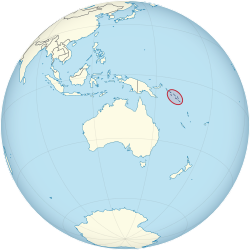
Solomon Islands on the globe (Oceania centered).svg
Establishment
1942
Time zone UTC+11
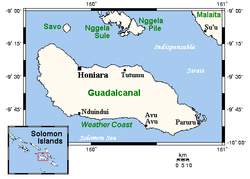
Guadalcanal Map GuadalcanalCloseup.png
Guadalcanal Map
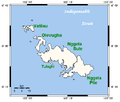
Solomon Islands - Guadalcanal Solomon Islands - Guadalcanal.PNG
Solomon Islands – Guadalcanal

US Naval Base Solomons refers to a group of United States Navy (USN) bases established in the Solomon Islands in the Pacific Ocean. Most of these facilities were constructed by USN Seabee units during World War II as part of the broader Pacific War.

Contents

In August 1942, the United States Armed Forces landed on Guadalcanal in the Solomon Islands during the Battle of Guadalcanal. Following the capture of the island, USN Seabees constructed a major installation known as Naval Base Guadalcanal. Additional naval bases were subsequently built on other islands throughout the Solomons to support Allied operations in the region. [1] [2] [3]

One of the primary functions of Naval Base Guadalcanal was to support the construction of the airfield later known as Henderson Field. The first aircraft landed at Henderson Field on August 12, 1942. The base also supported the large number of Allied troops stationed on Guadalcanal and served as a staging area for subsequent operations.

The waters off Naval Base Guadalcanal, particularly Savo Sound, became known as Ironbottom Sound because of the numerous ships and aircraft sunk during Operation Watchtower. On July 28, 1942, the USN and the United States Marine Corps conducted a practice amphibious landing at Naval Base Fiji on Koro Island. This exercise was intended to prepare troops for the forthcoming landings on Guadalcanal, which marked their first major offensive of the war. On July 31, 1942, the invasion force departed Fiji for Guadalcanal.

The Guadalcanal invasion force lacked many of the innovations that would later be developed during the Pacific War. Notably, it did not have specialized landing vessels for deploying troops and armored vehicles onto hostile beaches, such as the LST or LCT. Instead, supplies were transferred from ship cargo holds to small landing craft, which transported them to the beaches, where they were unloaded by hand.

Prior to the Allied landings, the Empire of Japan had established a base at Tulagi, a smaller island north of Guadalcanal. After its capture, the USN repaired and expanded the facility. The Guadalcanal bases were assigned the code names Bevy and Cactus, later renamed Mainyard. The codename Ringbolt was used for the operations that captured the Florida Islands, Tulagi, Gavutu, and Tanambogo.

One of the reasons Guadalcanal was selected for amphibious landings was the discovery on June 20, 1942, of a Japanese airfield under construction near Lungga Point. An operational airfield at that location could have threatened maritime supply routes between the United States and naval bases in Australia. Establishing an Allied airbase on Guadalcanal both protected these shipping lanes and enabled attacks against Japan's major base at Rabaul in the northern Solomon Islands.

Both Allied and Japanese forces suffered from chronic supply shortages during the Guadalcanal campaign. In response, the USN improved its logistical supply system, which later contributed to the effectiveness of the island-hopping campaign. [4]

The 6th Naval Construction Battalion arrived on Guadalcanal on August 10, 1942, from Naval Station Norfolk via Naval Base Espiritu Santo, thirteen days after the first United States Marine Corps units had landed. The Seabees discovered an unfinished 3,800-foot runway begun by Japanese forces. They extended the runway by 1,300 feet and surfaced it with Marston matting due to poor soil conditions and heavy rainfall. Construction was frequently interrupted by bombing raids, sniper fire, and artillery shelling. When enemy fire subsided, the Seabees established a camp and constructed a power station, freshwater system, and mess hall.

Supplies were initially unloaded from cargo ships into Higgins boats, tank lighters, and pontoon barges, which delivered materials directly to the beach. Later, three timber piers were constructed to facilitate unloading operations. [5] A pier was also built at Lung Lagoon and named Jennings Landing in honor of Chief Shipfitter Jennings. Roads, bridges, and fuel tank farms were constructed as the base expanded.

The 6th Naval Construction Battalion was relieved by Naval Mobile Construction Battalion 26 on January 5, 1943, and departed aboard the USS Hunter Liggett for rest and recuperation in Auckland, New Zealand. While in Auckland, the battalion worked on the Victoria Park camp and a USN mobile hospital before departing on March 12, 1943, for Naval Base Noumea. [6]

Construction Battalion 26 continued to improve Naval Base Guadalcanal, building gun mounts and emplacements, tunnels, approximately 6,000 feet of railroad track, multiple docks, more than 35 miles of primary roadway, 10 bridges, and two radio stations with 150-foot transmitter towers. The battalion departed on March 2, 1944. [7]

The 58th Naval Construction Battalion arrived on December 12, 1944, and conducted work on Vella Lavella and the Russell Islands before departing on March 11, 1945. [8] The 14th Naval Construction Battalion operated on Guadalcanal from November 4, 1942, to November 9, 1943. [9]

The Fleet Post Office for Naval Base Guadalcanal was designated FPO 145. [10] [11]

History

Following the Battle of Tulagi and Gavutu–Tanambogo in August 1942, naval bases were constructed throughout the Solomon Islands by the 6th and 26th Seabee units. At Tanambogo, an airfield known as Torokina Airfield was built. The Landings at Cape Torokina, designated as Operation Cherry Blossom, took place on November 1, 1943. At Tulagi, the United States Navy established a PT boat base, while a seaplane base was constructed in the Florida Islands.

The United States bases in the Solomon Islands were intended to disrupt the Tokyo Express, the Allied term for Japan's nighttime supply and reinforcement routes from Rabaul to Guadalcanal. US Navy Seabees constructed naval bases and airfields and provided support for amphibious landings across the region. Following the end of World War II and Victory over Japan Day, these bases were closed. Several of the former military airfields were later converted into civilian airports. [12] [13]

Except for some units retained to build, garrison, operate, and defend the base at Tulagi, most of the United States Marine Corps forces that had assaulted Tulagi and the nearby islets were soon redeployed to Guadalcanal. There, they assisted in the defense of the airfield at Lunga Point, later named Henderson Field by Allied forces. [14]
Solomon Islands Bases

[16]

A number of bases were constructed in the New Georgia Islands: [22]

New Hebrides

The New Hebrides islands lie south of the Solomon Islands and are sometimes included in US Navy listings of Solomon bases:

New Caledonia

The New Caledonia islands are located south of the Solomon Islands and are also sometimes included in US Navy listings:

Guadalcanal Airfields

The following airfields on Guadalcanal were constructed after the Battle for Henderson Field:

Units based at Henderson Field

At Henderson Field, also known as the base of the Cactus Air Force, the United States Navy stationed the following units: [30]

Units based at Carney Field

At Carney Field, the United States Navy stationed patrol and bombing units flying the Consolidated B-24 Liberator, designated PB4Y-1 in USN service:

New Georgia Airfield

Ondonga Airfield, located on New Georgia, was constructed following the New Georgia campaign. [31]

Units based at Ondonga Airfield

At Ondonga Airfield, the United States Navy stationed the following aviation units:

Segi Airfield

At Segi Airfield, the United States Navy stationed the following units: [32]

Several airfields were constructed at Naval Base Banika Island. These facilities were used to support operations against Japanese forces on New Georgia and at Munda.

Nissan Island Airfield

At Nissan Island Airfield, the United States Navy stationed the following units: [35]

Operation Huddle

Operation Huddle was the code name for a proposed United States naval base planned for Ndeni Island in the Santa Cruz Islands group, approximately 250 miles (400 km) east of the Solomon Islands. The plan was ultimately abandoned due to unfavorable terrain and the prevalence of cerebral malaria on the island.

Following the Battle of the Santa Cruz Islands, Ndeni Island was used in a limited capacity. Although no permanent land base was constructed, the destroyer-seaplane tender USS McFarland supported a flying boat squadron of Consolidated PBY Catalina aircraft at Graciosa Bay anchorage. The floating base departed after the naval Battle of Savo Island in August 1942. PBY Catalina aircraft later returned to Ndeni for reconnaissance missions during the Battle of the Eastern Solomons on August 24, 1942, and the Battle of the Santa Cruz Islands on October 26, 1942. [36] [37]

Tenders

The following tenders were stationed in the Solomon Islands during World War II:

See also

References

  1. Logistics: The Heart of the Six Months Battle, August 1942–February 1943 US Navy
  2. Solomon Islands Archived 2024-05-23 at the Wayback Machine pacificwrecks.com
  3. The Solomons Campaign: Guadalcanal, August 1942–February 1943 US Navy
  4. Bywater, Hector C. (1921). Sea-power in the Pacific: A Study of the American-Japanese Naval Problem. London, England: Constable and Co., Ltd.
  5. Seabee Guadalcanal US Navy
  6. 6th Seabee US Navy
  7. 26th Seabee US Navy
  8. 58th Seabee US Navy
  9. 14th Seabee US Navy
  10. 26th NCB history, NHHC, Seabee Museum, Port Hueneme, California
  11. Honan, William H. (December 1970). "Japan Strikes: 1941". American Heritage. 22 (1): 12–15, 91–95.
  12. Building the Navy's Bases in World War II. Vol. II. Washington, D.C.: United States Government Printing Office. 1947. p. 232. Retrieved May 6, 2012.
  13. Rottman, Gordon L. (2002). World War II Pacific Island Guide: A Geo-military History. Westport, Connecticut: Greenwood Press. p. 117. ISBN   978-0-313-31395-0.
  14. Griffith, Battle for Guadalcanal, p. 93.
  15. Stirling PT Boat pacificwrecks.com
  16. Florida Islands pacificwrecks.com
  17. Tulagi pacificwrecks.com
  18. Tulagi Harbor base pacificwrecks.com
  19. Gavutu Harbor seaplane base pacificwrecks.com
  20. Carter City pacificwrecks.com
  21. Makambo Island PT Boat base pacificwrecks.com
  22. New Georgia pacificwrecks.com
  23. Wickham Fleet Anchorage pacificwrecks.com
  24. Base at Sasavele Island pacificwrecks.com
  25. PaificWrecks.com. "Pacific Wrecks - Fighter 3 (Emergency Field)". pacificwrecks.com. Archived from the original on 2011-05-23. Retrieved 2026-01-08.
  26. PaificWrecks.com. "Pacific Wrecks - Crash Strip (The Grassy Strip)". pacificwrecks.com. Archived from the original on 2011-05-23. Retrieved 2026-01-08.
  27. PacificWrecks.com. "Pacific Wrecks - Coffin Corner". Archived from the original on 2019-10-17. Retrieved 2026-01-08.
  28. PacificWrecks.com. "Pacific Wrecks - Crash Strip (Koli Point)". Archived from the original on 2015-09-15. Retrieved 2026-01-08.
  29. PaificWrecks.com. "Pacific Wrecks - Koli Field (Bomber 3)". pacificwrecks.com. Archived from the original on 2011-01-31. Retrieved 2026-01-08.
  30. Henderson Field pacificwrecks.com
  31. Ondonga Airfield pacificwrecks.com
  32. Segi Airfield US Navy pacificwrecks.com
  33. Renard Sound Seaplane Base Archived 2022-09-22 at the Wayback Machine pacificwrecks.com
  34. Renard Sound Seaplane Base tracesofwar.com
  35. Nissan Island Airfield pacificwrecks.com
  36. Solomons Graciosa Bay pacificwrecks.com
  37. Operation Huddle codenames.info

9°25′55″S159°57′20″E / 9.43194°S 159.95556°E / -9.43194; 159.95556