Puli Khumri

Last updated

Puli Khumri
پل خمری
Pol001.jpg
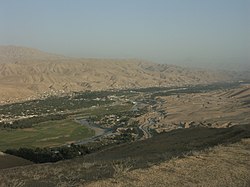
View of the city
Afghanistan adm location map.svg
Red pog.svg
Puli Khumri
Location in Afghanistan
Coordinates: 35°57′N68°42′E / 35.950°N 68.700°E / 35.950; 68.700
Country Flag of the Taliban.svg Afghanistan
Province Baghlan
District Puli Khumri
Government
[1]
  Type Municipality
   Mayor Maulvi Abdul Latif Mazlom
Area
3,752 ha (9,270 acres)
  Land181 km2 (70 sq mi)
Elevation
[2]
920 m (3,020 ft)
Population
 (2025) [4]
230,112
  Density1,270/km2 (3,290/sq mi)
   Urban
139,252
   Rural
90,860
Time zone UTC+04:30 (Afghanistan Time)
ISO 3166 code AF-PLK

Puli Khumri, [a] also written as Pul-i-Khumri or Pol-e Khomri, is a city in northern Afghanistan, serving as the capital of Baghlan Province. [5] [6] It is within the jurisdiction of Puli Khumri District and has an estimated population of 230,112 people. [4] Maulvi Abdul Latif Mazlom is the current mayor of the city. [1] His predecessor was Maulvi Mohammad Anwar Mustaqeem. [7]

Contents

Puli Khumri has a number of factories, bazaars, business centers, public parks, banks, hotels, restaurants, mosques, hospitals, universities, and places to play sports or just relax. It is home to Baghlan University. The Ghori cement factory is also in Puli Khumri. In 2015 there were 24,586 dwelling units in the city. [3] [2]

Puli Khumri sits at an elevation of approximately 920 m (3,020 ft) above sea level in the Hindu Kush mountain range. [2] The city is administratively divided into six districts ( nahias ), covering a land area of 181 km2 (70 sq mi). [3] It is connected by the Afghanistan Ring Road with Kunduz to the north, Charikar in Parwan Province to the southeast, and Mazar-i-Sharif in Balkh Province to the northwest.

History

During the 1980s, Puli Khumri was officially granted the status of the capital of Baghlan province in place of the central city of Baghlan. This transition occurred under the influence of Sayed Mansur Naderi, son of Sayed Kayan, who held significant military and political power at the time. [8] The relocation aimed to enhance public access to administrative offices, leveraging Puli Khumri's strategic location along the Kabul-Mazar highway. The cabinet of Mohammad Najibullah, led by Sultan Ali Keshtmand, initially proposed this move through declaration number 492 on March 1, 1989. It was subsequently formalized by Najibullah through decree number 1603 on March 9, 1989. [9]

From August 8-10, 1988, there were fires and explosions in the 3704th Ammunition Depot of the 40th Army (Soviet Union), located in the Kelgai Valley near the town. [10] The detonation of the explosives storage facility, according to eyewitnesses, resembled a nuclear one with the appearance of a characteristic nuclear "mushroom cloud". Eight soldiers and one civilian cook may have been killed, with others wounded. Western sources reported that the Soviet Ministry of Foreign Affairs (Soviet Union) denied there had been any casualties. [11]

The lead nation of the local Provincial Reconstruction Team was Hungary, which operated in the city from 2006 to March 2013[ citation needed ]. Previous to 2006, the lead nation was the Netherlands. [12]

Taliban insurgents have been active in the Dand-e-Shahabuddin part of Puli Khumri since 2917. [13] On 5 May 2019, Taliban members stormed the city's police headquarters, killing 13 police. [14] On 1 September 2019, Taliban assaulted the city, [15] but were repelled by the Afghan Army. On 16 January 2021, the district's NDS chief Fazal Wakilzada was killed in a Taliban attack. [16]

On 10 August 2021, Puli Khumri became the eighth provincial capital to be captured by the Taliban as part of their nationwide military offensive. [17] [18] On 13 October 2023, 7 people were killed and 15 injured in a suicide bombing at a Shia mosque carried out by Islamic State – Khorasan Province. [19]

Geography

Puli Khumri is in a valley by the Kunduz River in northern Afghanistan, about 100 km (60 mi) south of Kunduz, 200 km (120 mi) southeast of Mazar-i-Sharif, and 230 km (140 mi) north of Kabul. It sits at an elevation of approximately 920 m (3,020 ft) above sea level, within the Hindu Kush mountain range.

The city is a transit and trading hub in the region. [2] It is connected by the Afghanistan Ring Road with Baghlan to the north, Charikar to the southeast, and Mazar-i-Sharif to the northwest.

Puli Khumri has 6 city districts ( nahias ), [2] covering a land area of 181 km2 (70 sq mi) or 3,752 ha (9,270 acres). [3] Agricultural lands accounted for the largest land use in the city (65%), with the majority of that land in Districts 3, 5, and 6. Districts 1 and 2 had the highest dwelling densities but District 5 is home to the most dwelling units. Puli Khumri has a diverse housing stock consisting of regular, irregular, and hillside houses as well as apartment buildings. [2]

Climate

Puli Khumri features a cool semi-arid climate (BSk) under the Köppen climate classification. The average temperature in Puli Khumri is 15.9 °C or 60.6 °F, while the annual precipitation averages 282 mm or 11.10 in.

July is the hottest month of the year with an average temperature of 28.5 °C or 83.3 °F. The coldest month January has an average temperature of 3.0 °C or 37.4 °F.

Climate data for Puli Khumri
MonthJanFebMarAprMayJunJulAugSepOctNovDecYear
Mean daily maximum °C (°F)8.3
(46.9)
10.9
(51.6)
16.2
(61.2)
21.8
(71.2)
28.7
(83.7)
35.3
(95.5)
37.1
(98.8)
35.9
(96.6)
31.6
(88.9)
24.8
(76.6)
15.7
(60.3)
9.6
(49.3)
23.0
(73.4)
Daily mean °C (°F)3.0
(37.4)
5.7
(42.3)
10.7
(51.3)
16.0
(60.8)
21.3
(70.3)
26.5
(79.7)
28.5
(83.3)
27.0
(80.6)
22.5
(72.5)
16.5
(61.7)
9.1
(48.4)
4.2
(39.6)
15.9
(60.7)
Mean daily minimum °C (°F)−2.2
(28.0)
0.6
(33.1)
5.3
(41.5)
10.2
(50.4)
14.0
(57.2)
17.8
(64.0)
19.9
(67.8)
18.1
(64.6)
13.4
(56.1)
8.2
(46.8)
2.5
(36.5)
−1.1
(30.0)
8.9
(48.0)
Average precipitation mm (inches)31
(1.2)
43
(1.7)
63
(2.5)
65
(2.6)
27
(1.1)
0
(0)
0
(0)
0
(0)
0
(0)
8
(0.3)
20
(0.8)
25
(1.0)
282
(11.2)
Source: [20]

Demographics

According to Afghanistan's National Statistics and Information Authority, Puli Khumri has an estimated population of 230,112 people. [4] [21] In 2015 there were 24,586 dwelling units in the city. [2]

Economy

Men working on a scaffold, c. 1939 CH-NB - Afghanistan, Pol-i-Khomri (Puli Khumri, Pul-i-Kumri)- Menschen - Annemarie Schwarzenbach - SLA-Schwarzenbach-A-5-20-133.jpg
Men working on a scaffold, c. 1939

The economy of Puli Khumri is based on agriculture, trade, mining, transport, and textile production. There is at least one major textile factory in the city. [22] Agriculture is very important because of the rain and temperature; wheat, rice, and spices are the main crops. There are two dams in Puli Khumri, which provide the necessary electricity. Electrical transmission lines built from Puli Khumri bring a steady supply of electricity to Kabul.

Afghanistan's first cement factory, Ghori I Cement Factory, was built in 1954 in Puli Khumri with financial support from Czechoslovakia. A third plant is under construction since August 2025. [23] The limestone is mined from the hill behind the factory. [24]

There is a coal mine outside of the city in the village Kar-kar, but the production system is archaic.

Education

There are a number of public and private schools in Puli Khumri. [25] [26] There are also a number of universities. [27] Those who cannot go to school find a job. [28]

See also

Notes

References

  1. 1 2 "Special market for businesswomen in Pul-i-Khumri on cards". Pajhwok Afghan News. 11 August 2024. Retrieved 14 January 2026.
  2. 1 2 3 4 5 6 7 8 "State of Afghan Cities report 2015 (Volume-II)". UN-Habitat. p. 102. Retrieved 21 October 2015.
  3. 1 2 3 4 "State of Afghan Cities report 2015 (Volume-I English)". UN-Habitat. pp. 8, 131. Retrieved 22 October 2015.
  4. 1 2 3 "Estimated Population of Afghanistan 2025-26" (PDF). National Statistics and Information Authority. September 2025. p. 39. Retrieved 27 December 2025.
  5. "More than 350 security cameras installed in Pul-e-Khumri city". Ariana News. 23 December 2024. Retrieved 27 December 2025.
  6. "Bad roads give Baghlan residents nightmares". Pajhwok Afghan News. 31 March 2025. Retrieved 27 December 2025.
  7. "Pul-i-Khumri municipality revenue decreases this year: Mayor". Pajhwok Afghan News. 22 May 2022. Retrieved 14 January 2026.
  8. Author: Hakimi, Aziz Ahmed. Title: Fighting for Patronage: American counterinsurgency and the Afghan Local Police. Publisher: University of London. Date: 23.07.2015. Access date: 04.04.2024.
  9. Official Gadget of Ministry of Justice of Afghanistan Republic Government. (1989, July 6). Decree number 1603 of March 9, 1989 by Afghanistan President about transfer of Baghlan capital to Puli Khumri city and omission of Puli Khumri as a district in the administrative structure of the province. Retrieved April 5, 2024, from https://law.acku.edu.af/wp-content/uploads/2022/11/acku_risalah_knf2720_meem69_1368_n695_dari_title1.pdf
  10. https://rsva-ural.ru/library/mbook.php?id=1344 and ru:Взрывы_артиллерийского_склада_в_Пули-Хумри
  11. A team of authors. Volume 12. Chapter III "Soviet military chronology" // Soviet Armed Forces Review Annual / Ed. George M. Mellinger. — Academic International Press, 1993. — P. 60.
  12. McMahon, Robert (20 October 2005). "Afghanistan: PRTs Spreading, Though Impact Remains Unclear". Radio Free Europe / Radio Liberty. Archived from the original on 26 October 2021. Retrieved 19 December 2007.
  13. Amiry, Sharif (3 August 2017). "Pul-e-Khumri Residents Speak Out About Ongoing Battles". TOLOnews. Archived from the original on 26 October 2021. Retrieved 7 June 2020.
  14. "Afghan officials: Taliban launch complex attack on police". Taiwan News. Associated Press. 5 May 2019. Archived from the original on 26 October 2021. Retrieved 7 June 2020.
  15. "Several civilians dead as Taliban attacks northern city". www.aljazeera.com. 2 September 2019. Archived from the original on 26 October 2021. Retrieved 7 June 2020.
  16. "NDS district chief Fazal Wakilzada and his bodyguard were killed in today's IED blast in Pul-e-Khumri, Baghlan". afghanistan.liveuamap.com. 16 January 2021. Archived from the original on 26 October 2021. Retrieved 17 January 2021.
  17. Makoii, Akhtar Mohammad; Beaumont, Peter (10 August 2021). "Taliban fighters capture Afghan city at strategic junction north of Kabul". The Guardian . Retrieved 10 August 2021.
  18. "Taliban seizes eighth provincial capital, Pul-e-Khumri in Baghlan" (AV Media). YouTube. Al Jazeera English. 10 August 2021. Archived from the original on 22 December 2021. Retrieved 10 August 2021.
  19. "Dead, Wounded In Afghan Mosque Blast During Friday Prayers". Radio Azadi. Radio Free Europe/Radio Liberty. Retrieved 14 October 2023.
  20. "Climate پل خمری (Puli Khumri)". Climate-Data.org. Retrieved 9 September 2016.
  21. "State of Afghan Cities report 2015 (Volume-I English)". UN-Habitat. 2015. p. 12. Archived from the original on 26 October 2021. Retrieved 21 October 2015.
  22. "Pul-i-Khumri textile factory restructured; awaits inauguration". Pajhwok Afghan News. 17 September 2024. Retrieved 14 January 2026.
  23. "Construction of Third Ghori Cement Factory Begins in Baghlan". TOLOnews. 31 August 2025. Retrieved 29 November 2025.
  24. Magyar, Honvedseg (2010). "Baghlan taromány CIMIC kézikönyve" (PDF). Magyar Honvédség ÖHP. Archived from the original (PDF) on 13 December 2013.
  25. "17,500 Children Reached With Schooling in Baghlan's Remote Districts". TOLOnews. 20 July 2024. Retrieved 14 January 2026.
  26. "Religious School Students in Baghlan Call to Reopen Girls' Schools". TOLOnews. 3 July 2022. Retrieved 14 January 2026.
  27. "University Student Teaches 200 Baghlan Girls Sewing, Tailoring Skills". TOLOnews. 7 October 2022. Retrieved 14 January 2026.
  28. "Woman in Baghlan Provides Jobs to Girls Deprived of Schooling". TOLOnews. 19 February 2023. Retrieved 14 January 2026.