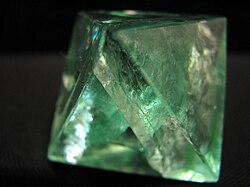
Regular octahedra occur in nature and science, such as the crystal structures and in stereochemistry as a resemblance of a chemical molecule known as octahedral molecular geometry. Other appearances are popular culture and music theory. It can be the core of polyhedra construction, and it can tile with different polyhedra to create a honeycomb.
The vertices and edges of a regular octahedron give rise to a graph, a discrete structure drawn in a plane. It is an example of a four-connected simplicial well-covered graph. It is also one of the six connected graphs in which the neighborhood of every vertex is a cycle of length four or five. Within this structure, the graph forms a topological surface called a Whitney triangulation.
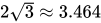
A regular octahedron is the cross-polytope in 3-dimensional space. It can be oriented and scaled so that its axes align with Cartesian coordinate axes and its vertices have coordinates , , and . Such an octahedron has edge length .[4]
Symmetry and duality
The dual of a regular octahedron is a cube. Both have the same symmetry.
The regular octahedron has three-dimensional symmetry groups, namely the octahedral symmetry. The regular octahedron has thirteen axes rotatonal symmetry: three axes of four-fold rotational symmetry (0°, 90°, 180°, and 270°) passing through a pair of vertices oppositing each other, four axes of three-fold rotational symmetry (0°, 120°, and 240°) passing through the center of opposite triangular faces, and six axes of two-fold rotational symmetry (0° and 180°) passing through the pair of opposite edges at their midpoints.[5] Additionally, the regular octahedron has nine reflectional planes.
The dual polyhedron can be obtained from each of the polyhedra's vertices tangent to a plane by a process known as polar reciprocation. One property of dual polyhedra is that the polyhedron and its dual share their three-dimensional symmetry point group. In the case of a regular octahedron, its dual polyhedron is the cube, and they have the same three-dimensional symmetry groups.[6] Like its dual, the regular octahedron has three properties: any two faces, two vertices, and two edges are transformed by rotation and reflection under the symmetry orbit, such that the appearance remains unchanged; these are isohedral, isogonal, and isotoxal respectively. Hence, it is considered a regular polyhedron. Four triangles surround each vertex, so the regular octahedron is by vertex configuration or by Schläfli symbol.[7]
Other properties
Measurements
3D model of regular octahedron
The surface area of a regular octahedron can be ascertained by summing the area of all its eight equilateral triangles, whereas its volume is twice the volume of a square pyramid; if the edge length is ,[8] The radius of a circumscribed sphere (one that touches the octahedron at all vertices), the radius of an inscribed sphere (one that tangent to each of the octahedron's faces), and the radius of a midsphere (one that touches the middle of each edge), are:[9] The dihedral angle of a regular octahedron between two adjacent triangular faces is , which is about 109.47°. This can be obtained from the dihedral angle of an equilateral square pyramid: its dihedral angle between two adjacent triangular faces is the dihedral angle of an equilateral square pyramid between two adjacent triangular faces, and its dihedral angle between two adjacent triangular faces on the edge in which two equilateral square pyramids are attached is twice the dihedral angle of an equilateral square pyramid between its triangular face and its square base.[10]
The regular octahedron has two types of closed geodesics. The closed geodesics are the paths on a regular octahedron's surface that are locally straight. In other words, they avoid the vertices, follow line segments across the faces that they cross, and form complementary angles on the two incident faces of each edge that they cross. These geodesics have the length of and .[11]
Combinatorial structure
The graph of a regular octahedron. It is a complete tripartite graph, meaning the vertices can be grouped into three different colors, as shown in the illustration.
The octahedral graph is a complete tripartite graph. It means that the octahedral graph is partitioned into three independent sets, each consisting of two opposite vertices, and there exists an edge between every pair of vertices from different independent sets.[14] It is an example of a Turán graph.
As a 4-connected simplicial, the octahedral graph is one of only four well-covered polyhedra, meaning that all of the maximal independent sets of its vertices have the same size (i.e., the same number of edges). The other three polyhedra with this property are the pentagonal dipyramid, the snub disphenoid, and an irregular polyhedron with 12 vertices and 20 triangular faces.[15]
The octahedral graph is one of only six connected graphs in which the neighborhood of every vertex is a cycle of length four or five, the others being the Fritsch graph, the icosahedral graph, and the edge graphs of the pentagonal bipyramid, snub disphenoid and gyroelongated square bipyramid. More generally, when every vertex in a graph has a cycle of length at least four as its neighborhood, the triangles of the graph automatically link up to form a topological surface called a Whitney triangulation. These six graphs come from the six Whitney triangulations that, when their triangles are equilateral, have positive angular defect at every vertex. This makes them a combinatorial analogue of the positively curved smooth surfaces. They come from six of the eight deltahedra—excluding the two that have a vertex with a triangular neighborhood.[16]
Other appearances
Beyond its existence as a Platonic solid, the regular octahedron appears in many fields, such as nature and science, popular culture, and music theory.
The regular octahedron is the known solution of a six-electron case in Thomson problem, concerning the minimum-energy configuration of charged particles on a sphere. The solution is done by placing the vertices of a regular octahedron inscribed in a sphere.[20]
If each edge of an octahedron is replaced by a one-ohmresistor, the resistance between opposite vertices is ohm, and that between adjacent vertices ohm.[21]
In popular culture
Two identically formed Rubik's Snakes can approximate an octahedron.
The hexany is the octahedron's orthogonal projection. Six musical notes can be arranged on the vertices of an octahedron in such a way that each edge represents a consonant dyad and each face represents a consonant triad.[23]
A regular octahedron is one of the eight convex deltahedra, polyhedra whose faces are all equilateral triangles.[24] It is a composite polyhedron constructed by attaching two equilateral square pyramids base-to-base.[25][6] When the square pyramids are a right pyramid, the regular octahedron becomes a square bipyramid, wherein its faces are all isosceles triangles.[26] In the case of a square bipyramid, its dual is a square prism.[27] Regardless of the different types of triangles, both a regular octahedron and a square bipyramid are examples of a simplicial polyhedron.
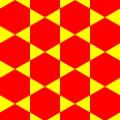
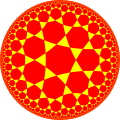
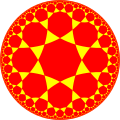
The regular octahedron is a type of trigonal antiprism, formed by taking a trigonal prism with equilateral triangle bases and rectangular lateral faces, and replacing the rectangles by alternating isosceles triangles. In the case of the regular octahedron, all of the resulting faces are congruent equilateral triangles.[28] The regular octahedron can also be considered a rectified tetrahedron, sometimes called a tetratetrahedron (by analogy to the cuboctahedron and icosidodecahedron); if alternate faces are considered to have different types (e.g. different colors or orientations), the octahedron can be considered a type of quasiregular polyhedron, a polyhedron in which two different types of polygonal faces alternate around each vertex.[29] It exists in a sequence of symmetries of quasiregular polyhedra and tilings with vertex configurations (3.n)2, progressing from tilings of the sphere to the Euclidean plane and into the hyperbolic plane. With orbifold notation symmetry of *n32 all of these tilings are Wythoff constructions within a fundamental domain of symmetry, with generator points at the right angle corner of the domain.[30][31]
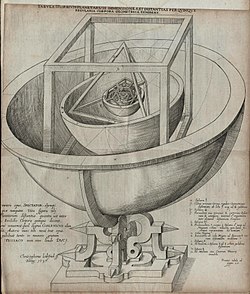
The interior of the compound of two dual tetrahedra is an octahedron, and this compound—called the stella octangula—is its first and only stellation.[33] Correspondingly, a regular octahedron is the result of cutting off from a regular tetrahedron, four regular tetrahedra of half the linear size (i.e. rectifying the tetrahedron). The vertices of the octahedron lie at the midpoints of the edges of the tetrahedron, and in this sense, it relates to the tetrahedron in the same way that the cuboctahedron and icosidodecahedron relate to the other Platonic solids.
One can also divide the edges of an octahedron in the ratio of the golden mean to define the vertices of a regular icosahedron. This is done by first placing vectors along the octahedron's edges such that each face is bounded by a cycle, then similarly partitioning each edge into the golden mean along the direction of its vector. Five octahedra define any given icosahedron in this fashion, and together they define a regular compound. A regular icosahedron produced this way is called a "snub octahedron".[37]
The Dehn invariant of a regular octahedron can be defined as a tensor product of the edge length and the dihedral angle of a regular octahedron, , which is non-zero. Every polyhedron with a Dehn invariant of zero can tile a space with its copy by attaching its faces to another, forming a honeycomb. The regular octahedron, nevertheless, cannot tile a space. Instead, two different polyhedra that join to tile the space can have the Dehn invariant of zero.[38] In the case of a regular octahedron, it can tile alternately to regular tetrahedra to form a vertex, edge, and face-uniform tessellation of space, which is named tetrahedral-octahedral honeycomb.[39]R. Buckminster Fuller, in the 1950s, applied these alternating polyhedra as a space frame, which developed the strongest building structure for resisting cantilever stresses.[40] Another honeycomb is tesselating the regular octahedra alternately with cuboctahedra, named the rectified cubic honeycomb.[41]
Miscellanea
Spherical octahedron
The spherical octahedron represents a regular octahedron projected to a sphere, a part of spherical polyhedron. There are eight spherical triangles,[42] formed by the arc of great circles. Fuller identified that there are 25 great circles.
The regular octahedron is a Hanner polytope, because it can be constructed by using the direct sum of three line segments. Its dual polyhedron, the cube, is constructed by the Cartesian product of three line segments.[43]
Like all regular convex polytopes, the octahedron can be dissected into an integral number of disjoint orthoschemes, all of the same shape characteristic of the polytope. A polytope's characteristic orthoscheme is a fundamental property because the polytope is generated by reflections in the facets of its orthoscheme. The orthoscheme occurs in two chiral forms which are mirror images of each other. The characteristic orthoscheme of a regular polyhedron is a quadrirectangular irregular tetrahedron.
The faces of the octahedron's characteristic tetrahedron lie in the octahedron's mirror planes of symmetry. The octahedron is unique among the Platonic solids in having an even number of faces meeting at each vertex. Consequently, it is the only member of that group to possess, among its mirror planes, some that do not pass through any of its faces. The octahedron's symmetry group is denoted B3. The octahedron and its dual polytope, the cube, have the same symmetry group but different characteristic tetrahedra.
The characteristic tetrahedron of the regular octahedron can be found by a canonical dissection[44] of the regular octahedron which subdivides it into 48 of these characteristic orthoschemes surrounding the octahedron's center. Three left-handed orthoschemes and three right-handed orthoschemes meet in each of the octahedron's eight faces, the six orthoschemes collectively forming a trirectangular tetrahedron: a triangular pyramid with the octahedron face as its equilateral base, and its cube-cornered apex at the center of the octahedron.[45]
If the octahedron has edge length 𝒍 = 2, its characteristic tetrahedron's six edges have lengths , , around its exterior right-triangle face (the edges opposite the characteristic angles 𝟀, 𝝉, 𝟁),[a] plus , , (edges that are the characteristic radii of the octahedron). The 3-edge path along orthogonal edges of the orthoscheme is , , , first from an octahedron vertex to an octahedron edge center, then turning 90° to an octahedron face center, then turning 90° to the octahedron center. The orthoscheme has four dissimilar right triangle faces. The exterior face is a 90-60-30 triangle, which is one-sixth of an octahedron face. The three faces interior to the octahedron are: a 45-90-45 triangle with edges , , , a right triangle with edges , , , and a right triangle with edges , , .
Notes
12(Coxeter 1973) uses the Greek letter 𝝓 (phi) to represent one of the three characteristic angles 𝟀, 𝝓, 𝟁 of a regular polytope. Because 𝝓 is commonly used to represent the golden ratio constant ≈ 1.618, for which Coxeter uses 𝝉 (tau), we reverse Coxeter's conventions and use 𝝉 to represent the characteristic angle.
See also
Centered octahedral number, figurate number that counts the points of a three-dimensional integer lattice that lie inside a regular octahedron centered at the origin;
↑Coxeter (1973) Table I(i), pp. 292–293. See the columns labeled , , and , Coxeter's notation for the circumradius, midradius, and inradius, respectively, also noting that Coxeter uses as the edge length (see p. 2).
↑Klein, Douglas J. (2002). "Resistance-Distance Sum Rules"(PDF). Croatica Chemica Acta. 75 (2): 633–649. Archived from the original(PDF) on 10 June 2007. Retrieved 30 September 2006.
↑Slavicsek, Bill; Baker, Richard (2005). Dungeons & Dragons For Dummies. Wiley. ISBN9780764599248.
↑Brigaglia, Aldo; Palladino, Nicla; Vaccaro, Maria Alessandra (2018). "Historical notes on star geometry in mathematics, art and nature". In Emmer, Michele; Abate, Marco (eds.). Imagine Math 6: Between Culture and Mathematics. Springer International Publishing. pp.197–211. doi:10.1007/978-3-319-93949-0_17. hdl:10447/325250. ISBN978-3-319-93948-3.
This page is based on this Wikipedia article Text is available under the CC BY-SA 4.0 license; additional terms may apply. Images, videos and audio are available under their respective licenses.