List of mammals

Last updated
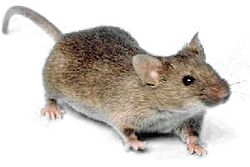
Mammals from different orders. From top left to bottom right: Monotremata (platypus), Didelphimorphia (opossum), Diprotodontia (kangaroo), Proboscidea (elephant), Cingulata (armadillo), Pilosa (sloth), Chiroptera (bat), Artiodactyla (whale), Artiodactyla (deer), Perissodactyla (rhinoceros), Eulipotyphla (hedgehog), Carnivora (seal), Carnivora (raccoon), Rodentia (mouse), Primate (monkey) Mammal collage.pngMonotremata (platypus)Didelphimorphia (opossum)Diprotodontia (kangaroo)Proboscidea (elephant)Cingulata (armadillo)Pilosa (sloth)Chiroptera (bat)Artiodactyla (whale)Artiodactyla (deer)Perissodactyla (rhinoceros)Eulipotyphla (hedgehog)Carnivora (seal)Carnivora (raccoon)Rodentia (mouse)Primate (monkey)
Mammals from different orders. From top left to bottom right: Monotremata (platypus), Didelphimorphia (opossum), Diprotodontia (kangaroo), Proboscidea (elephant), Cingulata (armadillo), Pilosa (sloth), Chiroptera (bat), Artiodactyla (whale), Artiodactyla (deer), Perissodactyla (rhinoceros), Eulipotyphla (hedgehog), Carnivora (seal), Carnivora (raccoon), Rodentia (mouse), Primate (monkey)

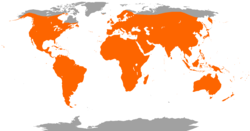
Mammalia is a class of vertebrate animals. Members of this class are called mammals. The order comprises 5,909 extant species, which are grouped into 163 families, themselves grouped into 27 orders in 3 major divisions. These orders can contain between one and thousands of species, grouped into genera and then into families. Mammals are characterized by the presence of mammary glands which in females produce milk for feeding their young, a neocortex region of the brain, and fur or hair. [1] [2] [3] Mammals are native to all major land masses and the oceans, and can be found worldwide. They live in every habitat on Earth. The basic mammalian body type is quadrupedal, with most mammals using four limbs for terrestrial locomotion; but in some, the limbs are adapted for life at sea, in the air, in trees or underground. They range in length from Kitti's hog-nosed bat, at 2 cm (1 in) with no tail, to the blue whale, at 32.6 m (107 ft) long, including tail.

Contents

The three major divisions of mammals are the infraclass Marsupialia, containing the marsupial animals wherein the young are carried in a pouch; the infraclass Placentalia, for which the fetus is carried in the uterus, and the order Monotremata, containing egg-laying species. [4] Marsupialia contains 334 species, Monotremata contains 5, and Placentalia contains the vast majority of extant mammals at 5,570 species. The majority of mammals, in terms of number of species, are in the two largest orders: Rodentia, or rodents, with 2,360 species, and Chiroptera, or bats, with 1,318. [5] [6] The exact organization of the species is not fixed, with many recent proposals made based on molecular phylogenetic analysis. In addition to the extant mammals, 70 species have been driven extinct since 1500 CE.

Conventions

The hierarchy of biological classification's eight major taxonomic ranks. Intermediate minor rankings are not shown. Biological classification L Pengo vflip.svg DomainKingdomClassOrderFamily
The hierarchy of biological classification's eight major taxonomic ranks. Intermediate minor rankings are not shown.

The author citation for the species or genus is given after the scientific name; parentheses around the author citation indicate that this was not the original taxonomic placement. Range maps are provided wherever possible; if a range map is not available, a description of the collective range of species in that genera is provided. Ranges are based on the International Union for Conservation of Nature (IUCN) Red List of Threatened Species unless otherwise noted. All extinct genera or species listed alongside extant species went extinct after 1500 CE, and are indicated by a dagger symbol "".

Classification

The class Mammalia consists of 5,909 extant species grouped into 1,295 genera belonging to 163 families. This does not include hybrid species or extinct prehistoric species. Modern molecular studies indicate that the 163 families can be grouped into 27 orders; these orders are divided into 3 major groupings: Marsupialia, an infraclass containing 7 orders of mammals which give birth to relatively undeveloped young that often reside in a pouch located on their mothers' abdomen for a time; Placentalia, an infraclass containing 19 orders of mammals that have fetuses that are carried in the uterus, and Monotremata, an order of egg-laying mammals. [4] Within these groupings, the orders are organized into named clades, and some of these orders are subdivided into named suborders. An additional 70 species have been driven extinct since 1500 CE: 13 in Marsupialia and 57 in Placentalia.

Infraclass Marsupialia

Infraclass Placentalia

  • Superorder Laurasiatheria
    • Order Artiodactyla (even-toed ungulates)
      • Suborder Ruminantia (ruminants): 6 families, 227 species
      • Suborder Suina (pigs and peccaries): 2 families, 20 species
      • Suborder Tylopoda (camels): 1 family, 7 species
      • Suborder Whippomorpha (whales and hippopotamuses): 15 families, 99 species
    • Order Carnivora (wolves and cats)
      • Suborder Caniformia (wolves, weasels, and seals): 9 families, 173 species (2 extinct)
      • Suborder Feliformia (cats and mongooses): 6 families, 125 species
    • Order Chiroptera (bats)
      • Suborder Yangochiroptera (leaf-nosed and vesper bats): 14 families, 929 species (3 extinct)
      • Suborder Yinpterochiroptera (fruit and horseshoe bats): 6 families, 398 species (6 extinct)
    • Order Eulipotyphla (hedgehogs and shrews): 4 families, 485 species
    • Order Perissodactyla (odd-toed ungulates)
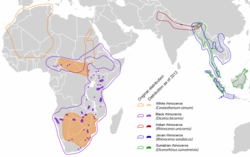
      • Suborder Ceratomorpha (rhinoceroses and tapirs): 2 families, 9 species
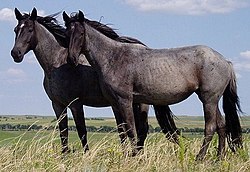
      • Suborder Hippomorpha (horses): 1 family, 9 species
    • Order Pholidota (pangolins): 1 family, 8 species
  • Superorder Xenarthra
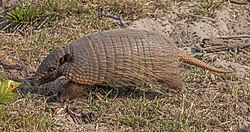
    • Order Cingulata (armadillos): 2 families, 22 species
    • Order Pilosa (sloths and anteaters)
      • Suborder Folivora (sloths): 2 families, 6 species
      • Suborder Vermilingua (anteaters): 2 families, 3 species

Order Monotremata (platypus and echidnas): 2 families, 5 species

Mammalia [7]

Mammals

The following classification is based on the taxonomy described by Mammal Species of the World (2005), with augmentation by generally accepted proposals made since using molecular phylogenetic analysis, as supported by both the IUCN and the American Society of Mammalogists. [5] [6]

Infraclass Marsupialia

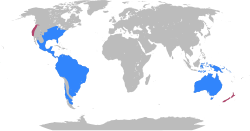
Marsupialia distribution (introduced in purple) Marsupial world distribution map.svg
Marsupialia distribution (introduced in purple)

Marsupialia is one of the three main divisions of mammals, and contains 334 extant species. It is distinguished from the other two groups in that marsupials give birth to relatively undeveloped young that often reside in a pouch located on their mothers' abdomen for a certain amount of time. [4] It is divided into two groupings: the superorder Australidelphia and Ameridelphia, which was previously considered a superorder but is now regarded as a paraphyletic group. Ameridelphia contains 99 extant species in 2 orders, each containing a single family: Didelphimorphia, or the opossums, and Paucituberculata, or the shrew opossums. Australidelphia contains 235 extant species in 18 families, grouped into 5 orders: Dasyuromorphia, or the Australian carnivorous marsupials; Diprotodontia, or the kangaroos and possums; Microbiotheria, or the monito del montes; and Notoryctemorphia, or the marsupial moles; and Peramelemorphia, or the bandicoots and bilbies. One additional species in Ameridelphia and twelve in Australidelphia were driven extinct in modern times.

Ameridelphia

Didelphimorphia

Members of the Didelphimorphia order are called didelphimorphs or opossums. They are found in North and South America, Australia, and southeastern Asia and are omnivorous, eating insects, small vertebrates, and vegetation. Didelphimorphia comprises a single family of 92 extant species in 18 genera. One additional species was driven extinct in modern times.

Not assigned to a named clade – one family
NameAuthority and speciesRangeSize and ecology
Didelphidae
(opossum)

Opossum 2.jpg

Gray, 1821

93 species (1 extinct) in 18 genera
North America and South America
Didelphidae distribution.png
Size range: 6 cm (2 in) long, plus 3 cm (1 in) tail (pygmy short-tailed opossum) to 50 cm (20 in) long, plus 47 cm (19 in) tail (Virginia opossum) [8]

Habitats: Forest, shrubland, grassland, savanna, inland wetlands, and desert [9]

Diets: Omnivorous, including insects, other invertebrates, small vertebrates, eggs, seeds, fruit, and nectar [10]
Paucituberculata

Members of the Paucituberculata order are called paucituberculatans or shrew opossums. They are found in western South America and are omnivorous, eating larva, small vertebrates, and vegetation. Paucituberculata comprises a single family of seven extant species in three genera.

Not assigned to a named clade – one family
NameAuthority and speciesRangeSize and ecology
Caenolestidae
(shrew opossum)

Caenolestes sangay. Foto Jorge Brito.jpg

Trouessart, 1898

7 species in 3 genera
Western South America
Rhyncholestes Range.jpg
Size range: 9 cm (4 in) long, plus 10 cm (4 in) tail (Incan caenolestid) to 15 cm (6 in) long, plus 15 cm (6 in) tail (northern caenolestid) [11]

Habitats: Forest and shrubland [12]

Diets: Invertebrate larvae, small vertebrates, fruit, and vegetation [13]

Superorder Australidelphia

Dasyuromorphia

Members of the Dasyuromorphia order are called dasyuromorphs or Australian carnivorous marsupials and include the marsupial shrews and the numbat. They are found in Australia and New Guinea and are carnivorous, eating a wide variety of vertebrates and invertebrates. Dasyuromorphia comprises 2 families containing 72 extant species in 14 genera. One additional family containing a single species was driven extinct in modern times.

Not assigned to a named clade – three families
NameAuthority and speciesRangeSize and ecology
Dasyuridae
(marsupial shrew)

Sarcophilus harrisii taranna.jpg

Goldfuss, 1820

71 species in 13 genera
Australia and New Guinea
Dasyuridae distribution.png
Size range: 4 cm (2 in) long, plus 9 cm (4 in) tail (southern ningaui) to 65 cm (26 in) long, plus 26 cm (10 in) tail (Tasmanian devil) [14]

Habitats: Forest, savanna, shrubland, grassland, inland wetlands, rocky areas, desert, and caves [15]

Diets: Wide variety of vertebrates and invertebrates [16]
Myrmecobiidae
(numbat)

Numbat.jpg

Waterhouse, 1841

1 species in 1 genus
Scattered Australia
Numbat area.png
Size: 20–29 cm (8–11 in) long, plus 12–21 cm (5–8 in) tail [17]

Habitats: Forest, savanna, shrubland, and desert [18]

Diet: Termites and ants, as well as other invertebrates [19]
Thylacinidae
(thylacine)

Thylacinus.jpg

C. L. Bonaparte, 1838

1 extinct species in 1 genus
Tasmania
ThylacineRangeMap.png
Size range: 123–195 cm (48–77 in) long, plus 50–66 cm (20–26 in) tail [20]

Habitats: Forest and grassland [21]

Diets: Kangaroos, wallabies, small mammals, and birds [22]
Diprotodontia

Members of the Diprotodontia order are called diprotodonts and include kangaroos, wallabies, potoroos, possums, the koala, and wombats. They are found in Australia and southeastern Asia and are omnivorous, but primarily eat a wide variety of vegetation and invertebrates. Diprotodontia comprises 11 families containing 140 extant species in 39 genera. These families are divided between three suborders: Macropodiformes, containing the kangaroos, wallabies, and potoroos; Phalangeriformes, or the possums; and Vombatiformes, or the koala and wombats. Eight additional kangaroo and potoroo species were driven extinct in modern times.

Suborder Macropodiformes Ameghino, 1889 – three families (full list)
NameAuthority and speciesRangeSize and ecology
Hypsiprymnodontidae
(musky rat-kangaroo)

Musky-rat.jpg

Collett, 1877

1 species in 1 genera
Northeastern Australia
Musky Rat Kangaroo area.png
Size: 15–27 cm (6–11 in) long, plus 12–16 cm (5–6 in) tail [23]

Habitats: Forest [24]

Diet: Insects and worms, as well as berries and roots [25]
Macropodidae
(kangaroo or wallaby)

Macropus giganteus - Brunkerville.jpg

Gray, 1821

67 species (4 extinct) in 13 genera
Australia and New Guinea
Macropodidae.png
Size range: 29 cm (11 in) long, plus 22 cm (9 in) tail (nabarlek) to 230 cm (91 in) long, plus 109 cm (43 in) tail (eastern grey kangaroo) [26]

Habitats: Desert, grassland, forest, shrubland, savanna, inland wetlands, and rocky areas [27]

Diets: Wide variety of plant material [28]
Potoroidae
(potoroo or rat-kangaroo)

Long-nosed potoroo.jpg

Gray, 1821

12 species (4 extinct) in 3 genera (1 extinct)
Eastern and scattered southern Australia
Potoroidae distribution.png
Size range: 26 cm (10 in) long, plus 18 cm (7 in) tail (long-nosed potoroo) to 34 cm (13 in) long, plus 48 cm (19 in) tail (rufous rat-kangaroo) [29]

Habitats: Desert, forest, shrubland, savanna, and inland wetlands [30]

Diets: Omnivorous, especially fungi [25]
Suborder Phalangeriformes Szalay, 1982 – six families (full list)
NameAuthority and speciesRangeSize and ecology
Acrobatidae
(feather-tailed possum or feather-tailed glider)

Acrobates neuneu.jpg

Aplin, 1987

2 species in 2 genera
Eastern Australia and New Guinea
Acrobatidae distribution.png
Size range: 5 cm (2 in) long, plus 6 cm (2 in) tail (feathertail glider) to 11 cm (4 in) long, plus 16 cm (6 in) tail (feather-tailed possum) [23]

Habitats: Forest [31]

Diets: Flowers, fruit, and invertebrates [32]
Burramyidae
(pygmy possum)

Mountain-pygmy-possum.jpg

Broom, 1989

5 species in 2 genera
New Guinea and southern and northeastern Australia
Burramyidae distribution.png
Size range: 5 cm (2 in) long, plus 6 cm (2 in) tail (Tasmanian pygmy possum) to 11 cm (4 in) long, plus 14 cm (6 in) tail (mountain pygmy possum) [33]

Habitats: Shrubland and forest [34]

Diets: Invertebrates and vegetation [35]
Petauridae
(possum)

Mahogany glider.jpg

C. L. Bonaparte, 1838

11 species in 3 genera
New Guinea and northern, eastern, and southern Australia
Petauridae distribution.png
Size range: 15 cm (6 in) long, plus 15 cm (6 in) tail (Leadbeater's possum) to 31 cm (12 in) long, plus 47 cm (19 in) tail (yellow-bellied glider) [36]

Habitats: Forest and savanna [37]

Diets: Sap, flowers, nectar, invertebrates, and small vertebrates [38]
Phalangeridae
(cuscus)

Southern Brown Cuscus, photo by CNZdenek & AJBurnett.jpg

Thomas, 1888

27 species in 6 genera
New Guinea, Sulawesi island and nearby islands in Indonesia, and scattered Australia
Phalangeridae distribution.png
Size range: 30 cm (12 in) long, plus 28 cm (11 in) tail (scaly-tailed possum) to 69 cm (27 in) long, plus 65 cm (26 in) tail (black-spotted cuscus) [39]

Habitats: Forest, savanna, and rocky areas [40]

Diets: Leaves, flowers, and fruit, as well as insects and eggs [41]
Pseudocheiridae
(ringtail possum)

Possum Ring-tailed444.jpg

Winge, 1893

18 species in 6 genera
New Guinea and northern, eastern, and southern Australia
Pseudocheiridae distribution.png
Size range: 17 cm (7 in) long, plus 15 cm (6 in) tail (pygmy ringtail possum) to 45 cm (18 in) long, plus 60 cm (24 in) tail (southern greater glider) [42]

Habitats: Forest, savanna, grassland, and rocky areas [43]

Diets: Leaves and fruit [44]
Tarsipedidae
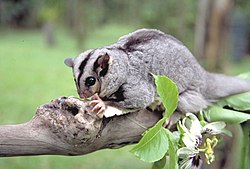
(honey possum)

Tarsipes rostratus Gould 2.jpg

Gervais & Verreaux, 1842

1 species in 1 genus
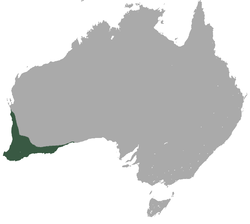
Southwestern Australia
Honey Possum area.png
Size: 6–9 cm (2–4 in) long, plus 7–11 cm (3–4 in) tail [45]

Habitats: Shrubland [46]

Diet: Nectar and pollen [47]
Suborder Vombatiformes Burnett, 1830 – two families
NameAuthority and speciesRangeSize and ecology
Phascolarctidae
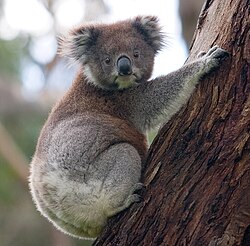
(koala)

Koala climbing tree.jpg

Owen, 1839

1 species in 1 genus
Southern and eastern Australia
Koala Range.jpg
Size: 67–82 cm (26–32 in) long [48]

Habitats: Forest and shrubland [49]

Diet: Eucalyptus leaves and bark, as well as other leaves [50]
Vombatidae
(wombat)

Vombatus ursinus -Maria Island National Park.jpg

Burnett, 1830

3 species in 2 genera
Southern and eastern Australia
Vombatidae distribution.png
Size range: 84 cm (33 in) long, plus 2 cm (1 in) tail (southern hairy-nosed wombat) to 115 cm (45 in) long, with no tail (common wombat) [48]

Habitats: Forest, savanna, shrubland, and grassland [51]

Diets: Grass, roots, bark, and fungi [52]
Microbiotheria

Members of the Microbiotheria order are called microbiotherians or monito del montes. They are found in southwestern South America and eat vegetation and invertebrates. Microbiotheria comprises a single family containing two extant species in a single genus.

Not assigned to a named clade – one family
NameAuthority and speciesRangeSize and ecology
Microbiotheriidae
(monito del monte)

Monito del Monte ps6.jpg

Ameghino, 1889

2 species in 1 genus
Southwestern South America
Microbiotheriidae distribution.png
Size range: 8 cm (3 in) long, plus 9 cm (4 in) tail (southern monito del monte) to about 17 cm (7 in) long, plus about 9 cm (4 in) tail (Pancho's monito del monte) [53]

Habitats: Forest [54]

Diets: Insects and other invertebrates, as well as vegetable matter [55]
Notoryctemorphia

Members of the Notoryctemorphia order are called notoryctemorphs or marsupial moles. They are found in central Australia and eat insects and seeds. Notoryctemorphia comprises a single family containing two extant species in a single genus.

Not assigned to a named clade – one family
NameAuthority and speciesRangeSize and ecology
Notoryctidae
(marsupial mole)

A hand-book to the marsupialia and monotremata (Plate XXXI) (cropped).jpg

Ogilby, 1892

2 species in 1 genus
Central Australia
Marsupial mole distribution map.svg
Size range: 8 cm (3 in) long, plus 1 cm (0.4 in) tail (northern marsupial mole) to 14 cm (6 in) long, plus 3 cm (1 in) tail (southern marsupial mole) [56]

Habitats: Shrubland, grassland, and desert [57]

Diets: Insects and seeds [58]
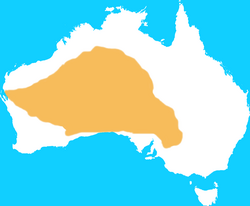
Peramelemorphia

Members of the Peramelemorphia order are called peramelemorphs and include bandicoots and bilbies. They are found in Australia and New Guinea and are omnivorous. Peramelemorphia comprises two families containing 19 extant species in 7 genera. Three additional species, including the sole member of a third family, were driven extinct in modern times.

Not assigned to a named clade – three families
NameAuthority and speciesRangeSize and ecology
Chaeropodidae
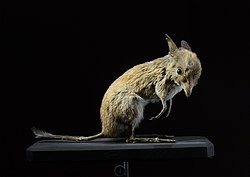
(pig-footed bandicoot)

Mus Nat Hist Nat 25022013 Chaeropus ecaudatus.jpg

Gill, 1872

1 extinct species in 1 genus
Central and western Australia
Pig-footed Bandicoot Distribution Map.png
Size range: 23–26 cm (9–10 in) long, plus 10–14 cm (4–6 in) tail [59]

Habitats: Forest, savanna, shrubland, and grassland [60]

Diets: Believed to be omnivorous [59]
Peramelidae
(bandicoot)

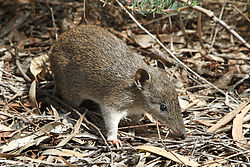
Southern Brown Bandicoot (Isoodon obesulus) 2, Vic, jjron, 09.01.2013.jpg

Gill, 1872

19 species (1 extinct) in 6 genera
Australia and New Guinea
Peramelidae distribution.png
Size range: 15 cm (6 in) long, plus 10 cm (4 in) tail (mouse bandicoot) to 44 cm (17 in) long, plus 16 cm (6 in) tail (long-nosed bandicoot) [61]

Habitats: Forest, shrubland, savanna, grassland, inland wetlands, and desert [62]

Diets: Omnivorous [63]
Thylacomyidae
(bilby)

Macrotis lagotis - bandicut conejo.jpg

Bensley, 1903

2 species (1 extinct) in 1 genus
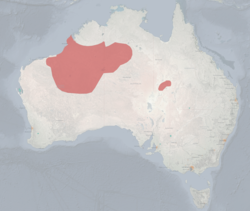
Western and central Australia
Bilby.png
Size range: 33–55 cm (13–22 in) long, plus 20–29 cm (8–11 in) tail (greater bilby) [64]

Habitats: Savanna, shrubland, and grassland [65]

Diets: Insects, as well as small vertebrates and vegetation [66]

Infraclass Placentalia

Placentalia is one of the three main divisions of mammals, and contains the vast majority of extant species with 5,570 species. It is distinguished from the other two groups in that the placental animals have fetuses that are carried in the uterus. [4] It is divided into four superorders: Afrotheria, Euarchontoglires, Laurasiatheria, and Xenarthra.

Afrotheria contains 87 extant species in 9 families, grouped into 6 orders: Afrosoricida, the golden moles and tenrecs; Hyracoidea, or hyraxes; Macroscelidea, or elephant shrews; Proboscidea, or elephants; Sirenia, or dugongs and manatees; and Tubulidentata, or aardvarks. Euarchontoglires contains 2,982 extant species in 56 families, grouped into 5 orders: Scandentia, or the treeshrews; Dermoptera, or the colugos; Lagomorpha, containing hares and pikas; Primates, containing monkeys and apes; and Rodentia, or rodents. Laurasiatheria contains 2,470 species in 69 families, grouped into 6 orders: Artiodactyla, containing deer, cattle, pigs, and whales; Carnivora, containing wolves, otters, seals, cats, and mongooses; Chiroptera, or bats; Eulipotyphla, containing hedgehogs, shrews, and moles; Perissodactyla, containing horses, tapirs, and rhinoceroses; and Pholidota, or pangolins. Xenarthra contains 31 species in 6 families, grouped into 2 orders: Cingulata, or armadillos, and Pilosa, the sloths and anteaters. One additional species in Afrotheria, 38 in Euarchontoglires, and 18 in Laurasiatheria were driven extinct in modern times.

Superorder Afrotheria

Afrosoricida
Afrosoricida distribution Afrosoricida range Color.jpg
Afrosoricida distribution

Members of the Afrosoricida order are called afrosoricids and include golden moles, otter shrews, and tenrecs. They are found in Sub-Saharan Africa and eat invertebrates, fish, amphibians, lizards, and vegetation. Afrosoricida comprises three families of 55 extant species in 20 genera. These families are divided between two suborders: Chrysochloridea, or the golden moles, and Tenrecomorpha, containing the otter shrews and tenrecs.

Suborder Chrysochloridea Broom, 1915 – one family
NameAuthority and speciesRangeSize and ecology
Chrysochloridae
(golden mole)

Amblysomus hottentotus (Palmiet Nature Reserve, South Africa East Coast) 2.jpg

Gray, 1825

21 species in 10 genera
Sub-Saharan Africa
Golden mole range.jpg
Size range: 6 cm (2 in) long, with no tail (Grant's golden mole) to 23 cm (9 in) long, with no tail (giant golden mole) [67]

Habitats: Forest, savanna, grassland, shrubland, and desert [68]

Diets: Invertebrates, as well as lizards [69]
Suborder Tenrecomorpha Butler, 1972 – two families
NameAuthority and speciesRangeSize and ecology
Potamogalidae
(otter shrew)

Giant otter shrew (Potamogale velox), Natural History Museum, London, Mammals Gallery.JPG

Allmann, 1865

3 species in 2 genera
Western and central Africa
Potamogalidae range.jpg
Size range: 12 cm (5 in) long, plus 9 cm (4 in) tail (Nimba otter shrew) to 34 cm (13 in) long, plus 29 cm (11 in) tail (giant otter shrew) [70]

Habitats: Forest and inland wetlands [71]

Diets: Crabs, fish, amphibians, worms, and insects [72]
Tenrecidae
(tenrec)

Kleiner-igeltanrek-a.jpg

Gray, 1821

31 species in 8 genera
Madagascar
Setifer setosus range map.svg
Size range: 4 cm (2 in) long, plus 4 cm (2 in) tail (pygmy shrew tenrec) to 35 cm (14 in) long, with no tail (tailless tenrec) [73]

Habitats: Forest, shrubland, grassland, savanna, and inland wetlands [74]

Diets: Invertebrates, as well as frogs, fish, shrimp, worms, and vegetation [75]
Hyracoidea

Members of the Hyracoidea order are called hyracoids or hyraxes. They are found in Africa and the Middle East and eat a variety of vegetation. Hyracoidea comprises a single family of five extant species in three genera.

Not assigned to a named clade – one family
NameAuthority and speciesRangeSize and ecology
Procaviidae
(hyrax)

Hyrax on the Rocks.JPG

Bonaparte, 1838

5 species in 3 genera
Africa and Middle East
Procaviidae Range.jpg
Size range: 32 cm (13 in) long, with no tail (yellow-spotted rock hyrax) to 60 cm (24 in) long, with no tail (southern tree hyrax) [76]

Habitats: Forest, savanna, rocky areas, shrubland, and desert [77]

Diets: Variety of vegetation [78]
Macroscelidea

Members of the Macroscelidea order are called macroscelids or elephant shrews. They are found in Africa and eat ants and termites, as well as other insects. Macroscelidea comprises a single family of 19 extant species in 6 genera.

Not assigned to a named clade – one family
NameAuthority and speciesRangeSize and ecology
Macroscelididae
(elephant shrew)

Rhynchocyon petersi from side.jpg

Bonaparte, 1838

19 species in 6 genera
Africa
Elephant shrew range genus.jpg
Size range: 8 cm (3 in) long, plus 8 cm (3 in) tail (Etendeka round-eared elephant shrew) to 21 cm (8 in) long, plus 19 cm (7 in) tail (four-toed elephant shrew) [79]

Habitats: Savanna, shrubland, grassland, rocky areas, and desert [80]

Diets: Ants and termites, as well as other insects [81]
Proboscidea

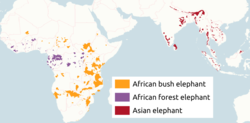
Members of the Proboscidea order are called proboscids or elephants. They are found in Sub-Saharan Africa and southern and southeastern Asia and eat grass, bark, roots, leaves, shrubs, and fruit. Proboscidea comprises a single family of three extant species in two genera, in the suborder Elephantiformes.

Suborder Elephantiformes Tassy, 1988 – one family
NameAuthority and speciesRangeSize and ecology
Elephantidae
(elephant)

African Elephant (Loxodonta africana) male (17289351322).jpg

J. E. Gray, 1821

3 species in 2 genera
Sub-Saharan Africa and southern and southeastern Asia
Loxodonta Elephas distribution.png
Size range: 550 cm (18 ft) long, plus 120 cm (4 ft) tail (Asian elephant) to 750 cm (25 ft) long, plus 150 cm (5 ft) tail (African savanna elephant) [82]

Habitats: Forest, savanna, shrubland, grassland, inland wetlands, and desert [83]

Diets: Grass, bark, roots, leaves, shrubs, and fruit [84]
Sirenia
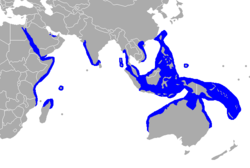
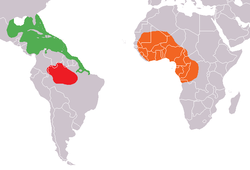
Sirenia distribution Sirenia distribution.png
Sirenia distribution

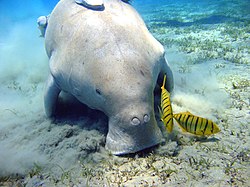
Members of the Sirenia order are called sirenians or sea cows and include dugongs and manatees. They are found in the Indian, Pacific, and western Atlantic Oceans and in South American and western African rivers, and eat aquatic vegetation and algaes, as well as fish and invertebrates. Sirenia comprises two families of four extant species in two genera. Additionally, a single species of dugong was driven extinct in modern times.

Not assigned to a named clade – two families
NameAuthority and speciesRangeSize and ecology
Dugongidae
(dugong)

Dugong Marsa Alam.jpg

J. E. Gray, 1821

2 species (1 extinct) in 2 genera (1 extinct)
Indian and Pacific Oceans
Dugong-range.png
Size range: 200–330 cm (7–11 ft) long (dugong) [85]

Habitats: Neritic marine and intertidal marine [86]

Diets: Seagrass, kelp, and other algaes, as well as crabs [87]
Trichechidae
(manatee)

Underwater photography on endangered mammal manatee.jpg

Gill, 1872

3 species in 1 genus
South American and western African rivers and western Atlantic Ocean
Mapa distribuicao Trichechus.png
Size range: 250 cm (98 in) long (West Indian manatee) to 390 cm (154 in) long (West Indian manatee) [8]

Habitats: Inland wetlands, neritic marine, oceanic marine, intertidal marine, coastal marine [88]

Diets: Aquatic vegetation, as well as fish and invertebrates [89]
Tubulidentata

Members of the Tubulidentata order are called tubulidentatans or aardvarks. They are found in Africa and eat termites, as well as other insects and fruit. Tubulidentata is composed of a single species.

Not assigned to a named clade – one family
NameAuthority and speciesRangeSize and ecology
Orycteropodidae
(aardvark)

Orycteropus afer 175359469.jpg

J. E. Gray, 1821

1 species in 1 genera
Africa
Aardvark area.png
Size: 94–142 cm (37–56 in) long, plus 44–63 cm (17–25 in) tail [90]

Habitats: Forest, savanna, shrubland, and grassland [91]

Diet: Termites, as well as other insects and fruit [92]

Superorder Euarchontoglires

Scandentia
Scandentia distribution Treeshrew range.jpg
Scandentia distribution

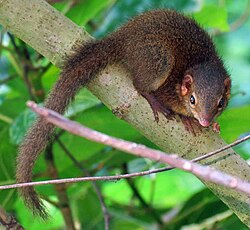
Members of the Scandentia order are called scandentians or treeshrews. They are found in India and southeastern Asia and eat insects and fruit, as well as small animals and plants. Scandentia comprises 2 families of 23 extant species in 4 genera.

Not assigned to a named clade – two families
NameAuthority and speciesRangeSize and ecology
Ptilocercidae
(pen-tailed treeshrew)

Ptilocercus lowii.jpg

Lyon, 1913

1 species in 1 genera
Southeastern Asia
Pen-tailed Treeshrew area.png
Size: 13–15 cm (5–6 in) long, plus 16–20 cm (6–8 in) tail [93]

Habitats: Forest [94]

Diet: Insects, small vertebrates, and fruit [95]
Tupaiidae
(treeshrew)

Tupaia javanica.jpg

J. E. Gray, 1825

22 species in 3 genera
India and southeastern Asia
Tupaiidae range.jpg
Size range: 11 cm (4 in) long, plus 11 cm (4 in) tail (northern smooth-tailed treeshrew) to 22 cm (9 in) long, plus 18 cm (7 in) tail (Mindanao treeshrew) [96]

Habitats: Forest and shrubland [97]

Diets: Insects and fruit, as well as small animals and plants [98]
Dermoptera

Members of the Dermoptera order are called dermopterans or colugos. They are found in southeastern Asia and eat leaves. Dermoptera comprises a single family of two extant species in two genera.

Not assigned to a named clade – one family
NameAuthority and speciesRangeSize and ecology
Cynocephalidae
(colugo)

Galeopterus variegatus 476925756.jpg

Simpson, 1945

2 species in 2 genera
Southeastern Asia
DistributionDermopteraCorrecting.png
Size range: 34–42 cm (13–17 in) long, plus 17–28 cm (7–11 in) tail (both species) [99]

Habitats: Forest [100]

Diets: Leaves [101]
Lagomorpha
Lagomorpha distribution Lagomorpha range inteur.png
Lagomorpha distribution

Members of the Lagomorpha order are called lagomorphs and include hares, rabbits, and pikas. They are found worldwide and eat a variety of plant material. Lagomorpha comprises 2 families of 93 extant species in 12 genera.

Not assigned to a named clade – two families
NameAuthority and speciesRangeSize and ecology
Leporidae
(hare or rabbit)

Oryctolagus cuniculus Tasmania 2.jpg

G. Fischer von Waldheim, 1817

64 species in 11 genera (full list)
Worldwide
Lagomorpha range inteur.png
Size range: 23 cm (9 in) long, plus 1 cm (0.4 in) tail (pygmy rabbit) to 68 cm (27 in) long, plus 14 cm (6 in) tail (European hare) [102]

Habitats: Desert, grassland, inland wetlands, forest, shrubland, rocky areas, savanna, caves, coastal marine, and intertidal marine [103]

Diets: Variety of plant material [104]
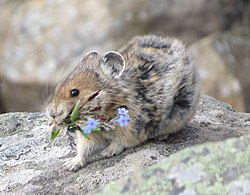
Ochotonidae
(pika)

American pika (ochotona princeps) with a mouthful of flowers.jpg

Thomas, 1897

29 species in 1 genus (full list)
Asia and western North America
Ochotonidae distribution.png
Size range: 11 cm (4 in) long, with no tail (Gansu pika) to 26 cm (10 in) long, with no tail (Turkestan red pika) [105]

Habitats: Desert, forest, shrubland, rocky areas, and grassland [106]

Diets: Variety of plant material, especially grass and sedges [107]
Primates
Primates distribution (non-human) Primate SpeciesDensity.png
Primates distribution (non-human)

Members of the Primates order are called primates and include monkeys and apes. Excluding humans, they are found in Central and South America, Sub-Saharan Africa, and Asia, and eat a variety of plant material, invertebrates, and small vertebrates. Primates comprises 16 families of 505 extant species in 81 genera. These families are divided between two suborders: Haplorhini, containing the apes, gibbons, New World monkeys, and tarsiers, and Strepsirrhini, containing the lemurs, galagos, and lorises.

Suborder Haplorhini Pocock, 1918 – nine families
NameAuthority and speciesRangeSize and ecology
Aotidae
(night monkey)

Panamanian night monkey.jpg

Poche, 1908

11 species in 1 genus
Central and northern South America and Central America
Aotidae distribution.png
Size range: 29 cm (11 in) long, plus 35 cm (14 in) tail (Nancy Ma's night monkey) to 48 cm (19 in) long, plus 42 cm (17 in) tail (gray-handed night monkey) [108]

Habitats: Forest and savanna [109]

Diets: Fruit, nuts, leaves, bark, flowers, gums, insects, and small vertebrates [110]
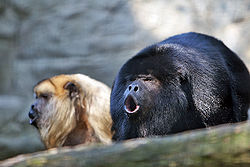
Atelidae
(howler, spider, or woolly monkey)

Howler monkey.jpg

J. E. Gray, 1825

23 species in 4 genera
South America and Central America
Alouatta range map.png
Size range: 30 cm (12 in) long, plus 66 cm (26 in) tail (black-headed spider monkey) to 71 cm (28 in) long, plus 60 cm (24 in) tail (Bolivian red howler) [111]

Habitats: Forest and savanna [112]

Diets: Fruit, leaves, seeds, insects, nuts, arachnids, nectar, flowers, and eggs [113]
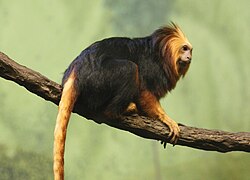
Callitrichidae
(marmoset or tamarin)

Golden-headed Lion Tamarin 095.jpg

Thomas, 1903

43 species in 7 genera
South America and Central America
Callitrichidae Range.png
Size range: 12 cm (5 in) long, plus 17 cm (7 in) tail (western pygmy marmoset) to 34 cm (13 in) long, plus 40 cm (16 in) tail (Superagüi lion tamarin) [114]

Habitats: Forest, shrubland, and savanna [115]

Diets: Insects, fruit, nectar, and gums [116]
Cebidae
(capuchin or squirrel monkey)

Tufted capuchin on a branch in Singapore.jpg

Bonaparte, 1831

18 species in 3 genera
South America and southern Central America
Cebidae distribution.png
Size range: 22 cm (9 in) long, plus 35 cm (14 in) tail (black squirrel monkey) to 56 cm (22 in) long, plus 56 cm (22 in) tail (black capuchin) [117]

Habitats: Forest, shrubland, and savanna [118]

Diets: Fruit, nuts, seeds, flowers, shoots, bark, gums, eggs, invertebrates, and small vertebrates [119]
Cercopithecidae
(Old World monkey)

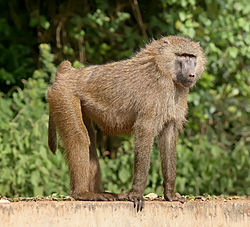
Olive baboon Ngorongoro.jpg

J. E. Gray, 1821

158 species in 23 genera
Sub-Saharan Africa and southern, southeastern, and eastern Asia
OldWorldMonkeys SpeciesDensity.png
Size range: 26 cm (10 in) long, plus 53 cm (21 in) tail (Angolan talapoin) to 100 cm (39 in) long, plus 84 cm (33 in) tail (Chacma baboon) [120]

Habitats: Inland wetlands, rocky areas, shrubland, savanna, grassland, forest, intertidal marine, and caves [121]

Diets: Fruit, leaves, a variety of vegetation, invertebrates, mushrooms, eggs, and small vertebrates [122]
Hominidae
(great ape)

Male gorilla in SF zoo.jpg

J. E. Gray, 1825

8 species in 4 genera
Western and central Africa and southeastern Asia, plus humans worldwide
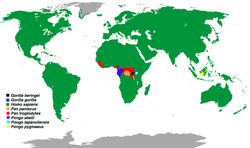
Distribution of the Great Apes.png
Size range: 60 cm (24 in) long, with no tail (bonobo) to 120 cm (47 in) long, with no tail (eastern gorilla) [123]

Habitats: Forest and savanna (excluding humans) [124]

Diets: Fruit and leaves, as well as other vegetation, insects, and small vertebrates (excluding humans) [125]
Hylobatidae
(gibbon)

Hylobates lar - Kaeng Krachan WB.jpg

J. E. Gray, 1870

29 species in 4 genera
Southeastern Asia
Distribucion hylobatidae.png
Size range: 41 cm (16 in) long, with no tail (lar gibbon) to 90 cm (35 in) long, with no tail (siamang) [126]

Habitats: Forest [127]

Diets: Leaves and fruit, as well as flowers, insects, and small vertebrates [128]
Pitheciidae
(titi or saki monkey)

Callicebus nigrifrons Minas Gerais.jpg

Mivart, 1865

58 species in 6 genera
Northern and central South America
Pitheciidae distribution.png
Size range: 23 cm (9 in) long, plus 42 cm (17 in) tail (Colombian black-handed titi monkey) to 57 cm (22 in) long, plus 19 cm (7 in) tail (bald uakari) [129]

Habitats: Forest, shrubland, and savanna [130]

Diets: Fruit, honey, leaves, flowers, invertebrates, and small vertebrates [131]
Tarsiidae
(tarsier)

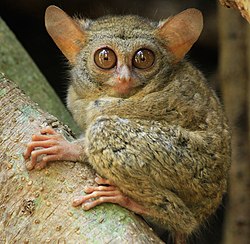
Tarsius spectrumgurskyae.jpg

J. E. Gray, 1825

14 species in 3 genera
Southeastern Asia
Combined Range of 9 Tarsier Species.jpg
Size range: 9 cm (4 in) long, plus 20 cm (8 in) tail (pygmy tarsier) to 15 cm (6 in) long, plus 31 cm (12 in) tail (Sangihe tarsier) [132]

Habitats: Inland wetlands, forest, and caves [133]

Diets: Insects, as well as small vertebrates [134]
Suborder Strepsirrhini É. Geoffroy, 1812 – seven families
NameAuthority and speciesRangeSize and ecology
Cheirogaleidae
(dwarf or mouse lemur)

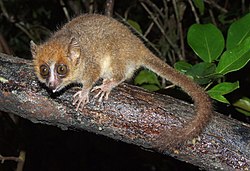
Zwergmausmaki--w.jpg

J. E. Gray, 1873

41 species in 5 genera
Madagascar
Cheirogaleidae distribution.png
Size range: 8 cm (3 in) long, plus 14 cm (6 in) tail (Gerp's mouse lemur) to 29 cm (11 in) long, plus 37 cm (15 in) tail (pale fork-marked lemur) [135]

Habitats: Forest and shrubland [136]

Diets: Insects, spiders, fruit, flowers, nectar, gums, resins, leaves, frogs, lizards, birds, and eggs [137]
Daubentoniidae
(aye-aye)

Wild aye aye.jpg

J. E. Gray, 1863

1 species in 1 genus
Western and eastern Madagascar
Daubentonia madagascariensis range map.svg
Size: 30–37 cm (12–15 in) long, plus 44–53 cm (17–21 in) tail [138]

Habitats: Forest and shrubland [139]

Diet: Insects, coconuts, and gums [140]
Galagidae
(galago)

Komba usata.jpg

J. E. Gray, 1825

19 species in 6 genera
Sub-Saharan Africa
Galagidae distribution.png
Size range: 9 cm (4 in) long, plus 16 cm (6 in) tail (Rondo dwarf galago) to 40 cm (16 in) long, plus 50 cm (20 in) tail (brown greater galago) [141]

Habitats: Forest, shrubland, and savanna [142]

Diets: Gums, insects and fruit [143]
Indriidae
(woolly lemur)

Von der Deckens sifaka 09.JPG

Burnett, 1828

19 species in 3 genera
Madagascar
Indriidae distribution.png
Size range: 23 cm (9 in) long, plus 26 cm (10 in) tail (Sambirano woolly lemur) to 72 cm (28 in) long, plus 5 cm (2 in) tail (indri) [144]

Habitats: Forest, shrubland, and savanna [145]

Diets: Leaves, buds, fruit, nuts, bark, and flowers [146]
Lemuridae
(true lemur)

Blue-Eyed Black Lemur.jpg

J. E. Gray, 1821

21 species in 5 genera
Madagascar
Lemuridae distribution.png
Size range: 27 cm (11 in) long, plus 36 cm (14 in) tail (western lesser bamboo lemur) to 55 cm (22 in) long, plus 65 cm (26 in) tail (red ruffed lemur) [147]

Habitats: Forest, shrubland, rocky areas, inland wetlands, and caves [148]

Diets: Fruit, leaves, other vegetation, and insects, as well as bark and nectar [149]
Lepilemuridae
(sportive lemur)

Hubbards sportive lemur 1.JPG

J. E. Gray, 1870

25 species in 1 genus
Madagascar
Lepilemur range map.svg
Size range: 18 cm (7 in) long, plus 25 cm (10 in) tail (northern sportive lemur) to 34 cm (13 in) long, plus 29 cm (11 in) tail (Holland's sportive lemur) [150]

Habitats: Forest [151]

Diets: Leaves and flowers [152]
Lorisidae
(loris or potto)

Sri Lankan Slender Loris 1.jpg

J. E. Gray, 1821

16 species in 5 genera
Western and central Africa and southern and southeastern Asia
Lorisidae distribution.png
Size range: 18 cm (7 in) long, plus vestigial tail (red slender loris) to 40 cm (16 in) long, plus 10 cm (4 in) tail (Central African potto) [153]

Habitats: Forest [154]

Diets: Insects and fruit, as well as shoots, leaves, eggs, mollusks, and small vertebrates [155]
Rodentia
Rodentia distribution Rodent range.png
Rodentia distribution

Members of the Rodentia order are called rodents. They are found worldwide, and eat a wide variety of plant material and invertebrates, with some species eating small vertebrates or carrion. Rodentia comprises 35 families of 2,360 extant species—about 40% of all mammal species—in 511 genera. These families are grouped into five suborders: Anomaluromorpha, containing the scaly-tailed squirrels and springhares; Castorimorpha, containing breavers, gophers, and kangaroo rats; Hystricomorpha, containing mole-rats, cavies, tuco-tucos, agoutis, and New World spiny rats and porcupines; Myomorpha, containing a wide variety of mice and rats; and Sciuromorpha, containing dormice and squirrels. Additionally, 38 species have been driven to extinction in modern times.

Suborder Anomaluromorpha Bugge, 1974 – two families
NameAuthority and speciesRangeSize and ecology
Anomaluridae
(scaly-tailed squirrel)

Idiurus macrotis.jpg

Gervais, 1849

7 species in 3 genera
Sub-Saharan Africa
Anomaluridae distribution.png
Size range: 6 cm (2 in) long, plus 7 cm (3 in) tail (pygmy scaly-tailed flying squirrel) to 46 cm (18 in) long, plus 45 cm (18 in) tail (Lord Derby's scaly-tailed squirrel) [56]

Habitats: Forest and savanna [156]

Diets: Fruit and bark, as well as flowers, leaves, nuts, and insects [157]
Pedetidae
(springhare)

Spring Hare (Pedetes capensis) (6042009463).jpg

J. E. Gray, 1825

2 species in 1 genus
Southern and eastern Africa
Pedetidae distribution.png
Size range: 34–46 cm (13–18 in) long, plus 39–48 cm (15–19 in) tail (both species) [158]

Habitats: Savanna, shrubland, and grassland [159]

Diets: Bulbs and roots, as well as stems, grain, and insects [160]
Suborder Castorimorpha Wood, 1955 – three families
NameAuthority and speciesRangeSize and ecology
Castoridae
(beaver)

American Beaver.jpg

Hemprich, 1820

2 species in 1 genus
North America, Europe, and Asia
Castor range.png
Size range: 80–90 cm (31–35 in) long, plus 20–30 cm (8–12 in) tail (both species) [161]

Habitats: Forest, shrubland, and inland wetlands [162]

Diets: Bark, cambium, twigs, leaves, and roots of trees and shrubs [163]
Geomyidae
(gopher)

Geomys bursarius.jpg

Bonaparte, 1845

36 species in 7 genera (full list)
North America and Central America
Geomyidae distribution.png
Size range: 8 cm (3 in) long, plus 5 cm (2 in) tail (Botta's pocket gopher) to 30 cm (12 in) long, plus 14 cm (6 in) tail (giant pocket gopher) [164]

Habitats: Inland wetlands, grassland, shrubland, savanna, forest, intertidal marine, and desert [165]

Diets: Roots, tubers, and stems [166]
Heteromyidae
(kangaroo rat or pocket mouse)

Heermannskangaroorat.png

J. E. Gray, 1868

63 species in 5 genera (full list)
North America, Central America, and northern South America
Heteromyidae distribution.png
Size range: 5 cm (2 in) long, plus 4 cm (2 in) tail (Merriam's pocket mouse) to 17 cm (7 in) long, plus 20 cm (8 in) tail (Nelson's spiny pocket mouse) [167]

Habitats: Rocky areas, shrubland, savanna, grassland, coastal marine, desert, and forest [168]

Diets: Seeds and vegetation, as well as insects and other invertebrates [169]
Suborder Hystricomorpha Brandt, 1855 – eighteen families
NameAuthority and speciesRangeSize and ecology
Abrocomidae
(chinchilla rat)

Abrocoma bennettii 2.jpg

Miller & Gidley, 1918

10 species in 2 genera
Western South America
Abrocomidae distribution.png
Size range: 15 cm (6 in) long, plus 5 cm (2 in) tail (ashy chinchilla rat) to 35 cm (14 in) long, plus 26 cm (10 in) tail (Asháninka arboreal chinchilla rat) [170]

Habitats: Shrubland, inland wetlands, forest, rocky areas, grassland, and savanna [171]

Diets: Variety of vegetation [172]
Bathyergidae
(mole-rat)

Cryptomys hottentotus Whatmore 1.jpg

Waterhouse, 1841

21 species in 5 genera (full list)
Sub-Saharan Africa
Bathyergidae distribution.png
Size range: 8 cm (3 in) long, plus 1 cm (0.4 in) tail (Caroline's mole-rat) to 35 cm (14 in) long, plus 4 cm (2 in) tail (Cape dune mole-rat) [173]

Habitats: Grassland, savanna, forest, shrubland, caves, and desert [174]

Diets: Tubers, roots, bulbs, and aloe leaves, as well as insects [175]
Capromyidae
(hutia)

Demarest's hutia.jpg

Waterhouse, 1841

18 species (8 extinct) in 9 genera (4 extinct) (full list)
Caribbean
Capromyidae distribution.png
Size range: 20 cm (8 in) long, plus 17 cm (7 in) tail (dwarf hutia) to 62 cm (24 in) long, plus 31 cm (12 in) tail (Desmarest's hutia) [176]

Habitats: Shrubland, intertidal marine, forest, inland wetlands, caves, and rocky areas [177]

Diets: Vegetation and small animals [178]
Caviidae
(guinea pig or cavy)

Hydrochoeris hydrochaeris in Brazil in Petropolis, Rio de Janeiro, Brazil 09.jpg

Fischer von Waldheim, 1818

21 species in 6 genera (full list)
Panama and South America
Caviidae distribution.png
Size range: 19 cm (7 in) long, with no tail (Shipton's mountain cavy) to 134 cm (53 in) long, plus 2 cm (1 in) tail (capybara) [179]

Habitats: Grassland, forest, rocky areas, savanna, shrubland, desert, and inland wetlands [180]

Diets: Variety of plant material [181]
Chinchillidae
(chinchilla or viscacha)

Bolivian vizcacha.jpg

Bennett, 1833

7 species (1 extinct) in 3 genera
Western and southern South America
Chinchillidae Map.jpg
Size range: 22 cm (9 in) long, plus 14 cm (6 in) tail (long-tailed chinchilla) to 61 cm (24 in) long, plus 20 cm (8 in) tail (plains viscacha) [182]

Habitats: Grassland, shrubland, savanna, and rocky areas [183]

Diets: Grass, seeds, lichen, and moss, as well as other vegetation [184]
Ctenodactylidae
(gundi)

Gundi at Helsinki Zoo.jpg

Gervais, 1853

5 species in 4 genera
Northern and eastern Africa
Ctenodactylidae range map.png
Size range: 12 cm (5 in) long, plus 2 cm (1 in) tail (Val's gundi) to 23 cm (9 in) long, plus 5 cm (2 in) tail (common gundi) [185]

Habitats: Savanna, shrubland, grassland, and rocky areas [186]

Diets: Leaves, stalks, seeds, and flowers [187]
Ctenomyidae
(tuco-tuco)

Ctenomys sericeus 216930243.jpg

Lesson, 1842

59 species in 1 genus (full list)
Southern South America
Ctenomyidae distribution.png
Size range: 11 cm (4 in) long, plus 7 cm (3 in) tail (white-toothed tuco-tuco) to 33 cm (13 in) long, plus 11 cm (4 in) tail (Conover's tuco-tuco) [188]

Habitats: Forest, desert, grassland, inland wetlands, coastal marine, shrubland, and savanna [189]

Diets: Grass, roots, stems, and other vegetation [190]
Cuniculidae
(paca)

Cuniculus paca.jpg

Miller & Gidley, 1918

2 species in 1 genus
Mexico, Cuba, Central America, and South America
Cuniculidae distribution.png
Size range: 50 cm (20 in) long, plus 1 cm (0.4 in) tail (lowland paca) to 80 cm (31 in) long, plus 3 cm (1 in) tail (mountain paca) [191]

Habitats: Forest and inland wetlands [192]

Diets: Leaves, stems, roots, seeds, and fruit [193]
Dasyproctidae
(agouti or acouchi)

Dasyprocta punctata (Gamboa, Panama).jpg

J. E. Gray, 1825

15 species in 2 genera (full list)
Mexico, Cuba, Central America, and South America
Dasyproctidae distribution.png
Size range: 30 cm (12 in) long, plus 4 cm (2 in) tail (green acouchi) to 76 cm (30 in) long, plus 4 cm (2 in) tail (black agouti) [194]

Habitats: Savanna and forest [195]

Diets: Fruit and seeds, as well as crabs [196]
Diatomyidae
(Laotian rock rat)

Laonastes aenigmamus - young male JP Hugot PLOS ONE.jpg

Mein & Ginsburg, 1997

1 species in 1 genus
Laos and Vietnam
Range Laonastes aenigmamus.png
Size: 21–30 cm (8–12 in) long, plus 12–17 cm (5–7 in) tail [185]

Habitats: Forest and rocky areas [197]

Diet: Leaves, grass, and seeds [198]
Dinomyidae
(pacarana)

Dinomys branickii.JPG

Peters, 1873

1 species in 1 genus
Northwestern South America
Dinomys branickii range map.png
Size: 73–79 cm (29–31 in) long, plus 14–23 cm (6–9 in) tail (plains viscacha) [170]

Habitats: Forest and grassland [199]

Diet: Fruit, leaves, and stems [181]
Echimyidae
(Neotropical spiny rat)

Makalata didelphoides.jpg

Peters, 1873

94 species (6 extinct) in 26 genera (3 extinct) (full list)
South America and Central America (introduced in North America, Europe, and Japan)
Echimyidae distribution.png
Size range: 12 cm (5 in) long, plus 13 cm (5 in) tail (Sao Lourenço punaré) to 57 cm (22 in) long, plus 40 cm (16 in) tail (nutria) [200]

Habitats: Forest, grassland, savanna, shrubland, inland wetlands, and rocky areas [201]

Diets: Grass, sugarcane, fruit, and nuts [202]
Erethizontidae
(New World porcupine)

Coendou spinosus (cropped).jpeg

Bonaparte, 1845

18 species in 3 genera (full list)
North America and South America
Erethizontidae distribution.png
Size range: 24 cm (9 in) long, plus 9 cm (4 in) tail (Paraguaian hairy dwarf porcupine) to 130 cm (51 in) long, plus 25 cm (10 in) tail (American porcupine) [203]

Habitats: Forest, shrubland, savanna, and grassland [204]

Diets: Leaves, stems, fruit, flowers, roots, seeds, nuts, and other vegetation [205]
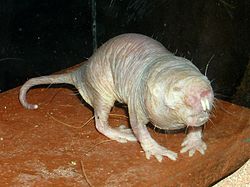
Heterocephalidae
(naked mole-rat)

Nacktmull.jpg

Landry, 1957

1 species in 1 genus
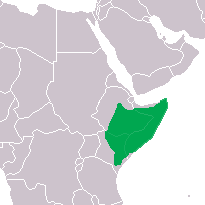
Eastern Africa
Heterocephalus glaber dis.png
Size: 7–11 cm (3–4 in) long, plus 3–5 cm (1–2 in) tail [206]

Habitats: Savanna, shrubland, grassland, and caves [207]

Diet: Tubers, roots, and corms [208]
Hystricidae
(Old World porcupine)

Weissschwanzstachelschwein Hystrix indica Tierpark Hellabrunn-12 (cropped).jpg

Fischer von Waldheim, 1817

11 species in 3 genera (full list)
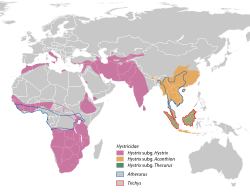
Africa, Italy, and Asia
Hystricidae distribution map.svg
Size range: 35 cm (14 in) long, plus 17 cm (7 in) tail (long-tailed porcupine) to 93 cm (37 in) long, plus 17 cm (7 in) tail (multiple in Hystrix) [209]

Habitats: Forest, grassland, shrubland, rocky areas, and savanna [210]

Diets: Vegetation, as well as carrion [211]
Octodontidae
(degu or viscacha rat)

Octodon degus -Heidelberg Zoo, Germany-8a.jpg

Waterhouse, 1839

14 species in 7 genera (full list)
Southern South America
Octodontidae distribution.png
Size range: 11 cm (4 in) long, plus 4 cm (2 in) tail (coruro) to 33 cm (13 in) long, plus 18 cm (7 in) tail (mountain viscacha rat) [212]

Habitats: Forest, grassland, shrubland, shrublands, rocky areas, and inland wetlands [213]

Diets: Bulbs, tubers, bark, and cacti [214]
Petromuridae
(dassie rat)

141 Dassie rat in Twyfelfontein Photo by Giles Laurent.jpg

Tullberg, 1899

1 species in 1 genus
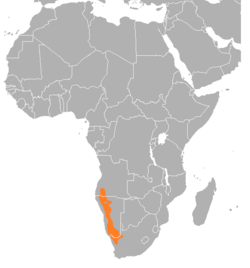
Southwestern Africa
Dassierot Suider-Afrika.png
Size: 13–22 cm (5–9 in) long, plus 11–18 cm (4–7 in) tail [215]

Habitats: Shrubland and rocky areas [216]

Diet: Variety of green plant material, seeds, and berries [217]
Thryonomyidae
(cane rat)

Thryonomys swinderianus1.jpeg

Pocock, 1922

2 species in 1 genus
Sub-Saharan Africa
Thryonomys range map.png
Size range: 41 cm (16 in) long, plus 11 cm (4 in) tail (lesser cane rat) to 77 cm (30 in) long, plus 20 cm (8 in) tail (greater cane rat) [215]

Habitats: Shrubland, grassland, inland wetlands, and forest [218]

Diets: Grass and cane, as well as bark, nuts, fruit, and crops [219]
Suborder Myomorpha Brandt, 1855 – nine families
NameAuthority and speciesRangeSize and ecology
Calomyscidae
(mouse-like hamster)

Calo10.jpg

Vorontsov & Potapova, 1979

8 species in 1 genus
Central Asia
Calomyscidae distribution.png
Size range: 6 cm (2 in) long, plus 5 cm (2 in) tail (Tsolov's mouse-like hamster) to 10 cm (4 in) long, plus 11 cm (4 in) tail (Great Balkhan mouse-like hamster) [220]

Habitats: Shrubland, grassland and rocky areas [221]

Diets: Seeds, flowers, and leaves, as well as animal matter [222]
Cricetidae
(New World rat or mouse)

Microtus pennsylvanicus 422200318.jpg

Fischer von Waldheim, 1817

705 species (11 extinct) in 144 genera (3 extinct) (full lists)
North America, South America, Europe, Asia,and northeastern Africa
Cricetidae distribution.png
Size range: 5 cm (2 in) long, plus 3 cm (1 in) tail (northern pygmy mouse) to 32 cm (13 in) long, plus 7 cm (3 in) tail (European hamster) [223]

Habitats: Forest, shrubland, inland wetlands, desert, rocky areas, grassland, savanna, caves, intertidal marine, and coastal marine [224]

Diets: Plant material and invertebrates; some species predominantly fish and other small vertebrates [225]
Dipodidae
(jerboa)

Allactaga williamsi 177950563.jpg

Fischer von Waldheim, 1817

33 species in 13 genera (full list)
Asia, northern Africa, and eastern Europe
Dipodidae distribution.png
Size range: 4 cm (2 in) long, plus 7 cm (3 in) tail (Baluchistan pygmy jerboa) to 23 cm (9 in) long, plus 30 cm (12 in) tail (great jerboa) [226]

Habitats: Desert, coastal marine, shrubland, grassland, rocky areas, and forest [227]

Diets: Seeds, plants, and insects [228]
Muridae
(Old World mouse or rat)

Mouse white background.jpg

Illiger, 1811

814 species (13 extinct) in 156 genera (full lists)
Worldwide except for Antarctica
Muridae distribution.png
Size range: 4 cm (2 in) long, plus 2 cm (1 in) tail (African pygmy mouse) to 47 cm (19 in) long, plus 37 cm (15 in) tail (alpine woolly rat) [229]

Habitats: Savanna, forest, shrubland, grassland, desert, inland wetlands, coastal marine, and rocky areas [230]

Diets: Plant material and invertebrates; some species predominantly fish and other small vertebrates [225]
Nesomyidae
(African or Malagasy rat or mouse)

Nesomys audeberti 260723875.jpg

Major, 1897

67 species in 21 genera (full list)
Sub-Saharan Africa
Nesomyidae distribution.png
Size range: 4 cm (2 in) long, plus 5 cm (2 in) tail (Monard's African climbing mouse) to 41 cm (16 in) long, plus 45 cm (18 in) tail (southern giant pouched rat) [231]

Habitats: Shrubland, forest, savanna, desert, grassland, inland wetlands, and rocky areas [232]

Diets: Plant material and invertebrates [225]
Platacanthomyidae
(Oriental dormouse)

Typhlomys cinereus ZooKeys-164-041-g004.jpg

Alston, 1876

2 species in 2 genera
Southern and eastern Asia
Platacanthomyidae distribution.png
Size range: 7 cm (3 in) long, plus 9 cm (4 in) tail (Chinese pygmy dormouse) to 14 cm (6 in) long, plus 11 cm (4 in) tail (Malabar spiny dormouse) [233]

Habitats: Forest [234]

Diets: Fruit, seeds, grain, and roots [235]
Sminthidae
(birch mouse)

Sicista betulina 122150166.jpg

Brandt, 1855

16 species in 1 genus (full list)
Asia and Europe
Sminthidae distribution.png
Size range: 4–8 cm (2–3 in) long, plus 6–12 cm (2–5 in) tail (multiple) [236]

Habitats: Inland wetlands, shrubland, forest, and grassland [237]

Diets: Seeds, berries, and insects [238]
Spalacidae
(mole-rat)

Slipak bilozubii (Nannospalax leucodon).jpg

J. E. Gray, 1821

23 species in 7 genera (full list)
Eastern Europe, eastern Africa, and Asia
Spalacidae distribution.png
Size range: 13 cm (5 in) long, with no tail (Middle East blind mole-rat) to 48 cm (19 in) long, plus 20 cm (8 in) tail (large bamboo rat) [239]

Habitats: Shrubland, grassland, forest, savanna, and desert [240]

Diets: Roots, bulbs, tubers, acorns, stems, and grain [241]
Zapodidae
(jumping mouse)

Zapus princeps.jpg

Coues, 1875

5 species in 3 genera
North America and China
Zapodidae distribution.png
Size range: 7 cm (3 in) long, plus 11 cm (4 in) tail (Chinese jumping mouse) to 11 cm (4 in) long, plus 16 cm (6 in) tail (Pacific jumping mouse) [242]

Habitats: Forest, shrubland, grassland, and inland wetlands [227]

Diets: Seeds, fungi, and insects, as well as nuts, berries, and fruit [243]
Suborder Sciuromorpha Brandt, 1855 – three families
NameAuthority and speciesRangeSize and ecology
Aplodontiidae
(mountain beaver)

Aplodontia rufa 75985702.jpg

Brandt, 1855

1 species in 1 genus
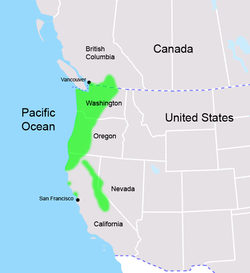
Western United States and southwestern Canada
Aplodontia rufa distribution map.png
Size: 23–43 cm (9–17 in) long, plus 2–6 cm (1–2 in) tail [244]

Habitats: Forest, shrubland, and inland wetlands [245]

Diet: Variety of plant material [246]
Gliridae
(dormouse)

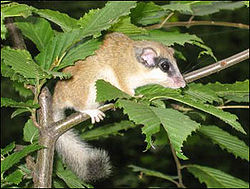
Dryomys nitedula.jpg

Muirhead, 1819

29 species in 9 genera (full list)
Europe, Africa, and Asia
Gliridae distribution.png
Size range: 6 cm (2 in) long, plus 6 cm (2 in) tail (Setzer's mouse-tailed dormouse) to 19 cm (7 in) long, plus 18 cm (7 in) tail (European edible dormouse) [247]

Habitats: Grassland, inland wetlands, rocky areas, savanna, shrubland, forest, desert, and coastal marine [248]

Diets: Fruit, nuts, insects, eggs, and small vertebrates [249]
Sciuridae
(squirrel, chipmunk, or marmot)

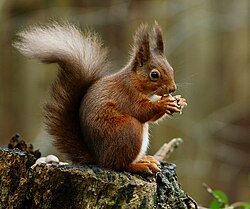
Squirrel posing.jpg

Fischer von Waldheim, 1817

284 species in 60 genera (full list)
Europe, Africa, Asia, North America, and South America
Sciuridae distribution.png
Size range: 6 cm (2 in) long, plus 6 cm (2 in) tail (lesser pygmy flying squirrel) to 75 cm (30 in) long, plus 24 cm (9 in) tail (Olympic marmot) [250]

Habitats: Forest, shrubland, grassland, inland wetlands, savanna, desert, rocky areas, and coastal marine [251]

Diets: Nuts, seeds, and other plant material; some species predominately insects [252]

Superorder Laurasiatheria

Artiodactyla

Members of the Artiodactyla order are called artiodactyls or even-toed ungulates, and include deer, cattle, pigs, camels, whales, and dolphins. They are found worldwide on land and in oceans, and eat a wide variety of plant material, fish, and other marine animals. Artiodactyla comprises 24 families of 349 extant species in 133 genera. These families are grouped into four suborders: Ruminantia, containing deer, cattle, goats, a giraffes; Suina, containing pigs and peccaries; Tylopoda, containing camels and llamas; and Whippomorpha, containing whales, dolphins, and hippopotomuses. Three additional species have been driven to extinction in modern times.

Suborder Ruminantia Scopoli, 1877 – six families
NameAuthority and speciesRangeSize and ecology
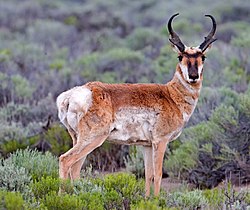
Antilocapridae
(pronghorn)

Antilocapra americana.jpg

J. E. Gray, 1866

1 species in 1 genus
Western North America (former range in yellow)
PronghornRange.png
Size: 130–140 cm (51–55 in) long, plus 9–11 cm (4–4 in) tail [253]

Habitats: Shrubland, grassland, and desert [254]

Diet: Shrubs, forbs, grass, cacti, and other plants [255]
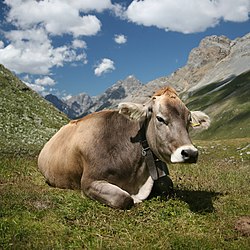
Bovidae
(cattle, antelope, or goat)

CH cow 2 cropped.jpg

J. E. Gray, 1821

148 species (2 extinct) in 53 genera (full list)
Africa, Asia, Europe, and North America
Bovidae distribution.png
Size range: 38 cm (15 in) long, plus 5 cm (2 in) tail (royal antelope) to 380 cm (150 in) long, plus 100 cm (39 in) tail (wild yak) [256]

Habitats: Forest, savanna, shrubland, grassland, desert, inland wetlands, and rocky areas, and coastal marine [257]

Diets: Grass, stems, and leaves [258]
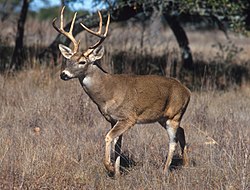
Cervidae
(deer)

White-tailed deer.jpg

Goldfuss, 1820

56 species (1 extinct) in 19 genera (full list)
North and South America, Europe, and Asia
Cervidae distribution.png
Size range: 70 cm (28 in) long, with no tail (dwarf brocket) to 300 cm (118 in) long, plus 16 cm (6 in) tail (moose) [259]

Habitats: Forest, shrubland, savanna, grassland, rocky areas, inland wetlands, neritic marine, intertidal marine, and intertidal marine [260]

Diets: Grass, bark, twigs, and shoots [261]
Giraffidae
(giraffe or okapi)

Giraffe Mikumi National Park.jpg

J. E. Gray, 1821

5 species in 2 genera
Scattered Sub-Saharan Africa
Giraffidae distribution.png
Size range: 200 cm (79 in) long, plus 30 cm (12 in) tail (okapi) to 470 cm (185 in) long, plus 100 cm (39 in) tail (Masai giraffe) [262]

Habitats: Forest, shrubland, savanna, grassland, and rocky areas [263]

Diets: Leaves, as well as other vegetation and fruit [264]
Moschidae
(musk deer)

Siberian Musk Deer.jpg

J. E. Gray, 1821

7 species in 1 genus
Asia
Moschidae distribution.png
Size range: 65 cm (26 in) long, plus 4 cm (2 in) tail (Siberian musk deer) to 100 cm (39 in) long, plus 6 cm (2 in) tail (white-bellied musk deer) [265]

Habitats: Forest, shrubland, grassland, and rocky areas [266]

Diets: Grass, moss, shoots, twigs, buds, and lichen [267]
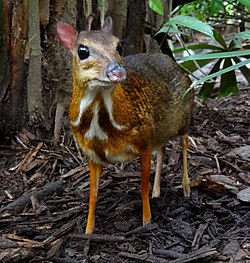
Tragulidae
(chevrotain)

Mouse-deer Singapore Zoo 2012.JPG

H. Milne-Edwards, 1864

10 species in 3 genera
Central and western Africa and southern and southeastern Asia
Tragulidae distribution.png
Size range: 35 cm (14 in) long, plus 6 cm (2 in) tail (lesser mouse-deer) to 102 cm (40 in) long, plus 11 cm (4 in) tail (water chevrotain) [268]

Habitats: Forest, savanna, shrubland, grassland, inland wetlands, and marine [269]

Diets: Fruit, leaves, buds, and grass [270]
Suborder Suina J. E. Gray, 1868 – two families
NameAuthority and speciesRangeSize and ecology
Suidae
(pig)

Wildschwein, Nahe Pulverstampftor.jpg

J. E. Gray, 1821

17 species in 6 genera
Asia, Europe, and Africa; introduced worldwide
Suidae distribution.png
Size range: 55 cm (22 in) long, plus 3 cm (1 in) tail (pygmy hog) to 210 cm (83 in) long, plus 45 cm (18 in) tail (giant forest hog) [271]

Habitats: Forest, savanna, shrubland, grassland, inland wetlands, desert, neritic marine, intertidal marine [272]

Diets: Omnivorous, including fungi, leaves, roots, bulbs, tubers, fruit, snails, worms, reptiles, birds, eggs, rodents, and carrion [273]
Tayassuidae
(peccary)

Collared peccary02 - melbourne zoo.jpg

Palmer, 1897

3 species in 3 genera
North and South America
Peccary range.png
Size range: 84 cm (33 in) long, plus 1 cm (0.4 in) tail (collared peccary) to 139 cm (55 in) long, plus 7 cm (3 in) tail (white-lipped peccary) [274]

Habitats: Forest, savanna, shrubland, grassland, and desert [275]

Diets: Fruit, seeds, and roots, as well as invertebrates, small vertebrates, and carrion [276]
Suborder Tylopoda Illiger, 1811 – one family
NameAuthority and speciesRangeSize and ecology
Camelidae
(camel)

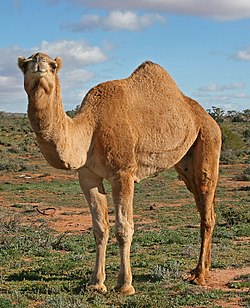
07. Camel Profile, near Silverton, NSW, 07.07.2007.jpg

J. E. Gray, 1821

7 species in 2 genera
South America, Africa, Asia, and Australia
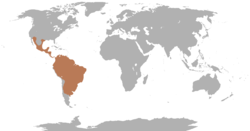
Camelid Range.png
Size range: 124 cm (49 in) long, plus 15 cm (6 in) tail (vicuña) to 350 cm (138 in) long, plus 64 cm (25 in) tail (wild Bactrian camel) [277]

Habitats: Shrubland, grassland, inland wetlands, and desert [278]

Diets: Grass, as well as other vegetation [279]
Suborder Whippomorpha Waddell, Okada & Hasegawa, 1999 – fifteen families
NameAuthority and speciesRangeSize and ecology
Balaenidae
(right whale)

Bowheads42.jpg

J. E. Gray, 1821

4 species in 2 genera
Temperate and polar Pacific and Atlantic Oceans
Balaenidae range map.png
Size range: 13.4–20.0 m (44–66 ft) long (bowhead whale) [280]

Habitats: Neritic marine and oceanic marine [281]

Diets: Krill, as well as other crustaceans and mollusks [282]
Balaenopteridae
(rorqual)

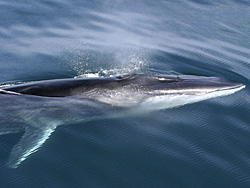
LMazzuca Fin Whale.jpg

J. E. Gray, 1864

10 species in 2 genera
Worldwide oceans
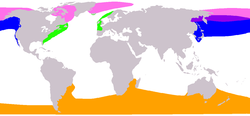
Balaenopteridae distribution.png
Size range: 6.5 m (21 ft) long (common minke whale) to 32.6 m (107 ft) long (blue whale) [283]

Habitats: Neritic marine and oceanic marine [284]

Diets: Krill and other crustaceans, as well as fish [285]
Cetotheriidae
(pygmy right whale)

Pygmy right whale.png

Brandt, 1872

1 species in 1 genus
Sub-Antarctic oceans
Cetacea range map Pygmy Right Whale.png
Size: 5.9–6.5 m (19–21 ft) long [280]

Habitats: Neritic marine and oceanic marine [286]

Diet: Crustaceans [287]
Delphinidae
(oceanic dolphin)

Tursiops truncatus 01-cropped.jpg

Gray, 1821

37 species in 19 genera
Worldwide oceans and seas, and rivers in South America and southern and southeastern Asia
Delphinidae distribution.png
Size range: 1.2 m (4 ft) long (spinner dolphin) to 9.8 m (32 ft) long (orca) [288]

Habitats: Neritic marine, oceanic marine, coastal marine, intertidal marine, and inland wetlands [289]

Diets: Fish, cephalopods, shrimp, and crustaceans [290]
Eschrichtiidae
(gray whale)

Graywhale MMC.jpg

Ellerman & Morrison-Scott, 1951

1 species in 1 genus
Northern Pacific Ocean
Cypron-Range Eschrichtius robustus.svg
Size: 13.0–14.2 m (43–47 ft) long [291]

Habitats: Neritic marine and oceanic marine [292]

Diet: Small crustaceans, as well as fish, molluscs, and other crustaceans [293]
Hippopotamidae
(hippopotamus)

Hippo (Hippopotamus amphibius) (16485955207).jpg

J. E. Gray, 1821

2 species in 2 genera
Scattered Sub-Saharan AfricaSize range: 1.5 m (5 ft) long (pygmy hippopotamus) to 5.1 m (17 ft) long (hippopotamus) [294]

Habitats: Forest, savanna, shrubland, grassland, inland wetlands, neritic marine, coastal marine [295]

Diets: Grass, water plants, shoots, leaves, and fruit [296]
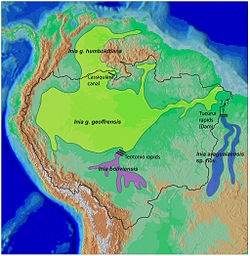
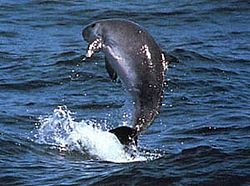
Iniidae
(South American river dolphin)

Inia.jpg

J. E. Gray, 1846

4 species in 1 genus
South American rivers
Inia range map PLoS ONE.jpg
Size range: 1.7 m (6 ft) long (Amazon river dolphin) to 2.6 m (9 ft) long (Araguaian river dolphin) [297]

Habitats: Inland wetlands [298]

Diets: Fish [299]
Kogiidae
(pygmy sperm whale)

Dwarf sperm whale (NOAA Pitman).jpg

Gill, 1871

2 species in 1 genus
Worldwide tropical and temperate oceans
Kogiidae distribution.png
Size range: 2.0 m (7 ft) long (dwarf sperm whale) to 4.2 m (14 ft) long (pygmy sperm whale) [300]

Habitats: Oceanic marine [301]

Diets: Cephalopods, fish, and crustaceans [302]
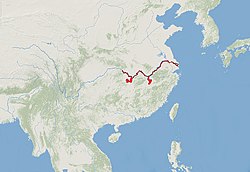
Lipotidae
(baiji)

Baiji 1.jpg

Zhou, Qian, Li, 1978

1 species in 1 genus
Yangtze river in China
Yangtze Dolphins range.jpg
Size: 1.8–2.6 m (6–9 ft) long [297]

Habitats: Inland wetlands [303]

Diet: Fish [304]
Monodontidae
(narwhal or beluga whale)

Narval v rossiiskoi Arktike.jpg

J. E. Gray, 1821

2 species in 2 genera
Arctic and subarctic oceans
Monodontidae distribution.png
Size range: 3.0 m (10 ft) long (beluga) to 5.0 m (16 ft) long (narwhal) [305]

Habitats: Neritic marine and oceanic marine [306]

Diets: Fish, cephalopods, and crustaceans [307]
Phocoenidae
(porpoise)

Neophocaena phocaenoides -Miyajima Aquarium -Japan-8a.jpg

J. E. Gray, 1825

8 species in 3 genera
North Atlantic, North Pacific, and Antarctic oceans, Black Sea, and South American and Asian coasts
Phocoenidae distribution.png
Size range: 1.2 m (4 ft) long (vaquita) to 2.4 m (8 ft) long (Dall's porpoise) [308]

Habitats: Inland wetlands, neritic marine, oceanic marine, intertidal marine, and coastal marine [309]

Diets: Squid and fish [310]
Physeteridae
(sperm whale)

Mother and baby sperm whale.jpg

Rafinesque, 1815

1 species in 1 genus
Worldwide oceans (concentrations in black)
Sperm whale range and concentration.svg
Size: 10.4–19.2 m (34–63 ft) long [300]

Habitats: Neritic marine and oceanic marine [311]

Diet: Squid, as well as sharks and fish [312]
Platanistidae
(South Asian river dolphin)

Ganges River Dolphin.jpg

J. E. Gray, 1846

2 species in 1 genus
Rivers of the Ganges Basin (orange) and the Indus Basin (blue)
SouthAsianRiverDolphin distribution2019.png
Size range: 2.0 m (7 ft) long (Indus river dolphin) to 4.0 m (13 ft) long (Ganges river dolphin) [313]

Habitats: Neritic marine and inland wetlands [314]

Diets: Fish and shrimp [315]
Pontoporiidae
(La Plata dolphin)

Pontoporia blainvillei 296896096.jpg

J. E. Gray, 1870

1 species in 1 genus
Southeastern South American coast
Cetacea range map La Plata River Dolphin.PNG
Size: 1.1–1.7 m (4–6 ft) long [297]

Habitats: Neritic marine and oceanic marine [316]

Diet: Fish, squid, and shrimp [317]
Ziphiidae
(beaked whale)

Arnoux's beaked whale.jpg

J. E. Gray, 1865

23 species in 6 genera
Worldwide oceans
Ziphiidae distribution.png
Size range: 3.7 m (12 ft) long (pygmy beaked whale) to 12.0 m (39 ft) long (Baird's beaked whale) [318]

Habitats: Oceanic marine [319]

Diets: Squid, as well as octopuses, crustaceans, and fish [320]
Carnivora
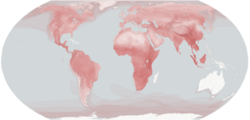
The extant distribution and density of Carnivora species, excluding introductions Carnivora Distribution.png
The extant distribution and density of Carnivora species, excluding introductions

Members of the Carnivora order are called carnivorans, and include dogs, bears, raccoons, weasels, seals, cats, hyenas, and mongooses. They are found worldwide on land an in oceans, and are omnivorous, with some species predominately eating plant material or aquatic animals. Carnivora comprises 16 families of 291 extant species in 131 genera. These families are grouped into two suborders: Caniformia, containing dogs, foxes, bears, raccoons, skunks, weasels, and seals, and Feliformia, containing cats, hyenas, mongooses, and civets. Six additional species have been driven to extinction in modern times.

Suborder Caniformia Kretzoi, 1943 – nine families
NameAuthority and speciesRangeSize and ecology
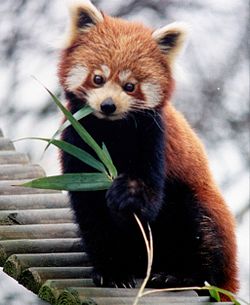
Ailuridae
(red panda)

Ailurus fulgens RoterPanda LesserPanda.jpg

Gray, 1843

1 species in 1 genus
Eastern Himalayas and southwestern China
Ailurus fulgens distribution clipped.svg
Size: 57–79 cm (22–31 in) long, plus 36–50 cm (14–20 in) tail [321]

Habitats: Forest and shrubland [322]

Diet: Bamboo sprouts, grass, roots, fruit, and nuts, as well as insects, eggs, and small vertebrates [323]
Canidae
(wolf or fox)

Scandinavian grey wolf Canis lupus (cropped).jpg

Waldheim, 1817

39 species (2 extinct) in 15 genera (1 extinct) (full list)
WorldwideSize range: 33 cm (13 in) long, plus 12 cm (5 in) tail (fennec fox) to 130 cm (51 in) long, plus 52 cm (20 in) tail (grey wolf) [324]

Habitats: Shrubland, grassland, inland wetlands, forest, desert, rocky areas, savanna, desert, and coastal marine [325]

Diets: Omnivorous, including a variety of vertebrates, crabs, insects, fruit, and carrion [326]
Mephitidae
(skunk or stink badger)

Striped Skunk (Mephitis mephitis) DSC 0030.jpg

É. Geoffroy & Cuvier, 1795

12 species in 4 genera (full list)
North America, South America, Southeast Asia
Skunk genera ranges.png
Size range: 17 cm (7 in) long, plus 15 cm (6 in) tail (striped skunk) to 52 cm (20 in) long, plus 8 cm (3 in) tail (Sunda stink badger) [327]

Habitats: Desert, shrubland, rocky areas, grassland, savanna, forest, inland wetlands, and coastal marine [328]

Diets: Omnivorous, particularly insects and fruit [329]
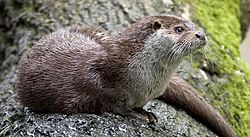
Mustelidae
(marten, polecat, otter, or badger)

Fischotter, Lutra Lutra.JPG

É. Geoffroy and Cuvier, 1795

63 species in 23 genera (full list)
All continents except Antarctica and Australia
Mustelid Distribution.png
Size range: 11 cm (4 in) long, plus 7 cm (3 in) tail (least weasel) to 130 cm (51 in) long, plus 65 cm (26 in) tail (giant otter) [330]

Habitats: Forest, grassland, rocky areas, shrubland, savanna, inland wetlands, desert, neritic marine, oceanic marine, coastal marine, and intertidal marine [331]

Diets: Omnivorous; some species predominately plant material or aquatic animals [332]
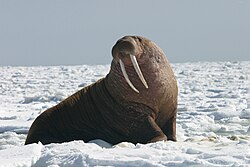
Odobenidae
(walrus)

Pacific Walrus - Bull (8247646168).jpg

Allen, 1880

1 species in 1 genus (full list)
Arctic Ocean and subarctic seas
Odobenus rosmarus distribution.png
Size: 260–315 cm (102–124 in) long [333]

Habitats: Neritic marine, oceanic marine, intertidal marine, and coastal marine [334]

Diet: Bivalve molluscs, as well as other invertebrates, fish, and seals [335]
Otariidae
(eared seal)

Sea Lions At La Jolla Cove - 32.jpg

J. E. Gray, 1825

16 species in 7 genera (full list)
Antarctic Ocean, southern seas, and coasts of South America, Australia, Pacific Asia and Pacific North AmericaSize range: 110 cm (43 in) long (Galápagos fur seal) to 330 cm (130 in) long (Steller sea lion) [336]

Habitats: Forest, shrubland, inland wetlands, neritic marine, oceanic marine, intertidal marine, and coastal marine [337]

Diets: Fish, as well as cephalopods and crustaceans [338]
Phocidae
(earless seal)

Common seal (Phoca vitulina) 2.jpg

J. E. Gray, 1821

19 species in 14 genera (full list)
Antarctic Ocean, Arctic Ocean, Northern Hemisphere coastlines, Caspian Sea, and Lake Baikal Size range: 150 cm (59 in) long (ribbon seal) to 500 cm (197 in) long (southern elephant seal) [339]

Habitats: Neritic marine, oceanic marine, intertidal marine, coastal marine, and inland wetlands [340]

Diets: Fish, shellfish, and cephalopods, as well as penguins and seals [341]
Procyonidae
(raccoon or ring-tailed cat)

Procyon lotor (raccoon).jpg

J. E. Gray, 1825

14 species in 6 genera (full list)
North and South America (common raccoon introduced to Europe, western Asia, and Japan)Size range: 30 cm (12 in) long, plus 31 cm (12 in) tail (ringtail) to 76 cm (30 in) long, plus 57 cm (22 in) tail (kinkajou) [342]

Habitats: Shrubland, forest, rocky areas, desert, grassland, and inland wetlands [343]

Diets: Omnivorous; some species predominately bamboo or fruit [344]
Ursidae
(bear)

2010-kodiak-bear-1.jpg

G. Fischer von Waldheim, 1817

8 species in 5 genera (full list)
North and South America and EurasiaSize range: 100 cm (39 in) long, plus 3 cm (1 in) tail (sun bear) to 280 cm (110 in) long, plus 21 cm (8 in) tail (brown bear) [345]

Habitats: Shrubland, grassland, forest, savanna, inland wetlands, desert, oceanic marine, coastal marine, and intertidal marine [346]

Diets: Omnivorous; some species predominately bamboo or fish and seals [347]
Suborder Feliformia Kretzoi, 1945 – seven families
NameAuthority and speciesRangeSize and ecology
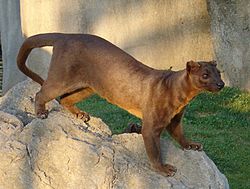
Eupleridae
(Malagasy carnivoran)

Cryptoprocta Ferox.JPG

Chenu, 1850

10 species in 7 genera
Madagascar
Eupleridae range.png
Size range: 26 cm (10 in) long, plus 19 cm (7 in) tail (narrow-striped mongoose) to 80 cm (31 in) long, plus 70 cm (28 in) tail (fossa) [348]

Habitats: Forest, shrubland, and inland wetlands [349]

Diets: Small mammals, birds, eggs, worms, insects, and fruit, as well as reptiles, frogs, and other invertebrates [350]
Felidae
(cat)

Panthera tigris corbetti (Tierpark Berlin) 832-714-(118).jpg

G. Fischer von Waldheim, 1817

41 species in 14 genera (full list)
Worldwide (Felinae (excluding the domestic cat) in blue, Pantherinae in green
Felidae range.png
Size range: 35 cm (14 in) long, plus 15 cm (6 in) tail (rusty-spotted cat) to 290 cm (114 in) long, plus 109 cm (43 in) tail (tiger) [351]

Habitats: Forest, desert, shrubland, savanna, grassland, rocky areas, and inland wetlands [352]

Diets: Mammals and birds, as well as fish and reptiles [353]
Herpestidae
(mongoose)

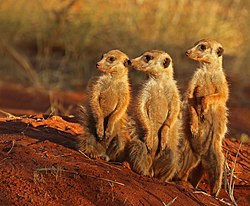
Meerkat (Suricata suricatta) Tswalu.jpg

Bonaparte, 1845

34 species in 14 genera (full list)
Southern Europe, Africa, and Asia
Herpestidae.png
Size range: 16 cm (6 in) long, plus 14 cm (6 in) tail (common dwarf mongoose) to 69 cm (27 in) long, plus 48 cm (19 in) tail (white-tailed mongoose) [354]

Habitats: Shrubland, forest, rocky areas, inland wetlands, savanna, grassland, desert, neritic marine, and coastal marine [355]

Diets: Small vertebrates, invertebrates, eggs, fruit, crabs, and fish, as well as other vegetation [356]
Hyaenidae
(hyena)

Spotted hyena (Crocuta crocuta).jpg

J. E. Gray, 1821

4 species in 4 genera
Africa and southern Asia
Hyaenidae range.png
Size range: 55 cm (22 in) long, plus 20 cm (8 in) tail (aardwolf) to 160 cm (63 in) long, plus 27 cm (11 in) tail (spotted hyena) [357]

Habitats: Forest, savanna, shrubland, grassland, inland wetlands, rocky areas, desert, intertidal marine, and coastal marine [358]

Diets: Variety of mammals, carrion, and insects [359]
Nandiniidae
(African palm civet)

Nandinia binotata, Manchester Museum.jpg

Pocock, 1929

1 species in 1 genus
Sub-Saharan Africa
African Palm Civet area.png
Size: 37–62 cm (15–24 in) long, plus 34–76 cm (13–30 in) tail [360]

Habitats: Forest, savanna, and shrubland [361]

Diet: Fruit, as well as rodents, eggs, and insects [362]
Prionodontidae
(Asiatic linsang)

Prionodon linsang - Museo Civico di Storia Naturale Giacomo Doria - Genoa, Italy - DSC02704.JPG

J. E. Gray, 1864

2 species in 1 genus
Southeastern Asia
Prionodon map.jpg
Size range: 31 cm (12 in) long, plus 30 cm (12 in) tail (spotted linsang) to 38 cm (15 in) long, plus 33 cm (13 in) tail (banded linsang) [360]

Habitats: Forest, shrubland, and grassland [363]

Diets: Small mammals, birds, eggs, and insects [364]
Viverridae
(civet or genet)

Malay civet.jpg

J. E. Gray, 1821

33 species in 14 genera (full list)
Southeastern AsiaSize range: 30 cm (12 in) long, plus 35 cm (14 in) tail (West African oyan) to 96 cm (38 in) long, plus 84 cm (33 in) tail (binturong) [365]

Habitats: Forest, savanna, shrubland, grassland, inland wetlands, and rocky areas [366]

Diets: Small vertebrates and invertebrates, as well as fruit, bulbs, and nuts [367]
Chiroptera
Chiroptera distribution Bat range.png
Chiroptera distribution

Members of the Chiroptera order are called chiropterans or bats. They are found worldwide, and predominately eat insects, with some species also eating fruit or fish. Chiroptera comprises 21 families of 1,318 extant species—about 20% of all mammal species—in 226 genera. These families are grouped into two suborders: Yangochiroptera, containing sheath-tailed, leaf-nosed, free-tailed, and vesper bats, and Yinpterochiroptera, containing Old World leaf-nosed, fruit, and horseshoe bats. Nine additional species have been driven to extinction in modern times.

Suborder Yangochiroptera Karl Koopman, 1984 – fourteen families
NameAuthority and speciesRangeSize and ecology
Cistugidae
(wing-gland bat)

Cistugo lesueuri.jpg

Lack, Roehrs, Stanley Jr., Ruedi, & Van Den Bussche, 2010

2 species in 1 genus
Southern AfricaSize range: 4 cm (2 in) long, plus 3 cm (1 in) (Angolan hairy bat) to 6 cm (2 in) long, plus 4 cm (2 in) tail (Lesueur's hairy bat) [368]

Habitats: Rocky areas, shrubland, grassland, and desert [369]

Diets: Insects [370]
Emballonuridae
(sheath-tailed bat)

Lesser Dog-like Bat imported from iNaturalist photo 129124225 on 2 December 2024.jpg

Gervais, 1855

54 species in 14 genera (full list)
Worldwide except for Europe and AntarcticaSize range: 3 cm (1 in) long, plus 1 cm (0.4 in) tail (Amazonian sac-winged bat) to 14 cm (6 in) long, plus 4 cm (2 in) tail (Pel's pouched bat) [371]

Habitats: Shrubland, forest, caves, savanna, inland wetlands, and desert [372]

Diets: Insects, as well as fruit [373]
Furipteridae
(smoky or thumbless bat)

Furipterus horrens 328727700.jpg

J. E. Gray, 1866

2 species in 2 genera
Central America and South AmericaSize range: 3 cm (1 in) long, plus 2 cm (1 in) (thumbless bat) to 5 cm (2 in) long, plus 4 cm (2 in) tail (smoky bat) [374]

Habitats: Forest and caves [375]

Diets: Insects [376]
Miniopteridae
(bent-winged or long-fingered bat)

Schreibers' Long-fingered Bat imported from iNaturalist photo 176555240 on 3 September 2024.jpg

Dobson, 1875

31 species in 1 genus (full list)
Europe, Africa, and western, southeastern, and eastern AsiaSize range: 3 cm (1 in) long, plus 3 cm (1 in) tail (Shortridge's long-fingered bat) to 8 cm (3 in) long, plus 7 cm (3 in) tail (great bent-winged bat) [377]

Habitats: Shrubland, forest, grassland, rocky areas, caves, savanna, inland wetlands, and desert [378]

Diets: Insects [379]
Molossidae
(free-tailed bat)

Molossus molossus.jpg

Gervais, 1855

120 species in 19 genera (full list)
Worldwide except AntarcticaSize range: 3 cm (1 in) long, plus 2 cm (1 in) tail (blunt-eared bat) to 18 cm (7 in) long, plus 8 cm (3 in) tail (hairless bat) [380]

Habitats: Forest, coastal marine, rocky areas, savanna, shrubland, grassland, caves, inland wetlands, and desert [381]

Diets: Insects [382]
Mormoopidae
(ghost-faced or mustached bat)

Wagner's Mustached Bat (Pteronotus personatus) (38053341645).jpg

Saussure, 1860

11 species in 2 genera (full list)
Southern North America, Central America, and northern and central South AmericaSize range: 4 cm (2 in) long, plus 1 cm (0.4 in) tail (sooty mustached bat) to 8 cm (3 in) long, plus 4 cm (2 in) tail (ghost-faced bat) [383]

Habitats: Savanna, caves, and forest [384]

Diets: Insects [385]
Mystacinidae
(New Zealand short-tailed bat)

Mystacina tuberculata.jpg

Dobson, 1875

2 species in 1 genus
New Zealand
Mystacina tuberculata distribution.svg
Size range: 6 cm (2 in) long, plus 0.5 cm (0.2 in) (New Zealand lesser short-tailed bat) to 9 cm (4 in) long, plus 2 cm (1 in) tail (New Zealand greater short-tailed bat) [386]

Habitats: Forest [387]

Diets: Invertebrates, fruit, nectar, and pollen [388]
Myzopodidae
(sucker-footed bat)

Myzopoda aurita 13060431.jpg

H. Milne-Edwards & A. Grandidier, 1878

2 species in 1 genus
MadagascarSize range: 4 cm (2 in) long, plus 4 cm (2 in) (western sucker-footed bat) to 7 cm (3 in) long, plus 6 cm (2 in) tail (Madagascar sucker-footed bat) [386]

Habitats: Forest, inland wetlands, and caves [389]

Diets: Insects [390]
Natalidae
(funnel-eared bat)

Natalus mexicanus.jpg

J. E. Gray, 1866

11 species in 3 genera (full list)
Central America, South America, and Caribbean Size range: 3 cm (1 in) long, plus 4 cm (2 in) tail (Mexican greater funnel-eared bat) to 6 cm (2 in) long, plus 6 cm (2 in) tail (Jamaican greater funnel-eared bat) [391]

Habitats: Caves and forest [392]

Diets: Insects [393]
Noctilionidae
(bulldog bat)

Noctilio albiventris.jpg

J. E. Gray, 1821

2 species in 1 genus
Mexico, Central America, and South AmericaSize range: 6 cm (2 in) long, plus 1 cm (0.4 in) (lesser bulldog bat) to 10 cm (4 in) long, plus 3 cm (1 in) tail (greater bulldog bat) [374]

Habitats: Forest, savanna, shrubland, and caves [394]

Diets: Insects, other invertebrates, and fish [395]
Nycteridae
(slit-faced bat)

Hairy Slit-faced Bat, Ngamiland West, BW-NC, BW imported from iNaturalist photo 173192567.jpg

Hoeven, 1855

16 species in 1 genus (full list)
Africa, western Arabian Peninsula, and southeastern AsiaSize range: 3 cm (1 in) long, plus 3 cm (1 in) tail (dwarf slit-faced bat) to 9 cm (4 in) long, plus 9 cm (4 in) tail (large slit-faced bat) [396]

Habitats: Shrubland, forest, grassland, rocky areas, savanna, caves, and desert [397]

Diets: Insects and other invertebrates, as well as fish, frogs, birds, and bats [398]
Phyllostomidae
(leaf-nosed bat)

RSL4735 - Morcego.jpg 1 - Platyrrhinus recifinus (3).jpg

J. E. Gray, 1825

203 species in 60 genera (full list)
South America, Central America, and southern North AmericaSize range: 3 cm (1 in) long, with no tail (little white-shouldered bat) to 13 cm (5 in) long, plus 4 cm (2 in) tail (greater spear-nosed bat) [399]

Habitats: Caves, savanna, forest, rocky areas, grassland, inland wetlands, shrubland, and desert [400]

Diets: Insects, fruit, nectar, and pollen, as well as small animals and blood [401]
Thyropteridae
(disk-winged bat)

Thyroptera discifera 216859954.jpg

Miller, 1907

5 species in 1 genus
Central America and South AmericaSize range: 3 cm (1 in) long, plus 2 cm (1 in) (De Vivo's disk-winged bat) to 6 cm (2 in) long, plus 4 cm (2 in) tail (LaVal's disk-winged bat) [402]

Habitats: Forest and savanna [403]

Diets: Insects [390]
Vespertilionidae
(vesper bat)

Pipistrellus pipistrellus lateral.jpg

J. E. Gray, 1821

464 species (3 extinct) in 53 genera (full lists)
Worldwide except for AntarcticaSize range: 2 cm (1 in) long, plus 2 cm (1 in) tail (pygmy bamboo bat) to 13 cm (5 in) long, plus 10 cm (4 in) tail (Schreber's yellow bat) [404]

Habitats: Savanna, forest, caves, grassland, shrubland, desert, neritic marine, coastal marine, rocky areas, and inland wetlands [405]

Diets: Insects, as well as fish [406]
Suborder Yinpterochiroptera Springer, Teeling, Madsen, Stanhope, & de Jong, 2001 – seven families
NameAuthority and speciesRangeSize and ecology
Craseonycteridae
(Kitti's hog-nosed bat)

Craseonycteris thonglongyai.png

Hill, 1974

1 species in 1 genus
Thailand and Myanmar
Kitti's Hog-nosed Bat area.png
Size: 2–4 cm (1–2 in) long, with no tail [407]

Habitats: Forest and caves [408]

Diet: Insects [409]
Hipposideridae
(Old World leaf-nosed bat)

Khajuria's Leaf-nosed Bat (Hipposideros durgadasi).jpg

Lydekker, 1891

86 species in 7 genera (full list)
Africa, Asia, and northern AustraliaSize range: 3 cm (1 in) long, with no tail (Malayan tailless leaf-nosed bat) to 13 cm (5 in) long, plus 4 cm (2 in) tail (striped leaf-nosed bat) [410]

Habitats: Shrubland, forest, grassland, savanna, caves, desert, rocky areas, and inland wetlands [411]

Diets: Insects [412]
Megadermatidae
(false vampire bat)

Megaderma spasma.jpg

H. Allen, 1864

6 species in 6 genera
Sub-Saharan Africa, southern and southeastern Asia, and northern AustraliaSize range: 5 cm (2 in) long, with no tail (lesser false vampire bat) to 13 cm (5 in) long, with no tail (ghost bat) [413]

Habitats: Savanna, shrubland, forest, caves, desert, grassland, rocky areas, and inland wetlands [414]

Diets: Insects and small vertebrates [415]
Pteropodidae
(fruit bat or megabat)

Lesser short-nosed fruit bat (Cynopterus brachyotis).jpg

J. E. Gray, 1821

199 species (6 extinct) in 46 genera (full list)
Africa, Asia, and Australia
Worldwide distribution of Pteropodidae.jpg
Size range: 4 cm (2 in) long, plus a minute tail (long-tongued nectar bat) to 37 cm (15 in) long, with no tail (great flying fox) [416]

Habitats: Forest, caves, rocky areas, savanna, inland wetlands, grassland, and shrubland [417]

Diets: Fruit, as well as flowers, pollen, and nectar [418]
Rhinolophidae
(horseshoe bat)

Rhinolophus rouxii.jpg

J. E. Gray, 1825

92 species in 1 genus (full list)
Europe, Africa, Asia, and AustraliaSize range: 3 cm (1 in) long, plus 1 cm (0.4 in) tail (Thai horseshoe bat) to 10 cm (4 in) long, plus 5 cm (2 in) tail (Maclaud's horseshoe bat) [419]

Habitats: Savanna, shrubland, forest, caves, desert, grassland, rocky areas, and inland wetlands [420]

Diets: Insects [421]
Rhinonycteridae
(trident bat)

Naturalis Biodiversity Center - RMNH.MAM.32126.b ven - Triaenops persicus afer - skin.jpeg

J. E. Gray, 1866

9 species in 4 genera
Africa, western Asia, and northern AustraliaSize range: 3 cm (1 in) long, plus 3 cm (1 in) (Percival's trident bat) to 8 cm (3 in) long, plus 4 cm (2 in) tail (African trident bat) [422]

Habitats: Forest, savanna, shrubland, caves, and rocky areas [423]

Diets: Insects [424]
Rhinopomatidae
(mouse-tailed bat)

Small mouse-tailed bat.jpg

Bonaparte, 1838

6 species in 1 genus
Northern and eastern Africa and western and southern AsiaSize range: 5 cm (2 in) long, plus 5 cm (2 in) tail (Egyptian mouse-tailed bat) to 9 cm (4 in) long, plus 9 cm (4 in) tail (greater mouse-tailed bat) [407]

Habitats: Grassland, shrubland, rocky areas, caves, forest, and desert [425]

Diets: Insects [426]
Eulipotyphla

Members of the Eulipotyphla order are called eulipotyphlans and include hedgehogs, shrews, and moles. They are found worldwide, and predominately eat insects, small vertebrates, and vegetation. Eulipotyphla comprises 4 families of 485 extant species in 53 genera. One additional species has been driven to extinction in modern times.

Not assigned to a named clade – four families
NameAuthority and speciesRangeSize and ecology
Erinaceidae
(hedgehog)

Erinaceus roumanicus 2020 G2.jpg

G. Fischer, 1814

24 species in 10 genera (full list)
Europe, Asia, Africa, and New ZealandSize range: 9 cm (4 in) long, plus 1 cm (0.4 in) tail (short-tailed gymnure) to 31 cm (12 in) long, plus 4 cm (2 in) tail (northern white-breasted hedgehog) [427]

Habitats: Shrubland, desert, forest, grassland, inland wetlands, savanna, rocky areas, and caves [428]

Diets: Insects, other invertebrates, a wide range of vertebrates, and carrion, as well as vegetation [429]
Solenodontidae
(solenodon)

Hispaniolan Solenodon crop.jpg

Gill, 1872

2 species in 2 genera
Cuba and Hispaniola
Solenodon range.jpg
Size range: 20 cm (8 in) long, plus 13 cm (5 in) tail (Cuban solenodon) to 49 cm (19 in) long, plus 25 cm (10 in) tail (Hispaniolan solenodon) [430]

Habitats: Forest and caves [431]

Diets: Invertebrates, reptiles, fruit, vegetables, and birds [432]
Soricidae
(shrew)

Shrew1opt.jpg

G. Fischer, 1814

418 species in 25 genera (full lists)
Worldwide except for Australia and AntarcticaSize range: 3 cm (1 in) long, plus 2 cm (0.8 in) tail (Etruscan shrew) to 18 cm (7 in) long, plus 14 cm (6 in) tail (goliath shrew) [433]

Habitats: Shrubland, desert, coastal marine, rocky areas, forest, intertidal marine, grassland, inland wetlands, savanna, and caves [434]

Diets: Insects and small vertebrates, as well as seeds and other plant material [435]
Talpidae
(mole)

ScalopusAquaticus.jpg

G. Fischer, 1814

24 species in 17 genera (full list)
Worldwide except for Australia and AntarcticaSize range: 6 cm (2 in) long, plus 5 cm (2 in) tail (Chinese shrew mole) to 24 cm (9 in) long, plus 21 cm (8 in) tail (Russian desman) [436]

Habitats: Forest, shrubland, inland wetlands, grassland, and coastal marine [437]

Diets: Small animals and plants [438]
Perissodactyla

Members of the Perissodactyla order are called perissodactyls or odd-toed ungulates, and include rhinoceroses, tapirs, and horses. They are found worldwide, and eat a variety of vegetation. Perissodactyla comprises 3 families of 18 extant species in 6 genera. These families are grouped into two suborders: Ceratomorpha, containing rhinoceroses and tapirs, and Hippomorpha, or horses.

Suborder Ceratomorpha Wood, 1937 – two families
NameAuthority and speciesRangeSize and ecology
Rhinocerotidae
(rhinoceros)

2012 Black Rhinoceros Gemsbokvlakte.jpg

J. E. Gray, 1821

5 species in 4 genera
Sub-Saharan Africa, northern India, Southeastern Asia
Rhinocerotidae distribution map en.png
Size range: 236 cm (93 in) long, plus tail (Sumatran rhinoceros) to 420 cm (165 in) long, plus 70 cm (28 in) tail (white rhinoceros) [439]

Habitats: Savanna, shrubland, grassland, forest, desert, and inland wetlands [440]

Diets: Succulent plants, as well as a variety of other vegetation [441]
Tapiridae
(tapir)

Schabrackentapir Tapirus indicus Tiergarten-Nuernberg-1.jpg

J. E. Gray, 1821

4 species in 1 genus
South America, Central America, and scattered southeastern Asia
Tapiridae - map.svg
Size range: 180 cm (71 in) long, plus 10 cm (4 in) tail (mountain tapir) to 300 cm (118 in) long, plus 10 cm (4 in) tail (Malayan tapir) [442]

Habitats: Forest, shrubland, grassland, savanna, and inland wetlands [443]

Diets: Shoots, aquatic vegetation, leaves, buds, twigs, and fruit [444]
Suborder Hippomorpha Wood, 1937 – one family
NameAuthority and speciesRangeSize and ecology
Equidae
(horse or donkey)

Nokota Horses cropped.jpg

J. E. Gray, 1821

9 species in 1 genus
WorldwideSize range: 182 cm (72 in) long, plus 32 cm (13 in) tail (kiang) to 280 cm (110 in) long, plus 111 cm (44 in) tail (wild horse) [445]

Habitats: Shrubland, grassland, savanna, inland wetlands, and desert [446]

Diets: Grass and shrubs [447]
Pholidota

Members of the Pholidota order are called pholidotans or pangolins. They are found in Sub-Saharan Africa and southern and southeastern Asia, and eat ants and termites, as well as other insects. Pholidota comprises a single family of eight extant species in three genera.

Not assigned to a named clade – two families
NameAuthority and speciesRangeSize and ecology
Manidae
(pangolin)

Manis pentadactyla (29054818144).jpg

J. E. Gray, 1821

8 species in 3 genera
Sub-Saharan Africa and southern and southeastern Asia
Manis ranges.png
Size range: 25 cm (10 in) long, plus 35 cm (14 in) tail (white-bellied pangolin) to 81 cm (32 in) long, plus 68 cm (27 in) tail (giant pangolin) [448]

Habitats: Savanna, forest, grassland, and shrubland [449]

Diets: Ants and termites, as well as other insects [450]

Superorder Xenarthra

Cingulata
Cingulata distribution Cingulata range.jpg
Cingulata distribution

Members of the Cingulata order are called cingulates or armadillos. They are found in South America and North America, and eat insects, other invertebrates, small reptiles, amphibians, and carrion. Cingulata comprises 2 families of 22 extant species in 9 genera.

Not assigned to a named clade – two families
NameAuthority and speciesRangeSize and ecology
Dasypodidae
(long-nosed armadillo)

Florida-015.jpg

Gray, 1821

9 species in 1 genus
South America, and central, southern, and eastern North AmericaSize range: 24 cm (9 in) long, plus 12 cm (5 in) tail (seven-banded armadillo) to 90 cm (35 in) long, plus 43 cm (17 in) tail (hairy long-nosed armadillo) [451]

Habitats: Forest, savanna, shrubland, and grassland [452]

Diets: Insects, other invertebrates, small reptiles, and amphibians [453]
Chlamyphoridae
(armadillo)

Six-banded armadillo (Euphractus sexcinctus).JPG

Bonaparte, 1850

13 species in 8 genera
South America and Central America
Chlamyphoridae Range map.jpg
Size range: 11 cm (4 in) long, plus 2 cm (1 in) tail (pink fairy armadillo) to 100 cm (39 in) long, plus 50 cm (20 in) tail (giant armadillo) [454]

Habitats: Forest, savanna, shrubland, grassland, and desert [455]

Diets: Insects, spiders, worms, rodents, lizards, snakes, other small vertebrates, and carrion [456]
Pilosa
Pilosa distribution Pilosa range.jpg
Pilosa distribution

Members of the Pilosa order are called pilosans and include sloths and anteaters. They are found in Mexico, Central America, and South America, and the sloths eat leaves, twigs, and fruit, while the anteaters eat ants, termites, and other insects. Cingulata comprises thee families of nine extant species in four genera. These families are grouped into two suborders: Folivora, or sloths, and Vermilingua, or anteaters.

Suborder Folivora Delsuc, Catzeflis, Stanhope, & Douzery, 2001 – two families
NameAuthority and speciesRangeSize and ecology
Bradypodidae
(three-toed sloth)

Bicho-preguica 3.jpg

Gray, 1821

4 species in 1 genus
Central America and northern South America
Three-toed sloth range.jpg
Size range: 45–75 cm (18–30 in) long, plus 2–11 cm (1–4 in) tail (pale-throated sloth) [457]

Habitats: Forest [458]

Diets: Leaves, twigs, and buds [459]
Choloepodidae
(two-toed sloth)

2 toed sloth.jpg

Gray, 1871

2 species in 1 genus
Central America and northern South America
Two toed sloth range species.jpg
Size range: 50 cm (20 in) long, plus 1 cm (0 in) tail (Hoffmann's two-toed sloth) to 88 cm (35 in) long, plus 4 cm (2 in) tail (Linnaeus's two-toed sloth) [457]

Habitats: Forest, shrubland, and grassland [460]

Diets: Leaves, twigs, and fruit [461]
Suborder Vermilingua Illiger, 1811 – two families
NameAuthority and speciesRangeSize and ecology
Cyclopedidae
(silky anteater)

Silky Anteater.jpg

Pocock, 1924

1 species in 1 genus
Central America and northern and eastern South America
Pygmy Anteater area.png
Size: About 20 cm (8 in) long, plus 16–29 cm (6–11 in) tail [462]

Habitats: Forest [463]

Diet: Termites and other insects [464]
Myrmecophagidae
(anteater)

Myresluger2.jpg

Gray, 1825

2 species in 1 genus
Mexico, Central America, and South America
Myrmecophagidae range species.jpg
Size range: 47 cm (19 in) long, plus 40 cm (16 in) tail (southern tamandua) to 140 cm (55 in) long, plus 90 cm (35 in) tail (giant anteater) [465]

Habitats: Forest, savanna, shrubland, and grassland [466]

Diets: Ants, termites, and other insects [467]

Monotremata

Monotremata distribution Ornithorhynchoids map.jpg
Monotremata distribution

Monotremata is the smallest of the three main divisions of mammals, containing only five extant species. It is distinguished from other mammals in that the monotremes are egg-laying rather than bearing live young, but, like all mammals, the female monotremes nurse their young with milk. [4] Unlike the other two divisions, it is considered an order rather than an infraclass, and in turn contains two families of extant species grouped together in the superfamily Ornithorhynchoidea: Ornithorhynchidae, containing only the platypus, and Tachyglossidae, containing four species of echidna in two genera. Monotremes are found in Australia and New Guinea and are carnivorous, eating insects, worms, shrimp, tadpoles, and small fish.

Superfamily Ornithorhynchoidea Flannery, McCurry, Rich, Vickers-Rich, Smith, & Helgen, 2024 – two families
NameAuthority and speciesRangeSize and ecology
Ornithorhynchidae
(platypus)

Duck-billed platypus (Ornithorhynchus anatinus) Scottsdale.jpg

Gray, 1825

1 species in 1 genus
Eastern Australia
Distribution of the Platypus (Ornithorhynchus anatinus).png
Size: 37–63 cm (15–25 in) long, plus tail [468]

Habitats: Inland wetlands [469]

Diet: Crayfish, shrimp, water insect larvae, snails, tadpoles, worms, and small fish [470]
Tachyglossidae
(echidna)

Short-beaked echidna in ANBG.jpg

Gill, 1872

4 species in 2 genera
Australia and New Guinea
Range map of extant members of the Tachyglossidae.png
Size range: 30 cm (12 in) long (short-beaked echidna) to 63 cm (25 in) long (eastern long-beaked echidna) [468]

Habitats: Forest, savanna, shrubland, grassland, and desert [471]

Diets: Termites, ants, other insects, and worms [472]

References

  1. Oftedal, O. T. (2002). "The mammary gland and its origin during synapsid evolution". Journal of Mammary Gland Biology and Neoplasia. 7 (3): 225–252. doi:10.1023/a:1022896515287. PMID   12751889. S2CID   25806501.
  2. Lui, J. H.; Hansen, D. V.; Kriegstein, A. R. (2011). "Development and evolution of the human neocortex". Cell . 146 (1): 18–36. doi:10.1016/j.cell.2011.06.030. PMC   3610574 . PMID   21729779.
  3. Feldhamer; Drickamer; Vessey; Merritt; Krajewski, p. 97
  4. 1 2 3 4 5 Power; Schulkin, pp. 1890–1891
  5. 1 2 Wilson; Reeder, pp. vii–xvi
  6. 1 2 "Explore Taxonomy". The Mammal Diversity Database. American Society of Mammalogists. Archived from the original on March 31, 2025. Retrieved April 22, 2025.
  7. Álvarez-Carretero, S.; Tamuri, A. U.; Battini, M.; Nascimento, F. F.; Carlisle, E.; Asher, R. J.; Yang, Z.; Donoghue, P. C. J.; dos Reis, M. (2022). "A species-level timeline of mammal evolution integrating phylogenomic data". Nature . 602 (7896): 263–267. Bibcode:2022Natur.602..263A. doi:10.1038/s41586-021-04341-1. hdl: 1983/de841853-d57b-40d9-876f-9bfcf7253f12 . PMID   34937052. S2CID   245438816.
  8. 1 2 Chernasky; Motis; Burgin, pp. 31–41
  9. "Didelphidae - Family". IUCN Red List of Threatened Species . International Union for Conservation of Nature . Retrieved March 2, 2026.
  10. Nowak 1990 vol. 1, pp. 17–30
  11. Chernasky; Motis; Burgin, pp. 41–42
  12. "Caenolestidae - Family". IUCN Red List of Threatened Species . International Union for Conservation of Nature . Retrieved March 2, 2026.
  13. Nowak 1990 vol. 1, pp. 36–37
  14. Chernasky; Motis; Burgin, pp. 43–49
  15. "Dasyuridae - Family". IUCN Red List of Threatened Species . International Union for Conservation of Nature . Retrieved March 2, 2026.
  16. Nowak 1990 vol. 1, p. 42
  17. Chernasky; Motis; Burgin, p. 43
  18. "Myrmecobiidae - Family". IUCN Red List of Threatened Species . International Union for Conservation of Nature . Retrieved March 2, 2026.
  19. Nowak 1990 vol. 1, p. 66
  20. Treu, Paul (2013). "Thylacinus cynocephalus". Animal Diversity Web . University of Michigan . Retrieved November 25, 2022.
  21. "Thylacinidae - Family". IUCN Red List of Threatened Species . International Union for Conservation of Nature . Retrieved March 2, 2026.
  22. Nowak 1990 vol. 1, p. 68
  23. 1 2 Chernasky; Motis; Burgin, p. 61
  24. "Hypsiprymnodontidae - Family". IUCN Red List of Threatened Species . International Union for Conservation of Nature . Retrieved March 2, 2026.
  25. 1 2 Nowak 1990 vol. 1, p. 98
  26. Chernasky; Motis; Burgin, pp. 62–69
  27. "Macropodidae - Family". IUCN Red List of Threatened Species . International Union for Conservation of Nature . Retrieved March 2, 2026.
  28. Nowak 1990 vol. 1, p. 105
  29. Chernasky; Motis; Burgin, pp. 61–62
  30. "Potoroidae - Family". IUCN Red List of Threatened Species . International Union for Conservation of Nature . Retrieved March 2, 2026.
  31. "Acrobatidae - Family". IUCN Red List of Threatened Species . International Union for Conservation of Nature . Retrieved March 2, 2026.
  32. Nowak 1990 vol. 1, p. 145
  33. Chernasky; Motis; Burgin, p. 53
  34. "Burramyidae - Family". IUCN Red List of Threatened Species . International Union for Conservation of Nature . Retrieved March 2, 2026.
  35. Nowak 1990 vol. 1, p. 130
  36. Chernasky; Motis; Burgin, pp. 59–60
  37. "Petauridae - Family". IUCN Red List of Threatened Species . International Union for Conservation of Nature . Retrieved March 2, 2026.
  38. Nowak 1990 vol. 1, p. 139
  39. Chernasky; Motis; Burgin, pp. 53–57
  40. "Phalangeridae - Family". IUCN Red List of Threatened Species . International Union for Conservation of Nature . Retrieved March 2, 2026.
  41. Nowak 1990 vol. 1, pp. 89–97
  42. Chernasky; Motis; Burgin, pp. 57–59
  43. "Pseudocheiridae - Family". IUCN Red List of Threatened Species . International Union for Conservation of Nature . Retrieved March 2, 2026.
  44. Nowak 1990 vol. 1, p. 132
  45. Chernasky; Motis; Burgin, p. 60
  46. "Tarsipedidae - Family". IUCN Red List of Threatened Species . International Union for Conservation of Nature . Retrieved March 2, 2026.
  47. Nowak 1990 vol. 1, p. 143
  48. 1 2 Chernasky; Motis; Burgin, p. 52
  49. "Phascolarctidae - Family". IUCN Red List of Threatened Species . International Union for Conservation of Nature . Retrieved March 2, 2026.
  50. Nowak 1990 vol. 1, p. 85
  51. "Vombatidae - Family". IUCN Red List of Threatened Species . International Union for Conservation of Nature . Retrieved March 2, 2026.
  52. Nowak 1990 vol. 1, p. 86
  53. Chernasky; Motis; Burgin, p. 42
  54. "Microbiotheriidae - Family". IUCN Red List of Threatened Species . International Union for Conservation of Nature . Retrieved March 2, 2026.
  55. Nowak 1990 vol. 1, p. 40
  56. 1 2 Chernasky; Motis; Burgin, pp. 202–203
  57. "Notoryctidae - Family". IUCN Red List of Threatened Species . International Union for Conservation of Nature . Retrieved March 2, 2026.
  58. Nowak 1990 vol. 1, p. 83
  59. 1 2 Nowak 2005, p. 124
  60. "Chaeropodidae - Family". IUCN Red List of Threatened Species . International Union for Conservation of Nature . Retrieved March 2, 2026.
  61. Chernasky; Motis; Burgin, pp. 50–51
  62. "Peramelidae - Family". IUCN Red List of Threatened Species . International Union for Conservation of Nature . Retrieved March 2, 2026.
  63. Nowak 1990 vol. 1, p. 69
  64. Chernasky; Motis; Burgin, p. 49
  65. "Thylacomyidae - Family". IUCN Red List of Threatened Species . International Union for Conservation of Nature . Retrieved March 2, 2026.
  66. Nowak 1990 vol. 1, p. 72
  67. Chernasky; Motis; Burgin, pp. 72–73
  68. "Chrysochloridae - Family". IUCN Red List of Threatened Species . International Union for Conservation of Nature . Retrieved March 2, 2026.
  69. Nowak 1990 vol. 1, p. 180
  70. Chernasky; Motis; Burgin, p. 72
  71. "Potamogalidae - Family". IUCN Red List of Threatened Species . International Union for Conservation of Nature . Retrieved March 2, 2026.
  72. Nowak 1990 vol. 1, pp. 177–188
  73. Chernasky; Motis; Burgin, pp. 69–71
  74. "Tenrecidae - Family". IUCN Red List of Threatened Species . International Union for Conservation of Nature . Retrieved March 2, 2026.
  75. Nowak 1990 vol. 1, pp. 189–198
  76. Chernasky; Motis; Burgin, p. 76
  77. "Procaviidae - Family". IUCN Red List of Threatened Species . International Union for Conservation of Nature . Retrieved March 2, 2026.
  78. Nowak 1990 vol. 2, p. 1043
  79. Chernasky; Motis; Burgin, pp. 74–75
  80. "Macroscelididae - Family". IUCN Red List of Threatened Species . International Union for Conservation of Nature . Retrieved March 2, 2026.
  81. Nowak 1990 vol. 2, p. 1740
  82. Chernasky; Motis; Burgin, p. 77
  83. "Elephantidae - Family". IUCN Red List of Threatened Species . International Union for Conservation of Nature . Retrieved March 2, 2026.
  84. Nowak 1990 vol. 2, pp. 996–999
  85. Chernasky; Motis; Burgin, p. 78
  86. "Dugongidae - Family". IUCN Red List of Threatened Species . International Union for Conservation of Nature . Retrieved March 2, 2026.
  87. Nowak 1990 vol. 2, pp. 984–987
  88. "Trichechidae - Family". IUCN Red List of Threatened Species . International Union for Conservation of Nature . Retrieved March 2, 2026.
  89. Nowak 1990 vol. 2, pp. 989–992
  90. Chernasky; Motis; Burgin, p. 75
  91. "Orycteropodidae - Family". IUCN Red List of Threatened Species . International Union for Conservation of Nature . Retrieved March 2, 2026.
  92. Nowak 1990 vol. 2, p. 1049
  93. Chernasky; Motis; Burgin, p. 84
  94. "Ptilocercidae - Family". IUCN Red List of Threatened Species . International Union for Conservation of Nature . Retrieved March 2, 2026.
  95. Nowak 1990 vol. 1, p. 249
  96. Chernasky; Motis; Burgin, pp. 84–85
  97. "Tupaiidae - Family". IUCN Red List of Threatened Species . International Union for Conservation of Nature . Retrieved March 2, 2026.
  98. Nowak 1990 vol. 1, p. 244
  99. Chernasky; Motis; Burgin, p. 85
  100. "Cynocephalidae - Family". IUCN Red List of Threatened Species . International Union for Conservation of Nature . Retrieved March 2, 2026.
  101. Nowak 1990 vol. 1, p. 252
  102. Chernasky; Motis; Burgin, pp. 184–191
  103. "Leporidae - Family". IUCN Red List of Threatened Species . International Union for Conservation of Nature . Retrieved March 2, 2026.
  104. Nowak 1990 vol. 2, p. 1720
  105. Chernasky; Motis; Burgin, pp. 180–183
  106. "Ochotonidae - Family". IUCN Red List of Threatened Species . International Union for Conservation of Nature . Retrieved March 2, 2026.
  107. Nowak 1990 vol. 2, p. 1718
  108. Chernasky; Motis; Burgin, pp. 118–119
  109. "Aotidae - Family". IUCN Red List of Threatened Species . International Union for Conservation of Nature . Retrieved March 2, 2026.
  110. Nowak 1990 vol. 1, p. 552
  111. Chernasky; Motis; Burgin, pp. 137–142
  112. "Atelidae - Family". IUCN Red List of Threatened Species . International Union for Conservation of Nature . Retrieved March 2, 2026.
  113. Nowak 1990 vol. 1, pp. 539–543
  114. Chernasky; Motis; Burgin, pp. 111–118
  115. "Callitrichidae - Family". IUCN Red List of Threatened Species . International Union for Conservation of Nature . Retrieved March 2, 2026.
  116. Nowak 1990 vol. 1, p. 558
  117. Chernasky; Motis; Burgin, pp. 120–124
  118. "Cebidae - Family". IUCN Red List of Threatened Species . International Union for Conservation of Nature . Retrieved March 2, 2026.
  119. Nowak 1990 vol. 1, pp. 553–556
  120. Chernasky; Motis; Burgin, pp. 143–172
  121. "Cercopithecidae - Family". IUCN Red List of Threatened Species . International Union for Conservation of Nature . Retrieved March 2, 2026.
  122. Nowak 1990 vol. 1, pp. 570–608
  123. Chernasky; Motis; Burgin, pp. 178–180
  124. "Hominidae - Family". IUCN Red List of Threatened Species . International Union for Conservation of Nature . Retrieved March 2, 2026.
  125. Nowak 1990 vol. 1, pp. 615–623
  126. Chernasky; Motis; Burgin, pp. 173–177
  127. "Hylobatidae - Family". IUCN Red List of Threatened Species . International Union for Conservation of Nature . Retrieved March 2, 2026.
  128. Nowak 1990 vol. 1, p. 611
  129. Chernasky; Motis; Burgin, pp. 125–137
  130. "Pitheciidae - Family". IUCN Red List of Threatened Species . International Union for Conservation of Nature . Retrieved March 2, 2026.
  131. Nowak 1990 vol. 1, pp. 545–551
  132. Chernasky; Motis; Burgin, pp. 109–111
  133. "Tarsiidae - Family". IUCN Red List of Threatened Species . International Union for Conservation of Nature . Retrieved March 2, 2026.
  134. Nowak 1990 vol. 1, p. 535
  135. Chernasky; Motis; Burgin, pp. 86–90
  136. "Cheirogaleidae - Family". IUCN Red List of Threatened Species . International Union for Conservation of Nature . Retrieved March 2, 2026.
  137. Nowak 1990 vol. 1, pp. 506–510
  138. Chernasky; Motis; Burgin, p. 102
  139. "Daubentoniidae - Family". IUCN Red List of Threatened Species . International Union for Conservation of Nature . Retrieved March 2, 2026.
  140. Nowak 1990 vol. 1, p. 534
  141. Chernasky; Motis; Burgin, pp. 102–106
  142. "Galagidae - Family". IUCN Red List of Threatened Species . International Union for Conservation of Nature . Retrieved March 2, 2026.
  143. Nowak 1990 vol. 1, pp. 500–505
  144. Chernasky; Motis; Burgin, pp. 98–101
  145. "Indriidae - Family". IUCN Red List of Threatened Species . International Union for Conservation of Nature . Retrieved March 2, 2026.
  146. Nowak 1990 vol. 1, p. 524
  147. Chernasky; Motis; Burgin, pp. 94–98
  148. "Lemuridae - Family". IUCN Red List of Threatened Species . International Union for Conservation of Nature . Retrieved March 2, 2026.
  149. Nowak 1990 vol. 1, pp. 512–519
  150. Chernasky; Motis; Burgin, pp. 90–93
  151. "Lepilemuridae - Family". IUCN Red List of Threatened Species . International Union for Conservation of Nature . Retrieved March 2, 2026.
  152. Nowak 1990 vol. 1, p. 522
  153. Chernasky; Motis; Burgin, pp. 106–109
  154. "Lorisidae - Family". IUCN Red List of Threatened Species . International Union for Conservation of Nature . Retrieved March 2, 2026.
  155. Nowak 1990 vol. 1, pp. 495–499
  156. "Anomaluridae - Family". IUCN Red List of Threatened Species . International Union for Conservation of Nature . Retrieved March 2, 2026.
  157. Nowak 1990 vol. 2, pp. 1619–1620
  158. Chernasky; Motis; Burgin, p. 203
  159. "Pedetidae - Family". IUCN Red List of Threatened Species . International Union for Conservation of Nature . Retrieved March 2, 2026.
  160. Nowak 1990 vol. 2, p. 1621
  161. Chernasky; Motis; Burgin, p. 191
  162. "Castoridae - Family". IUCN Red List of Threatened Species . International Union for Conservation of Nature . Retrieved March 2, 2026.
  163. Nowak 1990 vol. 2, p. 1307
  164. Chernasky; Motis; Burgin, pp. 198–202
  165. "Geomyidae - Family". IUCN Red List of Threatened Species . International Union for Conservation of Nature . Retrieved March 2, 2026.
  166. Nowak 1990 vol. 2, p. 1310
  167. Chernasky; Motis; Burgin, pp. 192–198
  168. "Heteromyidae - Family". IUCN Red List of Threatened Species . International Union for Conservation of Nature . Retrieved March 2, 2026.
  169. Nowak 1990 vol. 2, p. 1319
  170. 1 2 Chernasky; Motis; Burgin, p. 359
  171. "Abrocomidae - Family". IUCN Red List of Threatened Species . International Union for Conservation of Nature . Retrieved March 2, 2026.
  172. Nowak 1990 vol. 2, p. 1687
  173. Chernasky; Motis; Burgin, pp. 351–353
  174. "Bathyergidae - Family". IUCN Red List of Threatened Species . International Union for Conservation of Nature . Retrieved March 2, 2026.
  175. Nowak 1990 vol. 2, pp. 1637–1641
  176. Chernasky; Motis; Burgin, pp. 366–367
  177. "Capromyidae - Family". IUCN Red List of Threatened Species . International Union for Conservation of Nature . Retrieved March 2, 2026.
  178. Nowak 1990 vol. 2, p. 1703
  179. Chernasky; Motis; Burgin, pp. 355–356
  180. "Caviidae - Family". IUCN Red List of Threatened Species . International Union for Conservation of Nature . Retrieved March 2, 2026.
  181. 1 2 Nowak 1990 vol. 2, p. 1664
  182. Chernasky; Motis; Burgin, p. 358
  183. "Chinchillidae - Family". IUCN Red List of Threatened Species . International Union for Conservation of Nature . Retrieved March 2, 2026.
  184. Nowak 1990 vol. 2, pp. 1660–1662
  185. 1 2 Chernasky; Motis; Burgin, p. 349
  186. "Ctenodactylidae - Family". IUCN Red List of Threatened Species . International Union for Conservation of Nature . Retrieved March 2, 2026.
  187. Nowak 1990 vol. 2, p. 1622
  188. Chernasky; Motis; Burgin, pp. 360–364
  189. "Ctenomyidae - Family". IUCN Red List of Threatened Species . International Union for Conservation of Nature . Retrieved March 2, 2026.
  190. Nowak 1990 vol. 2, p. 1680
  191. Chernasky; Motis; Burgin, p. 355
  192. "Cuniculidae - Family". IUCN Red List of Threatened Species . International Union for Conservation of Nature . Retrieved March 2, 2026.
  193. Nowak 1990 vol. 2, p. 1678
  194. Chernasky; Motis; Burgin, pp. 357–358
  195. "Dasyproctidae - Family". IUCN Red List of Threatened Species . International Union for Conservation of Nature . Retrieved March 2, 2026.
  196. Nowak 1990 vol. 2, pp. 1675–1676
  197. "Diatomyidae - Family". IUCN Red List of Threatened Species . International Union for Conservation of Nature . Retrieved March 2, 2026.
  198. Jenkins, P. D.; Kilpatrick, C. W.; Robinson, M. F.; Timmins, R. J. (2005). "Morphological and molecular investigations of a new family, genus and species of rodent (Mammalia: Rodentia: Hystricognatha) from Lao PDR". Systematics and Biodiversity. 2 (4): 419–454. Bibcode:2005SyBio...2..419J. doi:10.1017/S1477200004001549. S2CID   86411689.
  199. "Dinomyidae - Family". IUCN Red List of Threatened Species . International Union for Conservation of Nature . Retrieved March 2, 2026.
  200. Chernasky; Motis; Burgin, pp. 367–374
  201. "Echimyidae - Family". IUCN Red List of Threatened Species . International Union for Conservation of Nature . Retrieved March 2, 2026.
  202. Nowak 1990 vol. 2, p. 1688
  203. Chernasky; Motis; Burgin, pp. 353–354
  204. "Erethizontidae - Family". IUCN Red List of Threatened Species . International Union for Conservation of Nature . Retrieved March 2, 2026.
  205. Nowak 1990 vol. 2, pp. 1652–1658
  206. Chernasky; Motis; Burgin, p. 351
  207. "Heterocephalidae - Family". IUCN Red List of Threatened Species . International Union for Conservation of Nature . Retrieved March 2, 2026.
  208. Nowak 1990 vol. 2, p. 1642
  209. Chernasky; Motis; Burgin, pp. 349–350
  210. "Hystricidae - Family". IUCN Red List of Threatened Species . International Union for Conservation of Nature . Retrieved March 2, 2026.
  211. Nowak 1990 vol. 2, p. 1644
  212. Chernasky; Motis; Burgin, pp. 365–366
  213. "Octodontidae - Family". IUCN Red List of Threatened Species . International Union for Conservation of Nature . Retrieved March 2, 2026.
  214. Nowak 1990 vol. 2, p. 1681
  215. 1 2 Chernasky; Motis; Burgin, p. 350
  216. "Petromuridae - Family". IUCN Red List of Threatened Species . International Union for Conservation of Nature . Retrieved March 2, 2026.
  217. Nowak 1990 vol. 2, p. 1650
  218. "Thryonomyidae - Family". IUCN Red List of Threatened Species . International Union for Conservation of Nature . Retrieved March 2, 2026.
  219. Nowak 1990 vol. 2, p. 1651
  220. Chernasky; Motis; Burgin, p. 213
  221. "Calomyscidae - Family". IUCN Red List of Threatened Species . International Union for Conservation of Nature . Retrieved March 2, 2026.
  222. Nowak 1990 vol. 2, p. 1418
  223. Chernasky; Motis; Burgin, pp. 220–280
  224. "Cricetidae - Family". IUCN Red List of Threatened Species . International Union for Conservation of Nature . Retrieved March 2, 2026.
  225. 1 2 3 Nowak 1990 vol. 2, p. 1346
  226. Chernasky; Motis; Burgin, pp. 206–209
  227. 1 2 "Dipodidae - Family". IUCN Red List of Threatened Species . International Union for Conservation of Nature . Retrieved March 2, 2026.
  228. Nowak 1990 vol. 2, p. 1329
  229. Chernasky; Motis; Burgin, pp. 281–348
  230. "Muridae - Family". IUCN Red List of Threatened Species . International Union for Conservation of Nature . Retrieved March 2, 2026.
  231. Chernasky; Motis; Burgin, pp. 214–219
  232. "Nesomyidae - Family". IUCN Red List of Threatened Species . International Union for Conservation of Nature . Retrieved March 2, 2026.
  233. Chernasky; Motis; Burgin, p. 209
  234. "Platacanthomyidae - Family". IUCN Red List of Threatened Species . International Union for Conservation of Nature . Retrieved March 2, 2026.
  235. Nowak 1990 vol. 2, p. 1432
  236. Chernasky; Motis; Burgin, pp. 204–205
  237. "Sminthidae - Family". IUCN Red List of Threatened Species . International Union for Conservation of Nature . Retrieved March 2, 2026.
  238. Nowak 1990 vol. 2, p. 1330
  239. Chernasky; Motis; Burgin, pp. 210–213
  240. "Spalacidae - Family". IUCN Red List of Threatened Species . International Union for Conservation of Nature . Retrieved March 2, 2026.
  241. Nowak 1990 vol. 2, pp. 1427–1429
  242. Chernasky; Motis; Burgin, pp. 205–206
  243. Nowak 1990 vol. 2, pp. 1331–1333
  244. Chernasky; Motis; Burgin, p. 374
  245. "Aplodontiidae - Family". IUCN Red List of Threatened Species . International Union for Conservation of Nature . Retrieved March 2, 2026.
  246. Nowak 1990 vol. 2, p. 1245
  247. Chernasky; Motis; Burgin, pp. 402–403
  248. "Gliridae - Family". IUCN Red List of Threatened Species . International Union for Conservation of Nature . Retrieved March 2, 2026.
  249. Nowak 1990 vol. 2, p. 1626
  250. Chernasky; Motis; Burgin, pp. 375–401
  251. "Sciuridae - Family". IUCN Red List of Threatened Species . International Union for Conservation of Nature . Retrieved March 2, 2026.
  252. Nowak 1990 vol. 2, p. 1246
  253. Chernasky; Motis; Burgin, p. 586
  254. "Antilocapridae - Family". IUCN Red List of Threatened Species . International Union for Conservation of Nature . Retrieved March 2, 2026.
  255. Nowak 1990 vol. 2, p. 1134
  256. Chernasky; Motis; Burgin, pp. 598–629
  257. "Bovidae - Family". IUCN Red List of Threatened Species . International Union for Conservation of Nature . Retrieved March 2, 2026.
  258. Nowak 1990 vol. 2, p. 1135
  259. Chernasky; Motis; Burgin, pp. 588–596
  260. "Cervidae - Family". IUCN Red List of Threatened Species . International Union for Conservation of Nature . Retrieved March 2, 2026.
  261. Nowak 1990 vol. 2, p. 1092
  262. Chernasky; Motis; Burgin, p. 587
  263. "Giraffidae - Family". IUCN Red List of Threatened Species . International Union for Conservation of Nature . Retrieved March 2, 2026.
  264. Nowak 1990 vol. 2, pp. 1085–1086
  265. Chernasky; Motis; Burgin, p. 597
  266. "Moschidae - Family". IUCN Red List of Threatened Species . International Union for Conservation of Nature . Retrieved March 2, 2026.
  267. Nowak 1990 vol. 2, p. 1090
  268. Chernasky; Motis; Burgin, pp. 585–586
  269. "Tragulidae - Family". IUCN Red List of Threatened Species . International Union for Conservation of Nature . Retrieved March 2, 2026.
  270. Nowak 1990 vol. 2, pp. 1081–1084
  271. Chernasky; Motis; Burgin, pp. 630–633
  272. "Suidae - Family". IUCN Red List of Threatened Species . International Union for Conservation of Nature . Retrieved March 2, 2026.
  273. Nowak 1990 vol. 2, p. 1054
  274. Chernasky; Motis; Burgin, p. 633
  275. "Tayassuidae - Family". IUCN Red List of Threatened Species . International Union for Conservation of Nature . Retrieved March 2, 2026.
  276. Nowak 1990 vol. 2, pp. 1065–1067
  277. Chernasky; Motis; Burgin, p. 644
  278. "Camelidae - Family". IUCN Red List of Threatened Species . International Union for Conservation of Nature . Retrieved March 2, 2026.
  279. Nowak 1990 vol. 2, p. 1072
  280. 1 2 Chernasky; Motis; Burgin, p. 566
  281. "Balaenidae - Family". IUCN Red List of Threatened Species . International Union for Conservation of Nature . Retrieved March 2, 2026.
  282. Nowak 1990 vol. 2, p. 964
  283. Chernasky; Motis; Burgin, pp. 567–569
  284. "Balaenopteridae - Family". IUCN Red List of Threatened Species . International Union for Conservation of Nature . Retrieved March 2, 2026.
  285. Nowak 1990 vol. 2, p. 972
  286. "Cetotheriidae - Family". IUCN Red List of Threatened Species . International Union for Conservation of Nature . Retrieved March 2, 2026.
  287. Nowak 1990 vol. 2, p. 962
  288. Chernasky; Motis; Burgin, pp. 576–583
  289. "Delphinidae - Family". IUCN Red List of Threatened Species . International Union for Conservation of Nature . Retrieved March 2, 2026.
  290. Nowak 1990 vol. 2, pp. 919–945
  291. Chernasky; Motis; Burgin, p. 567
  292. "Eschrichtiidae - Family". IUCN Red List of Threatened Species . International Union for Conservation of Nature . Retrieved March 2, 2026.
  293. Nowak 1990 vol. 2, p. 961
  294. Chernasky; Motis; Burgin, p. 585
  295. "Hippopotamidae - Family". IUCN Red List of Threatened Species . International Union for Conservation of Nature . Retrieved March 2, 2026.
  296. Nowak 1990 vol. 2, pp. 1069–1071
  297. 1 2 3 Chernasky; Motis; Burgin, p. 575
  298. "Iniidae - Family". IUCN Red List of Threatened Species . International Union for Conservation of Nature . Retrieved March 2, 2026.
  299. Nowak 1990 vol. 2, p. 906
  300. 1 2 Chernasky; Motis; Burgin, p. 570
  301. "Kogiidae - Family". IUCN Red List of Threatened Species . International Union for Conservation of Nature . Retrieved March 2, 2026.
  302. Nowak 1990 vol. 2, p. 953
  303. "Lipotidae - Family". IUCN Red List of Threatened Species . International Union for Conservation of Nature . Retrieved March 2, 2026.
  304. Nowak 1990 vol. 2, p. 902
  305. Chernasky; Motis; Burgin, p. 576
  306. "Monodontidae - Family". IUCN Red List of Threatened Species . International Union for Conservation of Nature . Retrieved March 2, 2026.
  307. Nowak 1990 vol. 2, p. 907
  308. Chernasky; Motis; Burgin, pp. 583–584
  309. "Phocoenidae - Family". IUCN Red List of Threatened Species . International Union for Conservation of Nature . Retrieved March 2, 2026.
  310. Nowak 1990 vol. 2, p. 911
  311. "Physeteridae - Family". IUCN Red List of Threatened Species . International Union for Conservation of Nature . Retrieved March 2, 2026.
  312. Nowak 1990 vol. 2, p. 956
  313. Chernasky; Motis; Burgin, p. 574
  314. "Platanistidae - Family". IUCN Red List of Threatened Species . International Union for Conservation of Nature . Retrieved March 2, 2026.
  315. Nowak 1990 vol. 2, p. 901
  316. "Pontoporiidae - Family". IUCN Red List of Threatened Species . International Union for Conservation of Nature . Retrieved March 2, 2026.
  317. Nowak 1990 vol. 2, p. 903
  318. Chernasky; Motis; Burgin, pp. 570–574
  319. "Ziphiidae - Family". IUCN Red List of Threatened Species . International Union for Conservation of Nature . Retrieved March 2, 2026.
  320. Nowak 1990 vol. 2, p. 946
  321. Chernasky; Motis; Burgin, p. 681
  322. "Ailuridae - Family". IUCN Red List of Threatened Species . International Union for Conservation of Nature . Retrieved March 2, 2026.
  323. Nowak 1990 vol. 1, p. 696
  324. Chernasky; Motis; Burgin, pp. 663–669
  325. "Canidae - Family". IUCN Red List of Threatened Species . International Union for Conservation of Nature . Retrieved March 2, 2026.
  326. Nowak 1990 vol. 1, pp. 638–677
  327. Chernasky; Motis; Burgin, pp. 681–683
  328. "Mephitidae - Family". IUCN Red List of Threatened Species . International Union for Conservation of Nature . Retrieved March 2, 2026.
  329. Nowak 1990 vol. 1, pp. 734–736
  330. Chernasky; Motis; Burgin, pp. 683–691
  331. "Mustelidae - Family". IUCN Red List of Threatened Species . International Union for Conservation of Nature . Retrieved March 2, 2026.
  332. Nowak 1990 vol. 1, p. 705
  333. Chernasky; Motis; Burgin, p. 676
  334. "Odobenidae - Family". IUCN Red List of Threatened Species . International Union for Conservation of Nature . Retrieved March 2, 2026.
  335. Nowak 1990 vol. 2, p. 865
  336. Chernasky; Motis; Burgin, pp. 673–676
  337. "Otariidae - Family". IUCN Red List of Threatened Species . International Union for Conservation of Nature . Retrieved March 2, 2026.
  338. Nowak 1990 vol. 2, p. 840
  339. Chernasky; Motis; Burgin, pp. 677–680
  340. "Phocidae - Family". IUCN Red List of Threatened Species . International Union for Conservation of Nature . Retrieved March 2, 2026.
  341. Nowak 1990 vol. 2, p. 867
  342. Chernasky; Motis; Burgin, pp. 692–693
  343. "Procyonidae - Family". IUCN Red List of Threatened Species . International Union for Conservation of Nature . Retrieved March 2, 2026.
  344. Nowak 1990 vol. 1, p. 695
  345. Chernasky; Motis; Burgin, pp. 670–672
  346. "Ursidae - Family". IUCN Red List of Threatened Species . International Union for Conservation of Nature . Retrieved March 2, 2026.
  347. Nowak 1990 vol. 1, p. 678
  348. Chernasky; Motis; Burgin, pp. 661–662
  349. "Eupleridae - Family". IUCN Red List of Threatened Species . International Union for Conservation of Nature . Retrieved March 2, 2026.
  350. Nowak 1990 vol. 1, pp. 766–771, 785
  351. Chernasky; Motis; Burgin, pp. 640–650
  352. "Felidae - Family". IUCN Red List of Threatened Species . International Union for Conservation of Nature . Retrieved March 2, 2026.
  353. Nowak 1990 vol. 1, p. 794
  354. Chernasky; Motis; Burgin, pp. 656–660
  355. "Herpestidae - Family". IUCN Red List of Threatened Species . International Union for Conservation of Nature . Retrieved March 2, 2026.
  356. Nowak 1990 vol. 1, pp. 769–785
  357. Chernasky; Motis; Burgin, pp. 662–663
  358. "Hyaenidae - Family". IUCN Red List of Threatened Species . International Union for Conservation of Nature . Retrieved March 2, 2026.
  359. Nowak 1990 vol. 1, p. 786
  360. 1 2 Chernasky; Motis; Burgin, p. 640
  361. "Nandiniidae - Family". IUCN Red List of Threatened Species . International Union for Conservation of Nature . Retrieved March 2, 2026.
  362. Nowak 1990 vol. 1, p. 757
  363. "Prionodontidae - Family". IUCN Red List of Threatened Species . International Union for Conservation of Nature . Retrieved March 2, 2026.
  364. Nowak 1990 vol. 1, p. 756
  365. Chernasky; Motis; Burgin, pp. 650–655
  366. "Viverridae - Family". IUCN Red List of Threatened Species . International Union for Conservation of Nature . Retrieved March 2, 2026.
  367. Nowak 1990 vol. 1, p. 749
  368. Chernasky; Motis; Burgin, p. 528
  369. "Cistugidae - Family". IUCN Red List of Threatened Species . International Union for Conservation of Nature . Retrieved March 2, 2026.
  370. Nowak 1990 vol. 1, p. 418
  371. Chernasky; Motis; Burgin, pp. 484–488
  372. "Emballonuridae - Family". IUCN Red List of Threatened Species . International Union for Conservation of Nature . Retrieved March 2, 2026.
  373. Nowak 1990 vol. 1, p. 307
  374. 1 2 Chernasky; Motis; Burgin, p. 491
  375. "Furipteridae - Family". IUCN Red List of Threatened Species . International Union for Conservation of Nature . Retrieved March 2, 2026.
  376. Nowak 1990 vol. 1, p. 410
  377. Chernasky; Motis; Burgin, pp. 525–528
  378. "Miniopteridae - Family". IUCN Red List of Threatened Species . International Union for Conservation of Nature . Retrieved March 2, 2026.
  379. Nowak 1990 vol. 1, p. 463
  380. Chernasky; Motis; Burgin, pp. 515–525
  381. "Molossidae - Family". IUCN Red List of Threatened Species . International Union for Conservation of Nature . Retrieved March 2, 2026.
  382. Nowak 1990 vol. 1, p. 472
  383. Chernasky; Motis; Burgin, pp. 492–493
  384. "Mormoopidae - Family". IUCN Red List of Threatened Species . International Union for Conservation of Nature . Retrieved March 2, 2026.
  385. Nowak 1990 vol. 1, p. 343
  386. 1 2 Chernasky; Motis; Burgin, p. 490
  387. "Mystacinidae - Family". IUCN Red List of Threatened Species . International Union for Conservation of Nature . Retrieved March 2, 2026.
  388. Nowak 1990 vol. 1, p. 408
  389. "Myzopodidae - Family". IUCN Red List of Threatened Species . International Union for Conservation of Nature . Retrieved March 2, 2026.
  390. 1 2 Nowak 1990 vol. 1, p. 414
  391. Chernasky; Motis; Burgin, p. 514
  392. "Natalidae - Family". IUCN Red List of Threatened Species . International Union for Conservation of Nature . Retrieved March 2, 2026.
  393. Nowak 1990 vol. 1, p. 409
  394. "Noctilionidae - Family". IUCN Red List of Threatened Species . International Union for Conservation of Nature . Retrieved March 2, 2026.
  395. Nowak 1990 vol. 1, p. 349
  396. Chernasky; Motis; Burgin, pp. 489–490
  397. "Nycteridae - Family". IUCN Red List of Threatened Species . International Union for Conservation of Nature . Retrieved March 2, 2026.
  398. Nowak 1990 vol. 1, p. 323
  399. Chernasky; Motis; Burgin, pp. 494–513
  400. "Phyllostomidae - Family". IUCN Red List of Threatened Species . International Union for Conservation of Nature . Retrieved March 2, 2026.
  401. Nowak 1990 vol. 1, p. 353
  402. Chernasky; Motis; Burgin, pp. 491–492
  403. "Thyropteridae - Family". IUCN Red List of Threatened Species . International Union for Conservation of Nature . Retrieved March 2, 2026.
  404. Chernasky; Motis; Burgin, pp. 528–565
  405. "Vespertilionidae - Family". IUCN Red List of Threatened Species . International Union for Conservation of Nature . Retrieved March 2, 2026.
  406. Nowak 1990 vol. 1, p. 417
  407. 1 2 Chernasky; Motis; Burgin, p. 465
  408. "Craseonycteridae - Family". IUCN Red List of Threatened Species . International Union for Conservation of Nature . Retrieved March 2, 2026.
  409. Nowak 1990 vol. 1, p. 322
  410. Chernasky; Motis; Burgin, pp. 467–475
  411. "Hipposideridae - Family". IUCN Red List of Threatened Species . International Union for Conservation of Nature . Retrieved March 2, 2026.
  412. Nowak 1990 vol. 1, p. 333
  413. Chernasky; Motis; Burgin, p. 466
  414. "Megadermatidae - Family". IUCN Red List of Threatened Species . International Union for Conservation of Nature . Retrieved March 2, 2026.
  415. Nowak 1990 vol. 1, p. 324
  416. Chernasky; Motis; Burgin, pp. 448–465
  417. "Pteropodidae - Family". IUCN Red List of Threatened Species . International Union for Conservation of Nature . Retrieved March 2, 2026.
  418. Nowak 1990 vol. 1, p. 260
  419. Chernasky; Motis; Burgin, pp. 475–483
  420. "Rhinolophidae - Family". IUCN Red List of Threatened Species . International Union for Conservation of Nature . Retrieved March 2, 2026.
  421. Nowak 1990 vol. 1, p. 332
  422. Chernasky; Motis; Burgin, pp. 466–467
  423. "Rhinonycteridae - Family". IUCN Red List of Threatened Species . International Union for Conservation of Nature . Retrieved March 2, 2026.
  424. Nowak 1990 vol. 1, pp. 339–342
  425. "Rhinopomatidae - Family". IUCN Red List of Threatened Species . International Union for Conservation of Nature . Retrieved March 2, 2026.
  426. Nowak 1990 vol. 1, p. 306
  427. Chernasky; Motis; Burgin, pp. 404–406
  428. "Erinaceidae - Family". IUCN Red List of Threatened Species . International Union for Conservation of Nature . Retrieved March 2, 2026.
  429. Nowak 1990 vol. 1, p. 170
  430. Chernasky; Motis; Burgin, p. 447
  431. "Solenodontidae - Family". IUCN Red List of Threatened Species . International Union for Conservation of Nature . Retrieved March 2, 2026.
  432. Nowak 1990 vol. 1, p. 201
  433. Chernasky; Motis; Burgin, pp. 406–441
  434. "Soricidae - Family". IUCN Red List of Threatened Species . International Union for Conservation of Nature . Retrieved March 2, 2026.
  435. Nowak 1990 vol. 1, p. 203
  436. Chernasky; Motis; Burgin, pp. 442–447
  437. "Talpidae - Family". IUCN Red List of Threatened Species . International Union for Conservation of Nature . Retrieved March 2, 2026.
  438. Nowak 1990 vol. 1, p. 229
  439. Chernasky; Motis; Burgin, pp. 636–637
  440. "Rhinocerotidae - Family". IUCN Red List of Threatened Species . International Union for Conservation of Nature . Retrieved March 2, 2026.
  441. Nowak 1990 vol. 2, p. 1029
  442. Chernasky; Motis; Burgin, p. 636
  443. "Tapiridae - Family". IUCN Red List of Threatened Species . International Union for Conservation of Nature . Retrieved March 2, 2026.
  444. Nowak 1990 vol. 2, p. 1026
  445. Chernasky; Motis; Burgin, pp. 634–635
  446. "Equidae - Family". IUCN Red List of Threatened Species . International Union for Conservation of Nature . Retrieved March 2, 2026.
  447. Nowak 1990 vol. 2, p. 1010
  448. Chernasky; Motis; Burgin, pp. 638–639
  449. "Manidae - Family". IUCN Red List of Threatened Species . International Union for Conservation of Nature . Retrieved March 2, 2026.
  450. Nowak 1990 vol. 2, p. 1241
  451. Chernasky; Motis; Burgin, p. 79
  452. "Dasypodidae - Family". IUCN Red List of Threatened Species . International Union for Conservation of Nature . Retrieved March 2, 2026.
  453. Nowak 1990 vol. 1, p. 166
  454. Chernasky; Motis; Burgin, pp. 79–81
  455. "Chlamyphoridae - Family". IUCN Red List of Threatened Species . International Union for Conservation of Nature . Retrieved March 2, 2026.
  456. Nowak 1990 vol. 1, pp. 159–163
  457. 1 2 Chernasky; Motis; Burgin, p. 83
  458. "Bradypodidae - Family". IUCN Red List of Threatened Species . International Union for Conservation of Nature . Retrieved March 2, 2026.
  459. Nowak 1990 vol. 1, p. 153
  460. "Choloepodidae - Family". IUCN Red List of Threatened Species . International Union for Conservation of Nature . Retrieved March 2, 2026.
  461. Nowak 1990 vol. 1, p. 151
  462. Chernasky; Motis; Burgin, p. 82
  463. "Cyclopedidae - Family". IUCN Red List of Threatened Species . International Union for Conservation of Nature . Retrieved March 2, 2026.
  464. Nowak 1990 vol. 1, p. 157
  465. Chernasky; Motis; Burgin, p. 81
  466. "Myrmecophagidae - Family". IUCN Red List of Threatened Species . International Union for Conservation of Nature . Retrieved March 2, 2026.
  467. Nowak 1990 vol. 1, p. 154
  468. 1 2 Chernasky; Motis; Burgin, p. 30
  469. "Ornithorhynchidae - Family". IUCN Red List of Threatened Species . International Union for Conservation of Nature . Retrieved March 2, 2026.
  470. Nowak 1990 vol. 1, p. 13
  471. "Tachyglossidae - Family". IUCN Red List of Threatened Species . International Union for Conservation of Nature . Retrieved March 2, 2026.
  472. Nowak 1990 vol. 1, p. 8

Sources