LGR4

Last updated
LGR4
Available structures
PDB Ortholog search: PDBe RCSB
Identifiers
Aliases LGR4 , BNMD17, GPR48, leucine-rich repeat containing G protein-coupled receptor 4, leucine rich repeat containing G protein-coupled receptor 4, DPSL
External IDs OMIM: 606666 MGI: 1891468 HomoloGene: 10226 GeneCards: LGR4
Orthologs
SpeciesHumanMouse
Entrez
Ensembl
UniProt
RefSeq (mRNA)

NM_018490
NM_001346432

NM_172671

RefSeq (protein)

NP_001333361
NP_060960

NP_766259

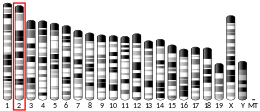
Location (UCSC) Chr 11: 27.37 – 27.47 Mb Chr 2: 109.75 – 109.84 Mb
PubMed search [3] [4]
Wikidata
View/Edit Human View/Edit Mouse

Leucine-rich repeat-containing G-protein coupled receptor 4 is a protein that in humans is encoded by the LGR4 gene. [5] [6] LGR4 is known to have a role in the development of the male reproductive tract, eyelids, hair and bone.

Mutations in this gene have been associated to osteoporosis (doi:10.1038/nature12124).

Related Research Articles

<span class="mw-page-title-main">GP1BA</span> Protein-coding gene in the species Homo sapiens

Platelet glycoprotein Ib alpha chain also known as glycoprotein Ib (platelet), alpha polypeptide or CD42b, is a protein that in humans is encoded by the GP1BA gene.

<span class="mw-page-title-main">GPR22</span> Protein-coding gene in the species Homo sapiens

Probable G-protein coupled receptor 22 is a protein that in humans is encoded by the GPR22 gene.

<span class="mw-page-title-main">GPR25</span> Protein-coding gene in the species Homo sapiens

Probable G-protein coupled receptor 25 is a protein that in humans is encoded by the GPR25 gene.

<span class="mw-page-title-main">GPR33</span>

Probable G-protein coupled receptor 33 is a protein that in humans is encoded by the GPR33 gene.

<span class="mw-page-title-main">Galanin receptor 3</span>

Galanin receptor 3 (GAL3) is a G-protein coupled receptor encoded by the GALR3 gene.

<span class="mw-page-title-main">Galanin receptor 2</span> Protein-coding gene in the species Homo sapiens

Galanin receptor 2, (GAL2) is a G-protein coupled receptor encoded by the GALR2 gene.

<span class="mw-page-title-main">Relaxin/insulin-like family peptide receptor 3</span> Protein-coding gene in the species Homo sapiens

Relaxin/insulin-like family peptide receptor 3, also known as RXFP3, is a human G-protein coupled receptor.

<span class="mw-page-title-main">Relaxin/insulin-like family peptide receptor 1</span>

Relaxin/insulin-like family peptide receptor 1, also known as RXFP1, is a human G protein coupled receptor that is one of the relaxin receptors. It is a rhodopsin-like GPCR which is unusual in this class as it contains a large extracellular binding and signalling domain. Some reports suggest that RXFP1 forms homodimers, however the most recent evidence indicates that relaxin binds a non-homodimer of RXFP1.
<span class="mw-page-title-main">GPR115</span> Protein-coding gene in the species Homo sapiens

Probable G-protein coupled receptor 115 is a protein that in humans is encoded by the GPR115 gene.

<span class="mw-page-title-main">Relaxin/insulin-like family peptide receptor 2</span> Protein-coding gene in the species Homo sapiens

Relaxin/insulin-like family peptide receptor 2, also known as RXFP2, is a human G-protein coupled receptor.

<span class="mw-page-title-main">LGR5</span>

Leucine-rich repeat-containing G-protein coupled receptor 5 (LGR5) also known as G-protein coupled receptor 49 (GPR49) or G-protein coupled receptor 67 (GPR67) is a protein that in humans is encoded by the LGR5 gene. It is a member of GPCR class A receptor proteins. R-spondin proteins are the biological ligands of LGR5. LGR5 is expressed across a diverse range of tissue such as in the muscle, placenta, spinal cord and brain and particularly as a biomarker of adult stem cells in certain tissues.

<span class="mw-page-title-main">LGR6</span>

Leucine-rich repeat-containing G-protein coupled receptor 6 is a protein that in humans is encoded by the LGR6 gene. Along with the other G-protein coupled receptors LGR4 and LGR5, LGR6 is a Wnt signaling pathway mediator. LGR6 also acts as an epithelial stem cell marker in squamous cell carcinoma in mice in vivo.

<span class="mw-page-title-main">Glycoprotein IX</span>

Glycoprotein IX (platelet) (GP9) also known as CD42a, is a human gene.

<span class="mw-page-title-main">GP5 (gene)</span>

Glycoprotein V (platelet) (GP5) also known as CD42d, is a human gene.
<span class="mw-page-title-main">OR4N4</span>

Olfactory receptor 4N4 is a protein that in humans is encoded by the OR4N4 gene.

<span class="mw-page-title-main">LRG1</span> Protein-coding gene in the species Homo sapiens

Leucine-rich alpha-2-glycoprotein 1 is a protein which in humans is encoded by the gene LRG1.

<span class="mw-page-title-main">LRRN2</span> Protein-coding gene in the species Homo sapiens

Leucine-rich repeat neuronal protein 2 is a protein that in humans is encoded by the LRRN2 gene.

<span class="mw-page-title-main">GPHA2</span>

Glycoprotein hormone alpha-2 is a protein that in humans is encoded by the GPHA2 gene.

<span class="mw-page-title-main">LRCH4</span>

Leucine-rich repeat and calponin homology domain-containing protein 4 is a protein that in humans is encoded by the LRCH4 gene.

<span class="mw-page-title-main">GPHB5</span>

Glycoprotein hormone beta-5 is a protein that in humans is encoded by the GPHB5 gene.

References

  1. 1 2 3 GRCh38: Ensembl release 89: ENSG00000205213 - Ensembl, May 2017
  2. 1 2 3 GRCm38: Ensembl release 89: ENSMUSG00000050199 - Ensembl, May 2017
  3. ↑ "Human PubMed Reference:". National Center for Biotechnology Information, U.S. National Library of Medicine.
  4. ↑ "Mouse PubMed Reference:". National Center for Biotechnology Information, U.S. National Library of Medicine.
  5. ↑ Loh ED, Broussard SR, Liu Q, Copeland NG, Gilbert DJ, Jenkins NA, Kolakowski LF Jr (Aug 2000). "Chromosomal localization of GPR48, a novel glycoprotein hormone receptor like GPCR, in human and mouse with radiation hybrid and interspecific backcross mapping". Cytogenet Cell Genet. 89 (1–2): 2–5. doi:10.1159/000015576. PMID   10894923. S2CID   607389.
  6. ↑ "Entrez Gene: LGR4 leucine-rich repeat-containing G protein-coupled receptor 4".

Further reading