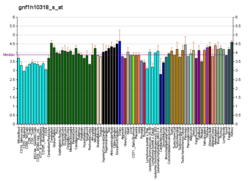
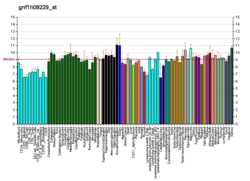
GPR139 appears to counter μ-opioid receptors (MOR) through multiple mechanisms.
GPR139 constitutively promotes MOR desensitization.[12] Expression of GPR139 at stoichiometric levels promoted β-arrestin recruitment to activated MORs. Appropriately, expression inhibited MOR — induced G protein activation. Overexpression of GPR139, but not stoichiometric expression, also decreased MOR at the cell surface.[12]
GPR139 counteracts MOR signaling at secondary effectors.[13] GPR139 expression inhibited GIRK channel activity through a Gq/11-dependent pathway. GPR139 activation increased cAMP production, also through a Gq/11-dependent pathway.[13]
Zelatriazin (TAK-41), (NBI-1065846) a potent, and GPR139 receptor selective agonist [14] which was in clinical trials to gauge the efficacy for treating psychiatric conditions such as major depressive disorder and the negative symptoms of schizophrenia, but was later dropped from development.
↑Liu C, Bonaventure P, Lee G, Nepomuceno D, Kuei C, Wu J, etal. (November 2015). "GPR139, an Orphan Receptor Highly Enriched in the Habenula and Septum, Is Activated by the Essential Amino Acids L-Tryptophan and L-Phenylalanine". Molecular Pharmacology. 88 (5): 911–925. doi:10.1124/mol.115.100412. PMID26349500.
↑Reichard HA, Schiffer HH, Monenschein H, Atienza JM, Corbett G, Skaggs AW, etal. (August 2021). "Discovery of TAK-041: a Potent and Selective GPR139 Agonist Explored for the Treatment of Negative Symptoms Associated with Schizophrenia". Journal of Medicinal Chemistry. 64 (15): 11527–11542. doi:10.1021/acs.jmedchem.1c00820. PMID34260228. S2CID235908256.
Further reading
Vanti WB, Nguyen T, Cheng R, Lynch KR, George SR, O'Dowd BF (May 2003). "Novel human G-protein-coupled receptors". Biochemical and Biophysical Research Communications. 305 (1): 67–71. doi:10.1016/S0006-291X(03)00709-5. PMID12732197.
Ottolenghi C, Fellous M, Barbieri M, McElreavey K (March 2002). "Novel paralogy relations among human chromosomes support a link between the phylogeny of doublesex-related genes and the evolution of sex determination". Genomics. 79 (3): 333–343. doi:10.1006/geno.2002.6711. PMID11863363.
Takeda S, Kadowaki S, Haga T, Takaesu H, Mitaku S (June 2002). "Identification of G protein-coupled receptor genes from the human genome sequence". FEBS Letters. 520 (1–3): 97–101. doi:10.1016/S0014-5793(02)02775-8. PMID12044878. S2CID7116392.
Gloriam DE, Schiöth HB, Fredriksson R (April 2005). "Nine new human Rhodopsin family G-protein coupled receptors: identification, sequence characterisation and evolutionary relationship". Biochimica et Biophysica Acta (BBA) - General Subjects. 1722 (3): 235–246. doi:10.1016/j.bbagen.2004.12.001. PMID15777626.
Matsuo A, Matsumoto S, Nagano M, Masumoto KH, Takasaki J, Matsumoto M, etal. (May 2005). "Molecular cloning and characterization of a novel Gq-coupled orphan receptor GPRg1 exclusively expressed in the central nervous system". Biochemical and Biophysical Research Communications. 331 (1): 363–369. doi:10.1016/j.bbrc.2005.03.174. PMID15845401.
This page is based on this Wikipedia article Text is available under the CC BY-SA 4.0 license; additional terms may apply. Images, videos and audio are available under their respective licenses.